This post contains affiliate links. We may earn a small commission when you buy through our links — at no extra cost to you.
Home canning is a rewarding way to preserve your garden’s bounty, but finding a pressure canner that reliably reaches and holds the required 10-15 PSI — without leaking, warping, or breaking — is harder than it should be. Many budget models promise large capacity but deliver thin metal, fragile handles, and gauges that drift out of spec after a few uses.
The real differentiator lies in the sealing system and pressure control method. A gasket that needs annual replacement is not a flaw if you expect it; a dial gauge without a backup weighted regulator can leave you guessing. Your stovetop type, typical batch size, and willingness to maintain the unit all narrow the field.
This guide helps you match your kitchen realities to a canner that will serve you for years. Whether you need a 23-quart workhorse for seasonal canning marathons or a compact digital unit for occasional pints, the best choice is the one that fits your process — not just your budget.



Best for Large Batch Canning
Presto 01781 23-qt
Key Features
- Capacity: 23 qt
- Material: Aluminum
- Pressure Control: Dial gauge
- Stovetop: Gas, electric coil
- Safety Features: Gasket seal, overpressure plug
- Price: Budget
The 23-quart capacity processes 7 quart jars at a time, making short work of a day’s garden harvest. The dial gauge lets you monitor pressure easily, and the aluminum base spreads heat evenly across gas and glass cooktops. Short pressure fluctuations when new typically settle as the gasket seats — nothing to second-guess.
Home canners who put up low-acid foods in volume get a dual-purpose pot that also pressure cooks large meals. Beginners pick up the process quickly with the printed pressure chart and included canning rack. The gasket is a consumable part; replacement rings cost little and snap in without fuss. The 12-pound pot takes two hands when loaded and needs a dedicated lower cabinet or deep shelf — not a fit for cramped kitchens where storage is tight.
Pros
- Fits 7 quart jars or 20 pint jars per batch for high-volume canning.
- Dial gauge and clear instructions make pressure monitoring approachable for beginners.
- Strong value—large capacity and durable aluminum build at a budget-friendly price.
Cons
- Gasket may need replacement after several seasons of heavy use.
- Heavy once loaded with water and jars; demands larger storage space.
If you can give it a permanent spot and swap the gasket every couple of years, this Presto returns value with every batch.
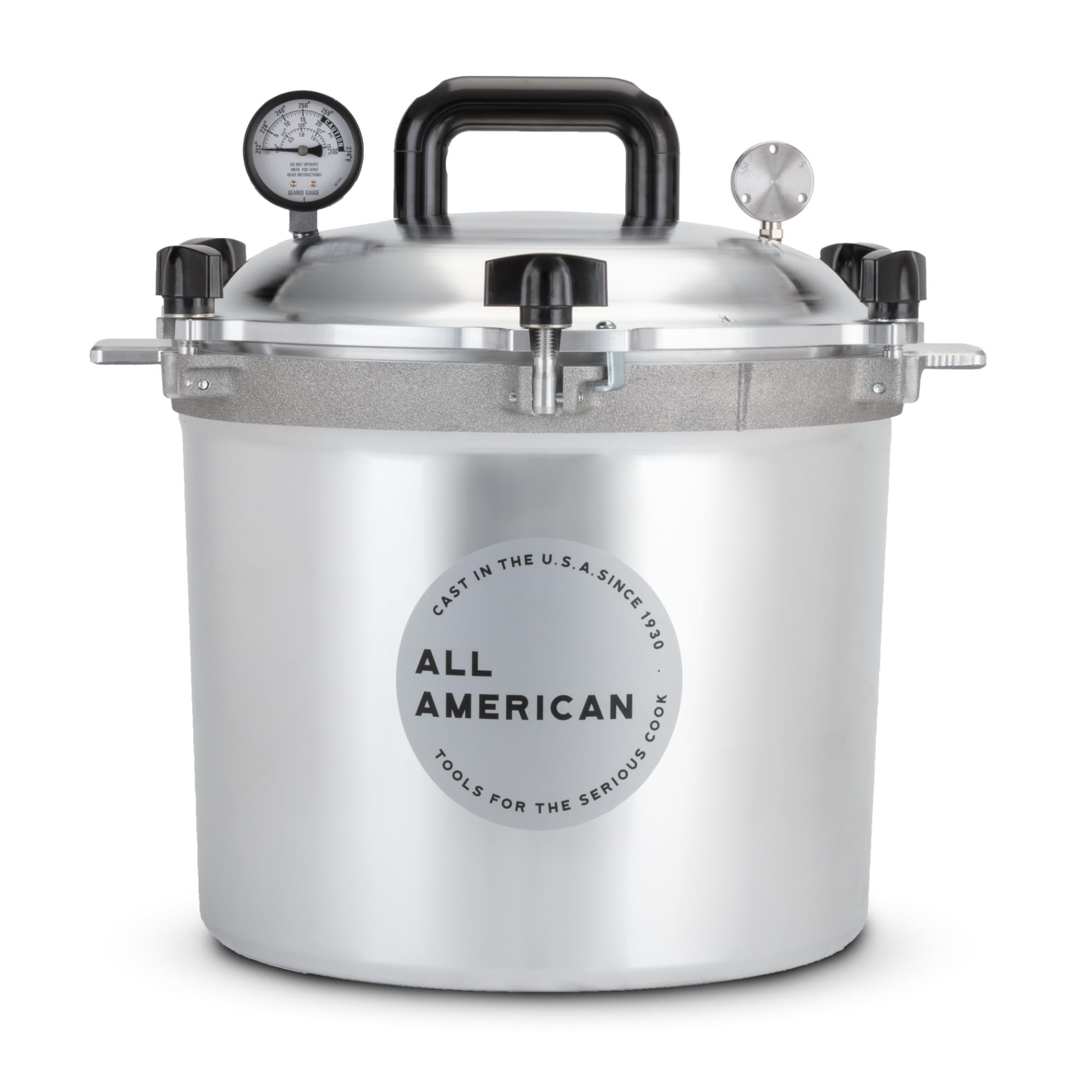
Best for Serious Home Canners
All American 921 21.5-qt
Key Features
- Capacity: 21.5 qt
- Material: Aluminum
- Pressure Control: Dial gauge + weighted
- Stovetop: Gas, electric coil
- Safety Features: Metal-to-metal seal, lid lock
- Price: Premium
The All American 921’s metal-to-metal sealing system eliminates the need for a replaceable gasket – a common failure point on other canners. Dual pressure control via dial gauge and weighted regulator provides two ways to monitor pressure, adding redundancy during canning sessions.
This premium-priced canner is for serious home canners who prioritize longevity and low maintenance over portability. The tradeoff: at nearly 18 pounds empty and significantly heavier when loaded, moving it from stove to sink requires effort. It fits best in a dedicated setup where the canner stays in place.
Pros
- Precision-machined aluminum body resists warping and corrosion for decades of use.
- No gasket to replace or maintain – the metal-to-metal seal stays effective through years of use.
- Dual pressure indicators allow cross-checking for accurate pressure management.
Cons
- At nearly 18 pounds empty and heavier when loaded, transporting the canner between stove and sink can be a physical challenge.
The All American 921 is built for canners who want one tool for a lifetime and don’t mind the weight – it’s a long-term investment, not a casual purchase.
Best for Small Batch Canners
Presto 02152 17-qt Digital
Key Features
- Capacity: 17 qt
- Material: Stainless steel
- Pressure Control: Digital automatic
- Stovetop: Self-contained (electric)
- Safety Features: Auto shutoff, lid lock
- Price: Premium
Step-by-step digital prompts guide you through both pressure and water bath canning with minimal attention. The automatic pressure control frees you from gauge-watching, making the process accessible for those who dislike stove monitoring or have physical limitations that make manual gauges difficult. However, the 17-quart body only accommodates five quart jars per batch — a design tradeoff that limits throughput. A small number of units may struggle to maintain consistent temperature, so verifying heat performance early is wise. If batch size matters more than convenience, the larger stovetop models offer greater capacity.
Pros
- Guides you through each stage with clear digital prompts
- Delivers reliable results for pressure and water bath methods
- Safety features and laminated instructions reduce guesswork
Cons
- Holds only five quart jars despite 17-quart size
- Some units may overheat or fail to maintain temperature
For canners who value set-and-forget ease over batch size, the digital workflow and built-in guidance deliver a gentle learning curve with consistent results.
Best for Budget Induction Canners
Denali Tanker 23-qt
Key Features
- Capacity: 23 qt
- Material: Stainless steel
- Pressure Control: Dial gauge + weights
- Stovetop: Induction, gas, electric
- Safety Features: Overpressure plug, dual control
- Price: Budget
The Denali Tanker pairs a dial gauge with a 10lb and 15lb weighted regulator — a redundancy rarely seen at this price. That makes it a practical learning tool for beginners who want to cross-check pressure without relying on a single system. However, dial gauge accuracy can vary between units, so it’s wise to verify with the weight before a full batch. Steam valve leakage, while occasional, may slow the initial pressure buildup.
This model suits budget-conscious canners who need induction compatibility and don’t mind performing a quick gauge check before each use. If you prefer absolute precision out of the box, a premium canner with a factory-calibrated gauge would be a better fit. For everyone else, the Tanker offers a solid entry point into pressure canning without overspending.
Pros
- Dual pressure control (dial gauge + weights) provides a backup if one system drifts.
- Stainless steel construction holds up well under regular use at a budget-friendly price.
- Clear instructions and straightforward operation suit first-time canners.
Cons
- When dial gauge precision matters most, some units may read higher or lower than actual pressure — calibrating against the weight is recommended.
- During initial heat-up, the steam valve may release more vapor than expected, which can slow pressure buildup.
For beginners on a budget who want induction compatibility and don’t mind verifying gauge accuracy, the Denali Tanker delivers solid value with a few user-managed quirks.
Best for Small Batch Canning
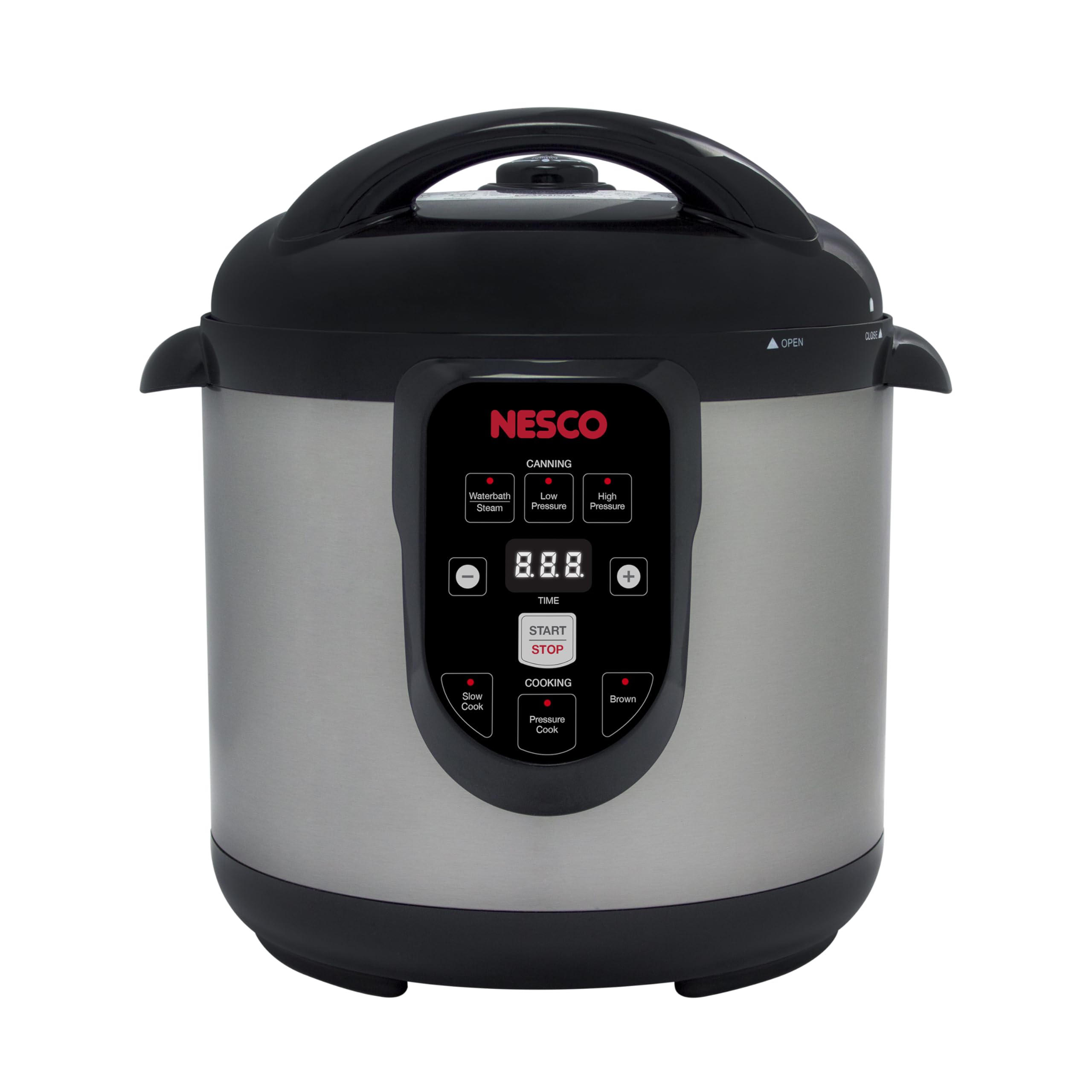
NESCO NPC‑9 9.5-qt Electric
Key Features
- Capacity: 9.5 qt
- Material: Stainless steel
- Pressure Control: Digital automatic
- Stovetop: Self-contained (electric)
- Safety Features: Digital safety system
- Price: Mid-range
This electric canner simplifies pressure canning with set-and-forget digital controls, ideal for small batches of pints. But its 9.5-quart capacity holds only four quart jars, making it impractical for processing a full garden harvest. For apartment dwellers or beginners canning in small quantities, it’s a convenient entry point.
Pros
- Digital controls simplify pressure canning with set-and-forget operation.
- Multi-function – can pressure can, slow cook, steam, and water bath.
Cons
- Only holds 4 quart jars per batch – limiting for larger canning needs.
A good fit for small-batch canning of pints or for beginners who prioritize ease over volume. Not intended for full-harvest processing.
Best for First-Time Canners
Supa Ant 23-qt Kit

Key Features
- Capacity: 23 qt
- Material: Aluminum/stainless base
- Pressure Control: Dial gauge
- Stovetop: Gas, electric
- Safety Features: Overpressure plug
- Price: Mid-range
The Supa Ant 23-qt pressure canner bundles a full set of canning tools—rack, jar lifter, funnel—making it a convenient entry point for beginners. Its large capacity and aluminum body are practical for batch canning, but lid fit and dial gauge reliability have been inconsistent between units, so careful inspection is recommended.
Pros
- Complete starter kit with all essential canning tools included.
- Large 23-qt capacity for processing multiple jars per batch.
Cons
- Lid closure and gauge accuracy can vary between units – worth checking upon arrival.
Best for first-time canners who want a single box solution and are willing to inspect the unit before heavy use.
Best for Small Families
Presto 01755 16-qt

Key Features
- Capacity: 16 qt
- Material: Aluminum
- Pressure Control: Dial gauge
- Stovetop: Gas, electric, flat top
- Safety Features: Overpressure plug
- Price: Budget
This 16-quart Presto is easier to handle and store than the standard 23-quart model, making it a practical choice for smaller households or beginners. It holds pressure steadily on flat-surfaced stoves for low-acid canning. The aluminum interior may stain cosmetically, but function remains unaffected. It’s best seen as a backup recommendation for those who want a more compact Presto rather than as a primary large-batch canner.
Pros
- Compact 16-quart size fits small kitchens and stores easily.
- Holds pressure steadily on flat-surfaced stoves for consistent canning results.
Cons
- Aluminum interior may develop cosmetic staining over time.
Best for those who want a more compact Presto and can accept cosmetic interior wear over time.
How to Choose
The most critical factor in a pressure canner is its ability to hold a steady 10-15 PSI, which depends on the sealing system and pressure control method.
Capacity
Larger canners process more jars per batch — a 23-quart model holds about 18 pints or 7 quarts — but they are heavier and take longer to heat up. A 16-quart is more manageable for small families and fits on smaller stovetops. Match capacity to your typical harvest size and physical ability to lift the full pot.
Material
Aluminum heats faster and is lighter, but it can warp on high heat and is not induction-compatible unless it has a stainless steel base. Stainless steel is more durable and induction-ready but costs more and takes longer to heat. The trade-off is weight and responsiveness versus longevity.
Pressure Control
Dial gauges give precise readings but can drift over time and need annual calibration. Weighted regulators are less precise but self-regulate and never need adjustment. Many experienced canners use both: a dial for monitoring and a weight for fail-safe pressure control. Digital models automate everything but add complexity and cost.
Stovetop Compatibility
Not all canners work on all stoves. Induction cooktops require a ferromagnetic base — aluminum alone won’t work. Gas and electric coil stoves work with most canners, but glass-top stoves may not support the weight of a fully loaded 23-quart canner. Always check your stove’s weight limit and the canner’s base material before buying.
Safety Features
A reliable sealing system is the primary safety feature. Gasketed canners need regular inspection and replacement; a worn gasket can cause pressure loss. Gasketless metal-to-metal seals eliminate that maintenance but require perfectly flat rims. Overpressure plugs, lid locks, and backup regulators add layers of protection. Digital models often include automatic shutoff.
FAQ
Can I use a pressure canner on a glass top stove?
Yes, but only if the canner’s base is flat and the total weight does not exceed your stove’s maximum load — usually around 50 lbs. A fully loaded 23-quart canner can weigh 40-50 lbs. Check your stove’s manual and place the canner on a center burner for even support.
How often should I replace the gasket on my Presto pressure canner?
Presto recommends replacing the rubber gasket every one to two years, depending on use. Signs of wear include cracking, hardening, or failing to hold pressure. A spare gasket is inexpensive and easy to swap.
Is a dial gauge or weighted gauge better for pressure canning?
Dial gauges provide precise PSI readings but require annual calibration and can be damaged if dropped. Weighted gauges are simpler and more robust, self-regulating at set pressures like 10 or 15 PSI. Many experienced canners use a weighted regulator as a backup to a dial gauge for safety.
Why does my pressure canner not reach 15 PSI?
Common causes include a worn gasket, a blocked vent pipe, insufficient heat, or an inaccurate gauge. Check that the gasket is sealing properly and clean the vent pipe with a pipe cleaner. If the gauge reads low but the canner seems to be under pressure, have it tested or switch to a weighted regulator.