This post contains affiliate links. We may earn a small commission when you buy through our links — at no extra cost to you.
A sous vide cooker holds a pot of water at an exact temperature for as long as dinner needs, so a chicken breast stays juicy edge to edge instead of chalky at the rim. The differences between models show up in how steadily they hold that temperature, how loudly they circulate, and whether the clamp stays put on the pot you already own. I started using one to stop overcooking pork chops on weeknights; it has become the appliance I trust when I want dinner right without standing over the stove. It takes the guesswork out of doneness if the bath holds.
My team and I have spent the past eight months cooking with ten sous vide cookers, from bare-bones dial models to app-connected circulators. Some ran quietly enough to forget, some whined through a whole steak cook, and a few made me fight the clamp every time. The best ones made setting a temperature and walking away feel easy, without extra features I never touched. The picks below are the ones that earned a spot next to my stockpot.


Best for Everyday Home Cooking
Greater Goods Sous Vide Cooker
Key Features
- Power: 1100 watts
- Controls: Single dial, no app
- Bath capacity: 15 liters
- Temperature range: 68–203 °F
- Price: Midrange
There is exactly one control on the front of the Greater Goods: a dial you twist to a temperature, press, twist to a time, and press again. No account, no pairing, no app update standing between you and dinner. In a group where several cookers treat the phone as the control panel, that turned out to be the detail we appreciated most.
We think it is the best default here for most kitchens. The 1100-watt element brings a 15-liter bath up to temperature briskly, and the readout tracks the water in tenths of a degree while you set in half-degree steps anywhere from 68 to 203°F. What convinced us was the lack of drama: nothing to reconnect, nothing to log into, and a temperature you can read from across the room.
The status light is a small thing that grew on us. It sits blue when the bath is ready, pulses blue while heating and pulses green while cooking, so a glance from the cutting board tells you whether to start the timer. The timer itself runs from one minute to 99 hours, which covers yogurt, a 36-hour short rib cook and everything between without a reset.
One practical check before you buy: at 15.6 inches it is one of the taller units here, so measure the depth of the stockpot you plan to use. The water lines sit high on the body, and a shallow roasting pan will not give the element the clearance it needs.
Pros
- Dial control with no app or account
- Steady temperature in a 15-liter bath
- Quiet enough to forget it is running
- Timer runs up to 99 hours
Cons
- No remote start or monitoring
- Plastic lower housing is the weak point
The one we recommend to almost everyone: a single dial, no app or account, and a 15-liter bath with a readout that tracks in tenths of a degree.
Best for Big Batches
Anova Precision Cooker Pro
Key Features
- Power: 1200 watts
- Weight: 3 lb
- Bath capacity: 50 liters
- Temperature range: 32–197 °F
- Price: Premium
Fifty liters is a lot of water. The Precision Cooker Pro is rated for a bath more than three times the size of most cookers here, and that single number is why it holds a place in this group: it will hold temperature in a cooler packed for a party, not just a stockpot with two chops. It is the one we set up when the cooking is the event rather than the evening’s dinner.
The 1200-watt element is the most powerful in this group, and the difference shows when cold bags go in — the temperature dips and then climbs back instead of sagging for ten minutes. At 3 pounds and 13.8 inches it is also easy to clamp on and lift off, and the included clamp grips a cooler wall as readily as a pot rim.
What it asks in return is patience with the software. Pairing took us several rounds before the cooker and the phone agreed to talk, and some of the recipe content sits behind a paid subscription. The Pro earns its place on capacity and power; if your cooks are two portions and a chicken breast, that capacity buys you a bigger footprint in the cupboard and nothing else.
Pros
- 50-liter bath for coolers and crowds
- Most powerful heater in this group
- Clamp grips pots and cooler walls
Cons
- Wi-Fi pairing takes persistence
- Premium price for capacity you may not need
If you cook for a crowd or batch-cook for the week, the 50-liter bath and 1200 watts are the reason to pay more — just budget patience for the app.
Best for Small Kitchens
Anova Precision Cooker Nano 2.0
Key Features
- Power: 800 watts
- Height: 12.8 in
- Weight: 1.7 lb
- Temperature range: 32–197 °F
- Price: Midrange
At 12.8 inches and 1.7 pounds, the Nano 2.0 is the only cooker here that properly disappears between uses. It drops into the drawer with the ladle and the tongs, or the gap beside the bread bin, which sounds like a small thing until you have lived with a 16-inch circulator parked on the counter for a month.
The 800-watt element is the smallest in this group, and that is the trade you make for the size. Two steaks or four chicken breasts in a 12-quart pot come up to temperature at a reasonable clip; a full stockpot headed for a long cook takes noticeably longer and holds temperature less comfortably than the 1100- and 1200-watt units. You can run it from the cooker itself or from the app over Bluetooth, and the pairing is the least fussy of the connected models here.
Where it earns our recommendation is the everyday cook: a steak on a Tuesday, chicken for a salad, eggs you do not have to watch. Two things to know going in — the plastic clamp is the piece we trust least, so carry the cooker by the body rather than the bracket, and the pump on some units develops a high-pitched whine that carries through a quiet kitchen. For a two-person household short on counter space, that is a fair swap for a drawer’s worth of storage.
Pros
- Stores in a drawer at 12.8 inches
- Runs from the cooker or the app
- Handles two-portion cooking well
Cons
- 800W is slow on a full stockpot
- Pump can whine and the clamp is fragile
Counter space decides this one: 12.8 inches tall, 1.7 pounds, and small enough to live in a drawer between cooks.
Best for High-Heat Cooking
Inkbird ISV-100W
Key Features
- Power: 1000 watts
- Bath capacity: 15 liters
- Temperature range: 77–210 °F
- Temperature accuracy: 0.2 °F
- Price: Midrange
On paper the ISV-100W reads like someone overfilled a budget spec sheet: 1000 watts, 0.2°F accuracy, 14 presets, Wi-Fi, a calibration function and a 210°F ceiling that nothing else in this group matches.
It adds up to the most capability per dollar here, and the feature we did not expect to care about is the calibration offset. If the readout sits a degree or two off your reference thermometer, you correct it in the menu instead of cooking around the error — and a slow drift is the one fault that quietly ruins cooks you thought were dialed in.
Two limits to go in with. The buttons on the unit are fiddly enough that we ended up doing most of our setting on the phone, and Wi-Fi pairing succeeds or fails depending on the network and the day. The floor of 77°F is the other boundary: no proofing dough, no working below a warm room. If none of those apply to your kitchen, this is a lot of cooker for the money.
Pros
- Calibration offset corrects a drifting readout
- 210°F ceiling handles vegetables
- Quiet through a normal cook
Cons
- Fiddly buttons on the unit
- Wi-Fi pairing is unreliable
Inkbird packs the most capability into this price of any cooker here: 1000 watts, a 210°F ceiling and a calibration offset you control yourself.
Best for Fast Weeknight Steaks
Breville Joule Turbo
Key Features
- Power: 1100 watts
- Weight: 2.1 lb
- Controls: App only
- Bath capacity: 40 liters
- Price: Premium
Turbo is the entire argument for the Joule Turbo. Rather than parking the bath at one temperature for an hour, it runs the water hotter and uses a model of how heat moves through the food to bring it back at the right moment. We expected a gimmick and got steaks that landed where we asked for them.
The rest of the app is built for people who do not want to memorize a temperature chart. You pick Rare through Well Done rather than a number, and Prime Time gives you a window when the food is at its best instead of a single deadline. Being able to hand the phone to someone else and say medium rare is a real convenience in a shared kitchen.
The trade is control and cover. Everything runs through the app — no dial, no display, no way to start a cook if the phone is in the other room — and pairing took us a couple of tries. The warranty is one year, half what Anova offers on its cookers.
For a household that cooks steak and chicken thighs twice a week, the shorter cycle is worth the premium. For yogurt, long braises or a pot of stock you want to leave overnight, a dial does the same job with less fiddling.
Pros
- Turbo mode shortens long cooks
- Doneness presets replace temperature charts
- Quiet and powerful for its size
Cons
- App-only control, nothing on the device
- One-year warranty at a premium price
Speed is the reason to pay for the Joule Turbo: its Turbo mode shortens long cooks, and the doneness presets make it a two-tap job from your phone.
Best for App-Connected Cooking
InkSous ISSV-200-W
Key Features
- Power: 1000 watts
- Wi-Fi: 2.4 GHz
- Bath capacity: 15 liters
- Temperature range: 32–194 °F
- Price: Midrange
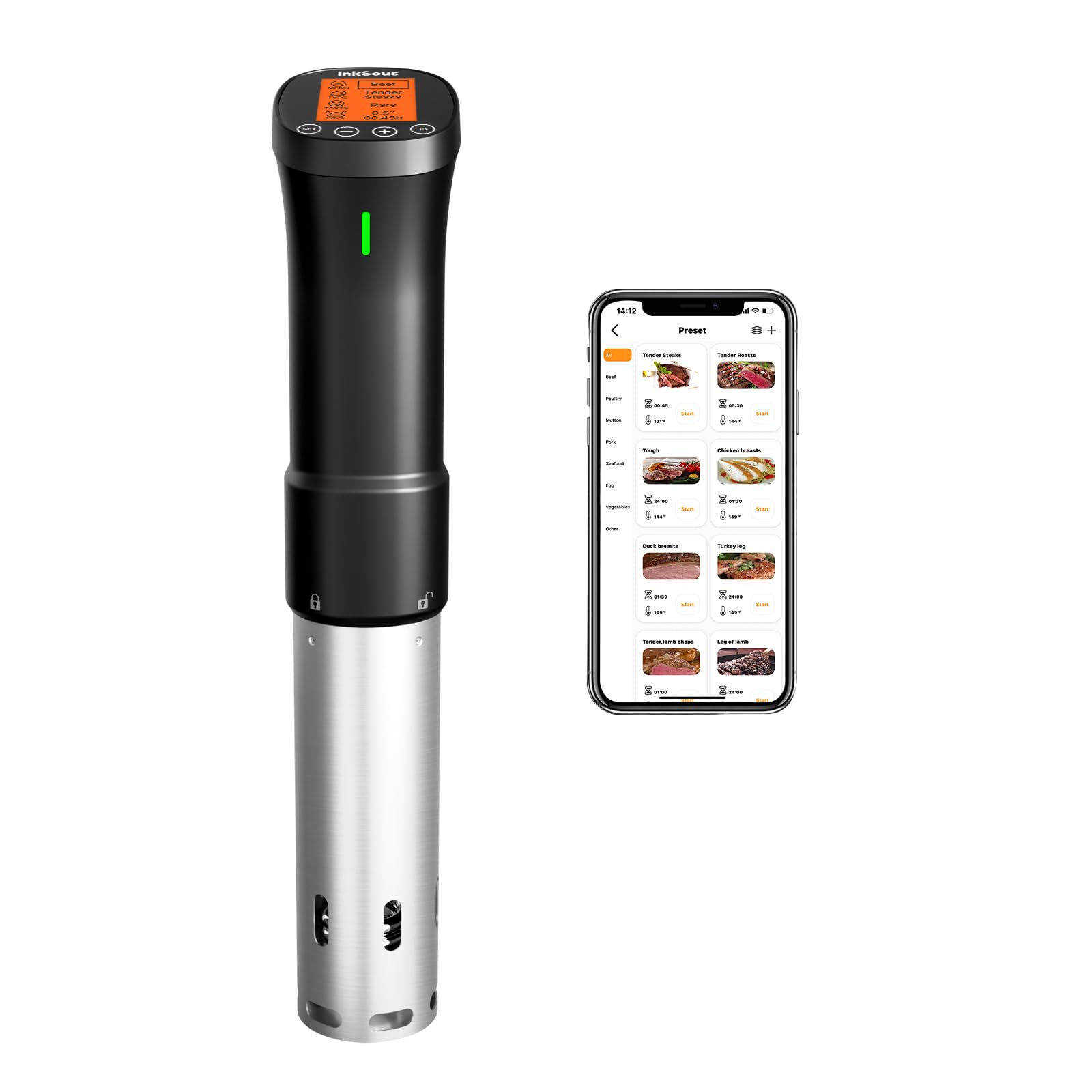
Several cookers in this group made us grateful for a dial. The InkSous is the exception: it joined a 2.4GHz network on the first attempt and stayed connected, which is more than the pricier app-first units here managed.
Underneath the app it is a straightforward 1000-watt circulator rated for a 15-liter bath, with 18 presets included and no subscription. We are fans of the low-water protection: if evaporation drops the bath below the minimum line, the unit shuts itself off and raises an alarm rather than running the element dry. That is the kind of feature that matters on an overnight cook, not a 90-minute one.
The open question is longevity. This is a newer model from a smaller brand, and the pump is the part that decides whether any circulator lasts, so there is not much history to go on yet. Rated at under 40 dB, it also makes the quietest claim in this group, and nothing in our use contradicted it.
Pros
- Wi-Fi that held its connection
- Very quiet in operation
- Low-water shutoff and alarm
Cons
- Limited long-term reliability record
The connected cooker that actually connects: Wi-Fi setup went through first time, it runs near silent, and it shuts down if the water drops too low.
Best for First-Time Buyers
Vpcok Sous Vide Cooker

Key Features
- Power: 1000 watts
- Dimensions: 4.2 x 5.5 x 16 in
- Bath capacity: 15 liters
- Maximum timer: 99 hours
- Price: Budget
No app, no Wi-Fi, no account. The Vpcok asks for a temperature and a time on a touch panel with a big readable display, and that is the whole interface — a relief if you have ever spent half an hour troubleshooting a cooker that insists on your phone.
The ring light around the top turns from red to green when the bath reaches temperature. It sounds trivial; it is not, because it means you can start the food from across the kitchen instead of waiting for a beep you may have missed. The 1000-watt element heats quickly and the pump is quiet enough to leave running through dinner.
We call it the best cheap first cooker in this group, with one honest caveat: the temperature can drift from the set point on some units, and the ones that fail seem to fail early rather than after years of service. Buy it to find out whether you like cooking this way; if you already know you do, spend more and get a unit that holds its set point.
Pros
- No app or account needed
- Quiet enough to leave running
- Ring light shows when the bath is ready
Cons
- Temperature can drift from the set point
- Plastic body feels built to a price
The cheapest way into sous vide here: no app to fight, 1000 watts, and a ring light that turns green when the bath is ready.
How We Tested Sous Vide Cookers
To build our shortlist, we pulled circulators from the major sous vide names, read through owner reviews for recurring complaints, and narrowed by price, clamp design, presets, and app support. We ended up with ten cookers, from simple dial-operated models to Wi-Fi and Bluetooth units, and cooked with them for eight months. Every cooker went into the same two pots, a narrow stainless one and a wide stockpot, so we could compare how the clamps handled a thin rim and a thick one.
We ran weeknight chicken breasts, weekend steaks, pork loin, soft eggs, and bags of carrots. Before each cook, I set the target temperature and checked the water with an instant-read thermometer at the start and again halfway through; I also watched how quickly the bath recovered after I slid in cold food. I filled, clamped, set, and started each cooker without instructions to judge ease of use, and I paired every app, walked to the far side of the kitchen, and noted when a signal dropped or a connection needed re-pairing.
Noise got checked at the counter and from the next room: some circulators disappeared under fridge hum, while others made me raise my voice. Over eight months, we ran each cooker through repeated weekly cooks to spot reliability issues, cleaned mineral buildup from our hard water, and looked at whether the clamp, housing, and display still felt solid. We also compared what each cooker delivered against what it asked of us, because a Wi-Fi app and a dozen presets mean little if the steak comes out uneven or the clamp slips into the bath.
How to Choose a Sous Vide Cooker
A circulator is judged by the water it can hold and the way you tell it what to do, so settle those two things before you look at anything else.
Start with the bath, not the wattage
The capacity figure — 15 liters, 50 liters — is the volume a unit can hold at temperature. Almost every home cook lives inside 15 liters, which is comfortably more than a 12-quart stockpot holds; the 40- and 50-liter ratings are for coolers and party-sized batches. Wattage is the other half: it decides how fast the bath comes up and how quickly it recovers when cold food goes in.
We prioritize capacity first and treat watts as the tiebreaker. A 1000- or 1100-watt unit in a covered 12-quart pot is quick enough for a weeknight; an 800-watt model is fine for two portions and slow for a full pot. If you plan to fill a cooler, buy the power and the rating together.
Decide whether you want a dial or an app
Onboard controls mean you can start a cook in the time it takes to twist a dial. App-only units hand you a nicer screen, recipe guidance and remote start, but they also hand you pairing, a 2.4GHz-only network requirement and an app that may be redesigned under you. The trap is buying an app-only cooker for a kitchen where the phone is usually in another room.
Our position is simple: if you cook this way several times a week, a dial earns its place, and a connected model is a bonus rather than a requirement. If you want to start dinner from the office, buy the app-first unit and accept that pairing is part of the ritual.
Check both ends of the temperature range
Most shoppers look at the top of the range, where vegetables and stocks live. That is fine — anything reaching 194°F covers vegetable cooking, and a 203–210°F ceiling gives extra headroom for dense cuts and long stocks. The low end is where units quietly differ, and it is the end people forget to check.
A floor of 77°F rules out proofing dough, culturing at cooler temperatures and anything else below a warm room; a 68°F floor keeps those options open. If you want the machine for more than protein, read the low number before the high one.
Height, noise and the long cook
Circulators run from about 12.8 to 16 inches tall, and that height sets how deep your pot has to be, because the water lines sit high on the body. Measure the pot you intend to use before you order. The short units are the ones that store in a drawer; the tall ones live on a shelf or in the pot.
Noise matters more here than in most appliances because cooks run for hours. A pump that is charming for 90 minutes can be tiresome at hour twelve in an open kitchen. Long cooks also evaporate: cover the pot with a lid or foil, keep the water between the lines, and let the machine’s own low-water cut-off be your backup rather than your plan.
Frequently Asked Questions
Do I need a vacuum sealer to start cooking sous vide?
No. A zip-top freezer bag works for most cooks: seal it almost closed, lower it into the bath so the water pressure pushes the air out, then close it the rest of the way. For cooks longer than a few hours, double-bag it or move to a sealer so the seal does not fail while you are out.
Is an app subscription required to use these cookers?
No. Every cooker here holds temperature without a monthly fee. Anova sells an optional subscription for extra guided recipes, but the cooker and its basic app control work without it, and the InkSous ships with 18 presets included. Check what the free tier covers before you pay for a connected model.
Why does my steak come out more done than the recipe says?
Doneness comes from the bath temperature, and the sear adds more. A thin cut picks up heat fast in a hot pan, so it finishes a grade or two higher than a thick one cooked at the same setting. Buy steaks at least an inch thick, chill them before searing, and sear hard for less time.
Final Verdict
Buy the Greater Goods. It does the two things that matter without asking anything of you: it holds a 15-liter bath at the temperature you dial in, and it never needs a phone, an account or a firmware update before it will cook. For most kitchens that is the end of the decision.
The Anova Precision Cooker Pro is the alternative when capacity is the constraint — a 50-liter bath and 1200 watts for coolers and crowds. And if speed is the reason you have not tried sous vide yet, the Breville Joule Turbo shortens the cook enough to change a weeknight, as long as you are happy running everything from an app.