This post contains affiliate links. We may earn a small commission when you buy through our links — at no extra cost to you.
Nobody buys a high-powered blender because they want a loud appliance. You buy one because you’re tired of fishing a half-frozen strawberry out of your smoothie, or scraping unblended kale off the sides while the motor starts to smell hot. The tradeoff is honest: the motors that genuinely crush ice and turn cashews into butter are louder, heavier, and pricier, and the wrong one will still bog down on a packed pitcher of frozen fruit. What you’re paying for is a machine that holds its speed under load and doesn’t need disassembly to get clean.
My team and I have spent the past 10 months living with eight of them, and the gap between the truly capable and the merely powerful shows up fast. The wattage on the box is a ceiling, not a promise — what matters is how a blender behaves once the blades hit resistance. So we judged these on that, on what you get for the money, on whether we dreaded cleaning up afterward, and on whether the lid stayed put. Each of the eight picks below earned its spot for a slightly different reason.



Best for Everyday Smoothies
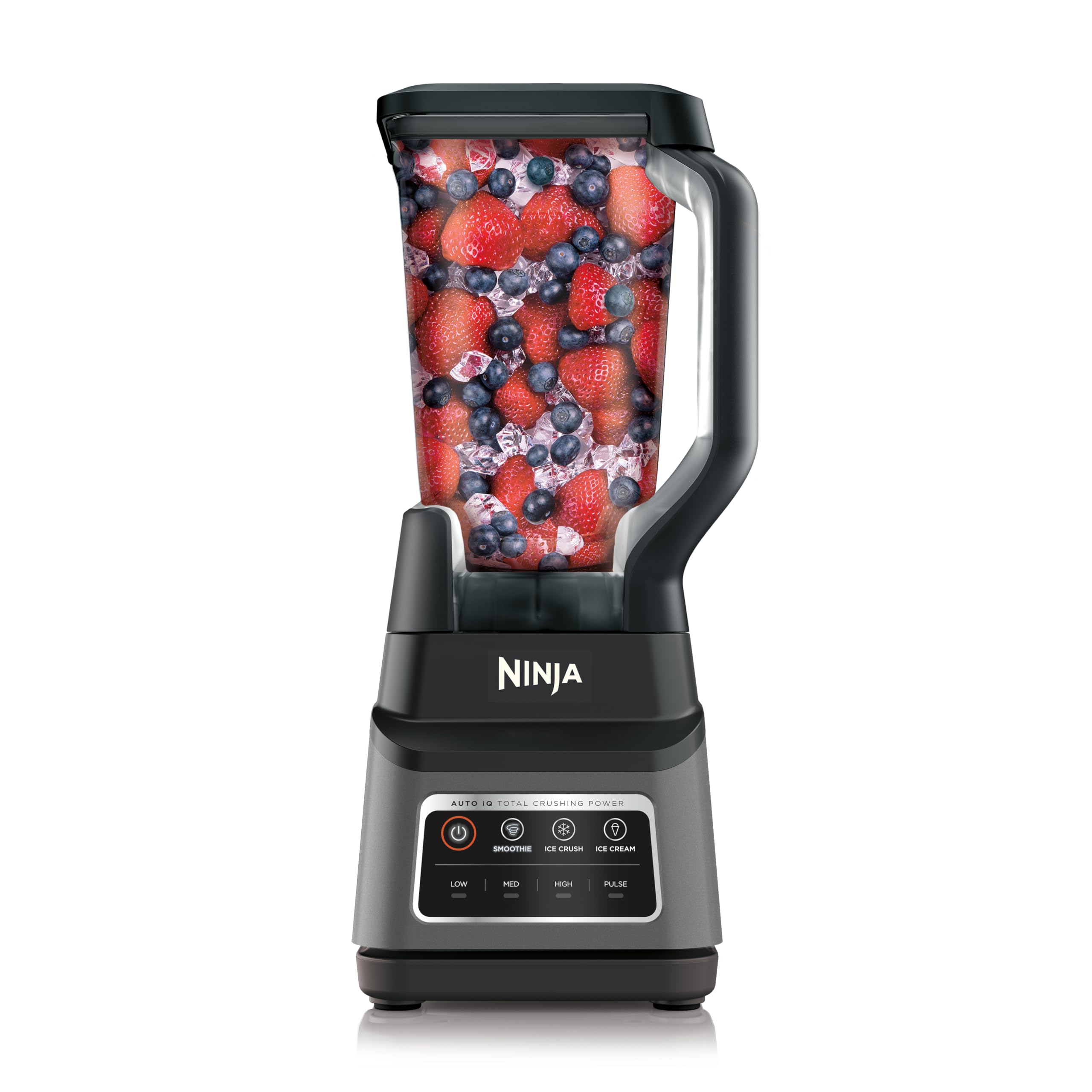
Ninja Professional Plus BN701
Key Features
- Dimensions: 6.75"D x 9"W x 17.5"H
- Max liquid: 64 fl oz
- Motor power: 1400 watts
- Pitcher capacity: 72 fl oz
- Price: Budget
Fourteen hundred watts, a 72-ounce pitcher and three Auto-iQ programs that pulse, blend and pause without anyone standing over them. It’s the best all-round combination of motor, capacity and price in this group, and that balance is why the Professional Plus is our top pick rather than the most powerful or the fanciest machine here.
The presets are the part we actually use. Load the jar, press a program and walk away; the cycle handles timing and pulsing, which is the difference between a smooth smoothie and one with berry skin in it. Manual speeds are there for the times you want to steer the texture yourself, and the stacked blade assembly pulls the load down into the blades instead of flinging it at the walls, so a full jar of frozen fruit comes out in one run rather than three. The 72-ounce pitcher carries a marked 64-ounce liquid line, which is four glasses at once and still leaves headroom.
Cleaning is where a lot of blenders quietly fail, and this one gets it right: the whole blade assembly lifts out, so there’s no reaching past a fixed blade with a sponge. Ninja lists the parts as dishwasher safe. We rinse ours by hand anyway, because high heat and a plastic jar are not a combination that ages well.
The trade-off is sound. A 1400-watt motor in a plastic housing at full speed is not a quiet appliance, and in a small apartment at dawn you will hear about it. We think the trade still works: the run is short, and a weaker blender grinding away for three times as long is not actually quieter.
Pros
- 1400 watts with three Auto-iQ programs
- 72-oz pitcher with a marked 64-oz line
- Blade assembly lifts out for cleaning
- Best power-to-price balance in this set
Cons
- Loud at full speed
- Plastic pitcher can crack
Our default recommendation: it crushes ice and frozen fruit in one pass, holds a family-size batch, and undercuts every premium machine it competes with.
Best for Blending Plus Chopping
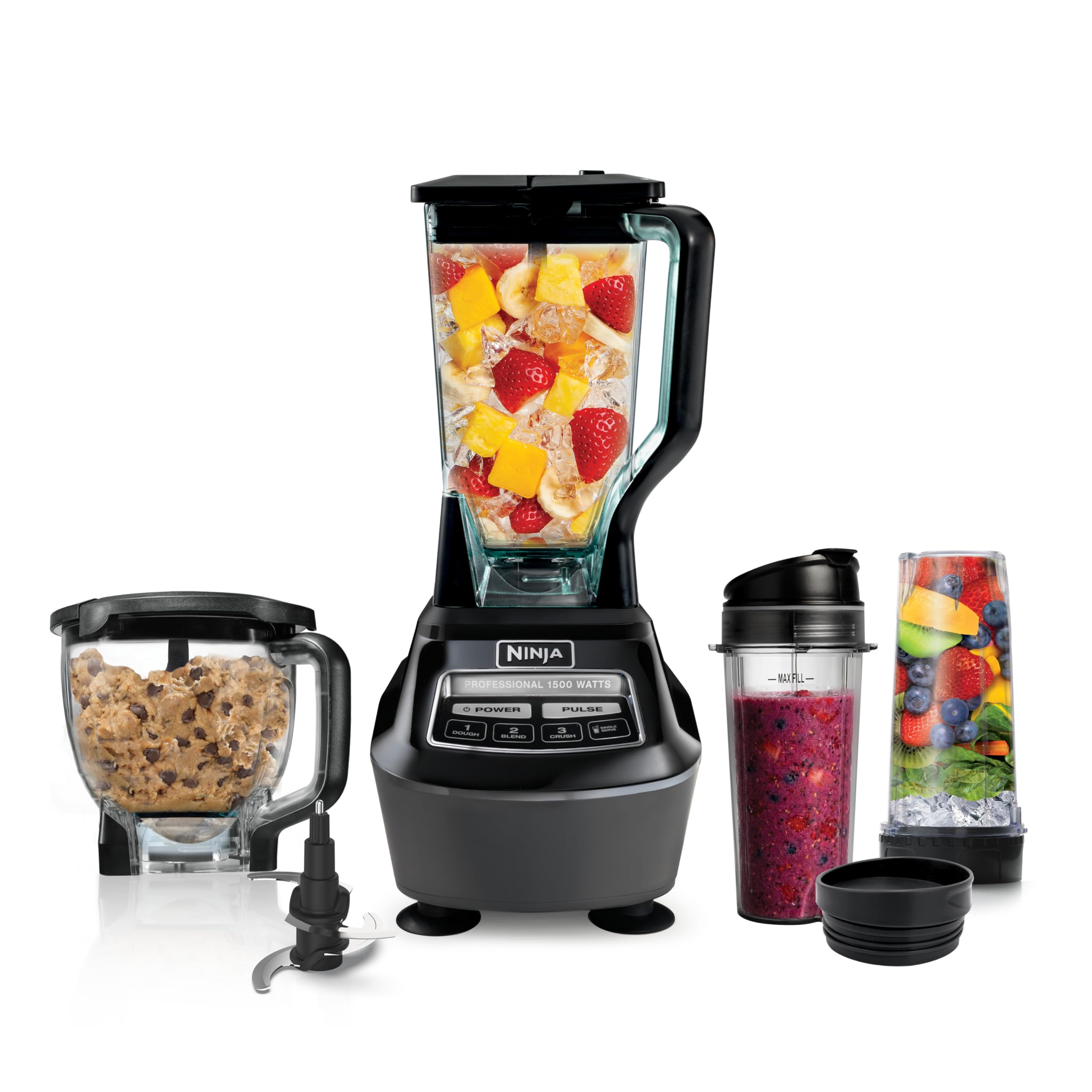
Ninja Mega Kitchen System BL770
Key Features
- Motor power: 1500 watts
- Included cups: Two 16 fl oz with lids
- Pitcher capacity: 72 fl oz
- Food processor bowl: 8 cups
- Price: Midrange
Two appliances share this base: a 1500-watt blender with a 72-ounce pitcher, and an 8-cup food processor bowl with its own chopping and dough blades, plus two 16-ounce cups with to-go lids. If your cabinet holds a blender you tolerate and a food processor you never bother to assemble, this is the machine that replaces both.
We rate it as the most versatile pick in this group, and the food processor is the reason. Chopping onions, mixing dough, puréeing a pot of soup: that’s bowl work, and a blender jar does it badly. Having one motor do both, without washing two appliances afterward, is the kind of convenience you notice in the first week and lean on by the second.
What you pay for it is counter space and volume. At just over 18 inches tall and nearly 16 inches deep it needs real room under a cabinet, and it’s the loudest machine here: a 1500-watt motor, a big jar and no sound enclosure. The to-go cups are the quieter bonus, since a single serving in a 72-ounce pitcher is mostly air, and the cups solve that.
Pros
- Blender and 8-cup food processor on one base
- Two 16-oz to-go cups included
- 1500 watts with five speeds
- Consistent chopping and puréeing
Cons
- Loudest machine in this group
- Takes serious counter depth
Buy it if you want blending, chopping and dough from one motor; it’s the most versatile machine here, provided loud and large don’t get in your way.
Best for Long-Term Ownership
Vitamix 5200
Key Features
- Speeds: 10 variable plus high
- Warranty: 7 years limited
- Motor power: 1380 watts
- Container capacity: 64 fl oz
- Price: Premium
Seven years. That’s the warranty on the 5200, and it explains the whole machine: a 1380-watt motor, a 64-ounce container shaped to fold the load into a vortex, ten variable speeds plus a high setting, and a tamper for thick blends that won’t feed themselves. No presets, no display, no programs. We think that’s the point. This is the blender you buy if you expect to be using it in 2033.
The variable-speed dial is what we kept coming back to. Starting slow and ramping up keeps a thick load moving instead of stalling it against the jar, and after a few weeks the dial becomes muscle memory in a way a row of buttons never does. It also means the 5200 handles work the preset machines won’t touch: nut butter, soup warmed by friction, flour from grain.
It is loud, as every machine here is, and the container is copolyester rather than glass, so it’s lighter in the hand than the motor base suggests. Cleaning is thirty seconds of hot water and a drop of soap at high speed, and the jar’s straight sides let a sponge reach the bottom.
The honest reservation is that you’re paying for the warranty and the simplicity rather than features. No one-touch programs, no vessel recognition, nothing that thinks for you. What you get instead is a machine with fewer parts to fail and the longest coverage in this roundup. For a household that blends daily and resents replacing appliances, that’s the better trade.
Pros
- Seven-year limited warranty
- Ten variable speeds plus high
- Tamper included for thick blends
- Few parts and simple controls
Cons
- No presets or one-touch programs
- Loud at high speed
The pick for anyone who wants one blender for a decade: the simplest design here, the longest warranty, and no convenience features to break.
Best for Quiet Blending
Breville Super Q BBL920BSS
Key Features
- Speeds: 12
- Capacity: 68 fl oz
- Warranty: 10 years limited
- Motor power: 1800 watts
- Price: Premium
Breville builds the Super Q around the thing almost every other blender here ignores: the noise. The motor sits in a sound-dampened housing, the 1800-watt rating is the highest in this group, and there are 12 speeds, five one-touch programs and a second blade system for blending straight into the personal cup.
The base recognizes which vessel you’ve set on it and adjusts accordingly, which sounds like a gimmick until you’ve made one smoothie in the cup and rinsed one part instead of three. The programs, two smoothie settings, ice crush, frozen dessert and soup, run to completion on their own, so you can walk away mid-blend rather than listening for a change in pitch.
Here’s our verdict on the quiet claim: the damped housing is engineering rather than marketing, and it’s the reason to choose this over the Vitamix if you blend early or in an open-plan kitchen. It doesn’t make the Super Q silent, because nothing with this much motor is, but it takes the hard edge off in a way the plastic-housing machines don’t.
Two things to accept. The locking lid is secure enough to walk away from and stiff enough that the first few removals need a firm two-handed twist. And at 15.5 pounds this is a machine that lives on the counter rather than coming down from a cabinet. The 10-year warranty answers the longevity question better than any other line on the box.
Pros
- Sound-dampened motor housing
- 1800 watts with 12 speeds
- Five one-touch programs
- 10-year limited warranty
Cons
- Stiff lid that is hard to remove
- Heavy at 15.5 pounds
The one to buy when noise is the deal-breaker; its damped housing, five programs and 10-year warranty earn the premium.
Best for Single Servings, Too
NutriBullet SmartSense NBF50700
Key Features
- Speeds: 5
- Motor power: 1400 watts
- Included cups: 32 fl oz and 24 fl oz
- Pitcher capacity: 64 fl oz
- Price: Budget
Here’s the quirk: this blender can tighten its own lid shut. The cup locks onto the base, the motor spins the whole assembly, and friction can crank the lid down hard enough that getting it back off takes both hands and some patience. It’s worth knowing before you buy, and it’s a small tax on a machine that is otherwise the most flexible mid-size blender here.
A 1400-watt motor, a 64-ounce pitcher for big batches, and 24- and 32-ounce cups for one person, all on the same base. The auto cycle senses how much load it’s under and adjusts speed and time, and the five-speed range goes low enough for nut flours and high enough to break down frozen berries without chunks. We like it best as a two-person machine: a full pitcher of salsa one day, a single green smoothie the next, without hauling out different equipment.
Cleanup is straightforward, since the cups and pitcher are dishwasher safe and the blade assembly twists off, and the gunmetal finish is the best-looking thing in this group of black and grey plastic. It isn’t quiet, though, and you’ll learn to hold the cup steady while you twist the lid.
Pros
- Pitcher plus 24- and 32-oz cups
- Auto cycle adjusts speed and time
- Five speeds from nut flour to smoothies
Cons
- Cup lid can tighten itself shut
- Loud at full speed
The most flexible pick for one or two people: a full pitcher and single-serve cups on the same base, once you get used to the lid.
Best for Small Kitchens
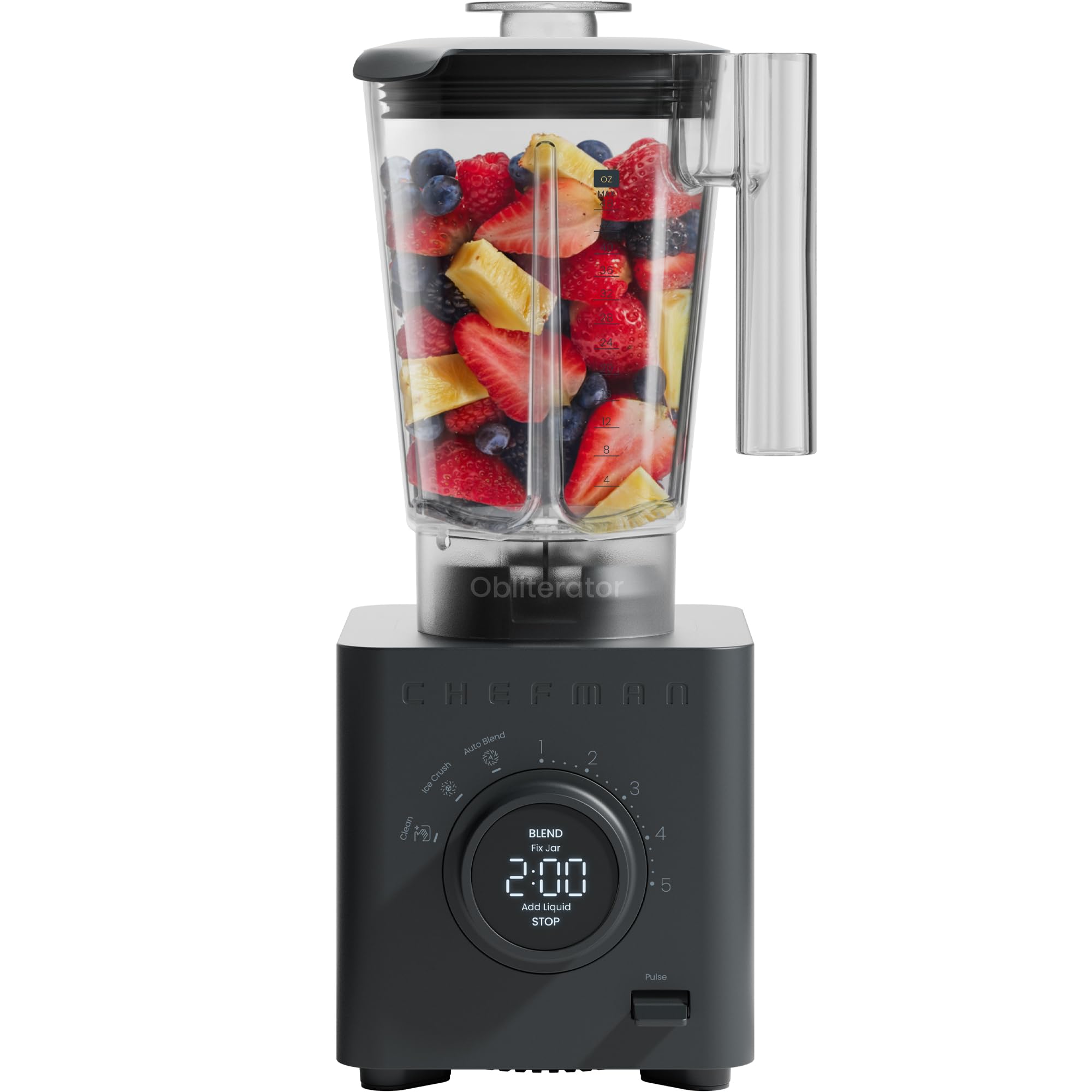
Chefman Obliterator
Key Features
- Speeds: 5 plus pulse
- Motor power: 1380 watts
- Jar capacity: 48 fl oz
- Jar material: Tritan
- Price: Midrange
Forty-eight ounces is the number that makes the Obliterator interesting. Most pitchers here run 64 to 72 ounces, which is right for a family and wrong for a couple who each want one smoothie. A half-empty jar is mostly air, and air is what the blades throw around instead of food.
The rest of the machine keeps up: 1380 watts, five speeds plus pulse, an Auto Blend function that adjusts to the load, a shatter-resistant Tritan jar, and both a tamper and a scraper in the box. The clean preset is the feature we used most. Water, a drop of soap, thirty seconds, done, and the jar is ready for the next round.
Where it gives ground is capacity, and that cuts both ways. Forty-eight ounces is two large smoothies or three small ones, so it isn’t the machine for a family of five, and at top speed it’s as loud as anything else here despite the airflow claims. Neither bothers us much: the slim footprint earns back the counter space, and the jar size is the reason the results come out consistent in the first place.
Pros
- 48-oz Tritan jar suits small batches
- Clean preset that actually works
- Auto Blend adjusts to the load
- Tamper and scraper included
Cons
- Loud at top speed
The pick for a small kitchen and one or two drinkers, since a 48-ounce jar makes better small batches than any big pitcher here.
Best for Tight Budgets
OMMO 1800W Countertop Blender
Key Features
- Blades: Six-blade stainless steel
- Dimensions: 7.5"D x 6.7"W x 17.3"H
- Motor power: 1800 watts
- Jar capacity: 60 fl oz
- Price: Budget
Eighteen hundred watts for the least money in this group: that’s the whole pitch, and it’s a real one. The OMMO’s motor does the heavy work, crushing ice and frozen fruit without the long, rattling struggle a cheap blender usually makes of either.
Around it you get a 60-ounce BPA-free jar, a six-blade stainless assembly, a variable speed knob with a pulse setting, and a lid with a handle that lifts off without spilling. It’s the simplest control layout in this roundup, with no presets, no display and nothing to learn before your first smoothie.
The compromises show up in the details rather than the blending. The pitcher base is where this machine ages, so treat the jar as hand-wash only, don’t torque the lid down hard, and don’t expect the plastic to feel like the Ninja’s.
Our take: this is a genuine 1800-watt blender at the lowest price here, and for anyone whose budget is the deciding factor it’s an easy recommendation over a weak machine that needs three passes. Go in expecting to look after the jar and it will keep earning its spot on the counter.
Pros
- 1800 watts at the lowest price here
- Simple variable dial with pulse
- Six-blade stainless steel assembly
Cons
- No presets or programs
- Loud at high speed
Real 1800-watt blending for the least money here; buy it when the budget decides, and treat the jar gently.
Best for Heavy Daily Volume
Waring MX1200XTX

Key Features
- Motor: 3.5 horsepower
- Weight: 13.7 lb
- Capacity: 64 fl oz
- Speed range: 1,500-20,000 RPM
- Price: Premium
The MX1200XTX is a commercial blender that happens to fit on a home counter: 3.5 horsepower, variable speed from 1,500 to 20,000 RPM, a maximum pulse that bursts to 30,000 RPM, and a 64-ounce copolyester jar. Waring rates it for 75-plus drinks a day. Nothing else in this roundup is built to that number.
In use, the difference we noticed is bluntness. There’s no tamper to fuss with, because the jar and blade are shaped so you can dump in ice, frozen fruit, nuts or hard vegetables, turn it to full and walk away. It turns ice to snow and leaves no strawberry seeds behind, and the dial gives you 11 speeds to work down from when you want texture rather than liquid.
It’s also the least domestic machine here: 13.7 pounds, 18 inches tall, no presets, no programs, no display, just a dial and switches. The warranty splits, three years on the motor and two on parts and labor, which is generous for commercial gear and shorter than what Vitamix and Breville offer at home.
So who buys it? Not a household making two smoothies a day, where a big jar and no presets is more machine and more counter footprint than the job needs. But if you blend in volume, whether that’s a café, a community kitchen or a family that empties a pitcher every morning, the Waring is the one here that won’t be the weak link.
Pros
- Commercial 3.5 HP motor, 75-plus drinks a day
- Variable 1,500-20,000 RPM control
- Handles thick frozen loads without a tamper
Cons
- Heavy, 18-inch-tall base
- No presets, programs or display
Only worth it if you blend in volume, but if you do, this is the one machine here built for a working day.
How We Tested High-Powered Blenders
We started with about 30 machines sold at major retailers and narrowed by pitcher size, motor spec, warranty length, and what came in the box — tamper, second jar, dishwasher-safe parts. Filtering for what each dollar actually bought left eight, which we purchased at full price and used at home for 10 months.
Each one ran the same handful of jobs across those months: a packed smoothie with frozen strawberries and ice, nut butter, hot soup, crushed ice, and a fibrous green blend. For the frozen loads we filled to the max line, started on the lowest speed, and timed how long it took to reach a texture with no visible chunks, then poured the result through a fine sieve to catch what the eye missed. We noted when a motor bogged, when we had to stop and shake the jar, and when a machine smelled hot afterward.
Lids got their own scrutiny, since a lid that won’t seat with one hand or a fill cap that pops loose mid-blend turns a two-minute job into a cleanup. We overfilled each pitcher with a thick blend to see if the lid crept, tipped full jars to check for leaks, and noted whether the cap doubled as a tamper. Noise we measured with a decibel meter at arm’s length during the ice crush, then judged again at 6 a.m. in a quiet kitchen. Cleaning was timed — warm soapy water, a 30-second blend, a rinse — and then done by hand to see what stayed stuck under the blade assembly and gasket.
Presets were tested against manual pulsing; a smoothie button that still needed three extra pulses counted against the machine. And after 10 months we checked pitchers for stress cracks, blades for wobble, and bases for any change in sound — the kind of durability you only learn by living with something.
How to Choose a High-Powered Blender
Wattage sells blenders, but the jar, the noise and the cleanup decide whether you’re still using yours next year.
Watts Set the Ceiling, Not the Result
Every machine here claims 1000 to 1800 watts, and the honest reading is that wattage caps what a blender can power through rather than describing how well it does it. A 1400-watt motor driving a well-shaped 72-ounce jar can beat a higher-rated motor in a jar that lets frozen fruit spin away from the blades.
Our rule: treat 1000 watts as the floor for ice and frozen fruit, then judge the jar shape, the blade stack and how the machine behaves with a full load. Peak wattage is usually a marketing figure; a stated horsepower rating is at least a consistent one.
Size the Pitcher to Your Household
Pitcher size changes results as much as capacity. A 64- to 72-ounce jar is right for three or four servings and wrong for a single smoothie, because the blades spend their time throwing fruit at the walls instead of pulling it down. If you usually blend for one or two, a 48-ounce jar such as the Chefman’s gives better small-batch texture.
The alternative is a machine with a second vessel. The NutriBullet SmartSense and the Ninja Mega Kitchen System both add cups to the same base, which solves the single-serving problem without giving up the family pitcher.
Be Realistic About Noise
No high-powered blender is quiet. A big motor spinning a blade fast through a hard jar makes a noise you feel in your teeth, and that is the physics of the category rather than a flaw in any one model.
What you can buy is mitigation. Breville builds the Super Q around a damped housing, and one-touch programs on several machines run to completion so you aren’t standing over the jar adjusting speed. If you blend at six in the morning in an apartment, pay for the mitigation. If you blend at noon with the radio on, put the money into a bigger jar instead.
Cleaning: What Dishwasher-Safe Really Means
The single best cleaning feature is a blade assembly that lifts out of the jar. It turns a sponge fight around a sharp edge into a thirty-second rinse, and it is the detail we check first on any new machine. A self-clean preset, as on the Chefman, handles the rest.
Treat dishwasher-safe as a claim about the plastic, not a promise. Repeated high-heat cycles are hard on jars, lids and gaskets, and hand-washing is the cheapest way to keep a pitcher from clouding, cracking or losing its seal.
Presets, Dials and Second Jobs
Programs are convenience, not performance. A one-touch cycle, like Ninja’s Auto-iQ or Breville’s five settings, removes the guesswork and delivers the same texture every morning. A variable dial, as on the Vitamix and the Waring, gives you control for nut butter, soup or flour, and asks you to pay attention.
If you want one motor to do more than blend, the Ninja Mega Kitchen System adds a food processor bowl and dough blade. If your second job is really a single serving, cups on the NutriBullet base cover it. Buy the second job only if you’ll use it weekly; otherwise it’s cabinet space.
Frequently Asked Questions
Is a high-powered blender worth it if I mostly make smoothies?
If your current blender leaves kale in ribbons or spins frozen berries without breaking them down, yes. The difference is one 30-second run instead of three, and a texture you don’t have to strain or chew.
If you blend soft fruit and yogurt, a 1000-watt machine is plenty and the extra headroom buys you nothing. Judge by the hardest thing you blend: ice and frozen fruit justify the power, banana and milk don’t.
Can these blenders crush ice on its own, with no liquid?
Not well, and it’s an easy way to stall a good machine. Ice needs something to carry it into the blades; a jar of nothing but cubes mostly spins.
Add about a quarter cup of liquid per cup of ice, start on low, and pulse in one-second bursts until the cubes break up before switching to high.
Will an 1800-watt blender trip my kitchen breaker?
It can. At 120 volts, 1800 watts draws roughly 15 amps, which is the full capacity of a standard kitchen circuit, so running one alongside a toaster, kettle or microwave on the same circuit can trip the breaker.
Check whether your counter outlets share a circuit with major appliances. If they do, blend with the other load off or choose a 1400-watt model.
Do I need a tamper?
Only for stiff, low-liquid blends: nut butter, thick frozen-dessert mixes, or a jar packed with greens. The Vitamix 5200 includes one and expects you to work it through the lid’s removable plug.
Most jars here are shaped to keep the load moving on their own. Either way, never put a spatula or spoon into a running blender.
Final Verdict
The Ninja Professional Plus is the blender most people should buy. Fourteen hundred watts, a 72-ounce pitcher and Auto-iQ programs turn ice and frozen fruit into a smooth pour without a second pass, all for well under what the premium machines here cost. The plastic jar and the full-speed noise are the price of that value, and for most kitchens it’s a fair trade.
If quiet is the deciding factor, the Breville Super Q is the alternative, with a damped housing and a 10-year warranty behind it. And if the same motor should chop vegetables and mix dough, the Ninja Mega Kitchen System does that for less than either premium machine.