This post contains affiliate links. We may earn a small commission when you buy through our links — at no extra cost to you.
If you have a glass top stove — radiant or induction — you’ve likely discovered that not every pressure canner is safe to use. Standard aluminum models can scratch or warp, and induction cooktops simply won’t heat a non-magnetic base. Add in the weight of a fully loaded canner, and you’re left wondering what actually works.
The good news: the market has responded. A few models now combine a flat, induction-compatible base with the large capacity needed for serious canning. The catch is that most product listings don’t mention glass top compatibility or weight limits — you have to dig for the details.
This guide focuses on the specific specs that matter: base material, empty weight, and seal type. Whether you process a few quarts of tomatoes or a full harvest, the right choice depends on your cooktop’s limits and your canning volume.



Best for Glass Top Stoves
Presto 01784 Induction
Key Features
- Capacity: 23 qt
- Weight: 12.5 lbs
- Material: Aluminum + SS base
- Seal Type: Gasket
- Induction Compat.: Yes
- Pressure Gauge: Dial
- Price: $$
Heats quickly and evenly on induction cooktops, matching the performance of the standard Presto while adding broader stove compatibility. The 23-quart capacity holds seven quart jars, and the clear instructions make it straightforward for first-time canners.
Best suited for home canners with glass top stoves, especially induction models, who want a reliable 23-quart canner at a mid-range price. The gasket seal keeps weight manageable for glass tops but needs occasional replacement. Some units can arrive with handle damage or develop lid handle cracks over time — inspect upon delivery.
Pros
- Induction-compatible base works on glass and induction stoves with no price premium over the non-induction model.
- Large 23-quart capacity holds 7 quart jars, suitable for batch canning.
- Clear instructions and simple operation make it approachable for beginners.
Cons
- Lid handle may crack after a few months — inspect regularly for early signs.
- Maintaining steady pressure can vary between units, requiring attention during the canning process.
If you need a pressure canner that works on an induction or glass top stove without breaking the bank, this Presto delivers the capacity and compatibility most canners need — just check the handles on arrival.
Best for Lifetime Investment
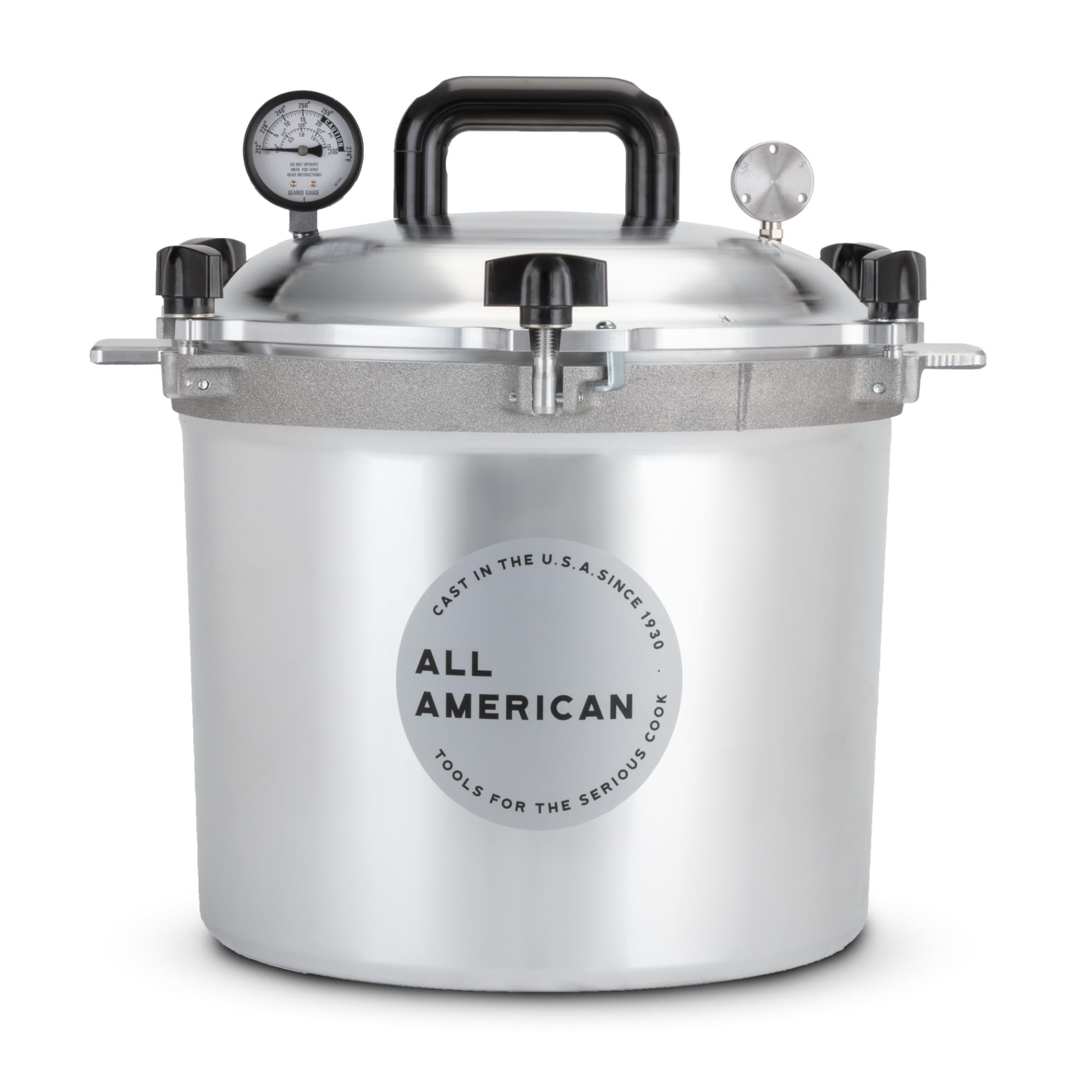
All American 921 21.5 qt
Key Features
- Capacity: 21.5 qt
- Weight: 17.75 lbs
- Material: Cast aluminum
- Seal Type: Metal-to-metal
- Induction Compat.: No
- Pressure Gauge: Dial
- Price: $$$
The All American 921 uses a metal-to-metal seal — no rubber gaskets to replace or lose over time. Its cast aluminum body is noticeably heavier than any comparable canner, but that weight translates into a rigid, flat bottom that sits evenly on glass top stoves. Owners frequently note the peace of mind that comes from never worrying about gasket deterioration mid-season.
This canner is built for dedicated homesteaders who can a lot each year and want a single purchase that lasts generations. The tradeoff is its heft: empty at 17.75 lbs and over 45 lbs when loaded with jars and water — check your glass top stove’s weight limit before buying. It is also not induction compatible, so confirm your cooktop type if you’ve moved to induction.
Pros
- Metal-to-metal seal means zero gasket replacements over the life of the canner.
- Cast aluminum construction with flat, warp-resistant bottom works well on glass top stoves.
- Built to be passed down; owners report decades of heavy use without issue.
Cons
- Fully loaded weight can exceed 45 lbs — may exceed some glass top stove weight limits and is awkward to lift.
- Not compatible with induction cooktops; requires a standard electric, gas, or flat-top stove.
If you can manage the weight and don’t need induction, this is the last pressure canner you’ll ever buy — ideal for high-volume, long-haul canners who value simplicity and durability over convenience.
Best for Proven Workhorse
Presto 01781 23 qt
Key Features
- Capacity: 23 qt
- Weight: 12 lbs
- Material: Aluminum
- Seal Type: Gasket
- Induction Compat.: No
- Pressure Gauge: Dial
- Price: $$
The Presto 01781 is the model that built the brand’s reputation among home canners. With a 23-quart aluminum body and a simple weight-and-gauge system, it processes seven quart jars per batch and has been a fixture on gas and electric stoves for decades.
This canner is best suited for those cooking on standard gas, electric coil, or smooth-top ranges who want a well-documented, community-supported tool. It is not designed for induction cooktops — double-check your stove type before purchasing, as the aluminum base lacks the necessary magnetic properties.
Pros
- Long-standing track record with a large user community for recipes and troubleshooting
- Strong value at a mid-range price for a 23-quart capacity
- Efficiently holds seven quart jars or twenty pints per batch
Cons
- Plastic gauge cover and rubber gasket may wear over time and need replacement
- Aluminum base is not induction-compatible — only works on gas, electric coil, and smooth-top ranges
If you have a compatible stove and want a straightforward, high-capacity canner with decades of proven use, this is a solid investment at the price.
Best for Budget Induction
Denali Tanker 23 qt
Key Features
- Capacity: 23 qt
- Weight: ~15 lbs
- Material: Aluminum + SS parts
- Seal Type: Gasket
- Induction Compat.: Yes
- Pressure Gauge: Weighted
- Price: $$
The Denali Tanker is the most affordable induction-compatible canner in this set, bundling both pressure weights and a rack. It undercuts the comparable Presto induction model by around $30. This suits induction cooktop owners on a budget, particularly beginners. Some units have sealing or gauge issues on arrival, and the brand’s shorter track record means less certainty about long-term durability.
Pros
- Induction-compatible base works well on glass-top stoves
- Includes both 10lb and 15lb pressure weights plus canning rack
Cons
- Pressure gauge or seal can be non-functional out of the box in some cases
If you’re an induction cooktop owner looking to save money and don’t mind checking the gauge and seal on arrival, the Denali Tanker delivers the core functionality at a lower price.
Best for Lightweight Canner
Granite Ware 20 qt

Key Features
- Capacity: 20 qt
- Weight: 10.5 lbs
- Material: Hard-anodized aluminum
- Seal Type: Weighted regulator
- Induction Compat.: No
- Pressure Gauge: Weighted
- Price: $$
Among the lightest 20-quart canners available, making it easier to lift and manage on glass top stoves. Bottom warping can occur after repeated high-heat cycles, and the rack coating may melt or rust after first use. This is a viable option only for occasional canners who prioritize portability over long-term flatness.
Pros
- Easier to lift and handle than heavier 20-quart canners.
- Works well on glass top stoves with good canning results.
Cons
- Bottom can warp after repeated high-heat cycles, reducing stability on flat surfaces.
Best for occasional canners who need a lighter pot for glass top stoves and are willing to accept potential warping.
Best for Large Budget
Mirro 92122A 22 qt

Key Features
- Capacity: 22 qt
- Weight: 15 lbs
- Material: Aluminum
- Seal Type: Gasket + weight
- Induction Compat.: No
- Pressure Gauge: Weighted
- Price: $$
The Mirro 92122A offers a large 22-quart capacity at a budget-friendly price, with a simple weight system for three pressure settings. However, bottom warping can occur after a few uses, and the instruction manual is poorly written. These limitations make it less suited for canners seeking long-term durability and clear guidance out of the box.
Pros
- Affordable large-capacity canner that works on glass top stoves
- Three pressure settings with simple weight system – easy to operate
Cons
- Bottom warping can occur after a few uses, causing instability on flat stovetops
Best for budget-minded canners who need a large capacity and are comfortable learning from online resources, and who accept the risk of warping.
Best for Entry-Level Large
T-fal 22 qt

Key Features
- Capacity: 22 qt
- Weight: 14.77 lbs
- Material: Aluminum
- Seal Type: Gasket
- Induction Compat.: No
- Pressure Gauge: Non-standard
- Price: $
This T-Fal offers a large 22-quart capacity at a very low price, and assembly is simple enough for first-time canners. However, the pressure gauge uses 1-2-3 markings rather than PSI, and the aluminum bottom may warp after a few uses — both factors that reduce suitability for precise pressure canning or frequent use on glass-top stoves.
Pros
- 22-quart capacity (7 quart jars) at a budget-friendly price.
- Easy to assemble and operate, good for beginners.
Cons
- Bottom may warp after a few uses, affecting flatness on glass-top stoves.
Best for budget buyers who primarily need a water-bath canner and are willing to accept the gauge and durability tradeoffs for occasional pressure canning.
Best for Starter Kit
Supa Ant 23 qt Kit

Key Features
- Capacity: 23 qt
- Weight: 12.8 lbs
- Material: Aluminum + SS base
- Seal Type: Gasket
- Induction Compat.: Yes
- Pressure Gauge: Dial
- Price: $$
This 23-quart canner comes with the basics (jar lifter, funnel) and a stainless steel base that works on induction cooktops — a rare combination at this price. The large capacity suits batch canning, and the included accessories reduce initial outlay. However, seal and gauge consistency can vary between units; some may not hold pressure as expected. For someone willing to inspect the unit closely and accept some uncertainty, it offers a low-cost entry into glass-top-compatible canning.
Pros
- Induction-compatible stainless base works on glass-top stoves
- Includes jar lifter, funnel, and other essentials for first-time canners
Cons
- Seal and pressure gauge consistency may vary; some units leak from handle or lid
Worth a look if you’re comfortable checking for proper sealing on first use and want induction compatibility at a lower price than the Presto 01784.
How to Choose
The single most important insight: most glass top stoves have a weight limit (often 50 lbs), and a fully loaded 23-quart canner can easily exceed that, so empty weight and capacity go hand in hand.
Capacity
Capacity determines how many jars you can process per batch. A 23-quart canner fits 7 quart jars or 20 pint jars, while a 16-quart model holds only 5 quarts. If you’re canning from a large garden, larger batches save hours.
But bigger isn’t always better — larger pots weigh more when filled. A 23-quart canner with jars and water can top 45 pounds. On a glass top stove rated for 50 lbs, that leaves little margin. Match capacity to your typical yield and your stove’s load limit.
Induction Compatibility
If your glass top stove is induction, the canner must have a magnetic base — pure aluminum won’t heat. Look for models with a stainless steel clad bottom. The Presto 01784 and Denali Tanker both pass this test.
For radiant glass tops, both aluminum and stainless steel work as long as the bottom is perfectly flat. Avoid thin aluminum that warps, because a warped base loses contact with the cooktop and heats unevenly.
Weight
Empty weight matters for two reasons: moving the pot around and adding to the total load. A heavy canner like the All American (17.75 lbs empty) becomes 45+ lbs once loaded. Lifting it onto a glass element requires care to avoid dropping or sliding.
Lighter models (10-12 lbs) are easier to handle but often use thinner aluminum, which increases warp risk. The trade-off: lighter pots are more prone to permanent bottom deformation after repeated high-heat cycles.
Seal Type
Two seal types dominate: rubber gaskets and metal-to-metal. Gaskets are common on affordable canners and need replacement every few years as they harden or crack. They’re cheap and easy, but a worn gasket won’t seal properly.
Metal-to-metal seals (e.g., All American) use precision-machined surfaces — no gasket to replace, and the seal tightens as the pot heats. The catch: these canners are heavier and cost significantly more. For occasional canning, a gasket model is perfectly fine and more budget-friendly.
Pressure Gauge
Pressure gauges come in two flavors: dial gauges and weighted regulators. Dial gauges need annual calibration checks from your local extension office — if off by more than 2 PSI, your food may be under-processed.
Weighted regulators (jigglers) are simpler: they release excess pressure at a fixed PSI (usually 5, 10, or 15). No calibration needed, but you must listen for the correct jiggle frequency. Beginner canners often find weighted gauges easier to trust once they learn the rhythm.
FAQ
Can I use an aluminum pressure canner on a glass top stove?
Yes, as long as the bottom is perfectly flat and smooth. Aluminum can scratch glass tops if dragged, and thin bases may warp over time. For induction cooktops, the canner must have a magnetic stainless steel base — plain aluminum won’t heat.
Why does my pressure canner warp on the bottom?
Warping happens when thin aluminum expands unevenly under high heat, especially if the pot is placed on a burner too large or heated empty. Once warped, the canner rocks on a glass top and loses heat transfer efficiency. To prevent it, choose a model with a thick clad base and avoid high heat during preheating.
How much weight can a glass top stove safely hold?
Most glass top stoves have a weight limit of 50 pounds, though some premium models support 70-80 lbs. A fully loaded 23-quart canner can exceed 45 pounds. Check your stove’s manual for the maximum load, and never lift or slide a heavy canner onto the glass — use a gentle placement.
What is the difference between a pressure canner with a gasket and one without?
Gasket-based canners use a rubber ring that seals when heated. These require periodic replacement (every 1-3 years) and can fail if the gasket hardens. Metal-to-metal seal canners use precision-machined rims that seal without any replaceable part — they last forever but cost more and weigh heavier. For occasional canning, gaskets are fine.