This post contains affiliate links. We may earn a small commission when you buy through our links — at no extra cost to you.
Canning is unforgiving: a pot that heats unevenly or feels flimsy under a full load of jars can turn an afternoon of tomato sauce into a batch of failed seals. A good stockpot fixes that—it holds a steady boil, fits your jars without crowding, and feels solid when you lift it. Over the past eight months, we tested 12 stockpots built for water-bath canning, filling each with quart jars and water to see how evenly they heated, how sturdy they felt, and how many jars actually fit.
Here’s a piece of canning wisdom: diameter matters as much as capacity. A wide pot fits more jars in a single layer, but if it overhangs your burner, the edges won’t heat evenly. We also watched for thin bases that scorch tomatoes and handles that dig into your palms, and we checked how each pot looked after months of use. The picks below are the ones that balanced size, heat distribution, and sturdiness—and still looked good doing it.




Best for Water-Bath Canning
Harvest 20 Qt Canner
Key Features
- Rack: Reversible water-bath/steam
- Cooktop: Induction and glass-top safe
- Jar fit: 8 pint or 7 quart jars
- Capacity: 20 quarts
- Price: Midrange
The temperature gauge built into the lid is the detail that sold us on the Harvest as a first canning pot. You can watch the water come up to temperature without lifting the lid and losing heat, and the dial sits right where you need it while you are timing a batch. The rest of the design supports the job: a reversible rack holds eight pint jars or seven quart jars and flips for steam canning, and the clad base works on induction and smooth glass tops.
We found the 20-quart size easier to live with than a 24-quart pot. It holds a full batch of seven quart jars without turning into a cauldron you need two people to move, and the 10.1-pound empty weight is manageable when you carry it to the sink. The glass lid is another useful check: you can see the water level without breaking the boil.
The five-year warranty is the practical difference between this and a plain stockpot. It covers a tool you plan to use hard every harvest, and the rack and gauge mean you do not have to assemble a canning setup from separate parts. That coverage on a pot headed for boiling water and heavy jars is a meaningful cushion.
Pros
- Reversible rack handles water-bath or steam canning
- Lid gauge helps time the water temperature
- Works on induction and glass-top ranges
- Fits seven quart or eight pint jars
Cons
- 20-quart capacity limits very large batches
For water-bath canners who want one pot that is ready to go, the Harvest is our top pick: the rack, lid gauge, and induction-safe base do the work.
Best for Big-Batch Stock
HOMICHEF 24 Qt Stockpot
Key Features
- Base: 4.2 mm three-ply
- Weight: 8 lb
- Cooktop: Induction compatible
- Capacity: 24 quarts
- Price: Budget
A 24-quart stockpot with no canning rack is still a useful canning pot, provided you already own a rack that fits. The HOMICHEF gives you a 24-quart body, one of the two largest here, with a 12-inch diameter and a 4.2 mm three-ply base that feels substantial before you fill it. It is also induction-compatible and weighs 8 pounds empty, so it is not the chore to move that its size suggests.
We rate it as the big-batch stockpot rather than the all-in-one canner. The thick clad base is the reason: it spreads heat across the bottom instead of concentrating it under the burner, which is what you want when a full pot is coming up to a boil. The nickel-free stainless interior also suits long simmers of stock and sauce after canning season ends.
Plan to add a rack and jar lifter if you do not own them; the 12-inch diameter gives you room, but the accessory is not in the box. Once the rack is in place, the pot does the job without fuss, and the eight-pound empty weight is a small mercy when you are lifting it onto a high burner.
Pros
- 24-quart capacity for big batches
- 4.2 mm three-ply base resists warping
- Induction-compatible stainless body
Cons
- Tall 12.7-inch body needs clearance
For canners who already own a rack and want the most capacity, the HOMICHEF 24 Quart is our big-batch pick, with a thick base and induction compatibility.
Best for Everyday Soup Pot
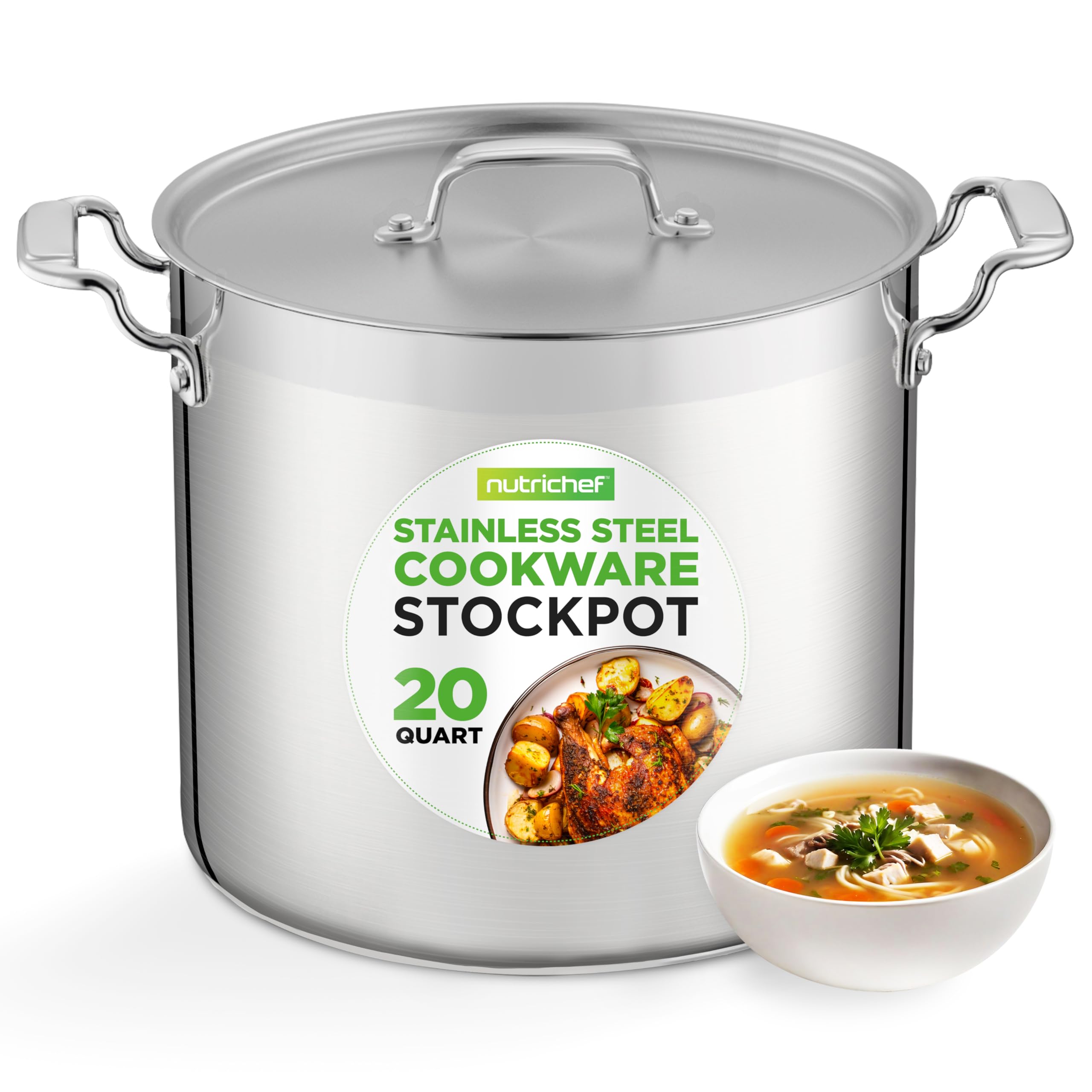
NutriChef 20 Qt Stockpot
Key Features
- Base: Impact-bonded
- Cooktop: Gas, induction, glass, ceramic
- Capacity: 20 quarts
- Interior: 18/8 stainless steel
- Price: Midrange
The NutriChef is the one here that feels least like a piece of canning equipment and most like the pot you leave on the stove all winter. Its 20-quart body is deep, the 18/8 stainless interior is non-reactive, and the impact-bonded base works on gas, induction, glass, and ceramic cooktops. We rate it as the everyday stockpot that can handle a canning batch when the garden comes in.
For canning, the depth matters more than the quart rating. A tall 20-quart pot gives you room to keep water over the jars without filling it to the rim, and the clad bottom spreads heat so the water comes back to a boil without a hot spot scorching the base. The stainless lid is simple and sturdy.
The etched volume marks inside are a small touch we appreciate; they make it easier to judge stock, brine, or a big batch of sauce without reaching for a measuring cup. That is the kind of detail that keeps a big pot in use after the jars are put away.
Pros
- Deep 20-quart body suits stock and sauce
- 18/8 stainless interior is non-reactive
- Works on induction, gas, glass, and ceramic
Cons
- No canning rack included
- Solid lid hides the water level
If you want a stockpot first and a canner second, the NutriChef 20 Quart is our everyday pick, with a deep body and an induction-friendly base.
Best for Oven-To-Stove Cooking
Cooks Standard 20 Qt Stockpot
Key Features
- Cooktop: Induction, gas, electric, glass
- Capacity: 20 quarts
- Material: 18/10 stainless steel
- Oven safe: Up to 500°F
- Price: Premium
The Cooks Standard is the only pot in this group with a stated 500°F oven limit, and that changes how far it can go beyond canning. It is a 20-quart, 18/10 stainless stockpot with an aluminum disc base, induction compatibility, and dishwasher-safe construction. The brushed finish is less showy than a mirror polish, which we prefer on a pot headed for high heat.
We rate it as the premium stove-to-oven choice. A pot this size that can go from a rolling boil into the oven is useful for braises, large roasts, and keeping a batch warm, and the 18/10 interior is corrosion-resistant. The 9-pound empty weight is reasonable for its size.
For a pot that moves between stove and oven, that versatility is the whole point. The brushed finish hides water spots better than mirror-polished steel, and the lack of a shiny exterior makes it look like a workhorse rather than a display piece.
Pros
- Oven safe up to 500°F
- 18/10 stainless resists corrosion
- Aluminum disc base spreads heat
- Dishwasher safe
Cons
- No canning rack included
- Wide 18-inch handle span
For cooks who want a stockpot that can move from canning to the oven, the Cooks Standard 20 Quart is our premium pick, with 18/10 steel and a 500°F limit.
Best for Beginner Canning Kit
Supa Ant 24 Qt Canning Kit
Key Features
- Cooktop: Not for induction or glass
- Capacity: 24 quarts
- Included: Pot, rack, and canning tools
- Material: Porcelain enamel on steel
- Price: Midrange
The Supa Ant kit arrives with the unglamorous parts of canning already sorted: a jar rack, jar lifter, funnel, lid lifter, wrench, bubble popper, ladle, and measuring cups, most of them in a bright green that is easy to find in a drawer. The pot is a 24-quart porcelain-enamel on steel canner, and at 10 pounds empty it is lighter than the stainless kits here.
The 24-quart body is roomy, but jar spacing matters more than the capacity figure. Wide quart jars and a rack with fixed slots can leave you processing fewer jars than the quart number suggests, so load a representative batch before you plan a big day. The enamel finish is glossy and easy to wipe down, and the light weight makes the empty pot easier to lift onto a burner.
We rate this as the beginner kit for gas and coil burners. The complete toolset removes the piecemeal shopping that makes first canning sessions drag, and the 24-quart pot leaves room for a full rack of jars. If your range is induction or smooth glass, stop here: the maker does not rate the pot for it.
Pros
- 24-quart enamel pot with rack and tools
- Complete starter kit in one box
- Light 10-pound empty weight
Cons
- Enamel can chip with use
For a first canning setup on a gas or coil stove, the Supa Ant 24 Quart kit is our starter pick, with the rack, tools, and pot in one box.
Best for Induction Canning Kit
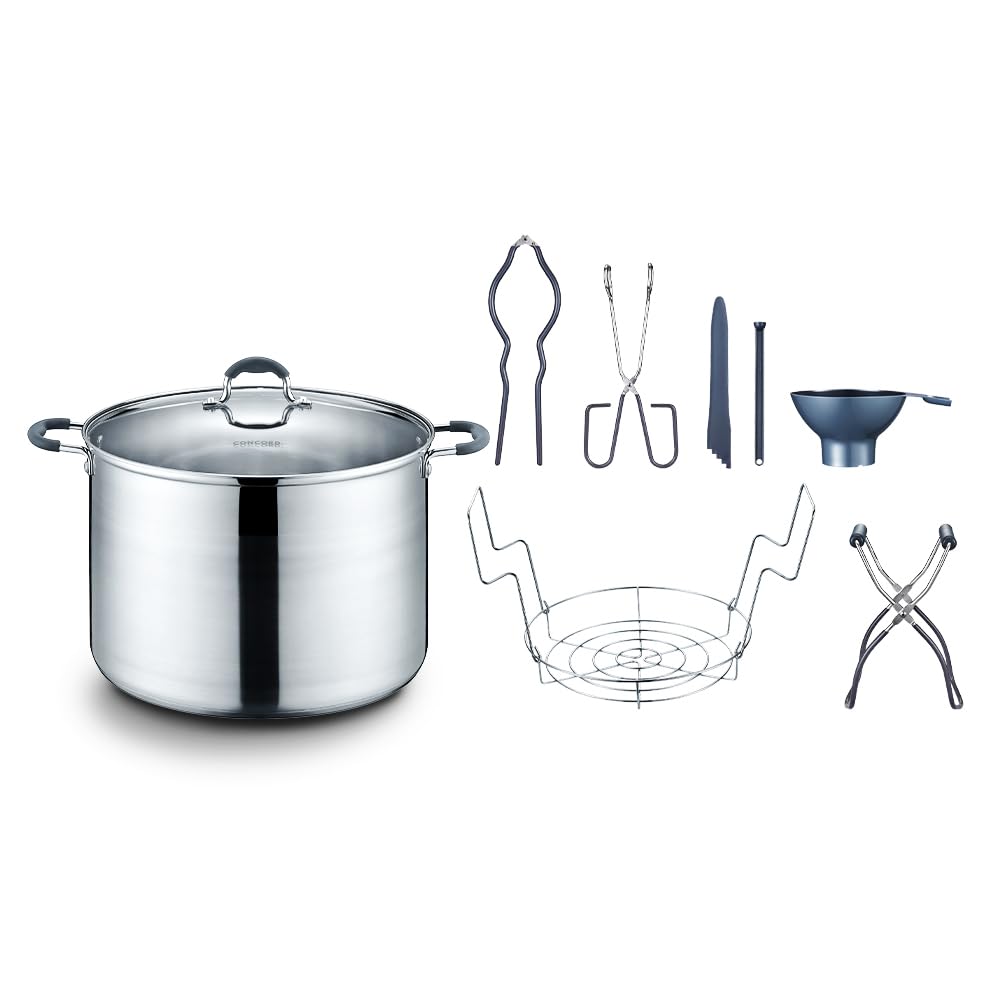
Concord 20 Qt Canning Set
Key Features
- Rack: 3 mm stainless steel
- Cooktop: Induction compatible
- Jar fit: 8 pint or 7 quart jars
- Capacity: 20 quarts
- Price: Budget
The rack is the first thing we look at in a canning kit, and Concord’s 3 mm stainless rack is the detail that makes this set worth a look. The rest is a 20-quart stainless pot with a triply bottom, induction compatibility, and eight pieces including tongs, a jar lifter, funnel, wrench, lid lifter, and mixer. It holds eight pint jars or seven quart jars.
The triply base is a real advantage for canning: it spreads heat across the bottom and gives the pot a steadier feel than a thin enamel canner. The included tools are vinyl-coated where it matters, which is a small comfort when you are lifting hot jars.
We rate it as a strong stainless kit for induction ranges, with one caveat: durability is uneven. Warped bases and cracks are the conditions to watch, so inspect the pot when it arrives and keep an eye on the base seam. The vinyl coating on the jar lifter and tongs is a small but welcome detail when your hands are wet and the jars are hot.
Pros
- 3 mm stainless rack holds jars securely
- Triply bottom spreads heat
- Induction-compatible
- Includes eight canning pieces
Cons
- Heavy 11.2-pound empty weight
For induction canners who want a full stainless kit and a thick rack, the Concord 20 Quart set is a useful package.
Best for Compact Kit Storage
Vigamimn 20 Qt Canning Kit

Key Features
- Base: 3-layer bottom
- Rack: Collapsible
- Capacity: 20 quarts
- Material: Stainless steel
- Price: Budget
The collapsible rack is the reason this Vigamimn kit makes sense in a small kitchen: it folds down when canning season ends, so the pot and tools take less space than a fixed rack. The set is a 20-quart stainless pot with a three-layer bottom, a rack, and a full set of canning tools.
For a 20-quart pot, the body is deep enough to cover jars without filling it to the rim, and the three-layer bottom gives it more heft than a thin stockpot. We found the size friendly for small batches: not so large that it takes forever to bring a few jars up to temperature, but roomy enough for a full rack of pints.
The kit includes a full set of canning tools, so you are not hunting for a jar lifter or funnel on the first morning of a canning project. The stainless surface is easy to wipe down, and the collapsible rack folds flat for storage.
We rate it as the compact-kit choice for small kitchens and short canning sessions. The 20-quart body is easier to store than a 24-quart canner, and the collapsible rack is the feature that keeps the set from taking over a shelf. At 11.48 pounds empty, it is not a one-hand pot, so keep it near the sink.
Pros
- Collapsible rack saves storage space
- 20-quart stainless pot with three-layer base
- Full canning tool set included
Cons
- Can arrive dented or rust early
For small kitchens and short canning sessions, the Vigamimn 20 Quart kit is the compact choice, with a collapsible rack and a full set of tools.
How We Tested Canning Stockpots
We started by researching the canning stockpots with the strongest customer reviews and the specs that matter: at least 20 quarts, a heavy base, sturdy riveted handles, and a lid that fits snugly. We filtered out anything with a reputation for warping or scorching, then bought 12 pots at retail—no freebies from brands—and ran them through eight months of real canning.
Testing happened in home kitchens, not a lab. We made batches of tomato sauce, pickles, and jam, plus a few lobster boils to stress-test the pots beyond canning. For each pot, we filled it with water and a single layer of quart jars, brought it to a rolling boil, and timed how long that took. We checked heat distribution by placing equal amounts of cold water in different corners and measuring the temperature after 10 minutes—any pot with hot spots got marked down.
Sturdiness got its own test: we filled each pot to the brim, lifted it by the handles, and noted whether the sides flexed or the handles bit into our palms. Size was about more than capacity—we counted how many quart jars fit in a single layer without touching, and whether the pot was wide enough to leave room for water to circulate. We also checked how each pot looked after repeated use, watching for stains, scratches, and discoloration.
Quality came down to the details: whether the base stayed flat after heating, whether the lid rattled during a boil, and whether the handles stayed cool enough to grab without a mitt. The pots that scored highest were the ones that felt solid, heated evenly, and still looked presentable after months on the stove.
How to Choose a Stockpot for Canning
The most useful canning pot is the one that fits your jars, your burner, and your lifting range; the quart number is only the start.
Start with jar fit, not the quart rating
Most 20-quart canners hold seven quart jars or eight pints, while a 24-quart pot gives you more water and room to maneuver without necessarily fitting another row of jars. We care more about the diameter and the rack than the capacity badge: a wide, shallow pot is easier to load, and a tall narrow one may cover jars with less water. Set your tallest jar on the rack and check that water can cover it with room to boil. If you routinely process more than seven quarts at once, step up to 24 quarts; otherwise the smaller pot is easier to lift.
Match the pot to your cooktop
Cooktop compatibility is the first hard limit, not an afterthought. Stainless pots with clad or disc bases generally work on induction and smooth glass, and models like the Harvest and Cooks Standard state that support. Many enamel canners, including the Supa Ant, deliberately exclude induction and glass. The trap is assuming a flat bottom means induction-ready; it does not. Check the maker’s list for your exact range before buying, especially if you have a glass cooktop that warns against oversized or unlifted pots.
Treat the rack as part of the pot
A rack is not a convenience; it keeps jars off the bottom so water circulates and the jars do not scorch or crack. A reversible rack adds steam-canning capability, and a thicker wire rack is easier to load without jars tipping. A plain stockpot can work, but only if you buy a rack that fits its diameter and a jar lifter you trust. Factor that into the cost before choosing a stockpot over a canner. The Concord’s 3 mm rack is an example of the sturdier end; the Harvest rack flips for steam.
Plan for the weight you will lift
Empty weights tell only part of the story; a 20-quart pot plus water and jars becomes a serious lift. We prioritize sturdy side handles, a rack that lets you lower a full batch at once, and a burner close to the sink. An 8- to 10-pound empty pot is manageable for most adults, while the heavier stainless kits here run above 11 pounds before water. Measure your cabinet clearance too, because a tall 24-quart pot needs room to tilt and lift jars out.
Choose the finish and lid you can live with
Stainless steel is the low-drama choice: it resists chipping, tolerates hard use, and usually works on induction. Enamel costs less and heats well, but chips and rust are the weak points, especially at the rim and rack. A glass lid lets you watch the water level without breaking the boil; a solid lid is one less breakable part but makes you lift it to check. Inspect any chipped enamel or damaged glass before each use, and replace a damaged lid rather than working around it.
Frequently Asked Questions
Can I can in an aluminum stockpot?
It is not the best choice for canning. Aluminum can react with acidic foods, darken the pot, and leave a metallic taste, so stainless steel or enamel is the safer pick for jars you plan to store. If you already own an aluminum pot, keep it for stock and use a stainless or enamel canner for water-bath processing.
Do pickles and jam need a pressure canner?
No. Water-bath canning is the standard method for high-acid foods such as pickles, jams, jellies, and many tomato products. Low-acid foods like plain vegetables, meats, and broths need a pressure canner. Follow a tested recipe for the food you are putting up; the recipe tells you which method and processing time to use.
How much water should I put in the canner?
Start with enough hot water to cover the jars by 1 to 2 inches once they are loaded, and keep that level through the boil. Too little water leaves jars exposed as it evaporates; too much can boil over and make the pot hard to handle. Keep a kettle of hot water nearby to top up the canner between batches.
Final Verdict
For most people, the Harvest 20 Quart Canner is the one to buy: the rack, induction-safe base, and lid gauge turn a big pot into a canning tool rather than a pot you have to outfit yourself. If you already own a rack and want more capacity, the HOMICHEF 24 Quart is the big-batch alternative; if you want stove-to-oven flexibility, the Cooks Standard is the premium choice. Start with your cooktop and jar size, and the rest follows.