This post contains affiliate links. We may earn a small commission when you buy through our links — at no extra cost to you.
Every August my kitchen turns into a tomato plant, and for years I stopped at the water bath — pickles, jam, crushed tomatoes, nothing else. What changed it was a friend’s counter buried in green beans and a pot that was never going to be safe. A pressure canner is the only piece of equipment that gets low-acid food — beans, corn, broth, the turkey carcass — hot enough to sit on a shelf for a year. It’s also the one appliance in the kitchen where close enough isn’t.
Nobody needs to be frightened of one, though. We’ve spent the better part of a year with eight canners on gas and glass-top burners, and the differences come down to how steadily they hold pressure and how much you trust the thing holding it. First-timers rarely realize a dial gauge wants recalibrating while a weighted gauge doesn’t — but the weight is louder, takes getting used to, and a 23-quart is heavy before you put anything in it. The picks below are the ones I’d hand to a friend.




Best for Most Home Canners
Presto 01781 23-Quart Canner
Key Features
- Cooktop: Regular and smooth-top ranges
- Capacity: 23 quarts
- Item weight: 12 lb
- Pressure reading: Dial gauge
- Price: Midrange
Twenty-three quarts is not a number you can picture until the first time you fill it: seven quart jars across the bottom, or nine pints with a second layer stacked above, and an afternoon’s picking gone in a single processing run. That capacity is why we point most people here. A small canner turns a bushel of tomatoes into three evenings; this one turns it into one.
What we like most is how little the pot itself gets in the way. It is 12 pounds empty, the lightest full-size stovetop canner in this group, and the heavy-gauge aluminum is there to spread heat evenly rather than to fight you at the burner. Presto rates it for regular and smooth-top electric ranges as well as gas; if your stove has a glass top, run a water-only batch first, because 23 quarts of jars is a lot of weight on one burner.
The dial gauge is the part to watch. Of everything that can go wrong on a stovetop canner, a needle reading low is the one that quietly ruins a batch, because every timing table assumes the gauge is honest. Bring it up to pressure with water before the first real load and check the needle against the regulator weight. If the two disagree, exchange it before you trust it with a winter’s worth of chili.
The 76-page book that ships in the box is better than the pamphlet most canners come with — real charts, real recipes, and a pressure-cooking section that gets used in the off season. The deluxe gauge also reads the complete processing range rather than just the top end, which is exactly what you want at altitude, where the right answer is often a pressure between the markings instead of a flat 15 pounds.
Pros
- Seven quarts or nine pints per batch
- 12 pounds empty, lightest full-size stovetop here
- Doubles as a water-bath canner and pressure cooker
- Clear 76-page instruction and recipe book
Cons
- Wide 17.5-inch body needs a big burner
We recommend the Presto 01781 to most people: seven quarts or nine pints a batch, 12 pounds to lift, and a price well under the premium canners here.
Best for Lifetime Purchase
All American 930 30-Quart
Key Features
- Seal: Metal-to-metal, no gasket
- Capacity: 30 quarts
- Material: Cast aluminum
- Item weight: 21.3 lb
- Price: Premium
No gasket. The 930 seals metal to metal, with clamping locks drawing a machined aluminum flange down onto the pot rim, and that single decision is what we keep coming back to: nothing rubber to stretch, crack, or go hunting for the week before harvest. It is also why the thing weighs 21.3 pounds before a single jar goes in.
That weight is the honest cost. A full 30-quart pot is a two-hand, clear-the-counter lift from stove to sink, and it is not a canner you tuck into a cupboard between seasons — it wants a burner of its own. The clamps want to be drawn down gradually and evenly, which is the one technique worth practicing with water before your first real batch; the lid seating is the fiddly part, not the sealing.
Thirty quarts puts it among the largest pots here, so a full load is a genuine canning day rather than an evening. It ships with both a dial gauge and a weighted regulator, so you can work to the needle or simply listen for the jiggle — and if the two ever disagree, the weight is the one telling the truth.
Pros
- No gasket to replace or lose
- Cast-aluminum body with reinforced edges
- 30 quarts, among the largest pots here
- Dial gauge and weighted regulator both included
Cons
- 21.3 pounds empty; a full pot takes two hands
- 19-inch height needs cabinet clearance
Buy the 930 if you are done replacing canners: no gasket, a machined metal-to-metal seal, and 30 quarts, with the weight and price of a lifetime tool.
Best for Hands-Off Electric Canning
Presto 02144 12-Quart Digital
Key Features
- Control: Digital, automatic
- Capacity: 12 quarts
- Functions: Pressure canning and water bath
- Item weight: 20.5 lb
- Price: Premium
The pitch here is simple: you put the jars in, tell the machine what you are canning, and walk away. The controller holds the temperature itself, the cover will not unlock under pressure, and the display walks you from step to step, including the jar-warming stage that a stovetop canner leaves you to remember on your own.
It is 12 quarts, which in practice means five quart jars or roughly eight pints. That is an evening’s harvest, not a weekend’s, and it is the trade you make for a machine that needs no burner and no babysitter. Two things we noticed: it does not heat the kitchen the way a 23-quart pot on high does, and the natural cool-down is slow enough that you plan the second batch around it rather than standing over the lid.
It handles pressure canning and water bath both, which is more useful than it sounds — tomato sauce and pickles in the same session as green beans, without dragging out a second pot. Presto lists ten built-in safety features; the one that earns its keep is the sensor holding the set temperature while you get on with something else.
Where it pays off is for anyone who has been put off pressure canning by the standing-and-watching part. Where it costs you is capacity and money both — it is the priciest electric here by a wide margin, and it holds half of what a 23-quart stovetop does. If you can only can in short evening windows, that is a fair trade; if August brings a garden’s worth of produce, this is the second canner, not the only one.
Pros
- Holds pressure and runs the timer itself
- Pressure canning and water bath in one
- Digital prompts walk you through each step
- Does not heat up the kitchen
Cons
- Five quarts a batch, half a stovetop load
- Lid gasket picks up strong smells
The 02144 is for anyone who wants the canner to hold pressure and count the minutes — set it, walk away, come back to sealed jars — at the cost of capacity.
Best for Small Harvests
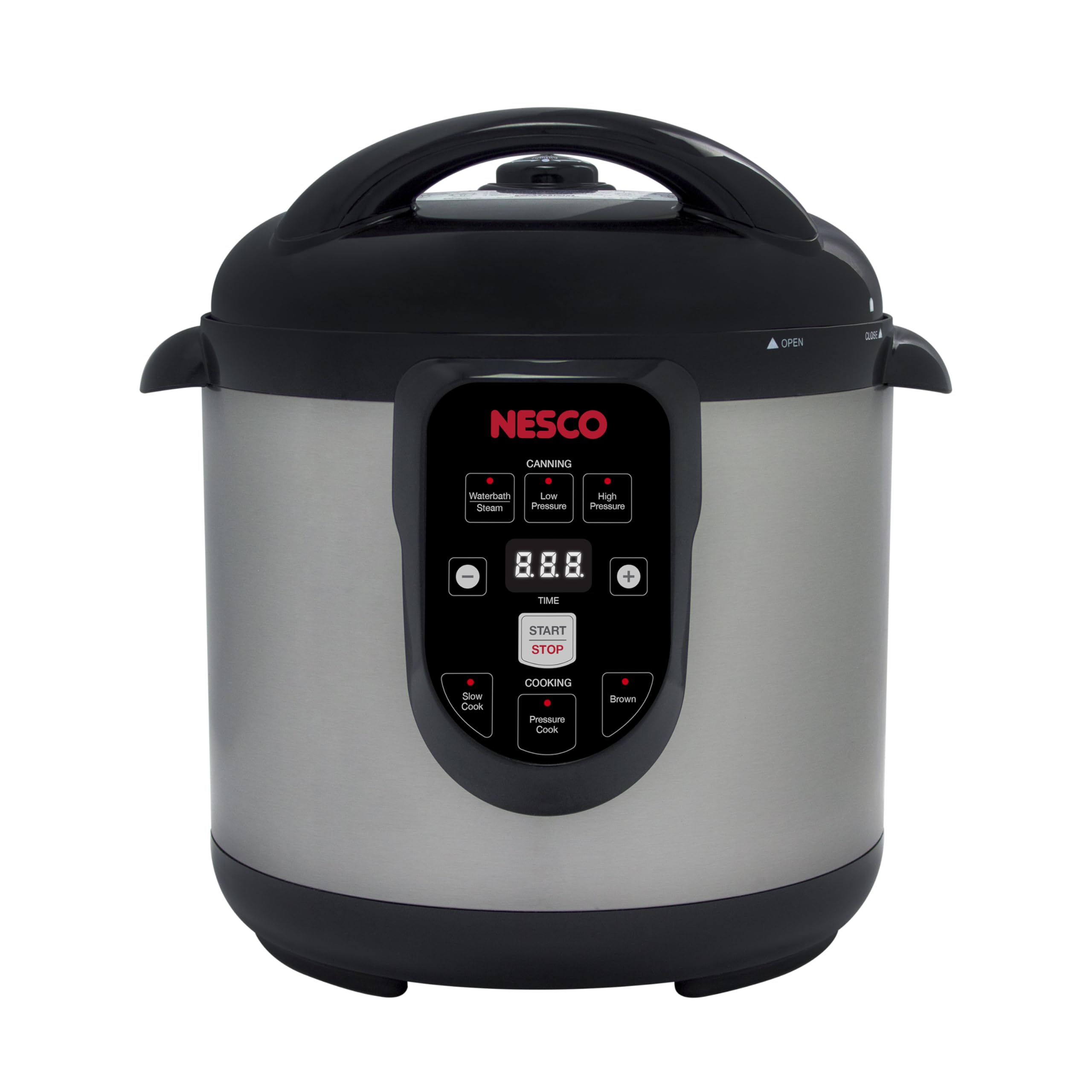
NESCO NPC-9 Electric Canner
Key Features
- Modes: Pressure can, water bath, steam, slow cook
- Control: Digital, automatic
- Capacity: 9 quarts
- Item weight: 22 lb
- Price: Budget
Four wide-mouth quarts. That is the real ceiling on the NPC-9’s 9-quart pot, and it is the number that decides whether this canner makes sense for you. For a first season, a small garden, a few jars of stock at a time, or a household of two, we think it is plenty — and it is the easiest canner here to say yes to.
Plug it into any counter outlet and it regulates its own pressure, which takes the two things people fear most about canning, a gauge to interpret and a burner to mind, off the table. The float valve and lid lock handle the rest. You set the program and the batch finishes while you are doing something else, which is the reason this one gets reached for again in soup season.
At 22 pounds it is not a pot you lift in and out of a cupboard, and that is fine: an electric canner lives on the counter anyway, and this one is small enough to justify the space. Between canning seasons it pressure cooks, steams, and slow cooks, so the footprint keeps earning its rent.
Pros
- Regulates its own pressure; no gauge to read
- Runs on any counter outlet
- Pressure cooks, steams, and slow cooks too
Cons
- Four wide-mouth quarts is the batch ceiling
- Manual leaves gaps for first-time canners
The NPC-9 is the electric canner for small harvests and first seasons: plug it in, set it, and process four jars without heating up the kitchen.
Best for Budget Full-Size Batches
T-fal 22-Quart Canner
Key Features
- Cooktop: Gas and electric coil
- Capacity: 22 quarts
- Jar capacity: 7 quarts, 18 pints, or 24 half-pints
- Pressure settings: Three pressure settings
- Price: Budget
The line that matters on the T-fal is the cooktop one: gas and electric coil, and that is it. No smooth-top glass, no induction. If that is your kitchen, read on, because everything else about this canner is a straightforward 22-quart workhorse at the low end of what full-size canners cost.
The layout is what won us over. Three pressure settings rather than one fixed weight, a locking lid with a beginner-friendly steam release, an easy-to-read gauge, and two racks in the box so pints stack above quarts without improvising spacers. Twenty-two quarts takes seven quart jars, eighteen pints, or twenty-four half-pints, and the aluminum body conducts heat well enough that coming up to pressure is not the drama it can be on a thin pot.
If a canner like this fails, it usually fails to build pressure, and that is a burner or a lid-seating problem as often as it is a pot problem. Run a water-only batch on your own stove the day it arrives, while the return window is still open, and check your jar sizes against the headspace before you plan a double layer.
Pros
- 22 quarts with two stacking racks
- Three pressure settings instead of one weight
- Undercuts the Presto and All American on price
Cons
- Gas and electric coil cooktops only
If your stove is gas or coil, this is the full-size canner to beat: 22 quarts, two racks, three pressure settings, for less than the big names.
Best for Gauge-Free Pressure Setting
Mirro 22-Quart Canner
Key Features
- Capacity: 22 quarts
- Material: Aluminum
- Item weight: 13.7 lb
- Pressure control: Three regulators, 5/10/15 PSI
- Price: Budget
Three regulators, not one. The Mirro ships with separate 5, 10, and 15 PSI weights, and each sets a fixed pressure mechanically: you choose the weight for your food and altitude, set it on the vent, and the jiggle tells you the pressure is there. No needle to drift, no calibration to chase, no dial to replace.
Around that it is a conventional 22-quart aluminum canner: two racks, cool-touch handles on both sides, a locking lid, and a steam release. At 6.21 kg it is one of the lighter full-size pots here, which matters more than the figure suggests once it is full of quart jars and you are carrying it from stove to trivet.
Our verdict is that this is the canner for someone who wants mechanical certainty and never wants to think about a needle again — a good match for a gas or coil stove and a household that cans in 22-quart batches. The one place it asks more of you is documentation: the charts in the box are thin, so keep a USDA guide or your extension service’s tables alongside it.
Pros
- Three weights set pressure without a gauge
- 22 quarts with two racks
- One of the lighter full-size pots here
Cons
- Fixed 5, 10, and 15 PSI steps only
- Three separate weights to store
Three separate regulator weights set the pressure mechanically, so there is no dial to trust and nothing to calibrate — a good 22-quart choice for anyone who likes mechanical certainty.
Best for Big Batches, Induction
RVGMBO 32-Quart Stainless

Key Features
- Cooktop: Gas, electric, induction
- Capacity: 32 quarts
- Material: 18/8 stainless steel
- Pressure: 10 to 15 PSI
- Price: Midrange
Stainless, not aluminum. The 18/8 body and the three-layer encapsulated base are the reason this one is here at all: it is the large canner in this group that states induction compatibility, and it sidesteps the upkeep that comes with a bare aluminum pot.
The lid is the interesting part. A single knob locks it from any angle, which is a nicer thing to operate with wet hands than four clamps or a twist-and-hope rim, and there is a lid window, a safety valve, and a release valve around it. Pressure adjusts between 10 and 15 PSI.
Thirty-two quarts is the largest capacity on this page, and that is the whole argument for it — the only thing close is the All American at 30 quarts, and nothing else here pairs that volume with stainless steel and an induction-ready bottom.
What we cannot tell you is how the lock holds up. There is very little written experience behind this model yet, so we are recommending the design rather than a track record. If you need the volume and cook on induction, that is a bet worth taking; if you want to know the lid still seals in five years, that is a different canner.
Pros
- 32 quarts, the largest batch here
- Stainless body with an induction-ready base
- One-hand locking lid
Cons
- 32 quarts is a two-person lift when full
- Too new for a track record on the lock
The one to pick when you need 32 quarts of volume, an induction-friendly base, and a lid you can lock with one hand.
Best for Volume Plus Tools
kilogorge 24-Quart Canner

Key Features
- Gauge: 14.5 PSI
- Cooktop: Gas, electric, flat top, induction
- Capacity: 24 quarts
- Included: Seven-piece canning set
- Price: Budget
It arrives as a kit: the 24-quart canner plus a canning funnel, tongs, a jar wrench, a jar lifter, a bubble remover, and a magnetic lid lifter — the things you otherwise end up ordering one at a time the week before your first batch. That bundling is most of the reason this one made the page.
The pot itself is a conventional aluminum canner with a 14.5 PSI gauge, a locking lid, two pressure relief valves, and a composite bottom rated for gas, electric, flat top, and induction. Twenty-four quarts sits between the 22-quart workhorses and the 30-quart monsters, which is a sensible size for a household that puts up a garden but does not want a pot it cannot lift.
Where we hesitate is track record. This is a new model with very little behind it, and a canner earns its reputation on gauges that still read true and seals that still hold after a few seasons. If the bundle and the induction-friendly base are what you need, it is a fair buy; run a water-only batch first and watch the gauge climb before you trust it with a harvest.
Pros
- Comes with a full set of canning tools
- Stated for induction and flat-top cooktops
- Gauge, locking lid, and two relief valves
Cons
- 19.6-inch width needs a wide burner
- Little long-term detail on gauge and seals
Its draw is the box: a 24-quart canner plus the filling tools you otherwise buy one at a time, on almost any cooktop.
How We Chose and Tested These Pressure Canners
We pulled every canner we could find that held at least seven quart jars and was rated for glass-top stoves, then cut the list to eight models across the price range — weighted-gauge and dial-gauge, aluminum and stainless. We ran them for ten months, through a full tomato season and a winter of dried beans and stock. Every load was the same: seven quarts, a measured volume of water, a stopwatch.
Pressure control got the closest look. We timed how long each canner took to climb from cold to 10 psi, then watched whether it held there for 90 minutes without touching the burner — some drifted a pound or two, others sat rock steady. With dial-gauge models we checked the reading against a second gauge; with weighted ones we swapped the 5, 10, and 15-pound weights to see how cleanly they seated. Lid seals got the same attention: a fingertip around every gasket after each batch, a check for steam escaping anywhere but the vent, and a note on which lids took two hands and a hip to lock.
Ease of use and size were judged on real canning days — lifting a loaded canner off a back burner, finding it a home in a cabinet afterward, then cleaning up. We compared value by what came in the box (rack, spare gasket, a manual worth reading) against the price, and durability by the end of the run: pitting, sticky gauges, gaskets gone stiff, handles that flexed under weight. Enjoyment is the one you can’t put on a spreadsheet, but after ten months it was obvious — a canner that comes up fast and jiggles at a steady rhythm is a good way to spend an afternoon.
How to Choose a Pressure Canner
The right canner is the one whose batch size, burner, and lifting weight all match the way you actually put up food. Get those three right and the rest is detail.
Stovetop or electric comes first
This is the fork that decides everything else. A stovetop canner needs a strong burner and your attention for the length of the processing run; in exchange it holds more jars per batch and costs less per quart of capacity. An electric model holds its own pressure and runs its own clock, but the two electrics here top out at 9 and 12 quarts.
If your canning happens in short evening windows, buy electric and accept the smaller batch. If August means a full Saturday with the burner on, buy stovetop.
How the pressure gets set, and how you check it
Three systems appear on this page: a weighted regulator that rocks at a fixed pressure, a dial gauge that shows you the number, and a digital sensor that holds it for you. Weights are the easiest to trust because there is nothing to drift, which is why the Mirro’s three regulators appeal to us. A dial tells you more, but only if the needle is honest — and every timing table you will follow assumes that it is.
Whichever you buy, bring it up to pressure once with water only and confirm what it tells you before a single jar goes in.
Match it to the burner, not just the kitchen
Cooktop compatibility is where canner shopping goes wrong. The T-fal is rated for gas and electric coil only. Plain aluminum needs a magnetic base before induction will see it, which is the whole reason the stainless RVGMBO and the kilogorge’s composite bottom are on this list.
A claim that a canner works on smooth-top ranges describes the base, not your glass surface’s tolerance for a loaded 20-pound pot. Check your range’s own guidance on heavy canners, and pick a burner that holds a rolling boil for the length of a processing run.
Quarts of capacity, and where the thing will live
Headline capacity is a poor guide by itself. A 22- or 23-quart canner takes seven quart jars; step up to 30 quarts and you need a serious harvest to justify a full load. Jar counts also shift with shape: wide-mouth quarts take more room than regular pints, and half-pints waste space unless you stack them.
Then there is storage. A 19-inch cast canner weighing 21 pounds lives on the stove, not in a cupboard. Decide where it goes before you decide how big.
Gaskets, seals, and the spares you will buy
Most canners seal on a rubber gasket, and a gasket that has hardened in a cupboard is the usual reason a batch never comes up to pressure. The All American sidesteps the question entirely with a machined metal-to-metal seal; everything else here needs a gasket eventually, plus a replacement weight or gauge if one is dropped.
Note the model number and buy the spare before you need it. Losing a harvest while a part ships is a worse trade than the part.
Frequently Asked Questions
Can I use an Instant Pot or another electric pressure cooker for canning?
Not the same appliance. The two electric canners here are sold specifically for pressure canning low-acid food at canning pressures, with lid locks and float valves built for it. A general-purpose multi-cooker may not sanction the process at all.
Check the manual for pressure canning applied to vegetables or meat. If it only covers water-bath or steam canning, use it for something else.
What can I pressure can that a water bath cannot handle?
Low-acid food: green beans, corn, carrots, potatoes, stocks, dried beans, and any meat, poultry, or seafood. Boiling water tops out at 212 degrees Fahrenheit, which does not kill the organisms that spoil those foods; a canner running at 10 or 15 PSI does.
Jam, pickles, salsa, and acidified tomatoes still belong in a water bath, and the stovetop canners here do both jobs.
What happens if a jar cracks inside the canner?
Leave the lid alone until the gauge reads zero; opening early is the one genuinely dangerous move in canning. Once it is down, lift out the intact jars and check whether the ones above the break sealed. A jar that did not seal goes in the fridge and gets eaten soon.
Scrub the rack, then check the vent and the weight for food debris before the next batch.
Final Verdict
The Presto 01781 is the canner we recommend to most people. Seven quarts or nine pints in a batch, 12 pounds to lift empty, a gauge that covers the full processing range, and a book that actually teaches you to use it — that is the balance most households want, and nothing else here matches it on all four.
Two alternatives change the answer. If you want the machine to hold pressure for you, the Presto 02144 does exactly that and pays for the privilege in capacity. If you are canning every year and want the last pot you will buy, the All American 930’s gasketless seal and 30 quarts are worth the weight.