This post contains affiliate links. We may earn a small commission when you buy through our links — at no extra cost to you.
Movie night has a rhythm: blankets down, lights low, then the sound of a pot lid rattling and someone yelling that the bottom is scorching. I’ve burned more batches on the stove than I’d like to admit, and I once owned an air popper that fired half its kernels into the couch cushions. A good popcorn maker is supposed to end all that — popping fast, leaving almost nothing behind in the kettle, and wiping out in under a minute so you actually reach for it again next week instead of burying it in the garage.
Over the past six months, my team and I ran 12 popcorn makers through real nights at home: Friday movies, after-school snacks, and a birthday party where I needed four batches back to back. What surprised me is how little the price tag or the wattage told us — how the kernels get moved around the kettle matters far more. A few machines felt flimsy after a dozen rounds, and some have no on/off switch at all, so you plug them in to start and unplug a hot appliance to stop. The ones below earned permanent counter space.



Best for Best-Tasting Popcorn
Original Whirley Pop
Key Features
- Capacity: 6 liters
- Warranty: 25 years limited
- Batch time: About 3 minutes
- Popping method: Stovetop with hand crank
- Price: Midrange
Every other pick here is an appliance with a cord. This one is a shallow aluminum pot with a lid, a crank and a stirring arm, and that difference is the whole reason it sits at the top of this list. What comes out is the most consistent popcorn we made for this guide — tender rather than styrofoam, evenly colored with no scorched patches, and very few kernels left at the bottom. Three minutes of turning a handle is the entire ritual.
The mechanism is as simple as it looks: the arm sweeps the bottom of the pot while the kernels heat, so nothing sits against the metal long enough to burn. Because you pour the oil yourself, you can go light on a weeknight or use butter-flavored coconut oil for the full theater effect, and popcorn takes salt far better when it has been popped in fat. It also asks for no real estate. The pot hangs on a hook or slides into a drawer, which is more than we can say for anything else in this roundup.
What it asks in return is your attention. It needs a burner and someone standing at it, so it is a poor fit for a kitchen where popcorn gets made in the middle of six other things. If that is your house, the electric picks below are the better answer, and the popcorn is still very good — just not quite this good.
Pros
- Most consistent popcorn of these picks
- About three minutes per batch
- Wipes clean, stores in a drawer
- 25-year limited warranty
Cons
- Nylon gears are the wear point
If popcorn is the reason you are shopping, this is the one we recommend: three minutes at the stove, nearly every kernel popped, and nothing to store but a shallow pan.
Best for Party Theater Setup
Nostalgia CCP510 Cart
Key Features
- Kettle: 8 oz
- Dimensions: 24.5 × 17.5 × 53 in
- Popping method: Hot-oil kettle with stirrer
- Yield per batch: 32 cups
- Price: Premium
Fifty-three inches is the number that decides this one before you plug it in. The CCP510 is a cart, not a countertop box — 24.5 inches deep, 17.5 wide, with a lighted interior and enough presence that you plan a corner of a room around it rather than a cupboard shelf. At under ten pounds it is far easier to shift than its height suggests, which matters the first time you need the outlet behind it.
What earns it a place here is the popcorn. The eight-ounce stainless kettle has a built-in stirring system and a dual-hinged lid, so you load it, close it and tilt to dump, and the warming deck holds a second batch while the first disappears. It produces the closest thing to theater popcorn in this group — crisp and glossy rather than chewy — and it does half the entertaining itself, which is why we set it up for parties rather than only for movie nights.
The costs are housekeeping costs. Assembly takes patience and the instructions are uneven, popcorn that misses the deck ends up on your floor, and the machine is built to work with the brand’s own popcorn kits, though plain kernels and oil do the job perfectly well. None of that is a reason to avoid it if you want the look; it is a reason to plan the first setup for an afternoon when nobody is waiting to eat.
Pros
- Theater-quality popcorn and a warming deck
- 8-ounce kettle with built-in stirring
- Light for its size at under ten pounds
- Tempered glass and steel, not plastic panels
Cons
- Kettle and glass corners are slow to clean
- Assembly instructions are uneven
We recommend this if the machine is part of the show: an 8-ounce kettle, theater-style popcorn, and a cart that earns its 53 inches every time a crowd shows up.
Best for Hands-Off Weeknights
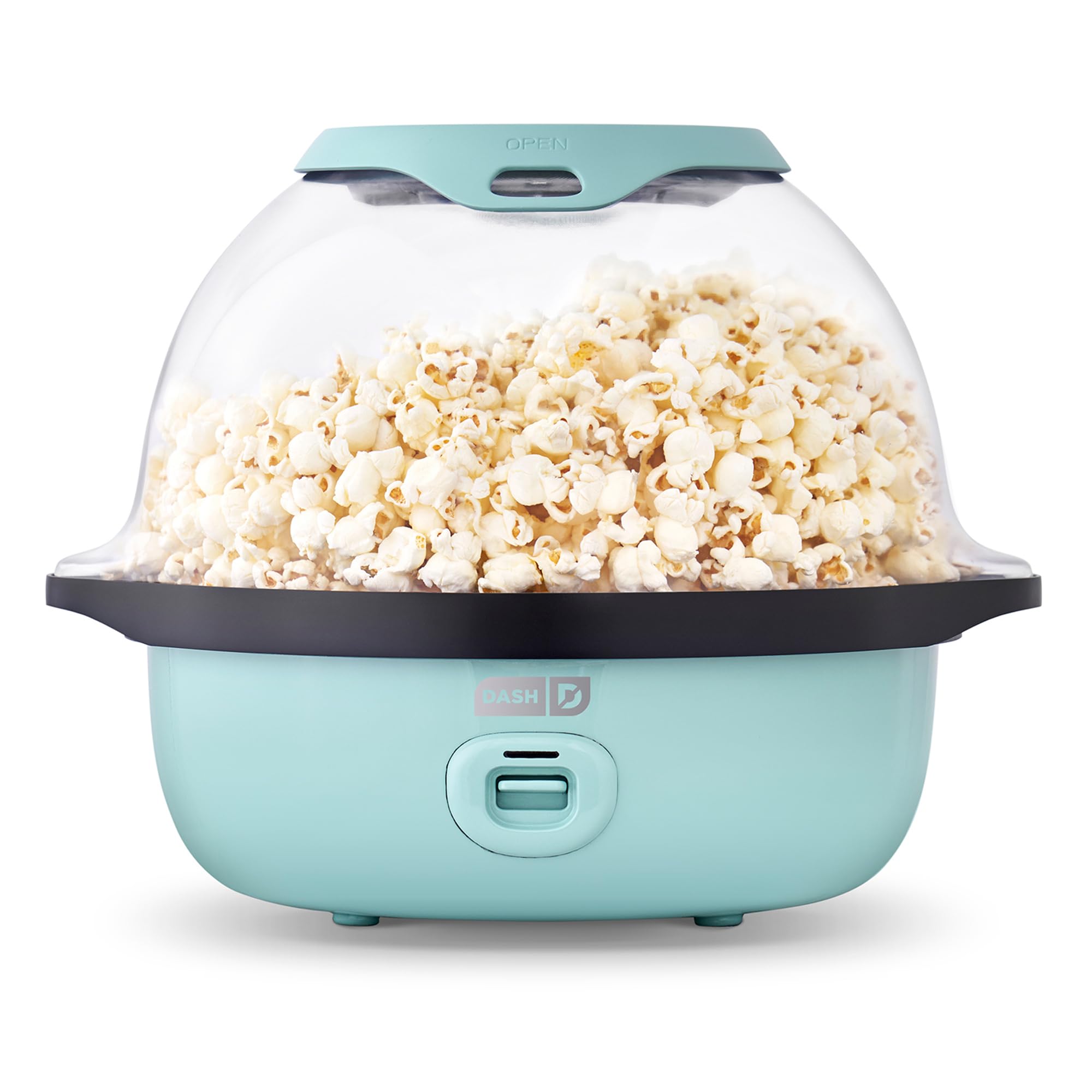
Dash SmartStore Deluxe
Key Features
- Storage: Lid and base nest
- Capacity: 24 cups
- Dimensions: 13.3 × 11.3 × 11.2 in
- Popping method: Hot-oil stirring
- Price: Midrange
The SmartStore trick is the reason to look at this Dash rather than any other stirring popper. The base, lid and bowl stack into a single unit about the size of a stock pot, so it lives in a cupboard instead of owning a permanent square of counter. The clear lid lifts off and becomes the serving bowl, which means the popcorn goes from machine to couch without a second vessel to wash.
In use it is a one-button machine: oil and kernels in, button pressed, motorized stirrer dragging the kernels across a heated plate until they pop. A melting tray in the lid handles butter while the batch finishes. We got light, crisp popcorn with almost nothing left unpopped, and the plate wipes out with a paper towel while the bowl goes in the sink. The butter tray is a genuinely useful feature rather than a bullet point.
Twenty-four cups is enough for a family night with leftovers, and it is quiet enough to run while the opening credits play. This is the electric popper we point people to when they want the machine to do the work rather than a pot to watch, and it sits in the sensible middle of this list on price for what it delivers.
Pros
- Lid and base nest for storage
- Pops nearly every kernel
- Lid doubles as the serving bowl
- One button, no guesswork
Cons
- Lid can work loose when you flip the bowl
Our pick when you want to press a button and walk away: it pops nearly every kernel, and the bowl, lid and base stack into one unit for the cupboard.
Best for Small Kitchens
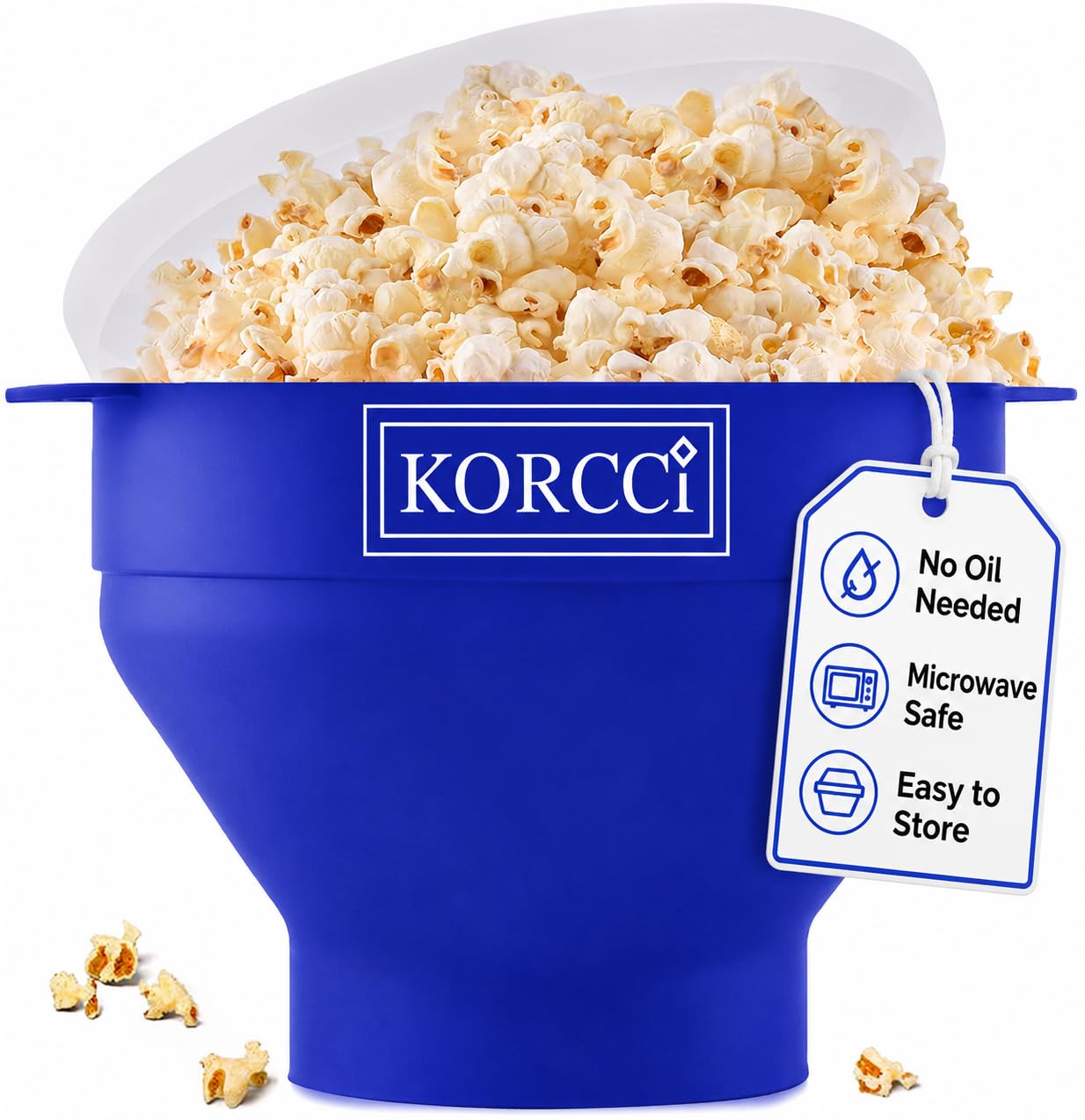
Korcci Silicone Popper
Key Features
- Capacity: 15 cups
- Cleaning: Dishwasher safe
- Material: Food-grade silicone
- Popping method: Microwave, oil optional
- Price: Budget
It costs the least of anything here, and we kept waiting to be disappointed. We weren’t. The silicone bowl takes a measured scoop of kernels with optional oil and salt, goes in the microwave for about three minutes, and comes out with most kernels popped and a texture far closer to a real popper than a microwave bag manages.
The design is what sells it beyond the price. It collapses to a couple of inches, the lid doubles as the measuring cup, the handles stay cool enough to lift the bowl out, and the whole thing goes in the dishwasher. The silicone is thick enough that it does not flop when full, which is the failure mode on cheaper versions of this idea.
The catch is your microwave. The bowl is 9 3/8 inches across, so it needs a turntable with room to spin and a door that shuts over it; check that clearance before you order, because it is the one thing that makes the difference between a bargain and a bowl you never use. Give it the space and there is nothing else to think about.
Pros
- Costs the least of these picks
- Collapses flat for drawer storage
- Dishwasher safe
- Pops with or without oil
Cons
- One bowl at a time, so a family refills
The least expensive way into good popcorn here, and the one we recommend for small kitchens: it collapses flat, goes in the dishwasher and needs no oil.
Best for Oil-Free Snacking
Presto PopLite
Key Features
- Weight: 2.1 lb
- Capacity: 18 cups
- Batch time: About 2.5 minutes
- Popping method: Hot air, no oil
- Price: Midrange
There is no on/off switch. You plug the PopLite in to start it and pull the plug out of the wall to stop it, and by the fourth or fifth batch that stops being a quirk and becomes the thing you mention to friends. Everything else about it is straightforward: a measuring cup that doubles as a butter melter on top, a chute that aims popcorn at the bowl, and a cord wrap underneath for storage.
As a hot-air popper it is the best of this group. Eighteen cups in about two and a half minutes is the biggest and fastest air-popped batch here, and the base and chute wipe clean without a kettle to scrub. Nothing else in this set gets you from a scoop of kernels to a full bowl with less washing up afterwards, which is exactly why it stays on the list despite the plug.
Air-popped corn is a different food from oil-popped: light, dry and dependent on what you put on it. That suits everyday snacking and anyone watching fat, and it is why the melting cap earns its place. Expect a few unpopped kernels to come out with the popcorn and keep the bowl close to the chute.
Pros
- About two and a half minutes for 18 cups
- Largest hot-air batch in this group
- Base and chute wipe clean
- Butter melts in the measuring cap
Cons
- Durability is the weak spot
The hot-air pick of this group: a big bowl in about two and a half minutes with no oil, and a base that wipes clean, though these do not last forever.
Best for Family-Size Batches
West Bend Stir Crazy

Key Features
- Lid: Doubles as serving bowl
- Capacity: 6 quarts
- Dimensions: 10 × 12 × 10.25 in
- Popping method: Hot-oil stirring
- Price: Midrange
The lid is the feature. A vented clear cover with a butter well at the center lifts off, flips and becomes the bowl you serve from, so six quarts of popcorn goes from plate to sofa without a second dish. The lid is dishwasher safe, which is more than most of the machines here can say, and the base nests with a cord wrap for storage.
Underneath is a nonstick popping plate and a motorized stirring rod that reverses as it turns, meant to keep kernels moving and stop them settling against the heat. It works well when you follow the sequence — oil, kernels, lid on, and the flip the moment popping slows to a crawl. Timing is the learning curve, and it is a short one.
Where it lands for us: this is the most generous of the bowl-style poppers here and the easiest to serve from, which makes it the family machine. The split on popping results is real, though — some batches finish with a stubborn layer of unpopped kernels, and results get more consistent once you stop second-guessing the flip.
Pros
- Six-quart batch served from the lid
- Dishwasher-safe lid
- Nonstick plate wipes clean
- Nests with a built-in cord wrap
Cons
- Bowl and lid are the parts that crack
A six-quart stirring popper whose lid becomes the serving bowl — we recommend it for big families who want one vessel to wash and no cart in the room.
Best for Compact Theater Look
West Bend Theater Crazy

Key Features
- Weight: 7.5 lb
- Capacity: 4 quarts
- Dimensions: 11.7 × 11.7 × 19.4 in
- Popping method: Hot-oil kettle with stirrer
- Price: Premium
It looks like a lobby machine that shrank in the wash, and that is the pitch. The Theater Crazy is 11.7 inches wide and 19.4 tall, small enough to sit beside a coffee maker, and it brings the parts that make a theater machine feel like one: a lit cabinet interior, a tilt door for serving and a kettle you dump with a lever rather than a spoon.
The kettle is stainless with a nonstick coating, a magnetic lid that lifts off for filling and a quick-release lever that tips it forward. A motorized rod stirs while it pops, and a kernel catcher underneath collects the ones that do not open so they stay out of the bowl. For a machine this size it is thoughtfully put together.
The friction is scale. Four quarts is two generous bowls and nothing more, which is fine for a household of three and thin for a party, and the serving door is small enough that a few pieces land on the counter on the way out. It is also a second-batch machine: you will run it twice for a crowd, and the second run is where the novelty wears off.
Our worry is durability. The door and the plastic parts are the things that go first, and a broken door on a theater machine ends the theater effect entirely. That is what keeps it in also-consider rather than higher up: we like the look and the footprint a lot, but you are buying a small appliance with a wear-prone front.
Pros
- Theater look in a countertop footprint
- Nonstick kettle with a tilt lever
- Kernel catcher keeps unpopped corn out
- Pops well when the kettle is loaded right
Cons
- Four-quart batch is small for a crowd
- Kettle and door corners take time to clean
A countertop theater machine for a kitchen that cannot host a cart: four quarts, a nonstick kettle and a tilt lever, in about the width of a coffee maker.
Best for Big Crowds
VEVOR 8 oz Kettle Popper

Key Features
- Kettle: 8 oz
- Weight: 28.7 lb
- Dimensions: 15.1 × 13.4 × 23.8 in
- Yield per batch: 48 cups
- Price: Premium
At 28.7 pounds and 23.8 inches tall, this is the one machine here that arranges your kitchen rather than the other way round. It sits on a counter and stays there. The cold rolled steel frame and tempered glass doors are built for a line of people rather than a bowl on a sofa, and the whole thing reads as equipment.
The numbers are why it exists: an 8-ounce kettle, 850 watts, up to 48 cups a batch, and a warming deck that holds the next round while you serve the first. Three switches run everything — warmer, stirrer, pot heater — which is about as simple as a machine of this size gets, and the hinged cover under the deck lets you scoop without dismantling anything.
It is also a machine with hot surfaces in the open. The kettle, the deck and the doors are all things you learn to work around, and the first few batches are a rehearsal rather than a routine. That is normal for theater equipment, but it is worth knowing before you buy one for a house with small children.
For volume, nothing else here comes close per batch, and the popcorn the kettle turns out is properly theater-style. We recommend it for the person already planning a fundraiser, a school fair or a standing movie night for a crowd. If that is not you, the Nostalgia cart gives a similar look with less to handle.
Pros
- 48 cups per batch, the most here
- Warmer holds a second batch
- 8-ounce kettle with built-in stirring
- Steel frame and tempered glass
Cons
- Kettle sits behind the door and arm
- Kettle and glass take time to clean
The big-batch choice: 48 cups a run and a warming deck, for a school fair or a party where the popcorn has to keep coming.
How We Tested a Dozen Popcorn Makers
We started with a shortlist of three dozen machines, then narrowed it by style, specs, and price — hot-air, stovetop-style, and oil-stirring models from roughly $30 to $250 — down to 12 that we bought and brought into our own kitchens. Testing ran six months, in home kitchens with families milling around, because that’s where these machines actually live: Friday movie nights, after-school bowls, and a birthday party where four batches went back to back.
Speed got a stopwatch rather than a guess. We timed from the moment a machine was switched on (or plugged in) until the first kernel popped and until the last one stopped, then counted what was left in the kettle — the good ones left a teaspoon or two of unpopped kernels, the weak ones a small handful — and noted how many ended up on the counter instead of in the bowl.
Cleaning happened by hand and in the dishwasher, and we paid attention to the parts that trap oil: the lid, the vents, the seam where the kettle meets the base. Some lids sit loose enough to rattle off mid-pop, and a couple of machines have no switch at all, which means unplugging something hot with buttery hands. We measured each footprint against a standard 24-inch counter and checked whether it fit back in a cabinet without a fight, timed assembly straight out of the box, and kept a running batch count to see which kettles warped, which plastics hazed, and which machines still felt solid at the end. Value came last: whether the pricier models actually popped better or just looked nicer on the counter.
How to Choose a Popcorn Maker
The type of machine matters less than two things a product photo can’t show you: how much popcorn you actually make at a time, and how much cleaning you’ll put up with afterwards.
Pick the method for the texture you want
The method decides what the popcorn tastes like before you add anything. Hot oil with a stirrer, or a stovetop crank, cooks kernels in fat and gives you the tender, slightly substantial bite of theater popcorn. Hot air produces a lighter, drier piece that needs butter or seasoning to feel like a treat. A microwave popper lands between the two, closer to steamed than fried, and a kettle machine is just an oil popper with a display case around it.
If popcorn is a plain snack you eat without thinking, hot air is fine. If the bowl is the point of the evening, choose oil.
Size the batch to the room
Capacity figures are per batch, and a batch disappears in one sitting because popcorn does not keep. Three to four quarts is two people, six quarts covers a family, and an 8-ounce kettle is a party. The trap is buying for the biggest crowd you ever host: a 48-cup machine owns counter space all year for the two nights it earns its place.
A small popper plus a second batch three minutes later usually beats an oversized one, unless you genuinely host often.
Count the parts you’ll have to wash
Every design hides its cleanup somewhere. A hot-air popper has a chute and a base to wipe; a stirring popper has a plate, a rod and a bowl; a kettle machine has a kettle, a lid, a warming deck and glass on several sides. Trust the easy-clean claims that are about flat nonstick surfaces and dishwasher-safe lids, because those are the parts that actually get dirty.
Four minutes of washing after three minutes of popping is how a popcorn maker ends up retired to a cupboard you never open.
Know which parts wear out
These machines fail at their moving parts. On a stirring popper it is the plastic bowl and lid; on a stovetop crank it is the gears; on a hot-air machine it is the element and the housing around it. None of that argues for spending more — it argues for buying the simplest design that does the job and treating the warranty as part of the specification.
Before you choose between two machines that pop equally well, check what the warranty covers and how long it runs.
Measure the spot before you commit
A theater cart runs 53 inches tall, a countertop kettle machine about 19, a bowl-style stirring popper roughly 13 inches across, and a stovetop popper lives in a drawer. Height matters more than width, because upper cabinets and a kettle lid both need clearance, and weight matters if the machine has to move between uses.
If it has to live in a cupboard, measure the cupboard rather than the counter.
Frequently Asked Questions
Can I pop corn in butter instead of oil?
Butter burns before the kernels finish — the milk solids scorch at popping temperatures and leave the batch tasting bitter. Pop in a neutral or butter-flavored oil and pour melted butter over the finished bowl, or use the melting tray on top of the machine so it is ready the moment the popping stops. Clarified butter is the one form that survives the heat.
How do I keep popcorn crunchy after movie night?
Let it cool completely, then seal it airtight. A batch that goes into a container while still warm steams itself soft within minutes, and no container rescues it afterwards. For a second batch, park the first under a plate rather than a sealed bag so it does not trap moisture, and keep any butter or seasoning until serving.
Why are there always unpopped kernels at the bottom?
Usually heat or load, not luck. Let the machine come to temperature before the kernels go in, fill to the marked line rather than heaping the plate, and stop when pops slow to a few seconds apart instead of chasing the last ones — those final kernels are the ones that scorch. Old kernels that have dried out are the other cause.
Can kids use a popcorn maker?
They can do the parts without hot oil or exposed metal: pouring kernels into an air popper or a microwave bowl, and pressing the button on a stirring popper. Kettle and theater machines put hot oil and hot metal at hand height, so keep children at the serving end. Whichever machine you choose, stay in the room while it runs.
Final Verdict
The Original Whirley Pop is the machine we point people to first, because popcorn is the entire product and it makes the best bowl of it here — three minutes at the stove, almost nothing to wash, and no counter space claimed.
Buy the Dash SmartStore instead if you want to press a button and walk away; it gives up a little texture and gains a lid that becomes the serving bowl. For a party that needs a centerpiece, the Nostalgia cart earns every one of its 53 inches.