This post contains affiliate links. We may earn a small commission when you buy through our links — at no extra cost to you.
A meat grinder that jams on the first cold cube of pork shoulder is an expensive lesson in reading the return policy. I want a machine that pulls meat through without stalling, has enough power to handle a weekend sausage batch, and comes apart without a wrestling match at the sink. Noise matters more than the box suggests, too: some models turn a quiet Sunday prep into something you can hear from the next room. Value isn’t the lowest sticker price—it’s a grinder that keeps its pace after months of burgers, meatballs, and breakfast sausage.
My team and I spent seven months with 12 meat grinders, grinding cold beef for weeknight burgers and pork shoulder for weekend sausage. We paid attention to how easily each one started, how steadily it fed, and how much effort cleanup took once the plates came off. The best models made grinding feel routine rather than like a project—and a few reminded us that a strong motor means little if the hopper, tamper, or feed chute fights you. Below are the ones that earned their counter space.


Best for Everyday Grinding
CHEFFANO Electric Meat Grinder
Key Features
- Rated power: 350W (2,800W peak)
- Sausage kit: 1 stuffer, 2 kubbe
- Safety listing: ETL
- Grinding plates: 3 (2, 5, 7 mm)
- Price: Budget
The ETL listing is what made us take this grinder seriously. Plenty of machines at this end of the market shout a four-digit wattage and skip the certification entirely; CHEFFANO’s 350-watt motor carries one, which means an outside body has looked at the wiring and the overload protection. For an appliance you use with your hands inches from raw meat, that’s worth more than another thousand watts on the box.
What arrives is a complete setup: three stainless plates at 2, 5, and 7 mm, two blades, a sausage maker, and two kubbe attachments, in a body about 13 inches long. The plate spread is the part we care about. A 7 mm plate for chili and a 2 mm for finely textured sausage is the difference between a machine you use once and one that stays out on the counter.
Cleaning is where budget grinders lose people, and this is the best of the inexpensive ones here. The alloy head lifts off in a single piece, the plates and blades rinse clean, and there’s no threaded collar to dig meat out of. The motor warms up on long runs and wants a break between batches, which is a fair trade for what this costs.
It won’t out-grind a LEM and it isn’t built to. What it will do is put fresh ground beef, a batch of breakfast sausage, and kubbe on the table without a second thought about whether you’re using it correctly — and that’s the whole reason it’s our default.
Pros
- ETL safety listing at a budget price
- Three plates from 2 to 7 mm
- Head lifts off in one piece to wash
- Sausage and kubbe kits included
Cons
- Peak wattage flatters a modest 350W motor
- Warranty term isn’t published
For most home cooks this is the one: a certified motor, three grinding plates, and cleanup that doesn’t ruin the evening, at a price that leaves room for the meat.
Best for Game and Bulk
LEM BigBite #8
Key Features
- Motor: 0.5 HP
- Warranty: 5 years
- Grind rate: 7 lb/min
- Grinding plates: 3
- Price: Premium
Thirty-two pounds of stainless steel does not slide around the counter while you feed it. The BigBite sits like a small drill press, and the half-horsepower motor moves 7 pounds of meat a minute through a #8 head without changing pitch — which is the sound of a grinder that isn’t working hard.
This is the machine we point at anyone who buys beef by the quarter or takes a deer every fall. It’s the strongest build in this group, the only one with a five-year factory warranty, and LEM still sells replacement parts for it. There’s no oiling and no gear case to open; the motor is permanently lubricated and the whole thing is designed to be dull about maintenance.
The stainless plates, knife, and stomper go in the dishwasher, and the noise-dampened drive makes it the quietest machine here — a long Sunday session is far less grating than it is on a screaming budget grinder. It’s also the heaviest, which is exactly why it doesn’t walk across the counter mid-batch.
Stuffing is the compromise. The tubes work, but the machine pushes sausage slowly compared with how it grinds, so if you make links by the twenty-five-pound batch, budget for a separate stuffer and let the LEM do what it’s good at.
Pros
- Grinds 7 lb a minute without bogging
- Five-year factory warranty, longest here
- Quietest and steadiest machine in this group
Cons
- Not designed to grind bones
If grinding is a hobby rather than an experiment, this is the one worth paying for: five years of warranty, seven pounds a minute, and a motor you never hear strain.
Best for Small Kitchens
LEM MightyBite #8
Key Features
- Motor: 500W
- Weight: 16.5 lb
- Warranty: 2 years
- Grind rate: 4–5 lb/min
- Price: Midrange
Half the BigBite’s weight, most of its speed. The MightyBite is the LEM we suggest when 32 pounds of stainless won’t fit on the counter or in the budget: 4 to 5 pounds a minute from a 500-watt motor, in a 16.5-pound body you can move with one hand.
What you give up is coverage and material. The warranty drops to two years, and the aluminum body and head are a lighter grade than the BigBite’s stainless. What you keep is the part that matters — a permanently lubricated motor with a circuit breaker, stainless plates, and three stuffing tubes in the box.
For the everyday job it’s the easier machine to own. A few pounds of chuck for burgers, a batch of brats, then it goes back in the cabinet; the head comes apart in three pieces and the plates rinse under the tap. That’s the difference between grinding on a Wednesday and saving it for a weekend project.
Pros
- 4 to 5 lb a minute at 16.5 lb
- Three stainless plates and stuffer tubes
- Light enough to lift and store
Cons
- Gristle can wrap the auger and stall the feed
- Not designed to grind bones
The LEM we recommend when the counters are small and the batches are five pounds rather than fifty, with the same grind and two years of cover.
Best for Sausage Sessions
STX Turboforce 3000
Key Features
- Speeds: 3
- Foot pedal: Included
- Peak power: 3,000W
- Grinding plates: 3
- Price: Midrange
One hand on the casing, one hand on the meat, and nothing left to press the switch — which is why the foot pedal on the Turboforce 3000 is the thing we noticed first. Tap to run, tap to stop, and the buttons on the head stay clean while your fingers don’t.
For stuffing a few dozen links at a time, this is the one we hand over. Three speeds, including a slow setting that fills casings without splitting them; three tube sizes; and an accessory kit that runs to a kubbe attachment, meat claws, and a burger press. The three-year parts-and-labor warranty is the longest here outside LEM.
Grinding is quick and undramatic, and the #12 head takes a thirty-pound session without complaint. Set it somewhere it can be loud, because it is, and keep the meat cold — this is a machine that rewards trimming sinew before the meat goes in rather than during.
Pros
- Foot pedal keeps both hands free
- Slow third speed suits filling casings
- Three-year parts-and-labor warranty
Cons
- Aluminum head needs drying right away
- Durability record is less settled than the LEMs’
Buy it if you stuff sausage more than you grind burger: the pedal turns a two-person job into a one-person one, and the kit covers everything but the casings.
Best for Whole-Animal Processing
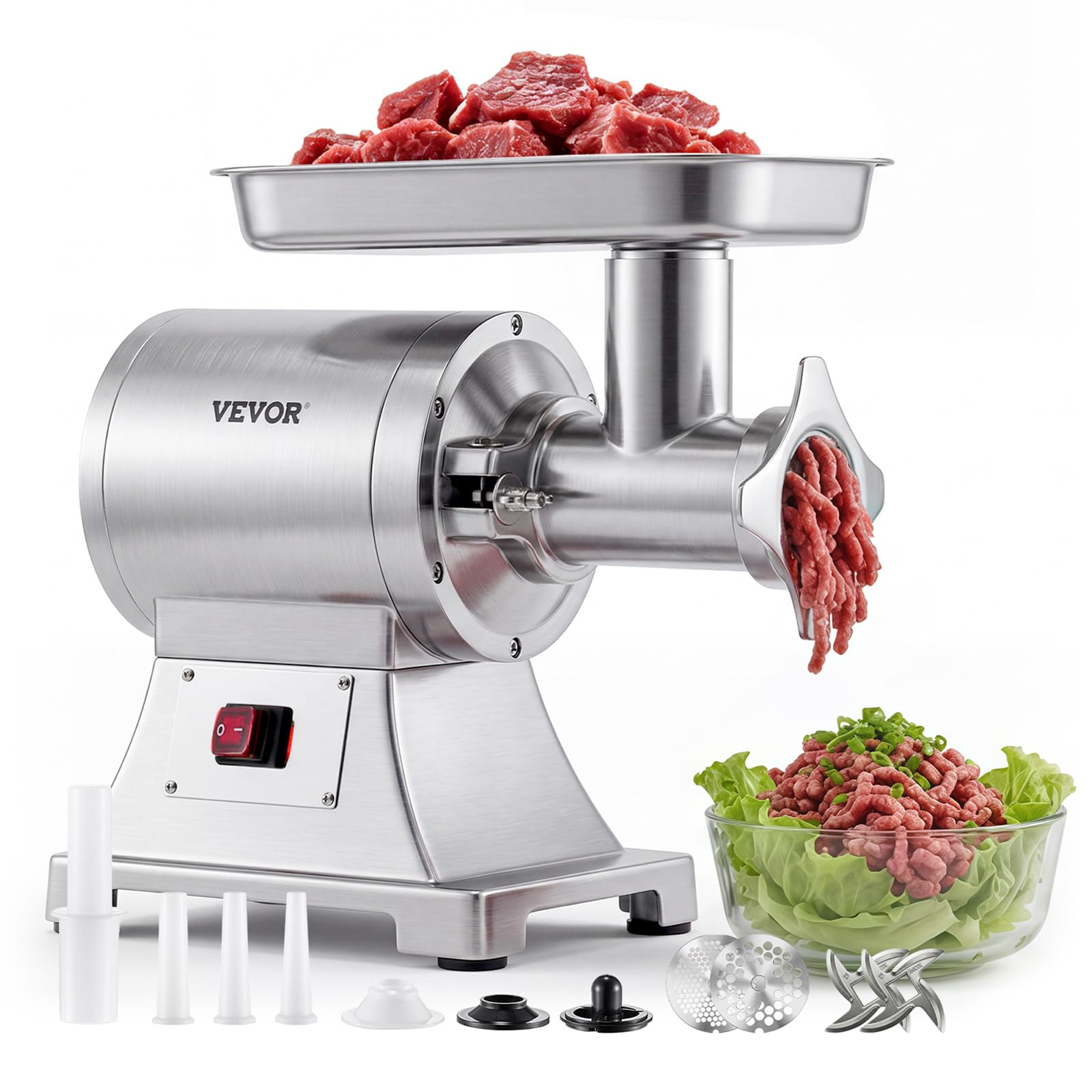
VEVOR #12 Meat Grinder
Key Features
- Motor: 750W / 1 HP
- Weight: 36.6 lb
- Throughput: 552 lb/h
- Grinding plates: 2 (6, 8 mm)
- Price: Midrange
Five hundred and fifty-two pounds an hour. VEVOR’s #12 is a commercial-pattern grinder with a 750-watt motor, and the number isn’t marketing arithmetic — this is a machine built to finish a whole deer in one sitting rather than a few pounds of chuck before dinner.
It’s also 36.6 pounds, 15.75 inches long, and put together like shop equipment: ETL listed, cold-air cooled so it doesn’t cook itself during a long run, and sat on anti-vibration pads that keep it planted while you feed it. Nothing about it feels like a kitchen gadget.
Then you clean it. The pan, blades, plates, and tubes are dishwasher-safe, but the grinding head doesn’t come off the body without a wrench, so the last stretch of the auger gets washed in place, at the sink, with the machine tilted. Keep a dedicated wrench in the drawer and it’s manageable; expect cleanup to take longer than it does on a LEM.
For three pounds of chuck on a Sunday, this is far too much machine. For two deer a season, or a quarter of beef split with family, it’s the most throughput for the money in this group — provided you have a utility sink and a shelf that can take the weight.
Pros
- Grinds 552 lb an hour
- Cold-air cooling for long sessions
- Dishwasher-safe pan, plates, and blades
Cons
- Head needs tools to remove for cleaning
- Bearings have failed in some units
For whole-animal processing it’s the most machine for the money here, as long as a wrench and a utility sink aren’t dealbreakers.
Best for First-Time Buyers
Aiheal Electric Meat Grinder

Key Features
- Blades: 2 stainless
- Rated power: 300W (3,200W peak)
- Sausage tubes: 3
- Grinding plates: 3 (2, 5, 7 mm)
- Price: Budget
Three stuffer tubes bundled with a 300-watt grinder is the whole pitch. The Aiheal arrives ready to make sausage rather than merely grind, which is more than most budget machines manage — usually you’re buying the tubes separately and discovering they don’t fit.
The rest is sensible: three plates at 2, 5, and 7 mm, two stainless blades, a food pusher, and a body that weighs about seven and a half pounds. Set the 3,200-watt peak claim aside — the rated motor is 300 watts, and that’s the number that decides how much meat goes through before the machine wants a rest.
For two pounds of chuck for dinner and a batch of breakfast sausage twice a month, that’s plenty, and the tubes mean you’re not shopping for extras. Push it toward a twenty-five-pound batch and it will tell you: the housing warms up, the feed slows, and it wants a break before you’re finished.
It’s the one we point first-time grinders to. If they keep at it they’ll be back for an LEM, and this one will still earn its shelf space on stuffing day.
Pros
- Three stuffer tubes included
- Three plates and two blades
- Light enough to store in a cabinet
Cons
- Durability is the weak part of its record
A good first grinder: small batches, real sausage attachments, and a price that makes trying the hobby low-risk.
Best for Tight Counters
Sinyder MG-203A

Key Features
- Speeds: 2 + reverse
- Peak power: 2,800W
- Dishwasher safe: No
- Grinding plates: 2 + fan plate
- Price: Budget
A reverse button on a budget grinder is worth more than another few hundred watts on the box. Jams are what end a grinding session early, and the Sinyder’s REV control backs the auger out instead of making you take apart a packed head with meat still in it.
Everything else is sensibly sized: a 2,800-watt peak motor claim with no rated figure published, two speeds, two grinding plates plus a fan plate, two blades, three sausage tubes, and a kubbe kit, all in a body about 12 inches long and light enough for a cabinet shelf. The 3.5-pound capacity puts it in the same class as the Aiheal.
It’s the smallest and simplest machine we’re recommending, and for a household that grinds a few pounds at a time that’s the point. It won’t keep up with a chest freezer, and it doesn’t pretend to — but for sausages and a Sunday meatloaf it’s more machine than the price suggests.
Pros
- Reverse clears jams without disassembly
- Compact and light enough to store
- Sausage tubes and kubbe kit included
Cons
- Every part has to be hand-washed
Small batches, a small counter, and no interest in a 30-pound appliance: that’s this one, and it handles jams better than most budget grinders.
How We Tested the Meat Grinders
We began by comparing motor ratings, included plates and sausage-stuffing attachments, replacement-part availability, and owner reviews, then narrowed the field to 12 models we bought ourselves. Testing ran for seven months in home kitchens, not a lab. The busiest sessions were weekend sausage batches with cold pork shoulder cut into cubes, followed by weeknight rounds of beef for burgers and meatballs. We also pushed fat, sinew, and a few intentionally awkward chunks through each grinder to see what happened.
Performance and power came down to actions: we fed cold meat at a steady pace, noted whether the auger pulled it in or stalled, and recorded when a machine needed the reverse switch or a full disassembly to clear a jam. We ran coarse and fine plates back to back and watched the texture, temperature, and speed of the output. Ease of use got checked at the start and end of every session—how the hopper locked, how the tamper fit, how simple the controls were to read with wet hands. For noise, we took decibel readings during a standard batch and noted whether we had to raise our voices across the kitchen.
Cleaning and durability were the slower tests. After each batch, we disassembled every removable part, washed it by hand, and looked for meat trapped in the auger housing, around the blade, and inside the feed chute. We reassembled each grinder repeatedly to see whether the process stayed intuitive or became a puzzle. Over seven months, we watched for loosening parts, worn gaskets, and motors that ran hotter or slower with repeated use. To judge value, we weighed the purchase price against grinding speed, build feel, and the accessories that came in the box—not just the wattage on the label.
How to Choose a Meat Grinder
The number printed largest on a meat grinder’s box is not the one that decides how well it works; rated motor power and how much of the machine you can get into the sink are.
Read rated watts, not the number on the sticker
The wattage a grinder shouts about is a peak or locked-rotor figure, measured for an instant with the motor straining. The rated number — 300, 350, 500 watts — is what the motor actually sustains while it works. A 3,000-watt headline on a 350-watt machine isn’t a lie, but it tells you nothing about speed or lifespan.
Compare rated power and pounds per minute, and treat a listing that hides the rated figure as a machine you know less about. Our top pick is a 350-watt grinder; the premium LEM does its work on half a horsepower.
Cleaning decides how often it gets used
Every grinder here makes ground beef. What separates them is the half hour afterward: how many pieces come apart, whether the head lifts off, and whether the plates can go in the dishwasher. The VEVOR needs a wrench to separate its grinding head from the body, which turns a rinse into a job.
Before you buy, count the parts and check that the head comes off without tools. That single detail decides whether the machine lives on the counter or in a cupboard.
Grinding and stuffing are two different jobs
A grinder pushes sausage through a tube; a dedicated stuffer does it with a piston and considerably more control. For a few dozen links a year, the compromise is fine, and a slow speed makes it much more pleasant — the three-speed STX is easier to stuff with than a single-speed machine.
If sausage is the main event and you’re filling twenty-five pounds at a time, budget for a separate stuffer and pick your grinder on how well it grinds.
Size the machine to the batch, not the freezer
Three to five pounds a minute is a home machine; seven is a serious one that keeps up with a deer. Weight follows throughput: a 16.5-pound grinder can live in a cabinet, while a 32- or 36-pound one wants a permanent spot with room to feed it.
Be honest about the largest batch you’ll ever run, then buy one size above that. A grinder that overheats halfway through a fifty-pound session has cost you more than the difference in price.
Warranty, listings, and the safety bits
Look for an ETL or equivalent listing, overload protection, and a reverse function. Together those are what stand between a jam and a burned-out motor, and they’re the first things a serious maker mentions.
Warranty length is the clearest signal of how long the manufacturer expects the machine to last: the LEMs carry five and two years, the STX three, and some budget listings never state one. Check that plates and blades are sold as replacements before you commit.
Frequently Asked Questions
Can a meat grinder grind bones?
Only if the manual says so. Most home grinders are explicitly not for bones, and forcing them through dulls the plate and knife and puts a load on the auger it wasn’t designed for. If pet food is the goal, look for a model whose listing names soft poultry bone as a supported use, and expect to replace plates more often.
Should the meat be cold when it goes in?
Cold and firm, not frozen solid. Chilled meat and fat cut cleanly and feed steadily; warm meat smears against the plate and clogs, and rock-hard frozen chunks stall the auger and dull the blade.
The test that works: cube the meat, chill it until it dents under a thumb but still holds its shape, and grind then. If the auger starts to labour, the meat is too cold — give it ten minutes on the counter.
How do I look after the plates and blades?
Treat them as wear items. Rinse and dry them immediately — a wet plate rusts overnight — and give them a thin coat of food-grade oil before storage. Replace the plate and knife together when the grind turns mushy or the blade no longer bites into a thumbnail; a dull set makes the motor work harder than a tough cut does.
Final Verdict
The CHEFFANO is the grinder we recommend for a normal kitchen: certified, quick to strip and wash, and inexpensive enough that trying the hobby carries no real risk. Step up to the LEM BigBite if you process game or a quarter of beef — the five-year warranty and seven pounds a minute are the difference between a hobby and a chore.
And if sausage matters more than burgers, the STX Turboforce 3000 earns its counter space on the foot pedal alone.