This post contains affiliate links. We may earn a small commission when you buy through our links — at no extra cost to you.
Pasta night tends to go wrong at the exact moment you tip four quarts of boiling water and noodles into a colander wedged against the sink. The water you wanted for the sauce goes down the drain, the steam fogs the kitchen, and you’re left with a crusted pot, a strainer, and a serving bowl to scrub. A pasta pot fixes most of that in one move: the noodles lift out in a perforated insert while the starchy water stays behind, so dinner comes out of one vessel instead of three.
Size is the part people underestimate, since a pot that’s too narrow makes long strands clump and one that’s too wide sulks for ages before the water comes back to a boil. Then there are the details that only show up after a few dinners — the insert’s little hook, whether the lid still seats flat, and whether the handles are still grabbable bare-handed after ten minutes at a rolling boil. We’ve cooked in 11 pasta pots over the past eight months, from thin stainless to heavy clad, and the spread between the best and the rest is wider than you’d think. The picks below are the ones that made dinner calmer rather than more theatrical.



Best for Everyday Pasta
Tramontina Gourmet 6-Quart Pasta Pot
Key Features
- Base: Tri-ply base
- Capacity: 6 quarts
- Draining: Lock-and-drain glass lid
- Oven safe: 500°F/260°C
- Price: Midrange
The lid is what earns this pot its cabinet space: glass with a ring of straining holes worked into the rim, locked with a turn, so you tip the pot over the sink and the water leaves while the pasta stays behind. Six quarts is the size most of us actually reach for on a weeknight — a pound of rigatoni with room to move, and enough headroom that the water doesn’t climb the walls the moment it boils. That combination is why this is our top pick: it takes the colander out of the process without turning into a single-purpose gadget.
Under the pasta, the base is tri-ply, an aluminum core bonded between layers of 18/10 stainless, and it behaves like real cookware rather than a boiling vessel and nothing more. We cooked tomatoes down in it for the better part of an hour without scorching the bottom, and the same even heat keeps a rolling boil rolling instead of surging in one spot. It’s rated for induction and for the oven to 500°F/260°C, so a sauce can start on the burner and finish in the oven, and the riveted handles are broad enough to grip through a folded towel.
The details hold up in use. The mouth is wide enough to get a wooden spoon around the bottom, the glass lets you watch without lifting the lid, the rim is tapered so pours don’t run down the outside, and metal utensils are fine against the steel — a small thing until you’ve ruined a nonstick pot with a pair of tongs. It’s dishwasher safe, and it makes a genuinely good stockpot and chili pot, which is how a pasta pot avoids living at the back of the cabinet.
What settles it for us is the lifetime warranty. On a midrange stainless pot, that’s a statement about how long the maker expects it to last, and it’s uncommon at this size. It also stores the way a six-quart pot should: a nine-inch body, nine inches tall, sliding into the slot a 12-quart set can’t use.
Pros
- Lock-and-drain lid replaces the colander
- Tri-ply base handles sauce, stock, and boils
- Induction compatible, oven safe to 500°F/260°C
- Lifetime warranty on a midrange pot
Cons
- Six quarts falls short for two-pound batches
Our pick for most kitchens: six quarts, a lock-and-drain lid that replaces the colander, and a tri-ply base good enough for sauce.
Best for Crowds and Canning
Cuisinart Chef’s Classic 12-Quart Set
Key Features
- Base: Aluminum encapsulated base
- Capacity: 12 quarts
- Included: Stockpot, pasta insert, steamer insert, lid
- Warranty: Limited lifetime
- Price: Premium
Twelve quarts announces itself the moment it hits the burner: it spans most of a large grate and stands about eleven inches tall before the lid goes on. That’s exactly right for a lobster boil, a double batch of Sunday sauce, a turkey carcass going into broth, or a season of tomatoes headed for jars. It is exactly wrong for a pound of spaghetti on a Tuesday.
For the kitchen that needs it, this is the best big-batch set here. The pasta insert is deep enough that a full batch sits properly under the water instead of steaming above it, and the steamer insert turns the same pot into a clam or vegetable steamer without another piece of equipment. The encapsulated aluminum base spreads heat across a wide floor so a simmer doesn’t concentrate in the middle, and the tapered rim pours cleanly when you’re decanting stock. Riveted handles plus a helper handle make a full pot a two-person carry rather than a dare, and the limited lifetime warranty covers a set built to take it.
The cost is footprint, not capability. At roughly eleven inches tall before the lid, it needs a cabinet with real height, and it’s wide enough that a fridge shelf is a genuine question — this is the set that ends up living on the stove because it doesn’t fit anywhere else. Measure the interior of your cabinet before you order. If pasta night usually means four servings, that’s a lot of real estate tied up in a pot you’ll use a few times a year.
Pros
- Deep insert submerges a full batch
- Steamer insert adds a second job
- Encapsulated base heats a wide floor
- Limited lifetime warranty
Cons
- Heavy at 11.2 pounds before water
- Steamer insert is shallow for the pot
Buy it when you cook in double batches, boil lobster, or put up tomatoes; for a pound of spaghetti it’s far more pot than you need.
Best for Saucy Pasta
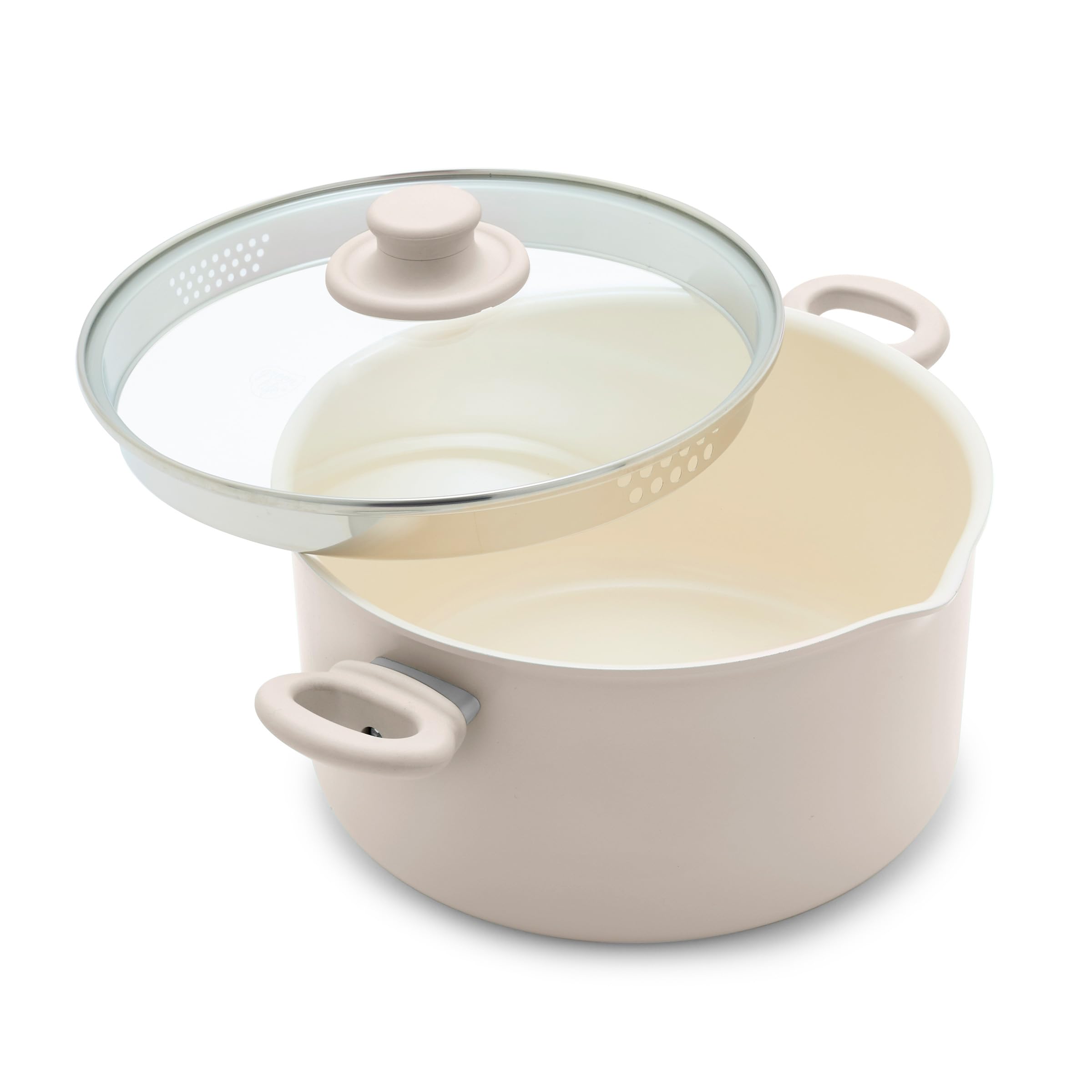
GreenLife 6-Quart Ceramic Stockpot
Key Features
- Coating: Ceramic nonstick, PFAS-free
- Capacity: 6 quarts
- Draining: Glass straining lid
- Oven safe: 350°F
- Price: Midrange
The case for this pot starts after the water is gone. Starchy pasta, a thick ragù, a cheese sauce that would weld itself to stainless — on the ceramic surface they slide off, and a wet cloth finishes the cleanup. The glass lid strains, so you aren’t fishing a colander out of the sink either. For a certain kind of weeknight cooking, that’s the whole argument in one pot.
It’s a six-quart pot, though the shape is generous at the rim and less so in use: a gallon of liquid takes it close to the top, so plan on a pound of pasta rather than two and leave room for the boil. Heat spreads evenly across the base, the handles stay comfortable on the stovetop, and it’s dishwasher safe, which matters more with a coating than with bare steel. The lid is glass with strainer holes, so you can watch the pasta and drain it without a second vessel.
Where we part company with the marketing is longevity. Ceramic is a wear surface: it releases beautifully while it’s intact, and the coating, not the steel underneath, is what will decide how long this pot stays in your kitchen. That isn’t a reason to avoid it — it’s the reason the pot costs what it does, and it’s a fair trade if you want sauce cleanup to take thirty seconds instead of ten minutes of soaking. Buy it for the release, and buy stainless when you want a pot that outlives the kitchen.
Pros
- Ceramic release for starchy, saucy pasta
- Straining lid skips the colander
- Wipes clean and dishwasher safe
Cons
- Oven safe to only 350°F
For pasta finished in its sauce and a cleanup measured in seconds, this ceramic pot delivers; just don’t expect the coating to outlast stainless.
Best for One or Two
Rorence 3.7-Quart Stock Pot
Key Features
- Handles: Silicone-wrapped, stay cool
- Capacity: 3.7 quarts
- Draining: Lid strainer and pour spouts
- Material: 18/8 stainless steel
- Price: Midrange
Not everyone wants a pot that takes two hands and a plan. At 3.7 quarts, this one holds a generous batch for two, a pot of soup with leftovers, or enough potatoes for a side dish, and it’s light enough that lifting it off the stove isn’t an event. The details are unusually thoughtful for the size: measurement marks stamped inside the wall, pour spouts on both sides so the pot works left- or right-handed, and a glass lid with straining holes punched through it. The stainless handles are wrapped in silicone and stay cool enough to grab barehanded.
We rate this the best small pot here, and the draining is why: the pour spouts and the lid strainer line up so you can tip the pot toward the sink without a colander, without a potholder slipping, and without decanting into a second vessel. Against the six-quart pots it’s the one that suits a household of one or two, and the one to look at if a full stockpot has quietly become something you avoid lifting. The measurement marks are the detail we appreciated most — fill to a line and you know your water without a measuring cup.
Pros
- Two pour spouts for either hand
- Light enough to lift one-handed
- Silicone-wrapped handles stay cool
Cons
- Lid and strainer section feel thin
The best small pot here for one or two people: 3.7 quarts, two pour spouts, and a straining lid you can work one-handed.
Best for Induction and Oven
Cooks Standard 12-Quart Pasta Pot Set

Key Features
- Capacity: 12 quarts
- Included: Stockpot, pasta insert, steamer insert, lid
- Material: 18/10 stainless steel
- Stovetops: Induction compatible
- Price: Premium
The other 12-quart set here costs less; this one is a couple of pounds lighter and comes with a stainless lid instead of glass. Those are the headline differences between two pots that do the same job, and they matter more than they sound when the pot is full and you’re the one carrying it to the sink.
What you get is a 12-quart stockpot, a deep pasta insert, a vegetable steamer insert, and that metal lid, all in mirror-polished 18/10 stainless with an aluminum disc bonded into the base. The disc spreads heat across the floor of the pot, the insert lifts out with a full batch of spaghetti so the water stays behind, and the steamer insert handles clams, corn, and broccoli. Cooks Standard states induction compatibility and oven use, which not every set at this size bothers to claim, and the lid can go into the oven with the pot.
Our hesitation is positional rather than practical. The finish, the rivets, and the weight of the thing feel like more pot than the price suggests, and if the pot has to work on an induction range or go into the oven, this is the one to choose. But the Cuisinart does the same job for less, and for most big-batch cooks that’s the deciding vote. Where this one wins is handling: nine pounds empty is easier to maneuver than eleven, and a metal lid has nothing to shatter.
Pros
- Lighter than the other 12-quart set
- Metal lid won’t shatter
- Stated induction and oven use
- Pasta and steamer inserts included
Cons
- Close to 15 inches tall with the lid on
A well-finished 12-quart set with a metal lid and stated induction and oven use, though the other big set here costs less for the same job.
Best for One-Pan Pasta
Sensarte 4.5-Quart Ceramic Stock Pot

Key Features
- Base: 4.8mm stainless steel base
- Coating: Ceramic nonstick, PFAS-free
- Capacity: 4.5 quarts
- Stovetops: Induction compatible
- Price: Budget
There’s no strainer anywhere on this pot — no holes in the lid, no insert, no pour spout — and it still earns a place, because draining isn’t what every pasta night needs. What it does well is the one-pan version: a wide, shallow 4.5-quart pot with a ceramic surface that lets you build a sauce, add pasta and a measured amount of water, and finish the whole thing without a colander entering the picture. On that job it’s the best pot here, and it’s the least expensive one in this group.
The build is a die-cast aluminum body on a 4.8mm stainless base, which is what makes it induction compatible and quick to heat, and at 2.34 kg it moves around the stove without a fight. The shallow shape is the point — a wide surface for reducing a sauce, low walls for getting a spoon into the corners — and the ceramic release means a starch-heavy sauce doesn’t cement itself to the bottom. Think of it as a complement to a boiling pot rather than a replacement: you’ll still want something with a strainer for a big batch of spaghetti.
Pros
- Ceramic surface releases sauce easily
- Wide shallow shape suits one-pan pasta
- Induction-compatible base
- Least expensive pot here
Cons
- Hand wash recommended over dishwasher
- Handles can get too hot to grab
For one-pan pasta and sauce it’s the best pot here, and the least expensive; just don’t buy it expecting it to drain.
How We Tested 11 Pasta Pots Over Eight Months
The shortlist started as research: pasta pots from the brands that keep coming up in kitchen reviews, filtered by capacity, insert style, material, and price. Eleven made the cut — a mix of inexpensive stainless, heavy clad, and enameled steel — and each one went into a working kitchen for eight months of real dinners.
Every pot got the same opening test: filled to its maximum line, brought to a rolling boil on the same burner, and held there for ten minutes. I took surface readings on each handle with an instant-read thermometer, then did the thing that actually matters and tried to lift the pot bare-handed. Size got its own round of cooking — a full pound of spaghetti to see whether strands clumped or cooked evenly, then two pounds of rigatoni to check whether the insert came out cleanly under a genuinely heavy load.
We used them off-label too: simmering stock, reheating chili, steaming broccoli in the insert, mixing meatball filling, because a pot this big has to earn its cabinet space. We also kept a running note on what each one cost against what it actually did, since spending more did not reliably buy a better boil.
After dinner came the unglamorous half: rinsing starch off the walls, checking whether water pooled in the rivets, and running each pot through the dishwasher when the maker allowed it. Over the months we watched for warped bases, insert handles that loosened, hooks that stopped gripping the rim, chipped enamel, and lids that quit seating flat.
How to Choose a Pasta Pot
The right pasta pot is the one you can fill, boil, drain, and wash without a second thought, so start with how much you cook and how the water gets out.
Capacity: the batch, the lift, and the shelf
Start with the batch you actually cook. A 6-quart pot sits at the center of this category because it takes a family-sized batch with room to spare; step up to 8 or 12 quarts only if you regularly cook two pounds or more, boil lobster, steam clams, or put up tomatoes. A 12-quart set is glorious twice a year and a storage problem the rest of it. Households of one or two should look at 3.5 to 4.5 quarts, which handles a half-pound batch and drains without a struggle.
Then check the lift and the shelf. Water weighs about eight pounds a gallon, so a brimming 12-quart pot holds 25 pounds of water before the pasta goes in, and you are carrying it to the sink. Measure your cabinet’s interior height as well: compact in a listing usually describes capacity, not footprint, and the tallest pot here stands close to fifteen inches with the lid on.
How the water leaves
Three designs do the same job differently. A locking strainer lid turns the pot itself into the colander: lock, tip, pour, one vessel and one wash. A lift-out insert or basket suits big batches better, because you lift the pasta out and leave the water behind, and the pot stays free for a second job. Pour spouts paired with holes in the lid rim are the simplest version and the easiest to live with on a small pot.
The trap is hole size. A lid drilled for spaghetti is not a colander: orzo, rice, small shells, and the last of the broken strands go straight down the drain. If you cook small shapes, buy the insert. Whatever you choose, count the parts you will wash — an insert is one more thing to scrub, and a locking lid is one fewer.
Stainless or ceramic nonstick
Stainless is the right default for a pot whose main job is boiling and draining. It takes metal utensils, it doesn’t care how hot the oven gets, and there is no coating to wear out — the Tramontina and both big sets here are stainless for exactly that reason. Ceramic nonstick earns its place at a different job: pasta finished in its sauce, where starch and cheese would otherwise cement to the bottom and soak for ten minutes.
Be clear-eyed about what you are buying. A ceramic coating is a wear surface, and the release you love in month one is the first thing to go. Want one pot for a decade of Sunday sauces? Buy stainless and stir. Want the thirty-second cleanup? Ceramic is worth the trade, and you should check the oven limit before you plan a baked finish.
Check the base, the oven, and the stove you actually have
Flat, heavy bases heat evenly and stay flat, which matters most on glass-top and induction ranges, where a warped pot rocks and heats in a ring. Induction compatibility has to be stated or verified: the base needs magnetic steel, and a fridge magnet stuck to the bottom answers the question in a second. Some pots here state induction compatibility and some don’t, and silence is not proof either way.
Oven limits vary more than shoppers expect — 350°F on the GreenLife, 500°F/260°C on the Tramontina — and a lid often has a lower limit than the pot it came with. If you plan to finish dishes in the oven, check the number on both, and confirm the lid can go in with the pot.
Frequently Asked Questions
How do I stop a big pot of pasta from boiling over?
Fill no more than two-thirds full, stir for the first minute so the strands don’t clump and trap steam, and drop the heat to a steady simmer once the water comes back to the boil — a hard, lid-on boil is what pushes starchy foam over the rim.
If your pot has an insert, keep the water line below the insert’s rim. The narrow channel between insert and pot wall is where water climbs first.
Is a pasta pot just a stockpot with a strainer?
Nearly. A 12-quart pasta set with the inserts taken out is a stockpot, which is why those sets handle broth, lobster, and chili as happily as spaghetti. What you pay extra for is the draining hardware: a lid with holes, a lift-out basket, or an insert.
If you already own a big stockpot and a colander you don’t mind washing, you have most of the function. The upgrade buys one less vessel to wash, not better boiling.
How much water goes in a pasta pot?
Roughly four quarts of water per pound of dry pasta, deep enough that the strands can move without packing together. In a 6-quart pot that means a pound is comfortable and two is a stretch.
Salt once it boils rather than before, and skip the oil — it coats the pasta and makes the sauce slide off.
Final Verdict
The Tramontina 6-quart is the pasta pot we recommend first. Six quarts covers a family batch, the lock-and-drain lid takes the colander out of the process entirely, and the tri-ply base means it sears, simmers, and makes stock — one pot doing two jobs, which is what earns cabinet space.
Cook in double batches and the Cuisinart 12-quart is the better buy; cook for one or two and the Rorence is easier to live with. Choose ceramic only if sauce cleanup is the thing that tips you.