This post contains affiliate links. We may earn a small commission when you buy through our links — at no extra cost to you.
Getting a full glass of juice from a bunch of kale often means fighting with clogs and re-running produce. The right masticating juicer sidesteps that entirely by prioritizing slow RPM over raw power.
The trade-off in this category isn’t between cheap and expensive—it’s between hands-free automation and hands-on value. A self-feeding model saves prep time but costs three times as much. For most households, a simpler machine with a wide chute and dishwasher-safe parts delivers more consistent results.
The juicers that handle leafy greens best combine a narrow motor speed (around 60 RPM) with a feed chute wide enough to accept whole leaves. That combination minimizes oxidation and keeps the pulp dry, which means more juice per bunch.




Best for High-Yield Leafy Greens
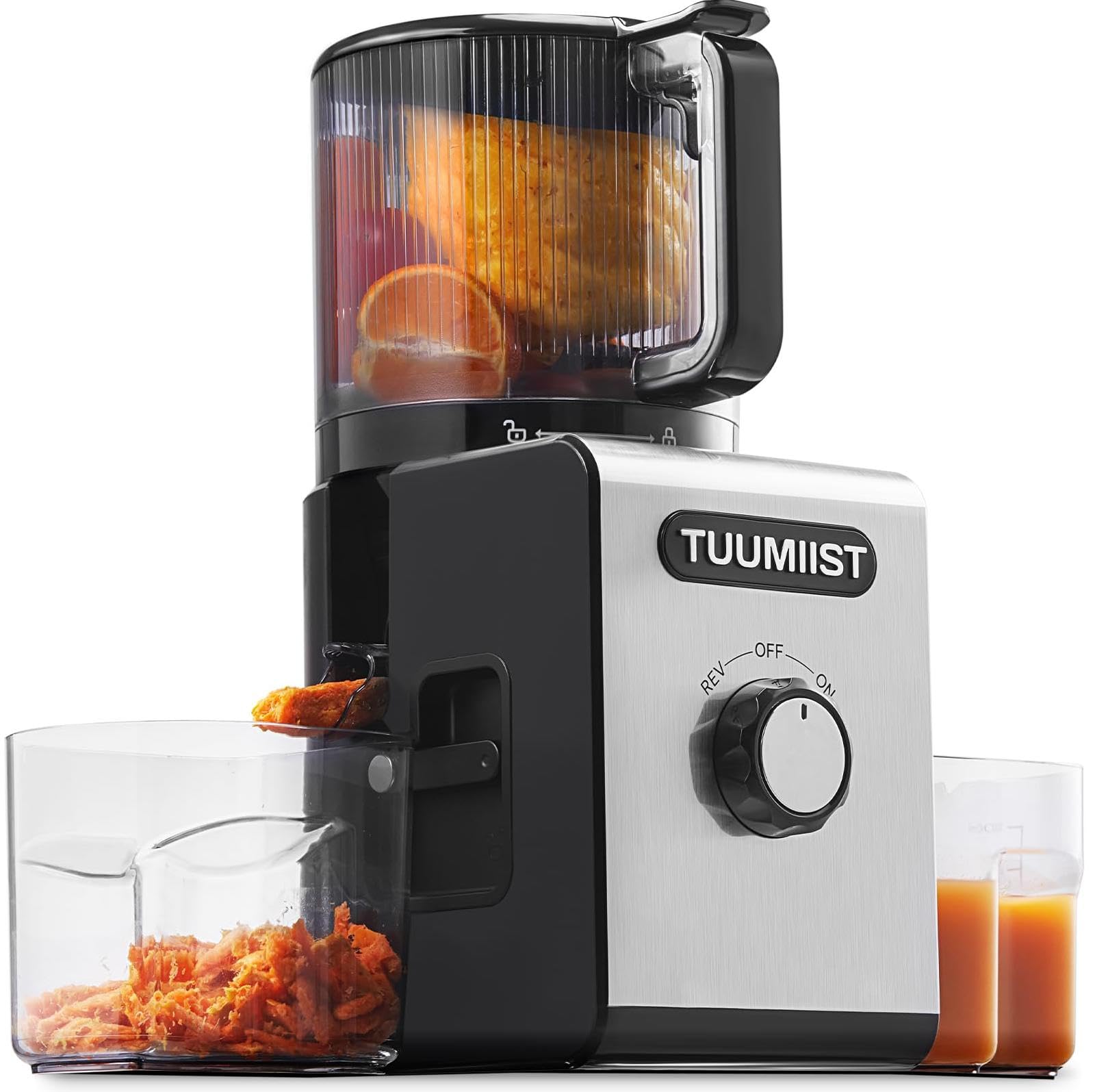
TUUMIIST TM780SJ
Key Features
- Motor Power: 350W
- RPM: 60
- Feed Chute: 6.5 in
- Cleaning: Dishwasher safe
- Price: $$
The wide 6.5-inch feed chute on this masticating juicer accepts whole apples, celery stalks, and large handfuls of leafy greens without precutting – a time-saver that directly addresses the buyer’s need for efficient fiber-heavy juicing. The 60 RPM slow-squeeze mechanism minimizes heat buildup and oxidation, preserving nutrients and flavor in the juice.
Juice yield is consistently high, even from fibrous greens like kale, spinach, and wheatgrass – the auger design extracts moisture well, leaving pulp noticeably dry. The twin-stage process handles soft and hard produce without clogging, which is a common concern with other slow juicers in this price range.
Assembly and disassembly are intuitive, and the strainer, auger, and hopper are all dishwasher-safe – a genuine convenience that reduces cleanup friction. The motor is quiet enough to use during early mornings without waking others, a feature appreciated by households where juicing is a daily habit.
This juicer is best suited for value-conscious buyers who prioritize juice quality and capacity over hands-free automation. Families processing large batches will appreciate the 100 oz hopper and the ability to juice continuously without frequent emptying. The only minor quibble: the cup lock can feel stiff out of the box, which eases after a few uses or with a light lubricant.
Build quality is solid for the mid-range price – the housing and components feel durable enough for regular use. When compared to premium models like the Nama J2, the TM780SJ lacks self-feeding but matches or exceeds juice yield at a significantly lower cost, reinforcing its position as the best value for leafy green juicing.
Pros
- Delivers consistently high juice yield from leafy greens and fibrous vegetables.
- Quick and simple assembly and cleanup, with dishwasher-safe parts.
- Runs quietly enough for early-morning juicing without disturbing others.
- Solid build quality at a mid-range price point.
- Offers strong value for money compared to other slow juicers with similar features.
Cons
- Cup lock can feel stiff when first used, requiring slight force to close.
For anyone who juices leafy greens regularly and wants solid performance without the premium price, the TM780SJ is the sensible choice.
Best for Hands-Free Premium
Nama J2
Key Features
- Motor Power: 200W
- RPM: 50
- Feed Chute: Self-feeding
- Cleaning: Hand wash only
- Price: $$$
The Nama J2 stands apart from the best-value TUUMIIST TM780SJ by offering a self-feeding hopper that accepts whole produce, eliminating the need to pre-cut most fruits and vegetables. Its 200W motor runs at 50 RPM, producing minimal noise — quiet enough to hold a conversation nearby. The cold-press auger achieves notably high juice yield, especially from fibrous greens like kale and celery, with low oxidation for a fresher taste.
Serious juicing enthusiasts who juice multiple times a week will appreciate the hands-free workflow and exceptional juice quality. The 30-ounce juice capacity suits individual or small-batch sessions, and the intuitive assembly lets you start juicing within minutes of unboxing. However, the 12.1-pound weight and large footprint demand dedicated counter space, and the premium pricing places it above casual buyers’ budgets. Those willing to invest in a long-term appliance for quiet, efficient juicing will find the tradeoff reasonable.
Pros
- Self-feeding hopper processes whole produce with no pre-chopping needed.
- Very quiet operation, suitable for early-morning or shared spaces.
- Easy to clean by hand despite hand-wash requirement, with smooth surfaces.
- Solid build quality and durable components support daily heavy use.
Cons
- Premium price may exceed the budget of cost-conscious buyers.
- Chamber can wobble slightly when processing hard or dense produce like beets.
For those who prioritize hands-free convenience, quietness, and juice yield over upfront cost, and who have the counter space to accommodate a heavier machine, the Nama J2 is a long-lasting investment.
Best for Easy Cleanup Beginner
Ninja JC151
Key Features
- Motor Power: 150W
- Feed Chute: Small (not specified)
- Cleaning: Dishwasher safe
- Price: $$
The Ninja JC151 makes cleanup simple with dishwasher-safe parts and two interchangeable pulp filters – a rare combination in this price range. While it doesn’t match the juice yield of the top pick for fibrous greens, its reliable build and straightforward assembly make it a strong entry-level choice.
This juicer suits daily juicers who prioritize easy cleanup over maximum extraction from leafy greens. The motor sound will be noticeable in quiet kitchens – those sensitive to noise may prefer a quieter unit. Occasional clogging with fibrous greens like kale or wheatgrass has been noted, though the NeverClog claim holds up for most fruits and softer vegetables.
Pros
- Cleanup takes minutes – all parts are dishwasher-safe.
- Simple to assemble and operate, even for first-time juicer users.
- Produces good juice yield from most produce at a mid-range price.
Cons
- In a quiet home, the motor hum and occasional squeak may be distracting – less of an issue in a busy kitchen.
- When processing large batches of fibrous greens, the pulp filter may need occasional clearing mid-session.
The Ninja JC151 is right for anyone who values time on cleanup over marginal juice yield from greens. For dedicated green juicing, the top pick extracts more and runs quieter.
Best for Durable Long-Term
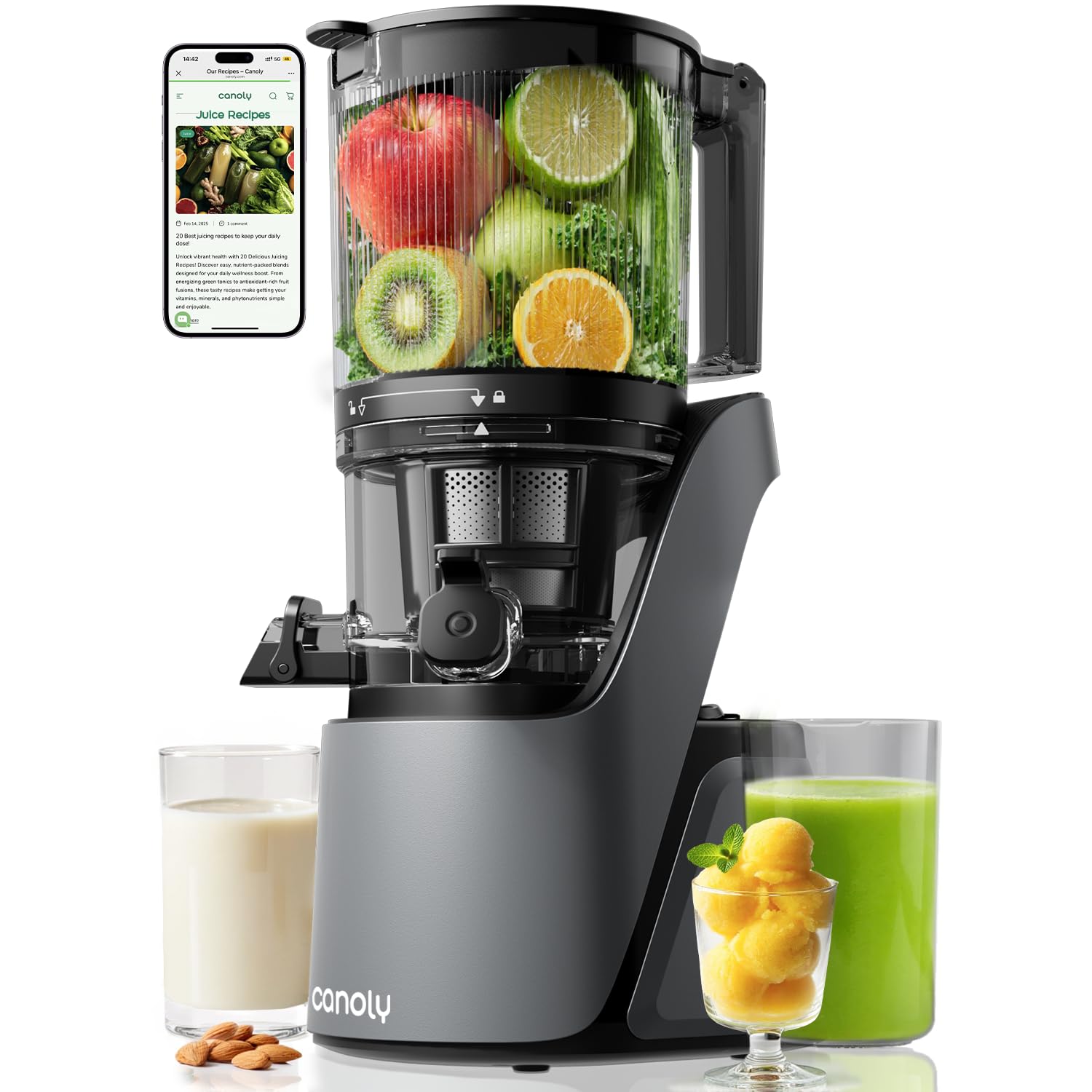
Canoly C16
Key Features
- Motor Power: 250W AC brushless
- RPM: 45
- Feed Chute: 6 in
- Price: $$$
A 250W AC brushless motor and 45 RPM operation produce juice with notably dry pulp, while the 6-inch feed chute handles whole apples and large celery stalks without pre-cutting. The motor runs quietly, and the parts rinse clean under running water with minimal effort.
This build quality is backed by a 15-year motor warranty — the longest in its price tier — making it a strong candidate for families or daily juicers who want a single machine for years. However, during heavy processing of dense produce, some units may vibrate or wobble; placing the juicer on a stable, non-slip surface mitigates this. Budget shoppers will find better value elsewhere, as the Canoly sits at a mid-premium price point.
Pros
- Sturdy construction with a 15-year motor warranty that signals durability.
- High juice yield leaves pulp noticeably dry, maximizing extraction.
- Parts rinse clean quickly and assembly is straightforward.
- Quieter operation than many similarly priced masticating juicers.
Cons
- During heavy processing of hard vegetables, vibration may be noticeable on lightweight countertops.
For buyers who plan to juice heavily for years and value a warranty that outlasts the competition, the Canoly C16 justifies its mid-premium price with a build that backs it up.
Best for Powerful Hard Veggies
YPONE SJ-057
Key Features
- Motor Power: 400W
- RPM: 55
- Feed Chute: 5.8 in
- Cleaning: Dishwasher safe
- Price: $$
The YPONE’s 400W motor processes carrots, beets, and apples in seconds, producing noticeably dry pulp that signals good extraction. Juice yield is consistent across hard produce, and the 5.8-inch chute handles whole fruits without pre-cutting, speeding up prep. This is the model to reach for when speed and power matter more than gentle handling of leafy greens.
This juicer is best suited for households that prioritize hard vegetables over fibrous greens. Celery stalks and pineapple cores can jam the chute, and some owners have reported the motor stopping after a few months of regular use – so it’s a better match for occasional heavy-vegetable juicing than daily green routines. The PVC construction and dishwasher-safe parts keep cleanup simple, but the clogging risk means you’ll want to cut fibrous items into small pieces before feeding.
Pros
- Fast processing of hard vegetables like carrots and beets
- High juice yield with noticeably dry pulp
- Dishwasher-safe parts make cleaning easy
- Good power for the mid-range price
Cons
- Fibrous greens like celery and kale can clog the chute
- Motor longevity is inconsistent; some units may stop working after months of use
If your juicing centers on hard vegetables and you want a fast, powerful machine, the YPONE delivers – but it’s not the pick for daily green juice routines.
Best for Versatile 3-In-1
Aeitto EasePress
The Aeitto EasePress stands out by combining a cold press juicer with a sorbet maker and nut milk function, all in one filter-free unit. The upgraded quiet motor and straightforward assembly make it easy to use, while the rinse-clean design cuts down on scrubbing. This is a step beyond simple juicers like the budget-friendly alternatives, offering added versatility in a mid-range package.
This model suits tech-savvy users and families who appreciate the convenience of an app for recipes and settings, and who want the ability to make more than just juice. However, the app integration may not appeal to those who prefer a straightforward, no-frills operation. Additionally, since the EasePress is a newer entry, its durability under heavy daily use is not yet known. For occasional juicing and occasional sorbet or nut milk, it should serve well.
The 3-in-1 design does not compromise juice quality; leafy greens and fibrous vegetables yield well with the slow cold-press mechanism. A 6-inch feed chute accepts whole apples and large carrots without precutting, and the filter-free system separates pulp cleanly. The unit is larger than dedicated juicers, so counter space should be considered.
Pros
- Makes juice, sorbet, and nut milk in one appliance
- Filter-free design rinses clean quickly
- Easy to assemble and operate
- Quiet operation with sturdy build
Cons
- App integration adds extra steps for those wanting simple operation
- Long-term durability under heavy daily use is still unconfirmed
If you want a juicer that also produces sorbet and nut milk, and you’re comfortable with an app, the Aeitto EasePress packs useful extras without sacrificing juice quality.
Best for Budget Starter
Aeitto Classic

Key Features
- RPM: 50
- Feed Chute: Fits whole fruits
- Cleaning: Dishwasher safe
- Price: $
The Aeitto Classic delivers solid juice yield from leafy greens and fibrous vegetables at a price that undercuts most competitors. Cleaning is simple with dishwasher-safe parts, and the auto shut-off lid safety adds peace of mind. However, because this model has been reviewed by fewer than 100 users, its ability to hold up under daily heavy use is not yet known. That makes it a strong match for occasional juicers who want to test the cold-press waters without a big investment, but less suitable for anyone planning to juice every day for months on end.
Pros
- Very good performance and build quality for the price
- Easy to clean – dishwasher-safe parts save time
- High juice yield with dry pulp reduces waste
Cons
- Long-term durability under frequent heavy use is not yet established
- Juice-only functionality – no sorbet or nut milk options
Best for occasional, budget-conscious shoppers who want a functional cold-press juicer with easy cleanup and are not relying on it for daily heavy use.
Best for Ultra-Quiet Premium
Hurom H320

Key Features
- Motor Power: 150W
- Feed Chute: Self-feeding
- Cleaning: Hand wash only
- Price: $$$
The H320 delivers whisper-quiet juicing and high juice yield from leafy greens, thanks to its slow masticating mechanism and quality construction. However, the premium cost (more than many mid-range options) and the requirement to hand-wash all parts mean it’s best suited for someone who wants a serene juicing experience and doesn’t mind spending extra. Plastics may show staining from produce like carrots or beets over time, but performance remains consistent.
Pros
- Very quiet operation – near-silent during use.
- High juice extraction from fibrous greens and vegetables.
- Premium build quality and attractive design.
Cons
- High price limits value for casual juicers.
- Hand-wash only parts may be inconvenient for those used to dishwasher-safe juicers.
Choose the H320 if quietness is your top priority and budget is secondary; otherwise, comparable juice yield is available at a lower cost.
Best for Smart Batch King
TUUMIIST TM880SJ
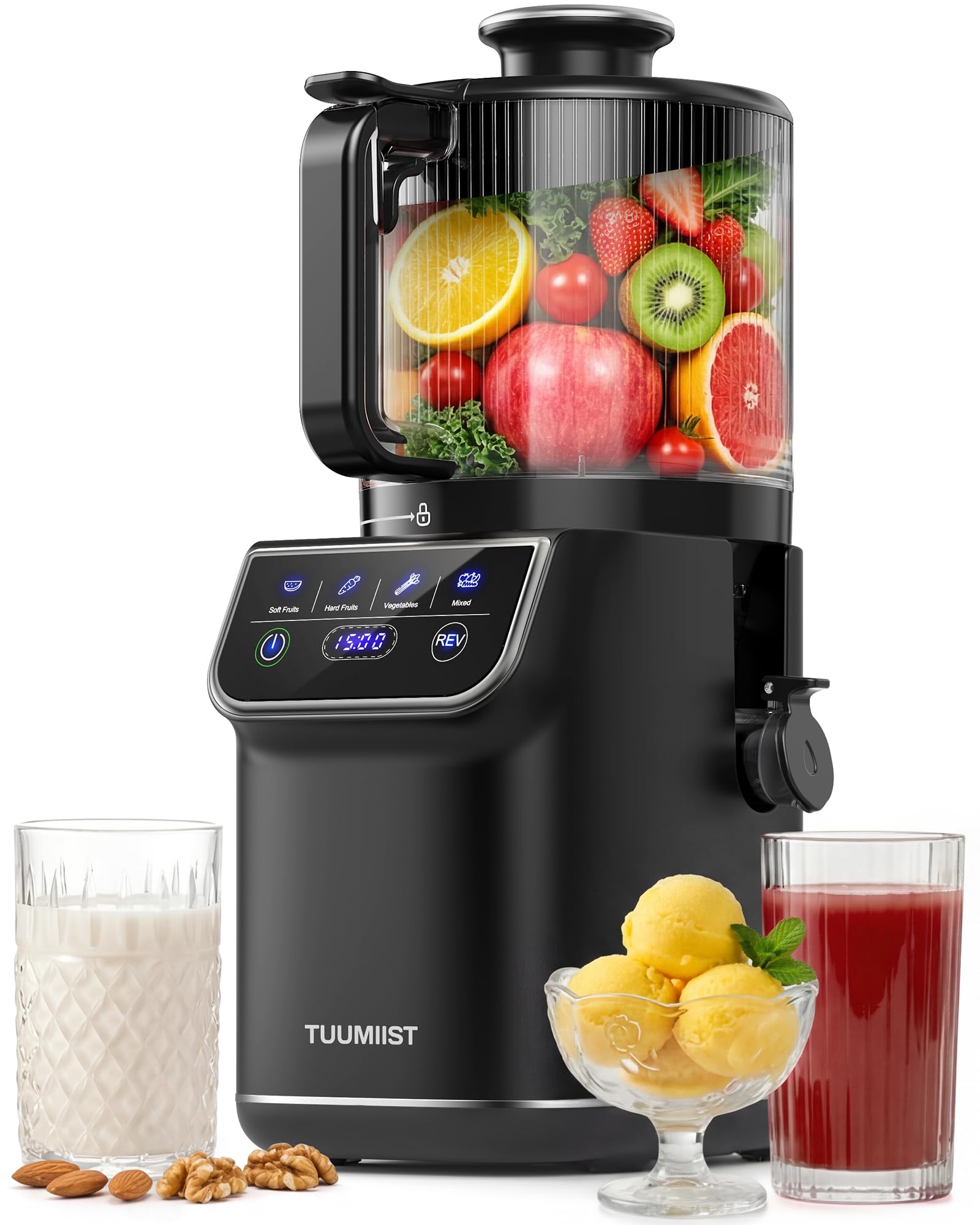
The TUUMIIST TM880SJ brings a touchscreen interface and auto-reverse to masticating juicing, alongside a 100 oz hopper for batch processing. Juice yield is high with dry pulp, and the 3-in-1 function handles sorbet and nut milk. Quiet operation adds to the appeal for daily use. However, the motor can heat up during extended heavy use – a tradeoff for large continuous batches. It costs more than the top-pick TM780SJ, which offers similar juice quality without the smart features.
Pros
- Smart touch interface with auto-reverse simplifies operation and cleanup.
- High juice yield with dry pulp, ideal for leafy greens and fibrous vegetables.
Cons
- Motor can heat up during extended heavy use, limiting continuous batch juicing.
Best for tech-interested households that value the smart touch display and batch capacity over the lower price of the TM780SJ, as long as heavy continuous runs are kept moderate.
How to Choose
The most important factor for leafy greens is slow rotation speed (under 60 RPM) to minimize oxidation and maximize yield.
Motor Power and RPM
Higher wattage doesn’t automatically mean better juice extraction. A 150W motor running at 60 RPM will outperform a 400W motor spinning at 80 RPM for greens because the slower speed reduces heat and oxidation.
A more powerful motor (300W+) can handle dense vegetables like beets and carrots without slowing, but it also generates more noise. For leafy greens, focus on the RPM rating – anything between 45 and 60 is ideal.
Feed Chute Width
A wider chute (6 inches or more) lets you drop in whole leaves or large chunks, cutting prep time significantly. The trade-off is that a larger opening may require a bigger auger and chamber, increasing the machine’s footprint and weight.
Narrow chutes (under 5 inches) demand more cutting, which can be tedious for daily juicing. However, they often produce drier pulp because the produce is fed in smaller pieces, giving the auger more surface area to press.
Hopper Capacity
A larger hopper (90–100 oz) lets you juice an entire batch without stopping to reload – perfect for families. The hidden cost is that a full hopper makes the machine top-heavy, and you may need to cut produce into smaller pieces to prevent jams in the feed tube.
Smaller hoppers (24 oz) are fine for single servings. The advantage is a more compact countertop footprint and easier handling when cleaning.
Ease of Cleaning
Dishwasher-safe parts drastically reduce cleanup time – just rinse and load. The catch is that high heat can warp plastic components over time, so check the manufacturer’s top-rack recommendations.
Hand-wash-only models often have fewer parts and no fine strainers, which means less scrubbing by hand. But they require immediate rinsing to prevent pulp from drying and sticking.
Noise Level
Quiet operation matters if you juice early in the morning or live in a small space. Masticating juicers are inherently quieter than centrificals, but some models (like the Ninja JC151) produce a squeaky or loud hum that can be disruptive.
Premium models with brushless DC motors (e.g., Nama J2, Hurom H320) run near-silently. The trade-off is a higher price – you’re paying for better motor insulation and precision engineering.
FAQ
Why does my masticating juicer keep clogging with celery?
Fibrous greens like celery have long strands that can wrap around the auger. To reduce clogging, cut celery into 2-inch pieces and alternate with softer produce like cucumber. Some juicers with a reverse function can clear jams instantly.
Is a slow juicer worth the extra money for leafy greens?
Slow juicers operate at 45–60 RPM, which minimizes heat buildup and oxidation, preserving more nutrients and producing a greener juice. For regular leafy green juicing, a slow juicer justifies the higher cost over a centrifugal model. At the $100–$200 price point, you get the best value.
How do I clean a masticating juicer without scrubbing?
Look for models with dishwasher-safe parts or a strainer-free design. Rinse immediately after use to prevent pulp from drying. A cleaning brush included with most juicers helps reach small crevices.
What wattage should I look for in a juicer for greens?
For leafy greens, wattage is less important than RPM. A 150W motor running at 60 RPM is more effective than a 400W motor at higher speeds. Focus on slow rotation and a wide feed chute instead.