This post contains affiliate links. We may earn a small commission when you buy through our links — at no extra cost to you.
The trouble with most juicers isn’t the juicing — it’s the scrubbing afterward and the pile of damp pulp that tells you money went in the bin. Cold press models crush and slowly squeeze produce instead of shredding it at speed, so they coax out more liquid and leave the pulp drier. The catch: slow squeezing means more parts to take apart and a feed chute that usually demands some knife work first. What you’re really buying is a machine you won’t resent by Thursday.
I switched off a shrieking centrifugal model years ago and have never missed the noise, though I do miss how fast the old one went back together. Over eight months, my team ran nine juicers through daily breakfast duty, and the gaps in cleanup and yield were wider than any spec sheet admits. Here’s what first-timers underestimate: a wide feed chute matters more than wattage if you want to keep using the thing. The picks below are the ones still earning their counter space.



Best for Daily Hands-Free Juicing
Nama J2 Cold Press Juicer
Key Features
- Motor: 200 W
- Weight: 12.1 lb
- Dimensions: 9"D x 9.8"W x 17.7"H
- Auger speed: 50 RPM
- Price: Premium
The feature that makes the J2 our top pick is the hopper. You fill it once with the whole recipe — apples, carrots, a handful of greens — and walk away while the auger works through it at 50 RPM. That one design decision removes the job that makes people quit juicing: standing at the counter feeding produce in one piece at a time.
What happens downstream holds up. The 200W motor is slow and quiet enough that a 6 a.m. juice doesn’t carry through the house, and the pulp comes out dry enough that you’re not pouring juice you paid for into the bin. Leafy greens go through without the auger stalling or wrapping, which is the test most budget machines in this group fail first.
Cleaning is quick-release: chamber, auger and strainers lift out, and the brush that comes with it handles the mesh. Two things we don’t love. The pitchers and hopper are plastic at a price where you might reasonably expect glass, and the lid has to be unlocked in a set order before it opens — a small ritual you repeat every single time.
Neither has changed our recommendation. If fresh juice is a daily habit or you’re juicing for two, the J2 is the machine that keeps the habit going, and spread over a couple of years of skipped juice-bar cups the outlay looks less dramatic. If you’re not sure the habit will stick, buy the TUUMIIST below and keep the difference.
Pros
- Self-feeding hopper takes a whole recipe
- Very quiet at 50 RPM
- Dry pulp and strong juice yield
- Quick-release parts rinse clean
Cons
- Plastic pitchers and hopper at a premium price
- Lid unlocks only in a set order
For daily juicing, the J2 is the machine we point people to: the self-feeding hopper keeps the habit alive — load a recipe, walk away, come back to clear juice and dry pulp.
Best for Everyday Family Juicing
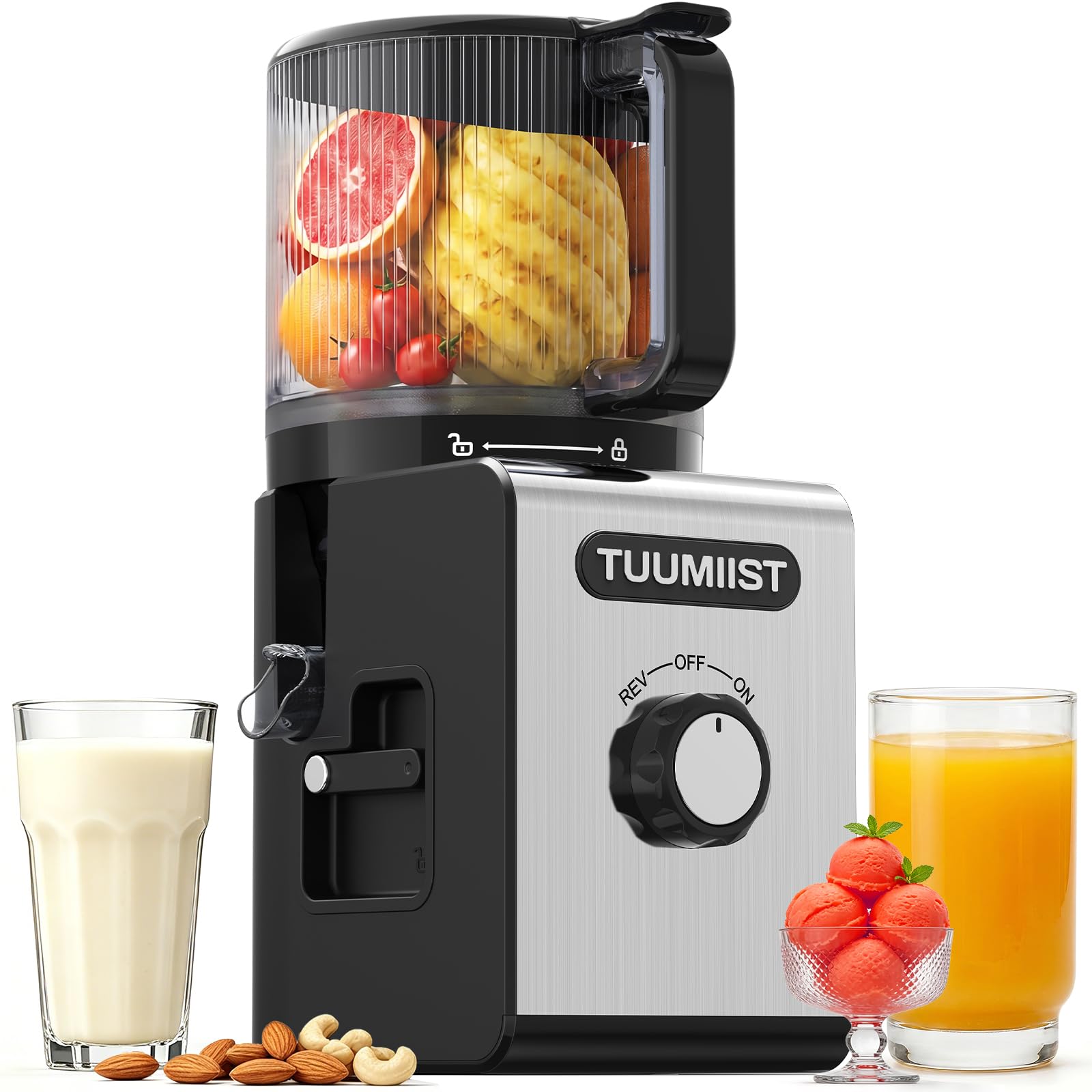
TUUMIIST TM-780SJ
Key Features
- Motor: 350 W
- Speed: 60 RPM
- Hopper: 100 oz
- Feed chute: 6.5 in
- Price: Midrange
The TM-780SJ does the two things that make the Nama worth owning — a wide chute and a hopper big enough for a whole recipe — for a fraction of the money. The 6.5-inch chute swallows whole apples and a trimmed bunch of celery, and the 100-ounce hopper means you’re not standing there dropping in one carrot at a time. At 350W and 60 RPM it doesn’t feel strained.
Where it earns its place, though, is the strainer arrangement. One basket handles juice, nut milk and sorbet with no swapping mid-recipe, and there’s no mesh to scrub because the design doesn’t use any. That’s worth more day to day than an extra hundred watts, and it’s the reason we put this one first for anyone shopping to a budget.
The catch is the small plastic parts. The handle and the latch are what we’d treat gently, and the body is plastic throughout — that’s where the savings show. Set it up once, leave it assembled on the counter, and the fragility matters a lot less than it does for someone who packs it away after every use.
Pros
- 6.5-inch chute takes whole apples
- One strainer for juice, nut milk and sorbet
- No mesh basket to scrub
Cons
- Plastic handle and latch are the weak points
This is where we send value-minded buyers: a wide chute, a full-size hopper and one strainer for juice, nut milk and sorbet, at a fraction of the top pick’s price.
Best for Small Kitchens
Ninja NeverClog JC151
Key Features
- Motor: 150 W
- Cleaning: Dishwasher safe
- Juice jug: 24 fl oz
- Dimensions: 12.11"D x 7.15"W x 15.93"H
- Price: Midrange
The JC151 is the machine that fits. At 7.15 inches wide and just under 16 inches tall, it slides under an upper cabinet in kitchens where a 17-inch juicer would be a permanent obstacle, and it weighs under eight pounds, so lifting it out of a cupboard isn’t a chore. If your counter is also your prep space, that shapes the whole decision.
It’s also the easiest of the group to deal with after the juice is made: the jug, pulp container and auger parts are dishwasher safe, and the two interchangeable pulp filters let you choose between a clear juice and something with body. The 150W motor is the least powerful here and it shows — the feed opening is narrow enough that apples and big carrots get cut down first, hard fruit can set off a squeal, and soft stringy things like mango are where the never-clog promise stops being true.
We still recommend it, because the parts you touch every day — the dishwasher-safe ones, the compact body, the pulp control — are the parts that decide whether a juicer gets used. It’s a starter machine that doesn’t behave like one, as long as you don’t expect it to eat a whole apple.
Pros
- Under 16 inches tall, fits under cabinets
- Dishwasher-safe jug, pulp bin and parts
- Two pulp filters for clear or hearty juice
Cons
- Narrow feed opening forces real pre-cutting
- Squeals when it hits hard fruit
We keep this one for small kitchens: it tucks under a cabinet, its parts go in the dishwasher, and it asks only that you cut your produce down first.
Best for Family Batches
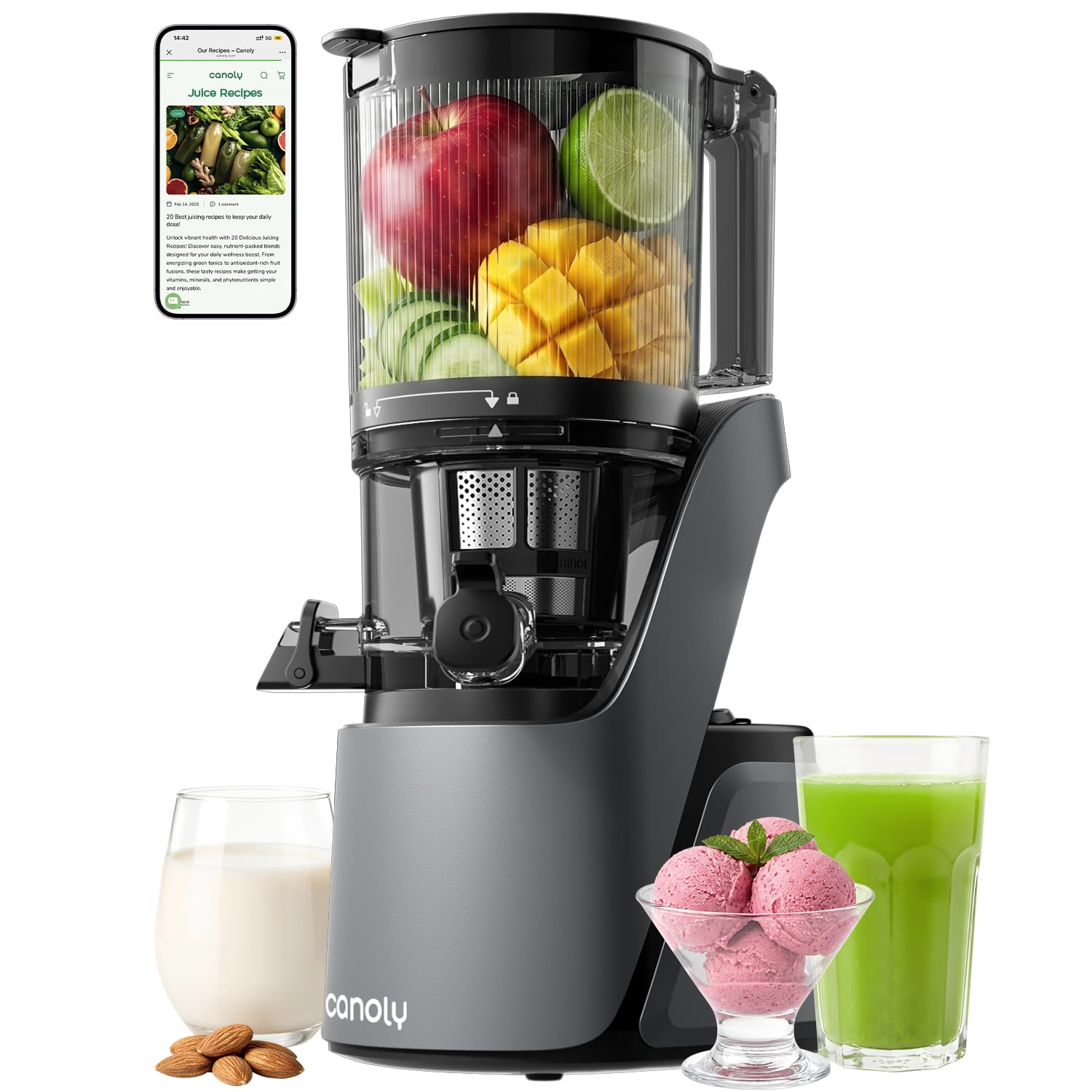
Canoly C16
Key Features
- Motor: 250 W
- Hopper: 90 oz
- Feed chute: 6 in
- Noise rating: 35 dB
- Price: Midrange
Ninety ounces of hopper is a serious amount of produce, and the C16’s 6-inch chute is wide enough that most of it goes in whole. Fill it once and the machine works through a family-sized batch while you rinse the next round of carrots — that’s the version of juicing this machine is built for, and it’s why it stays on the counter in a busy kitchen.
The 250W brushless motor turns the auger at 45 RPM, and Canoly quotes 35 dB. Treat a figure like that as a claim rather than a measurement; what matters is the design behind it, and a brushless motor at that speed is the calm end of this category by construction. Nothing about the C16 sounds like it’s straining.
Three strainers cover juice, sorbet and nut milk, and the detachable pulp outlet is the detail we appreciated most — it opens up so pulp doesn’t pack into a corner you can’t reach. Assembly is straightforward, though the main chamber needs a firm twist to seat, and at 12.6 pounds and 17.3 inches tall it’s a machine you lift carefully rather than tuck away.
What you’re paying for here is capacity and calm rather than cleverness. If you juice for a household and want it done in one load without waking anyone, the C16 makes that easy; if you juice a glass at a time, it’s more hopper than you need and the TUUMIIST above will do the same job for less.
Pros
- 90-ounce hopper takes a family batch
- Brushless 45 RPM motor runs quietly
- Detachable pulp outlet for easier cleaning
Cons
- 12.6 pounds and 17 inches tall
- Chamber takes a firm twist to seat
We like it for families who juice in batches: the 90-ounce hopper and slow brushless motor turn a big pile of produce into juice without a racket.
Best for First Juicer
AMZCHEF ZM-1919
Key Features
- Cleaning: Hand wash recommended
- Max power: 600 W
- Dimensions: 8.9"D x 7.7"W x 13.3"H
- Feed chute: 6.0 in
- Price: Budget
A 6-inch chute with built-in cutting blades, a reversing auger and both a fine and a sorbet filter for the lowest outlay of any full-featured machine here — the ZM-1919 is the value argument in this guide. It’s 13.3 inches tall, short enough to live on a shelf between uses, and narrow enough that it doesn’t colonise the counter.
We like it for the everyday stuff. Carrots, celery, cucumber and apple go through at a steady clip, and the fine filter leaves the juice clean enough that we stopped reaching for a second strainer. The sorbet filter is the bonus that makes it earn its space — frozen banana and berries come out like soft-serve, which is the sort of thing that turns a juicer from an intention into a habit.
Two things to know before you buy. AMZCHEF says hand wash only, so there’s no dishwasher shortcut, and a big apple still wants halving whatever the chute measurement says — the blades inside do some of the work, not all of it. Neither is a dealbreaker at this end of the market; both are part of why it costs less than the machines above it.
Pros
- 6-inch chute with pre-cutting blades
- Two filters cover juice and sorbet
- 13.3 inches tall, stores on a shelf
Cons
- Hand wash only, no dishwasher
- Large apples still need halving
This is where we send budget buyers: a wide chute, two filters and steady juice for the lowest outlay of any full-featured machine in this guide.
Best for Whole-Fruit Feeding
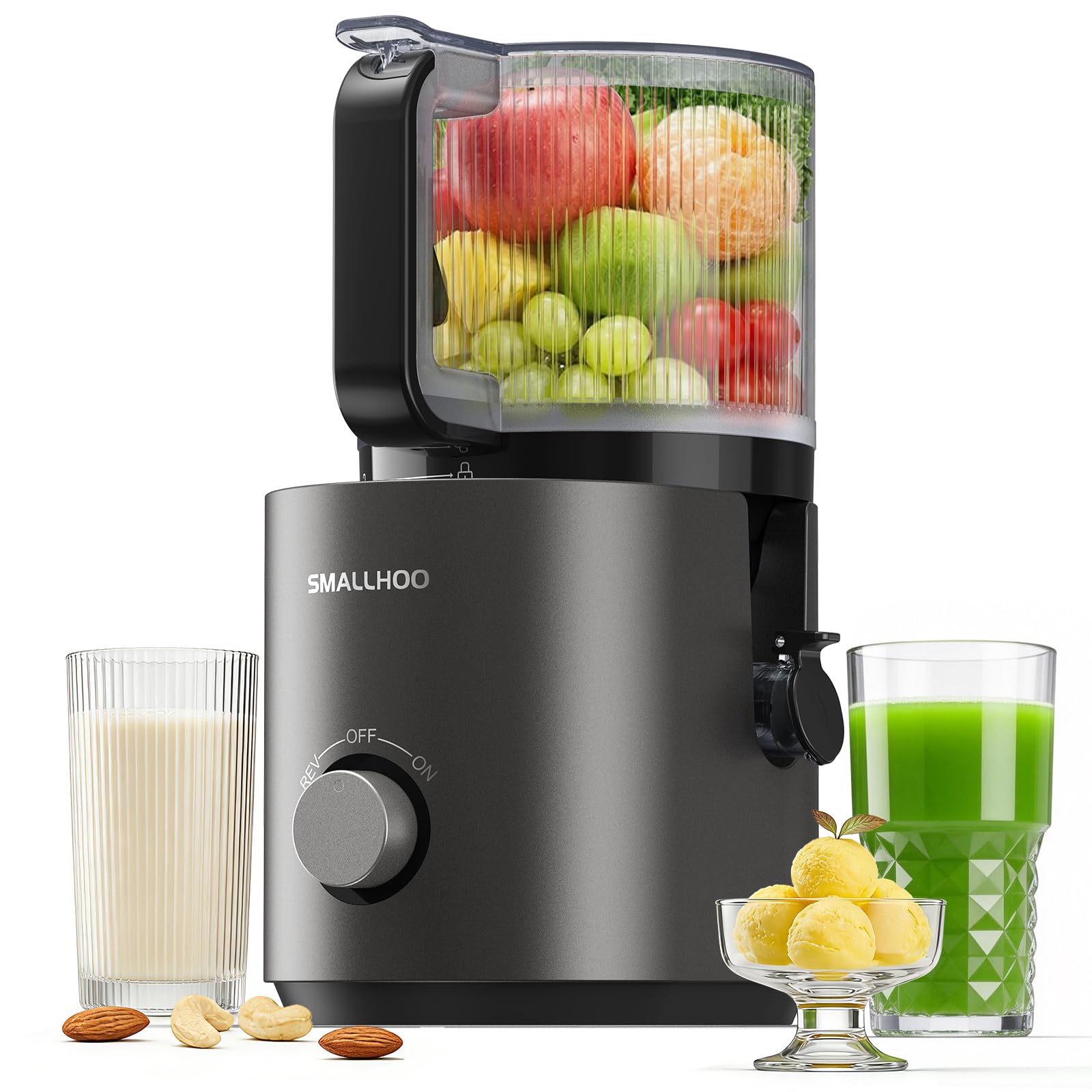
SMALLHOO 1080
Key Features
- Motor: 350 W
- Speed: 60 RPM
- Hopper: 120 oz
- Feed chute: 7 in
- Price: Budget
Seven inches is the widest feed chute in this guide, and paired with a 120-ounce hopper it makes the 1080 the most hands-off machine here after the Nama. Whole apples, oranges and most of a celery bunch go in without a knife, and the hopper holds enough that you’re loading once instead of constantly. For a household that eats a lot of whole fruit, that’s the feature that matters.
At 350W and 60 RPM it handles the core job properly: the pulp comes out dry, the juice is clear, and the reverse switch clears a jam without dismantling anything. We also appreciated the safety lid that cuts the motor when it’s open — a small thing that matters in a house with children who like pressing buttons.
The trade is size and history. This is a 17-inch-tall, 13-inch-deep machine, so measure the gap under your cabinets before you commit; it’s also a newer design than the Nama or the Ninja, which is worth knowing if you like your appliances to have a long record behind them. But you’re buying the chute and the hopper, and nothing else here feeds produce as easily at this price.
Pros
- 7-inch chute, the widest here
- 120-ounce hopper for batch loading
- Reverse switch clears jams
Cons
- 17 inches tall; check cabinet clearance
Whole-produce feeding is the reason we recommend it: a 7-inch chute and a 120-ounce hopper, once you’ve checked your cabinet clearance.
Best for Small Daily Batches
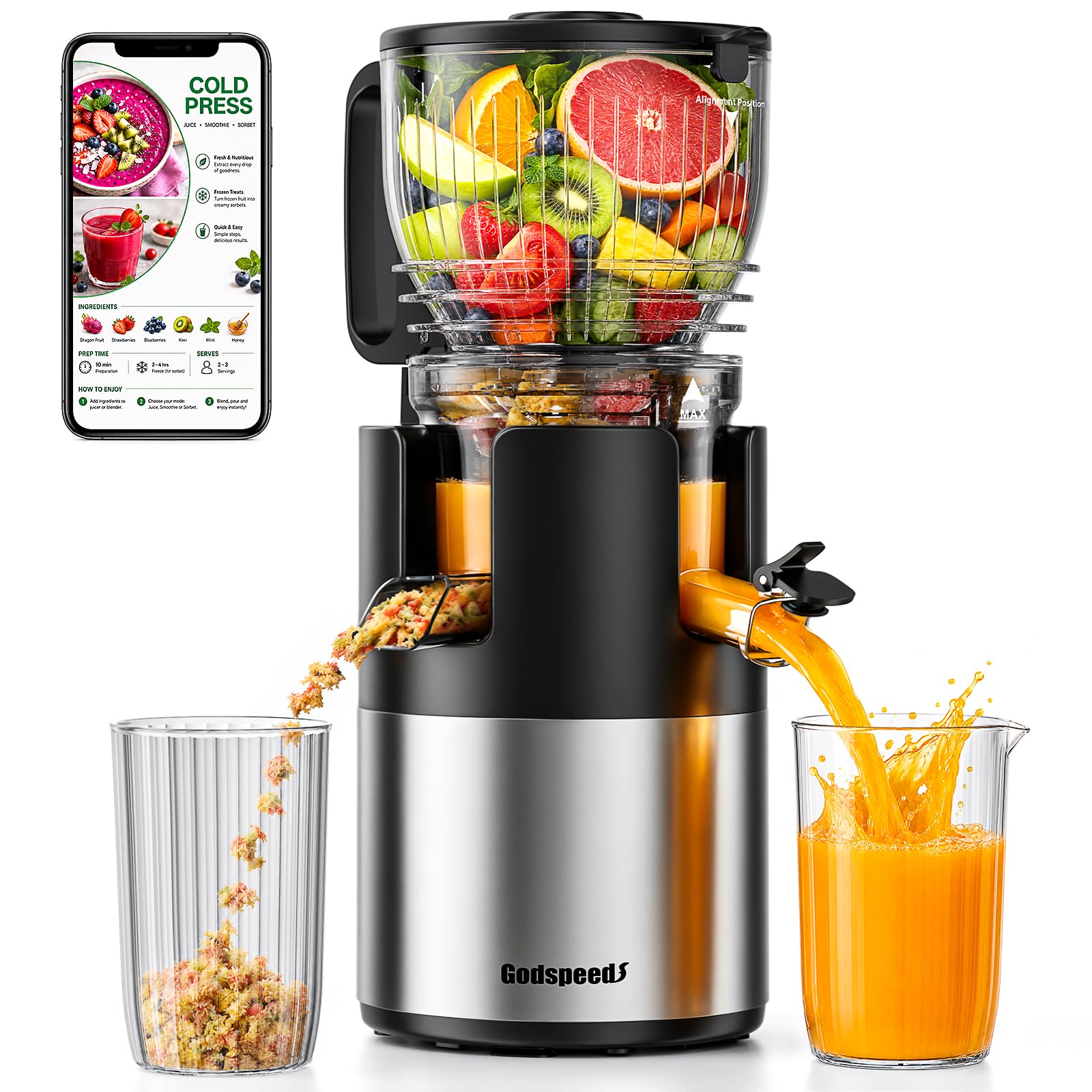
Godspeeds Smoothpress
Key Features
- Motor: 300 W
- Speed: 58 RPM
- Warranty: 10 years
- Feed chute: 6 in
- Price: Midrange
A ten-year warranty on a kitchen appliance is unusual enough that it was the first thing we noticed about the Smoothpress. Most machines here list a single year, and Godspeeds is betting a decade on a 300W plastic-bodied juicer — whatever else you make of that, it says something about how the maker expects the parts to age.
The machine itself is a 6-inch-chute, 58 RPM slow juicer with a detachable toothed filter instead of a mesh basket, and that’s a design we liked: mesh is where pulp sets like concrete, while a toothed ring rinses clean under the tap in seconds. It’s also six inches wide, the narrowest body in this group, so it disappears onto a shelf that would never take a Nama.
Juice quality is where it’s strongest. Apples, carrots and celery come out with dry pulp and very little foam, and cleaning is three parts and a brush. The compromise is the 473 ml capacity: this is a two-glasses-at-a-time machine, and a family would be reloading it all morning.
So it suits someone who juices a glass or two a day, wants the machine to survive the decade, and won’t surrender a foot of counter to get there. If you’re feeding four people, the Canoly’s hopper is the better use of your space.
Pros
- Ten-year warranty
- Toothed filter rinses without mesh scrubbing
- 6-inch-wide body, narrowest here
- 58 RPM extraction through a 6-inch chute
Cons
- 473 ml capacity suits one or two glasses
We trust this one for the long haul: a narrow body, easy cleanup, and the longest warranty in this guide.
Best for Single Servings
Fretta F5000

Key Features
- Motor: 200 W
- Dimensions: 7.5"D x 6.3"W x 15"H
- Feed chute: 4.25 in
- Juice container: 1 L
- Price: Budget
The 4.25-inch chute is the smallest here by a wide margin, which means apples get quartered and celery gets chopped — and that’s the whole trade with the F5000. What you get for the chopping is the least expensive machine in this guide, a genuinely compact body at 6.3 inches wide and 15 inches tall, and a simple one-piece assembly that goes back together without a diagram.
Within that limit it juices properly: carrot and beet go through without complaint, the 200W motor is quiet enough for an early start, and the lid cuts the motor the moment it’s opened, which is the safety feature we’d want on a cheap machine in a house with kids. The 1-liter juice container sizes it honestly — this is a one-person, one-glass juicer, and it’s good at being exactly that. If you’re juicing for two, spend a little more on the TUUMIIST instead.
Pros
- Narrow 6.3-inch body fits tight counters
- Simple one-piece assembly
- Motor cuts out when the lid opens
Cons
- 4.25-inch chute requires real chopping
- 1-liter juice container suits one person
For one person and a tight counter, this is our pick: the least expensive machine here, simple to assemble, and worth a few extra minutes with a knife.
How We Tested Nine Cold Press Juicers
We built a shortlist of two dozen machines from manufacturer specs, retailer reviews, and the questions readers send us most, then filtered by auger type, feed-chute width, how many parts were dishwasher-safe, and where each one landed on price. Nine made the cut. Each went through eight months of ordinary use in our own kitchens rather than a lab bench.
Most of that testing happened at 6:45 on weekday mornings, when a juicer’s noise matters most and nobody wants to dismantle five parts before work, and again on Sunday afternoons when we pushed whole bunches of kale, celery, and knuckled carrots through to see what jammed. We weighed produce going in and juice coming out, then squeezed the spent pulp in a paper towel to check how much liquid we’d left behind. Every teardown and wash was timed with a stopwatch, including the brush work around the screen, which is where most of the hassle hides.
We logged noise with a decibel meter and by the cruder measure of whether the machine woke a sleeping toddler down the hall. For durability, we ran fibrous celery and hard beets daily and looked for hairline cracks in the housing, staining on the clear parts, and any shift in motor pitch by month six. Then we did the math an owner actually cares about: ounces of juice per pound of produce weighed against minutes of cleanup and the asking price. Anything that clogged mid-batch or needed a second pass fell to the back of the list.
How to Choose a Cold Press Juicer
The right cold press juicer is the one that doesn’t make you resent the prep, so weigh chute size and cleanup before you weigh motor wattage.
Chute width decides how much of your morning goes to chopping
Feed chutes here run from 4.25 inches to 7 inches, and that gap isn’t cosmetic: a 4.25-inch opening takes a quartered apple, a 7-inch one takes it whole. A wide chute is the biggest time-saver in the category, but the measurement is a promise rather than a guarantee. Produce still has to be shaped to fit, so a full head of celery or an oddly branched carrot may need a knife whatever the listing claims.
The practical test is your own shopping list. If whole apples, carrots and beets are your staples, buy 6 inches or wider. If you mostly juice cucumber, citrus and greens, a narrow chute costs you almost nothing and saves counter space.
Hopper capacity: batch loading versus one-at-a-time
A wide chute still wants you standing there. A hopper lets you load the entire recipe, walk away and come back to a full jug, which is the real dividing line in this group. Capacity numbers of 24 to 120 ounces look comparable but describe different things — a juice jug, a pulp bin, a feed hopper — so check what the figure actually refers to before you compare.
For one person, a single chute and a one-liter jug are plenty. For a household juicing most mornings, a large hopper earns its footprint; you’ll use it more often than you expect because the setup stops feeling like an event.
Cleaning, build quality and what the warranty tells you
These machines are hand-washed more often than not, even when the maker lists dishwasher-safe parts, because pulp sets fast and mesh traps fibre. Count the pieces that touch wet pulp and look at the filter: a mesh basket needs a brush and patience, while a toothed or metal-free ring rinses under the tap in seconds. That single difference decides whether daily juicing survives past the first month.
Build is where the savings hide. The failures in this category are plastic — handles, hopper lids, latches — so a long warranty is worth real money on a plastic-bodied machine, and a one-year term is a fair warning about how the maker expects the parts to age.
Noise, height and where the machine lives
Slow augers are quieter than centrifugal juicers, but hard produce is where the noise shows up, and a machine that squeals through a carrot is one you’ll stop using before the neighbours do. More consequential is height: these run from about 13 to 17.7 inches tall, and most counters leave roughly 18 inches of clearance to the upper cabinets. A 17-inch juicer fits but leaves no room to tip the lid back.
Measure width too. A 6-inch body disappears onto a shelf that a 13-inch-wide machine would dominate, and a 13-inch-tall model slides under low cabinets that a 17-inch one cannot.
Frequently Asked Questions
Is a cold press juicer better than a blender?
For juice you drink straight, yes. A slow auger presses and separates instead of whipping everything together, so you get clear juice and dry waste rather than a purée that needs straining through a bag. A blender still wins for thick smoothies and anything you want the fibre in. If you like texture, keep blending and save your money.
Can these juicers make sorbet and nut milk?
Most of the machines here ship with a second strainer or filter for exactly that. Frozen fruit goes through the coarse filter for a soft-serve texture, and it helps to let it stand a few minutes so the auger can bite. Soaked nuts go through the fine filter for milk. Rinse the strainer immediately — nut and fruit residue sets like cement.
How do I stop leafy greens from clogging the auger?
Alternate. Feed a handful of greens, then a carrot or an apple; fibrous leaves on their own wrap around the auger, while a hard item behind them scours the chamber and pushes pulp out. Roll kale or spinach into a tight bundle, feed it slowly, and hit reverse the moment the motor note changes. That rhythm handles wheatgrass too.
Final Verdict
The Nama J2 is the juicer we point most people to, because the self-feeding hopper removes the reason juicing stops: standing at the counter feeding produce in one piece at a time. It’s a premium machine with plastic pitchers and a lid that unlocks in one particular order, and it’s still the one worth stretching for if fresh juice is a daily habit.
If it isn’t, the TUUMIIST TM-780SJ gives you a wide chute, a full-size hopper and one no-mesh strainer for a fraction of the outlay. And when the counter is small and the dishwasher is non-negotiable, the Ninja JC151 is the better answer.