This post contains affiliate links. We may earn a small commission when you buy through our links — at no extra cost to you.
The pitch is a smoothie in 30 seconds: frozen fruit in, cup off, lid on, out the door. What actually happens is a fistful of spinach chasing itself around the blades while the berries stay whole — and then you’re at the sink digging pulp out of a blade assembly that doesn’t come apart. A personal blender should collapse breakfast into one dish; the wrong one just hands you a second mess to clean.
I’ve owned several over the years, including one that walked itself across the counter and another that leaked through my tote on the train. My team and I have now spent six months with 12 of them, and one pattern held: the blenders that broke down frozen fruit cleanly were almost always the ones that rinsed clean in seconds. Wattage is the number most shoppers fixate on and the least useful one — blade shape, cup proportions, and how the motor handles a frozen load tell you far more. The picks below are the ones that survived a daily smoothie habit.


Best for Everyday Smoothies
Ninja Fit QB3001SS
Key Features
- Motor: 700 W
- Capacity: 16 fl oz
- Cups included: 2
- Dimensions (D x W x H): 4.3 x 4.3 x 13 in
- Price: Midrange
Four and a third inches is the width of the Ninja Fit’s base, and that number is most of the argument. The 700-watt motor lives in a column barely wider than the 16-ounce cup you screw onto it, so it sits beside a coffee maker without rearranging the counter. We put frozen berries, ice and protein powder through ours and never felt short of power; the blades pull the load down instead of skating over the top of it.
Two cups come in the box, each with a spout lid, so the thing you blend in is the thing you drink from and the second one is clean for tomorrow. Sixteen ounces is one generous smoothie, though. Load in a frozen banana, yogurt and a scoop of protein and you’re at the max line, so if you routinely pour a 24-ounce tumbler, the Nutri-Plus or one of the nutribullets here is the better fit.
One speed, no programs: press the cup down to run the blades, release to stop. That sounds primitive next to a preset panel, but it’s the control you want when a chunk of frozen mango needs nudging back toward the blade. Cleanup is a rinse and a wash — the blade assembly twists off the cup, and there’s no pitcher to get in the way.
The number worth noticing is the one-year warranty, because motors in this class do quit and some Fits stop well before the first year is out. Register it the week it arrives and keep the receipt where you can find it; that registration is the difference between a replacement and a shrug.
Pros
- 700 watts in a 4.3-inch-wide base
- Two 16-oz cups with spout lids included
- Blade twists off for quick rinsing
- Fast enough for a weekday smoothie
Cons
- Loud at full speed
For one smoothie a day, this is the personal blender we reach for: 700 watts, two lidded cups and a base that lives on the counter without crowding it.
Best for Two-Person Mornings
Ninja Nutri-Plus BN301
Key Features
- Motor: 900 peak watts
- Capacity: 20 fl oz
- Cups included: 3
- Dimensions (D x W x H): 4.7 x 4.7 x 13.8 in
- Price: Midrange
Three 20-ounce cups arrive in the box — two with spout lids, one with a storage lid — and that’s the reason to step up from the Ninja Fit. It’s the same narrow, push-to-blend format, just with more room in the cup and more motor behind it: 900 peak watts against the Fit’s 700. The base is only 4.7 inches across, so the bigger cups cost you height rather than counter width.
The storage lid is the part we ended up using most. Blend a double batch at night, cap it, and the cup goes straight into the fridge without a second container or a washing-up session in the morning. With three cups in rotation, two people can make separate smoothies back to back without one waiting on the other, which is more than the single-cup options here can manage.
It stands 13.8 inches tall and weighs a bit over five pounds, so measure the gap under your upper cabinets before you commit to a spot on the counter. Cups, lids and the blade assembly are top-rack dishwasher safe, which we leaned on more than we expected to.
Pros
- Three 20-oz cups with lids and a storage cap
- 900 peak watts for frozen fruit
- Dishwasher-safe cups, lids and blade
- Same small footprint as the Fit
Cons
- You hold the cup down through the whole blend
Buy this one if two people blend in the morning: three 20-ounce cups, 900 peak watts and dishwasher-safe parts make it the easiest Ninja to share.
Best for Thick Frozen Blends
nutribullet Pro+
Key Features
- Motor: 1,200 W
- Capacity: 32 fl oz
- Controls: Pulse and 60-second blend
- Cups included: 2
- Price: Premium
A 32-ounce cup is closer to a full-size blender jar than a personal tumbler, and it’s the main thing the nutribullet Pro+ gives you that the Ninjas here don’t. Fill it with frozen berries, a handful of spinach, carrots and ice, and the 1,200-watt motor keeps going where smaller bases start to labor. If you have ever stood over a struggling blender shaking the cup, that headroom is the feature you’re paying for.
The controls are worth understanding before you buy: a pulse button for chunky textures like salsa, and a hands-free 60-second cycle for smoothies, so you can step away while it works. Both cups, 32 and 24 ounces, come with to-go lids, and the cups, lids and blade assembly are top-rack dishwasher safe.
The blade gasket is the part to look after. Rinse the blade right after use rather than leaving it to soak, because a gasket that works loose is what takes these assemblies out of service, and the gasket isn’t sold on its own. Beyond that it’s a machine with power to spare: for thick, frozen-heavy blends and two servings at once, this is the most capable one here.
Pros
- 1,200 watts of blending headroom
- 32-oz cup plus a 24-oz second cup
- Pulse plus a hands-free 60-second cycle
Cons
- Loud enough that you’ll time your blending
If your smoothies are thick with frozen fruit and greens, the 1,200-watt Pro+ has the headroom — and a 32-ounce cup closer to a blender jar than a tumbler.
Best for Tight Budgets
Consciot CB08
Key Features
- Motor: 900 W max
- Speed: 25,000 RPM
- Controls: Hands-free twist-to-blend
- Cups included: Three: 24, 17 and 10 oz
- Price: Budget
Twist the cup into the base and the Consciot starts on its own — no button to hold, no program to choose. We didn’t expect hands-free blending at this price, and it comes attached to an 11-piece kit: three cups, two to-go lids, a resealable lid, spare seals and a cleaning brush.
The cup sizes do a lot of the work. Twenty-four ounces takes a full smoothie, 17 ounces a smaller shake, and 10 ounces a dressing or a dip, so the same base covers more than breakfast. Suction feet keep it planted while it runs, the cups and lids are dishwasher safe, and an overheat cut-out stops the motor before it cooks itself.
Two things to know. The cup needs a firm twist to seat on the micro-switches, and a half-hearted turn just means nothing happens — you’ll learn it in a day. The other is life expectancy: some units burn out within months, the warranty runs a year, and at this price replacing it costs less than repairing it. Treat it as a first blender, a dorm appliance or a second machine for the office, and it makes a lot of sense.
Pros
- Hands-free twist-to-start blending
- Three cup sizes, 24 to 10 oz
- 900-watt motor with overheat protection
- Suction feet keep it from walking
Cons
- Some units burn out within months
The cheapest way here to get three cups and a hands-free base — as long as you accept that the motor is the part that lets it down.
Best for Simple Single Servings
nutribullet Original
Key Features
- Capacity: 24 fl oz
- Controls: Twist and press
- Warranty: One year limited
- Cups included: 1
- Price: Midrange
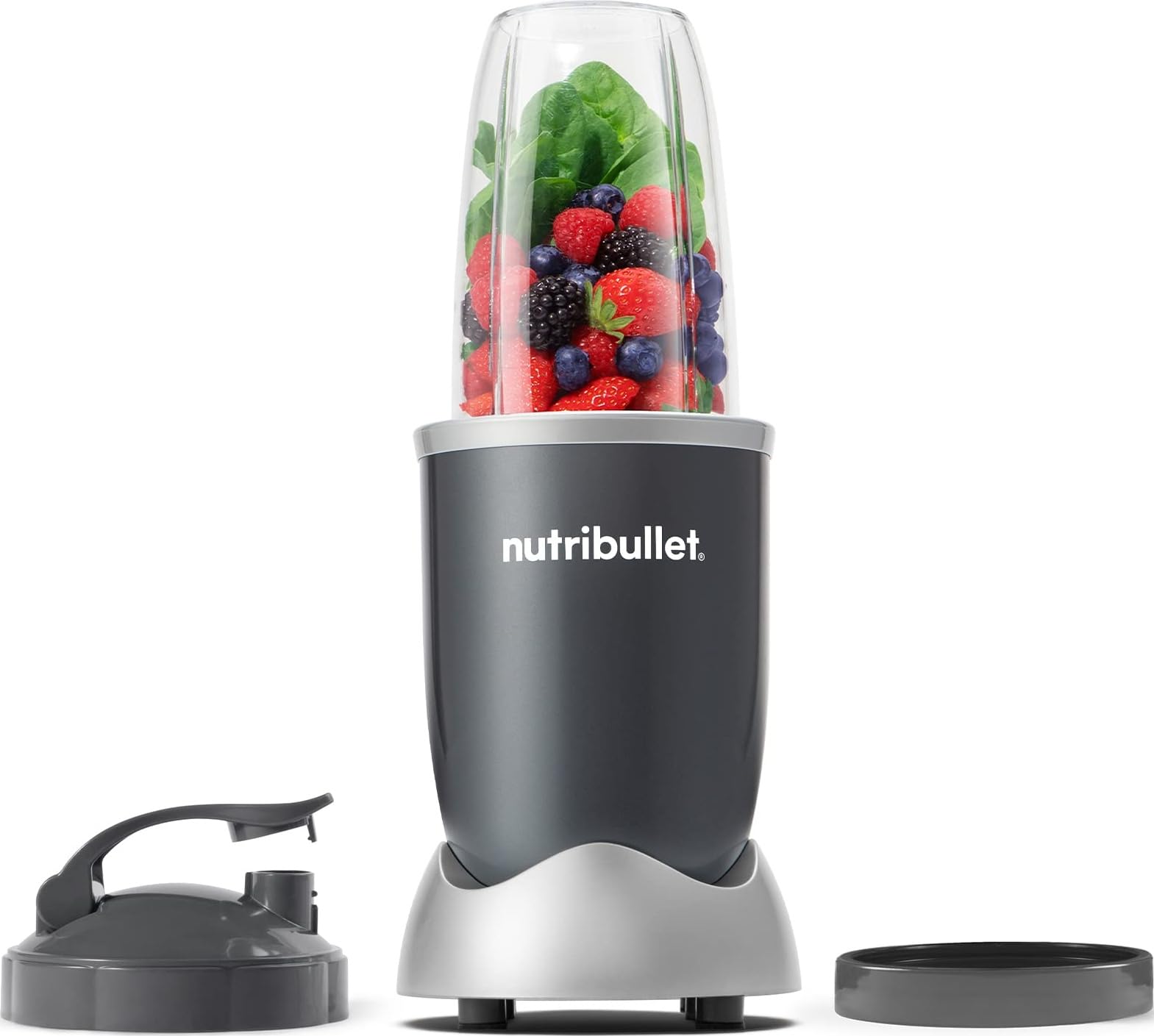
One 24-ounce cup, one extractor blade, one to-go lid, and a base you press the cup down onto. The original nutribullet hasn’t changed much because it doesn’t need to: load the cup, screw the blade on, invert it, push. There’s nothing to program and not much to get wrong, which is why it’s the one we hand to anyone who wants no decisions with breakfast. The 5.5-inch-square base tucks into a corner and stays there.
What you give up is flexibility. A single cup means a second smoothie waits for a wash, and the blade-and-cup coupling is the part to look after: screw the blade on straight and snug rather than forcing it, rinse promptly, and don’t overtighten, because a cracked cup or a gasket that works loose ends more of these blenders than a dead motor does. For one person, one drink, one rinse, it remains the least fussy route from frozen fruit to something you can carry out the door.
Pros
- Twist-and-press operation with no settings
- 24-oz cup doubles as the glass
- Small 5.5-inch-square base
Cons
- One cup only, so back-to-back blends need a wash
One cup, one blade, one motion — the simplest personal blender here, and still a sensible buy if you want zero decisions with your breakfast.
Best for Budget Starter Kit
Savorfuze BL3658

Key Features
- Motor: 900 W peak
- Blades: Cross and flat grinder
- Capacity: 700 ml cups
- Grinder cup: 300 ml
- Price: Budget
A flat grinder blade is the odd extra here, and no other pick in this roundup includes one. Alongside it you get two 700-ml cups, a 300-ml grinder cup, a four-leaf cross blade, two to-go lids, spare seals and a cleaning brush, all driven by a 900-watt peak motor spinning at 25,000 RPM.
Operation is twist-to-start: lock the cup into the base and the motor runs, with an auto-lock switch so it won’t spin unless the cup is seated properly. Suction cups hold the base still on the counter, and the cups and blades are dishwasher safe as long as the motor base stays out of the water.
What you don’t get is a long history. This is the least-proven blender here, which is why it sits below the Ninjas, and the flat blade is a dry-goods tool — seeds, spices, coffee — rather than a second blender. If the kit list is what sold you and the budget is tight, it’s a sensible way to spend it.
Pros
- Two 700-ml cups plus a 300-ml grinder cup
- Flat grinder blade for dry goods
- Auto-lock switch and suction feet
Cons
- Smaller name with a shorter record
The most accessories for the least money here — two big cups, a grinder cup and a spare blade — if you’re happy buying from a smaller name.
How We Tested: Six Months, 12 Blenders, a Lot of Kale
We started with the models that had the deepest review histories and, just as importantly, the fewest recurring complaints about cracked cups, stretched gaskets, and blades that dulled within a year. From there we filtered by cup size, whether the parts were dishwasher safe, and how easy it was to order a replacement cup on its own. That narrowed the field to 12 blenders, which we ran almost daily for six months.
Every blender got the same load: frozen strawberries, a fistful of spinach, and ice, blended for exactly the time its manual recommended. We counted whole chunks left in the cup, checked the texture against a spoon, and felt the base afterward for heat — a motor that ran warm on one smoothie told us it wouldn’t last through back-to-back shakes. We pushed harder with peanut butter and dates, then ice alone. The testing scenes were real ones: rushed weekday mornings, a protein shake after the gym, an iced coffee in the afternoon.
Cleaning got its own pass. We rinsed each cup with warm soapy water, ran it for 20 seconds, and looked for seeds and pulp wedged under the blade, then washed the parts in the dishwasher if the manufacturer allowed it. Noise was measured at arm’s length because most of us blend before 7 a.m. We also measured each base’s footprint on the counter, checked whether the cup fit a car cup holder, and whether the whole thing cleared the upper cabinets.
Over six months we tracked the slow stuff: gaskets that stretched, blades that wobbled, hairline cracks at the cup threads, lids that stopped sealing. At the end we weighed what each blender came with against what it cost, since a bargain that needs a new cup in a year isn’t one.
How to Choose a Personal Blender
A personal blender is only worth owning if it handles frozen fruit without complaint and rinses clean in under a minute — every other decision follows from those two.
Match the motor to what goes in the cup
Watts are a rough proxy for what a blender will take, and the useful line in this category sits around 700. Below that you are blending soft fruit, protein powder and milk; frozen berries and ice will stall a weak motor or leave it spinning without moving the load. Between 700 and 900 watts — the Ninja Fit, the Nutri-Plus and the Consciot here — frozen fruit and a handful of ice are routine. The 1,200-watt nutribullet Pro+ is for cups loaded with carrots, greens and frozen fruit at once.
One caveat: many of these figures are quoted as peak watts, the burst a motor manages rather than what it sustains. Compare peak with peak, and read a large gap as a real difference and a small one as marketing.
Cup size and how many cups you need
Sixteen to 24 ounces is one adult smoothie; smaller is a snack, larger is two servings. The cup count matters more than most buyers expect. One cup means washing between blends, two means tomorrow’s can be prepped while today’s is in the dishwasher, and three lets two people drink at different times. A storage lid is the quiet upgrade, turning a spare cup into fridge storage.
The trap is buying small and planning to work around it. If you drink a 24-ounce shake every morning, a 16-ounce cup will have you filling to the line and cleaning the collar every time.
Controls: hold, twist or preset
Push-to-blend, as on both Ninjas, runs the motor only while you press the cup down. It’s more work, but it’s also the control that lets you pulse frozen chunks back into the blades instead of leaving them wedged. Twist-to-start models such as the Consciot run hands-free once the cup is locked, which suits anyone who wants to walk away or finds holding a button awkward.
Presets are the least important feature here. A manual pulse does most of what they do, and you’re never more than a few seconds from the texture you want.
Footprint, height and noise
Width is easy: these bases run about four to seven inches across and will fit almost anywhere. Height is where people get caught. The Ninjas stand close to 14 inches, and the shorter nutribullet and Consciot bases still need cup clearance overhead, so measure the gap under your upper cabinets before you pick a spot.
Noise climbs with power. The 1,200-watt Pro+ is the loudest machine here, and if you blend before anyone else in the house is awake, that’s a real argument for staying nearer 700 watts.
Frequently Asked Questions
Do I need to add liquid to a personal blender?
Yes, almost always. The blades need something to pull the ingredients into, so start with enough liquid to cover them, add soft ingredients next, and put frozen fruit and ice in last. Fill only to the max line — overfilling is a common cause of a leak around the blade collar.
Why buy a personal blender instead of using a full-size one?
Because you drink from the cup you blend in, so there’s no pitcher to wash and no leftover smoothie to decant. That’s the whole trade: a personal blender is built for one or two servings. If you blend for three or more people, or make soup in quantity, a pitcher blender is the better tool.
Can I blend hot soup in one?
Not in a sealed cup. Hot liquid builds pressure, and a locked lid on a full cup can pop or spray when you open it. Let soup cool to warm, fill the cup no more than halfway, and leave the lid off or vented while you blend. If hot blending is a regular job, use a blender with a vented pitcher lid.
What usually breaks first, and can I make one last longer?
The motor and the blade coupling, in that order — cups crack and gaskets work loose, and a base that stops spinning is usually the end of it. Rinse the blade assembly straight after use instead of soaking it, screw cups on straight rather than forcing them, give the motor a rest between cycles, and register the warranty the week it arrives.
Final Verdict
The Ninja Fit is the one we point most people to. Seven hundred watts in a base four inches wide, two lidded 16-ounce cups, and a price that doesn’t ask you to think hard about it — it handles a daily smoothie and rinses clean in the time it takes to cap the cup. For one person, one drink, one rinse, nothing here is easier to live with.
Change the requirement and the answer changes. Two people blending in the morning should take the Ninja Nutri-Plus and its three 20-ounce cups; anyone loading the cup with frozen fruit, carrots and greens should take the nutribullet Pro+. And if the budget decides, the Consciot gives you three cups and hands-free blending for much less, with a shorter working life to match.