This post contains affiliate links. We may earn a small commission when you buy through our links — at no extra cost to you.
Fresh juice is a five-minute pleasure attached to a twenty-minute chore — that’s the bargain every juicer strikes with you. Pulp wedges into the mesh basket, fiber ropes around the auger, and half the machine has to come apart before you get to drink what you made. The right one doesn’t erase that work so much as shorten it: a basket that rinses clean, a chute that doesn’t demand pre-chopping, a motor that won’t wake the house before sunrise. That gap between a machine you use weekly and one that gets banished to a cabinet is what I went looking for.
Centrifugal and masticating juicers are barely the same appliance — the fast ones are cheaper and quicker but foam up and punish leafy greens, while the slow ones coax out more ounces and run quiet at the cost of time and money. My team and I put 11 juicers through eight months of daily rounds, and the ones below are the machines that earned a permanent spot on the counter rather than a shelf in the pantry.




Best for Everyday Cold Pressing
Nama J2 Cold Press Juicer
Key Features
- Motor: 200 W, 50 RPM
- Hopper: Self-feeding, full recipe
- Cleaning: Hand wash only
- Footprint: 9 x 9.8 x 17.7 in
- Price: Premium
Fill the hopper once and walk away. That’s the whole idea here: a self-feeding hopper takes an entire recipe — apples, celery, a knob of ginger, half a lemon — and the machine cuts and draws it down on its own while you get on with the rest of breakfast. We’ve spent enough mornings dropping one carrot at a time into a narrow chute to know that isn’t a small convenience. It’s the difference between a juicer you use and one that ends up in a cupboard.
Slow is the point. The auger turns at 50 RPM on a 200-watt motor, so nothing gets hot, and the pulp comes out dry enough that you stop feeling like half the shopping went into the bin. Leafy greens go through without the coaxing they need in a fast machine, and two strainers let you choose between a clean, pulp-free pour and a juice with more body.
It’s also the quietest machine in this group by a distance — a low, even hum rather than the shriek a centrifugal juicer makes — which matters at six in the morning. The parts release in a couple of clicks, so cleanup starts before the pulp has a chance to dry onto anything.
What you’re paying for is the hopper and the motor, and this is the most expensive machine here by a wide margin. Whether that’s worth it comes down to one question: will you juice most days? If yes, the time it gives back is the purchase. If you’re a twice-a-month juicer, the TUUMIIST below does the same load-and-walk-away trick for a lot less.
Pros
- Loads an entire recipe in one go
- Dry pulp and strong extraction from greens
- Quietest machine in this set
- Quick-release parts for fast cleanup
Cons
- Hand wash only, no dishwasher
- Plastic pitchers at the top price
For anyone who will juice several mornings a week, this is the one we recommend: load it once, walk away, and get the best juice in this group.
Best for Batch Juicing Value
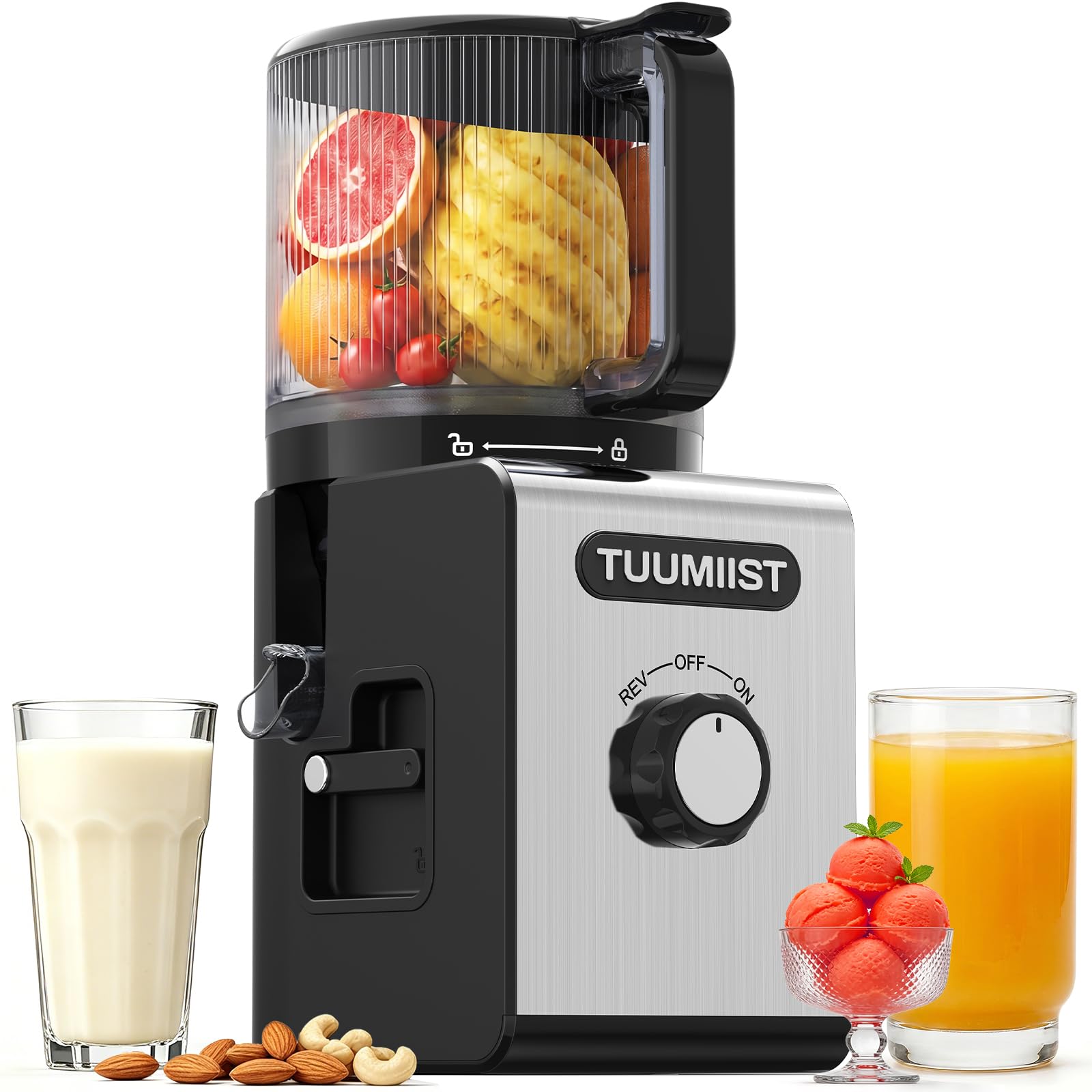
TUUMIIST 3-in-1 Cold Press Juicer
Key Features
- Motor: 350 W, 60 RPM
- Hopper: 100 oz
- Cleaning: Dishwasher safe
- Feed chute: 6.5 in
- Price: Midrange
This is the pick we hand to most people, and the argument is short: a 100-ounce hopper, a 6.5-inch chute, and one strainer that handles juice, nut milk and sorbet, for a fraction of what the top pick costs. The spec sheet reads like a premium machine’s, and in use it mostly behaves like one.
The rhythm is what sells it. Load the hopper, switch on, and come back to a cup of juice and a cup of pulp. At 60 RPM and 350 watts it’s slow enough that nothing heats up, and the single strainer means no swapping baskets mid-recipe — the chore that makes most 3-in-1 machines more trouble than they’re worth. Sorbet from frozen fruit is a genuine second use rather than a line on the box.
Where it gives ground is build. The plastic handle and the lid fittings are the parts to watch, and at 17 inches tall it needs a clear run under the cabinet, so measure that gap before it earns a permanent spot. Everything detaches for the dishwasher, which is what keeps a daily juicer out of the cupboard instead of back in it.
Pros
- Huge hopper for the money
- One strainer covers juice, sorbet and nut milk
- Dishwasher-safe parts
- Strong owner satisfaction on performance
Cons
- Plastic handle and lid are the fragile points
The best-value juicer here: a 100-ounce hopper and one strainer for juice, nut milk and sorbet, with a plastic build that won’t last forever.
Best for Tight Counters
Ninja NeverClog JC151
Key Features
- Motor: 150 W high-torque
- Cleaning: Dishwasher safe
- Pulp bin: 36 oz, two filters
- Juice jug: 24 oz
- Price: Midrange
At just over seven inches wide, this is the machine that fits where the Nama doesn’t. On a counter that already carries a coffee maker and a toaster, that’s not a footnote — it’s the reason a juicer stays out and gets used instead of living in a cupboard.
The trade is prep. The feed opening is narrow enough that apples need quartering and celery needs cutting down, so you’ll spend a few minutes with a knife before you spend a few with the machine. In exchange you get the simplest cleanup in this group: a 24-ounce jug, a 36-ounce pulp bin, two interchangeable filters for less or more pulp, and parts that go straight into the dishwasher. A reverse button clears a jam without disassembly, and we reached for it more often than we expected.
It isn’t faultless. Mango and other soft, fibrous fruit can clog the screen, and apples produce a squeal that’s out of character with how quietly it handles carrots and beets. The jug is small, too — fine for one glass, and one refill away from two.
Pros
- Fits a crowded counter at seven inches wide
- Easiest cleanup of the group
- Two pulp filters for texture control
- Reverse function handles jams
Cons
- Narrow chute means real knife work
- 24-ounce jug fills fast
The small-kitchen pick: it fits under a cabinet, comes apart for the dishwasher in seconds, and asks for a few minutes of chopping in return.
Best for Whole-Fruit Prep
YPONE 2-in-1 Cold Press Juicer
Key Features
- Motor: 400 W, 55 RPM
- Weight: 9.74 lb
- Strainers: Dual 0.3 mm mesh
- Feed chute: 5.8 in
- Price: Midrange
A 5.8-inch chute is the reason to look here. Whole apples, a fist of beet, carrots without halving — nothing else in this group feeds this easily at this price, and it’s the single change that makes a daily glass feel less like prep work.
Behind the chute sits a 400-watt motor turning one auger at 55 RPM, with twin 0.3 mm mesh strainers and a reverse function for the occasional jam. It’s compact in the right way: five inches deep at the base, so it tucks back against the wall, and light enough at 4.42 kg to carry to the sink one-handed. The 500 and 700 ml cups suit a glass or two rather than a pitcher.
Durability is the open question. The motor is the part that goes, and a year of cover is the bare minimum rather than generous. Buy it for the chute and the footprint, keep the receipt somewhere findable, and feed tough stalks at an even pace instead of forcing them.
Pros
- Wide chute takes whole fruit
- Shallow five-inch base
- Dual fine mesh strainers and reverse
- Positive juice output at the price
Cons
- One-year warranty only
- Cups are small for batch juicing
If you want whole apples to go in without a knife, this is the cold press we point to — just accept a one-year warranty.
Best for Fast Fruit Juice
Breville Juice Fountain Compact
Key Features
- Motor: 700 W
- Speeds: 1
- Juice jug: 25 oz, froth separator
- Feed chute: 3 in
- Price: Budget
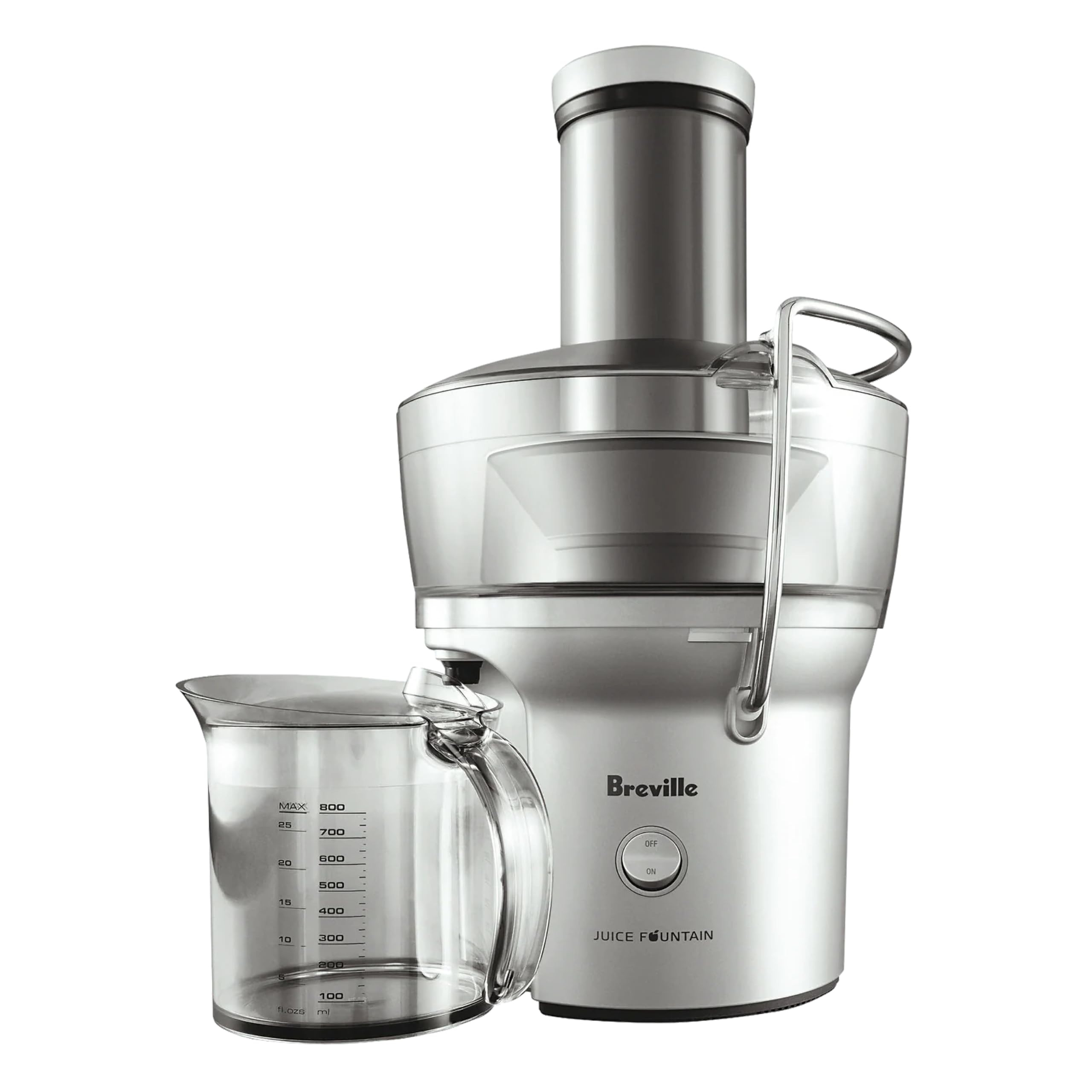
Nothing else here turns a shelf of produce into juice as quickly. A 700-watt motor spins a titanium-reinforced disc against a stainless micro-mesh basket, and the three-inch chute takes whole apples and oranges, so the job is one sitting rather than a project.
For a machine under ten inches square, that’s a lot of power, and Breville spends it on speed rather than finesse. The 25-ounce jug has a froth separator built into the spout, which sounds like a marketing line until you pour a glass of apple juice that isn’t half foam. The cord wraps under the base and the parts are dishwasher safe.
Centrifugal juicing has costs, and this one pays all of them. It’s loud, the pulp comes out wetter than a cold press leaves it, and greens need chasing through with something firmer behind them. The filter basket is the part to watch — it’s thin stainless, and a hard stalk can dent it, so feed celery and chard steadily. It stays on the list because nothing else at the price gets you from a full fridge to a jug this fast.
Pros
- Very fast for the money
- Compact footprint with cord storage
- Froth separator in the jug
- Whole fruit through a three-inch chute
Cons
- No variable speed or reverse
The fastest juicer here: whole fruit in, a jug of juice out, and a noise level you’ll plan your morning around.
Best for Family Batches
Hamilton Beach Big Mouth
Key Features
- Motor: 800 W max
- Pulp bin: 80 oz
- Warranty: 3 years
- Feed chute: 3 in
- Price: Midrange
It’s loud. Not mildly noisy at breakfast — this is a machine you warn the household about before switching on, and 800 watts of centrifugal force in a plastic body is exactly why. If quiet matters more than speed, stop reading here.
What the noise buys is throughput. The three-inch Big Mouth chute takes a whole apple or a fistful of carrots, the pulp bin holds 80 ounces so you aren’t emptying it mid-batch, and the strainer brush in the box earns its keep. Juice bowl, lid, pusher and pulp bin all go in the dishwasher.
Build is ordinary, and early failure is the thing to watch. What balances it is a three-year limited warranty — longer cover than most of the cold presses here — which is why we’re comfortable pointing a family at a plastic machine.
Here’s who it’s for: someone juicing for four, several times a week, who wants the job finished fast and doesn’t want to spend cold-press money on it. For one glass on a quiet Sunday it’s more machine, and much more noise, than the job needs.
Pros
- Large 80-ounce pulp bin
- Three-year limited warranty
- Whole produce through the chute
- Dishwasher-safe pulp bin, bowl, lid and pusher
Cons
- Plastic body and lid fittings
For family-sized batches on a budget: a whole apple down the chute, an 80-ounce pulp bin, and the longest warranty on any centrifugal here.
Best for First Cold Press
TUUMIIST 580 Cold Press Juicer

Key Features
- Motor: 300 W, 55 RPM
- Filter: No mesh basket
- Run time: 20 min on, 20 off
- Feed chute: 5.8 in
- Price: Budget
There’s no mesh filter to scrub. That’s the appeal: the basket is a smooth perforated piece rather than a fine screen, so cleanup is a rinse and a wipe instead of five minutes with a brush under the tap. If you’ve owned a juicer and stopped using it because of the washing up, this is the design to look at.
The rest is sensible rather than special. A 300-watt motor turns a single auger at 55 RPM, the 5.8-inch chute takes whole apples, and an eight-inch footprint leaves the counter looking normal. It’s BPA-free, dishwasher safe and light enough to move with one hand.
Endurance is where it asks for patience, because the record here is uneven — some machines run for months, others stop inside a few weeks. Buy it as a first cold press for a glass or two a day, not as the engine of a family’s weekly juice.
Pros
- No mesh basket to scrub
- Wide 5.8-inch chute on a budget machine
- Small eight-inch footprint
- BPA-free and dishwasher safe
Cons
- 20-minute cool-down after each 20 minutes
- 30-day guarantee only
The cheapest way into cold-press juicing, and the easiest of the lot to clean — as long as your batches stay small.
Best for Compact Cold Press
Anybear Cold Press Juicer

Key Features
- Motor: 200 W, 180 N·m
- Warranty: 5 years
- Feed chute: 4.3 in
- Chute material: Tritan
- Price: Midrange
Five years of cover is the longest warranty here by a wide margin, and it’s the first thing to say about a name most people won’t recognize. Anybear backs this machine with free replacement for five years, which changes the arithmetic on a juicer that costs about what the Ninja does.
The design is unusual in small ways. The 4.3-inch chute sits between the narrow machines and the big-hopper ones, and it’s made from Tritan rather than the usual ABS, the material argument being a juice that tastes of the fruit rather than the plastic. The filter is a single stainless piece, so there’s no mesh basket to scrub, and the 200-watt motor claims 180 N·m of torque, which is enough for carrots and beet.
What we can’t tell you is how it behaves in year three. This is a newer model with less of a track record behind it, and a five-year warranty is a promise rather than a history. If the safety net is what you want and you juice a glass at a time, it’s a fair bet; if you want a machine with a long record, the Breville is the safer call.
Pros
- Five-year warranty with free replacement
- Tritan feed chute
- Single stainless filter, no mesh basket
- Compact 6.65-inch width
Cons
- Narrower chute than the big-hopper picks
- Unproven over the long term
A compact cold press with the longest warranty in this group and the shortest track record — worth it if the safety net is what you’re buying.
How We Put 11 Juicers Through Their Paces
We started with every juicer we could find from kitchen appliance brands with a track record, then narrowed the field by feed chute width, motor type, footprint, warranty length, and price, filtering out anything too tall for a standard upper cabinet or dogged by complaints about cracked housings. That left 11 machines, which we ran for eight months in our own kitchens: big Sunday batches of carrot, apple, and ginger, rushed weekday mornings before work, and a few experiments with wheatgrass. Each one stayed on the counter for at least a month, so it got used on the days we were tired and in a hurry.
To judge performance, we weighed produce in and juice out to calculate yield, then squeezed the spent pulp in a paper towel to see how much liquid was left behind. We dropped whole carrots and apples down the chute to find which machines handled them without stalling, and pushed two pounds of kale through each one to watch for fiber backing up the auger or pulp climbing the screen. Assembly and disassembly got timed with a stopwatch, and we rinsed every mesh basket by hand with a brush, checking the seam where the screen meets the frame for packed pulp.
Noise we measured from three feet away and also judged the honest way — whether the machine drowned out a podcast or carried into the next room. Over eight months we watched for the slower failures: hairline cracks around the pulp bin, plastic that yellowed, motors that smelled warm on a second batch, seals that stopped sitting flush. Value came down to cost per ounce of juice set against how often we’d genuinely use the thing, since a pricey machine that clogs on greens is worse than a modest one that doesn’t.
How to Choose a Juicer
The juicer you’ll still be using in six months is the one that’s quick to load and quicker to clean, because friction sends more machines to the cupboard than weak motors ever do.
Cold press or centrifugal?
A centrifugal juicer shreds produce against a spinning basket at high speed. It’s fast, it’s cheap and it’s loud, and the juice comes out with more air and foam beaten into it. A cold press, also called masticating, crushes slowly at around 50 to 60 RPM: quieter, better with greens and ginger, drier pulp, and juice that separates more slowly in the fridge. It costs more and takes longer.
Choose centrifugal if you juice a few times a week and want it over with, and the Breville here is the quickest way to a jug. Choose cold press if greens are the point, if you juice before the rest of the house wakes up, or if you’ve owned a fast juicer and quietly stopped using it.
The chute and hopper decide how much chopping you do
A three-inch chute takes a whole apple but not a bunch of celery. Five- and six-inch chutes take apples, beet and long carrots without a knife. The trap is assuming a wide chute means no prep at all: long stalks still need halving, and anything soft or stringy needs something firmer behind it to carry it through.
A hopper is the bigger step up, because it holds an entire recipe and lets you load once instead of standing there. Count the items in your usual juice — if it’s four or more, a hopper machine like the Nama or the TUUMIIST is worth the extra money.
Cleaning is a part-count problem
Every juicer is a cleaning job. The real differences are how many pieces end up in the sink and whether one of them is a fine mesh basket. No-mesh designs rinse clean under the tap; mesh screens need a brush and a few patient minutes. Dishwasher-safe is a genuine help, though it usually doesn’t cover the mesh basket or the pulp chute, which are the two pieces that actually need attention.
Before you commit, picture the parts on your draining board. Under five is a daily habit; seven or eight is a job you start postponing.
Noise, height and where it lives
Centrifugal machines are loud, and an 800-watt one will wake the house. Cold presses hum. If you juice at six in the morning, that settles the argument on its own. A few motors also want a rest between batches, which matters if you juice for the week in one go rather than for one glass.
Height catches people out more than width. A machine standing 17 or 18 inches with its hopper on may not clear the cabinet, while a 14-inch one slides under. Measure from the counter to the underside of the cabinet, not the width of the gap.
Buy for the motor and the warranty
The parts that fail on a juicer are nearly always plastic: the auger housing, the filter basket, the handle on the lid. None of that shows up in a spec sheet, which is why the warranty is the most useful number on the box. Cover across this group runs from one year to five.
Feed fibrous produce at an even pace rather than forcing it, and check what the warranty actually covers — motor and labour, or parts only — then keep the receipt somewhere you’ll find it.
Frequently Asked Questions
Is a juicer worth it if I already have a blender?
They do different jobs. A blender keeps the fiber and needs liquid to move, so what you get is a smoothie you eat with a spoon. A juicer separates the pulp, so a pile of carrots, a few celery stalks and an apple become a glass you can drink standing up.
If you want greens in a drink without the texture, a juicer earns its counter space. If you want something thick and spoonable, your blender already does it.
Do I have to peel and pit everything before juicing?
Peel citrus, because the oil in the rind is bitter and a cold press pushes it straight into the juice. Pit stone fruit — cherry and plum stones can damage an auger or a filter basket.
Everything else can go in whole or in big pieces: berries, pomegranate seeds, apple quarters with the skin on, and leafy greens rolled into a bundle so they feed themselves through.
How long does fresh juice keep in the fridge?
Cold-press juice holds for a couple of days in a full, lidded bottle, because less air is beaten into it. Centrifugal juice separates and starts to taste flat within a day, so shake it and drink it sooner.
Make roughly what you’ll drink in a day or two rather than a week’s worth, and keep the bottle at the back of the fridge where the temperature is steadiest.
Final Verdict
Buy the Nama J2 if you’ll juice most days. The hopper is what makes it stick: you load a whole recipe once, walk away, and come back to dry pulp and clear juice, and you never stand over the chute feeding carrots in one at a time. That’s the feature worth paying for, and it’s why it takes the top spot despite the price.
If that price is out of reach, the TUUMIIST 3-in-1 gives you the same load-and-leave rhythm for a fraction of the money, with a plastic build that won’t age as gracefully. And if the counter is the constraint, the Ninja’s seven-inch width settles the decision before anything else does.