This post contains affiliate links. We may earn a small commission when you buy through our links — at no extra cost to you.
There’s a short window each summer when peaches, plums, and berries are cheaper and better than they’ll be all year, and the pile on my counter always outpaces what two people can eat. That’s when a dehydrator earns its counter space: slice, load, come back to fruit that keeps for months instead of a fridge drawer of mold. What separates a good machine from a frustrating one isn’t the drying itself. It’s whether it holds a steady low temperature, holds enough fruit to make the setup worthwhile, and doesn’t sound like a hair dryer running overnight.
I spent the past seven months running 11 dehydrators through a summer’s worth of fruit: strawberries, apple rings, mango, banana chips, and more fruit leather than I care to admit. A few were quiet enough to run overnight in a small kitchen; two got banished to the garage. A bargain machine that dries unevenly costs more in wasted fruit than it saves, and one with stingy capacity turns a half hour of slicing into a lost weekend. The picks below are the ones that made all that prep pay off.

Best for All-Around Fruit Drying
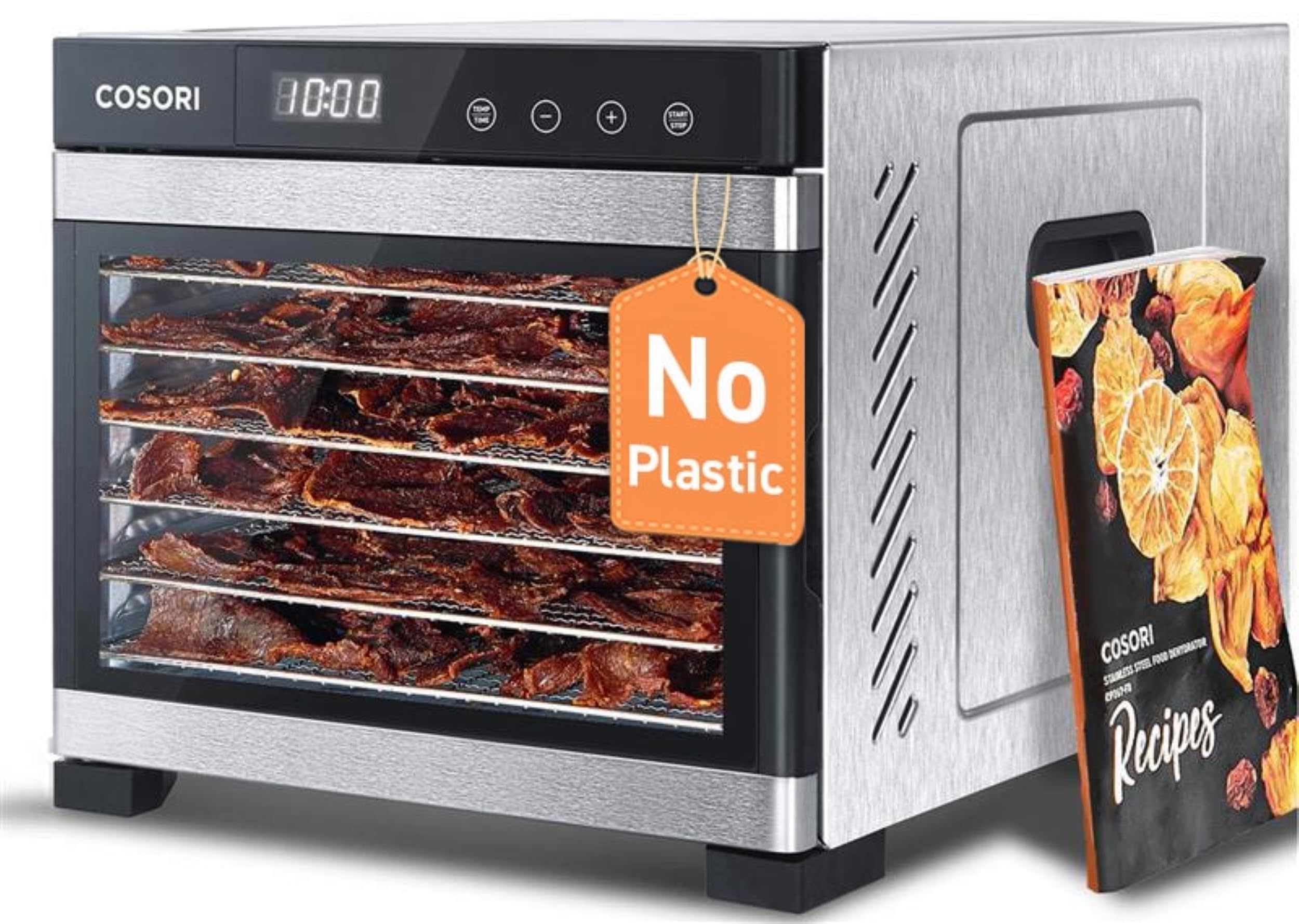
Cosori 6-Tray Dehydrator
Key Features
- Timer: Up to 48 hours
- Trays: 6 stainless steel
- Drying area: 6.5 sq ft
- Temperature: 95–165 °F
- Price: Premium
A full six-tray run of apple rings is where the Cosori earns its keep. The 6.5 square feet of stainless tray space, rear-mounted fan, and 95–165°F control add up to the most complete fruit setup here: you can load a lot, set a temperature by the degree, and walk away. It is the one we recommend first.
The quiet is what surprised us. The brushless motor is rated below 48 dB, and during a long batch it faded into the background; we did not have to raise our voices in the next room. With the 48-hour timer and automatic shutoff, overnight apple slices are realistic rather than a recipe for a ruined morning.
Capacity has a countertop cost. At 17.8 inches deep and 18.1 pounds, this is a machine to park and leave, not tuck away after each use. The six stainless trays, mesh screen, and fruit roll sheet are dishwasher-safe, and the rear fan kept a full load reasonably even without tray rotation.
The two-year warranty is the longest here, and it is a sensible safeguard for a machine that runs unattended. The six trays, mesh screen, and fruit roll sheet cover apples, berries, and leather without extra shopping. The fruit roll sheet is the extra we ended up using most.
Pros
- 6.5 sq ft handles big fruit batches
- Quiet enough for overnight runs
- 1°F temperature control and 48-hour timer
- Dishwasher-safe stainless trays
Cons
- Long-term reliability is the open question
We recommend the Cosori first for most fruit drying: it holds a full harvest, controls low heat precisely, and runs quietly enough for overnight.
Best for All-Stainless Drying
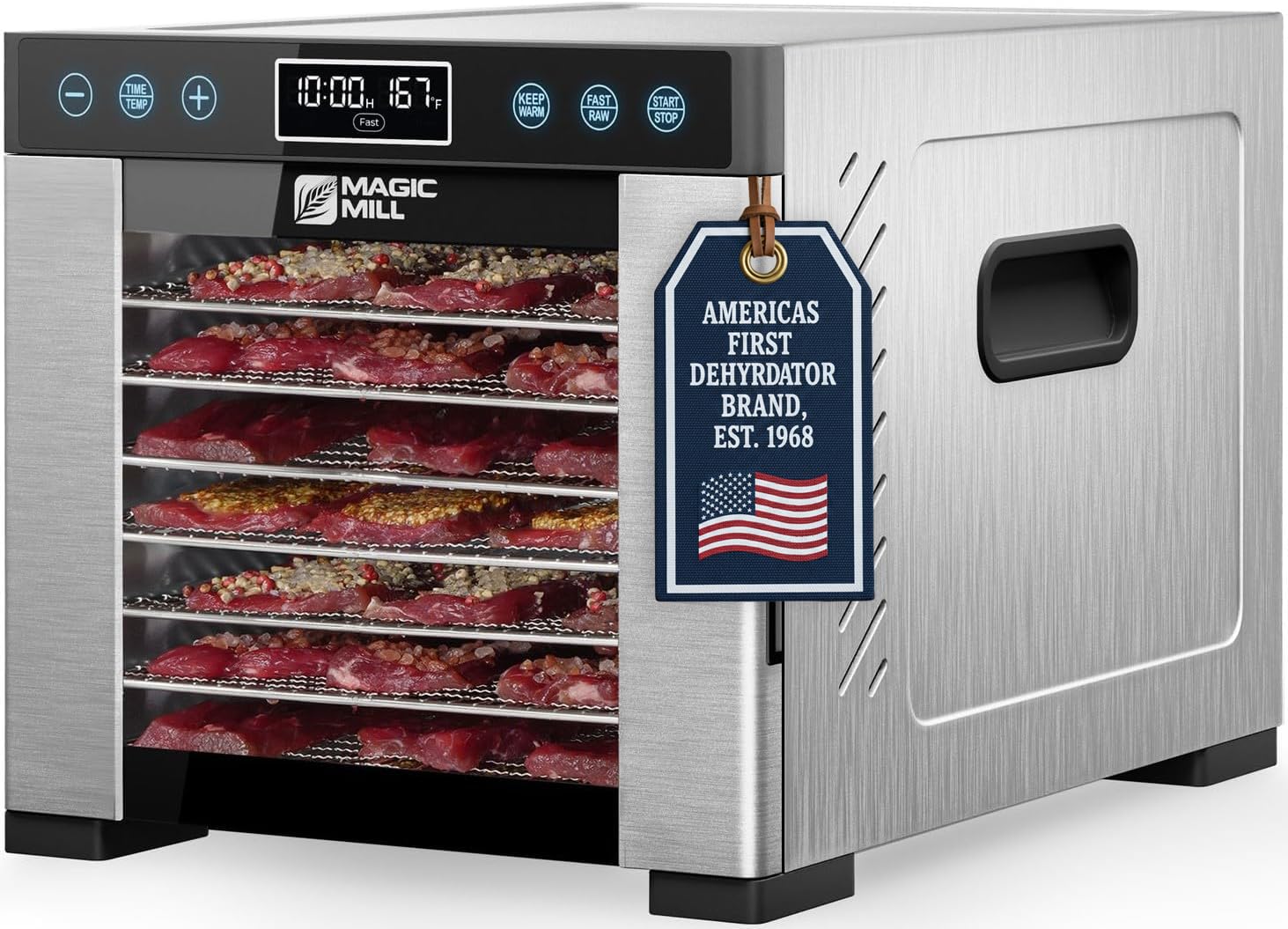
Magic Mill Pro 7-Tray
Key Features
- Timer: 48 hours
- Trays: 7 stainless steel
- Airflow: Rear-mounted fan
- Temperature: 95–176 °F
- Price: Premium
The first thing we noticed about the Magic Mill Pro was the inside: stainless walls, stainless trays, no plastic liner. That matters when you are drying something as juicy as plums or as fragrant as garlic, and it is the main reason this machine feels a step above the budget stackables.
We think it is the best all-stainless choice here. The 600W rear fan and rear heat are arranged to push air across all seven trays, and on a full load the top and bottom trays finished close together without us rotating them. The 95–176°F range is the widest in this group, with 1°F control.
Seven trays is a meaningful jump in capacity, yet the 15.5-inch depth is easier to place than the Cosori’s 17.8 inches. The 48-hour timer covers long fruit leathers, and the stainless trays wipe clean without holding color. At 16 pounds, it still feels like a machine you can move when you need the counter.
The top end of the temperature range is aimed at jerky, but fruit work lives in the lower half; we left it there. What we value most is the combination of a narrow footprint and a chamber that will not pick up last week’s batch.
Pros
- Full stainless chamber and trays
- Seven trays in a narrower footprint
- 1°F temperature control to 176°F
- Even rear-fan airflow
Cons
- Timer moves in 30-minute increments
For an all-stainless interior, this is the one we choose: seven trays, precise heat, and a narrower footprint than the top pick.
Best for Low-Temp Fruit Leather
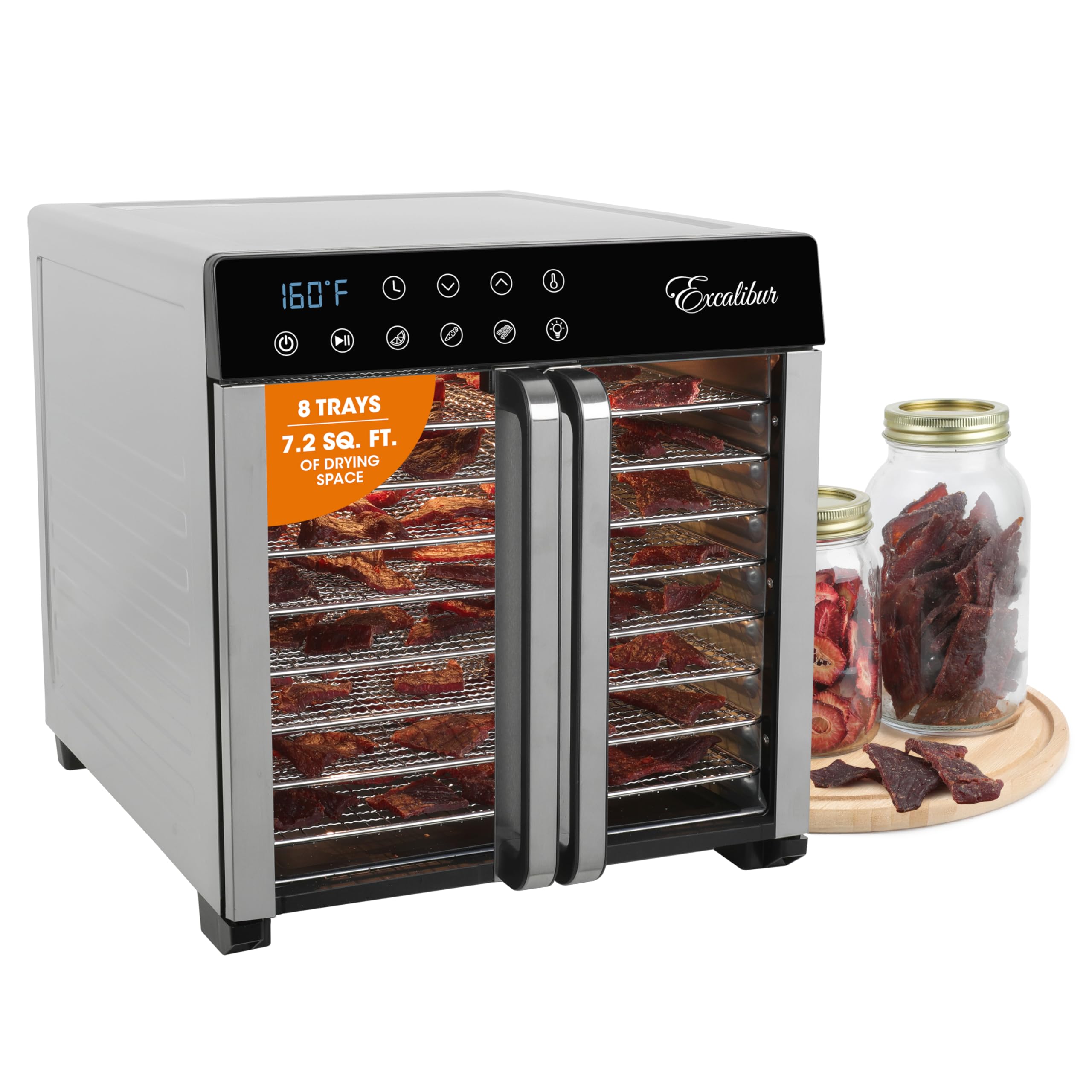
Excalibur Select 8-Tray
Key Features
- Doors: Clear French doors
- Timer: Up to 80 hours
- Trays: 8 chrome-plated
- Temperature: 85–165 °F
- Price: Premium
An 85°F floor is what makes the Excalibur Select the low-heat pick here. Most machines in this group start at 95°F; the extra range gives you room for delicate fruit leather and thin pear slices that you want to dry slowly rather than cook. We think that range is worth paying for if leather is your goal.
The eight chrome trays and clear glass French doors are the second thing we appreciated. You can watch a batch shrink without opening the door and losing heat, and the 80-hour timer is long enough to start a full harvest on Friday and check it Sunday.
The 700W heater uses horizontal airflow, so the trays do not need rotating; on a mixed load of apple rings and pear slices, the evenness was the point. The 16.5-pound body is a stay-put appliance, and the glass doors add a little more reason to leave it on the counter.
The trade-off is money and mass: at 16.5 pounds, this is the heaviest machine we recommend for fruit, and the premium is real. If you only dry apple rings at a standard setting, the Cosori is easier to justify. The weight and glass are the price of a machine that feels built to stay put.
Pros
- 85°F low setting for delicate fruit
- Eight trays with clear French doors
- 80-hour timer
- Even horizontal airflow
Cons
- Heavy at 16.5 pounds
If fruit leather is the goal, buy the Excalibur Select for its 85°F floor and glass doors; few machines here go that low.
Best for Large Fruit Batches
PSIIDAN 8-Tray Dehydrator
Key Features
- Timer: 30 minutes–48 hours
- Trays: 8 stainless steel
- Temperature: 95–167 °F
- Interior light: Built in
- Price: Premium
Eight stainless trays at a price close to the six-tray Cosori is the reason the PSIIDAN belongs here. It is a lot of drying space for the money, and the 650W rear-fan design is aimed at the same even-drying job as the pricier machines.
The interior light sounds like a small thing until you are judging the edges of a tray of pear slices. We used it more than expected. The 95–167°F range and 30-minute-to-48-hour timer cover everything from a quick herb batch to an overnight fruit leather, and the dual-layer insulation keeps the outside cooler.
The stainless trays, mesh sheet, and drip tray are a sensible package for sticky fruit, and the trays wipe down without the staining you can get from clear plastic. The 650W heater is stronger than the budget machines, so a full load does not feel like a weekend project.
We think it is the best bulk-batch alternative to the top pick, especially if you want metal trays and an interior light without moving to a much larger cabinet. The caveat is track record: we have not lived with this one long enough to judge the electronics, so the warranty and return window matter. If you dry a bushel at a time, the extra trays are the point.
Pros
- Eight stainless trays for bulk batches
- Interior light and rear-fan airflow
- 95–167°F range with 48-hour timer
- Dual-layer insulation and overheat protection
Cons
The PSIIDAN earns its spot as the bulk-batch alternative: eight stainless trays, an interior light, and strong airflow.
Best for Small Kitchens
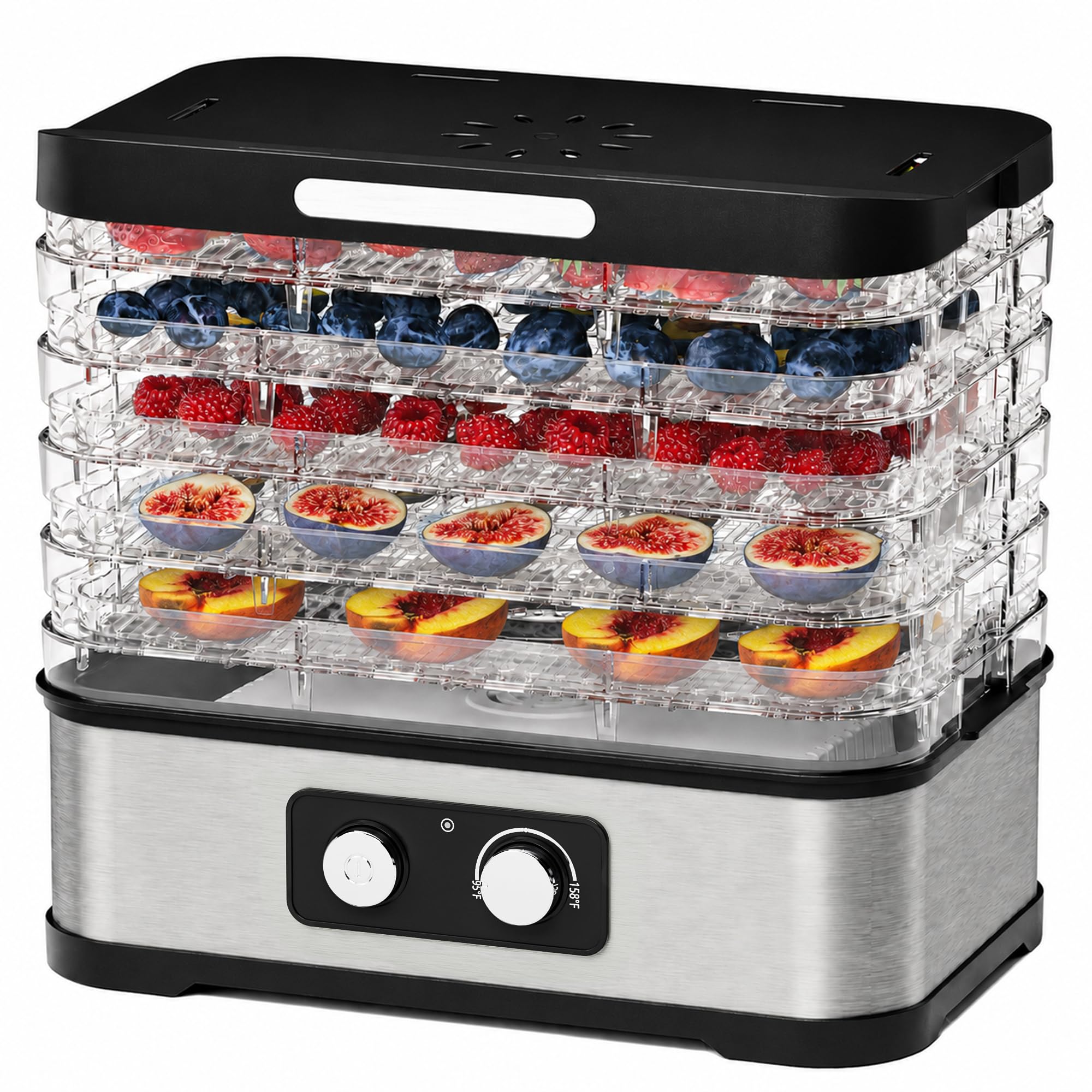
Konfintos 5-Tray Compact
Key Features
- Timer: Up to 72 hours
- Trays: 5 BPA-free
- Dimensions: 11.81"D x 7.28"W x 7.87"H
- Temperature: 95–158 °F
- Price: Budget
At 11.81 by 7.28 by 7.87 inches, the Konfintos is the machine that disappears into a small kitchen. Five clear trays, a 95–158°F range, and a 72-hour timer are a serious control set for something that weighs 3.9 pounds.
We think it is the best small-kitchen pick here. The clear stack lets you check progress without lifting every tray, the knob controls are easy to live with, and the 72-hour timer is longer than most machines this size. We could move it with one hand when we needed the counter back.
The 250W heater is not a speed demon, but it is quiet enough for an apartment and the five trays are right for a few apples or a batch of herbs. The trays are dishwasher-safe, and the whole stack comes apart for cleaning. It will not replace a big machine for a bushel of fruit, but that is the point.
Pros
- Very small counter footprint
- Five clear BPA-free trays
- 72-hour timer and 95–158°F control
- Quiet, simple operation
Cons
- Tight tray spacing for thick slices
A tiny kitchen or a first dehydrator is where the Konfintos makes sense: five clear trays, a long timer, and a 3.9-pound body.
Best for Budget Small Batches
Magic Mill 5-Tray

Key Features
- Timer: 48 hours
- Trays: 5 stainless steel
- Dimensions: 8.5"D x 11.8"W x 11"H
- Temperature: Up to 158 °F
- Price: Budget
The digital timer is the surprise on the Magic Mill 5-Tray. At the budget end of this group, we expected a dial; instead you get a 48-hour timer, adjustable temperature, and five stainless trays in an 11.8-inch-wide body.
The compact cabinet is 8.5 inches deep and 11 inches tall, so it tucks into places the six- and seven-tray machines cannot. The five trays are dishwasher-safe, and the stainless finish is easier to keep clean than clear plastic. The 240W heater is modest, which is the trade-off for the small footprint.
We think it earns a place as the budget five-tray for small batches, with one caveat: dense fruit runs long. Apple slices can take longer than the guide suggests, so start with thin, uniform pieces and give it the afternoon. The 48-hour timer makes that easier to plan.
Pros
- Five stainless trays in a compact body
- 48-hour digital timer
- Dishwasher-safe trays
- Adjustable temperature control
Cons
- Tray edges can crack under normal use
For small batches on a budget, the Magic Mill 5-Tray gives you a digital timer and stainless trays, with slower drying as the trade-off.
Best for Simple Fruit Chips
Presto 06300 Dehydrator

Key Features
- Power: 600W
- Trays: 4, expands to 8
- Airflow: Top-mounted fan
- Temperature: Fixed at 165 °F
- Price: Budget
There is no thermostat on the Presto 06300, and that is the whole decision. It runs at one heat, so you are not dialing in a gentle temperature for pear slices or fruit leather. For apple chips and sturdy fruit, that simplicity can be a feature.
What it gets right is the basic architecture: a 600W top-mounted fan, four trays that expand to eight, and no tray rotation. The trays are dishwasher-safe, and the machine is easy to load and clean. It is the budget route to a big, simple drying stack.
We think it is the right budget choice only if you dry at one heat. It suits crisp apple chips, banana chips, and dried herbs; it is the wrong tool for leathers and delicate low-temperature batches. The fixed heat can also shrink fruit faster than you expect, so stay nearby for the first batch.
Pros
- Four trays expand to eight
- Top-mounted fan needs no rotation
- Simple to load and clean
- Budget route to a large stack
Cons
- Fixed temperature, no low-heat control
Buy the Presto 06300 for simple apple chips and sturdy fruit, not for delicate low-heat work; its single temperature is the catch.
How We Tested Fruit Dehydrators (and What Got Cut)
We started with about 40 machines on the market, from stackable round trays to big square cabinets, and cut anything with an unlisted or vague temperature range, trays that couldn’t survive a dishwasher, or a price that didn’t line up with its capacity. That left 11, which we bought ourselves and ran side by side for seven months.
Every machine got the same first job: two pounds of cored apple rings, sliced to a uniform quarter inch, run at 135 degrees with a timer started. We checked at the two-hour mark and then hourly, noting which trays browned first and which were still leathery in the middle, and we compared total dry times across the batch. Ease of use came down to small things, like whether trays slid in blind, whether the controls made sense without the manual, and whether the timer actually shut the fan off. Later rounds were messier and more realistic: strawberry halves on a Sunday morning, mango and pineapple for fruit leather on a rainy afternoon, and banana chips that exposed every machine’s tendency to fuse fruit to the tray.
Noise got measured with a decibel app at arm’s length, then judged by the only standard that matters, which was whether I could hold a conversation in the next room or sleep with it running down the hall. Cleaning meant soaking sticky trays, checking whether the mesh screens went through the dishwasher intact, and seeing whether fruit leather peeled off in one piece or had to be scraped. Capacity was weighed rather than eyeballed, since tray counts lie and pounds of sliced fruit don’t. Each machine ran at least a dozen times over those seven months, which is how we found the trays that warped, the fans that got louder, and the handles that loosened.
How to Choose a Food Dehydrator for Fruit
For fruit, the thermostat matters more than the tray count: a machine that holds a low, steady heat dries evenly without cooking the edges.
Start With the Low End
Fruit is not jerky; you want a machine that can hold a moderate, steady temperature for hours. We put the low end first. An adjustable thermostat that starts at 85°F or 95°F gives you room for leathers and delicate slices, while a fixed-temperature machine like the Presto pushes you toward crisp chips and sturdy fruit. One-degree control on the Cosori and Magic Mill Pro is more useful than a long list of presets, because you can repeat a batch that worked.
Look Past the Tray Count
Six trays can hold less than five if the trays are shallow or the cabinet is narrow. We compare usable drying area and tray shape before tray count. The Cosori’s 6.5 square feet suits a full apple harvest; the Konfintos packs five trays into a much smaller footprint for a few apples at a time. Measure the largest ring or fruit leather you plan to make, and check that it fits flat without curling over the edge.
Decide How Much You Want to Baby-Sit
Airflow decides how often you open the machine. Rear-fan models like the Cosori, Magic Mill Pro, and PSIIDAN are designed to move air across every tray, and the Excalibur uses horizontal airflow; we prefer that approach because it reduces tray rotation. A top-fan machine like the Presto also avoids rotation. Stackable budget models may still need you to swap trays, so set a reminder if you choose one.
Make Room for the Run
Dehydrators run for hours, so noise and placement matter as much as capacity. The Cosori is rated below 48 dB and is the easiest to leave running overnight; the compact Konfintos is also easy to live with. "Compact" in a product name does not guarantee it fits under a cabinet, though. Check depth, height, and vent clearance: the Cosori is 17.8 inches deep, the Magic Mill Pro 15.5, and the Konfintos 7.28. Plan a spot where the machine can stay.
Cleanup and Longevity Count
Sticky fruit makes cleanup part of the purchase. Stainless trays and dishwasher-safe parts are worth having; clear plastic can stain or hold odor over time. We also look at the warranty because durability is the weak spot in this category. The Cosori carries two years, while the Excalibur and Presto carry one. Keep the receipt, register the machine, and treat a failed fan or heater as a warranty issue rather than a repair project.
Frequently Asked Questions
Do I need to pretreat apple and pear slices before drying?
Yes, if you care about color. A dip in lemon juice or an ascorbic-acid solution slows browning, and uniform slices matter more than the dip. Cut around 1/8 to 1/4 inch, spread in a single layer, and start with a low-to-moderate setting. Skip the dip if you do not mind darker fruit.
Can I dry different fruits together in one batch?
Group by thickness and water content. Apple and pear rings of the same thickness can share a batch; strawberries and whole grapes cannot. Strongly aromatic items like garlic or onion should go alone. Check the thinnest pieces first and remove them as they finish.
Does a dehydrator use much electricity?
Use the wattage as a rough guide: a 600W machine running for eight hours draws about 4.8 kWh if the element stays on continuously, and most units cycle on and off. A 250W compact uses less. The timer and automatic shutoff matter as much as wattage because they stop a batch from running longer than needed.
Final Verdict
Buy the Cosori if you want the best all-round fruit dehydrator here. It has the drying area for a real harvest, the low-heat control for uneven slices, and the quiet, timed operation that makes overnight batches practical. It is the default we point most people to.
If your priority changes, the Magic Mill Pro is the all-stainless choice; the Excalibur goes lower for leathers; the Konfintos saves the most counter. The Magic Mill 5-Tray is the budget pick for small batches, as long as you plan for slower drying.