This post contains affiliate links. We may earn a small commission when you buy through our links — at no extra cost to you.
A home espresso machine is an expensive way to make mediocre coffee—unless it holds temperature through back-to-back shots, steams milk without waking the neighbors, and keeps working after the honeymoon phase. I’ve learned that the difference between a machine you love and one you resent rarely comes down to the pressure gauge; it’s whether the second shot tastes as good as the first, and whether you can pull it before you’ve had coffee.
Over eight months, I pulled shots on 12 machines, from bare-bones manuals to push-button models, and the ones I kept reaching for made repeatable espresso with minimal fuss. Price mattered less than stable temperature and a steam wand that didn’t sputter. A machine that takes forever to heat up or leaks onto the counter is a machine you’ll stop using by week three. The picks ahead are the ones that earned their counter space—for straight shots, milk drinks, and the mornings when you need both.



Best for First Serious Setup
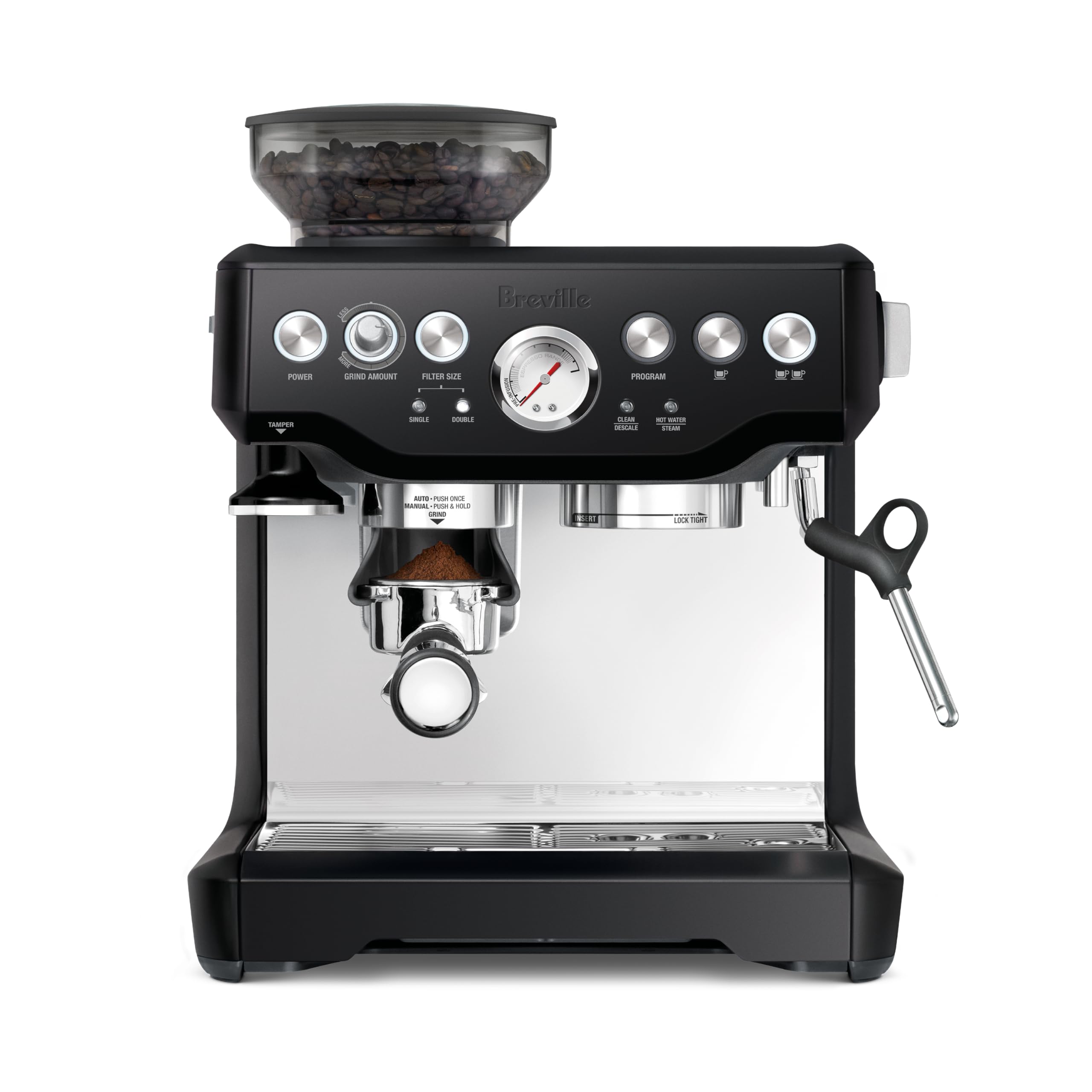
Breville Barista Express
Key Features
- Weight: 22.1 lb
- Grinder: Integrated conical burr
- Water tank: 67 fl oz
- Temperature control: PID
- Price: Premium
A grinder, a brew head and a steam wand in one 12.5-inch-wide body is the whole argument for the Barista Express, and it is why this is the machine we hand to anyone starting from nothing. You fill the hopper, the conical burr grinder doses fresh coffee straight into the portafilter, and there is nothing else to buy.
Digital temperature regulation keeps the brew water steady, and low-pressure pre-infusion wets the puck before full pressure arrives so the shot builds evenly instead of lurching. What we noticed after a few weeks was how little the machine drifts: same beans, same setting, same shot, which is the difference between learning and guessing. The 67-ounce tank means refills are not a daily chore, and 22.1 pounds keeps the machine planted when you lock the portafilter in.
It is not a push-button machine. Expect a couple of weeks of dialing in, grinding finer or coarser, nudging the dose, tasting, repeating, and a manual wand that needs practice before it produces latte-art microfoam. We minded the learning curve less than we expected, because the machine answers immediately: change one thing and the next shot tells you whether it worked.
One measurement to take before you commit to a spot on the counter: the machine stands 15.9 inches tall, so a low upper cabinet will rule out the corner you had in mind.
Pros
- Grinder, brew head and steam wand in one
- PID temperature control and pre-infusion
- Large 67 fl oz water tank
Cons
- Longevity is uneven; some units fail within a few years
We recommend the Barista Express to anyone who wants a real espresso setup without buying a grinder separately, because it is the most complete single purchase in this guide.
Best for Hands-Off Milk
Breville Barista Touch
Key Features
- Milk: Automatic steam wand
- Width: 15.5 in
- Grinder: Integrated conical burr
- Heat-up: ThermoJet, 3 seconds
- Price: Premium
The wand is the reason to buy this one. Set a milk temperature and texture on the touchscreen and the Barista Touch does the steaming itself, turning the step most people quietly give up on into a button press.
Underneath, it is our top pick’s formula with a faster heart: the same conical burr grinder dosing on demand, the same pre-infusion, plus a ThermoJet heater that reaches brew temperature in about three seconds, so you can pull a shot and steam milk without standing around. We think the screen and the automatic wand justify the jump in price if milk drinks are a daily habit and the technique is not something you want to learn. If you do want to learn it, the Express brews the same way for less.
It is the widest machine in this guide at 15.5 inches, and 21.8 pounds means it stays where you put it. The touchscreen is what changes ownership: you stop thinking in grams and seconds and start pressing the name of the drink you want.
Pros
- Automatic wand sets milk temperature and texture
- ThermoJet heat-up in about three seconds
- Touchscreen presets make repeat drinks easy
Cons
- Grinder and frother failures can arrive within a year
If you want café-style milk without learning to texture it, the Barista Touch delivers it from a preset, and we think that is worth the premium for daily latte drinkers.
Best for Espresso Plus Coffee
Ninja Luxe Café Premier
Key Features
- Milk: Hands-free dual froth
- Weight: 31.6 lb
- Brew styles: Espresso, drip, cold brew
- Grinder settings: 25
- Price: Premium
Most machines here make espresso and stop. The Luxe Café Premier also makes a pot of drip coffee and a cold brew, and froths milk hands-free while you get on with something else, which is why it earns its place as the pick for a household that cannot agree on one drink.
The hardware is more considered than that pitch suggests. A 25-setting conical burr grinder feeds an assisted tamper that takes the guesswork out of dose and pressure, Barista Assist walks you through each step, and the dual froth system combines a spinning whisk with steam so dairy and non-dairy milk both come out silky rather than bubbly. Cold brew here is built for speed rather than an overnight steep.
At 31.6 pounds it is the heaviest machine in this guide by a wide margin, and that is the trade: it sits rock-steady while it works, but you will not be sliding it to the sink to fill it. Decide where it lives before the box comes open.
Pros
- Espresso, drip coffee and cold brew in one
- Hands-free frothing for dairy and non-dairy milk
- 25 grind settings with an assisted tamper
Cons
- Motor and grinder failures can arrive within 15 months
For a household split between a latte drinker and someone who just wants a mug of coffee, we think the Luxe Café is the machine to buy.
Best for Brew Temperature Control
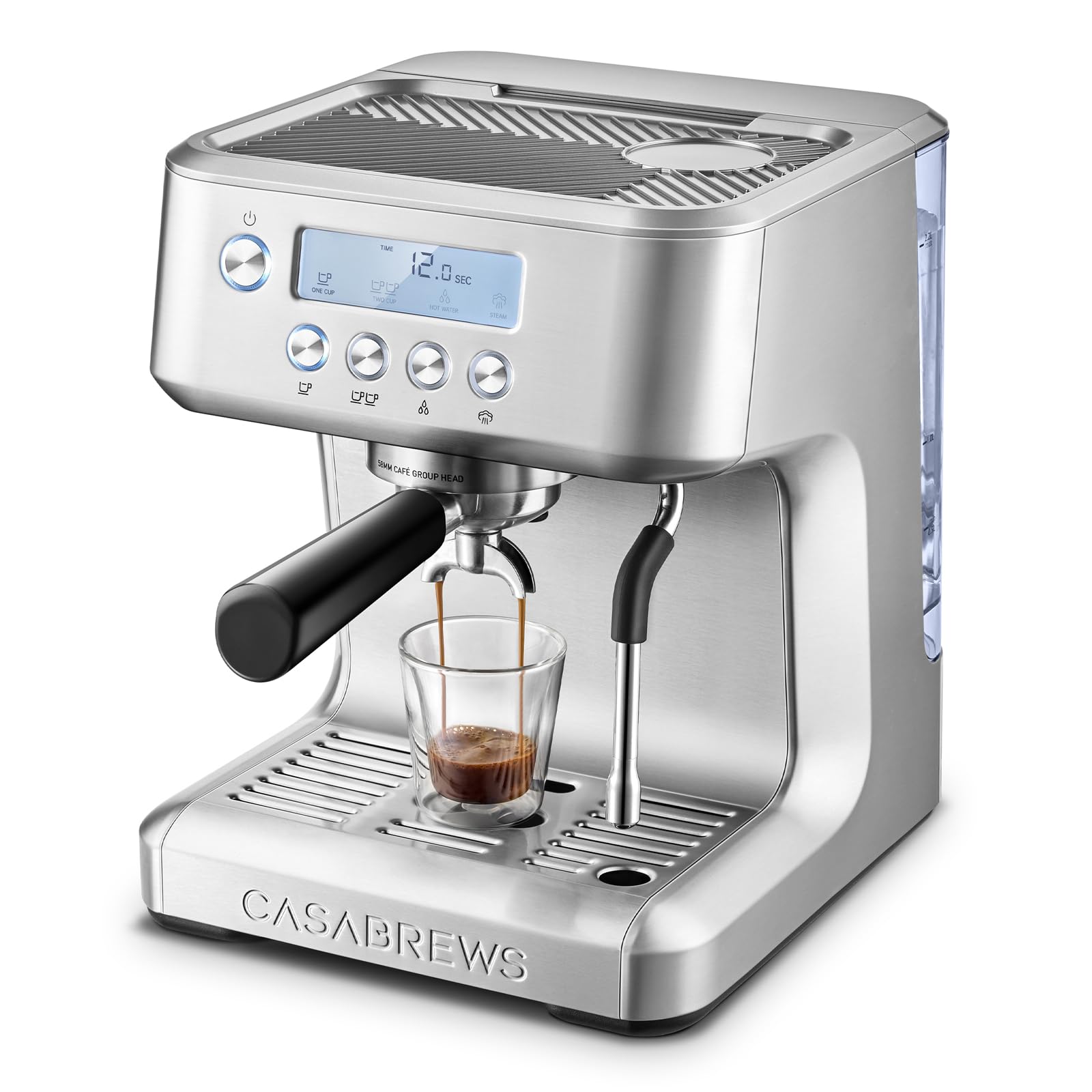
CASABREWS Ultra
Key Features
- Pump: 20 bar
- Water tank: 73 fl oz
- Portafilter: 58mm
- Brew temperatures: 4 settings
- Price: Midrange
The portafilter measures 58mm, the diameter most barista accessories are cut for, and that one number tells you who this machine is for: someone who already owns a grinder, a tamper and a favourite basket, and wants the rest of the setup to keep up.
Around that brew head there is more control than anything else at its price in this guide: four brewing temperatures set from the front panel, pre-programmed single and double shots, a hot-water function for americanos, and a 73-ounce tank that is the largest stated capacity here. At 10.31 inches wide and 13.6 pounds it still fits a normal counter.
No grinder, and that is the whole decision. We rate it the best step-up for someone who wants temperature control and a standard portafilter without paying premium money. Pair it with a decent burr grinder and it has everything the shot needs; skip the grinder and no temperature setting will rescue stale coffee.
Pros
- Four settable brew temperatures
- 58mm portafilter takes standard baskets
- 73 fl oz tank, the largest here
Cons
- No grinder; you supply ground coffee
Our pick for the tinkerer on a smaller budget: the Ultra gives you four brew temperatures and a 58mm portafilter, and asks you to bring your own grinder.
Best for Small Kitchens
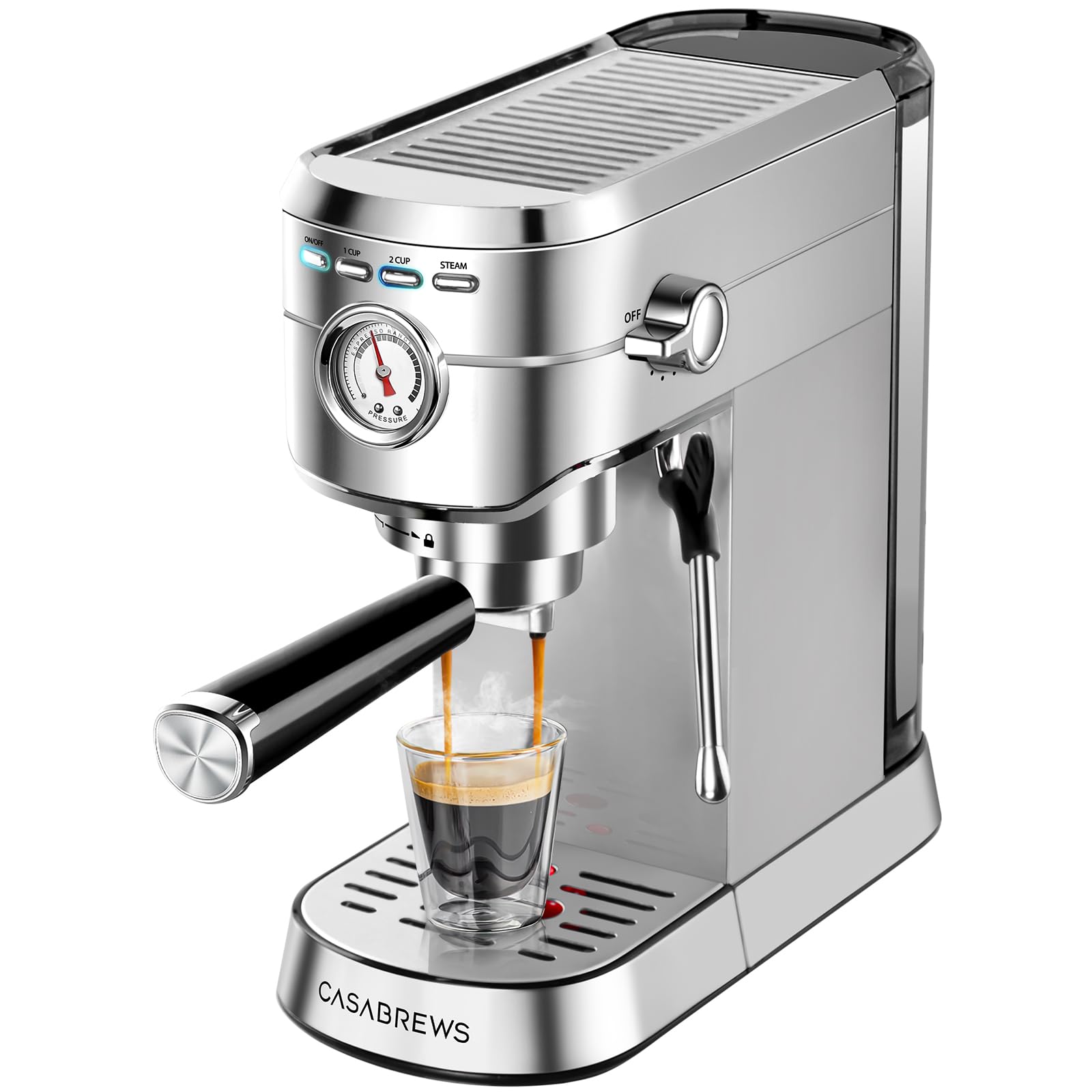
CASABREWS CM5418
Key Features
- Pump: 20 bar
- Width: 5.47 in
- Weight: 8.6 lb
- Water tank: 34 oz
- Price: Budget
At 5.47 inches wide, the CM5418 is the narrowest machine in this guide, a hair under the CHULUX, and at 8.6 pounds it will sit on the strip of counter between the sink and the wall that nothing else can use.
You give up remarkably little for the size. There is a 20-bar pump, a 51mm portafilter with single and double baskets, a steam wand that textures milk properly once you have practised, and a hot-water function, all wrapped in brushed stainless. We rate it the right first machine for a small kitchen precisely because it does not demand a dedicated coffee corner.
Two things to know before ordering. Cup clearance under the spout is tight, so measure your tallest mug against it. And some of these machines stop working altogether, which makes the one-year warranty worth reading rather than skimming.
Pros
- Narrowest footprint here at 5.47 in
- 20-bar pump and 51mm portafilter
- Hot-water function for americanos
Cons
- Tight clearance under the spout for tall mugs
The CM5418 is what we point to when the counter is the constraint: a real portafilter, steam wand and hot-water function in 5.47 inches.
Best for No-Fuss Mornings
Nespresso Vertuo Pop+
Key Features
- Heat-up: 30 seconds
- Cup sizes: Five, espresso to 12 oz
- Water tank: 25.4 fl oz
- Coffee input: Vertuo capsules
- Price: Budget
One capsule, one button, thirty seconds. The Pop+ heats up in about half a minute and brews five sizes, from a single espresso to a 12-ounce coffee, each with a layer of foam the machine builds in rather than one you have to steam.
The footprint is 8.6 inches wide and 7.9 pounds, and the 25.4-ounce tank clips to the side so you can lift it off and refill without moving the machine. It is the smallest tank here by a distance, which is the thing you will notice most in daily use.
The case for the Pop+ is that it removes every decision except which capsule: no grinder, no dose, no tamp, nothing to dial in. The trade is that the pods are the ongoing cost and the range belongs to Nespresso rather than to you, so it makes most sense for someone already buying a coffee a day.
Pros
- 30-second heat-up and one-touch brewing
- Five cup sizes from espresso to 12 oz
- Compact 8.6-inch footprint
Cons
- Loud enough to notice in a quiet kitchen
- Some coffee drips into the disposal tray
The Pop+ answers the question the other machines ignore: what if you do not want a hobby? One capsule, one button, espresso in half a minute.
Best for Second Setup
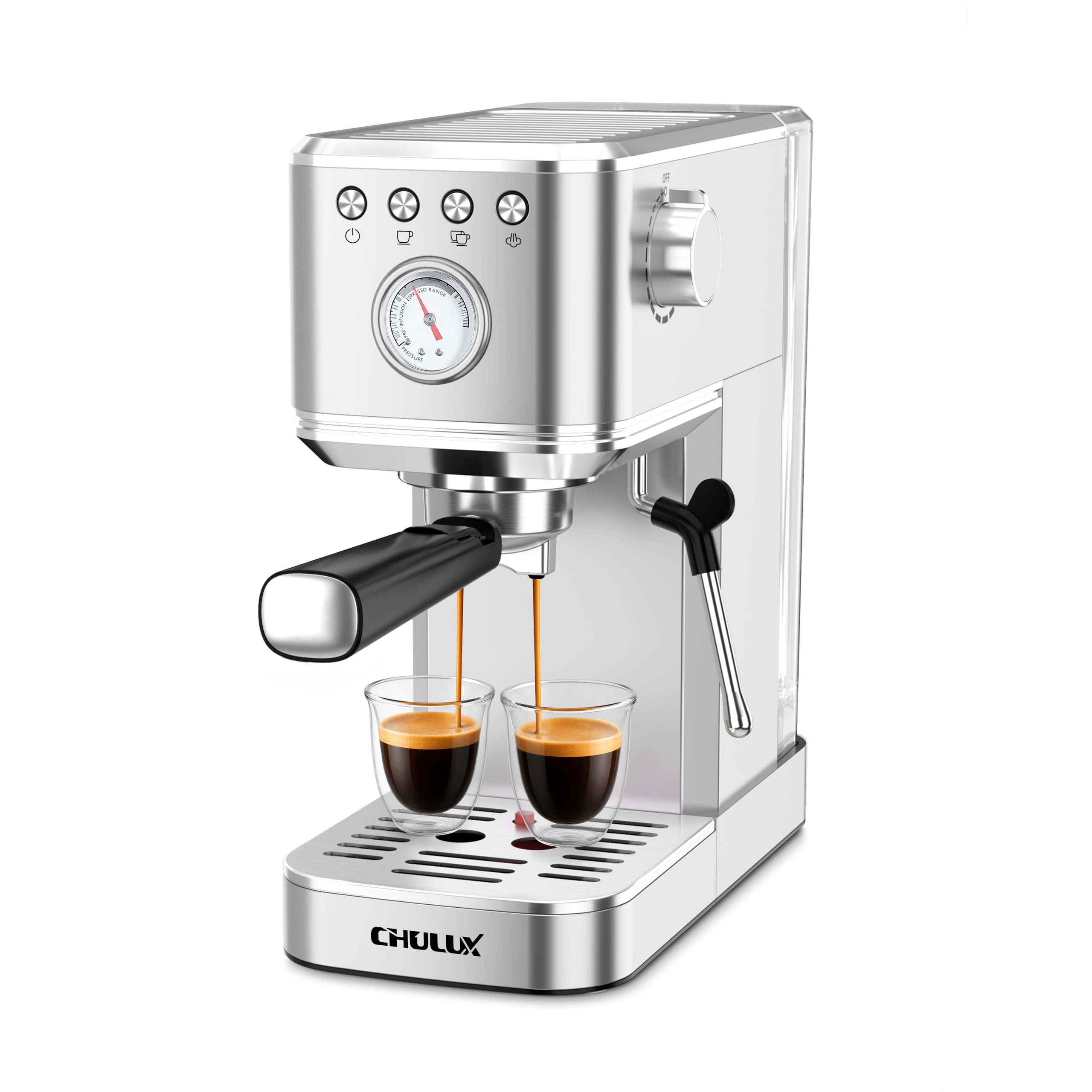
CHULUX C5010
Key Features
- Pump: 20 bar
- Width: 5.5 in
- Pressure gauge: Real-time readout
- Temperature control: PID
- Price: Budget
At 5.5 inches wide and 7.8 pounds, the CHULUX comes within a hair of the narrowest machine here and still finds room for a 40-ounce tank and a 20-bar pump.
The front panel is where the money went: a real-time pressure gauge, PID temperature control, pre-infusion and programmable shot buttons. That is a more informative face than several machines here that cost many times as much.
It feels like what it is, a light machine with a stainless wrap, and its steam wand needs practice before the foam is worth pouring. Neither is a dealbreaker at this end of the range, but this is not the machine you buy to impress anyone.
Where it makes sense is as a second setup: a desk at the office, a dorm room, a small apartment kitchen where the coffee maker and the kettle already fight for space. And the gauge is the detail that keeps it useful, because it tells you your grind is off before your tongue does.
Pros
- Real-time pressure gauge
- PID control and pre-infusion
- 5.5 in wide with a 40 oz tank
Cons
- Some units stop heating within months
We point anyone setting up a second coffee spot at the CHULUX: a pressure gauge, PID control and a real steam wand in a 5.5-inch frame.
How We Tested 12 Espresso Machines at Home
We started with a shortlist of more than 30 machines, reading owner reviews and spec sheets, then narrowed it to 12 that covered the main styles—single boiler, heat exchanger, dual boiler, and superautomatic—across a range of prices. We spent eight months with them, pulling shots every weekday morning before work and again on weekend brunches when friends came over.
Each machine started from cold at least once so we could time how long it took to reach brew temperature, and we pulled back-to-back doubles to see whether the second and third shots tasted as sweet as the first. We weighed doses and outputs, watched for sour or bitter notes, and handed the portafilter to a coffee-averse friend to see how many steps it took to get a drinkable shot. We also steamed milk for lattes and cappuccinos, noting whether the wand sputtered, scalded the milk, or cleaned up easily.
Noise got judged from the next room—could we hear it over the kettle? Reliability and durability meant living with them: we checked gaskets and steam knobs for wear, watched for drips under the reservoir and group head, and noted whether the drip tray filled faster than expected. Value came last: we compared what each machine could do—and how consistently it did it—against what it asked you to spend.
How to Choose an Espresso Machine
The right machine is the one that matches the drink you make most mornings; everything else is a specification you stop noticing within a month.
Grind at home, buy ground, or use pods
A built-in burr grinder is the biggest convenience a machine can offer, and it is why the two Breville Baristas take up so much of this guide: they grind on demand, so what lands in the basket is fresh. The CASABREWS machines assume you own a grinder, and the Vertuo Pop+ sidesteps the question with capsules. The trap is buying a grinder-less machine and feeding it pre-ground coffee from a bag opened a month ago. Espresso is unforgiving about staleness, and no pump pressure rescues it. If you do not own a grinder, price one in before you choose a machine, not after.
Decide how much milk you actually make
Milk separates these machines more than any other feature. A manual steam wand, on the Barista Express, both CASABREWS models and the CHULUX, gives the most control and demands the most practice; microfoam for latte art is a skill rather than a setting. Automatic systems, the Touch’s wand and the Ninja’s dual froth, do the work for you and charge more for it. Watch for the trap: big bubbles look impressive for ten seconds and collapse in the cup. If you drink cappuccino daily, either pay for the automation or commit to practising.
Read past the bar number
Almost every machine here advertises a 20-bar pump, and that figure tells you less than it appears to. Espresso brews at a fraction of that pressure, and the pump’s headline number is not what reaches the cup. Temperature is what you taste. PID regulation on the Barista Express and the CHULUX holds brew water steady, and the adjustable settings on the CASABREWS Ultra let you correct a shot that runs sour or bitter. Between two otherwise similar machines, take temperature control and pre-infusion over the larger bar figure.
Measure the counter, not just the machine
Espresso machines are deeper and taller than the gap people leave for them. The Barista Express stands 15.9 inches tall, so a low upper cabinet rules out the obvious corner; the Barista Touch runs 15.5 inches wide; the Ninja weighs 31.6 pounds, which matters if you planned to lift it. Measure width, depth, counter-to-cabinet height, and the clearance under the spout for your tallest mug. That last figure is the one almost no listing prints, and it decides whether you drink from a cup or a demitasse.
Budget for what comes after
The machine is the smallest part of the spend. Beans for a grinder-equipped model, pods for the Vertuo Pop+, and descaler for all of them add up over a year, and capsule machines trade cheaper hardware for more expensive coffee. Descaling matters more than buyers expect: scale is what kills pumps and heaters, and hard water makes it a frequent job. Check the warranty before you commit, since Breville covers two years and CASABREWS one, and if you drink two milk drinks a day, let the running cost of pods decide between capsule and bean.
Frequently Asked Questions
How do I know when the grind is right?
Taste it and time it. A double shot should run roughly 25 to 30 seconds and pour like warm honey. If it gushes out thin and pale, grind finer; if it drips slowly and tastes bitter, go coarser. Change one step at a time and keep the dose the same, or you will not know which change did the work.
Can I make regular coffee with an espresso machine?
Yes, as an americano: pull a shot and top it with hot water. Both CASABREWS machines have a hot-water function for exactly this, which gives you a long black rather than a filter-style cup. Only the Ninja Luxe Café has a true drip side and a cold-brew setting, so pick it if a pot of coffee matters as much as espresso.
Do these machines need plumbing?
No. Every machine here fills from a removable tank, from 25.4 ounces on the Vertuo Pop+ to 73 ounces on the CASABREWS Ultra, so what you need near the machine is a power outlet and a clear path to the sink. A larger tank means fewer refills; a smaller one is easier to lift, rinse and fill.
Can I brew and steam at the same time?
Not on the single-boiler machines. On the CASABREWS models the boiler has to cool after frothing before it will brew again, and the shot buttons flash until it does, so brew first and steam second. If you make several milk drinks back to back, a machine with a ThermoJet heater, like the Barista Touch, switches between the two in seconds.
Final Verdict
The Breville Barista Express is the machine we recommend to most people: a conical burr grinder, PID control, pre-infusion and a real steam wand in one 12.5-inch body, for less than the Barista Touch that automates the milk.
If milk technique is the step you know you will not practise, pay for the Touch and let its wand do it. And if you do not want to grind at all, the Vertuo Pop+ takes the job away entirely, with the pods as what you pay for that.