This post contains affiliate links. We may earn a small commission when you buy through our links — at no extra cost to you.
Nut butter is the hardest thing you can ask a food processor to do. Almonds go from crumbs to a dry clump to a paste that creeps up the bowl, and the motor has to grind through every stage without a break. Plenty of machines stall at the powder stage, smell hot, or leave you with gritty butter and a blade hub packed solid. What separates the good ones is torque that holds up over eight or ten minutes of continuous running, a bowl you can scrape without losing a knuckle, and a lid that comes off cleanly when everything is sticky.
Over the past eight months, my team and I made almond, peanut, and cashew butter in 11 food processors — often three batches back to back — and the pattern had less to do with wattage than I expected. Here’s what nobody tells a first-time buyer: most people stop about thirty seconds before the butter turns glossy, because the machine sounds terrible right before it starts working. The picks below are the ones that kept going.


Best for Everyday Nut Butter
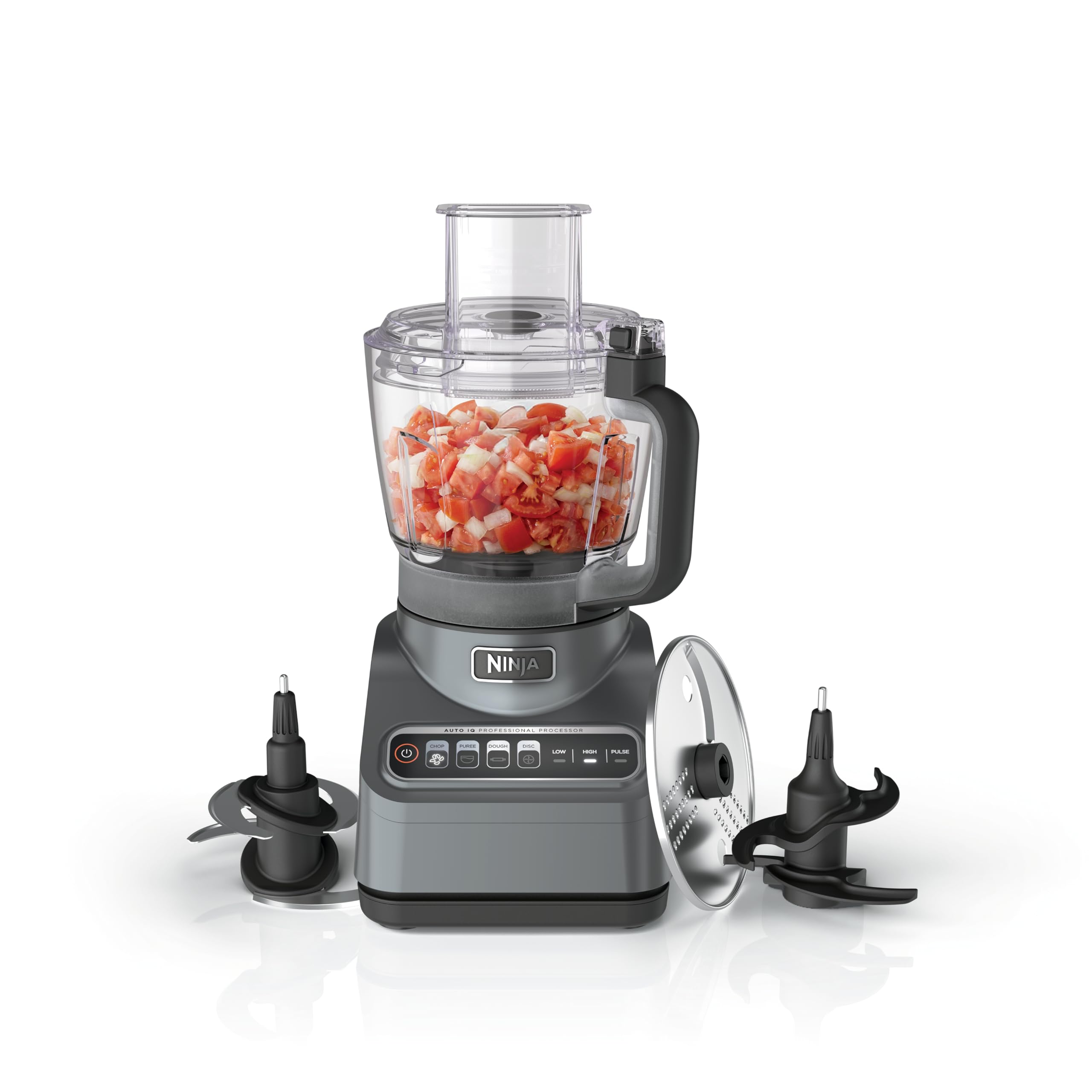
Ninja Professional Plus BN601
Key Features
- Motor: 1000 peak watts
- Controls: 3 speeds, 4 Auto-iQ presets
- Dimensions: 7.76" D x 9.88" W x 16.02" H
- Bowl capacity: 9 cups
- Price: Midrange
A thousand watts is the number a nut-butter shopper scans for, and the Ninja BN601 is the machine here that makes the most of it. It’s a peak rating rather than a continuous one — the figure describes a hard burst, not a promise about ten minutes of grinding — so what actually matters is whether the motor keeps turning once the almonds stop being crumbs and start being paste. Ours did, provided we worked in pulses and scraped the bowl down between them.
What we hadn’t expected was how much of the work the manual controls do. The Auto-iQ presets are genuinely useful for onions and dough, but each one runs a fixed cycle and then stops, well before nuts have given up their oil, so nut butter happens on the three speeds and the pulse button with the machine under your hand. The 9-cup bowl is the other half of the argument: fill it much past two-thirds and the blade carves a tunnel through the paste while the sides stay dry. Nine cups means a batch worth the cleanup, with enough headroom for the nuts to keep tumbling.
The bowl, lid and blades come apart for washing, and a hot rinse before the paste sets saves you a soak. Against the premium machines here it gives up capacity and not much else, and it costs the least of the high-power group. If you want one machine that chops, slices, mixes dough and turns out a jar of peanut butter on a Sunday, start here.
Pros
- 1000 peak watts for a full bowl of nuts
- 9-cup bowl leaves room for nuts to churn
- Three speeds plus pulse for long grinds
- Least expensive of the high-power machines here
Cons
- Plastic lid is the part that fails over time
The machine we point most nut-butter buyers to: 1000 peak watts, a 9-cup bowl with room for the nuts to churn, and the friendliest price among the high-power picks.
Best for Big Batches
Cuisinart Pro Custom 11
Key Features
- Motor: 625 watts
- Weight: 16.9 lb
- Included: Steel blade, three slicing/shredding discs, spatula
- Bowl capacity: 11 cups
- Price: Premium
Eleven cups is the largest bowl in this group, and it changes what a batch means: where the 9-cup machines here give you a jar, this one gives you several. The motor is rated at 625 watts, which is not the biggest number on this page, but it sits in a base that weighs 16.9 pounds, and that mass is why the machine stays planted through a long, vibrating grind instead of creeping toward the counter’s edge.
Getting the lid on takes learning. It latches at the back rather than the front, so you press the rear edge down first and then the front; fight that sequence and you’ll be lifting the lid off to reseat a blade that popped out of place. Once we had the order right it stopped being a nuisance. We think the fiddling is worth it — the reward is a bowl deep enough to justify the setup, and this is the machine in this group with the best long-term record behind its motor.
Three slicing and shredding discs come in the box, which is what keeps it on the counter between nut butter days: it slices, shreds and grates with a steadiness the plastic-bowl machines here don’t match, and it feels like a scaled-down commercial unit. The catch is where it lives. It’s the heaviest thing here and one of the bulkiest, and hauling it out of a low cupboard with a bowl of paste in your other hand gets old.
Pros
- 11-cup bowl handles the largest batches here
- 16.9-pound base stays put during long grinds
- Three slicing and shredding discs included
- Power and reliability record suited to dense paste
Cons
- Only one speed, plus pulse
- Bowl and lid feel less robust than the motor
For anyone making nut butter in quantity, this is the pick — the biggest bowl here on a base heavy enough to stay put through a long grind.
Best for Small Kitchens
Cuisinart Pro Classic 7-Cup
Key Features
- Motor: 600 watts
- Warranty: 5 years on motor, 3 years limited
- Dimensions: 7" D x 11.25" W x 14.5" H
- Bowl capacity: 7 cups
- Price: Premium
Seven cups is the floor for making nut butter, and the Cuisinart Pro Classic is the machine that shows what that floor means: a batch just big enough for one jar, ground by a 600-watt motor that comes as a relief after the 1500-watt Ninja. We noticed the difference on the second batch — with the loud machines you leave the kitchen, with this one you don’t have to.
The flat cover is the detail we ended up appreciating most. Swap the feed-tube lid for the compact one and the whole thing stores low enough to slide under a shelf, which is more than the tall machines here manage. Then there’s the warranty: three years limited, five on the motor. That’s the longest coverage in this group by a wide margin, and for a job that punishes motors it’s worth more than any preset.
Everything else is small-kitchen sensible — an extra-large feed tube that takes whole tomatoes and potatoes, and a 4mm slicing disc we used more than any other attachment. What it won’t do is keep up with a household that goes through nut butter quickly: at 7 cups you’re making it twice as often as you would with the 9- or 11-cup machines, and that’s the whole trade.
Pros
- Flat cover lets it store low under a shelf
- 600 watts in a noticeably quieter machine
- Five-year motor warranty, the longest here
- Extra-large feed tube takes whole produce
Cons
- Bowl and lid are hand wash only
- Lid plastic is the part that cracks first
We recommend it to small households and small counters: a 7-cup batch, a quiet motor, and the longest motor warranty in this group.
Best for Smooth Nut Butter
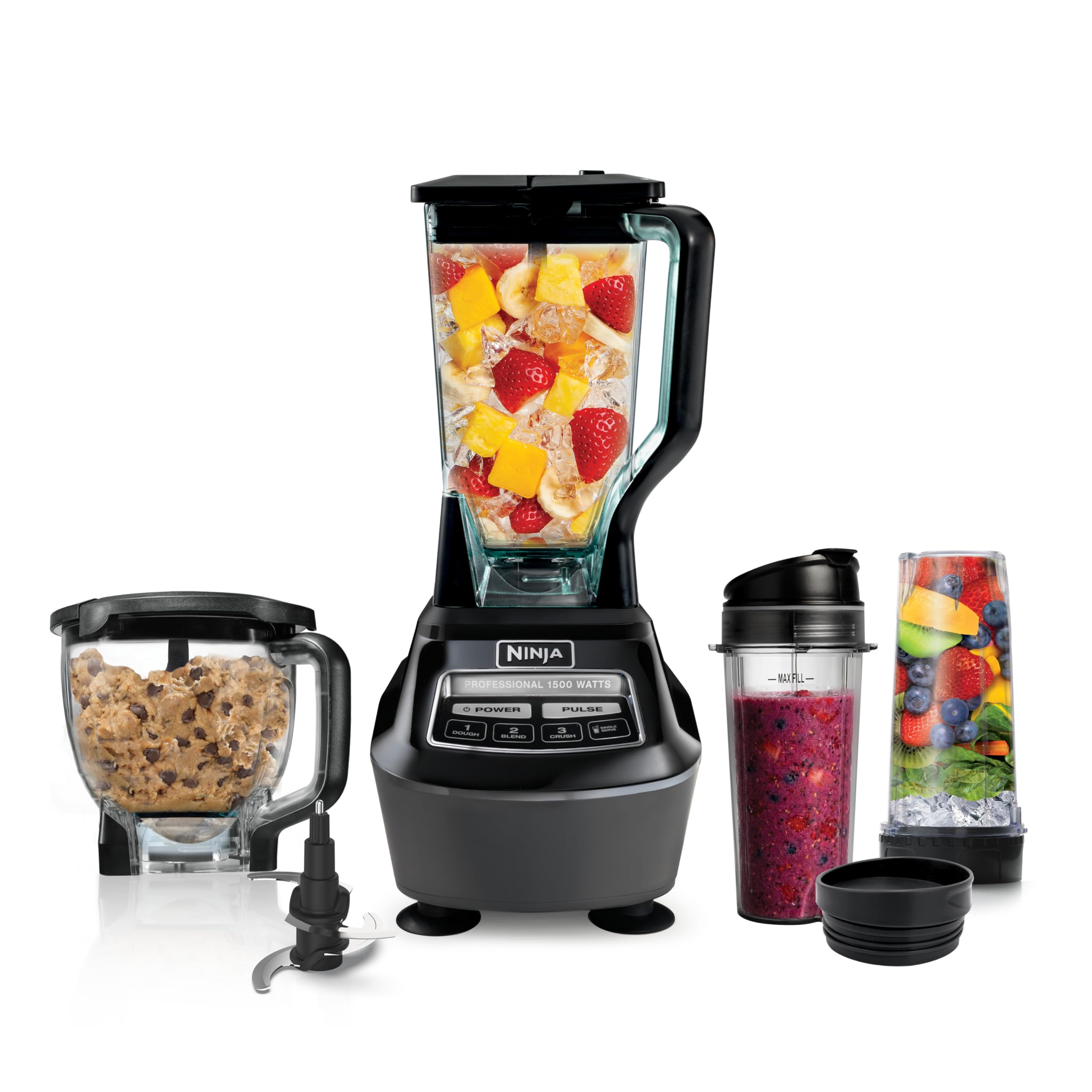
Ninja Mega Kitchen System BL770
Key Features
- Motor: 1500 watts
- Weight: 9.2 lb
- Processor bowl: 8 cups
- Blender pitcher: 72 oz
- Price: Premium
A 72-ounce pitcher and an 8-cup processor bowl on one 1500-watt base — the BL770 is the only machine here that answers two questions at once. For nut butter you’ll reach for the pitcher, because a fast vortex pulls almonds into a smooth butter in a way a flat processor bowl struggles to match, and there’s enough headroom that the motor never sounds like it’s straining.
Heat is the catch with a blender. Keep running and the friction that smooths the butter also warms it, and thick spread turns pourable without much warning. We stop while it still holds a shape, scrape down, and give it a rest before the next run — with this much power, short bursts finish the job. The 8-cup bowl is the more conventional route and handles a decent batch, though it’s the smaller half of the system.
So the case for it is a particular kitchen: smoothies most mornings, nut butter often enough to care, and a deep stretch of counter for an 18-inch machine. If what you want is a food processor first, the BN601 does that job with less fuss and takes up less room. If you want one motor that does both, nothing here is more capable.
Pros
- 1500 watts, the most power in this group
- 72-oz pitcher makes smooth, pourable batches
- 8-cup processor bowl for chopping and dough
- One base covers blending and processing
Cons
- Very loud at full speed
- One-year warranty, shortest of the premium picks
Buy it if you want one motor for smoothies and nut butter and you have the counter to park it — 1500 watts is the most power here by a wide margin.
Best for Budget Batches
Hamilton Beach 70730

Key Features
- Motor: 450 watts
- Speeds: 2 plus pulse
- Weight: 6.2 lb
- Bowl capacity: 10 cups
- Price: Budget
Ten cups for less money than anything else here is a strong opening line, and the bowl is genuinely ten cups — bigger than either Ninja’s, second only to the Cuisinart Pro Custom 11. The motor is the smallest in this group at 450 watts, which is the trade the price makes: this machine will turn nuts into butter, in modest batches, as long as you don’t ask it for a month’s supply at once.
The bowl scraper earned its place the first time we made almond butter in it. It’s a manual arm you move side to side while the machine runs, and with a paste that climbs the walls and leaves the blade spinning in a hollow, that’s the difference between stopping to scrape constantly and hardly stopping at all. The suction-cup feet are the other small thing that matters — the base doesn’t travel.
The bowl and discs come apart for washing, and two speeds plus pulse give you enough control to work gradually rather than in one long, hot run. Just go in with the right expectations. This is the pick for someone who makes a jar of almond butter now and then and wants a big bowl without spending much; a household grinding weekly should spend the extra on the bigger motor, and the jar-a-month cook won’t miss it.
Pros
- 10-cup bowl at the lowest price here
- Manual bowl scraper keeps thick paste moving
- Suction-cup feet hold the base still
- Two speeds plus pulse for gradual grinding
Cons
- 450 watts caps batch size
- Motor and plastic are the weak point over time
Our budget pick for a household that makes a jar now and then: ten cups, a scraper that does real work, and a motor to treat gently.
How We Tested Nut Butter in 11 Food Processors
We started with a list of roughly 40 full-size food processors, setting aside mini choppers and anything with a bowl too small to hold two cups of nuts. We narrowed by motor rating, blade geometry, bowl capacity, and whether the manual explicitly rated the machine for long, uninterrupted running — a detail that turns out to matter more than wattage. That left 11 machines, all bought at retail so no one could send us a tuned-up unit.
Every machine made nut butter at least four times, in home kitchens, on weekday evenings and weekend mornings when the counters were already messy. Each batch started with two cups of nuts: raw almonds, which are the slowest and the real test of patience; roasted peanuts, which come together fast; and cashews, which throw the most paste up the walls. We timed switch-on to pourable butter, counted how many times we had to stop and scrape, and checked the base for hot spots with an infrared thermometer between batches. Noise got measured at counter height, and the spread was wide — a few crossed 90 decibels, while others we could talk over.
Cleaning was done by hand every time, even on the models claiming dishwasher-safe parts, because nut butter hides in lid gaskets and around the blade hub and we wanted to see it. We noted whether the lid locked with one hand, whether the feed tube was wide enough to add nuts mid-run, and whether the seal came out for washing. Durability came from running three batches back to back and then sniffing for hot plastic, and value came down to a simple question: did the machine finish the job on its own, or did we end up adding oil or reaching for something else?
How to Choose a Food Processor for Nut Butter
Nut butter is the hardest everyday job a food processor takes on, and the number printed largest on the box is rarely the one that gets it smooth.
Peak Watts and What They Actually Promise
There’s a reason the numbers on these boxes are so big: wattage is usually a peak figure, describing the moment the motor works hardest rather than a rating for twenty minutes of grinding. Nut butter is a long, heavy job — the nuts stop flowing and start resisting — so the useful question isn’t who has the biggest number but whether the machine has pulse control and enough mass to sit still while you use it.
Plan on short runs, a scrape between each, and a rest every so often. The 1500-watt Ninja has the most headroom here; the 1000-peak-watt Ninja is the realistic baseline for a full bowl of nuts.
Work Bowl Size: Bigger Isn’t Greedy
A full bowl of nuts will not become butter. The blade needs a gap to throw them through, and once the paste packs the walls the blade just spins in a hole. Fill these bowls two-thirds at most, which makes the stated capacity a little misleading: a 7-cup machine gives you a small jar per batch, a 9- to 11-cup machine gives you a proper one.
Buy the largest bowl you can store and afford — the Cuisinart Pro Custom 11 is the roomiest here at 11 cups — and expect to scrape down whatever you choose.
The Parts That Fail
Ask what breaks and the answer is rarely the motor first: it’s the plastic lid, the feed tube and the hub that holds the blade. Nut paste is close to the worst thing you can put in one of these — dense, sticky and warm from friction — and the load lands on those parts.
Two habits help. Hand wash the lid even when the maker says it’s dishwasher safe, because heat and detergent are hard on plastic, and give the motor a break instead of running it until the paste is perfectly smooth. Warranty length is the best proxy for how much the maker trusts the machine: one year on both Ninjas, three years plus five on the Cuisinart Pro Classic’s motor.
Counter Space, Weight and Cleanup
These are tall appliances. Most run 14 to 16 inches high and the Ninja combo is over 18, so measure the clearance under your cabinets before you decide one lives on the counter. Weight cuts both ways: the 16.9-pound Cuisinart stays planted through a long grind, while the 6.2-pound Hamilton Beach is easier to haul out and put away.
For cleanup, look for a bowl with smooth sides and a blade you can lift out without hunting for a release, and rinse with hot water before nut butter sets, because once it does you’re soaking.
Frequently Asked Questions
Do I need to roast the nuts or add oil?
Neither is required, but warm nuts give up their oil faster, so a few minutes in a dry pan shortens the grind. Add oil only if the paste stays powdery after several rounds of pulsing — a teaspoon of a neutral oil at a time. Never add water; it seizes the mixture into something that won’t smooth out.
Is a blender better than a food processor for nut butter?
For a small batch of thin, pourable butter, a high-power blender with a tamper gets there faster. For a full jar of thick spread, a food processor’s wide bowl and slower blade need less scraping and fewer stops. A standard blender will strain and stall, so only the 1500-watt class is worth trying.
How long does homemade nut butter keep?
Store it in a clean jar with a tight lid in the fridge and plan on a few weeks rather than months — without the stabilizers commercial brands add, the oil separates and the flavor fades. Stir the separated oil back in rather than pouring it off, and make small batches until you know your household’s pace.
Final Verdict
For most kitchens the Ninja Professional Plus BN601 is the answer: 1000 peak watts for a full bowl of nuts, a 9-cup bowl with room to churn, and the lowest outlay of the high-power machines here. Grind in pulses, don’t wait on the presets, and it will make a jar of peanut butter as readily as it chops an onion.
Step up to the Cuisinart Pro Custom 11 when one session needs to fill several jars — the largest bowl here, on a base heavy enough to stay put. If counter space or noise is the constraint, the Cuisinart Pro Classic 7-Cup is the quieter machine with the longest motor warranty, as long as you’re content making nut butter a jar at a time.