This post contains affiliate links. We may earn a small commission when you buy through our links — at no extra cost to you.
A food chopper should save you the knife work, not hand you a different chore. The promise is simple: drop in an onion or herbs, press or pull, and get dinner moving. The reality depends on whether the blades reach the edges, whether the lid seals without a fight, and whether you can rinse it without fishing onion paper out of a gasket. I keep a chef’s knife close, but on weeknights I want fewer steps and less mess—and no chopper that turns carrots into half mush and half rocks.
Over the past six months, we worked through 12 manual and electric food choppers, mostly on onions, garlic, herbs, nuts, and carrots. The good ones loaded quickly, cleaned up by hand, and chopped evenly enough that I stopped checking every batch. The bad ones dulled fast, struggled with anything firmer than a mushroom, or left paste where I wanted slices. We weighed value against how often you would reach for one, not the sticker, and the picks below are the ones that earned counter space.



Best for Everyday Chopping
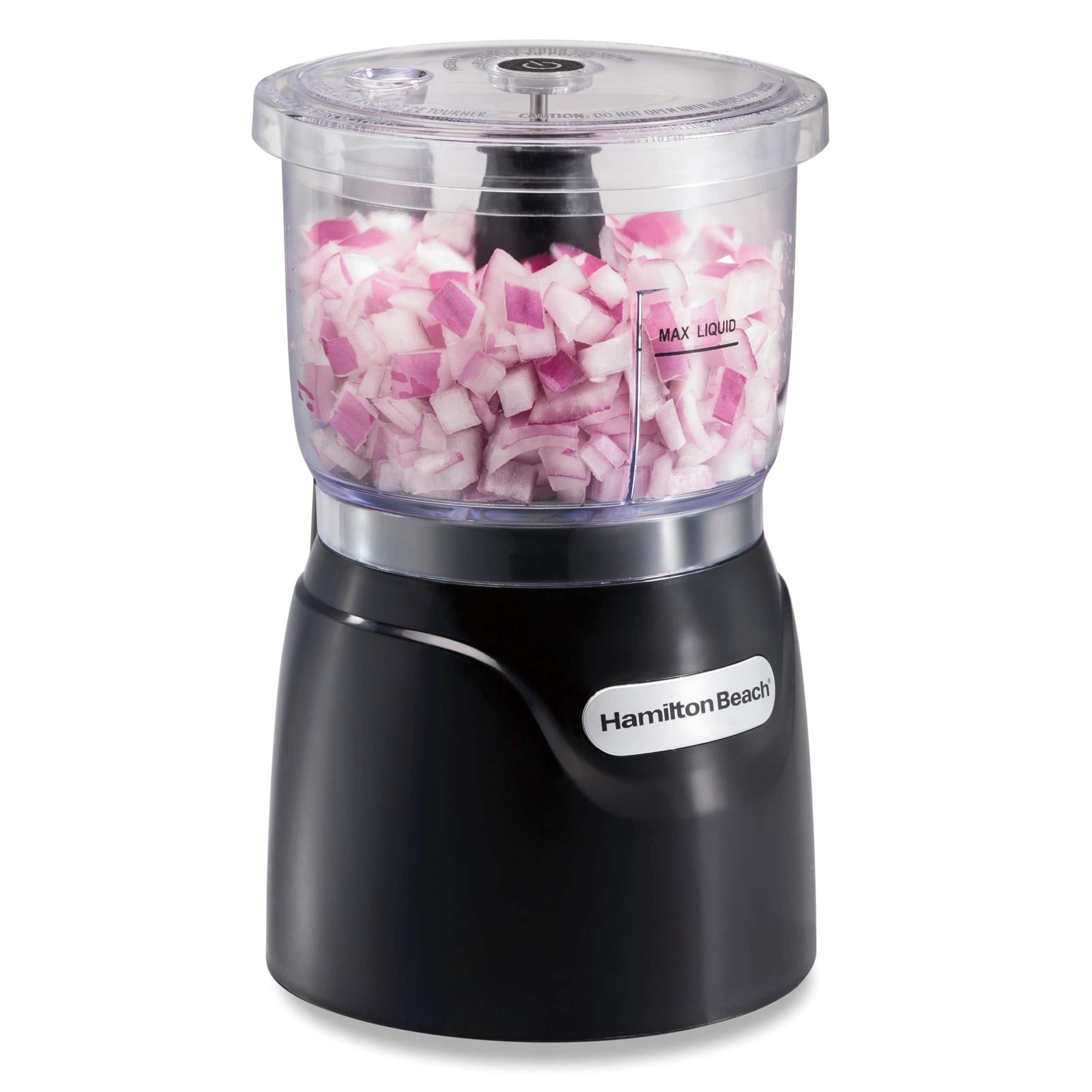
Hamilton Beach 3-Cup Chopper
Key Features
- Motor: 350 watts
- Controls: Stack and press
- Bowl capacity: 3 cups
- Dishwasher safe: Bowl, lid and blade
- Price: Budget
There is no button to find on the Hamilton Beach. You stack the bowl on the base, drop the blade over the spindle, set the lid on top and press down; let go and it stops. That stack-and-press arrangement is the entire interface, and it is a large part of why this is the chopper we point most people toward.
Three cups and 350 watts turn out to be a very useful size. Onions, carrots, parsley and nuts all went through without the motor feeling like the limit, and there is more in reserve here than a machine in this bracket usually offers. Because the lid is also the switch, you get pulse control by feel: short presses for a coarse chop, a longer hold when you want something closer to a puree. Hummus and pesto come out smooth enough that we stopped hauling out the full-size processor for them.
The bowl, lid and blade all go on the dishwasher’s top rack, so cleanup is three pieces and no brush. Where it runs out is volume. Prepping for a crowd means emptying the bowl three or four times, and it will not slice or julienne anything. For a household chopping an onion, a pepper and a handful of herbs at a time, neither of those matters much.
Pros
- 350 watts with power in reserve
- Press the lid to chop, release to stop
- Bowl, lid and blade are dishwasher safe
Cons
- 3 cups fills fast when prepping for a crowd
We recommend it as the default: enough power for onions, nuts and hummus, and only three pieces to wash afterward.
Best for Herbs and Nuts
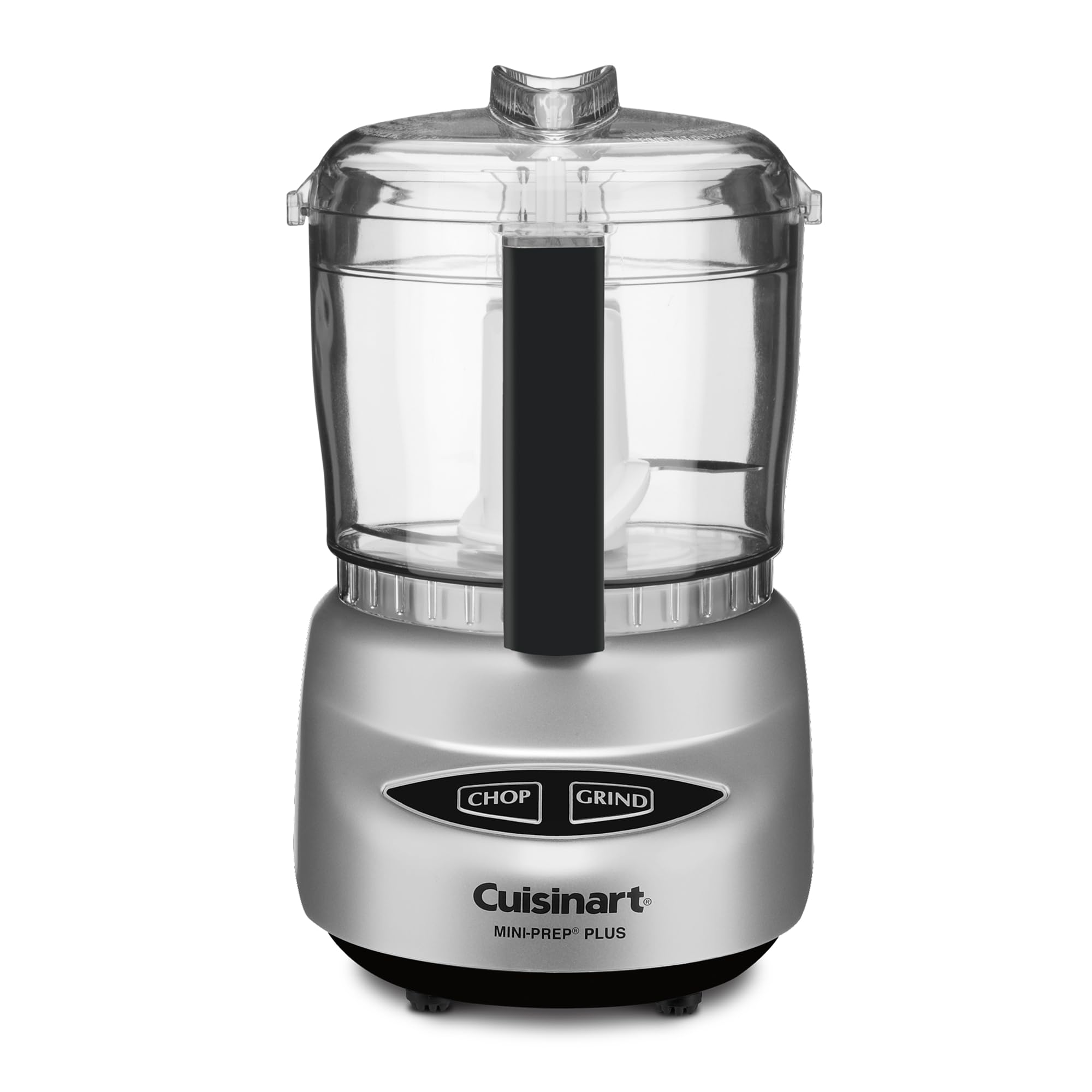
Cuisinart Mini-Prep Plus
Key Features
- Blade: Reversible, two edges
- Motor: 250 watts
- Warranty: 18 months
- Bowl capacity: 24 oz
- Price: Midrange
One blade, two jobs. The Cuisinart’s stainless blade has a sharp edge for chopping and a blunt one for grinding, and you flip it over to change what the machine does.
Sharp side up, parsley, onion and a shallot come out as pieces. Blunt side up, parmesan, almonds and spices get ground rather than cut. The 24-ounce bowl and 250-watt motor sit in a useful middle: bigger than a pull chopper, smaller than anything you would leave out on the counter permanently. A push-button panel runs it, and the bowl, lid and blade all go in the dishwasher.
The job it handles better than anything else here is in-between prep: a pile of parsley, a cup of almonds, breadcrumbs for a topping, a small batch of pesto. We found the two-edge blade genuinely useful rather than a gimmick, because grinding nuts on the blunt side gives you crumbs instead of nut butter. A spatula comes in the box, which sounds trivial until you are scraping herb paste out of a bowl with a handle in the way. It will not dice, though — the blade spins, so onions need short pulses and a little patience.
Pros
- Reversible blade chops on one side, grinds on the other
- 250 watts in a compact 24-ounce bowl
- Bowl and lid are dishwasher safe
Cons
- Work bowl plastic feels thin
We reach for this one when a recipe needs a cup of something finely chopped; it will not give you an even dice, and we do not ask it to.
Best for Small, Tough Jobs
Ninja Express Chop
Key Features
- Motor: 200 watts
- Weight: 2 lb
- Cleaning: Hand wash only
- Bowl capacity: 16 oz
- Price: Premium
Sixteen ounces sounds like a step down from the 3-cup machines here, and on paper it is. The Ninja’s bowl is narrow, though, and narrow is what keeps four garlic cloves or a handful of walnuts under the blade instead of flinging them up the sides.
The power head sits on top and lifts off in one piece. Hold it down and 200 watts takes nuts to a paste, grinds spices, or turns soaked cashews into something you can call a sauce; tap it and you get a rough chop of onion or parsley without the machine walking across the counter.
Cleaning is the part to know about. The bowl and lid are hand-wash only, so this is not the chopper to grab on a weeknight if you want to load the dishwasher and walk away. The blade lifts straight out, and a rinse before anything dries keeps it to about a minute at the sink.
Where we reach for it is small, tough, oily jobs: a knob of ginger, a shallot, a spoonful of curry paste, walnuts for a topping — the sort of thing that disappears under a wide 3-cup bowl. If your chopping is measured in cups rather than spoonfuls, one of the bigger electrics serves you better.
Pros
- Narrow bowl keeps small loads under the blade
- 200 watts takes nuts to a paste
- Runs quietly for its power
Cons
- Bowl base can crack under the blade
We like it for the smallest jobs — four garlic cloves, a knob of ginger — where its narrow bowl beats anything else here.
Best for Bulk Dicing
Fullstar Pro Chopper
Key Features
- Blades: 4 plus spiralizer
- Cleaning: Top-rack dishwasher safe
- Bowl capacity: 5 cups
- Blade material: 420 stainless steel
- Price: Midrange
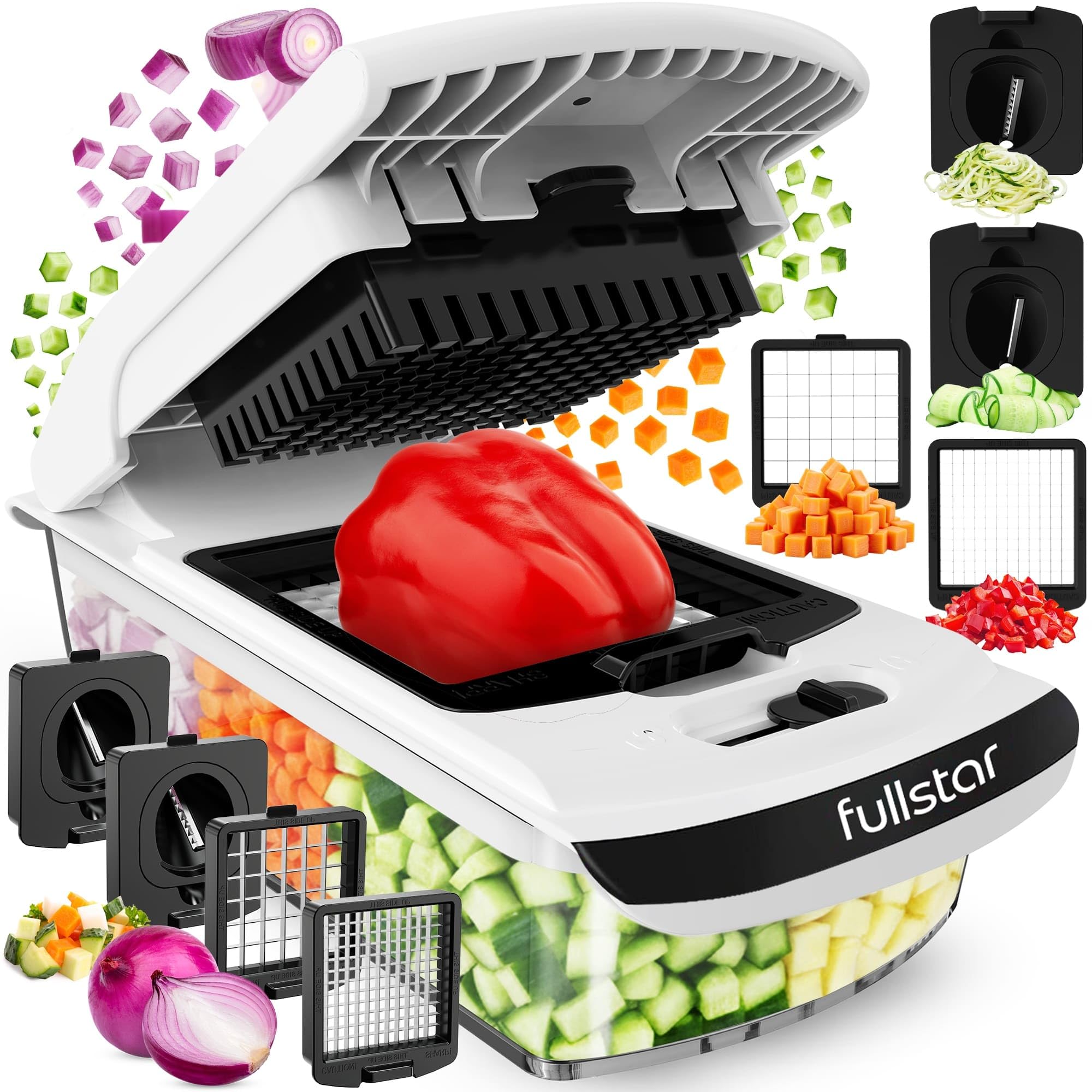
Five cups of diced onion is a lot of onion, and that is the argument for the Fullstar: it is the tool here that turns a sheet pan’s worth of vegetables into even cubes while you stand in one place. We get it out for a week of cooking, not for a single shallot. Before bulk prep, nothing else here comes close.
The mechanism is a grid. Load the container, set a blade frame on top, put the lid on and press the whole thing down; the vegetables go through the squares and come out the same size. Four blades cover dicing, slicing and spiralizing, and the soft-grip handle and rubber base keep it from skidding when you lean on it.
Leaning is part of the deal. Carrots and potatoes need a real push, and the firmer the vegetable, the more of your weight goes through the lid. Anything delicate we still cut by hand. What you get in return is uniformity: onions, peppers and cucumbers come out in the same dice every time, which is what makes this worth cabinet space if you cook in batches.
The frame, blades and container are top-rack dishwasher safe, and Fullstar includes a brush and a scraper. You will use both, because the grid holds onion slivers that a rinse will not shift. A few passes with the brush and it is done, which is the difference between this living on the counter and living in the cupboard.
Pros
- Uniform dice from a fixed grid
- Five-cup container takes a sheet pan’s worth
- Frame, blades and container are dishwasher safe
Cons
- Needs real pressure on carrots and potatoes
- Blades lose their edge with heavy use
We buy this one for batch prep: five cups, an even cube and no outlet, as long as you are dicing firm vegetables by volume.
Best for Quiet, Cordless Prep
Kuhn Rikon Pull Chop
Key Features
- Included: Protective blade cover
- Operation: Cord pull
- Bowl capacity: 2 cups
- Container care: Dishwasher safe
- Price: Midrange
The Kuhn Rikon costs more than two of the electrics here, which is an odd place for a manual chopper to sit. What you are paying for is a mechanism: a cord you pull, a blade that turns a set amount each time, and no motor, no cord and no plug anywhere.
That mechanism gives you something a spinning blade cannot — steps you can count. Five pulls is a rough chop, ten to fifteen is fine enough for salsa or a dressing, and you can stop and look between pulls. The 2-cup bowl is right for one onion or a handful of herbs, the non-slip base keeps the whole thing planted on the counter while you work, and it is the quietest chopper here by a distance.
Cleanup is easy: the container is dishwasher safe, the blade cover clips on so the blade stores inside the bowl instead of loose in a drawer, and the bowl can go in the microwave if a dressing needs warming. The blade itself is genuinely sharp, so handle it by the stem and leave the cover on when it is not in use.
Pros
- Pull count sets the texture precisely
- Non-slip base stays put while you pull
- Container is dishwasher safe and blade stores inside
Cons
- Produce has to be cut into chunks first
We think the manual splurge is worth it here: quiet, cordless and predictable, with a blade that stores inside the bowl.
Best for Garlic and Herbs
Black+Decker 1.5-Cup Chopper
Key Features
- Lid: Oil-adding holes
- Blades: Bi-level stainless steel
- Cleaning: Dishwasher-safe parts
- Bowl capacity: 1.5 cups
- Price: Budget
Garlic, herbs, breadcrumbs, a handful of chocolate, two carrots for a soup base — the Black+Decker is for the jobs too small to justify hauling out anything bigger, and it is sized so you never wonder whether it is worth it.
One touch runs it and letting go stops it, which is the only control a machine this size needs. The bi-level blade puts cutting edges near the bottom of the 1.5-cup bowl as well as higher up, so a small load still meets steel. There are holes in the lid for drizzling oil into hummus or vinaigrette while it runs, which is a nicer trick than it sounds, and the whole thing fits in a drawer.
We kept coming back to it for the thirty-second jobs — a clove of garlic, a handful of parsley, breadcrumbs for a topping — because there is nothing to assemble and nothing to dread washing. It is the least expensive electric here, and it does the least: no slicing, no puree beyond a rough one. That is the trade, and at this size it is the right one.
Pros
- One-touch pulse with nothing to assemble
- Bi-level blade reaches small loads
- Removable parts are dishwasher safe
Cons
- 1.5-cup bowl limits it to small jobs
- Plastic cup can crack with heavy use
The drawer chopper we actually use: garlic, herbs and breadcrumbs in seconds, with nothing to assemble and nothing to dread washing.
Best for Dicing Plus Slicing
Mueller Pro 10-in-1 Chopper
Key Features
- Blades: 8 interchangeable
- Weight: 2.9 lb
- Cleaning: Dishwasher safe
- Operation: Manual press
- Price: Midrange
Two dicer grids and six more blades for slicing, julienne, grating and shredding, all pressing through into one container: the Mueller Pro is a chopper and a mandoline sharing a frame, and it costs about what the plain dicers here do.
The dicing is the same press-through-grid business as the Fullstar, and it works on onions, cucumber, potatoes and peppers, with the container catching everything underneath. The difference is everything else in the box — a slicer for cucumbers and radishes, a grater for hard cheese and carrot, and a julienne blade that cuts matchsticks fine enough for shoestring fries or slaw.
Eight blades mean eight things to keep track of, though they come with their own storage bins. Everything is dishwasher safe and a brush comes in the box for the grids. The frames seat tightly enough that changing a blade takes a firm tug, which is worth knowing before you commit to a recipe that switches between slicing and dicing.
If you want one box that dices, slices and grates, this is the pick here, and the dicing is good enough that the extra blades are a bonus rather than the reason to buy. If you only ever press dice, a simpler frame with fewer loose parts is easier to live with.
Pros
- Eight blades cover slicing, grating and julienne
- Container catches what you cut
- Everything is dishwasher safe
Cons
- Julienne blade cuts very thin matchsticks
We like this one for a small kitchen that wants a mandoline’s jobs too — it dices like the dicers, then slices and grates.
Best for Garlic and Ginger
Ourokhome Pull Chopper 500ml

Key Features
- Blades: 3 stainless steel
- Weight: 7.04 oz
- Cleaning: Dishwasher safe
- Bowl capacity: 500 ml
- Price: Budget
Ten pulls for a coarse chop, fifteen for medium, twenty or more for a puree — the Ourokhome puts texture control in your arm, and for garlic, ginger, herbs and a small onion it is the least expensive chopper here that is genuinely useful.
Three stainless blades sit at different angles, the lid locks on with a twist, and the pull is smooth enough that a knob of ginger or a handful of parsley takes seconds. The ridges running up the inside of the cup catch chopped bits that a smooth bowl would let go of, so there is a brush or a fingernail involved at the sink. It is dishwasher safe on the top rack, and with no cord it is the one here that travels — a rental kitchen or a camping box does not need an outlet.
Pros
- Pull count sets the texture
- Three blades set at different angles
- Small enough to live in a drawer
Cons
- 500 ml bowl needs an onion quartered first
- Bowl and pull cord are the weak points
The cheapest chopper we would actually recommend: a few pulls turn garlic, ginger or parsley into a paste, with no cord and no counter space.
How We Tested 12 Food Choppers at Home
We started by sorting the field by how people actually chop: manual pull-cord models for small jobs, electric countertop choppers for bigger batches, and a few with slicing discs for cucumbers and mushrooms. We cut the list to 12 units across price points and sizes, then brought them into our home kitchens for six months. Each chopper lived through weeknight dinners, Sunday meal prep, and a run of holiday cooking, with onions, garlic, ginger, parsley, carrots, nuts, and cooked chickpeas going in repeatedly.
We loaded each one the same way and paid attention to the boring friction: whether the lid lined up on the first try, how hard a manual pull felt after ten pulls, and whether the bowl had a fill line that made sense. For chopping performance, we pulsed in short bursts and spread the results on a cutting board to see if the pieces were even or if the blades had turned half the batch to paste. We also ran a slicing test on models that came with a disc, checking whether cucumber and mushroom slices stayed intact instead of tearing.
Cleaning got its own pass: we hand-washed every lid, bowl, and blade, then checked gaskets and blade hubs for trapped parsley and onion skin. To judge sharpness and durability, we kept notes on how the blades cut after weeks of carrots and nuts, and whether hinges, cords, and locking tabs developed wobble or cracks. We compared that wear against the price and the counter space each model demanded. The picks below are the ones that kept chopping evenly, cleaned up without a fight, and felt worth reaching for after the novelty wore off.
How to Choose a Food Chopper
The chopper that earns counter space is the one sized to the amount you actually cut at once, so settle that before you look at wattage.
Start With the Bowl, Not the Motor
Capacity decides how often you reach for the machine. A 1.5-cup bowl is for garlic, herbs, breadcrumbs and half an onion; 3 cups is the everyday size, enough for an onion plus a pepper or a batch of hummus; 5 cups is bulk dicing, where the container doubles as the bowl you tip into a pan. Buying bigger than you cook means more to wash for the same result, and buying smaller means emptying the bowl mid-recipe. Count what you chop for one meal and match that.
Manual or Electric Is a Trade, Not a Tier
An electric buys you speed and takes the effort out of onions and nuts; the cost is noise, a cord and a bowl you wash around a motor base. A press dicer hands the effort back to you in exchange for uniform cubes and a dishwasher-safe frame. A pull chopper trades capacity for quiet and control, with no plug and no motor to clean around, but the produce has to go in already chunked. Most kitchens are best served by one electric for volume and one manual for small jobs, because they cover different work rather than competing.
Where the Cut Actually Comes From
Two mechanisms, two results, and the ingredient decides which you want. A press-through grid forces food through fixed squares, so onions, peppers and potatoes come out in even cubes: the right tool for salsa, soup bases and anything that should look uniform. A spinning or rotating blade cuts by chance, which is fine for herbs, nuts, breadcrumbs and pastes, and wrong when you want a dice you can see. If uniformity matters more than speed, buy the grid. If your chopping is mostly crumbs and pastes, buy the blade.
Cleanup Decides Whether You Keep Using It
Count the pieces before you buy. A three-part electric — base, bowl, blade and lid — takes less time to wash than a dicer with a frame, two grids, a lid and a container, and a hand-wash-only bowl is a real constraint on a weeknight. Check that the frame and lid are dishwasher safe, and whether a brush comes with it: grids hold onion slivers that rinsing will not shift, and a brush is the difference between a two-minute job and a five-minute one.
Expect One Part to Fail First
It is almost never the motor. The part that goes is a plastic bowl that cracks at the rim, a lid clasp or hinge that snaps, or a pull cord that stops retracting, and none of it is repairable in most cases. That is why a stated warranty is worth more here than an extra blade you will use twice. Buy from a maker that offers one, keep the receipt, and treat the bowl and the lid as the parts that set the machine’s lifespan.
Frequently Asked Questions
Is a food chopper the same thing as a food processor?
No. A chopper has a small sealed bowl with one blade or one press grid, and you load it and then run it. A food processor has a wide work bowl plus a feed tube, so you can drop whole vegetables down a chute onto a slicing disc while the motor runs, and it usually shreds as well as chops.
The test is the feed tube: if you want to push a whole cucumber through and get uniform rounds into a bowl, that is processor work. If you load, press, empty and rinse, a chopper is quicker at both ends.
Can chopper blades be sharpened?
Not practically. Press grids and small rotary blades do not take an edge the way a knife does, and there is no fixture for working the little serrations. When the cut starts crushing rather than slicing, the blade is the part that has aged.
So check before you buy whether replacement blades are sold for that model. That single question is the difference between replacing a part and replacing the whole machine.
Why does my chopper turn onions to mush?
Because the blade kept going after the pieces were already the size you wanted. A rotary chopper cuts by chance, so a second too long is the difference between dice and paste, and an overfilled bowl makes it worse by leaving the top layer to be beaten rather than cut.
Pulse in short bursts, stop while the pieces still look like pieces, and fill the bowl no more than about half full for a coarse chop.
Final Verdict
The Hamilton Beach is the chopper we tell most people to buy, because it does the everyday job — an onion, a cup of nuts, a batch of hummus — with three pieces to wash and no button to hunt for. It is the safest place to spend, and it is the one that will still get used on a Tuesday.
Two requirements change that answer. If you dice by volume, the Fullstar’s five-cup grid turns a week of prep into one standing at the counter. If you want no cord, no noise and nothing to plug in, the Kuhn Rikon’s pull mechanism is the one to own.