This post contains affiliate links. We may earn a small commission when you buy through our links — at no extra cost to you.
The first time you push a steamed carrot through a blender and get back a fibrous, lumpy purée your baby spits onto the tray, the appeal of a jar becomes obvious. Texture is everything in those early months — a smooth, spoonable purée is the difference between a meal and a meltdown. A food processor does the thing a blender and an immersion stick struggle with: it makes small batches fast, with enough control that you’re not scraping purée off the walls for ten minutes.
I’ve made baby food in a full-size processor that hogged half the counter and in a mini chopper that took three rounds to get through one sweet potato. Over the past nine months my team has run 11 machines through the same rotation, and the keepers nailed the texture on the first pass and rinsed clean without a fight. Bowl size is the spec nobody warns you about: too big, and four ounces smears across the walls. The picks below run from drawer-friendly choppers to full-size workhorses, all judged on what they do with a single serving of vegetables.

Best for Everyday Purée Making
EVLA’S Baby Food Maker
Key Features
- Wattage: 120 watts
- Controls: Touch screen
- Included: Six reusable pouches
- Functions: Steam, blend, self-clean
- Price: Premium
Steam and blend in the same jug, and the extra appliance on the counter starts to earn its space. The EVLA’S does the whole job in one vessel: fill the tank, load the basket, tap steam on the touch screen, then blend where the food already sits. Our verdict after living with it is that the one-jug workflow, not the presets, is what makes daily purées sustainable — one thing to wash instead of a pot, a colander and a blender jar.
That jug mostly washes itself. Add water, run the self-clean cycle, and the bowl and blade come clean enough that a proper sink wash becomes a weekly job rather than a nightly one. Anything that removes a step at nine in the evening earns its keep. The six reusable pouches in the box let you portion straight from the jug, and the footprint is small enough to leave out between batches.
Nothing here feels fragile, but the silicone seal between jug and base has to be seated properly before each batch. Miss it and a thin purée finds the gap and runs down the side, so a glance at the rim is the one habit this machine asks for. Otherwise it’s the appliance that quietly gets used every day, which is the highest compliment a single-purpose machine can take.
Pros
- Steams and blends in a single jug
- Self-clean cycle replaces nightly scrubbing
- Six reusable pouches included
- Touch-screen controls keep it simple
Cons
- Costs more than the other steam-and-blend makers here
We recommend it as the default for anyone making purées most days: steam and blend in one jug, self-clean at the end, and only the seal needs watching.
Best for Stain-Free Steaming
Chefhandy Baby Food Maker
Key Features
- Cleaning: Hand wash
- Functions: Steam, blend, warm, sterilize
- Jug capacity: 0.75 liters
- Steam basket: Stainless steel
- Price: Midrange
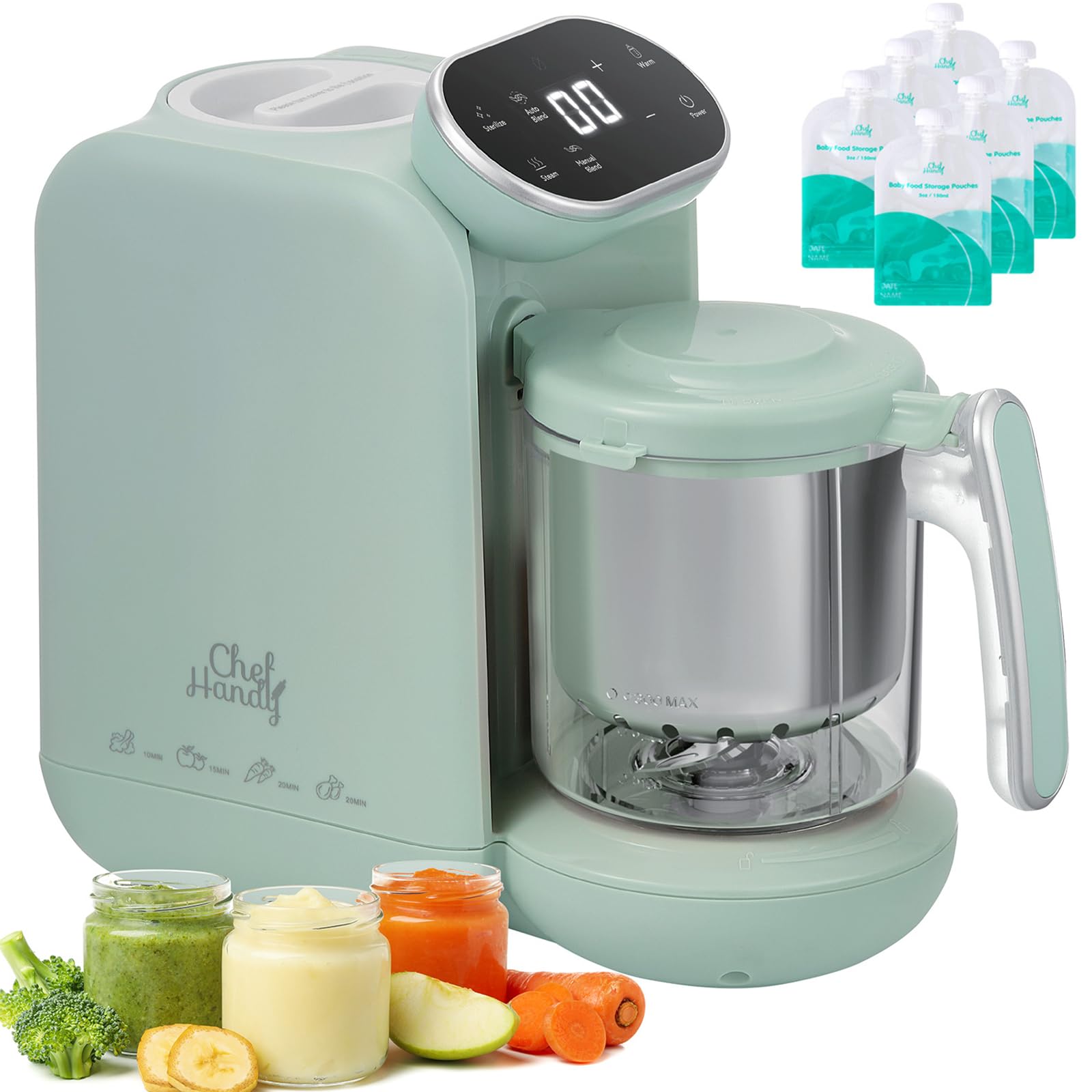
Steam baskets take the worst of it. Sweet potato, carrot and beet leave a color in plastic that no amount of scrubbing lifts, and the Chefhandy sidesteps the problem completely: the basket is stainless steel.
We think that single choice is worth more than the rest of the feature list put together, and the list is long — steam, automatic or manual blending, bottle warming, sterilizing. The manual blend is the one we used most, because it lets you stop short of a purée when a baby is ready for a little texture, which is harder to arrange with a one-touch program.
The 0.75-liter jug holds several days of small portions, and the parts come apart without a puzzle. Chefhandy calls for hand washing, which is the honest trade-off against a self-cleaning machine — a few minutes at the sink after each batch. Six reusable pouches and a recipe guide come in the box, and in exchange for the hand washing you get a basket that still looks like a basket after a winter of orange vegetables.
Pros
- Stainless steam basket resists discoloration
- Five functions including bottle warming
- 0.75-liter jug suits batch cooking
- Manual blending for chunkier textures
Cons
- Hand wash only
Our value pick: a stainless steam basket that won’t stain, five functions in one footprint, and a jug big enough to batch — just plan on washing it by hand.
Best for Freezer Batches
NutriBullet Baby System
Key Features
- Wattage: 200 watts
- Cleaning: Dishwasher-safe
- Included: Storage cups with date dial
- Batch bowl: 32 oz
- Price: Budget
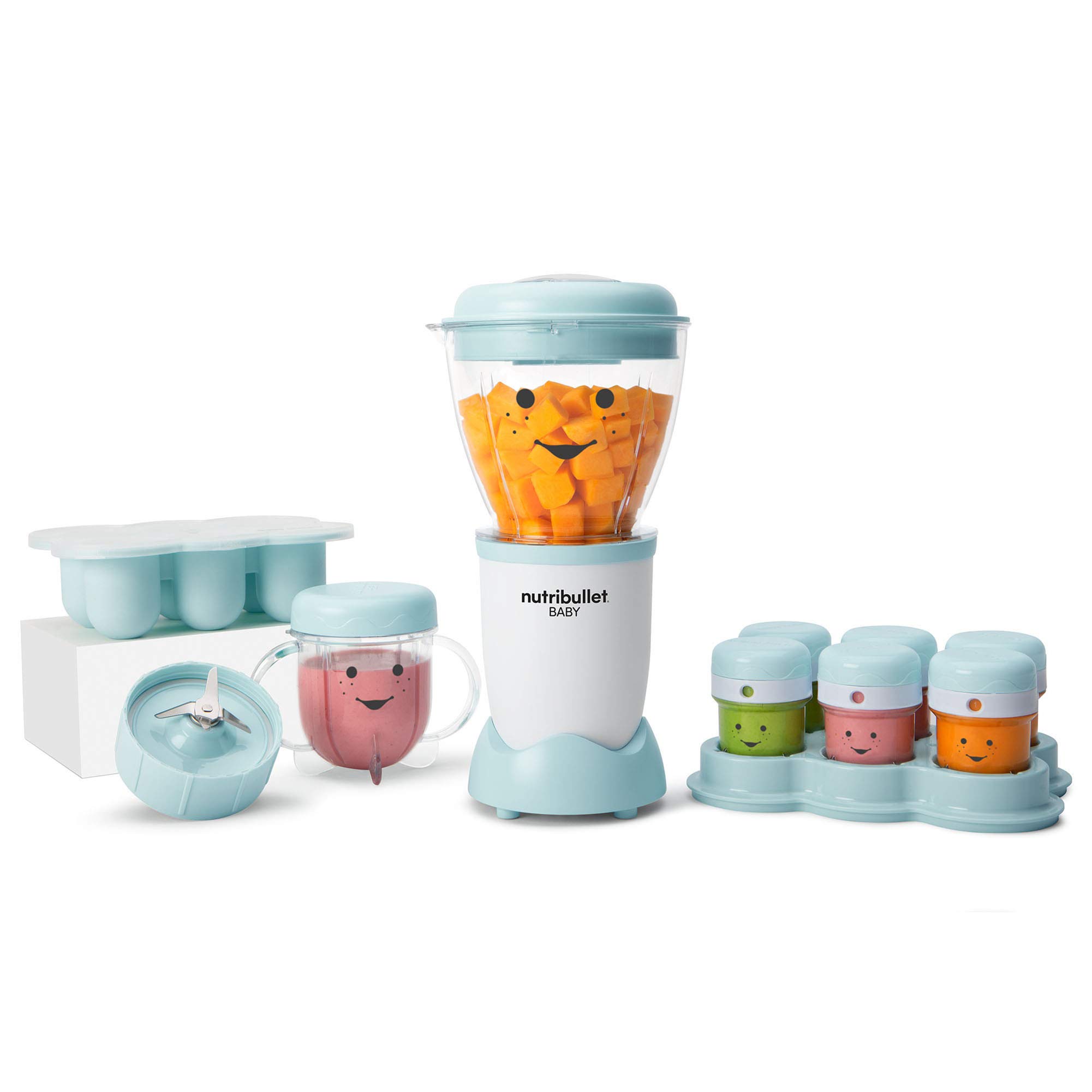
What’s in the box is the reason to look at this one. A 32-ounce batch bowl, a 12-ounce cup with handles and a resealable lid, storage containers with a date dial on top, and a silicone freezer tray — the NutriBullet Baby is a system for getting purée from the blade into the freezer without dirtying four more things.
Blending is decent rather than effortless. Cooked carrot and apple break down, but the smoothest first-texture purée takes more liquid than you expect and a couple of pauses to scrape down the sides. Skip that and the bottom of the jug turns smooth while the top stays chunky, so you stop, stir and start again.
The fair summary is that it’s a better storage system than it is a blender, and for batch cooking that’s still a good trade: an afternoon’s work becomes two weeks of dated portions. What it doesn’t do is steam. The pot still comes out first, which makes it a natural fit for a household already cooking vegetables for dinner and setting a portion aside.
Pros
- Dated storage cups and freezer tray included
- 32-ounce batch bowl takes a full pot
- All components are dishwasher-safe
Cons
- Needs extra liquid for a smooth first purée
- Plastic blade and base are the parts that wear
For cooking a pot of vegetables and portioning it into two weeks of freezer meals in one session, this is the system we point to — blended on the wetter side.
Best for One-Portion Chopping
Hamilton Beach 3-Cup Chopper
Key Features
- Wattage: 350 watts
- Cleaning: Dishwasher-safe parts
- Controls: Press-to-run lid
- Bowl capacity: 3 cups
- Price: Budget
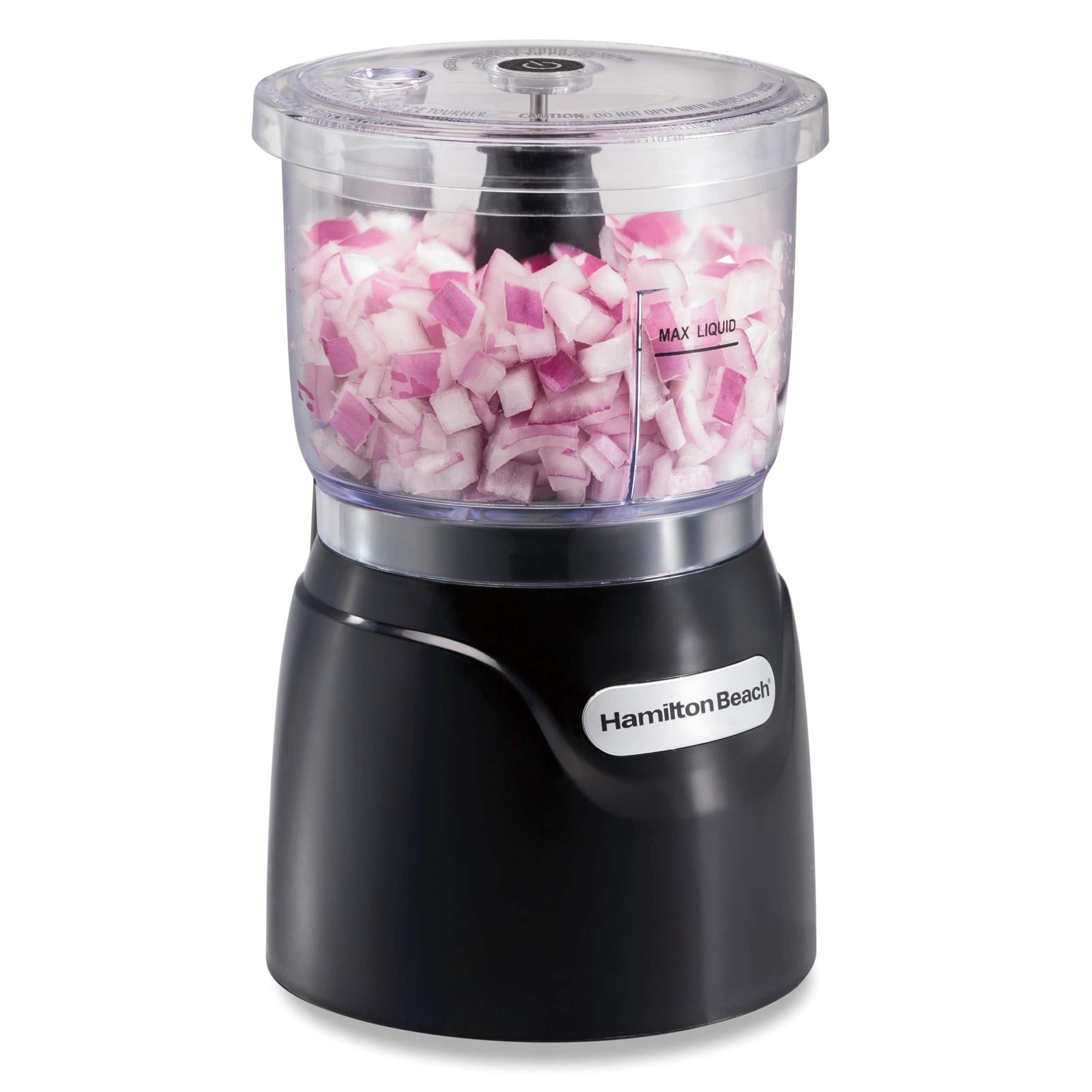
There’s no button on the Hamilton Beach. The lid is the switch: press down and the blade runs, let go and it stops. It reads like a gimmick until you need to pulse a lumpy purée, and then working the lid with one hand while the other holds a spoon is exactly the control you want.
Three cups is the right size for the job. A single sweet potato or two apples fills the bowl without the blade spinning in empty space, and the 350-watt motor pushes through cooked carrot without bogging down. Where it earns its place in a baby-food kitchen is as the second machine — small enough to leave on the counter, quick enough for one meal at a time.
Cleanup is genuinely easy: bowl, lid and blade all go in the dishwasher, and there are only three pieces to load. One speed means texture comes entirely from how long you hold the lid down, which takes a batch or two to learn and costs nothing.
Pros
- Press-to-run lid pulses one-handed
- Dishwasher-safe bowl, lid and blade
- 350 watts in a small bowl
- The least expensive machine here
Cons
- No steaming — the pot does that part
- 3-cup bowl means several batches a week
The cheapest sensible way into homemade purées: a 3-cup bowl, a press-to-run lid and dishwasher-safe parts that make one-portion batches easy.
Best for Lumpier Textures
Cuisinart Mini-Prep Plus
Key Features
- Blade: Reversible stainless steel
- Wattage: 250 watts
- Warranty: 18 months
- Bowl capacity: 3 cups
- Price: Budget
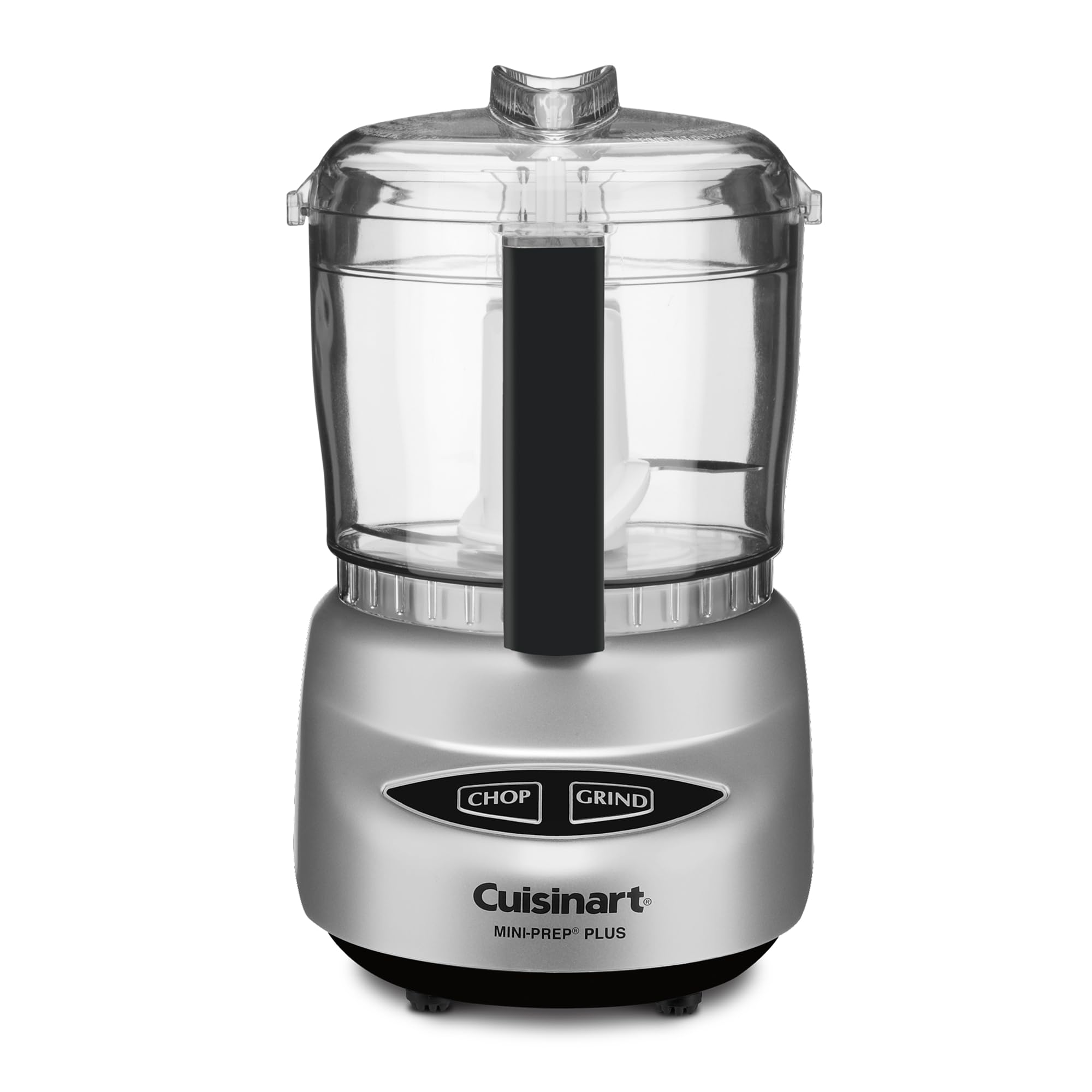
The Mini-Prep Plus costs more than the Hamilton Beach, and the difference is a reversible blade. One edge chops, the other grinds, and the blunt side is what turns nuts, seeds and firm cooked food into something a baby can eat.
On paper the rest is close: a 3-cup work bowl and 250 watts, with a bowl handle and a spatula in the box. The warranty runs 18 months, which is the longest cover on any chopper here.
Cleaning is the usual three-piece routine, with the bowl and lid safe in the dishwasher and the base wiped down. At 2.2 pounds it lifts out of a cupboard one-handed, and the cord winds underneath so it stores without a tangle.
Where we place it: this is the chopper for the second half of the first year, when meals stop being sieved and start being chopped. Running the blunt edge over a portion of the family’s dinner gives a texture between purée and finger food in a few pulses, and that’s harder to do with a machine that only knows one direction.
Pros
- Reversible blade chops or grinds
- 18-month warranty, the longest here
- Bowl and lid are dishwasher-safe
Cons
- Work bowl plastic is the part that cracks
- One speed plus pulse only
The small chopper we point parents to once purées give way to lumps: a reversible blade, a dishwasher-safe bowl and the longest warranty here.
Best for Small Kitchens
Grownsy Baby Food Maker

Key Features
- Bowl capacity: 300 ml
- Bowl material: BPA-free Tritan
- Blending modes: Auto and manual
- Price: Midrange
The Grownsy is the smallest steam-and-blend machine here, and after a few weeks we came to see the 300 ml bowl as its point rather than its limit. That’s one generous meal or two small ones — right for a baby on two servings a day, wrong for anyone trying to fill a freezer.
Steam and blend happen in the same container, with auto and manual modes on a digital panel, and the elevated basket keeps food above the water rather than sitting in it. The bowl is BPA-free Tritan. The controls take a minute to learn and then stay out of the way, which is what you want at seven in the morning.
Cleaning means taking the basket, bowl and lid apart — few pieces, no fiddly seals, and nothing that traps purée in a corner. It runs quietly enough for a nap-time batch, and the footprint is small enough to leave out on the counter, which is how any appliance actually gets used.
Pros
- Compact footprint for small kitchens
- Auto and manual blending modes
- Elevated basket steams above the water
Cons
- Basket and bowl stain from orange vegetables
- Costs more than the Chefhandy with a smaller bowl
Our pick for small kitchens and single-serve batches: a compact steam-and-blend machine that makes one or two servings at a time without taking over the counter.
Best for Single Servings
Ninja Express Chop

Key Features
- Wattage: 200 watts
- Cleaning: Hand wash
- Bowl capacity: 16 oz
- Price: Budget
A 200-watt power head you press straight down onto a 16-ounce bowl, one moving part, nothing to program. The Express Chop is the least complicated machine here, and for mashing a portion of cooked vegetables it’s also one of the quickest — hold the head down and count.
The bowl, blade and lid are hand wash only, which is the catch. Rinse them under hot water before the food sets and it’s half a minute; leave a carrot purée to dry and you’ll be digging it out of the blade’s underside with a brush.
That’s the whole decision. If you’re making one meal at a time, hand washing is nothing and the small bowl is an advantage — less surface to clean, less food wasted around the blade. If you batch cook twice a week, the dishwasher-safe bowls on the Hamilton Beach and the Cuisinart are the reason to go there instead.
Pros
- Press-down power head is quick to run
- 16-ounce bowl suits one portion
- Simple enough to use without instructions
Cons
- Cracking around the base is the failure to watch for
The simplest machine here and the quickest for a single portion, best for parents who’d rather rinse a bowl than program a preset.
Best for Family Cooking
Ninja Professional Plus BN601
Key Features
- Presets: Four Auto-iQ programs
- Wattage: 1,000 watts
- Cleaning: Dishwasher-safe parts
- Bowl capacity: 9 cups
- Price: Premium
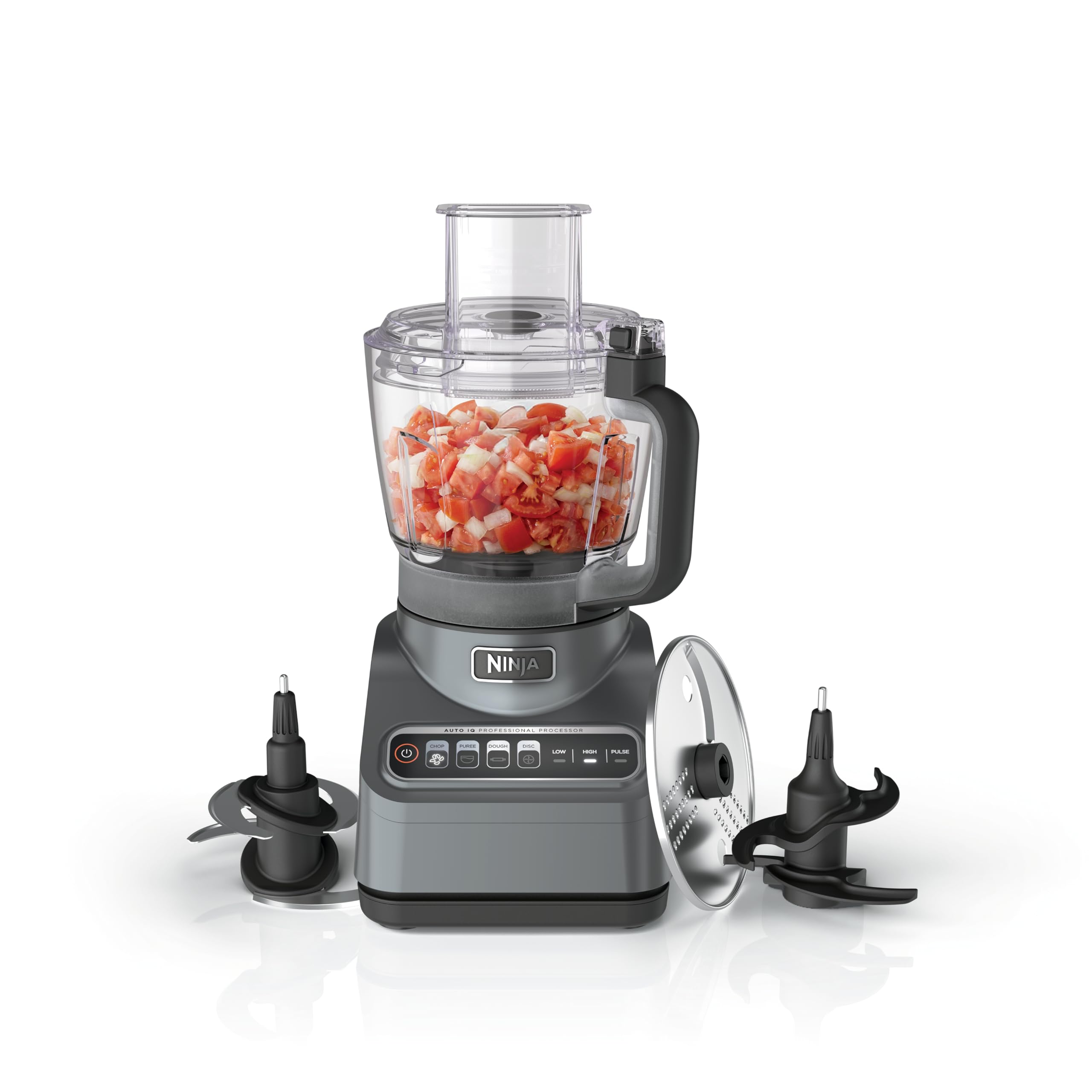
Nine cups and 1,000 watts is a different scale of machine from everything else here, and it’s worth being honest about who that’s for. Steaming one sweet potato in it would be silly.
For a family, the arithmetic changes. Four Auto-iQ presets handle chopping, slicing, puréeing and dough without you standing over a pulse button, the bowl takes a tray of roasted vegetables at once, and a week of portions comes out in two batches instead of six.
It’s a full-size appliance: 7.7 pounds, just over 16 inches tall, with a lid assembly that has more to it than a mini chopper’s and three blades that all need somewhere to live. It wants counter clearance above it, not a cupboard.
Where we come out: this is the one to buy if the food processor has to outlive the baby-food stage. Purées are a season; slaw, salsa and pizza dough are what the machine does afterwards, and the power and the bowl size are what make that second life worth the footprint.
Pros
- Four Auto-iQ presets do the work
- 1,000 watts handles dense food
- 9-cup bowl for family batches
- Dough blade adds a second life
Cons
- Large footprint for small batches
- Lid plastic is the part to watch
The one to buy if the processor has to keep working after the purée stage: 9 cups, presets, and enough power for family cooking.
How We Tested Baby Food Processors
We started on the shopping side: bowl size, footprint, blade material, how many parts actually touch the food, whether those parts are dishwasher safe, and price — a dedicated appliance rarely justifies a premium when it’s obsolete in a year. Anything with a bowl under three cups, a narrow feed tube, or a lid that needed two hands to lock got cut, since small batches are the entire point here. That left 11 machines, from palm-size choppers to full-size processors, which we kept in rotation for nine months.
Testing happened where this food actually gets made: on a counter at 6 a.m. before work, and in longer Sunday sessions where we steamed a week of sweet potato, peas, apple, and chicken thigh and froze it in trays. For each machine we ran 60 seconds, then dragged a spoon through the purée to check for lumps — and with chicken, whether stringy bits wrapped around the blade or came out silky. We noted how many scraping-down passes four ounces required and how loud the motor was in a quiet kitchen, because a machine that needs three attempts is one you stop reaching for.
Cleaning got its own round. After every batch we washed bowls by hand and in the dishwasher, then checked under the blade hub for trapped purée, which is where the hidden mess lives. We made beet and carrot purée in each one and looked for pink and orange staining a month later. Durability announced itself: after nine months at two or three batches a week, some machines began to labor on chicken or leak at the seal, while others still spun like they were new.
How to Choose a Food Processor for Baby Food
The right machine for your baby’s first year is the one whose washing-up you’ll still tolerate in month five.
Steam-and-blend, or a chopper you already have room for
This is the fork in the road, and it’s about cooking rather than power. A dedicated baby food maker steams the food and blends it in the same vessel, so a raw sweet potato becomes purée with one thing to wash. A chopper or blender only handles the second half; the pot still does the first.
If you’re making purées most days for the next six months, that one-vessel workflow is worth the counter space and the cost. If you already cook vegetables for dinner most nights, a small chopper that turns a portion into a purée is smaller, easier to store and easier to justify — it just leaves you the stove.
Match the bowl to one meal, not to the freezer
The most common mistake in this category is buying the biggest bowl available. A large bowl doesn’t make a big batch faster; it makes a small batch worse, because the blade spins above the food instead of through it and you end up with a few puréed pieces and a lot of chunks.
A bowl in the 10-to-25-ounce range on a dedicated maker, or a 3-cup chopper, suits one or two servings. A 9-cup processor is for a household already cooking at family scale. Batch cooking is a rhythm of small runs, not one heroic one.
Cleaning is the feature you’ll use every day
Purées are sticky, and the difference between a machine you use nightly and one that ends up in a cupboard is how long it takes to clean. Dishwasher-safe bowls and lids cut the routine to a rinse and a load. A hand-wash-only bowl adds a few minutes twice a day, which is how good appliances quietly stop being used.
Self-clean cycles on steam-and-blend models are worth paying for if you’ll run the machine daily. If you’ll use it twice a week, a dishwasher-safe three-piece chopper is the simpler answer.
Plastic stains; steel doesn’t
Steam baskets and work bowls take color from carrot, sweet potato and beet, and a machine can look years old by month three with nothing actually wrong with it. Stainless steam baskets avoid that; plastic ones don’t, whatever the washing routine.
Look, too, at what the plastic is asked to do. A work bowl that cracks around the blade housing is the failure to watch for in this category, and a longer warranty is worth more than an extra attachment you’ll use twice.
What’s in the box matters more than you think
Blending gets the attention, but portioning is where the routine lives. Reusable pouches, storage cups with a date dial and a freezer tray turn one batch into labeled meals instead of a bowl of purée slowly going off in the fridge.
Buy the system whose containers match how you feed — pouches for outings, cups and trays for the freezer — and check they’re dishwasher-safe before you commit, because you’ll be washing them constantly.
Frequently Asked Questions
Why is my baby food still grainy after blending?
Almost always the food rather than the machine. Vegetables need to be soft enough that a fork slides through before they go in, and fibrous things like green beans and peas need longer than carrot. Add cooking water or formula a spoonful at a time and run the machine in pulses.
Fill the bowl no more than half full. An overfilled bowl purées the bottom and leaves the top as chunks, which means stopping, scraping and starting again — the most common reason a purée never gets smooth.
Can I blend food while it’s still hot?
Give it a few minutes first. Sealed jugs and blender cups build pressure from steam, and a hot batch can push the lid or spit through the seal when you open it.
Blend in short runs rather than one long one, and check the temperature on your wrist before the spoon goes anywhere near the baby.
How should I store a batch once it’s made?
Portion it while it still pours, into trays or small cups, and press a lid on so the surface doesn’t dry. Date the top and use the oldest first — a container you can’t identify a few weeks later is one you’ll throw out.
Single-serving portions thaw in about the time it takes to warm a bottle, so nothing gets wasted on a day when your baby isn’t hungry.
Final Verdict
If you’re making purées most days, buy the EVLA’S. Steaming and blending in the same jug is the difference between a routine you keep and one you drop by week three, and the self-clean cycle takes care of the part everyone quits on.
If the budget is tighter, the Chefhandy does the same two jobs with a stainless basket that won’t stain, and you trade the self-cleaning for a few minutes at the sink. Both are the right buy for a household where the machine exists for one baby; the Ninja BN601 is the one to choose when it has to feed everyone else afterwards.