This post contains affiliate links. We may earn a small commission when you buy through our links — at no extra cost to you.
A sharp santoku knife makes everyday slicing, dicing, and mincing effortless—until it dulls, chips, or even snaps. Many budget-friendly options look great on paper but fail to hold an edge past the first month, and a handful carry real safety risks.
The answer isn’t automatically a high price tag. Forged construction, sensible steel hardness (56–58 HRC), and a comfortable handle matter far more than flashy marketing or a Damascus finish. The best home-cook knives deliver consistent performance without requiring constant maintenance or a second mortgage.
That’s why this guide focuses on the mid-range sweet spot: knives that combine reliable materials, proven edge retention, and ergonomic design. Whether you prefer the heft of a forged blade or the lightness of a stamped workhorse, the right choice comes down to how you cook—not how much you spend.





Best for Serious Home Cooks
Mercer Genesis 7" Santoku
Key Features
- Blade Material & Construction: Forged German Steel
- Blade Length: 7 inches
- Handle Material: Santoprene
- Edge Type: Plain
- Price: $$
The Mercer Genesis holds its edge noticeably longer than typical options in this price bracket, and its weight distribution makes chopping feel almost effortless. The Santoprene handle stays secure even with wet hands, reducing fatigue during extended prep sessions.
The forged X50CrMoV15 steel blade is built for repeated daily use—many home cooks have put theirs through years of regular chopping without dulling. One tradeoff: the blade can develop spotting if left wet in a dish rack, so a quick dry after washing keeps it in shape. The handle’s utilitarian look lacks the polish of wood or metal but delivers consistent grip where it counts.
This santoku suits serious home cooks who want a dependable daily driver without spending over $100. It’s also a solid upgrade for culinary students moving on from cheap stamped knives. The Santoprene handle prioritizes function over aesthetics—if wood grain is a must, the Cutluxe alternative offers that look at a similar price, though edge retention may not match.
Pros
- Stays sharp far longer than expected for this price range
- Balanced weight distribution feels natural in hand
- Non-slip handle provides secure grip even when wet
- Durable build that withstands heavy home and light professional use
Cons
- Leaving the blade wet can lead to surface spotting—requires thorough drying after washing
- Santoprene handle has a utilitarian look that may not appeal if you prefer wood or metal grain
A mid-range santoku that holds its edge and feels balanced without any safety concerns—right for anyone who wants forged performance without the premium price tag.
Best for No-Nonsense Workhorse
Victorinox Fibrox 7" Santoku
Key Features
- Blade Material & Construction: Stamped Stainless
- Blade Length: 7 inches
- Handle Material: Fibrox
- Edge Type: Granton
- Price: $$
The Victorinox Fibrox Santoku cuts with an edge that stays sharp through heavy prep sessions, a quality more often associated with forged blades. The stamped high-carbon stainless steel delivers precise slices while the textured Fibrox handle stays secure even when your hands are wet — a combination that has made it a fixture in professional kitchens.
This knife is for home cooks and culinary students who prioritize performance over aesthetics. The Fibrox handle, while undeniably functional, lacks the warmth of wood or the heft of metal — a tradeoff that matters little when you’re focused on consistent, comfortable cutting. It suits anyone who wants a reliable workhorse without the premium price tag of forged alternatives like the Mercer Genesis.
Pros
- Blade arrives exceptionally sharp and holds its edge through extended use.
- Lightweight build reduces fatigue during long cooking sessions.
- Non-slip handle provides secure grip in wet conditions.
Cons
- Fibrox handle feels cheap compared to wood or metal alternatives.
- Granton edge does not fully prevent food from sticking to the blade.
If you value cutting performance over handle material, this is the most capable santoku you can buy for the money — no apologies needed.
Best for Home Cooks Chopping
Cutluxe 7" Santoku
Key Features
- Blade Material & Construction: Forged German Steel
- Blade Length: 7 inches
- Handle Material: Pakkawood
- Price: $
Cutluxe delivers forged German steel and a comfortable wood handle at a price that undercuts most competitors. The 7-inch blade slices through steak and vegetables with minimal resistance, offering the heft and balance typical of far pricier knives. However, the edge may require sharpening sooner than the top pick, so keeping a honing rod handy is wise.
The Pakkawood handle feels secure and well-proportioned, and the included sheath adds convenience. This santoku suits home cooks who value forged construction and wood aesthetics and are comfortable with occasional maintenance. It is less ideal for those with smaller hands or wrist issues due to its weight, or cooks who prefer a knife that holds its edge longer without intervention.
At this price, the Cutluxe offers a forged blade and wood handle that rivals knives three times the cost. It’s a smart buy for budget-conscious cooks who don’t mind a minor tradeoff in edge retention.
Pros
- Razor-sharp edge glides through tough vegetables and proteins with minimal effort.
- Comfortable Pakkawood handle provides a secure grip and balanced feel during chopping.
- Exceptional value: forged German steel and wood handle at a budget-friendly price.
Cons
- Edge may dull faster than higher-priced forged knives, requiring more frequent sharpening.
- Heft may feel fatiguing during prolonged use for those with smaller hands or wrist concerns.
For home cooks seeking a budget forged santoku with wood handle, the Cutluxe delivers fantastic value with a minor tradeoff in edge retention. Pair it with a sharpener and it performs above its price class.
Best for Serious Home Chefs
Wusthof Classic 7" Santoku
Key Features
- Blade Material & Construction: Forged German Steel
- Blade Length: 7 inches
- Handle Material: Composite
- Edge Type: Plain
- Price: $$$
The Wusthof Classic Santoku delivers exceptional initial sharpness and edge retention that outperforms most mid-range knives. The 7-inch forged blade strikes a balance between heft and maneuverability, making it suitable for all-day prep work. Backed by a lifetime warranty, this knife is built to endure decades of use.
This Santoku is for cooks who prioritize longevity over convenience. The high carbon stainless steel (58 HRC) is notoriously difficult to sharpen without diamond stones or professional equipment — a tradeoff that pays off for those who value edge stability. Its premium cost also places it outside budget-focused kitchens, but the build quality justifies the investment for enthusiasts.
Pros
- Remarkable sharpness out of the box with edge retention that lasts months
- Perfectly balanced weight for extended cutting sessions
- Forged construction with a lifetime warranty
Cons
- Home sharpening requires diamond stones or professional service — less of an issue for those who outsource maintenance
- Premium pricing may not suit budget-oriented home cooks
If you want a knife that will outlast your kitchen and don’t mind occasional professional sharpening, this Santoku delivers uncompromising build quality.
Best for Small Hands Control
Cutluxe 5" Santoku
Key Features
- Blade Material & Construction: Forged German Steel
- Blade Length: 5 inches
- Handle Material: Pakkawood
- Edge Type: Hollow
- Price: $
The Cutluxe Santoku delivers a forged German steel blade in a compact 5-inch form that prioritizes precision over volume. It’s noticeably smaller than standard santokus, which makes it ideal for detailed prep work like mincing herbs or slicing cherry tomatoes, but less suited to large-scale chopping tasks. Compared to the 7-inch Cutluxe, this one trades reach for agility.
This knife fits best in the hands of cooks who find full-size blades unwieldy or prefer the feedback a short blade provides. The handle and overall weight can feel a bit heavy relative to its length—those with very small hands may find the grip a touch thick, while others will appreciate the heft for stability. It’s not a general-purpose workhorse; it’s a specialist for controlled cutting.
Pros
- Very sharp out of the box, slicing through tomatoes and vegetables with ease.
- Compact 5-inch blade gives excellent control for precision tasks.
- Budget-friendly price for a forged German steel knife that feels solidly built.
Cons
- Weight and handle thickness may feel too large for very small hands.
- Edge can arrive less-than-ideal, requiring initial sharpening in some cases.
Best for home cooks who want a nimble, precise blade and don’t need a full-size knife for heavy chopping.
Best for Snack Prep Travel
OXO 4" Mini Santoku
Key Features
- Blade Material & Construction: Stamped Stainless
- Blade Length: 4 inches
- Handle Material: Stainless Steel
- Edge Type: Plain
- Price: $
The OXO Mini Santoku’s 4-inch blade and non-slip grip make it ideal for quick fruit and vegetable prep. Its stamped stainless steel construction keeps the knife lightweight and easy to maneuver, especially for small-handed users or when packing for camping.
This knife’s size is its defining trait — too small for dicing a large onion or breaking down a chicken, but perfect for slicing an apple, trimming herbs, or cutting cheese for a snack. The thin blade needs prompt drying after washing to avoid rust spots, a tradeoff common in budget-friendly mini knives.
Pros
- Compact 4-inch blade handles small fruits, vegetables, and garnishes with ease
- Non-slip handle provides secure grip even with wet hands
- Budget-friendly price for a reliable mini knife
Cons
- Blade may develop rust spots if not dried immediately after washing
- 4-inch blade is too small for general prep tasks like dicing large vegetables or slicing meat
Pick this up as a second knife for quick snacks, outdoor meals, or for cooks who prefer a smaller blade — don’t expect it to replace your main santoku.
Best for Extreme Budget Buyers
DDF iohEF 7" Santoku

Key Features
- Blade Material & Construction: Forged Japanese Steel
- Blade Length: 7 inches
- Handle Material: Stainless Steel
- Edge Type: Plain
- Price: $
This all-metal santoku arrives razor-sharp and holds its edge well for a budget knife. The blade may develop stains or tarnish after weeks of use, especially if not dried promptly, and some users find the balance slightly handle-heavy. These limitations keep it from competing with mid-range forged options, but for extreme budget buyers who prioritize sharpness and light weight, it’s a practical pick.
Pros
- Razor-sharp edge with impressive edge retention for the price.
- Solid all-metal construction feels durable and is easy to clean.
Cons
- Balance can feel slightly handle-heavy for some users.
- Blade finish may stain or tarnish over time.
This knife fits home cooks who need a functional, sharp santoku on a tight budget and can accept occasional staining or a slightly handle-heavy balance.
Best for Occasional Home Cooks
KEEMAKE 7" Santoku
Key Features
- Blade Material & Construction: Forged German Steel
- Blade Length: 7 inches
- Handle Material: Pakkawood
- Price: $
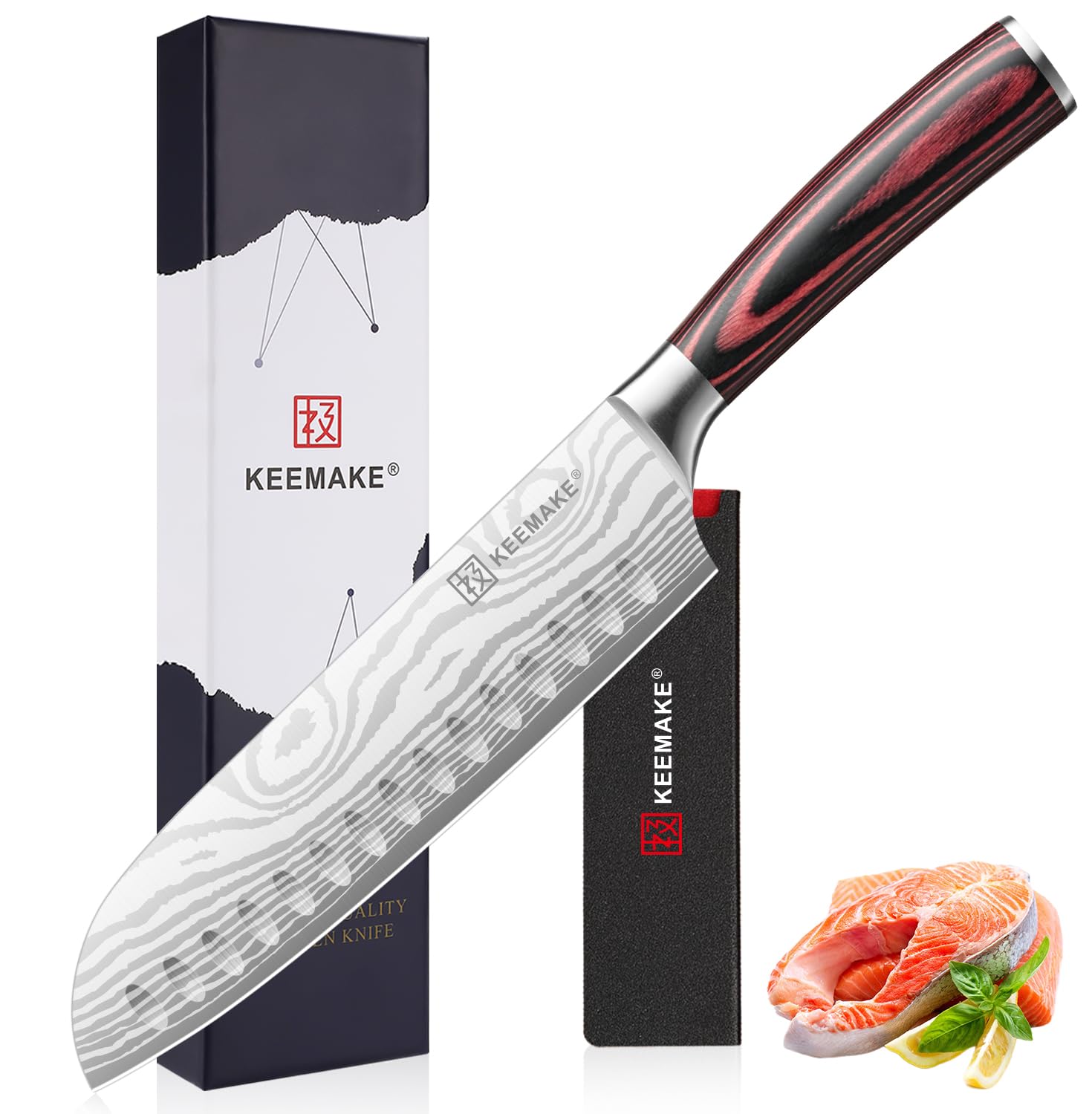
The KEEMAKE Santoku looks more expensive than its budget price suggests, with a vivid red Pakkawood handle and full tang construction that feels substantial. However, quality control is inconsistent—some units arrive with a dull edge that requires immediate sharpening, and the limited number of long-term reports makes it a gamble for daily use. Best suited for occasional cooks who want an attractive knife without a large investment.
Pros
- Sharp edge out of the box that responds well to standard sharpening
- Full tang construction with an attractive red Pakkawood handle at a budget price
Cons
- Wave pattern does not prevent food sticking—expect to still have food cling to the blade
This knife works well for infrequent meal prep where aesthetics matter and you can check the blade upon arrival.
Best for Precision Tasks Small
Wusthof Gourmet 5" Santoku
Key Features
- Blade Material & Construction: Stamped Stainless
- Blade Length: 5 inches
- Handle Material: Polypropylene
- Edge Type: Hollow
- Price: $$
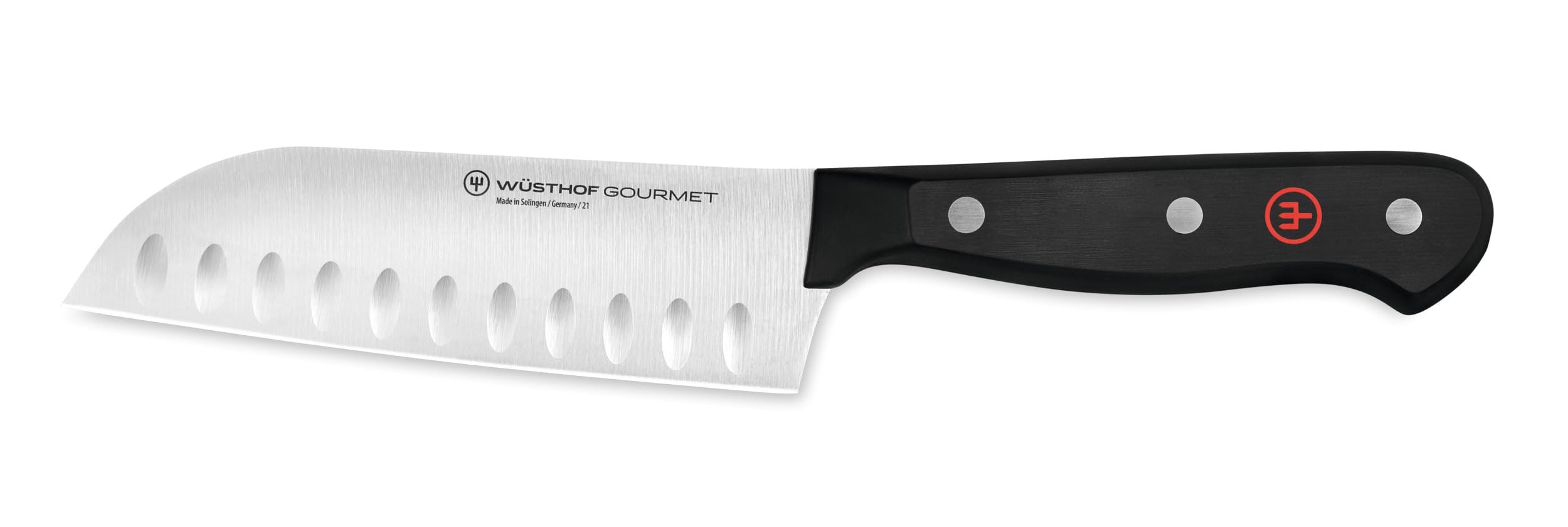
Offering Wusthof quality at a lower price point, this 5-inch santoku delivers sharp performance for precise cuts on vegetables and boneless proteins. The stamped blade and polypropylene handle feel less substantial than forged alternatives from Mercer or Cutluxe, making it better suited for lightweight tasks than heavy chopping. The lightweight design is nimble for smaller hands but may not inspire confidence for dense squash or root vegetables.
Pros
- Sharp hollow edge makes slicing and dicing straightforward.
- Lightweight balance aids maneuverability during precision work.
Cons
- Stamped blade may flex during heavy chopping, unlike forged designs.
- The knife’s light heft may not suit those who prefer a weighted feel for cutting.
This Wusthof is a sensible pick if you need a compact, sharp santoku for light-to-moderate kitchen work and want to stay within the brand’s price hierarchy.
Best for Absolute Budget Buyers
Farberware 5" Santoku

Key Features
- Blade Material & Construction: Stamped Stainless
- Blade Length: 5 inches
- Handle Material: Stainless Steel
- Price: $
The Farberware Edgekeeper offers the convenience of a built-in sharpener in a budget-friendly package. However, the self-sharpening mechanism may not actually sharpen effectively, and the blade can arrive dull out of the box. For those who prefer a reliably sharp edge, this knife often requires manual honing—negating the convenience it promises.
Pros
- Built-in sharpener maintains a usable edge with minimal effort.
- Budget-friendly price includes sheath and sharpening mechanism.
Cons
- Plastic handle feels cheap during extended use.
- Self-sharpening sheath can fail to sharpen the blade effectively.
Suits budget buyers who value convenience and don’t mind occasionally sharpening the blade manually.
How to Choose
The most important factor in a santoku knife is the balance between blade hardness and edge retention, which determines how often you need to sharpen.
Blade Material & Construction
Forged knives are cut from a single piece of steel, then heat-treated and shaped under pressure. This creates a heavier, denser blade that usually holds an edge longer and feels more substantial in hand.
Stamped knives are laser-cut from a sheet of steel, making them lighter and less expensive. Many professional chefs prefer stamped designs like Victorinox Fibrox because they are easier to handle during long prep sessions and still deliver excellent sharpness.
Blade Length
A 7-inch blade is the standard all-purpose santoku length—long enough to slice through large vegetables, short enough for controlled dicing. It works well for most home cooks and fits most kitchen drawers.
5-inch or 4-inch santokus are better for small tasks like mincing garlic, trimming herbs, or cutting fruit. They give you more control but require extra passes for larger items. Choose a shorter blade if you have small hands or limited counter space.
Handle Material & Ergonomics
Handle material directly affects grip security and comfort. Santoprene and Fibrox provide a non-slip surface even when wet, reducing hand fatigue. Pakkawood looks premium but can become slippery with oil or moisture.
Full tang construction (metal extending through the handle) adds weight and balance. Lightweight handles with metal scales like stainless steel are easy to clean but may feel cold or slippery. Test the balance in your hand before buying.
Edge Type
Hollow or granton edges (small dimples) create air pockets that reduce food sticking, especially for starchy vegetables like potatoes. However, these edges are harder to sharpen at home without a guided system.
Plain edges are simpler to maintain and provide a cleaner cut through meat and fish. They also glide through dense produce with less resistance. Choose plain if you plan to sharpen manually; choose granton if sticking is your top frustration.
FAQ
Why does my new santoku knife chip after a few uses?
Chipping usually happens when the blade steel is too hard (above 58 HRC) and thin. Many budget knives with high HRC numbers are prone to chipping if used on hard surfaces like bones, frozen foods, or glass cutting boards. Stick to knives between 56–58 HRC for a good balance of sharpness and toughness.
Is a forged santoku knife really better than a stamped one for home cooking?
Forged knives are heavier and more durable, with a thicker spine that provides better weight for chopping. Stamped knives like the Victorinox Fibrox are lighter and still very sharp, making them easier to handle for long prep sessions. For most home cooks, a forged knife in the $30–60 range offers the best durability without breaking the bank.
How do I stop food from sticking to my santoku knife?
Granton or hollow edges reduce sticking by creating air pockets, but they won’t eliminate it completely. Using a slicing motion instead of a straight chop and wetting the blade with water before cutting sticky foods also helps. For precision cuts, a plain edge with less surface area often performs better.
Can I put my santoku knife in the dishwasher?
No. Dishwasher heat and detergents dull the edge quickly and can warp wood or composite handles. Hand wash with mild soap and dry immediately to prevent rust and maintain edge life. Even stainless steel knives can develop spots if left wet.