This post contains affiliate links. We may earn a small commission when you buy through our links — at no extra cost to you.
For years my chef’s knife did every job in my kitchen, including the ones it was bad at: splitting a peach, trimming a chicken thigh, mincing a shallot on a crowded board. Then a petty knife — five inches of blade, sitting between a paring knife and a chef’s knife — took over half my small prep work in a week. What separates a good one from a forgettable one isn’t cosmetic: blade length, handle shape, and where the weight sits all change how the knife behaves in a pinch grip, and most knife sets don’t even include this size, so you’re choosing it from scratch.
Sharpness is the first thing shoppers ask about, and fairly so — a petty knife lives on tomatoes, garlic, citrus, and herbs, and a dull edge skids on all of them. But a thin edge on indifferent steel goes dull within weeks, so value only reveals itself after a few months of real cooking. We spent six months with 12 petty knives, watching how each blade aged, how the size felt in hand, and whether the handle stayed solid after a sink full of dishes. The ones still in rotation are below.




Best for Everyday All-Purpose Prep
Mercer Culinary Genesis 5-Inch Utility Knife
Key Features
- Handle: Santoprene
- Weight: 3.5 oz (0.1 kg)
- Blade length: 5 in
- Construction: Forged, full tang
- Price: Budget
The least expensive forged knife in this group is the one we point most people toward. Mercer’s Genesis utility knife pairs a five-inch blade with a full tang and a textured Santoprene handle, and between them they cover the work a petty exists for: shallots and garlic, herbs, mushrooms, a tomato for a sandwich, a chicken breast opened flat.
The handle is the part we noticed first. Santoprene has a slight tack to it that polished wood does not, so a wet hand still gets a secure grip, which matters when you are working beside a sink or moving quickly through a pile of vegetables. It is the knife we reach for when the board is already messy.
The blade is taper-ground German steel, forged rather than stamped, and it arrives sharp enough to bite a tomato skin without pressure. Steel like this will not hold a whisper edge as long as the harder Japanese blades here, but it comes back in a few passes on a honing steel, which is the trade most home cooks are better off making.
Five inches suits most hands: long enough to get through a pile of mushrooms, short enough to choke up on for a garlic clove. At 3.5 ounces it is light through a long prep and still planted enough to feel deliberate on the board. A lifetime warranty against material defects sits behind it as well.
What settles it is that nothing else here does this much for so little. Construction, grip, and length all land where a home cook actually uses a petty, and the money you do not spend on the knife is better spent on a whetstone. Keep a steel by the board and it stays ready through a week of dinners.
Pros
- Forged, full-tang build at a budget price
- Textured handle stays secure with wet hands
- Five-inch blade suits most hands and boards
Cons
- Hand wash and dry; not dishwasher safe
- Handle runs short for large hands
We recommend the Mercer Genesis to most cooks: a forged, full-tang five-inch petty that grips well wet and handles small prep without fuss.
Best for Heavy Daily Prep
ZWILLING Pro 5.5-Inch Prep Knife
Key Features
- Handle: POM
- Weight: 6.4 oz
- Blade length: 5.5 in
- Construction: Forged, full tang
- Price: Premium
The curved bolster is what the Zwilling’s price buys you. Instead of a hard shoulder where blade meets handle, the steel ramps up into a curve that meets your index finger and puts your hand forward on the blade, which is the pinch grip most cooks settle into anyway. It is forged from a single piece of steel, ice-hardened, and finished with a triple-riveted POM handle.
At 6.4 ounces it is the heaviest knife here, and we came to like that on carrots, squash, and anything that fights back: the mass does the work and you steer rather than push. For a five-and-a-half-inch blade it feels like a lot of knife, deliberately so. This is the one for someone who cooks every night and wants a small knife with chef-knife authority.
Where it stops earning its keep is fine tip work: stripping sinew, topping strawberries, cutting a scallion into threads. There the weight is more knife than the job needs, and the German edge will not fall through a ripe tomato the way the thinner Japanese blades here do. It is rated dishwasher safe; we hand wash ours anyway and dry it before it goes back in the block.
Pros
- Curved bolster seats your hand forward for control
- Ice-hardened forged blade for daily use
- 6.4 ounces of mass steadies heavy cuts
Cons
- Most expensive knife in this group
For cooks who prep every day, the Zwilling Pro’s curved bolster and 6.4 ounces of forged mass make it the best upgrade here.
Best for Precision Detail Work
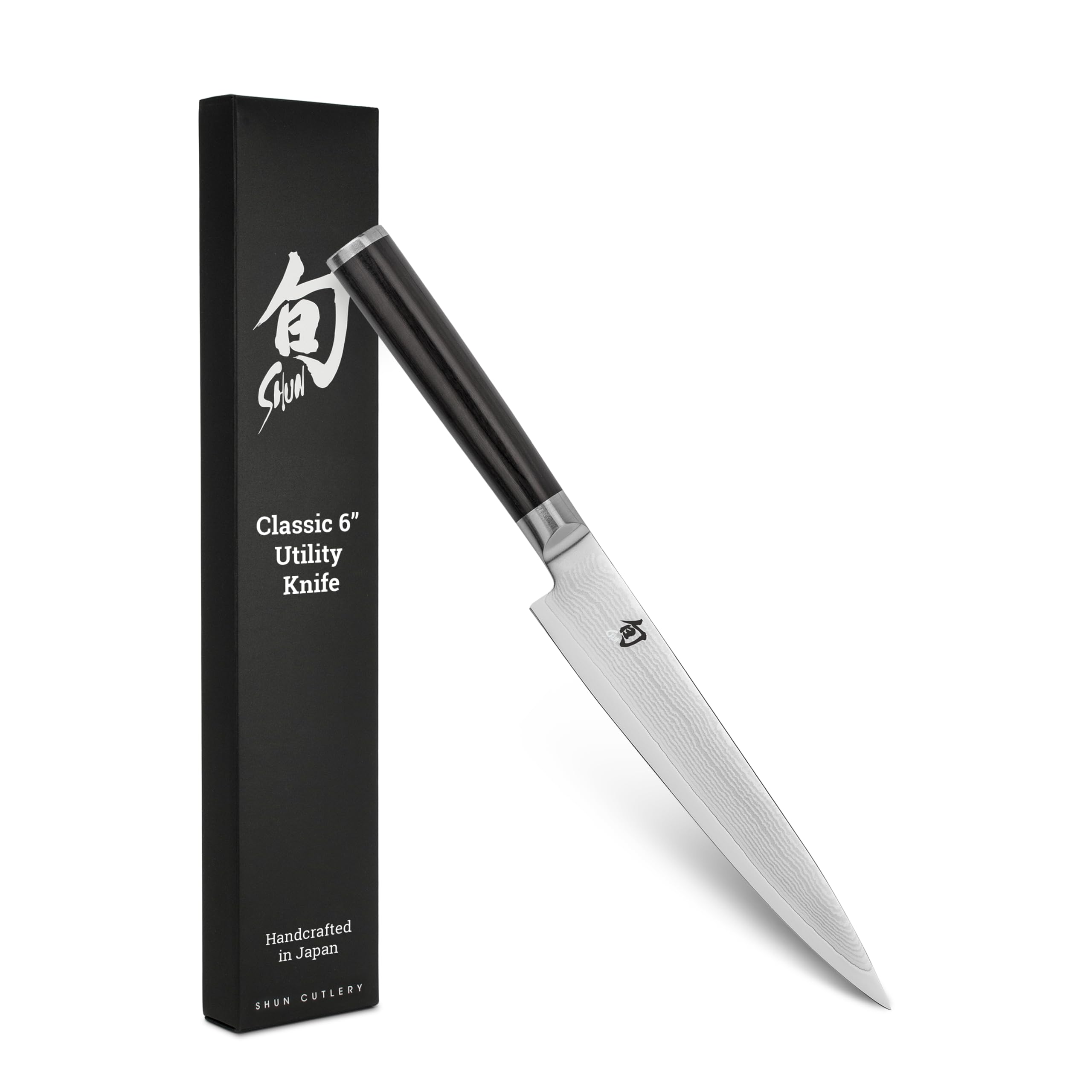
Shun Classic 6-Inch Utility Knife
Key Features
- Steel: VG-MAX, 68-layer Damascus
- Weight: 2.8 oz (80 g)
- Edge angle: 16 degrees per side
- Blade length: 6 in
- Price: Premium
Sixty-eight layers of Damascus over a VG-MAX core is what you see first, and Shun has made the pattern part of the design rather than something hidden under a polish. The blade is honed to 16 degrees per side and the pakkawood handle is D-shaped, so it fills the palm and rolls the edge toward the board.
At six inches and 2.8 ounces it is the longest knife here and one of the lightest, and that pairing is the whole idea. It reaches across an onion, slides under the skin of a fish fillet, and handles the small, fiddly cuts where a chef’s knife feels like a shovel. It rewards a light hand rather than a firm one.
A thin, hard Japanese edge asks more of you than German steel: wipe and dry it before it goes back in the block, keep it out of the dishwasher, and do not twist the blade to lever anything apart. Treat it that way and the edge lasts. Careless minutes simply cost more here than they do on a soft German blade.
This is the knife we pick up when the job is delicate rather than big: supreming citrus, taking the top off a strawberry, cutting scallions into threads. It is also the best-looking knife in the group by some distance, which counts for something when the thing lives on the counter.
Pros
- Six-inch Damascus blade with a fine 16-degree edge
- Light 2.8 ounces for delicate detail work
- A finish worth leaving on display
Cons
- Handle runs small for large hands
Choose the Shun if you want a longer Japanese petty with a fine edge and a beautiful finish, and you will dry it every time.
Best for Traditional Handle Feel
Cutluxe 5.5-Inch Utility Knife
Key Features
- Steel: German 1.4116, 56+ HRC
- Handle: Pakkawood
- Weight: 5.28 oz
- Construction: Forged, full tang
- Price: Budget
The pakkawood is the first thing you notice on the Cutluxe: figured, warm, and triple-riveted to a full tang that runs the length of the handle. The blade is forged German steel, the 1.4116 mix at 56-plus Rockwell, hand-sharpened to 14 to 16 degrees per side and covered by a lifetime warranty against material and workmanship defects.
At 5.28 ounces it has real presence on the board. A sweet potato or a wedge of cabbage does not deflect it, and the handle gives you something to push against without gripping hard. In the hand it reads as a more expensive knife than it is, which matters if you are replacing a tired drawer one blade at a time.
That acute edge is the liveliest part of the package. It goes through tomato and citrus cleanly and holds up to board work, and it is the closest thing in this group to a Japanese grind on a German blade. It is not a cleaver, so keep it off bones and frozen food, and dry the wood rather than leaving it in the rack.
Pros
- Full tang and pakkawood give it a planted feel
- Hand-sharpened 14- to 16-degree edge bites cleanly
- Lifetime warranty against defects
Cons
- Heaviest of the five-inch knives here
The Cutluxe is our pick for anyone who wants a full-tang, wood-handled petty with some heft and a lifetime warranty behind it.
Best for Small Hands
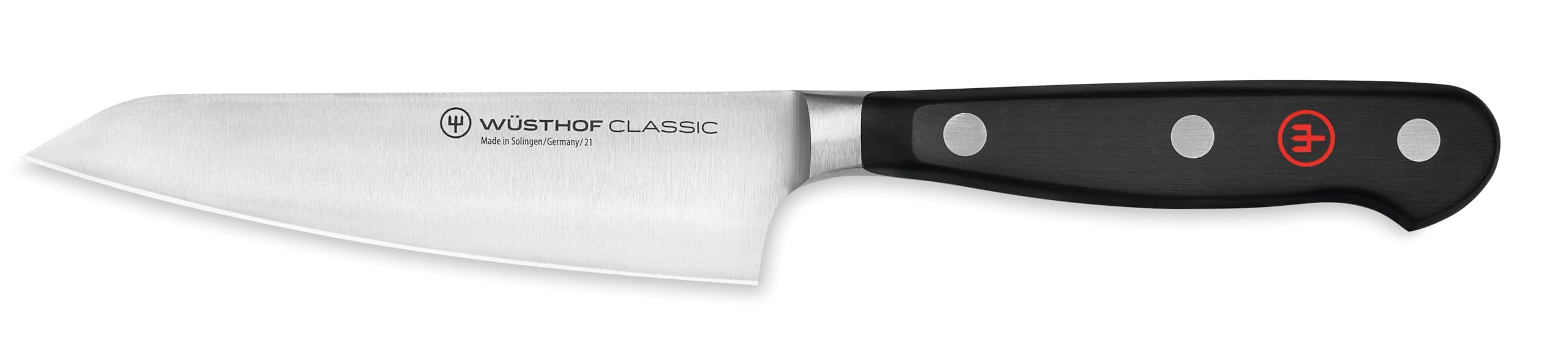
Wüsthof Classic 4.5-Inch Asian Utility
Key Features
- Handle: POM
- Weight: 2.56 oz
- Blade length: 4.7 in
- Construction: Forged, full tang
- Price: Midrange
Wüsthof calls this an Asian utility knife, and the shape explains the name: a straight edge that curves gently toward the tip, on a blade just under five inches long. It is forged, full-tanged, triple-riveted, and at 2.56 ounces one of the lightest knives here.
The curve is what makes it useful. It rocks a little, so you can mince garlic or parsley without lifting the tip off the board, and the short blade lets you work close in for shallots and small fruit. We used it most for the jobs that sit between a paring knife and a chef’s knife: a few mushrooms, a lime, one onion.
If a six-inch petty feels like too much knife, this is the one to buy. It is short enough to control from the fingertips, stiff enough not to wander, and shaped to keep the tip where you put it. The caveat is that it is genuinely small: a pile of potatoes is chef’s-knife work, and the blade runs out of length on a big squash.
Pros
- Curved edge rocks for mincing and small prep
- Light 2.56 ounces, easy to control up close
- Forged Solingen build in a compact blade
Cons
- Short handle for large hands
For small hands and small jobs, the Wüsthof Classic Asian Utility is the compact petty we hand people first.
Best for Long Prep Sessions
KEEMAKE 5-Inch Utility Knife
Key Features
- Steel: High-carbon stainless
- Handle: Pakkawood
- Weight: 3.52 oz
- Blade length: 5 in
- Price: Budget
Twenty minutes of shallots, garlic, and herbs is where a light knife earns its keep, and at 3.52 ounces the Keemake is the lightest five-inch knife here. We felt it most at the end of a long prep: your hand stays relaxed because there is so little to hold up, and the contoured pakkawood sits naturally against the fingers.
The blade is forged high-carbon stainless with a plain edge, and it does the tomato test straight out of the box, through the skin without crushing what is underneath. It is built for produce, cheese, and light trimming rather than heavy butchery, and it steers accordingly, which is exactly what you want from a knife this size.
Set beside the Mercer, it trades some grip and a little mass for a lighter, better-looking knife. Set beside the Kimura, it costs about the same and gives you a forged blade rather than a stamped one. It is the one we hand someone who complains that every small knife feels clumsy.
Pros
- Lightest five-inch knife here at 3.52 ounces
- Contoured pakkawood handle sits comfortably
- Sharp enough for tomato skins out of the box
Cons
The Keemake is the lightweight pick: 3.52 ounces of forged steel that keeps your hand fresh through a long prep.
Best for Edge Retention
Dalstrong Shogun 6-Inch Utility Knife

Key Features
- Steel: AUS-10V, 62+ HRC
- Weight: 4.2 oz (120 g)
- Edge angle: 8 to 12 degrees per side
- Blade length: 6 in
- Price: Premium
There are two six-inch petty knives in this group and they are not the same tool. Where the Shun is thin and quick, the Dalstrong Shogun is heavier and harder: AUS-10V at 62-plus Rockwell, 67 layers of Damascus cladding, and an edge finished at 8 to 12 degrees per side. It also ships with a sheath, which is rare at this level and useful if the knife travels.
Hardness is the point. At 62 Rockwell this is the most wear-resistant blade here, and the geometry behind the edge is thin enough to fall through an onion rather than push through it. The G10 handle is textured and impervious to water, and at 4.2 ounces the knife feels deliberate rather than dainty.
The trade is maintenance: an edge this hard and this thin belongs on stones rather than a honing steel, and it rewards a light hand. We think it is the right buy for a cook who already has a chef’s knife and wants a small blade that stays razor-sharp for months, and the wrong one for a single-knife kitchen.
Pros
- 62+ HRC AUS-10V holds an edge longer than the German picks
- G10 handle stays grippy and will not absorb water
- Ships with a sheath for storage and travel
Cons
- Hard, thin edge chips if levered or twisted
Buy the Dalstrong if you want the hardest, keenest small blade here and you will treat it like the fine instrument it is.
Best for Affordable Japanese Steel
Kimura 5-Inch Utility Knife

Key Features
- Handle: POM
- Weight: 3 oz (85 g)
- Blade length: 5.1 in
- Construction: Stamped, full tang
- Price: Midrange
Seki, Japan is on the box, and that is the reason to look at this one. Kimura’s five-inch utility knife is stamped from a single piece of high-carbon chrome-molybdenum steel with a full tang, triple rivets, and a full bolster, and it sits in the middle of the range, well below the forged Japanese knives here.
Stamped construction means thinner stock and less weight: 3 ounces, which puts it among the lightest full-tang knives in this group. It cuts accordingly, quick and thin and easy to steer, with a double bevel that suits either hand and a bolster that gives your index finger somewhere to sit.
What you give up is heft and finish. There is not much steel here, so it feels dainty next to the forged German knives, and the look is plain rather than polished. For trimming green beans or sectioning an orange, none of that matters.
It earns its place as the value route into Japanese steel: the thin geometry and the edge that comes with it, at a price closer to the German budget knives. If you want that same idea with more substance behind the edge, that is what the Shun is for.
Pros
- Made in Seki with a full tang and bolster
- Light 3 ounces for quick, precise work
- Japanese steel at a midrange price
Cons
- Stamped blade flexes if you bear down
The Kimura is the affordable way into Japanese steel: thin, light, made in Seki, with a plain finish to match the price.
Best for Tight Budgets
HENCKELS Solution 6-Inch Utility Knife

Key Features
- Handle: ABS
- Weight: 3.04 oz
- Blade length: 6 in
- Construction: Stamped
- Price: Budget
If the goal is to spend as little as possible on a knife that still slices a tomato, the Henckels Solution is the answer. It is a stamped six-inch utility knife in stainless steel with an ABS handle, 3.04 ounces on the scale, and it arrives sharp.
Six inches is as long as a petty really gets, and on a stamped blade that length comes with some flex. You feel it in a hard carrot, or trying to cut a straight line through a block of cheese: the blade wanders. For sandwiches, fruit, and light trimming it is perfectly steady.
It also feels like what it is, an inexpensive utility blade rather than a piece of kit you pass down. But it is rated for the dishwasher, which most of the knives here are not, and for a rental kitchen, a first apartment, or a knife that lives in a drawer, that is the right priority to have.
Pros
- Cheapest way into a sharp utility knife
- Sharp out of the package
- Dishwasher rated, unlike most picks here
Cons
- Blade flexes in hard food
- Slim handle suits small hands better
Buy the Henckels Solution if budget is the deciding factor and you want a sharp six-inch utility knife you will not fret over.
How We Tested the Best Petty Knives
We started with a shortlist of roughly 40 petty knives from makers with a track record, then narrowed it on the specs that actually matter at this size: blade length between 4.5 and 7 inches, steel type, handle construction, and whether the maker publishes a hardness rating. We dropped anything with a pattern of reviews about chipped edges or handles that came loose, and we kept a spread of prices so the cheaper knives had to earn their place next to the expensive ones. Twelve made the cut.
Testing ran for six months in our home kitchens. Every knife went through the same first week: slicing ripe tomatoes to see whether the edge crushed them, mincing shallots and garlic, supreming citrus, and stripping herbs — the small, fiddly jobs this knife is built for. Each one also went through a full Sunday meal prep, trimming chicken thighs and breaking down a whole bird, since that’s where a short blade either feels nimble or feels like the wrong tool entirely.
We weighed every knife on a kitchen scale and noted where the balance point sat, then used each for a 20-minute stretch of continuous prep with wet hands to see whether the handle turned slippery or dug into a hot spot. Edges were checked with paper and tomato tests at the start, middle, and end of the six months, honing only when a knife genuinely needed it, so we could tell which blades held an edge and which just felt sharp on day one. Anything sold as dishwasher-safe went through a cycle, after which we looked for gaps at the bolster and rust or micro-chipping along the edge. The knives still in rotation at month six are the ones on this list.
How to Choose a Petty Knife
Length is the decision that matters most: a petty earns its place by being the small blade your chef’s knife is not, and the wrong size turns it into a duplicate.
Start with length, and be honest about your chef’s knife
The useful range runs from about four to six inches. A five-inch blade handles most small prep and still fits a compact grip; a six-inch blade reaches across an onion and starts behaving like a small chef’s knife. The trap is buying six inches when you already own an eight-inch chef’s knife. You end up with two knives doing the same job, and the petty never leaves the block. If your chef’s knife is a big one, a four-and-a-half- to five-inch petty is the better partner.
Length also decides who can use the knife comfortably. The Wüsthof here, at 4.7 inches, is our choice for a small hand or a narrow board; the Shun and the Dalstrong at six inches suit a cook who wants reach.
Weight and handle decide how it feels after ten minutes
Weights in this group run from 2.56 to 6.4 ounces, and the spread is not cosmetic. A light knife is easier to steer for delicate work and less tiring over a long session; a heavy one steadies a cut through dense vegetables and gives you something to push against. Match it to the work you do most, not to the number that sounds better.
Handles matter just as much. Textured Santoprene holds a wet hand better than polished pakkawood, while wood and POM feel better dry and look better on the counter. If you cook with wet hands, put grip ahead of looks.
Steel hardness sets the trade between keen and tough
The Cutluxe lists 56-plus Rockwell with a 14- to 16-degree edge; the Dalstrong lists 62-plus at 8 to 12 degrees. The harder, thinner blade takes a finer edge and holds it longer, but it chips more readily and belongs on a whetstone. The softer, thicker one gives up some sharpness and comes back in seconds on a honing steel.
The practical rule: if you want one knife you never think about, buy German. If you want the sharpest edge in the kitchen and you will maintain it, buy Japanese.
Plan for the care, not just the cut
Every knife here will outlive its edge if you treat it well, and most failures involve water. A petty gets used, wiped once, and put away damp, which is how fine edges corrode and wood handles go grey. Wash and dry by hand, dry again before it goes into the block, and store it where the tip will not knock against anything.
Only one knife here is rated for the dishwasher. Assume hand washing for everything else, including the knives described as easy care.
Buy one knife, not a block
A petty is the easiest knife to buy badly, because sets make it look cheap to add one. They are not. A set fills the block with a second and third knife you will not reach for and spreads your money across blades you did not want. Buy the single knife, put the difference toward a stone, and add a chef’s knife when you find you need the length.
Frequently Asked Questions
What’s the difference between a petty knife and a paring knife?
A paring knife is short, usually three to four inches, and built for work in your hand: peeling an apple, hulling a strawberry, trimming a bean. A petty runs four to six inches with a taller blade and a straighter profile, so it works on a board. If you peel over the sink, buy the paring knife; if you chop on a board, buy the petty.
Do pakkawood and rosewood handles need oiling?
They do, because stabilized wood dries out with repeated washing. Once a month, rub in a thin coat of food-safe mineral oil, leave it an hour, then wipe off the excess and buff. Do not soak the handle, and do not substitute cooking oil, which turns rancid. A handle that looks chalky or feels rough is asking for it.
How do I know when my petty knife needs sharpening?
Use a ripe tomato as the test: a sharp petty breaks the skin cleanly and finishes the slice. If the skin splits before the blade gets through, ten passes on a honing steel will bring German steel back, while a hard Japanese blade wants a whetstone instead. Sharpen at the first sign of dragging rather than waiting for a struggle.
Final Verdict
For most kitchens the answer is the Mercer Genesis 5-inch. It is forged, full-tanged, comfortable in a wet hand, and it does the small, precise work a petty exists for while costing less than any other forged knife on this page.
Spend more for a reason: the Zwilling Pro if you cook every night and want mass behind the edge, the Shun if you want a longer Japanese blade and will dry it every time. Small hands or a short board? Start with the Wüsthof.