This post contains affiliate links. We may earn a small commission when you buy through our links — at no extra cost to you.
Many home cooks are drawn to Japanese chef knives for their razor sharpness, but the first scratch of rust or chip on the edge can be disheartening. The problem isn’t the knife—it’s the mismatch between blade hardness and daily use. A high-hardness blade (60+ HRC) holds an edge superbly but requires gentle handling, while softer steels are more forgiving but need frequent sharpening.
The sweet spot for most home cooks lies in mid-range knives around 58-60 HRC, where you get good edge retention without extreme brittleness. Understanding this trade-off is the key to choosing a knife that will serve you for years, not just weeks.
This guide cuts through the marketing noise to recommend knives that deliver genuine Japanese steel performance at prices that make sense, with honest notes on what care they need.


Best for Daily All-Rounder
HOSHANHO Chef 8"
Key Features
- Blade Steel: 10Cr15CoMoV (HRC 60)
- Edge Angle: 13° per side
- Handle Material: Pakkawood
- Blade Length: 8 Inches
- Weight Balance: 350g
- Price: $$
The HOSHANHO 8-inch gyuto uses Japanese 10Cr15CoMoV steel heat-treated to 60 HRC — hard enough for excellent edge retention but soft enough to resist chipping on hard vegetables or bone. Out of the box, the 13-degree edge slices through onions and tomatoes with minimal drag, and owners report the sharpness holds up well through weeks of home cooking without needing a touch-up.
The blade is 350 grams — weighty enough to power through squash but balanced so the pinch grip feels natural for precise cuts. The pakkawood handle is smooth, with no rough seams, and the full tang construction adds confidence during rock-chopping. One trade-off: the knife ships without a sheath or blade guard, so you’ll need a magnetic strip or a separate cover to protect the edge and your fingers during storage.
This gyuto is for the home cook who wants a capable daily driver without stepping up to the premium pricing or fragility of 62+ HRC blades. It outperforms the slimmer 7-inch santoku from the same store (which may need more frequent honing) and handles everything from herbs to butternut squash. The missing sheath is the only real concession — budget a few dollars for a blade guard if you don’t have a magnetic rack.
Pros
- Razor-sharp edge right out of the box, with impressive staying power through regular use
- High-quality build with a comfortable pakkawood handle and clean finish
- Delivers performance comparable to knives costing twice as much
Cons
- No protective sheath or blade guard included — requires separate purchase or storage solution
A mid-range gyuto that balances sharpness and durability without the chipping risk of harder blades — just add a sheath to complete the setup.
Best for Budget Sharpness
DDF iohEF Santoku 7"
Key Features
- Blade Steel: 5Cr15Mov (HRC 58)
- Edge Angle: 15° per side
- Handle Material: Stainless Steel
- Blade Length: 7 Inches
- Weight Balance: 8 oz
- Price: $
The DDF iohEF Santoku’s 5Cr15Mov steel blade is remarkably sharp right from the box, making quick work of herbs, tomatoes, and boneless proteins. At 7 inches and 8 ounces, its lightweight design suits home cooks who prefer a nimble knife for general slicing and dicing. This budget-friendly option delivers sharpness that rivals pricier Japanese knives, though the thin blade means it’s not built for heavy-duty tasks.
This knife is a good match for budget-conscious cooks with larger hands who want a lightweight blade for everyday slicing. The thin steel can flex noticeably when cutting hard squash or frozen items, so it’s best reserved for vegetables, boneless meats, and herbs. The stainless finish may show minor tarnish over time if not dried promptly after washing – a small tradeoff for the price.
Pros
- Razor-sharp 5Cr15Mov steel delivers precise cuts immediately.
- Lightweight at 8 ounces reduces hand fatigue during longer prep sessions.
- Budget-friendly price with sharpness comparable to higher-end options.
Cons
- Thin blade can flex when cutting hard vegetables like squash – not ideal for heavy chopping.
- Stainless finish may develop tarnish spots if not dried after washing – requires extra care.
The DDF iohEF Santoku delivers impressive sharpness for the price, but its thin blade means it’s best suited for lighter kitchen tasks where precision matters more than brute force.
Best for Premium Craftsmanship
Shun Classic 8"
Key Features
- Blade Steel: VG-MAX Damascus
- Edge Angle: 16°
- Handle Material: Pakkawood (D-shaped)
- Blade Length: 8 Inches
- Weight Balance: 200g
- Price: $$$
The Shun Classic 8-inch is a premium benchmark Japanese knife, featuring a VG-MAX Damascus core and a hand-sharpened 16-degree edge that cuts with remarkable precision. Its hammered finish and D-shaped Pakkawood handle give it a refined, balanced feel that reduces hand fatigue during longer prep sessions. This knife sits above entry-level Shun models in both build quality and cutting performance.
This knife is best suited for cooking enthusiasts who value fine craftsmanship and are willing to handle a delicate blade. The high-hardness steel can chip when used on hard foods like butternut squash or bones, or if struck against a hard surface. It requires careful hand washing, drying, and a soft cutting board to maintain its edge. For those who choose their tools with intention and enjoy the ritual of maintenance, the Shun Classic delivers an exceptional cutting experience.
Pros
- Razor-sharp out of the box with lasting edge retention for precision slicing.
- Beautiful hammered Damascus finish with visible craftsmanship.
- Lightweight and well-balanced design reduces hand fatigue during extended use.
Cons
- The blade may chip when cutting hard foods like butternut squash or bones, or on accidental impacts with hard surfaces.
A top-tier Japanese knife for those who prioritize sharpness and beauty over hard-use durability — ideal for enthusiasts who will treat it with care.
Best for Compact Santoku
HOSHANHO Santoku 7"
Key Features
- Blade Steel: 10Cr15CoMoV (HRC 62)
- Edge Angle: 15° per side
- Handle Material: Pakkawood
- Blade Length: 7 Inches
- Weight Balance: 11.2 oz
- Price: $$
The HOSHANHO 7-inch santoku uses the same 10Cr15CoMoV steel (HRC 62) as the 8-inch gyuto that took our top spot, but in a shorter blade that gives home cooks more maneuverability for detail work like chopping herbs or dicing small vegetables. The pakkawood handle fits securely in hand, and the 15-degree edge angle delivers noticeable sharpness out of the box.
This santoku suits cooks who prefer a nimble blade for all-purpose cutting and don’t mind a slightly shorter reach for larger ingredients. Some users have noted that the edge may require more frequent honing than expected — a few weeks of regular use can soften the initial sharpness. That tradeoff is manageable with a steel rod after each session, and the knife remains a solid companion for everyday meal prep.
Pros
- Slices through vegetables and meat with minimal effort
- Ergonomic handle provides a comfortable, secure grip
- Well-balanced knife that delivers capable performance at a mid-range price
Cons
- During heavy prep sessions, the edge may lose its initial sharpness sooner than expected — regular honing helps maintain performance
A capable santoku for home cooks who value blade maneuverability over long cutting surface, with a manageable edge-retention quirk that honing addresses.
Best for Damascus Value
SHAN ZU Damascus 8"
Key Features
- Blade Steel: 10Cr15Mov (HRC 62)
- Handle Material: G10 Glass Fiber
- Blade Length: 8 Inches
- Weight Balance: 260g
- Price: $$
The SHAN ZU’s 8-inch blade arrives razor-sharp and maintains its edge well through regular use, with a balanced G10 handle that feels secure in hand. Its 10Cr15Mov steel at 62 HRC provides good edge retention for the price. Compared to the top pick’s verified long-term record, this knife’s durability under daily heavy cutting is less documented—a distinction for those planning years of frequent use.
This knife suits home cooks who want an attractive Damascus blade at a mid-range price without sacrificing immediate sharpness. Ideal if you use a chef knife a few times a week and value initial performance and aesthetics. However, those who cook heavily every day may prefer a model with more extensive long-term user history.
Pros
- Razor-sharp edge with good edge retention for a mid-range knife
- Comfortable G10 handle with good balance reduces fatigue
- Attractive 67-layer Damascus pattern adds visual appeal
Cons
- Long-term durability under frequent heavy use is less documented than some alternatives
A sharp, well-balanced mid-range knife with a striking Damascus finish—best for home cooks who value immediate performance and aesthetics over decades of heavy daily use.
Best for Small Hands
Matsato Chef 6.3"
Key Features
- Blade Steel: 1.4116 Stainless
- Handle Material: Wood
- Blade Length: 6.3 Inches
- Weight Balance: 176g
- Price: $
The Matsato’s defining feature is the finger hole at the base of the handle, which locks your index finger into a stable grip — especially useful for controlled slicing and rocking cuts. The short 6.3-inch blade and 176-gram weight make it noticeably more maneuverable than a full-size chef knife, ideal for detail work like trimming vegetables or slicing fruit. Edge retention, however, is not consistent across units, so the initial razor sharpness may fade sooner than expected.
This knife suits home cooks with smaller hands who value ergonomics and precision over long-term edge longevity. The finger hole design and lightweight build reduce fatigue during shorter prep sessions. But if you routinely process large quantities or need a blade that holds its edge for weeks between sharpenings, the Matsato’s variable edge retention becomes a limitation — occasional use and routine honing keep it performing well.
Pros
- Very sharp out of the box for immediate cutting tasks.
- Comfortable handle with finger hole improves control for smaller hands.
- Budget-friendly price for a Japanese-style chef knife with solid build.
Cons
- Edge retention can vary between units, so the knife may need more frequent sharpening than some alternatives.
A capable option for cooks who prioritize a comfortable, precise grip and don’t mind touching up the edge more often — less suited for heavy weekly prep.
Best for Budget Small Hands
imarku Santoku 7"
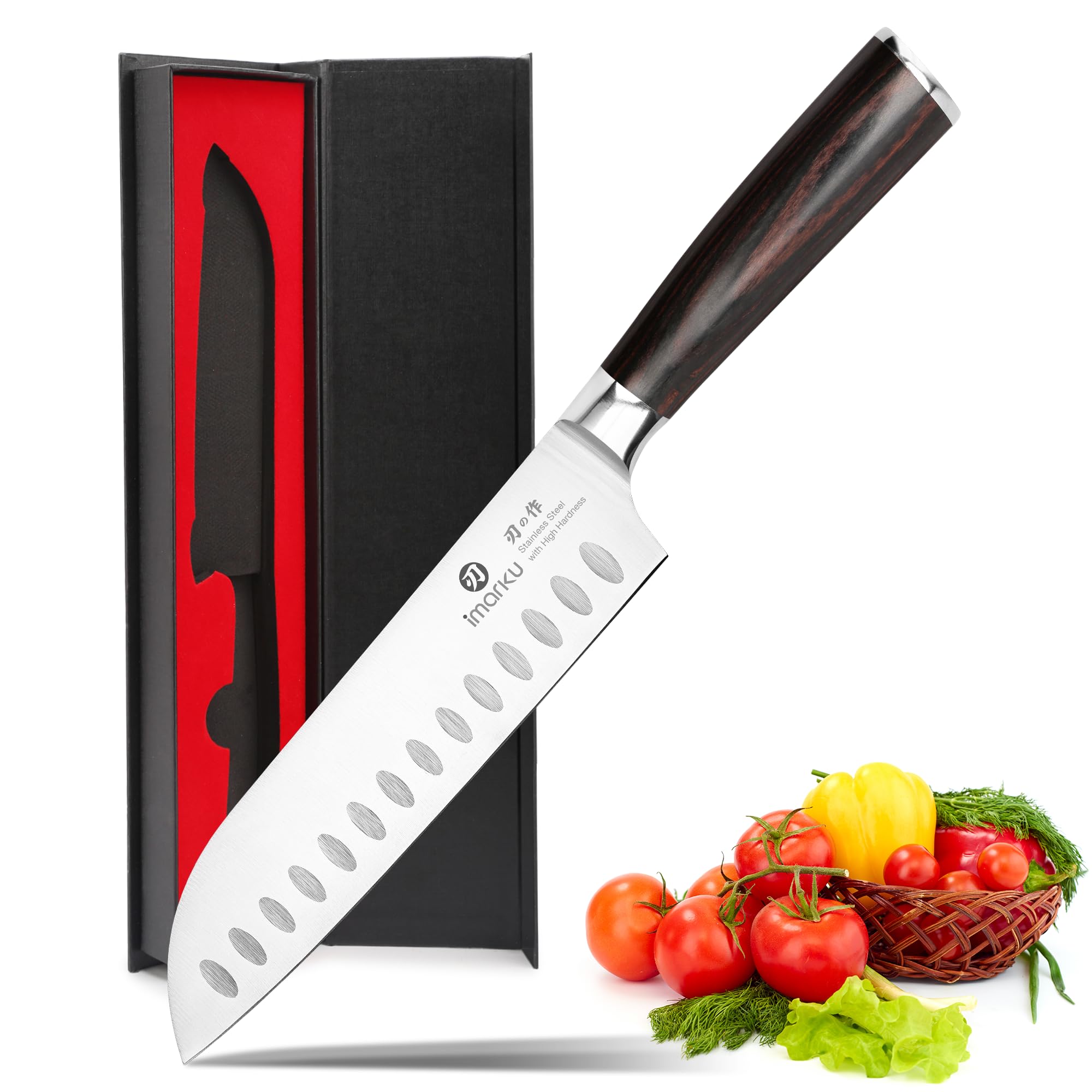
Key Features
- Blade Steel: High Carbon Stainless
- Edge Angle: 15-18° per side
- Handle Material: Pakkawood
- Blade Length: 7 Inches
- Weight Balance: 6.88 oz
- Price: $
The imarku Santoku slices through vegetables and boneless proteins with impressive precision right out of the box, and its light 6.9-ounce frame makes it easy to maneuver for smaller hands. The value is hard to beat at this price point. That said, its long-term durability is a gamble—blade fracture has been noted in some units during standard cutting tasks, so this knife is best treated as a capable short-term performer rather than a daily workhorse for heavy prep.
Pros
- Razor-sharp edge from the start with good edge retention
- Comfortable ergonomic handle fits smaller hands well
Cons
- Blade fracture has been noted in some units during normal cutting—best for occasional use rather than daily heavy chopping
A sharp, lightweight santoku for budget-conscious home cooks with smaller hands—ideal if you’re comfortable accepting possible long-term durability issues.
Best for Visually Striking
FAMCÜTE Chef 8"
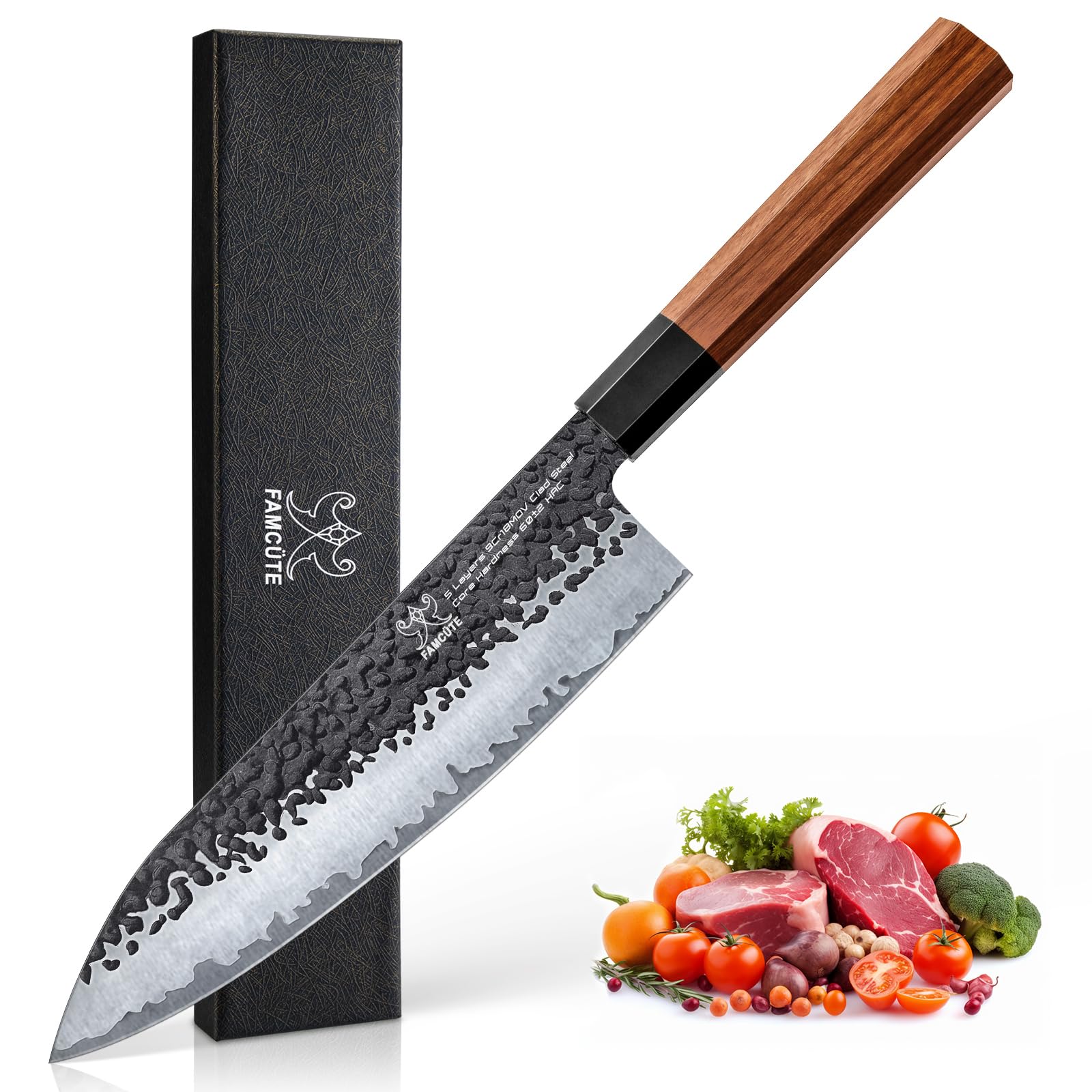
Key Features
- Blade Steel: 9CR18MOV clad (HRC 62)
- Handle Material: Rosewood
- Blade Length: 8 Inches
- Weight Balance: 11.64 oz
- Price: $
This knife delivers impressive sharpness and a beautiful traditional look at a budget-friendly price. The rosewood handle is comfortable and the blade holds its edge well. However, the steel is not stainless, and some units have shown rust spots or chipping on wooden boards. For home cooks who don’t mind extra care — immediate drying and avoiding hard cutting surfaces — it offers strong value.
Pros
- Razor-sharp edge that maintains sharpness well between sharpenings.
- Visually appealing with a traditional Japanese design and comfortable rosewood handle.
Cons
- Rust spots or chipping can occur, especially if used on wooden cutting boards and not dried immediately.
Best suited for home cooks who prioritize aesthetics and initial sharpness and are willing to adopt careful drying and board selection.
Best for Heavy Substantial
KYOKU Shogun 8"

Key Features
- Blade Steel: VG10 Damascus (HRC 58-60)
- Edge Angle: 8-12°
- Handle Material: G10 fiberglass
- Blade Length: 8 Inches
- Weight Balance: 1.4 lbs
- Price: $$
The KYOKU Shogun 8" brings a substantial 1.4-pound heft and a genuine Damascus pattern to the mid-range market. Its VG10 core takes a fine edge, and the G10 handle offers a secure grip. However, the tip may chip or fracture even with careful use, and the blade can develop surface rust if not dried immediately. These maintenance demands keep it from being a top runner-up, but home cooks willing to hand-wash and dry promptly will appreciate the weight and aesthetics.
Pros
- Razor-sharp edge straight from the box
- Attractive Damascus pattern with a high-quality finish
Cons
- Tip may chip or fracture during normal use
- Surface rust may develop if blade is not dried immediately after washing
Ideal for home cooks who prioritize a heavy, visually striking knife and are diligent about immediate drying and gentle use.
Best for Budget Shun
Shun Sora 8"
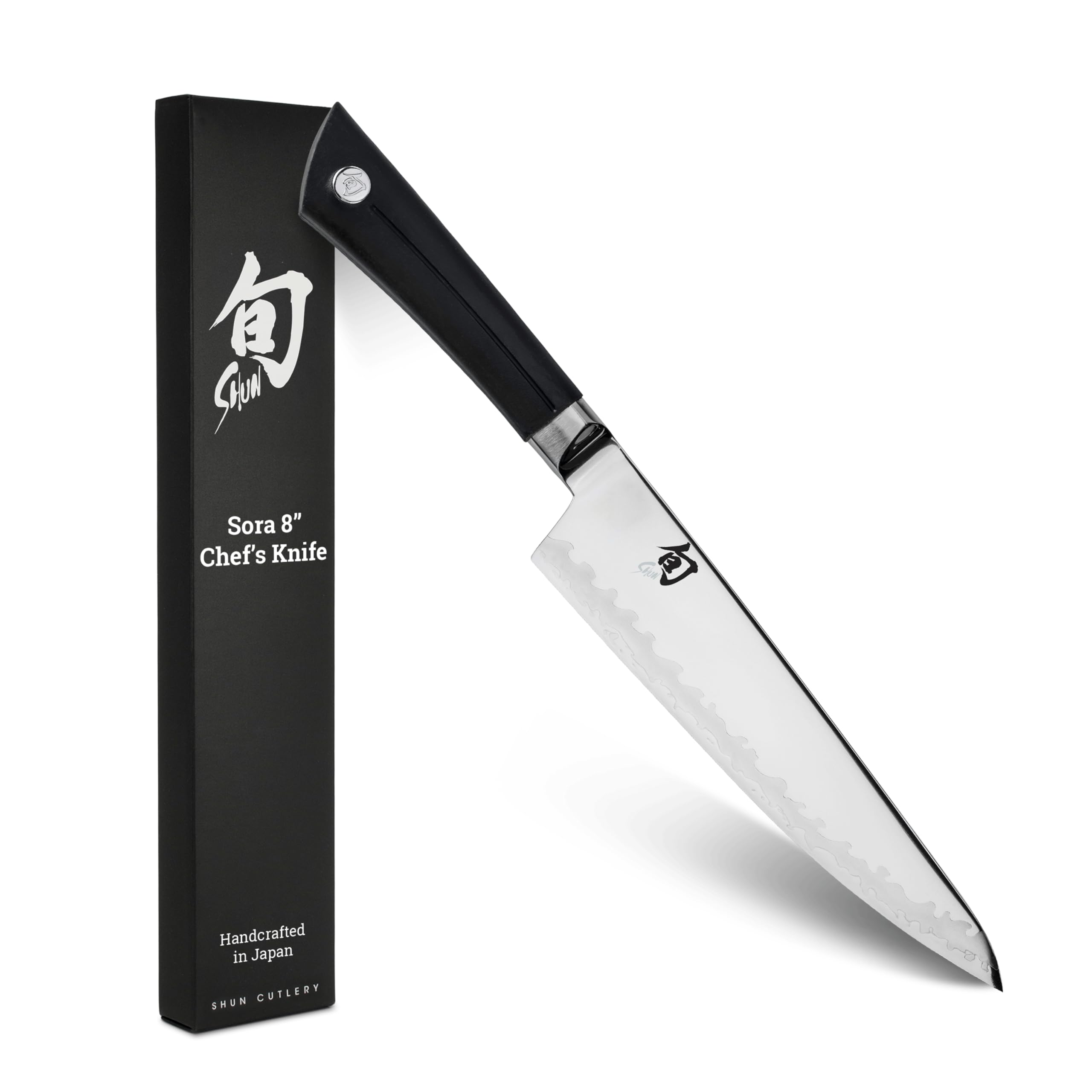
Key Features
- Blade Steel: VG10 core (composite)
- Edge Angle: 16°
- Handle Material: PP/TPE polymer
- Blade Length: 8 Inches
- Weight Balance: 6.56 oz
- Price: $$
The Sora delivers the sharpness and edge retention expected from Shun’s VG10 steel, with a lightweight build that reduces hand fatigue during extended prep. Where it compromises is the polymer handle – it lacks the tactile warmth of wood or G10 – and like other hard Shun blades, the thin edge and tip can chip when cutting through hard foods or on glass boards. These tradeoffs explain why the Sora sits below the Classic and HOSHANHO options in our ranking.
Pros
- Very sharp out of the box with edge retention that holds up well through daily prep.
- Light enough to reduce hand fatigue during longer cooking sessions.
Cons
- The thin edge and tip can chip when cutting hard foods like squash or bones – worth avoiding such tasks.
- The polymer handle lacks the premium feel of wood or G10, noticeable if you’re used to higher-end Shun models.
Best suited for budget-conscious home cooks who want a genuine Shun knife and are willing to avoid hard cutting tasks and accept a synthetic handle.
Best for Damascus Fiberglass
SHAN ZU Damascus 8" v2

Key Features
- Blade Steel: 10Cr15CoMoV (HRC 62)
- Edge Angle: 15°
- Handle Material: Fiberglass G10
- Blade Length: 8 Inches
- Price: $$
This SHAN ZU delivers a genuine Damascus pattern and good initial sharpness, backed by a fiberglass G10 handle that resists moisture better than wood. It’s nearly identical to the more popular sibling model, differing mainly in handle material — the more established option has a longer track record of consistent performance. For home cooks who prefer G10’s feel over wood and want a Damascus knife without spending over $70, this is a suitable pick, though those prioritizing a well-documented long-term durability may lean toward the other version.
Pros
- Sharp out of the box with lasting edge retention.
- Beautiful 67-layer Damascus pattern with solid build quality.
Cons
- Long-term durability under frequent heavy use has a shorter track record.
Best suited for home cooks who want a Damascus knife with a G10 handle and are comfortable with a less-proven track record compared to the more popular SHAN ZU model.
How to Choose
The key to picking the right Japanese chef knife is understanding the trade-off between blade hardness and everyday durability.
Blade Steel Hardness and Composition
High-carbon stainless steel with HRC above 60 yields a razor edge but makes the blade prone to chipping on hard foods like butternut squash or bones. Steels like 10Cr15CoMoV at 60 HRC offer a balanced sweet spot: sharp enough for effortless slicing yet tough enough for daily prep.
At lower hardness (56-58 HRC), blades are more forgiving but lose their edge faster. For home cooks who primarily cut vegetables and boneless meat, a knife in the 58-60 HRC range provides the best combination of sharpness retention and impact resistance.
Edge Angle and Sharpness
Japanese knives are typically ground to 15-16 degrees per side, compared to 20 degrees for Western knives. This sharper angle cuts through food with less force but also leaves the edge more vulnerable to rolling or chipping when twisted against hard surfaces.
To protect the edge, use a wooden or plastic cutting board and avoid glass, stone, or bamboo boards. A gentle straight-up-down slicing motion—rather than a heavy rock—further reduces the risk of damage.
Handle Material and Grip
Pakkawood (resin-impregnated wood) is classic and comfortable but can crack over time if left wet. G10 fiberglass handles are more durable, water-resistant, and provide a secure grip even with oily hands. Rosewood is visually appealing but may react to moisture if not dried immediately.
The handle shape also matters: D-shaped or octagonal profiles offer better control during pinch grips. Choose a material and shape that feels secure in your hand, especially when wet.
Blade Length for Home Cooking
An 8-inch gyuto is the most versatile size for general cooking, offering enough length to slice roasts and cabbage while still being nimble. A 7-inch santoku is shorter and lighter, with a flatter profile that excels at push-cutting and mincing.
Home cooks with smaller hands or limited counter space often find a 7-inch blade more maneuverable. Anything over 8 inches becomes unwieldy for most daily tasks, while blades under 6 inches lack reach for larger ingredients.
Weight and Balance Control
Lightweight knives (under 8 oz) reduce wrist fatigue but require more downward force to cut through dense vegetables. Heavier knives (over 12 oz) provide momentum but can tire the arm during long prep sessions.
A well-balanced knife in the 8-11 oz range feels neutral in the hand—neither blade-heavy nor handle-heavy. The balance point should fall just forward of the handle, allowing a pinch grip to control the blade naturally.
FAQ
Why does my Japanese chef knife chip so easily?
Japanese knives with hardness above 60 HRC are intentionally brittle to achieve extreme sharpness. Chipping happens when the edge meets hard foods (bones, squash seeds, frozen items) or when the blade is twisted during cutting. To avoid chips, slice through hard vegetables with a straight up-down motion and never cut through bones or frozen food. Using a wooden cutting board also reduces shock to the edge.
Is it okay to use a Japanese knife on a bamboo cutting board?
Bamboo boards are very hard and can quickly dull or even chip a sharp Japanese edge. Soft wood boards (such as hinoki, beech, or teak) or high-quality plastic boards are better choices. If you already have a bamboo board, use a gentle slicing motion and avoid aggressive chopping to minimize damage.
How do I sharpen a Japanese knife at home without ruining the edge?
Use a whetstone with 1000 and 3000 grit sides. Soak the stone, hold the knife at a consistent 15-16 degree angle, and draw the blade across the stone from heel to tip. Finish with a few strokes on a leather strop. Avoid pull-through sharpeners and electric sharpeners—they remove too much metal and can ruin the delicate edge geometry.
Gyuto vs santoku: which is better for a home cook?
The gyuto (8-inch) is a true chef’s knife with a curved belly for rocking cuts, ideal for slicing meat and herbs. The santoku (7-inch) has a flatter edge and shorter length, making it more agile for push-cutting vegetables and mincing. For a home cook who preps a lot of vegetables and wants one knife that does it all, a santoku is often the better choice. If you frequently slice large roasts or use a rocking motion, go with a gyuto.