This post contains affiliate links. We may earn a small commission when you buy through our links — at no extra cost to you.
My chef’s knife did everything for years, and then a friend handed me a santoku to break down a cabbage and I never fully went back. The shape is the whole argument: a sheep’s-foot blade with a nearly flat belly, no sharp point, and often a row of hollows that keeps food from clinging. It isn’t a gadget. It’s a shorter, lighter, more forgiving knife that turns the onion-and-garlic grind of a weeknight into something closer to pleasant — less steering, less sticking, fewer mangled cuts.
Looks matter more with knives than most of us admit — the one you like the look of is the one you leave out on the board — but the blade matters more. I’ve cooked with 12 santokus over the past six months, and the gap between a good one and a merely pretty one shows up around the second sweet potato. What follows are the ones that held an edge, sat balanced in a wet hand, and were still worth their price after months of nightly dinners and hand washing.


Best for Everyday Home Prep
Mercer Genesis 7-Inch Santoku
Key Features
- Care: Hand wash and dry
- Steel: Forged high-carbon German steel
- Handle: Santoprene, non-slip
- Blade length: 7 inches
- Price: Midrange
The handle on the Mercer Genesis looks like it belongs on a power tool, and that was the first thing we noticed lifting it out of the box. Santoprene is the reason the knife earns its keep: wet hands, oily hands, hands slick with onion, and the grip doesn’t change. On a knife you pick up twenty times while dinner is happening, that matters more than a polished finish.
It’s the santoku we point most home cooks to, and the case is straightforward. A forged blade of high-carbon German steel with a taper-ground edge gives you a knife that takes daily board work without going soft, and 7 inches is the length that covers the most ground — long enough for a cabbage, short enough that the tip still goes where you aim it. It sits in the middle of the price range here, and it’s the one we reach for first when there’s a lot of prep and no time to think about which knife to use.
What keeps it at the top is how little it asks for. No wooden scales to oil, no hollow edge to work around at the stone, no coating to wear through at the edge — wipe it, dry it, put it back. A knife that fits into a routine instead of interrupting one is worth more than a fancy handle, and that’s most of the reason this one lives on the counter rather than in the drawer.
Pros
- Forged German steel takes daily board work
- Santoprene handle stays grippy when wet
- 7-inch blade covers cabbage and onions alike
- No wood, coating, or hollow edge to maintain
Cons
- No blade guard or sheath included
This is the one we tell most home cooks to buy: a forged German blade, a 7-inch reach that suits most boards, and a grip that works when your hands are wet.
Best for Small Kitchens
Babish 6.5-Inch Santoku
Key Features
- Edge: Granton (hollow)
- Steel: 1.4116 German steel
- Handle: Full tang, black
- Blade length: 6.5 inches
- Price: Midrange
Half an inch doesn’t sound like much until you’re dicing on a small board. The Babish runs a 6.5-inch blade against our top pick’s 7, and that’s exactly why we suggest it for tight counters and crowded boards — the shorter blade leaves room to finish a stroke instead of running out of board halfway through an onion. It’s forged from a single piece of 1.4116 German steel and ground with a Granton edge, so cucumber coins and potato slices drop away instead of climbing the blade.
We were struck by how much of the comfort comes from the full-tang handle. The weight sits back in your palm rather than out at the tip, and a long session of dicing doesn’t leave your wrist complaining. That balance is what separates a mid-price knife that behaves like a considered one from a budget blade that fights you. Ours has become the knife that gets picked up for a quick lunch, when the board is small and the sink is already full.
Pros
- Forged 1.4116 German steel at a mid price
- Granton edge drops wet slices instead of holding them
- Full-tang handle balances back in the palm
Cons
- Edge can chip under hard use
For small boards and tighter budgets, we reach for the Babish: forged German steel in a shorter blade that gives up very little to our top pick.
Best for Tight Budgets
DDF iohEF 7-Inch Santoku
Key Features
- Edge: 15° per side, double-bevel
- Steel: 5Cr15MoV stainless
- Handle: Stainless steel, no rivets
- Blade length: 7 inches
- Price: Budget
There are no rivets and no handle scales on the DDF iohEF — the handle is stainless steel, continuous with the blade. That sounds like a small thing until you’ve owned a knife whose handle works loose and starts collecting whatever you were chopping. Nothing to tighten, nothing to hide in, nothing to come apart in a sink full of dishes.
The edge is ground at 15 degrees on both faces, so a left-handed cook gets the same knife a right-handed one does — worth checking, because not every santoku is symmetric. It arrives genuinely sharp, and at 8 ounces the whole thing is light enough that a long prep session doesn’t wear you out. Tomatoes, peppers, and herbs go through in one pass.
Budget is where this knife makes its case. You get a full 7-inch santoku in one piece of steel for less than the mid-price picks, and the 5Cr15MoV steel is the sensible compromise at that price: it takes a fine edge easily and gives it up sooner than the German steels do, so a honing rod earns a permanent spot in the drawer beside it. Two minutes with the rod keeps it cutting, and that’s the trade you make for the money.
Pros
- One-piece stainless body with no rivets
- 15-degree edge ground on both faces
- Light enough for long prep sessions
Cons
- Must be dried right after washing
Our budget pick and a smart first knife: one continuous piece of steel, a genuinely sharp edge, and a full 7 inches of blade.
Best for Precision Detail Work
HOSHANHO 5-Inch Santoku
Key Features
- Edge: Hand-sharpened, 15°
- Steel: 10Cr15CoMoV, triple-layer
- Handle: Pakkawood
- Blade length: 5 inches
- Price: Premium
The steel is the reason to look at the HOSHANHO: a high-carbon 10Cr15CoMoV core laminated between two softer layers and hand-sharpened to 15 degrees. That’s a finer edge than the softer stainless steels elsewhere in this group take, and it’s why we think the premium is justified if you do a lot of small, precise work.
Five inches is the other half of the argument. This isn’t the knife for a cabbage; it’s the one for shallots, garlic, herbs, mushrooms, and the small board you keep by the stove. The pakkawood handle is smooth and warm in the hand and the best-looking in this group, and the frosted blade finish hides the scratches a polished blade collects within a month.
Where we’re cautious is the edge itself. A hard, thin Japanese edge is a joy until it meets a glass board or a sink, and after that it’s a job for a stone. Keep it on wood or plastic, dry it after washing, and it rewards you daily. Let it live in the dishwasher and you’ll blunt the one thing you paid for.
Pros
- Hard 10Cr15CoMoV steel takes a fine edge
- Pakkawood handle is the best-looking here
- 5-inch blade is nimble for detail work
Cons
- Premium price for a compact blade
If you want the finest steel in this group and mostly work small, the HOSHANHO earns its premium: hard Japanese steel and a pakkawood handle.
Best for Dishwasher Users
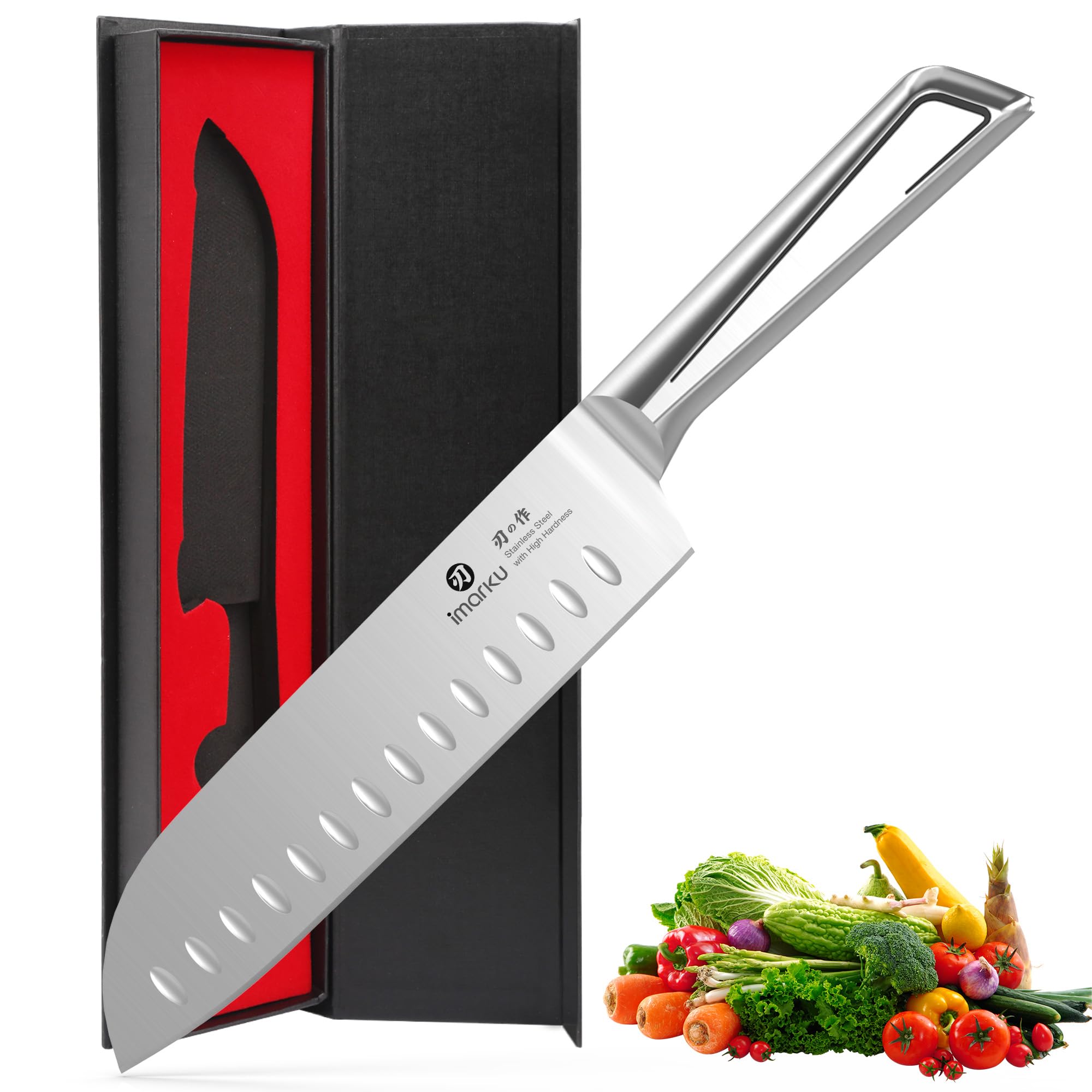
imarku 7-Inch Santoku
Key Features
- Care: Dishwasher safe
- Edge: Hollow (scalloped)
- Steel: High-carbon stainless
- Blade length: 7 inches
- Price: Midrange
Plenty of knives claim to be dishwasher safe and then turn out to have a wooden or riveted handle that quietly gives up after a few cycles. The imarku doesn’t have that problem, because there’s nothing to give up: blade and handle are one seamless length of steel, 12 inches end to end, with no gaps for water to sit in.
That’s why it earns a place here — it’s the knife for people who know they’ll never hand wash. Past the convenience, it’s a proper 7-inch santoku: a 0.1-inch spine gives it enough weight to fall through a potato, and hollow scallops along the blade break the suction on wet, sticky slices.
The scallops earn their keep on cucumber, zucchini, and anything starchy, and they cost you a little at sharpening time. Only part of the edge meets a stone at any moment, so a rod is the easier tool for keeping this one aligned; save the stone for when the edge genuinely needs metal taken off.
What it won’t do is flatter you. There’s no pakkawood, no frosted finish, no gift box — just a brushed steel tool that looks like exactly what it is. In a busy kitchen where a knife gets cleaned in a hurry and put straight back to work, we think that’s the right trade.
Pros
- Seamless all-steel body is dishwasher safe
- Hollow edge releases wet, sticky slices
- 0.1-inch spine gives it weight for potatoes
Cons
- Steel handle offers no soft grip
For anyone who knows they’ll never hand wash a knife, the imarku is the pick: one seamless piece of steel that goes in the dishwasher and sheds wet slices.
Best for Travel and Camping
PAUDIN 5-Inch Santoku

Key Features
- Steel: High-carbon stainless, 56+ HRC
- Handle: Pakkawood
- Included: Hard sheath and gift box
- Blade length: 5 inches
- Price: Midrange
The PAUDIN arrives in a hard plastic sheath inside a gift box, which tells you what it’s for: this is the santoku that leaves the kitchen. Five inches of blade and under four and a half ounces means it disappears into a tote, a picnic basket, or a drawer that’s already full.
The blade is high-carbon stainless rated at 56+ HRC, with grooves down both faces to keep slices from sticking, and that hardness is what you want in a small knife — it takes a keen edge and holds it through a pile of garlic and shallots. A 5-inch blade also concentrates your force, so thin slicing feels easier here than it does with a 7-inch knife.
It’s a specialty knife rather than a first knife. On a cabbage or a watermelon the blade simply runs out of length, and that’s the boundary of what this one is for. As the second santoku — the one that goes to the campsite, the rental, or the small board by the stove — it earns its place, and the sheath means it can travel without a second thought.
Pros
- Hard 56+ HRC steel holds a fine edge
- Hard sheath and gift box included
- 5-inch blade is easy to control
Cons
- Stamped, not forged construction
The PAUDIN is the second santoku — the one that lives in a bag or a camper — with a hard sheath, a 5-inch blade, and steel that holds its edge.
Best for First Kitchens
Cuisinart Triple Rivet 7-Inch

Key Features
- Steel: Forged stainless steel
- Bolster: Extra-wide safety bolster
- Included: Matching blade guard
- Blade length: 7 inches
- Price: Budget
An extra-wide bolster on a budget knife is the detail that made us look twice at the Cuisinart. The bolster is the thick collar between blade and handle, and here it runs deep enough to put a physical stop between your fingers and the edge — exactly what you want the one time your hand slips forward on a wet board.
The rest is unfussy and solid: a forged stainless blade, a triple-riveted handle, and a matching blade guard in the box. That’s a more complete package than several knives here that cost more, and the steel takes a decent edge and keeps it long enough for weeknight cooking.
Sharpening is where the design asks something of you. A bolster running all the way down to the edge keeps the heel of the blade off a whetstone, so the last fraction of an inch stays a touch duller than the rest. A rod, angled carefully into that corner, gets you there; a stone alone won’t.
For a budget knife, that’s an easy trade. This is the one we hand to someone outfitting a first kitchen: a forged blade, a guard for storage, and none of the fuss of a carbon knife. Give it a drawer and an occasional hone and it handles weeknight dinners without drama.
Pros
- Forged stainless blade at a budget price
- Extra-wide bolster stops the hand sliding forward
- Matching blade guard included
Cons
- Feels heavier than its size suggests
A forged 7-inch blade, a hand stop built into the bolster, and a guard in the box — the Cuisinart is the most complete budget knife here.
Best for Spare and Camp
Home Hero 7-Inch with Sheath

Key Features
- Steel: 3Cr13, nonstick coated
- Handle: Plastic
- Included: Two knives with sheaths
- Blade length: 7 inches
- Price: Budget
Two 7-inch santokus with sheaths is an odd way to sell a knife, and it’s also the reason the Home Hero is here. One lives in the kitchen drawer, the other in the camping box, the rental, or the drawer of a life that involves cutting boards in more than one place.
The blade is 3Cr13 high-carbon stainless with a nonstick coating, forged rather than stamped. The coating does real work: minced garlic and sticky rice slide off instead of clinging, and cleanup is a rinse rather than a scrub. The steel underneath is on the soft side, so it wants a few passes on a rod more often than the German blades here.
The plastic handle is comfortable enough and the balance is ordinary; nothing about this feels like a knife you’ll pass down. What you get instead is a sheath for each blade, which makes the pair genuinely useful to hand someone setting up a first apartment.
That’s the case for it, in the end. This is a knife you can give away without also handing over a lecture about carbon steel and whetstones, and one you won’t wince at when it lands in a sink of dishes. It’s the least precious knife here, and that’s exactly what it’s for.
Pros
- Two sheathed 7-inch santokus in one set
- Nonstick coating wipes clean
- Sheaths make drawer storage safer
Cons
- Nonstick coating wears where you hone
We recommend the Home Hero as a spare rather than a centerpiece: two sheathed 7-inch santokus, and neither one needs babying.
How We Tested 12 Santoku Knives
We started with research: steel types, blade lengths, handle materials, and the price bands home cooks realistically shop in, from budget starters to knives that cost as much as a good pan. We ruled out anything with a welded bolster that read as hollow in owner reviews and anything whose listed weight didn’t match how buyers described the feel. That left 12 santokus, which we cooked with for six months.
Every knife got the same first hour. We weighed it, found its balance point on an index finger, checked handle seams and rivets under a bright light, and photographed the finish so we’d have something to compare against later. Then we cut: a ripe tomato for the skin, a case of onions, sweet potatoes, cabbage, and a steady supply of herbs — the ordinary weekly work of a home kitchen rather than a test bench. We noted whether the blade steered, whether food stuck to the face, and whether the handle went slick once our hands were wet.
Durability is where six months earns its keep. Each knife was hand-washed and honed the way a home cook would, and at the one-, three-, and six-month marks we repeated the tomato and paper tests to see how the edge was holding. We also watched what time did to the look of the thing — handle fading, scratching, any spotting on the blade — because a knife that still looks good is one you keep reaching for. Value had the final say, and several of the most expensive knives cut no better than ones at half the price.
How to Choose a Santoku Knife
Length, grip, steel, and how you’ll actually clean it decide most of the outcome — settle those four in that order and the rest is detail.
Start with length, then work backward
Five, 6.5, and 7 inches are the sizes worth considering, and the right one is decided by your board and your hand rather than your ambition. A 7-inch santoku is the standard for a reason: it clears a cabbage, spans an onion, and still fits a normal drawer. A 6.5-inch blade is the compromise for small counters and crowded boards. A 5-inch santoku is a detail knife — garlic, shallots, herbs, mushrooms — and it’s the size that travels.
The trap is buying long because long sounds serious. If your cutting board is short, a 7-inch blade runs out of room mid-stroke and you end up working in cramped little pushes that are harder on your wrist than a shorter knife would be. Measure the usable length of your board before you size up.
What the steel actually buys you
The steel grade is shorthand for two things: how fine an edge the knife can take, and how long it keeps it. Entry-level steels such as 3Cr13 are soft — they sharpen in a minute and go dull during a week of real cooking. A 5Cr15MoV or a 1.4116 German steel holds a working edge through a long prep and tolerates some neglect. High-carbon Japanese steels like 10Cr15CoMoV take the finest edge of the lot and surrender it if you abuse them.
Two traps. Stainless means stain-resistant, not rustproof; any of these will spot if you leave it wet in a rack. And a coated blade, such as a nonstick one, can’t be maintained like bare steel, because the coating wears away at the edge every time you hone it.
Handles are about wet hands, not looks
Almost every handle feels fine in a dry shop. The real test is a wet one: mince an onion and see whether your grip has shifted. Rubberized and textured grips, like the Santoprene on our top pick, hold on. Pakkawood is warm and grippy until it’s soaked. A polished stainless handle looks superb and turns slick the moment your hands are wet — and in a kitchen your hands will be wet.
Construction matters too. Forged knives are heavier and usually dearer; stamped knives are lighter and perfectly capable. One-piece all-steel bodies have no seams to loosen or trap food, which is why they’re the ones that survive a dishwasher.
The dishwasher question, answered honestly
Most santoku knives are hand-wash only, and the reason isn’t snobbery: dishwasher detergent is abrasive, the drying cycle is hot, and edges knock against whatever else is in the basket. A knife that goes through that weekly will cut worse in a year than one that gets wiped and dried.
So decide honestly how you clean up. If you know you’ll never hand wash, buy a seamless all-steel knife and accept that its edge is a consumable. If you’ll spend thirty seconds at the sink, you can buy anything here and keep it sharp for years. We’d rather have a good knife and a tea towel than a compromise and a free pass.
Hollow edges help — with the right food
Granton or hollow-edge scallops along the blade create air pockets that break the suction between steel and food, and they’re why a good santoku sheds cucumber coins and potato slices instead of wearing them. Onions, zucchini, mozzarella, and anything wet benefit most. Dense meat and hard cheese don’t care either way.
A hollow edge is not a substitute for sharpness, and it costs you a little at the stone: only part of the edge makes contact at any moment, so keep a rod handy for quick realignment and save the stone for when the edge genuinely needs metal removed.
Frequently Asked Questions
Can a santoku replace a chef’s knife?
For vegetables, boneless proteins, and most everyday prep, yes — that is the job it was designed for. What it doesn’t do is rock. The santoku’s edge is flatter and its tip is a sheep’s foot rather than a point, so rocking through a pile of herbs or working around a bone is clumsier than with a chef’s knife.
Keep a chef’s knife if you rock-chop or do a lot of trimming. If most of your prep happens flat on the board, one santoku covers it.
How do I know when my santoku needs sharpening?
Run it over a ripe tomato. If the skin splits before the blade bites, the edge needs work; if the knife glides through under its own weight, it doesn’t.
Hone first — a few light passes on a rod realign an edge that has rolled — and sharpen on a stone only when honing stops bringing it back. Most knives people call dull are just tired edges that needed thirty seconds of attention.
Are santoku knives suitable for left-handed cooks?
Most are. A santoku ground evenly on both faces cuts the same in either hand, and that covers the majority of what’s sold; the DDF iohEF, for example, is ground 15 degrees per side. Check the listing for double-bevel or 50/50 wording before you buy.
Traditional single-bevel Japanese knives are the exception. They’re ground for one hand, and a right-handed one will steer badly for a left-handed cook, so leave those alone unless the maker offers a left-handed version.
Final Verdict
The Mercer Genesis is the santoku we recommend to most home cooks. It has the blade — forged German steel, 7 inches, taper-ground — and the grip that stays put when your hands are wet, and it asks nothing beyond a wipe and a dry.
If your board is small or your hands are, the Babish at 6.5 inches is the better fit and costs less. If you want the finest steel here and mostly work small, the HOSHANHO is worth the step up.