This post contains affiliate links. We may earn a small commission when you buy through our links — at no extra cost to you.
Many santoku knives arrive razor-sharp but lose that edge within weeks. The market is packed with budget options that look impressive but cut corners on steel quality and handle ergonomics, leaving home cooks frustrated.
The real difference isn’t in initial sharpness—it’s in how long the blade stays usable and how comfortable it feels during long prep sessions. A knife that’s too light or too heavy can ruin the cooking experience.
This guide focuses on edge retention, balance, and handle quality. These are the factors that determine whether a santoku becomes a daily driver or a drawer dweller.





Best for Home Cooks Daily
TUO 7" Santoku
Key Features
- Blade Steel: 1.4116 German
- Edge Type: Granton
- Handle Material: Pakkawood
- Weight: 0.45 lb
- Construction: Forged
- Price: Mid-Range
The TUO Santoku arrives exceptionally sharp, slicing through tomatoes and proteins with minimal effort. The hollow-edge (Granton) design reduces sticking, and the forged German steel holds its edge well with routine honing. The Pakkawood handle is ergonomically shaped and well-balanced, making it comfortable for extended prep. Its fit and finish feel premium, rivaling knives in the $100 range.
This knife suits home cooks who want a single daily driver for slicing, dicing, and chopping — it also makes a thoughtful gift thanks to its attractive packaging. That said, quality control can vary: a few units may arrive with blade imperfections or require immediate sharpening. If you prefer a heavier blade (like a cleaver), the 0.45 lb weight will feel light, but that’s a subjective tradeoff. Broad user consensus over years confirms this santuko delivers consistent quality for the price, making it a safe bet for first-time buyers.
Pros
- Exceptionally sharp out of the box and retains its edge with regular honing.
- Beautiful design with impeccable finish that looks and feels premium.
- Comfortable, ergonomic handle with good balance for extended use.
Cons
- Light weight may not satisfy those who prefer a heavier, cleaver-like feel.
- Edge quality control can vary — some units arrive with blade imperfections or need immediate sharpening.
The TUO Santoku delivers outstanding value — it’s the santoku most home cooks should consider first.
Best for Professional Performance
Mercer Genesis 7"
Key Features
- Blade Steel: X50CrMoV15 German
- Edge Type: Plain
- Handle Material: Santoprene
- Weight: 2.99 oz
- Construction: Forged
- Price: Mid-Range
The Mercer Genesis stands out for its X50CrMoV15 German steel blade that arrives exceptionally sharp and holds its edge well – a stark contrast to stamped blades that dull quickly. The Santoprene handle provides a secure, non-slip grip even when wet, reducing fatigue during extended prep.
This knife suits home cooks who want professional performance without paying for a Wüsthof or Henckels, and those with hand or wrist issues will appreciate its 2.99 oz weight and balanced feel. The blade can develop rust spots if left wet, so immediate hand-drying is needed – a minor maintenance tradeoff for the edge quality. Cooks who prefer a heavier cleaver-like santoku should look elsewhere.
Pros
- Exceptional sharpness and edge retention that rivals premium German knives.
- Ergonomic Santoprene handle stays grippy when wet and reduces hand fatigue.
- Strong value for the price – forged construction at a mid-range cost.
Cons
- Can develop rust spots if not dried immediately after washing.
- Lightweight build may feel too delicate for those accustomed to heavier knives for chopping.
The Mercer Genesis offers elite-level sharpness and comfort for a mid-range price – just be prepared for the extra drying step.
Best for Budget-Conscious Home
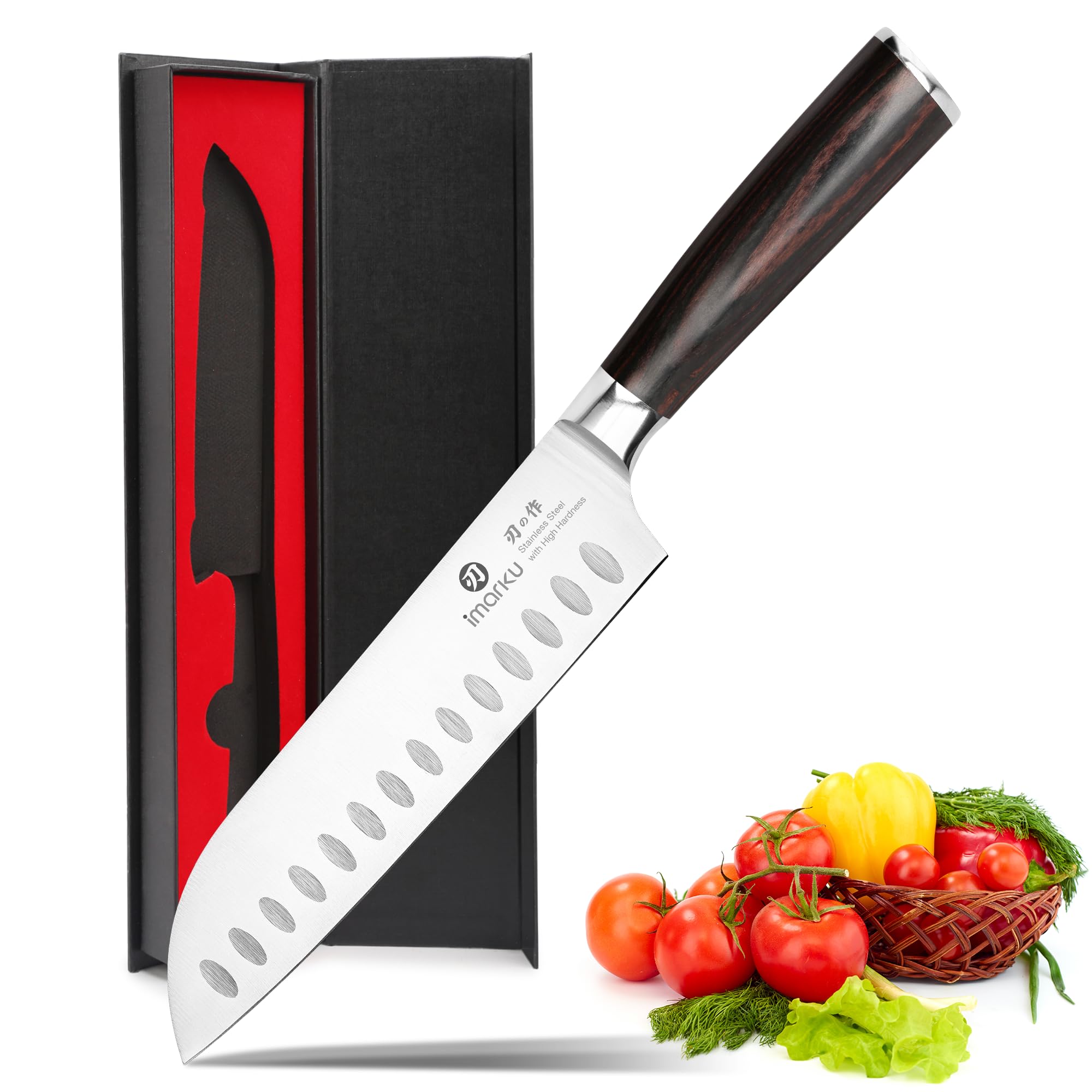
imarku 7" Santoku
Key Features
- Blade Steel: High Carbon Japanese
- Edge Type: Granton
- Handle Material: Pakkawood
- Weight: 0.43 lb
- Construction: Forged
- Price: Budget
This 7-inch santoku cuts with the precision of knives three times its price. The lightweight Pakkawood handle and hollow edge make it comfortable for smaller hands and efficient on vegetables, meat, and fish. A smart pick for budget-conscious home cooks who value initial sharpness, though those who regularly chop dense squash or heavy ingredients should note that occasional blade chipping has been reported with extended heavy use.
Pros
- Razor-sharp out of the box with edge retention that rivals far pricier knives.
- Comfortable, lightweight handle suited for smaller hands and long prep sessions.
Cons
- Under sustained heavy use – dense vegetables, squash, or impact – some units may develop blade chipping or snapping over time.
For home cooks who want professional-level sharpness on a budget and can reserve this knife for lighter prep work, the imarku delivers exceptional value.
Best for Lightweight Slicing
Victorinox Fibrox 7"
Key Features
- Blade Steel: High Carbon SS
- Edge Type: Granton
- Handle Material: Fibrox
- Weight: 3.2 oz
- Construction: Stamped
- Price: Mid-Range
The Victorinox Fibrox 7” slices through produce and boneless meat with factory-edge sharpness that rivals knives costing triple. The non-slip Fibrox handle stays secure even with wet hands, making it a go-to for precise slicing and dicing. The thin stamped blade can flex under heavy chopping, so this is best for everyday prep rather than splitting winter squash or thick carrots. It’s ideal for home cooks who want a razor-sharp, lightweight tool and are comfortable touching up the edge more often than with a forged knife.
Pros
- Cuts through produce effortlessly right out of the box
- Non-slip Fibrox handle stays comfortable and secure during use
- Professional-grade performance at a mid-range price
Cons
- Lightweight stamped blade can flex during heavy chopping on dense ingredients
- Edge may dull faster than forged knives, requiring more frequent honing
A nimble santoku for daily slicing and dicing – choose it if you prioritize grip and value over chopping power.
Best for Enthusiast Cooks
Wüsthof Classic 7"
Key Features
- Blade Steel: 58 HRC German
- Edge Type: Granton
- Handle Material: Composite POM
- Weight: 3 oz
- Construction: Forged
- Price: Premium
The Wüsthof Classic 7" uses forged construction and a PEtec edge to retain sharpness far longer than stamped knives – a real advantage for cooks who rely on consistent performance through heavy prep. It’s also noticeably lightweight and well-balanced, making it highly agile for slicing and dicing. That said, the hard steel (58 HRC) can chip if twisted into bones or frozen food, and the premium price puts it out of reach for casual buyers. This santoku is best suited for dedicated home cooks or professionals who will hand-wash it and respect the blade’s limits – and who want a knife that will hold up for decades, not just a few seasons.
Pros
- Razor-sharp out of the box with superior edge retention
- Well-balanced and lightweight feel for agile cutting
- Forged construction that will last decades with proper care
Cons
- Premium price tag – not a budget-friendly option
- Hard steel may chip if used on bones or frozen food
Serious cooks who demand edge retention and are willing to hand-wash and avoid hard ingredients will find this santoku a lifelong companion. For everyday home cooks on a tighter budget, the top pick delivers more accessible performance at a fraction of the cost.
Best for Hefty Chopping
Cutluxe 7" Santoku
Key Features
- Blade Steel: 1.4116 German
- Edge Type: Granton
- Handle Material: Pakkawood
- Weight: 9.12 oz
- Construction: Forged
- Price: Mid-Range
The Cutluxe Santoku delivers a sharp, well-balanced blade that handles dense vegetables with authority, thanks to its 9.12 oz forged construction and hollow-ground edge. The triple-riveted Pakkawood handle feels solid and comfortable during extended prep sessions, offering a classic look that rivals knives costing twice as much. Where it differs from the top pick is in edge longevity — this blade will need more frequent sharpening, typically within a few months of regular use.
This knife suits home cooks who prefer a heavier, more substantial blade for chopping through squash, potatoes, and root vegetables. The weight gives it momentum, but those who favor light, nimble knives may find it tiring over long sessions. If edge retention is your priority — or you need a knife that holds its factory sharpness for months — the top pick performs better in that regard.
Pros
- Razor-sharp out of the box for precise slicing and dicing.
- Comfortable, well-balanced handle with reassuring heft.
- Premium feel and forged construction at a budget-friendly price.
Cons
- Blade edge dulls faster than premium forged options — plan for sharpening after a few months of regular use.
- Heavier weight (9.12 oz) may feel unwieldy for those accustomed to lighter santokus.
A strong value for home cooks who want a forged knife with classic styling and don’t mind touching up the edge regularly.
Best for Students Tight Budget
DDF iohEF 7" Santoku

Key Features
- Blade Steel: 5Cr15Mov
- Edge Type: Plain
- Handle Material: Stainless steel
- Weight: 0.5 lb
- Construction: Forged
- Price: Budget
This knife delivers impressive sharpness and lightweight balance for the price, making it suitable for light slicing and vegetable prep. However, the thin stainless blade can stain or tarnish if not dried promptly, and it lacks the edge retention of forged knives — best for occasional use rather than daily heavy chopping.
Pros
- Extremely sharp out of the box — cuts through produce with minimal effort.
- Lightweight and well-balanced — reduces hand fatigue during prep.
Cons
- Blade may stain or tarnish if not dried immediately — requires extra care after washing.
Worth considering for students or first-time buyers who want a sharp knife without a big investment, provided they accept the need for immediate drying and light-duty use.
Best for Babish Fans Daily
Babish 6.5" Santoku

Key Features
- Blade Steel: 1.4116 German
- Edge Type: Granton
- Handle Material: Stainless + ABS
- Weight: ~0.5 lb
- Construction: Forged
- Price: Budget
The Babish 6.5" Santoku offers excellent build quality and heat treatment, delivering a razor-sharp edge and comfortable grip for the price. The shorter blade and occasional chipping reports are notable drawbacks, limiting its appeal for heavy-duty use. It’s a good fit for Babish enthusiasts or home cooks who value control over blade length.
Pros
- Razor-sharp out of the box with lasting edge retention
- Comfortable grip with balanced weight distribution
Cons
- Blade may chip or crack after several months of use
A solid budget santoku for Babish fans or home cooks who prefer a shorter blade and can accept occasional durability risk.
Best for Precise Slicing
HOSHANHO 7"

Key Features
- Blade Steel: 10Cr15CoMoV Japanese
- Edge Type: Plain
- Handle Material: African Pakkawood
- Weight: 0.7 lb
- Construction: Forged
- Price: Mid-Range
The HOSHANHO’s 10Cr15CoMoV steel delivers exceptional initial sharpness that rivals knives costing twice as much. However, edge retention can be inconsistent, with some owners needing to sharpen within weeks of regular use, and the 0.7 lb weight feels heavier than typical santokus. It suits home cooks who appreciate a sharp, hard-steel blade and don’t mind periodic maintenance.
Pros
- Ultra-sharp 62 HRC steel cuts effortlessly through vegetables and boneless protein.
- Attractive full pakkawood handle provides a comfortable grip.
Cons
- Edge may lose its initial sharpness sooner than expected with daily prep.
Best for buyers who prioritize raw cutting performance and aesthetics over long edge life, and are comfortable with regular sharpening.
Best for Arthritis-Friendly Use
Mercer Millennia 7"

Key Features
- Blade Steel: Japanese Steel
- Edge Type: Granton
- Handle Material: Santoprene
- Weight: 3.17 oz
- Construction: Stamped
- Price: Budget
This stamped blade delivers impressive sharpness for its price, and the textured Santoprene handle stays secure even when wet. However, the thin blade lacks the heft for heavy chopping and the handle may feel less premium than the top pick’s Fibrox—making it better suited as an affordable backup or for users who prioritize weight savings.
Pros
- Razor-sharp edge that’s simple to maintain with a honing rod.
- Non-slip Santoprene handle provides secure grip even with wet hands.
Cons
- Thin blade flexes under heavy chopping—not ideal for dense vegetables.
A practical backup for light to medium prep, especially for those with arthritis or weak wrists who want a lightweight, low-maintenance santoku.
Best for Simple Handle Preference
Victorinox Swiss Classic 7"

Key Features
- Blade Steel: Stainless Steel
- Edge Type: Granton
- Handle Material: Polypropylene
- Weight: 3.9 oz
- Construction: Stamped
- Price: Mid-Range
The Victorinox Swiss Classic delivers the same sharp, lightweight performance as the Fibrox but with a simpler polypropylene handle that lacks the textured grip many prefer. Given near-identical edge retention and a slightly lower price, the main reason to choose this over the Fibrox is handle preference and saving a few dollars.
Pros
- Razor-sharp edge that holds well for a stamped knife.
- Lightweight design with comfortable handle suitable for all-day prep.
Cons
- Plastic handle lacks the textured grip and premium feel of the Fibrox.
A practical choice for budget-conscious home cooks who value a lightweight, sharp santoku and don’t mind a simpler handle over the Fibrox’s textured grip.
Best for Familiar Brand Value
Cuisinart 7" Santoku

Key Features
- Blade Steel: Stainless Steel
- Edge Type: Plain
- Handle Material: Stainless steel
- Weight: 8.32 oz
- Construction: Forged
- Price: Budget
The Cuisinart santoku is sharp out of the box and includes a blade guard, all at a budget-friendly price from a known brand. However, its 8.3-ounce weight is heavier than most santokus, making it feel unwieldy for quick chopping, and edge retention is only average – requiring more frequent honing than alternatives like the imarku or Mercer.
Pros
- Sharp out of the box with decent edge holding for the price.
- Includes a matching blade guard for safe storage.
Cons
- Heavier than typical santokus – may feel unbalanced during extended prep sessions.
A decent choice if you value a familiar brand and low upfront cost, but the heavier weight and average edge retention make it less ideal for frequent use compared to similarly priced alternatives.
Best for Extreme Budget Backup
Home Hero 2-Pack

Key Features
- Blade Steel: 3Cr13 Stainless
- Edge Type: Plain
- Handle Material: Plastic
- Weight: ~0.3 lb each
- Construction: Forged (claimed)
- Price: Budget
This two-piece set delivers functional sharpness and includes protective sheaths for safe storage — hard to argue with the price. However, the low-end 3Cr13 steel means the edge fades quickly with regular use, and the plastic handle can feel slippery when wet. The set works for occasional chopping in a dorm or rental kitchen where theft or loss is a real concern, but it’s not suited for daily meal prep.
Pros
- Two sharp knives with sheaths at an entry-level price
- Protective sheath included for each blade
Cons
- For regular home cooking, the 3Cr13 steel requires frequent sharpening — acceptable for occasional use only
Best suited for extreme budget buyers who need two knives for a rental kitchen or dorm room where loss or theft is a concern — not a primary knife for daily cooking.
Best for Wüsthof Brand Loyalty
Wüsthof Gourmet 7"

Key Features
- Blade Steel: High Carbon SS
- Edge Type: Hollow
- Handle Material: Polypropylene
- Weight: 4.6 oz
- Construction: Stamped
- Price: Premium
This Wüsthof delivers the brand’s signature sharpness in a lightweight, easy-to-maneuver package. However, the stamped construction and polypropylene handle feel underwhelming at a premium price, and the thin blade may flex under pressure. Edge retention is below average for the price, making it a harder sell when the Mercer Genesis offers similar performance for less.
Pros
- Extremely sharp out of box – slices through tomatoes and onions with minimal effort.
- Lightweight and well-balanced – easy to maneuver for precise slicing.
Cons
- Thin blade may flex when cutting dense vegetables like squash, feeling insubstantial.
If brand loyalty and a lightweight slicer matter more than edge retention and handle feel, this is a valid entry point. Otherwise, better value exists at lower prices.
Best for Precision Slicing Only
Shun Classic 5.5"

Key Features
- Blade Steel: VG-MAX Damascus
- Edge Type: Plain
- Handle Material: Pakkawood
- Weight: 5 oz
- Construction: Forged
- Price: Luxury
This 5.5-inch Damascus santoku delivers extreme sharpness and a beautiful layered pattern, ideal for fine slicing and delicate prep. The brittle VG-MAX steel can chip on hard squash or bones, and the short blade limits handling of larger ingredients — it’s a precision specialist, not a daily workhorse.
Pros
- Incredibly sharp – slices through tomatoes and meat effortlessly.
- Beautiful Damascus cladding with a premium Pakkawood handle.
Cons
- Brittle steel can chip when used on bones, frozen food, or hard squash.
A stunning precision knife for collectors and enthusiasts who accept its fragility and short reach.
How to Choose
The most important factor in a santoku knife is how well it balances edge retention with blade hardness—because a super-hard blade that chips is useless, and a soft blade that dulls quickly is frustrating.
Blade Steel & Hardness (HRC)
Hardness is measured on the Rockwell scale (HRC). Softer steels (52–56 HRC) are tougher and less likely to chip, but they dull faster and require more frequent sharpening. Harder steels (58–62 HRC) hold a sharp edge longer but are more brittle.
For a santoku used on vegetables, fish, and boneless meat, a hardness around 56–60 HRC offers the best compromise. Above 60 HRC, the blade can chip on hard squash or if twisted, so those knives require careful use.
Edge Type: Granton vs. Plain
Granton (hollow) edges feature small scallops along the blade that create air pockets, reducing food sticking. This is especially helpful for slicing potatoes, carrots, or cheese. The trade-off is that the scallops slightly weaken the blade and can make sharpening more difficult.
Plain edges are stronger and easier to sharpen at home, but you’ll need to wipe the blade more often to prevent food from clinging. If you primarily slice soft produce, the Granton edge saves time. For heavy chopping or dense ingredients, a plain edge is more durable.
Handle Material
Handle material affects grip, comfort, and longevity. Pakkawood is a layered resin-impregnated wood that feels warm, looks premium, and provides good grip when dry. It’s common on mid-range forged knives and requires a little drying care.
Synthetic handles like Santoprene or Fibrox offer superior non-slip grip, especially when wet or greasy, and are often used on professional knives. Plastic or polypropylene handles are cheaper but can feel slippery and less substantial. Stainless steel handles look sleek but can be cold and slippery.
Weight & Balance
A heavier knife (9–12 oz) provides momentum for chopping through dense vegetables and gives a reassuring heft. A lighter knife (3–5 oz) is nimble and reduces wrist fatigue during long prep sessions, but may lack the authority to push through tough ingredients.
Balance is equally important: a well-balanced knife feels like an extension of your hand. Most forged santokus have a slightly forward-heavy balance due to the bolster, while stamped knives tend to be handle-heavy. Try lifting the knife at the bolster—if it tips forward, it’s blade-heavy, which aids chopping but can strain the wrist.
Construction: Forged vs. Stamped
Forged knives are shaped from a single bar of steel under heat and pressure, resulting in a thicker, denser blade with a full tang and bolster. They are generally heavier, more durable, and hold an edge longer. The trade-off is higher cost.
Stamped knives are cut from a sheet of steel like a cookie cutter. They are lighter, thinner, and more affordable, but they lack the heft and edge retention of forged knives. Many professional kitchens use stamped knives for their lightweight agility, but they require more frequent sharpening and can feel flimsy for heavy tasks.
FAQ
Why does my new santoku knife chip so easily?
If your santoku chips easily, the blade is likely too hard (over 60 HRC) or you’re using it on unsuitable surfaces. Avoid cutting on glass, stone, or metal boards, and never twist the blade while cutting. Harder steels like Shun’s VG-MAX or Wüsthof’s PEtec require careful use—stick to wood or plastic cutting boards and hand-wash only.
Is a santoku knife better than a chef’s knife for vegetables?
A santoku’s flatter edge and thinner profile make it excellent for push-cutting vegetables, especially for julienne, dice, and slice work. However, its lack of a curved belly means it doesn’t rock well for mincing herbs or garlic. If you primarily prep vegetables, a santoku is a great choice; if you do a lot of rocking cuts, a chef’s knife is more versatile.
How often should I sharpen a high-carbon German steel santoku?
For a typical home cook using a German steel santoku (e.g., 1.4116 or X50CrMoV15), honing with a steel every few uses will maintain the edge for 2–3 months. Actual sharpening on whetstones or a pull-through sharpener is needed every 3–6 months depending on use. Signs it’s time: the knife struggles to slice through a tomato skin.
Can I put my santoku knife in the dishwasher if it says dishwasher safe?
Even if a knife claims to be dishwasher safe, hand-washing is strongly recommended. The high heat and harsh detergents can dull the blade, damage the handle (especially wood or pakkawood), and cause rust spots on high-carbon steel. A few minutes of hand-washing and drying will preserve the knife’s edge and appearance for years.