This post contains affiliate links. We may earn a small commission when you buy through our links — at no extra cost to you.
Serrated knives—bread knives, steak knives—are notoriously difficult to sharpen at home. Most pull-through sharpeners claim they work, but the carbide slots often chew through the delicate scalloped edges, leaving you with a duller blade and a damaged edge.
The real distinction is between general-purpose sharpeners that handle serrated as an afterthought and tools purpose-built for the job. A dedicated tapered diamond rod sharpens each tooth individually, preserving the scallop geometry, while a fast pull-through trades precision for speed. The right choice depends on how much time you’re willing to invest and whether you primarily maintain serrated or straight edges.
This guide focuses on sharpeners that actually respect serrated blades—from budget manual rods to electric models with dedicated serrated stages—to help you match the tool to your knife collection and sharpening habits.



Best for Serrated Knife Owners
Wamery Retractable Diamond
Key Features
- Type: Manual retractable rod
- Serrated Method: Tapered diamond rod
- Sharpening Material: Diamond
- Portability: Pocket-sized
- Price: $
The Wamery’s retractable diamond rod uses a tapered design that fits inside each serration scallop, allowing precise tooth-by-tooth sharpening without altering the blade’s original cutting angle. This approach avoids the aggressive metal removal typical of carbide pull-through sharpeners, making it suitable for bread knives, steak knives, and other serrated blades where edge geometry matters.
In use, you rotate the rod through each gullet with light pressure until a burr forms, then flip to the flat side to deburr. The process is deliberate — a full 10-inch bread knife takes several minutes — but the result is a genuinely sharp edge on each tooth. The compact, lightweight design (0.07 lbs) slides into a pocket or camping kit, so it’s always available when you need to restore a dull serrated blade.
This tool is for home cooks and outdoor enthusiasts who own serrated knives and are willing to invest time per tooth for a precise sharpen. It’s not a quick fix: sharpening a full blade requires patience and a steady hand. Those who need to touch up multiple knives rapidly or prefer electric convenience will find the pace frustrating. But for dedicated serrated maintenance at a budget-friendly price, the Wamery fills a specific gap.
Pros
- Tapered rod matches serration scallop size for safe, individual tooth sharpening
- Compact enough for pocket carry or camping gear
- Cost-effective alternative to electric sharpeners for serrated blades
Cons
- Sharpening each serration individually demands steady focus and time
- Not designed for quick touch-ups or sharpening multiple knives in one session
If you prioritize preserving serrated edge geometry over speed, the Wamery does exactly what it sets out to do — no shortcuts, no compromises.
Best for Mixed Knife Sets
AccuSharp Knife Sharpener
Key Features
- Type: Manual pull-through
- Serrated Method: Pull-through carbide slot
- Sharpening Material: Tungsten Carbide
- Portability: Compact (0.1 lbs)
- Price: $
For home cooks who need a quick edge on mixed knife sets, the AccuSharp delivers immediate results with a single pull-through. Unlike the tapered rod of the Wamery, which sharpens each serration individually, the AccuSharp uses carbide blades that cut fast across both straight and serrated edges.
This sharpener suits budget-conscious buyers who prioritize convenience over precision. The carbide blades remove metal aggressively, so it’s not for premium or delicate serrated knives — those are better served by a purpose-built rod sharpener.
Pros
- Restores dull edges in seconds with just a few passes
- Handles both straight and serrated blades without switching tools
- Budget-friendly price that outperforms many sharpeners at the same cost
Cons
- Carbide blades can remove too much metal if used repeatedly on the same spot
- Not ideal for expensive knives where preserving blade life matters
Fast and affordable for everyday kitchen knives, but the aggressive carbide blades limit its use on higher-end blades.
Best for All-In-One Sharpener
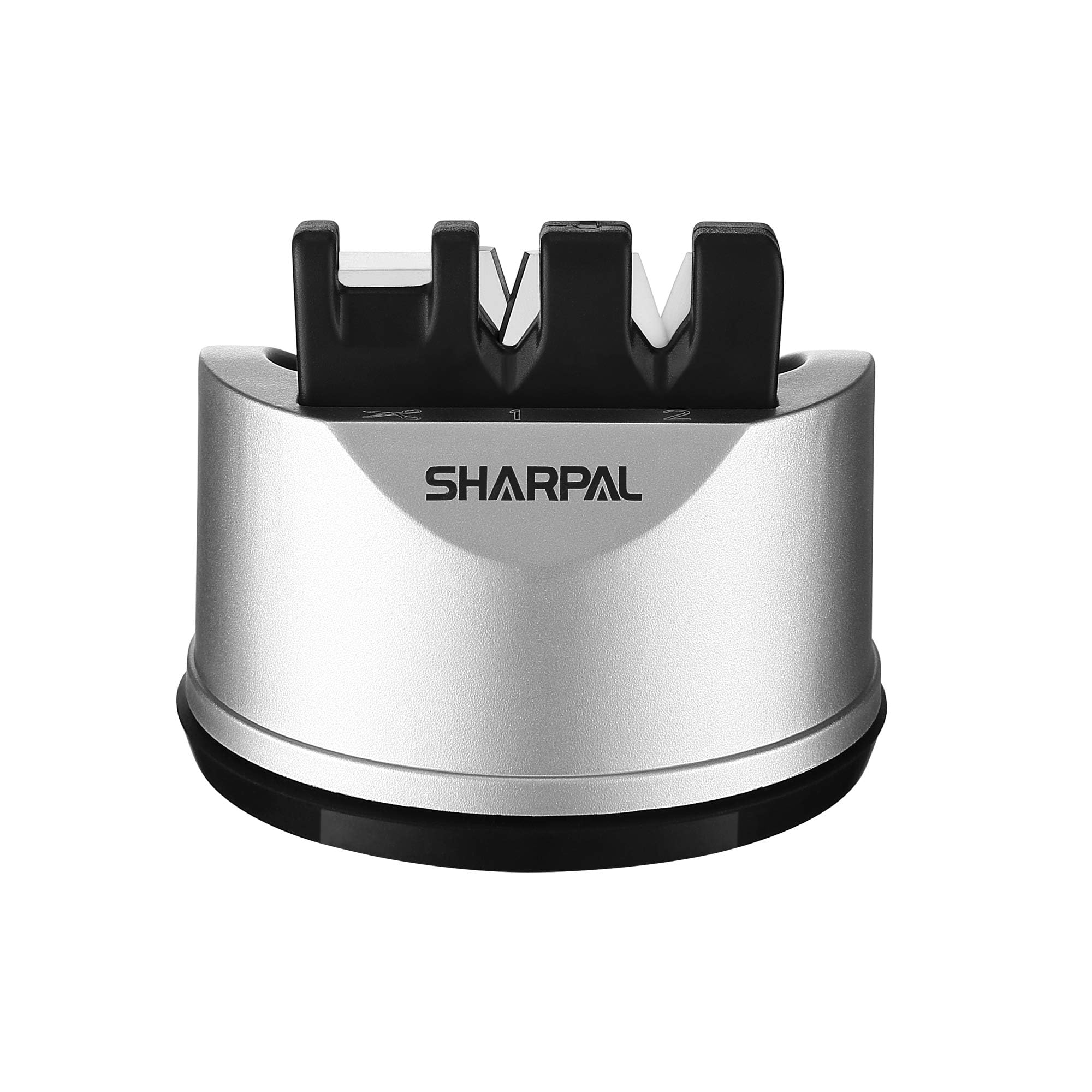
SHARPAL 191H 3-Stage
Key Features
- Type: Manual 3-stage
- Serrated Method: Carbide slot
- Sharpening Material: Carbide, Ceramic
- Portability: Compact (3 oz)
- Price: $
The suction base grips smooth counters firmly, allowing one-handed operation without slipping. Unlike the top pick’s dedicated tapered diamond rod that sharpens each serration individually, the SHARPAL’s carbide slot works faster but removes more metal – a tradeoff that suits occasional bread knife touch-ups. It also handles straight knives and scissors through its three stages.
This sharpener fits home cooks who need a single, compact tool for kitchen knives, scissors, and lightly serrated blades. The suction holds best on polished stone or laminate; on textured tile or wood it may not stay put. Very dull knives require many passes to restore an edge, and heavily serrated knives with deep scallops are better served by a rod-style sharpener.
Pros
- Suction base keeps the sharpener steady on smooth surfaces during use.
- Sharpens straight knives, serrated blades, and scissors in one tool.
- Compact size fits easily in a drawer or small kitchen space.
Cons
- Suction base may not hold on rough or uneven countertops.
- Very dull knives may require many passes; not ideal for heavily serrated blades needing individual tooth work.
A budget-friendly all-in-one for households with mixed blades – the suction base and three-stage system handle everyday sharpening on smooth surfaces.
Best for Serious Home Cooks
Chef’sChoice 15XV Electric
Key Features
- Type: Electric 3-stage
- Serrated Method: Dedicated stropping stage
- Sharpening Material: Diamond Abrasives
- Portability: Heavy (4.2 lbs)
- Price: $$$
Chef’sChoice 15XV uses 100% diamond abrasives and precision angle guides to produce razor-sharp edges on straight and serrated blades alike. Unlike manual tapered rod sharpeners that require patience for each tooth, this electric model sharpens serrated knives through a dedicated stropping stage in seconds, making it a time-saver for regular use.
This sharpener suits serious home cooks and knife enthusiasts who sharpen frequently and want a set-and-forget approach. The premium price reflects diamond abrasive durability, though the wheels may wear over time and blade scratching has been reported – a tradeoff worth weighing for owners of expensive knife sets.
Pros
- Razor-sharp edges on any blade type
- Easy sharpening with built-in angle guides
- Single tool handles both straight and serrated knives
Cons
- Diamond wheels can wear over time; scratching has been noted
- Premium pricing makes it a larger investment for casual sharpeners
For frequent sharpeners who prioritize speed and consistency, the 15XV delivers reliable results – just keep an eye on wheel wear and blade finish.
Best for Budget Serrated Slot
Orange Ninja 4-Stage

Key Features
- Type: Manual 4-stage
- Serrated Method: Dedicated serrated slot
- Sharpening Material: Carbide, Diamond Rods, Ceramic
- Portability: Portable (10.9 oz)
- Price: $
The dedicated serrated slot sets this apart from many budget sharpeners, allowing owners of serrated knives to maintain those teeth without a separate tool. For casual cooks with mixed knife sets, the four stages cover coarse, medium, fine, and serrated sharpening. However, durability can be inconsistent – some units may damage knives or the serrated slot may become non-functional. This makes it best for occasional use on moderate knives where budget is the priority, not for expensive or heavily used blades.
Pros
- Dedicated serrated sharpening slot saves buying a separate tool.
- Ergonomic non-slip grip makes the three-step process easy to handle.
Cons
- Durability may be inconsistent – some units can damage knives or the serrated slot may become non-functional.
Best for casual cooks on a tight budget who need serrated sharpening for occasional use on moderate knives, but not for daily or high-value blades.
Best for Flexible Angle Users
Chef’sChoice 1520 Electric

Key Features
- Type: Electric 3-stage
- Serrated Method: Yes (with stropping)
- Sharpening Material: Diamond Abrasives
- Portability: Heavy (4.2 lbs)
- Price: $$$
The 1520 delivers precise angle control with diamond abrasives, accommodating both 15° Japanese and 20° European blades in one unit. It handles serrated knives through a dedicated stage, though its performance here mirrors the less expensive 15XV without offering a clear edge. The premium price and occasional reports of blade scratching make it a choice for cooks who need the dual-angle flexibility rather than a dedicated serrated solution.
Pros
- Dual-angle capability for mixed knife collections
- Effective on both straight and serrated blades with diamond abrasives
Cons
- Premium pricing offers little advantage over lower-cost models for serrated sharpening
- Blade scratching may occur on some knives
Best suited for cooks who own both Japanese and European knives and want one electric sharpener for both angles, but those focused primarily on serrated sharpening will find better value elsewhere.
How to Choose
The most important factor in serrated knife sharpening is using a tool designed for individual tooth sharpening—a tapered diamond rod—rather than a generic carbide slot that damages the scallop edges.
Manual vs. Electric
Manual sharpeners give you full control over pressure and angle, which is critical for serrated teeth. Electric sharpeners offer speed and consistency for straight edges, but their serrated stages often provide only a light honing, not true sharpening of each scallop.
If you own multiple serrated knives and sharpen them monthly, a manual tapered rod is the better investment. Electric models are best for households that sharpen straight-edged knives frequently and want a single device that can also touch up serrated blades.
Serrated Method
The method used for serrated blades determines whether you restore the edge or ruin it. A dedicated tapered diamond rod fits into each scallop individually, matching the existing bevel angle. Pull-through carbide slots, even those labeled for serrated knives, apply a straight edge across the teeth, flattening the scallops over time.
Look for sharpeners that explicitly describe individual tooth sharpening or include a thin, cone-shaped abrasive rod. The more precisely the tool matches the scallop curve, the longer your serrated knife will last.
Sharpening Material
Diamond abrasives cut faster and last longer than tungsten carbide or ceramic, especially on hard stainless steel serrated blades. Carbide is aggressive—effective for quick edge restoration on budget knives, but removes metal quickly, reducing the lifespan of expensive blades.
For serrated knives, a fine-grit diamond rod (25–30 micron) provides enough bite to sharpen without gouging. Coarse carbide wheels or rods should be reserved for heavily dulled blades or non-serrated edges.
Portability
Portable sharpeners—pocket-sized rods or folding diamond files—are ideal for campers or outdoor cooks who need to touch up bread or steak knives on the go. Their small size limits the number of passes per tooth, making the job slower but highly effective.
Countertop models with suction bases or large electric units offer more stability, allowing faster sharpening with consistent pressure. Choose pocket-sized if you travel with serrated knives; choose a stable base if you sharpen at home and value speed.
Durability
Build quality determines how long a sharpener remains usable. Plastic hinges on folding rods often fail after a few months, while all-metal or reinforced designs withstand years of use. Diamond wheels on electric sharpeners wear gradually and can scratch blades if the abrasive breaks down.
For manual tools, look for metal construction or thick plastic with no moving parts. For electric units, check user feedback about wheel longevity and scratching. A slightly higher upfront cost often saves money over replacing a broken sharpener.
FAQ
Can you use a regular knife sharpener on serrated knives?
Most regular sharpeners, especially pull-through types with carbide or ceramic slots, will damage serrated teeth by grinding them down. Only sharpeners with a dedicated tapered rod or a stropping stage designed for serrated blades should be used. A generic sharpener will leave your bread knife duller and the scallops flattened.
How do I sharpen a bread knife without damaging the serrations?
Use a tapered diamond rod. Insert the rod into each scallop at the same angle as the existing bevel, then stroke away from the edge 5–10 times per scallop. This preserves the scallop shape and sharpens the micro-edge. Avoid any pull-through sharpener—even those claiming serrated compatibility.
Is a diamond rod better than carbide for serrated knives?
Yes. Diamond rods cut precisely and remove less metal, allowing you to sharpen each tooth individually without altering the scallop geometry. Carbide is too aggressive and flattens the teeth, reducing the knife’s cutting performance and lifespan.
Why does my electric knife sharpener scratch the blade?
Scratches usually come from worn diamond wheels or abrasive particles trapped between the blade and the sharpening wheel. Some electric models use coarser abrasives that leave fine linear marks. Check if the serrated stage is a stropping stage (which is safer) rather than a grinding wheel.