This post contains affiliate links. We may earn a small commission when you buy through our links — at no extra cost to you.
Poultry shears often look identical online, but the difference between a pair that lasts years and one that falls apart after a few birds comes down to a few hidden details. Springs snap. Blades separate. Handles get slippery when wet.
The real challenge isn’t finding a pair that cuts—it’s finding one that keeps cutting after the first month. This guide focuses on the build choices that separate reliable tools from disposable ones, so you can match the shear to how often you actually cook.
Whether you spatchcock a turkey twice a year or break down chickens every week, the right shear saves time and frustration. No hype, just what works.


Best for Spatchcocking, Home Cooks
OXO Good Grips Poultry Shears
Key Features
- Spring Durability: Spring fails after weeks
- Ease of Cleaning: Separates for clean
- Handle Grip: Comfortable grip
- Price: $$
These shears slice through chicken backs and turkey joints with minimal effort, thanks to sharp stainless steel blades that hold their edge. The two halves detach for access to crevices, making post-use cleanup quick compared to fixed shears.
Ideal for home cooks who spatchcock poultry regularly or break down whole birds. The spring-loaded mechanism reduces hand fatigue, but under daily heavy use the spring may wear out – a tradeoff for the convenience. This is less of a concern for moderate weekly use.
Pros
- Cuts through poultry bones and joints with clean, minimal effort.
- Detachable halves allow thorough cleaning after each use.
- Comfortable ambidextrous grip with a secure locking mechanism.
Cons
- Blades may separate if opened too wide during cutting, requiring careful handling.
Best suited for home cooks who value ease of cleaning and sharp bone-cutting performance, with the understanding that the spring’s lifespan aligns with moderate use.
Best for Heavy Users, Multiple Birds
MAD SHARK Heavy Duty Shears
Key Features
- Spring Durability: Spare springs included
- Handle Grip: Non-slip ergonomic
- Price: $$
Thick 3.5mm molybdenum-vanadium steel blades and included replacement springs set this shear apart for frequent poultry prep. Unlike the top pick’s easy-clean design, the MAD SHARK prioritizes raw cutting power and longevity with spare parts. It handles whole birds and thick joints effortlessly, though the larger handle size may not suit smaller hands. Best for home cooks who process multiple birds at once and want a robust tool with a fish scaler and bottle opener built in.
Pros
- Heavy-duty 3.5mm blades cut through bones with minimal effort.
- Includes replacement springs to extend the tool’s lifespan.
- Stays sharp longer than budget alternatives, cutting like butter out of the box.
Cons
- Spring may need replacement after several months of regular use, though extras are provided.
- Large size can feel cumbersome for users with smaller hands or limited storage.
If you regularly process multiple birds and want a shear that won’t let you down, the MAD SHARK delivers with thicker blades and included spare springs – just be aware of its larger build.
Best for Budget, Everyday Cutting
LIVINGO Kitchen Scissors
Key Features
- Ease of Cleaning: Separates for dishwasher
- Handle Grip: Steel handle
- Price: $
The LIVINGO Kitchen Scissors offer strong cutting performance for everyday chicken and small poultry tasks, backed by durable all-metal construction that stays together during heavy cuts. They suit budget-conscious cooks who want a reliable kitchen shear for poultry, especially if spatchcocking large turkeys isn’t routine. The short 2.83-inch blade can struggle with large bird spines, so larger birds may require extra effort.
Pros
- All-metal build stays together during cutting.
- Easy to separate for thorough dishwasher cleaning.
- Blades remain sharp through continued use.
Cons
- Short blade (2.83 inches) can make spatchcocking large turkeys difficult.
- Center pivot can separate in some units during heavy use.
If you mainly cut chickens and smaller birds and don’t need to tackle full turkeys, these shears offer dependable performance at an attractive price.
Best for Professional Chefs
Fiskars Poultry Shear
The Fiskars Poultry Shear combines adjustable blade tension, a serrated edge, and alloy steel construction – features geared toward professionals who handle a range of cuts. However, the premium price places it alongside cheaper options that handle basic chicken cutting just as well. Buyers who trust the Fiskars brand and seek a customizable cutting feel, rather than a bargain, will find this a capable tool. For those frequently tackling thick turkey bones, the heavy-duty alternative with thicker blades may be a more direct choice.
Pros
- Adjustable blade tension for custom cutting feel on bones versus softer tasks.
- Alloy steel construction made in Finland – holds up to regular professional use.
Cons
- Premium price compared to entry-level shears that handle basic poultry tasks.
If customizing blade tightness and build quality matter more than cost, this Fiskars delivers. Casual cooks can save money with a simpler design.
Best for Multi-Tool, Grill
DRAGON RIOT Heavy Duty Shears
Key Features
- Ease of Cleaning: Separates for clean
- Handle Grip: Slippery when wet
- Price: $$
German stainless steel with micro-serrated edge cuts through poultry bones effectively, and the built-in bottle opener and fish scaler add utility for grill sessions. The main tradeoff: the handles become slippery when wet or greasy, which can be a safety concern during prep. This shear suits grill masters who want extra features like opening a beer while working, and who can keep a towel nearby to maintain grip. Those who work with wet hands regularly should consider a model with textured rubber handles instead.
Pros
- Cuts through chicken bones and joints with ease.
- Built-in bottle opener and fish scaler add versatility for grill sessions.
Cons
- Handles become slippery when wet or greasy, affecting control.
- Possible manufacturing inconsistencies can affect durability – inspect promptly.
A capable shear for grill cooks who want multi-tool functionality, provided you keep the handles dry.
Best for Chicken Only, Light
SimCoker Poultry Shears

Key Features
- Spring Durability: Spring loaded
- Handle Grip: Non-slip
- Price: $
The SimCoker Poultry Shears cut through chicken joints with ease, thanks to sharp 3CR14 steel blades and a spring-loaded mechanism that reduces hand fatigue. The non-slip ABS handle keeps a secure grip even when wet. However, the 3.5mm blade thickness is too light for spatchcocking large turkeys or breaking thick bones — this pair thrives on smaller birds and occasional kitchen tasks.
Pros
- Very affordable for effective chicken and small poultry cutting.
- Sharp blades cut through joints without excessive force.
Cons
- Not heavy-duty enough for large turkeys or thick bones.
Best for occasional chicken cutting on a budget; consider a thicker-blade shear for turkey spatchcocking.
Best for Light Poultry, General
HUUSK Kitchen Scissors

The HUUSK Kitchen Scissors cut through chicken skin and small joints with the sharpness of pricier shears, and the lightweight build makes extended prep comfortable. However, the 2.0mm blade can flex when tackling turkey bones or thick cartilage, and the steel requires immediate hand-drying after each wash to avoid rust spots. For heavy-duty poultry shearing, this budget option falls short.
Pros
- Very sharp out of the box with good edge retention
- Lightweight and comfortable for extended use
Cons
- Prone to rust if not dried immediately after washing
Works well for light chicken prep if you always hand-dry immediately — not the tool for spatchcocking turkeys or wet sink kitchens.
Best for Spatchcock Small Birds
Gerior Heavy Duty Shears

These shears cut through chicken backbones and smaller birds with ease, and the ergonomic handle stays comfortable during longer prep sessions. Some units may arrive with blade misalignment or spring issues, so performance varies out of the box. The lifetime replacement policy helps but adds an extra step if a replacement is needed.
Pros
- Cuts through chicken and small turkey backbones effectively
- Comfortable ergonomic handle reduces hand fatigue
Cons
- Cutting performance on thicker bones may fall short of expectations
A decent option for smaller birds if you’re comfortable with a possible replacement request due to quality variance.
Best for Holiday Turkeys
SLEMOON Heavy Duty Shears

Key Features
- Spring Durability: Spring breaks easily
- Ease of Cleaning: Dishwasher safe
- Handle Grip: Slippery
- Price: $$
Exceptionally sharp cutting performance on poultry bones, with an ergonomic fishbone handle that reduces hand fatigue. The spring may detach after several uses and is not easily replaceable; edge sharpness can fade faster than expected on some units.
Pros
- Extremely sharp blade handles poultry bones with ease.
- Fishbone handle design provides comfortable, non-slip grip.
Cons
- Spring may detach after limited use and replacement parts are hard to find.
Best suited for occasional holiday turkey prep where replacing the spring is an acceptable tradeoff.
Best for Light Cutting
Brigii Kitchen Shears
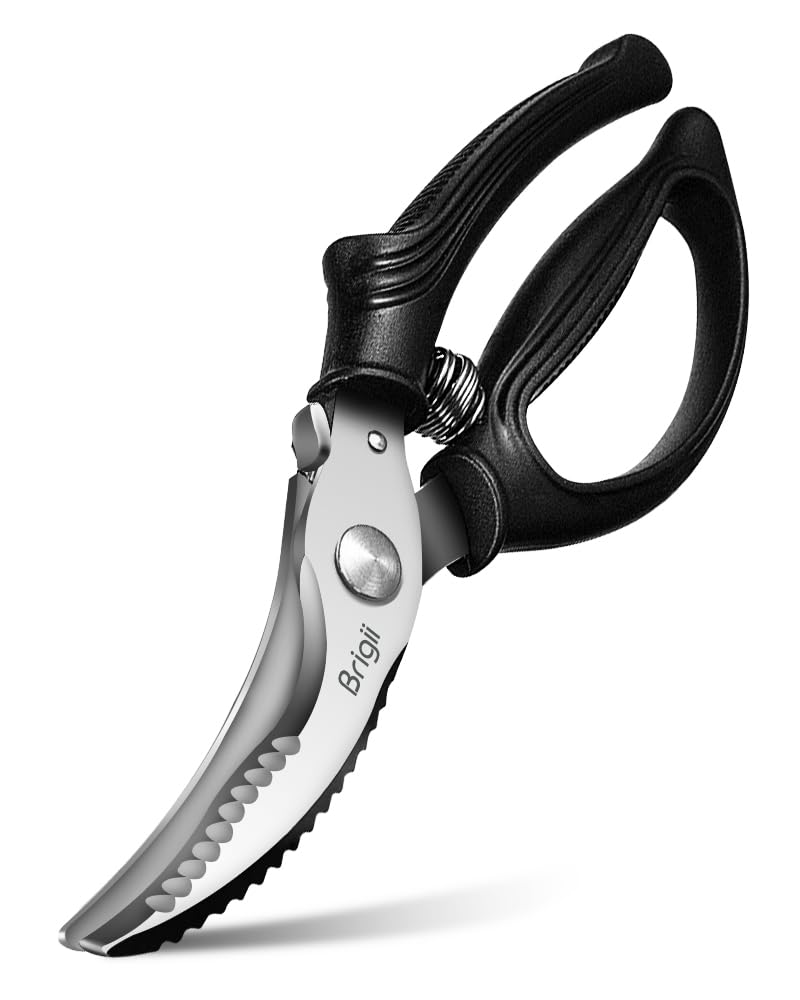
Key Features
- Spring Durability: Spring detaches
- Ease of Cleaning: Dishwasher safe
- Price: $
These shears deliver impressive cutting performance on chicken and small birds thanks to sharp stainless steel blades and a comfortable grip. The polypropylene handles feel sturdy and the blades separate for cleaning. However, the spring mechanism can detach during cutting—occasionally flying off—which makes them best suited for light, infrequent poultry tasks where you can inspect the spring before each use.
Pros
- Cuts through poultry bones and joints with minimal effort
- Sturdy build with comfortable, non-slip grip
Cons
- Spring can detach and fly off during use, posing a safety risk
For light poultry cutting on a budget, these shears work well but require checking the spring before each use—skip them for frequent or heavy-duty tasks.
Best for Backup Pair
Gerior Poultry Shears Set

Key Features
- Ease of Cleaning: Separates for clean
- Handle Grip: Non-slip rubber
- Price: $
This two-pack offers sharp cutting performance and simple disassembly for cleaning, all at a budget-friendly price. However, the pivot may separate during use on some units, making this set better suited for light kitchen tasks or as a spare rather than a primary tool for regular bone cutting.
Pros
- Two shears included for a low price – great value for a backup pair.
- Sharp blades cut poultry cleanly, and the handles stay grippy when wet.
Cons
- The pivot can come undone during cutting, requiring re-tightening mid-use.
A decent spare for light poultry prep or non-heavy cutting, but not the shear to reach for every time you break down a bird.
How to Choose
The most important factor in poultry shears is blade thickness, because thinner steel flexes under bone pressure and dulls faster.
Blade Thickness
Thicker blades (3.5mm or more) handle the torsional stress of cutting through rib bones and backbones without flexing. Thinner steel, around 2mm, works for joints but will struggle—and eventually chip—on dense turkey bones.
If you only cut chickens, a 2.5mm blade may suffice. For spatchcocking turkeys or breaking down multiple birds, prioritize 3.5mm. The extra weight is noticeable but pays off in cleaner cuts and longer edge life.
Spring Durability
Spring-loaded shears reduce hand fatigue, but the spring is the most common failure point. External springs (like those on OXO and Brigii) detach or break after weeks of heavy use. Internal springs last longer but are harder to replace.
Models that include spare springs, like MAD SHARK, offer a practical workaround. If you cook poultry weekly, budget for spring replacement—or choose a non-spring shear with adjustable tension, like the Fiskars, which eliminates the failure point entirely.
Ease of Disassembly
Shears that separate into two halves allow thorough cleaning of the pivot area, where raw poultry fat and bacteria accumulate. A simple rinse won’t reach the hinge, and trapped residue can lead to rust and dullness.
However, the disassembly mechanism itself can be a weak point. Some shears come apart unintentionally during cutting if the pivot lock isn’t secure. Look for a positive-click locking tab that doesn’t rely on a loose screw.
Handle Grip
Handles made of smooth plastic or metal become slick when wet or greasy, reducing control during forceful cuts. Rubberized or textured grips provide consistent traction even with wet hands.
Aluminum and stainless steel handles look premium but require a dry towel nearby. For safety, prioritize a non-slip coating if you often cut poultry with damp hands.
FAQ
Why does my poultry shears spring keep popping out after a few uses?
Most spring-loaded shears use an external coil that can detach when the blades are opened too wide or when the retaining notch wears down. This is common in budget and mid-range models. To avoid it, choose shears with a captive spring (internal) or one that includes replacement springs, like the MAD SHARK.
Can I sharpen kitchen shears that have a serrated blade?
Serrated blades can be sharpened, but it requires a fine round file or a specialized sharpening rod that matches the serration pattern. The edge lasts longer than plain steel between sharpenings, but once dull, the process is more involved. For ease of maintenance, plain-edge shears are simpler to touch up with a standard sharpener.
How do I stop my poultry shears from rusting even though they say stainless steel?
‘Stainless’ means stain-resistant, not stain-proof. Shears rust when moisture stays in the pivot or on the blade edge. Hand-wash and dry immediately with a cloth, paying special attention to the hinge. Avoid leaving them in the sink or dishwasher cycle without a thorough dry. A light coat of food-safe mineral oil on the pivot prevents corrosion.
Are poultry shears that come apart for cleaning more likely to break?
They can, if the locking mechanism is weak. Shears that separate for cleaning rely on a pivot screw or a spring-loaded button to stay closed during use. Models with a metal tab or a threaded screw (like OXO) are secure, while those with a simple snap-fit are prone to coming apart mid-cut. Test the lock before buying—if it feels loose, expect trouble.