This post contains affiliate links. We may earn a small commission when you buy through our links — at no extra cost to you.
Picking a knife sharpener often means choosing between speed and edge quality. Pull-through models get the job done in seconds but can remove too much metal, while whetstones produce razor edges but demand practice and patience.
The right choice depends on your knives and how much you sharpen. A coarse carbide pull-through works fine for everyday stainless steel but risks thin Japanese blades. Whetstones reward time invested with a polished edge that lasts longer.
This guide highlights sharpeners that balance convenience, safety, and results for different priorities — whether you need a quick touch-up between meals or want to master hand-sharpening.


Best for Fast Everyday Sharpening
AccuSharp Knife Sharpener
Key Features
- Mechanism: Pull-through
- Abrasive & Grit: Tungsten carbide, coarse
- Ease of Use: Very easy
- Durability: Carbide durable, long-lasting
- Portability: Compact, portable
- Price: $
Sharpens a dull knife to a usable edge in about 10 seconds – just pull through the carbide slot a few times. It works on both straight and serrated blades, making it a versatile tool for any kitchen. The diamond-honed tungsten carbide is aggressive enough to revive neglected knives quickly, and the ergonomic handle gives a comfortable grip. All parts are dishwasher safe for easy cleaning.
For home cooks who want speed without complexity, this is the simplest solution. Campers and hunters also value its portability and quick field use. However, thin or premium blades (like Japanese knives) require caution: the carbide can remove too much metal if you use heavy pressure. Use light strokes and just a couple of passes. It also leaves a functional but coarse edge – not the polished razor finish you’d get from a whetstone. If that matters, consider a different method.
Pros
- Sharpens a knife in seconds – no setup or skill required.
- Works on both straight and serrated blades, from chef knives to bread knives.
- Budget-friendly and durable, with replaceable carbide.
Cons
- Edge finish is coarse and functional rather than polished – not ideal for razor-edge enthusiasts.
- On thin or premium knives, the aggressive carbide can remove too much metal with heavy passes.
The AccuSharp is the go-to for home cooks who want a fast, no-nonsense way to keep everyday knives sharp – just be mindful with delicate blades.
Best for Versatile Tool Sharpening
Work Sharp MK2 Electric
Key Features
- Mechanism: Electric belt
- Abrasive & Grit: Abrasive belts, various
- Ease of Use: Moderate skill needed
- Durability: Belts need replacement
- Portability: Benchtop
- Price: $$$
The Work Sharp MK2 handles everything from chef’s knives to lawnmower blades using a two-speed belt system that produces very sharp edges. It’s a step up from simple pull-through sharpeners, offering the versatility to tackle various blade types without the $150+ price of higher-end electrics. The tradeoff: you need to learn light, consistent passes to avoid overheating the edge, and the abrasive belts are a recurring expense that adds up over time. This suits DIYers and home chefs who already understand sharpening basics and want one machine for multiple tools, not someone looking for a no-fuss kitchen quick fix.
Pros
- Sharpens a wide range of blades from kitchen knives to garden shears and lawnmower blades
- Quick learning curve once you get the feel for pressure and passes
- Consistently produces razor-sharp edges for cutting tasks
Cons
- Applying too much pressure can overheat the edge, requiring light, controlled passes
- Abrasive belts wear after several sharpenings, adding to long-term cost
Best for DIYers who sharpen varying tools and want electric speed without the premium price, provided they’re comfortable with careful technique and occasional belt replacement.
Best for Learning Hand Sharpening
Sharp Pebble Whetstone Kit
Key Features
- Mechanism: Whetstone
- Abrasive & Grit: 1000/6000 aluminum oxide
- Ease of Use: Requires practice
- Durability: Can dish over time
- Portability: Kit with base
- Price: $$
The Sharp Pebble kit includes a 1000/6000-grit stone, angle guide, and bamboo base – everything needed to start sharpening with water stones. With practice, it produces edges that slice through paper and hold longer than pull-through sharpeners. Best for budget-conscious enthusiasts who want to learn, but not for impatient users seeking instant results. Freehand sharpening takes practice, and the stone may develop slight dishing over time.
Pros
- Razor-sharp edge quality achievable with proper technique
- Complete beginner set with angle guide and non-slip bamboo base
- Great value compared to high-end sharpening stones
Cons
- Maintaining consistent angle takes practice – not for those wanting instant results
- Stone may develop slight dishing after extended use
If you are willing to invest time in learning, this kit offers an affordable path to professional-quality edges without the cost of premium stones.
Best for Camp and Kitchen
Work Sharp Field Sharpener
Key Features
- Mechanism: Guided manual
- Abrasive & Grit: Diamond, ceramic, strop
- Ease of Use: Easy guided
- Durability: Diamond plates costly
- Portability: Self-contained case
- Price: $$$
This compact kit bundles diamond plates, ceramic rods, and a leather strop in a travel-friendly case. Guided 20° and 25° angles take the guesswork out of sharpening, so even a first-timer can restore a pocket knife or fillet blade to hair-shaving sharpness in a few passes.
It suits outdoor enthusiasts who want a single sharpener for camp chores and kitchen prep, but the small base can feel cramped when honing large chef knives. Replacement diamond plates are pricey, so this is best for those who value portability over long-term consumable cost.
Pros
- Handles kitchen knives, pocket knives, fish hooks, and axe blades with one tool.
- Guided angle slots make sharpening reliable for beginners.
- Produces a polished edge quickly, from dull to shaving-sharp.
Cons
- When sharpening large chef knives, the compact base may feel small and limit stroke length.
- Replacing worn diamond plates adds to the long-term cost, more than buying a new budget sharpener.
A portable guided system that delivers razor edges on the go – best for campers and hunters who want one tool that does it all, provided they can accept the small base and future plate costs.
Best for Consistent Professional Edges
Chef’sChoice 15XV Electric
Key Features
- Mechanism: Electric
- Abrasive & Grit: 100% diamond, 3 stages
- Ease of Use: Very easy
- Durability: Discs wear faster
- Portability: Countertop
- Price: $$$$
The Chef’sChoice 15XV uses three diamond-abrasive stages (sharpening, honing, polishing) to create a steady 15° edge in about a minute. Unlike pull-through carbide sharpeners, it removes metal gradually and leaves a polished finish — no guesswork or angle judgment required. The guided slots make it simple: just pull the blade through each stage in sequence.
This electric sharpener suits home cooks or enthusiasts who sharpen multiple knives regularly and want consistent results without investing time in whetstone practice. The $170 price and the possibility that diamond discs may wear out after months of heavy use mean it’s a premium purchase best reserved for busy kitchens where speed and repeatability matter. For occasional touch-ups, a simpler manual sharpener like the AccuSharp offers better value.
Pros
- Consistently razor-sharp edges after a few pulls through the three stages
- Easy to use – just pull through the guides, no skill required
- Sharpens serrated knives as well as straight edges
Cons
- Diamond discs may lose sharpening performance over several months of heavy use
If you sharpen several knives weekly and value speed over manual craftsmanship, this electric sharpener delivers dependable 15° edges. The disc wear is a real but manageable tradeoff for consistent results.
Best for Fast Reprofiling Steel
SHARPAL 162N Diamond Stone
Key Features
- Mechanism: Diamond bench stone
- Abrasive & Grit: 325/1200 monocrystalline diamond
- Ease of Use: Requires skill
- Durability: Coarse coating may flake
- Portability: Storage case
- Price: $$$
The SHARPAL 162N uses monocrystalline diamond to remove metal quickly while maintaining a dead-flat surface, making it a strong choice for knife enthusiasts who need to reshape high-hardness steels or refresh dull edges without waiting. The 325 grit side works fast for heavy reprofiling, but the jump to 1200 grit can leave an unfinished edge that requires an intermediate stone. Some users report that the coarse diamond coating may flake after moderate use, so lighter pressure helps extend its life. This stone fits best in a workshop where speed and flatness matter more than a complete sharpening system – you will want a strop or finer stone for a polished finish.
Pros
- Removes material up to 5x faster than traditional oil stones
- Flat surface from MirrorFlat technology ensures even sharpening across the blade
- Durable monocrystalline diamond coating works on hard, wear-resistant steels
Cons
- Coarse side diamond coating can flake after moderate use, especially on harder steels
- The 325-to-1200 grit jump is large; many users need an intermediate stone for a consistent edge
This stone suits knife enthusiasts and woodworkers who need a fast, flat diamond surface for reprofiling hard steels, but the coarse side’s durability and the large grit gap mean it works best as part of a multi-stone setup.
Best for Quick Daily Touch-Ups
Rada Quick Edge Sharpener

Key Features
- Mechanism: Steel wheels
- Abrasive & Grit: Hardened steel wheels
- Ease of Use: Very easy
- Durability: Durable, lasts years
- Portability: Compact, fits drawer
- Price: $
Made in the USA with hardened steel wheels, this pull-through sharpener requires zero skill and stays in a drawer for years. It keeps already sharp knives in good shape, but struggles with very dull blades, and its compact size can feel tight when handling large chef knives.
Pros
- Simple pull-through design with no learning curve.
- Compact stainless steel wheels that last for years.
Cons
- Small housing can feel cramped when sharpening large chef knives.
Best for home cooks who keep their knives reasonably sharp and want a quick, no-skill maintenance tool.
Best for Budget Kitchen Fix
Kitchellence 3-Stage Sharpener
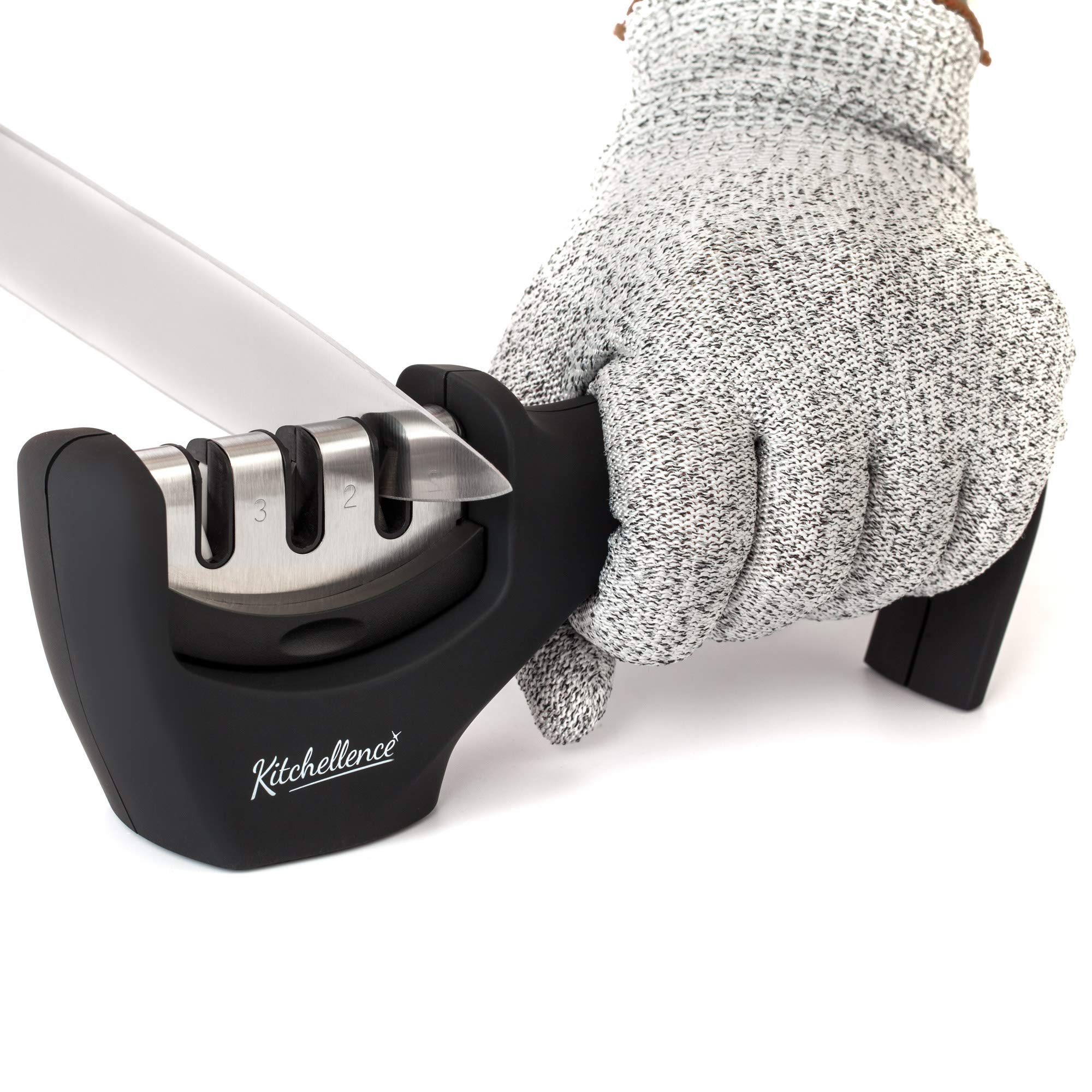
Key Features
- Mechanism: 3-stage pull-through
- Abrasive & Grit: Diamond, carbide, ceramic
- Ease of Use: Very easy
- Durability: Carbide aggressive, fragile
- Portability: Compact
- Price: $
This pull-through sharpener requires no skill and includes a cut-resistant glove and scissor slot, making it convenient for quick touch-ups on everyday kitchen knives. However, the carbide stage can remove too much metal on thin blades, and the resulting edge may be inconsistent – better suited for inexpensive knives where perfect sharpness isn’t critical.
Pros
- Very easy to use – just pull through and done, no technique needed.
- Effective on most kitchen knives and scissors for regular maintenance.
Cons
- On thin blades, the carbide stage may remove too much metal and cause damage – best reserved for thicker or inexpensive knives.
Best for rental homes or dorm kitchens where knives are cheap and a quick fix is needed – skip for quality knife sets.
Best for Survival Backup Sharpener
SHARPAL 101N Pocket Sharpener

Key Features
- Mechanism: Multi-tool pull-through
- Abrasive & Grit: Carbide, ceramic, diamond rod
- Ease of Use: Easy
- Durability: Basic
- Portability: Pocket-sized
- Price: $
The SHARPAL 101N packs six functions into a pocket-sized body: carbide and ceramic sharpening slots, a diamond rod for hooks, plus a fire starter and whistle. The sharpening capability is basic — the carbide slot can scratch thin blades if used too aggressively, and the tool is too small for kitchen knives. This works well as a backup in a camping kit or EDC pouch, but anyone needing a primary knife sharpener should look at dedicated options.
Pros
- Six functions in one compact package – sharpens, starts fires, and serves as an emergency whistle.
- Lightweight and pocketable with a lanyard hole – ideal for survival kits.
Cons
- Carbide slot can mar thin blades if overused – best for coarse touch-ups on outdoor knives, not kitchen work.
Keep this in a go-bag or glovebox for emergency repairs and fire-starting, but rely on a dedicated sharpener for regular knife maintenance.
Best for Field Pocket Sharpener
Lansky Blademedic

Key Features
- Mechanism: 4-in-1 pull-through
- Abrasive & Grit: Carbide, ceramic, diamond rod
- Ease of Use: Easy
- Durability: Carbide aggressive
- Portability: Compact, magnetic closure
- Price: $
The Blademedic packs a metal body with magnetic closure, carrying carbide, ceramic, and a diamond rod for straight, serrated, and gut-hook blades. Its pull-through slots make edge maintenance fast — ideal for a truck glovebox or pack. But the carbide slot is aggressive enough to remove metal from thinner or softer steel knives, limiting use with kitchen blades. It suits pocket knives and outdoor tools, not countertop cooking knives.
Pros
- Compact all-in-one solution for various blade types
- Easy to use with no setup
Cons
- Carbide slot can remove metal too quickly from softer steel blades
Best suited as a field companion for everyday carry and outdoor knives; reserve kitchen sharpening for a less aggressive tool.
Best for Complete Beginner System
Intelitopia Whetstone Set

Key Features
- Mechanism: Whetstone set
- Abrasive & Grit: 400/1000 & 3000/8000 corundum
- Ease of Use: Requires practice
- Durability: Dish faster than premium
- Portability: Kit with base
- Price: $$
The Intelitopia set provides all the stones and accessories needed to achieve sharp edges with practice – a cost-effective way to begin hand sharpening. However, the stones wear faster than premium options, and the sparse instructions may send beginners to YouTube for guidance. The included flattening stone helps mitigate dishing, but those sharpening frequently may prefer more durable stones.
Pros
- Includes two double-sided stones, flattening stone, strop, and angle guide – everything a beginner needs to start.
- Saves money compared to buying each component separately.
Cons
- Stones may dish faster than premium water stones, requiring more frequent flattening.
Best for budget-conscious beginners willing to learn and keep a flattening stone handy; not ideal for heavy use or those wanting quick results.
Best for Entry-Level Stone Tryout
KEENBEST 400/1000 Stone

Key Features
- Mechanism: Whetstone
- Abrasive & Grit: 400/1000 aluminum oxide
- Ease of Use: Requires practice
- Durability: Wears quickly, needs flattening
- Portability: Small stone with base
- Price: $
This stone delivers an affordable way to learn water stone sharpening on soft steel knives. Its non-slip rubber base stays in place, and the 400/1000 grits handle basic edge restoration. However, the stone is soft and can dish after a few uses, and the lack of a finer grit means edges won’t reach a polished finish.
Pros
- Budget-friendly way to try hand sharpening with water.
- Rubber base keeps stone stable during use.
Cons
- Stone is soft and may dish after a few uses, requiring flattening.
Best for absolute beginners or anyone wanting to test water stones on soft steel knives with occasional use – plan to upgrade once you need a longer-lasting stone or finer polish.
Best for Small Kitchen Spaces
SHARPAL 191H Suction Sharpener
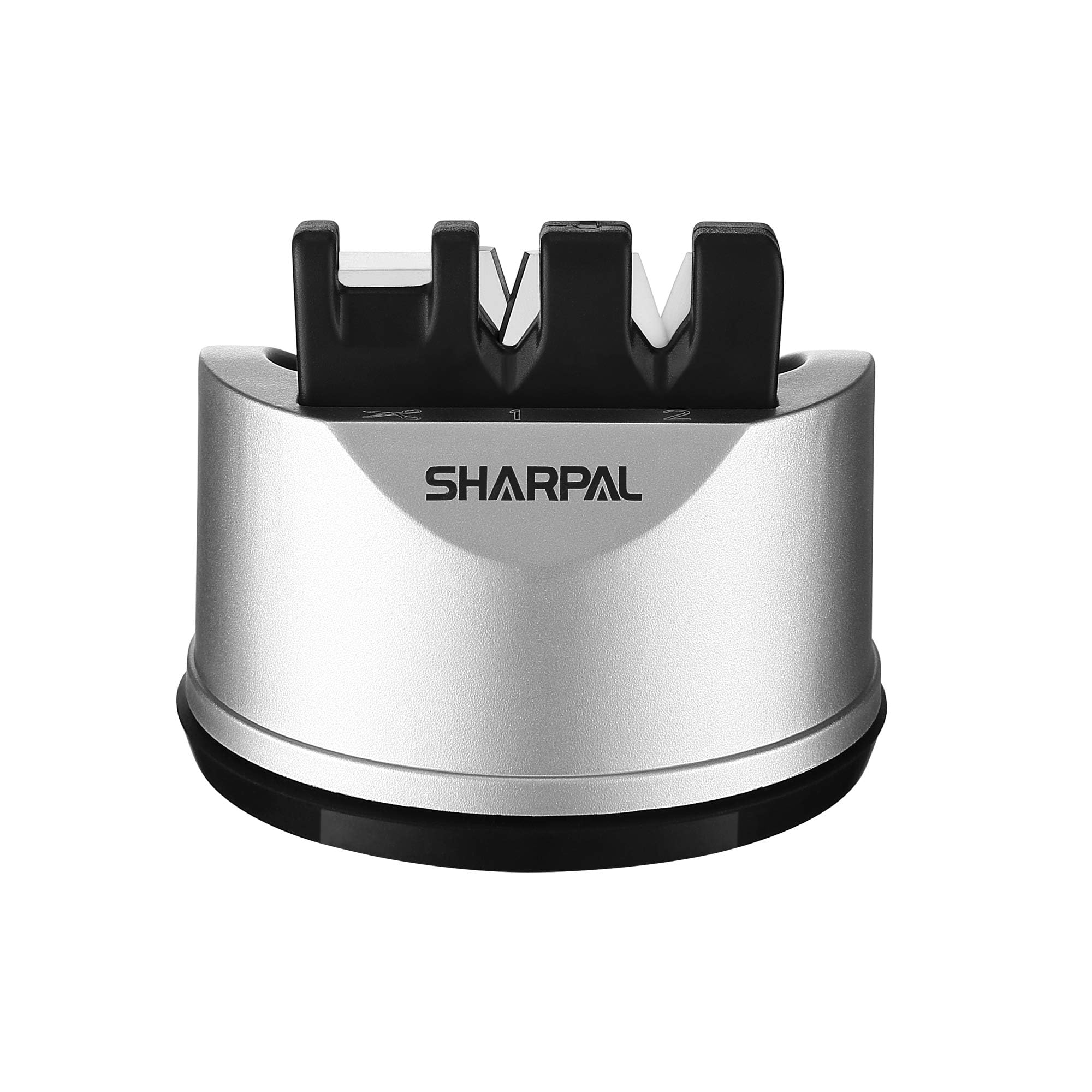
Key Features
- Mechanism: Suction base pull-through
- Abrasive & Grit: Carbide, ceramic
- Ease of Use: Easy, hands-free
- Durability: Suction may weaken, average
- Portability: Compact, suction base
- Price: $
The SHARPAL 191H uses a suction base to stay put on smooth countertops, freeing both hands for sharpening – a real advantage in tight kitchen spaces. Its compact body includes a scissor slot, adding utility. However, the edge it produces is decent but not razor-sharp, best for casual users who prioritize convenience over peak performance.
Pros
- Suction base holds firmly on smooth surfaces, freeing both hands for sharpening in small kitchens.
- Compact footprint and dedicated scissor sharpening slot add utility without taking counter space.
Cons
- Suction may lose grip on textured or uneven surfaces over time, reducing stability.
Works well for occasional touch-ups in kitchens with smooth countertops where convenience matters more than a razor edge.
Best for Disposable Knife Backup
Longzon 5-in-1 Sharpener
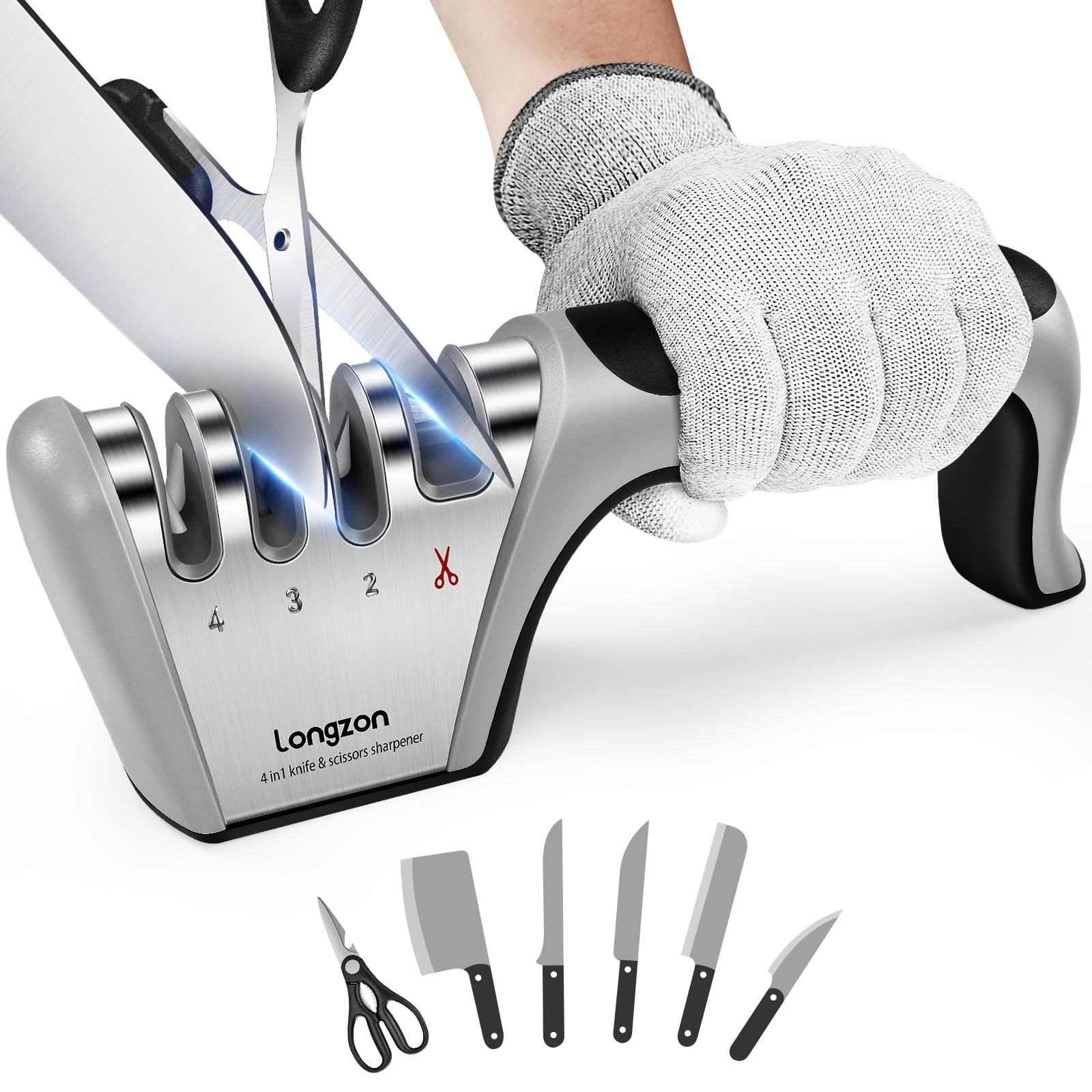
Key Features
- Mechanism: 5-in-1 pull-through
- Abrasive & Grit: Carbide, ceramic
- Ease of Use: Easy
- Durability: Teeth break quickly
- Portability: Compact
- Price: $
The Longzon 5-in-1 delivers a cut-resistant glove and scissor slot for under $10, making it an affordable emergency kit. However, the carbide sharpening stage can remove more metal than desirable on decent knives, and the teeth may wear quickly. This is a backup tool for cheap blades you won’t cry over.
Pros
- Very low price – often under $10 with extra accessories
- No skill required – simple pull-through design
Cons
- Carbide slot can damage thin blades – best for cheap knives you won’t miss
Keep this in a drawer for last-resort sharpening of budget knives or scissors – not for your everyday chef’s blade.
How to Choose
The sharpener you choose should match your knife’s steel and your willingness to learn – fast pull-throughs work for most, but whetstones reward patience with superior edges.
Sharpening Mechanism
Pull-through sharpeners use fixed-angle slots that guide the blade across abrasive surfaces. They are the fastest method but often use aggressive carbide that removes metal quickly — a few passes are enough, and more can shorten knife life.
Whetstones require freehand angle control but let you decide how much metal to remove. Electric sharpeners automate the process but lock you into a fixed angle and can overheat the edge if you linger.
Abrasive Material and Grit
Tungsten carbide is common in budget pull-throughs: it cuts fast but leaves a rough edge and is unforgiving on thin blades. Diamond abrasives last longer and cut harder steels but cost more. Ceramic hones refine the edge but are brittle.
Grit numbers indicate coarseness: lower numbers (300-400) reprofile dull knives, medium (1000) sharpens, high (6000+) polishes. A single coarse stone can maintain a knife, but two stones or a combination stone cover more ground.
Ease of Use
Pull-through sharpeners require no skill — just a steady pull. The trade-off is that you have no control over angle or pressure, making it easy to oversharpen and damage a blade. Electric sharpeners are nearly as simple but need attention to avoid burning the edge.
Whetstones demand practice: consistent angle and pressure are essential for a straight edge. Beginners often benefit from angle guides or clamp systems. The learning curve is real, but the payoff is a sharper, longer-lasting edge.
Durability of Abrasive Components
Carbide inserts in pull-throughs can last for years on occasional use, but cheap steel teeth may break. Diamond-coated surfaces are hard but can flake if the bond is weak — frequent users should expect to replace diamond plates every 6-12 months.
Whetstones dish out over time, especially softer aluminum oxide stones. Flattening stones can restore them, but eventually the stone becomes too thin. Budget stones wear faster and may need replacement after a year of weekly use.
Portability and Size
Pocket-sized sharpeners fit in a backpack or glove box, making them ideal for campers and hunters. Their small size, however, can be awkward for large chef knives — the blade may not fit in the slot or the handle feels cramped.
Countertop electrics and bench stones take up drawer or shelf space but offer stability and room to work. Suction-base models free up hands but need a smooth, clean surface to grip.
FAQ
Can a pull-through knife sharpener damage my good knives?
Yes, if the sharpener uses coarse tungsten carbide and you apply too much pressure or run the knife through repeatedly. The carbide removes metal aggressively and can thin the blade over time. Use light, smooth strokes and limit passes to three or four per knife.
What is the best sharpener for a beginner who doesn’t want to learn angles?
A guided manual sharpener like the Work Sharp Field Elite or a pull-through like the AccuSharp requires no angle control. For electric convenience, the Work Sharp MK2 has an integrated angle guide. Both produce reliable edges without any technique.
How often should you replace the abrasive wheels on a manual knife sharpener?
Replace carbide inserts or diamond plates when they no longer restore a sharp edge after a few strokes — typically every 6 to 12 months for weekly use. If the sharpener starts gouging the blade or leaving scratches, it’s time for a replacement.
Is a whetstone worth the effort compared to an electric sharpener?
If you want the sharpest possible edge and don’t mind investing 10-15 minutes per knife, a whetstone delivers a polished, long-lasting edge that electrics can’t match. Electric sharpeners are faster and require less skill but produce a less refined edge and cost more upfront.