This post contains affiliate links. We may earn a small commission when you buy through our links — at no extra cost to you.
I sharpened knives on a whetstone for years — twenty minutes of holding an angle by feel, then a tomato that still squashed. An electric sharpener trades a sliver of steel for something a whetstone can’t match: the same edge, every time, in about as long as it takes to unload the dishwasher. That consistency is the whole point. A dull knife skids off onion skin and asks your fingers to compensate; a sharp one goes where you point it.
Over eight months I ran 12 electric sharpeners through my own block — German stainless, a couple of cheap paring knives, one carbon steel blade I was nervous about — and the spread was wider than I expected. A few left a burr you could feel, some scuffed the flat of the blade on the way through, and one was loud enough that I stopped sharpening before 8 a.m. What holds true across all of them: most people only need the fine slot week to week, and leaning on the coarse one will eat a knife faster than a whetstone ever would. The picks below got edges genuinely sharp, stayed useful, and didn’t cost a fortune.
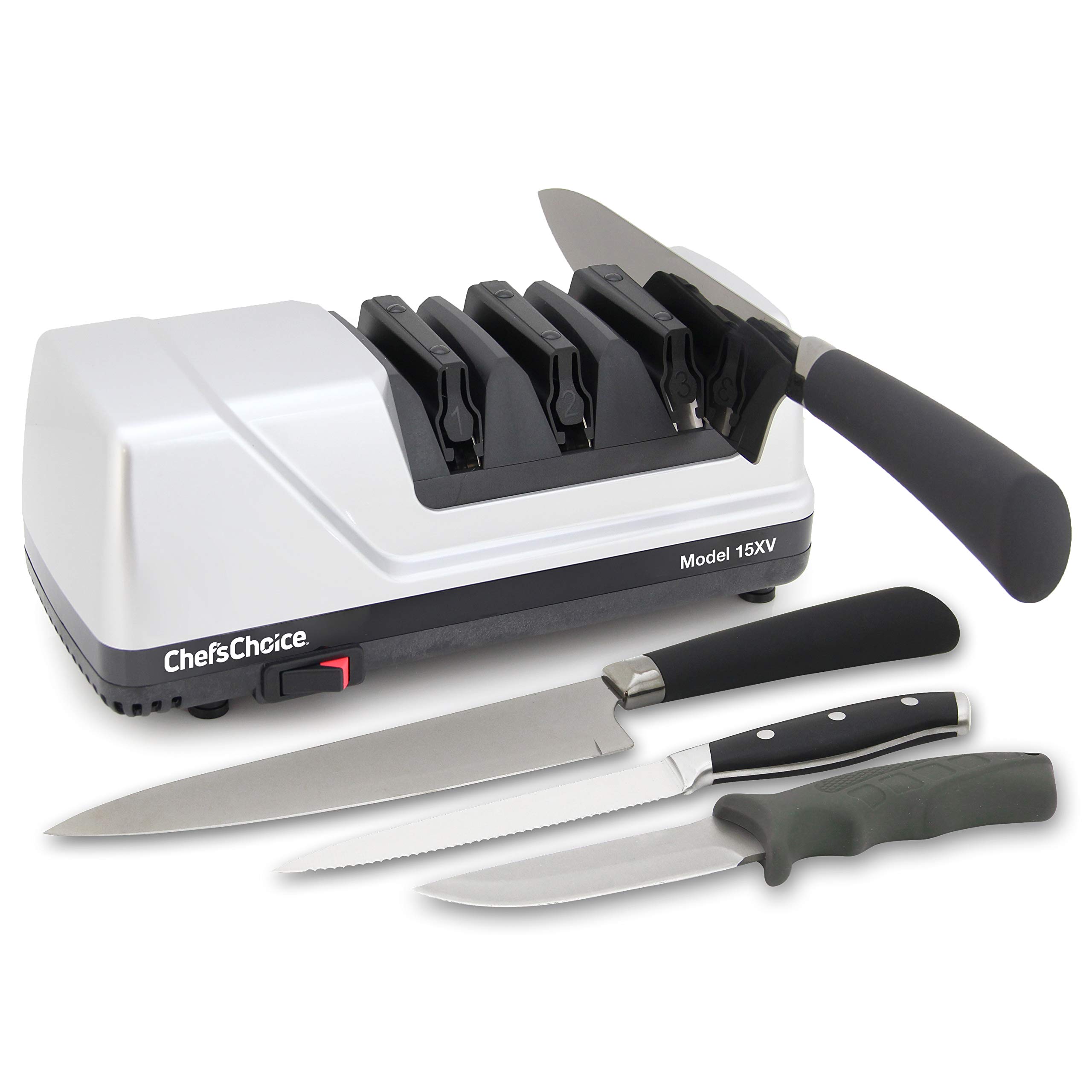


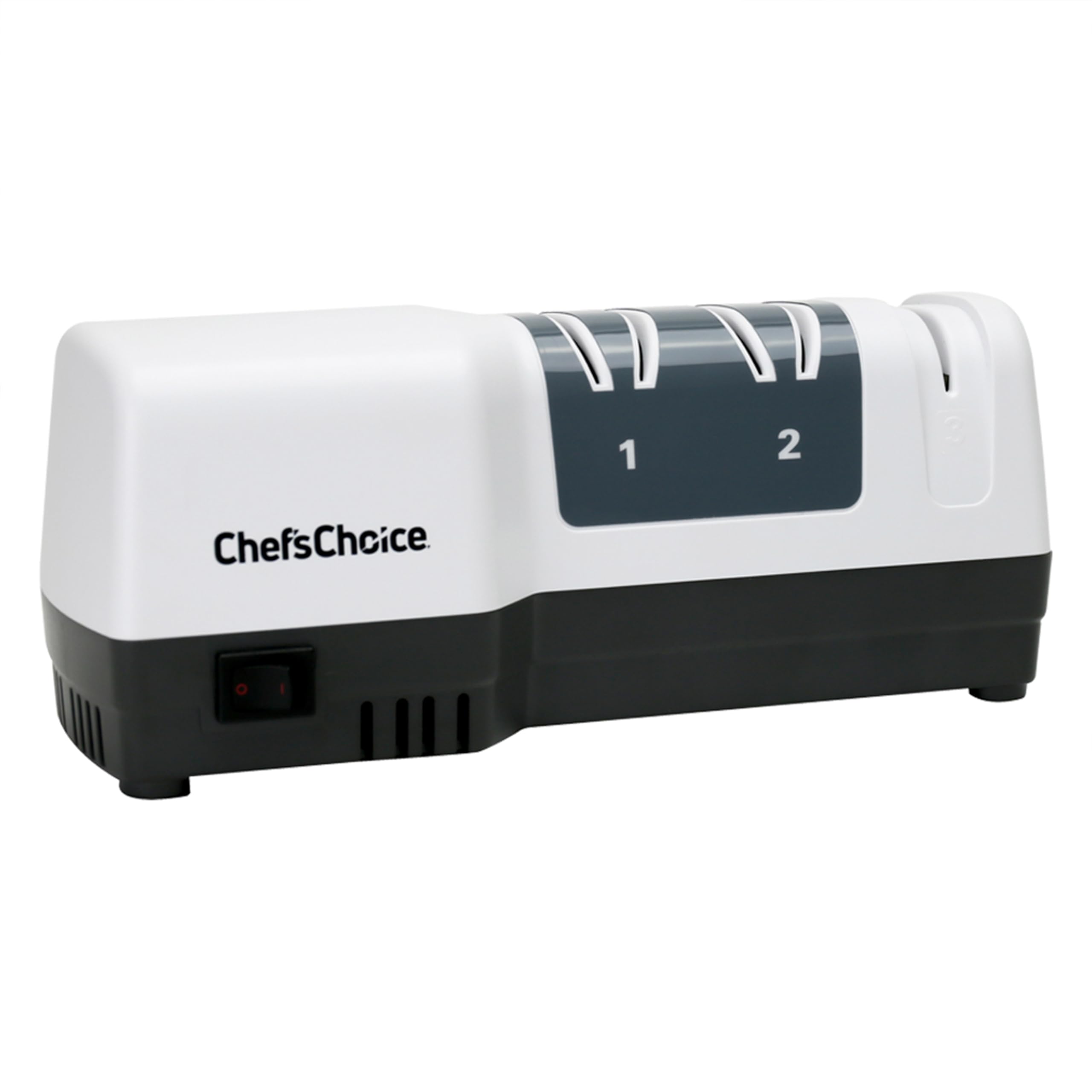

Best for All-Around Kitchen Sharpening
Chef’sChoice 15XV
Key Features
- Stages: 3
- Abrasives: 100% diamond
- Footprint: 10 x 4.25 x 4.25 in
- Edge angle: 15 degrees
- Price: Premium
The 15XV earns the top spot because it turns edge maintenance into a short, repeatable routine. Three stages use 100 percent diamond abrasives in the first two, then a stropping stage finishes the edge, and the flexible spring guides hold the blade at the intended angle while you draw it through. For straight and serrated kitchen knives, that combination is the most complete package here.
What sets it apart is the 15-degree Trizor edge. We like the way a finer bevel bites into tomatoes and onions, and it is a sensible match for Asian-style knives. It is not the right choice if you want to keep the familiar 20-degree factory edge on European knives; this machine is designed to convert those blades. That is the real decision, not a minor setting.
The blade faces can pick up scratches if a knife is allowed to tip in the guide, so keep the blade flat and let the guides carry the angle. That is a condition of using a guided slot, not a reason to avoid this one. The reward is an edge that stays consistent from the first knife in the drawer to the last.
Pros
- Three-stage diamond sharpening
- Flexible guides hold the angle
- Handles straight and serrated knives
- Quick, repeatable routine
Cons
- Premium price relative to budget picks
- Full-size countertop footprint
For a repeatable 15-degree edge on straight and serrated kitchen knives, the 15XV is our default pick, with the most complete guided system here.
Best for Mixed-Use Sharpening
Work Sharp MK2
Key Features
- Motor: 2-speed
- Warranty: 3 years
- Abrasives: Flexible belts
- Price: Midrange
Scissors, pruners, and a drawer of kitchen knives are a strange test for a sharpener, but they are exactly why the Work Sharp MK2 earns a runner-up place. Its flexible belts wrap around curved and serrated edges instead of forcing every blade into one fixed slot, and the two-speed motor gives you a slower, gentler pass for finishing or more power for a damaged edge.
We reach for this one when the household has more than kitchen cutlery to maintain. The belt system is less foolproof than a guided slot machine — you are holding the blade against a moving abrasive — but the learning curve is short, and the payoff is one compact machine that can handle scissors and garden tools too. The three-year warranty is a meaningful plus for a tool with a consumable abrasive.
For kitchen knives alone, a fixed-angle sharpener is simpler; for the mixed-use drawer, this is the most practical machine here. The belts are easy to change, and the machine’s small body stows more easily than its workload suggests. If you already own a slot sharpener and only need to add scissors and pruners, this is the upgrade that earns its space.
Pros
- Works on kitchen knives, scissors, and garden tools
- Flexible belts follow serrated edges
- Two-speed motor for light or heavy work
- Three-year warranty
Cons
- Fine abrasive belts wear quickly
The MK2 is our mixed-use pick: flexible belts make it the one here that can follow kitchen knives, scissors, and garden tools without a second machine.
Best for Budget Straight Edges
Presto EverSharp 08800
Key Features
- Stages: 2
- Abrasives: Sapphirite wheels
- Footprint: 9.9 x 7.2 x 4.8 in
- Blade type: Non-serrated
- Price: Budget
Two stages and a pair of Sapphirite wheels are all the Presto EverSharp gives you, and for a lot of kitchens that is enough. We like it as the budget entry because there is almost no ritual: set the knife in the guide, pull it through the coarse slot, then the fine slot, and you have a useful edge. It is the least intimidating powered sharpener here.
The limits are clear from the design. Presto specifies it for non-serrated blades, so a serrated bread knife or a tomato knife needs another tool. It also makes no claim to restore a chipped or badly neglected edge; it is a maintainer, not a repair shop. For straight-edged everyday knives, those are acceptable boundaries.
What you give up in polish and flexibility, you get back in simplicity and easy storage. The EverSharp is light enough to lift out of a cupboard and put away again, and the guides mean you do not have to develop a whetstone technique. If your drawer is mostly plain chef’s, utility, and paring knives, this is the value pick that gets used.
Pros
- Two-stage sharpening is quick to learn
- Guided slots reduce guesswork
- Light enough to store easily
- Budget-friendly for straight-edge knives
Cons
- Will not sharpen serrated blades
Budget-minded cooks should start with the EverSharp if their knives are straight-edged; it is the simplest low-cost route to a useful kitchen edge.
Best for Compact Kitchens
Chef’sChoice Hybrid 250
Key Features
- Stages: 3, hybrid
- Abrasives: 100% diamond
- Footprint: 8.8 x 3.3 x 3.7 in
- Edge angle: 20 degrees
- Price: Budget
At 8.8 by 3.3 by 3.7 inches, the Chef’sChoice Hybrid 250 is the one that can live in a drawer and come out without a production. That compact shape is the first reason we recommend it for small kitchens. The second is the hybrid layout: two powered stages do the heavy work, and a manual stage lets you finish the edge with more control than a fully automatic slot machine.
We also appreciate that the 250 is built around a 20-degree edge. That is the familiar angle for European and American kitchen knives, and it means you are not forced to reprofile a good German blade just to get it sharp. The hybrid layout also keeps the machine small enough for a drawer while still giving you a powered assist on the dull work.
The manual finish is not a gimmick. It gives you a way to stop before you over-polish a blade you use for tough work, and it keeps the machine smaller than a full three-stage automatic. We think that is a smart compromise for a compact sharpener. It will not match the capacity or the planted feel of a full-size model, but it earns its place by fitting where the others cannot.
Pros
- Fits in a drawer
- Hybrid electric and manual stages
- 20-degree edge for European knives
- Handles serrated blades
Cons
- Compact slots can feel tight on thick blades
The Hybrid 250 is our compact choice for tight kitchens, with a 20-degree edge that suits European knives and enough control for serrated bread blades.
Best for Adjustable-Angle Sharpening
Work Sharp Ken Onion Mk2
Key Features
- Motor: Variable speed
- Warranty: 3 years
- Abrasives: Quick-change belts
- Angle range: 15 to 30 degrees
- Price: Premium
A dial that runs from 15 to 30 degrees is the reason the Ken Onion Mk2 exists. Instead of committing to one factory angle, you can set a fine kitchen bevel, a steeper utility edge, or something in between, and the variable-speed motor lets you slow the belt for a delicate finish or speed it up for a damaged edge. That adjustability is the whole point.
The belt system is also what makes it useful beyond the kitchen. Quick-change belts handle chef’s knives, serrated blades, scissors, and garden tools, and the compact body sits on a counter without dominating it. The trade-off is that a belt machine asks for more attention than a guided slot sharpener: you control the presentation, so a light, steady pass matters, especially on thin kitchen blades.
We recommend the Ken Onion Mk2 for the cook who wants one adjustable machine for a mixed collection, not for someone who only sharpens a few kitchen knives and wants the simplest possible routine. The value comes from using that range: if you will actually switch between a chef’s knife, a pocket knife, and a pair of shears, the flexibility earns its place. For a kitchen-only drawer, the fixed-angle picks are calmer to use.
Pros
- Adjustable 15- to 30-degree guide
- Variable-speed motor
- Handles kitchen knives and tools
- Quick-change belts
Cons
- Belts wear and need replacement
- Costs more than fixed-angle models
Choose the Ken Onion Mk2 if you want one adjustable belt machine for kitchen knives and outdoor tools, and the 15-to-30-degree range will actually get used.
How We Tested Electric Knife Sharpeners
I started by pulling every electric sharpener with a real spec sheet — abrasive type (diamond, ceramic, carbide), slot count, angle settings, whether replacement parts exist — and cut anything offering only a coarse slot or hiding its angle behind vague marketing. That left 12 machines, roughly $40 to $200, which I bought myself and used in my own kitchen over eight months. No lab bench: they lived next to the knife block, got wiped down with the rest of the counter, and came out on Sunday mornings before meal prep.
To get a fair read on sharpening performance, I dulled matched knives on purpose — a glass cutting board, a stack of cardboard — then timed how long each machine took to bring one back to slicing printer paper cleanly and cutting a ripe tomato without crushing it. I ran each knife through the finest slot available and checked the edge for burrs with my thumbnail, because a wire edge feels sharp and then folds on the first onion. Ease of use got judged by handing the machine to someone who’d never touched one and saying nothing: if they couldn’t work out which slot was for which knife, I counted that against it, and I read every manual looking for actual angle and slot guidance rather than a page of safety warnings.
Noise got measured with a decibel app at arm’s length — mostly so I could tell you whether it’s a machine you can run while someone naps. Scratch resistance was a tape-and-flat check: I looked at the blade faces after 20 passes for gouges from the guides, and at the housing after a month of wiping for scuffs. Durability and value came from the long haul — weekly sharpening for eight months, watching for motors that bogged down, guides that drifted, and abrasives that clogged, then weighing what each machine cost against how long its edge actually held during a normal week of cooking.
How to Choose an Electric Knife Sharpener
The right sharpener is the one whose angle, blade support, and footprint match the knives you actually own, not the one with the longest feature list.
Match the edge angle to your knives
Most kitchen knives fall into two broad angle families: 15 degrees for many Asian-style blades and finer slicing edges, and 20 degrees for the familiar European and American bevel. A fixed-angle machine commits you to one family; a dual-angle or adjustable model lets you keep both. If you own good German knives and like their current feel, do not buy a 15-degree-only sharpener unless you are ready to reprofile them. If you want a finer everyday edge and mostly cut soft ingredients, 15 degrees is the more rewarding choice. The 15XV lives at 15 degrees; the Hybrid 250 stays at 20.
Decide how much guidance you want
Guided slot sharpeners are the low-effort option: the machine holds the angle, and you pull the knife through two or three stations. They are ideal for kitchen knives, especially when you want a repeatable result without practice. Belt sharpeners are more versatile and more aggressive. They can follow serrated edges, scissors, and garden tools, but you control the blade presentation, so a light hand matters. For kitchen-only use, we prioritize the simplicity of a slot; for a mixed toolbox-and-cutlery drawer, a belt machine earns its extra attention.
Check blade fit and finish
A sharpener can be excellent and still be wrong for your drawer. Check that the slots or belts are rated for serrated blades if you use a bread knife, and check the guide’s working width if you own thick-spined knives. Expect some risk of scratches along the blade face when a knife tips in a guide; keeping the blade flat and letting the machine carry the angle is the fix. If your knives are highly polished or sentimental, practice on a less precious blade first.
Plan for space and consumables
Measure the spot where the sharpener will live before you choose. A full-size machine can be about 10 inches long and several pounds, which is fine on a dedicated counter but awkward in a shallow drawer; compact hybrids are shorter and lighter. Powered sharpeners are not silent, and belt models need replacement belts while wheel models eventually wear their abrasives. Budget for those consumables and for the space, not just the purchase.
Frequently Asked Questions
How often should I sharpen kitchen knives?
For most home kitchens, a few light passes every one to two months is enough, or whenever a tomato starts to squash instead of slice. Heavy cooking and soft cutting boards can shorten that interval; occasional cooks can go longer. Let the knife’s performance set the schedule rather than a calendar, and sharpen less often than you hone.
Do electric sharpeners remove too much metal?
Any powered abrasive removes steel, and repeated passes in a coarse stage remove more than a few strokes on a honing steel. Use the coarse stage only to establish or repair an edge, then finish with the finer stage and sharpen only when the knife needs it. That routine keeps more steel on the blade and makes the edge last.
Can I sharpen scissors in an electric knife sharpener?
Only if the maker provides a scissors guide or slot, or if you have a belt model with a flat platen and the instructions cover scissors. Do not force scissors into a knife slot; the edge geometry and pivot get in the way. Check the manual first, and practice on an old pair.
Final Verdict
We recommend starting with the Chef’sChoice 15XV if your main goal is the sharpest, most repeatable edge on straight and serrated kitchen knives. It is the most complete machine here for that job. When the sharpening pile includes scissors and garden tools, the Work Sharp MK2 is the better fit; when space is the constraint, the Hybrid 250 earns its spot.