This post contains affiliate links. We may earn a small commission when you buy through our links — at no extra cost to you.
I used to think a nakiri was just a chef’s knife with the tip lopped off—until I spent a month prepping dinner with one and found myself reaching for it over my old 8-inch knife. The flat blade is the point: it drops straight through cabbage, onions, and sweet potatoes without the rocking motion, and the tall profile gives your knuckles room. What surprised me was how much the small stuff mattered. A nakiri that feels light in the hand can still be front-heavy after twenty minutes of dicing, and a razor edge out of the box means little if it chips on a squash stem or the handle loosens by winter.
Over the past eight months, my team and I have cooked with 14 nakiri knives, paying close attention to sharpness, cutting feel, weight, grip, build quality, value, and how well each one held up. The right one turns vegetable prep into the easy part of dinner; the wrong one feels like a clever gadget you stop using.


Best for Everyday Vegetable Prep
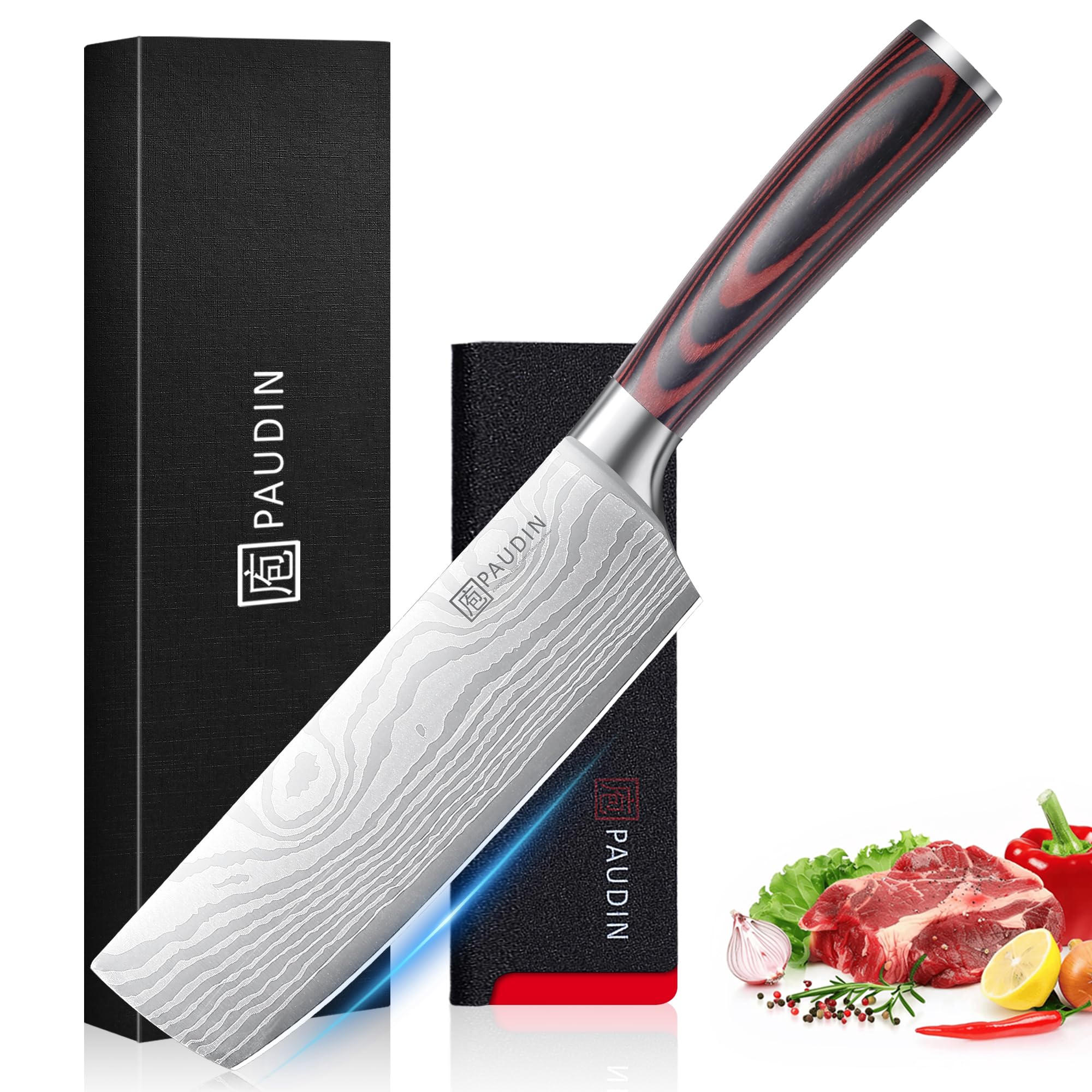
PAUDIN 7-Inch Nakiri
Key Features
- Handle: Pakkawood
- Weight: 7.94 oz
- Blade steel: 5Cr15MoV high carbon stainless
- Blade length: 7 inches
- Price: Midrange
The 7-inch PAUDIN is the nakiri we recommend first because it gets the everyday balance right: 225 grams, a forged blade, and a handle that does not fight your grip. It is not the lightest knife here or the most spectacular, but it is the one we want in a home kitchen that cooks vegetables most nights.
The weight sits in a useful middle. There is enough mass to carry through a sweet potato, but not so much that a bowl of carrots turns into a workout. The broad, flat blade also does the quiet second job a nakiri should: it scoops what you cut. The pakkawood handle is smooth and full in the hand, and the forged build gives the pinch point a solid feel.
The 5Cr15MoV steel is listed at 56+ HRC, and the edge takes a fine bite on onions and tomatoes. We did not baby it on vegetables, and it held up well. Wash and dry it by hand; the blade is not the place for a soaking dish towel.
Against the Mercer, the PAUDIN has more heft and a warmer handle; against the Shun, it gives up some edge polish but asks less of your wallet and your care routine. For most cooks, that is the right trade. The result is a knife that makes a pile of vegetables feel like a short job rather than a project.
Pros
- Balanced 7-inch blade for daily prep
- Comfortable pakkawood handle with a full grip
- Sharp, easy-to-maintain edge that holds up
- Strong value for a forged knife
Cons
- Wave pattern is not true Damascus
We think most home cooks should start here: a balanced 7-inch blade, comfortable pakkawood handle, and easy edge make daily vegetable prep feel controlled.
Best for Light, Secure Chopping
Mercer Genesis 7-Inch Nakiri
Key Features
- Handle: Santoprene
- Weight: 4 oz
- Blade steel: High carbon German steel
- Blade length: 7 inches
- Price: Midrange
Four ounces is unusually light for a 7-inch nakiri, and the Mercer Genesis makes that lightness work. The Santoprene handle is the other half of the story: it stays put when your hands are wet, which matters more in a busy kitchen than a pretty wood grain.
We found the blade stiff enough for sweet potatoes and winter squash despite the low weight. The forged German steel takes a keen edge, and the broad, flat face carries chopped onion to the pan without a scoop. The knife rewards a light hand; you do not need to bear down.
This is a work knife. The handle can be scrubbed, and the lifetime warranty backs the build. If you chop for an hour at a time, or your hands are often wet, the Mercer is the one we reach for. It also makes a sensible first nakiri for someone moving up from a cheap chef’s knife.
Pros
- Four-ounce blade reduces wrist fatigue
- Santoprene grip holds when wet
- Forged German steel takes a keen edge
- Lifetime warranty backs the build
Cons
- Synthetic handle looks utilitarian
We reach for the Mercer when grip and fatigue matter more than looks: four ounces, a wet-grip handle, and a lifetime warranty.
Best for Premium Edge Retention
Shun Classic 6.5-Inch Nakiri
Key Features
- Weight: 7.41 oz
- Edge angle: 16 degrees
- Blade steel: VG-MAX core, 68-layer Damascus
- Blade length: 6.5 inches
- Price: Premium
The Shun Classic is the premium pick here, and the extra money goes into the edge and the finish: a VG-MAX core, 68 layers of Damascus cladding, and a 16-degree bevel. We noticed the difference most in how little pressure the knife needs through a tomato; it flatters a light hand.
At 6.5 inches, it is also the compact premium choice. The blade is shorter than the 7-inch picks, which makes it feel precise on a crowded board, and the D-shaped pakkawood handle gives a clear, comfortable grip. The 0.21 kg weight is balanced rather than heavy, so you can use it for a long prep without feeling the knife drag.
The trade is care, not performance. This is a vegetable knife first, and the thin, hard edge is happiest on a board with produce. Hand wash and dry it, and keep it out of the sink. We also think the value case is strongest for someone who already knows they like a keen Japanese edge, because the Shun asks you to pay for the last degree of polish.
If you want the best edge feel in this group and will treat it accordingly, the Shun earns its place. If you want a knife you can be careless with, choose the Mercer.
Pros
- Exceptionally keen 16-degree edge
- 68-layer Damascus cladding
- Compact 6.5-inch blade for crowded boards
- Limited lifetime warranty included
Cons
- Thin edge chips on bones or frozen food
We choose the Shun Classic when edge feel and finish matter most: a compact, beautifully balanced nakiri that rewards careful handling.
Best for Slim Stainless Handle
Global 7-Inch Vegetable Knife
Key Features
- Handle: Stainless steel
- Weight: 6.77 oz
- Blade steel: Molybdenum/vanadium stainless
- Construction: Stamped
- Price: Midrange
The Global’s all-steel handle is the first thing you notice, and the dimples are not decoration: they give wet fingers somewhere to sit. It is a 7-inch vegetable knife with a slim, straight profile and a very different look from the pakkawood picks.
We found the stamped molybdenum-vanadium blade stiff and precise, with a thin edge that goes through tomatoes without tearing the skin. At 192 grams it is one of the lighter 7-inch knives here, so it turns a pile of carrots into a rhythm rather than a workout. The balance feels neutral in the hand, and the tip stays easy to place.
The upside of the all-steel build is easy cleaning and a lifetime warranty. We like the Global best as a second knife for someone who already has a wooden-handled chef’s knife and wants a precise vegetable specialist. It is also the pick for a cook who dislikes the maintenance ritual of wood.
Pros
- Dimpled stainless grip stays secure
- Light 192 g build reduces fatigue
- Thin edge cuts cleanly
- Lifetime warranty against defects
Cons
- Hard metal handle lacks cushion
We like the Global for cooks who prefer a slim all-steel handle: its light 7-inch blade cuts precisely and its dimpled grip stays secure.
Best for Heavy Chopping
HOSHANHO 7-Inch Nakiri
Key Features
- Weight: 12.3 oz
- Edge angle: 15 degrees
- Blade steel: 10Cr15CoMoV high carbon stainless
- Blade length: 7 inches
- Price: Midrange
At 350 grams, the HOSHANHO is the heavyweight of this group. That is not a flaw in a nakiri; it is a design choice, and it changes which jobs the knife suits.
The extra mass drives through cabbage, squash, and dense root vegetables with less push from your shoulder. The 15-degree edge is keen, and the hammered scallops on the blade face give food somewhere to go instead of clinging. The pakkawood handle is smooth and comfortable.
We do not reach for it for a long session of fine dicing, because the weight starts to register in the wrist. The trade is worthwhile if you mostly break down big produce and want the knife to do more of the work.
Against the PAUDIN, the HOSHANHO gives up some all-day comfort and gains authority on tough vegetables. We like it for a cook who wants to feel the blade’s mass behind every cut, not for someone who chops scallions for twenty minutes.
Pros
- 350 g blade powers through dense produce
- Hammered face reduces sticking
- Comfortable pakkawood handle with a secure feel
- Keen 15-degree edge for clean slices
Cons
- Edge can chip with rough use
For squash, cabbage, and dense produce, we choose the HOSHANHO’s 350-gram blade and hammered face over the lighter picks.
Best for Budget Starter Knife
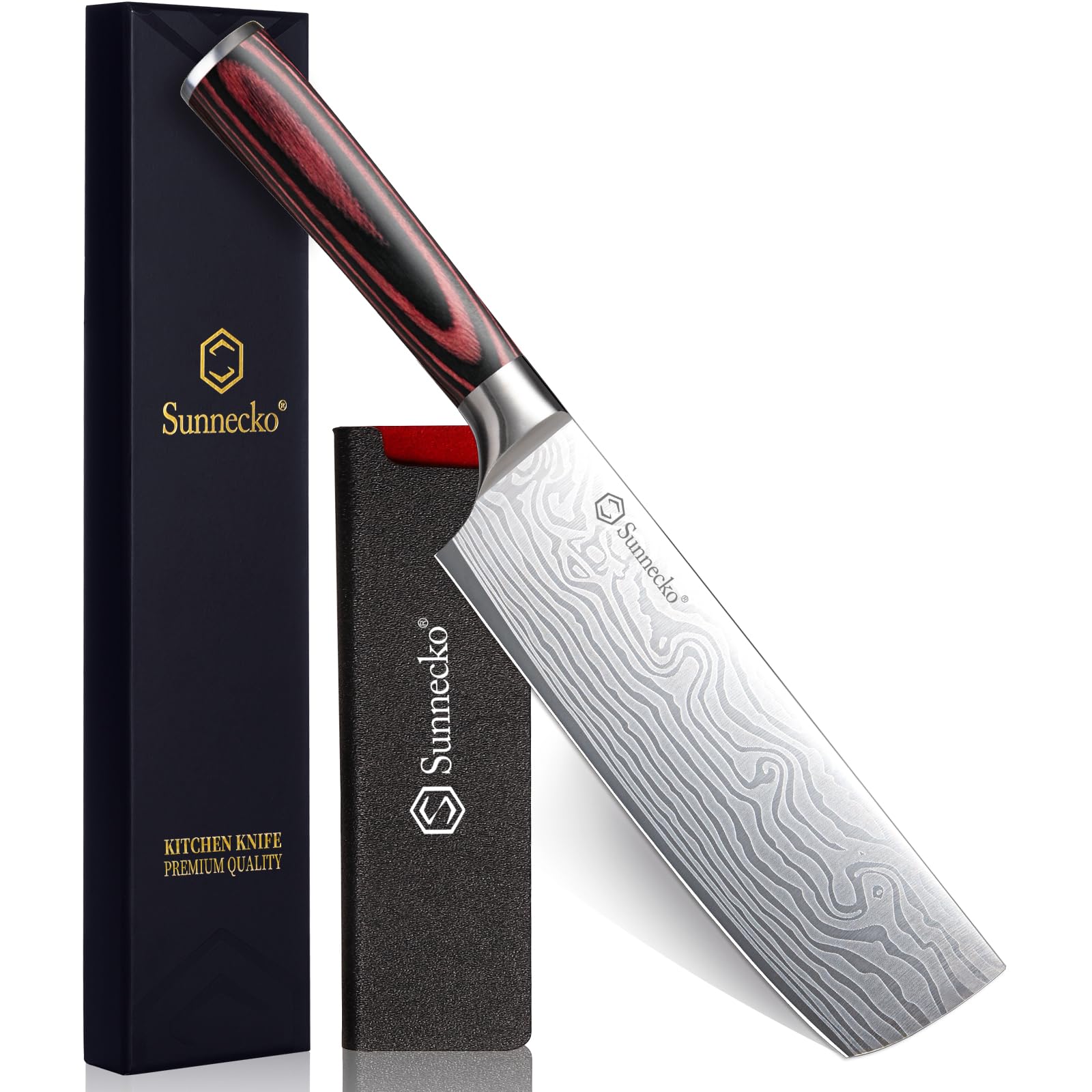
Sunnecko 7-Inch Nakiri
Key Features
- Size: 7 inches
- Weight: 15.2 oz
- Included: Sheath
- Edge angle: 12 degrees
- Price: Budget
The sheath is the detail that makes the Sunnecko easy to live with. Plenty of nakiri knives arrive in a box and nothing else; this one gives you a place to put the blade when it leaves the board.
The 12-degree edge is the keenest geometry in this group, and it shows on onions and peppers. The broad blade scoops, the pakkawood handle is comfortable, and the knife feels more substantial than its budget position suggests.
We like it as a first nakiri because it cuts cleanly without asking for a big commitment. The sheath makes storage simpler, and the handle is comfortable enough for a long vegetable session. This is a knife that earns its place by doing the basics well rather than by feeling luxurious.
For a new cook who wants a sheath and a keen edge, the Sunnecko is an easy recommendation. If you want a knife you can use hard without thinking about the edge, the Mercer or PAUDIN is the safer choice.
Pros
- 12-degree edge is the keenest here
- Protective sheath included for storage
- Comfortable pakkawood handle
- Strong value for a first nakiri
Cons
- 0.43 kg weight tires wrists
- 12-degree edge is delicate
We suggest the Sunnecko for budget-minded cooks who want a keen 12-degree edge and a protective sheath in one package.
Best for Smaller Hands
Kimura 6.5-Inch Nakiri

Key Features
- Handle: POM resin
- Weight: 5.12 oz
- Blade steel: High carbon 13 chrome molybdenum stainless
- Blade length: 6.5 inches
- Price: Midrange
At 6.5 inches and just over five ounces, the Kimura is the compact option in this group. It suits a smaller hand or a crowded board, and it makes precise work of shallots and herbs without the length of a 7-inch blade getting in the way.
The high-carbon 13 chrome molybdenum steel takes a 15-degree edge, and the full tang runs into a POM handle with three rivets. We found the grip secure and the blade stiff enough for carrots and potatoes. The made-in-Japan claim is part of the appeal, and the knife has a clean, workmanlike look.
The handle is durable and easy to clean, and the three rivets give it a solid feel. This is a knife built for daily use rather than display, and the compact blade is easy to control when the board is crowded.
We recommend the Kimura to a cook who wants a Japanese-made nakiri without a premium commitment, especially if a 7-inch blade feels long. It is not the knife for someone who wants a showpiece, but it is a practical one.
Pros
- Compact 6.5-inch blade
- Full tang, triple-riveted build
- 15-degree edge for clean slices
- Japanese-made blade and full tang
Cons
- POM handle feels less refined than wood
- Fit and finish below premium Japanese knives
The Kimura is our pick for smaller hands and tight boards: a compact, Japanese-made nakiri with a full tang and a keen edge.
Best for Guard and Sheath
MOSFiATA Nakiri with Guard

Key Features
- Weight: 8.8 oz
- Included: Sheath and finger guard
- Edge angle: 14–16°
- Blade steel: EN1.4116 German high carbon stainless
- Price: Midrange
The finger guard and sheath are what set the MOSFiATA apart. The guard is a useful idea for a new cook who wants a little more protection, and the sheath gives the blade a home outside the drawer.
The blade is comfortable through onions, peppers, and other everyday vegetables. The 14–16° edge is keen, the handle fills the hand, and the included gift box makes this an easy present for someone setting up a kitchen.
At 8.8 ounces, it has more heft than the lightest picks here, and that mass makes it feel steady on dense vegetables. It is a comfortable knife for everyday chopping, though not the one we choose for an hour of fine dicing.
We see the MOSFiATA as a sensible first nakiri or gift: the protection is useful, the blade is comfortable, and the price sits in the middle of this group. If you want a lighter knife, the Mercer is easier on the wrist; if you want a cleaner finish, the Shun is the step up.
Pros
- Sheath and finger guard included
- Comfortable handle for daily chopping
- 14–16° edge cuts cleanly
- Good value at the midrange
Cons
- Finger guard is awkward to fit
- Printed pattern is cosmetic
We see the MOSFiATA as a sensible first nakiri or gift: its sheath and finger guard add protection, and the blade is comfortable in hand.
Best for Low-Cost All-Rounder
KnifeSaga 7-Inch Nakiri

Key Features
- Handle: Wood
- Weight: 1.15 lb
- Blade steel: Innovative Japanese NextGen stainless steel
- Blade length: 7 inches
- Price: Budget
At 0.52 kg, the KnifeSaga is the heaviest knife in this group. That mass is the reason to choose it or skip it: it gives the blade momentum through a pile of squash, and it makes the knife feel planted on the board.
The broad 7-inch blade has Granton scallops that help food release, and the edge arrives sharp enough for raw potatoes. The wood handle is comfortable, and the company backs the knife with a lifetime warranty.
We noticed the weight most when switching back to lighter knives; the KnifeSaga has presence, and that is the point. It is a knife for deliberate, high-volume vegetable work rather than quick touch-ups.
The low-cost position makes it an easy experiment for someone who has not used a nakiri before. It is also a reasonable second knife for a household that wants a heavy vegetable blade without paying premium prices.
We treat the KnifeSaga as a heavy, low-cost entry point with a broad blade and a clear purpose. If you want a light daily driver, look at the Mercer; if you want momentum, this one earns a look.
Pros
- Granton scallops reduce sticking
- Lifetime warranty backs the blade
- Broad 7-inch blade for scooping
- Low-cost entry into nakiri
Cons
- 0.52 kg weight tires wrists
We treat the KnifeSaga as a low-cost way to try a broad, heavy blade; it suits short bursts of vegetable prep, not all-day fine dicing.
How We Tested 14 Nakiri Knives
We started by reading through customer reviews and spec sheets for more than 40 nakiri knives, then narrowed the field by blade steel, blade length and height, handle shape, weight, and price. We ended up buying 14 models that represented the range home cooks are most likely to consider, from budget-friendly starters to pricier Japanese imports.
For eight months, those knives lived in our home kitchens and came out for weeknight dinners, weekend meal prep, and the occasional big batch of soup. We shredded cabbage and kale, diced onions and carrots, sliced ripe tomatoes, cut sweet potatoes and butternut squash, and minced herbs. We noted whether the blade dropped through food cleanly or needed pressure, whether pieces stuck to the flat side, and how the edge held up after repeated board contact. We also weighed every knife on a kitchen scale and used each one for at least one 30-minute prep session, watching for hot spots, wrist fatigue, and whether the handle felt secure when wet.
Durability got its own check: after each session we washed and dried the blades by hand, then looked for chips, stains, rust spots, and handle separation. We noted fit and finish out of the box—spine thickness, handle seams, balance at the bolster—and revisited each knife at the end of the eight months to see how the edge, handle, and finish had aged. To judge value, we compared what each knife delivered against what it cost, not just the sticker price but the sharpening and care it seemed to demand. The knives that rose to the top were the ones that stayed sharp, felt controlled in the hand, and still looked and performed like they had plenty of life left.
How to Choose a Nakiri Knife
The right nakiri feels like a vegetable tool, not a status object: you should notice the cut and the board, not the knife fighting back.
Start with length and hand fit
A 7-inch blade gives you more board coverage for cabbage, squash, and big piles of onions. A 6.5-inch nakiri like the Shun Classic or Kimura is easier to control on a small board or in a smaller hand. We do not treat 7 inches as mandatory; choose the length you can keep flat through a cut.
The trap is thinking a nakiri can do cleaver work. Its thin, flat blade is built for vegetables and boneless proteins, not bones or frozen food. If you break down chickens, keep a chef’s knife or cleaver nearby.
Choose a weight you can live with
The Mercer Genesis is the light end at four ounces, while the HOSHANHO is 350 grams and the KnifeSaga is 0.52 kg. Light blades reduce wrist fatigue; heavy blades add momentum through dense produce. Neither is better in the abstract.
Think about the longest prep you do in one go. If it is twenty minutes of onions and peppers, a light knife is easier. If you break down squash and cabbage in short bursts, a heavier blade can do more of the work. Balance matters as much as the number: the knife should feel stable at the pinch point.
Read steel, edge angle, and care together
German-style steels such as the Mercer’s and MOSFiATA’s favor toughness, while the Japanese high-carbon blades here favor a keener edge. Edge angle tells you a lot: the Shun’s 16 degrees, the HOSHANHO and Kimura at 15, and the Sunnecko at 12. Lower angles cut more cleanly and need more care.
Do not assume a Damascus pattern means layered steel. Some finishes are decorative. More important is the care routine: hand wash and dry these knives, and keep hard, thin edges away from bones and frozen food.
Handles, food release, and included protection
A pakkawood handle feels warm and looks traditional; Santoprene and all-steel handles are easier to scrub and better in wet hands. The Global’s dimpled steel handle is the most secure of the metal options, while the Mercer’s Santoprene is the most forgiving.
Hammered or scalloped blade faces help food release, and a sheath matters if the knife lives in a drawer. A finger guard can add confidence for a new cook, but only if it fits easily enough to use. Check the warranty too; several picks here carry a lifetime guarantee.
Frequently Asked Questions
Can a nakiri replace my chef’s knife?
For vegetables, often yes. The flat blade excels at push-cutting and scooping, and it gives you cleaner straight slices through onions and cabbage. It is less useful for rock-chopping herbs or breaking down meat. If you already own a chef’s knife, a nakiri is a strong second knife; if most of your prep is vegetables, it can be your primary.
How do I sharpen a nakiri?
Use a whetstone and match the existing bevel: most knives here are around 15 to 16 degrees, with the Sunnecko listed at 12. A few light passes on a fine stone are better than a heavy session on a pull-through sharpener. Hone only lightly; a rod realigns an edge, it does not restore a dull one.
Do I need a wooden cutting board?
A soft board is kinder to a thin Japanese edge than glass or stone. End-grain wood, hinoki, or a quality plastic board all work; avoid pulling the knife through a hard surface. If you use plastic, rinse and dry it so the blade is not sitting in moisture.
Final Verdict
The PAUDIN is the nakiri we recommend first. It has enough weight for real vegetables, a comfortable pakkawood handle, and a broad blade that scoops as well as it slices. For most home cooks, it is the balance point between performance, care, and price.
If your hands tire easily or the board gets wet, the four-ounce Mercer is the better tool. If you want the keenest edge and the finest finish, the Shun earns its premium. The rest of the list covers heavy chopping, compact hands, and a tight budget without asking you to compromise on the basics.