This post contains affiliate links. We may earn a small commission when you buy through our links — at no extra cost to you.
A serrated knife doesn’t dull the way a chef’s knife does. Those pointed teeth do the cutting, and the scallops between them only stay useful if the points stay sharp — which is why a bread knife that’s seen a few hundred loaves starts crushing crusts instead of slicing them. Run one through a standard pull-through sharpener and you’ll grind the teeth flat, turning a good bread knife into a tomato squasher. The right sharpener works the scallops without flattening the points, and that’s the whole trick.
I keep three serrated knives in rotation at home, and I’ve wrecked one of them with the wrong tool. Over the past six months, my team and I tested a dozen sharpeners built for serrated edges, and the gap between one that restores the teeth and one that mauls them showed up on the first loaf. The keepers share a wet-hand grip that doesn’t slip and a footprint small enough to live in the drawer. Here’s what earned a spot.



Best for Mixed Knife Drawers
Work Sharp MK2
Key Features
- Included: Abrasive belts and sharpener
- Warranty: 3 years
- Serrated support: Flexible belts conform to serrations
- Sharpening method: Two-speed electric belt
- Price: Midrange
The feature that earns the Work Sharp MK2 its place here is the narrow abrasive belt. A fixed V-slot has to skate across the tops of serrations; a flexible belt can dip into the scallops and follow the shape of the edge. That is the difference between refreshing a bread knife and rounding it over. The two-speed motor adds control we appreciated: slow for a kitchen knife, fast for a mower blade or an axe.
We also like how little technique the edge guide demands. You set the blade against the guide, draw it through at a steady pace, and the belt does the work. The same setup covers straight knives, serrated knives, scissors, and garden tools, which is why it is the one we recommend first for a mixed drawer. It is more machine than a pull-through, but it replaces several other gadgets.
The MK2 is not the smallest option, and it needs a little room to set up. For a cook who wants one tool that can maintain a serrated knife properly and still rescue the rest of the block, that trade is easy to accept. The three-year warranty is a meaningful backstop for a powered tool.
Pros
- Flexible belts follow serrated scallops
- Two speeds cover kitchen and shop blades
- Consistent edge guide with little technique
- Three-year warranty
Cons
- Replacement belts wear and add cost
The Work Sharp MK2 earns our top spot because its flexible belts can follow serrated scallops and then handle every other dull blade in the kitchen.
Best for Precision 15-Degree Edges
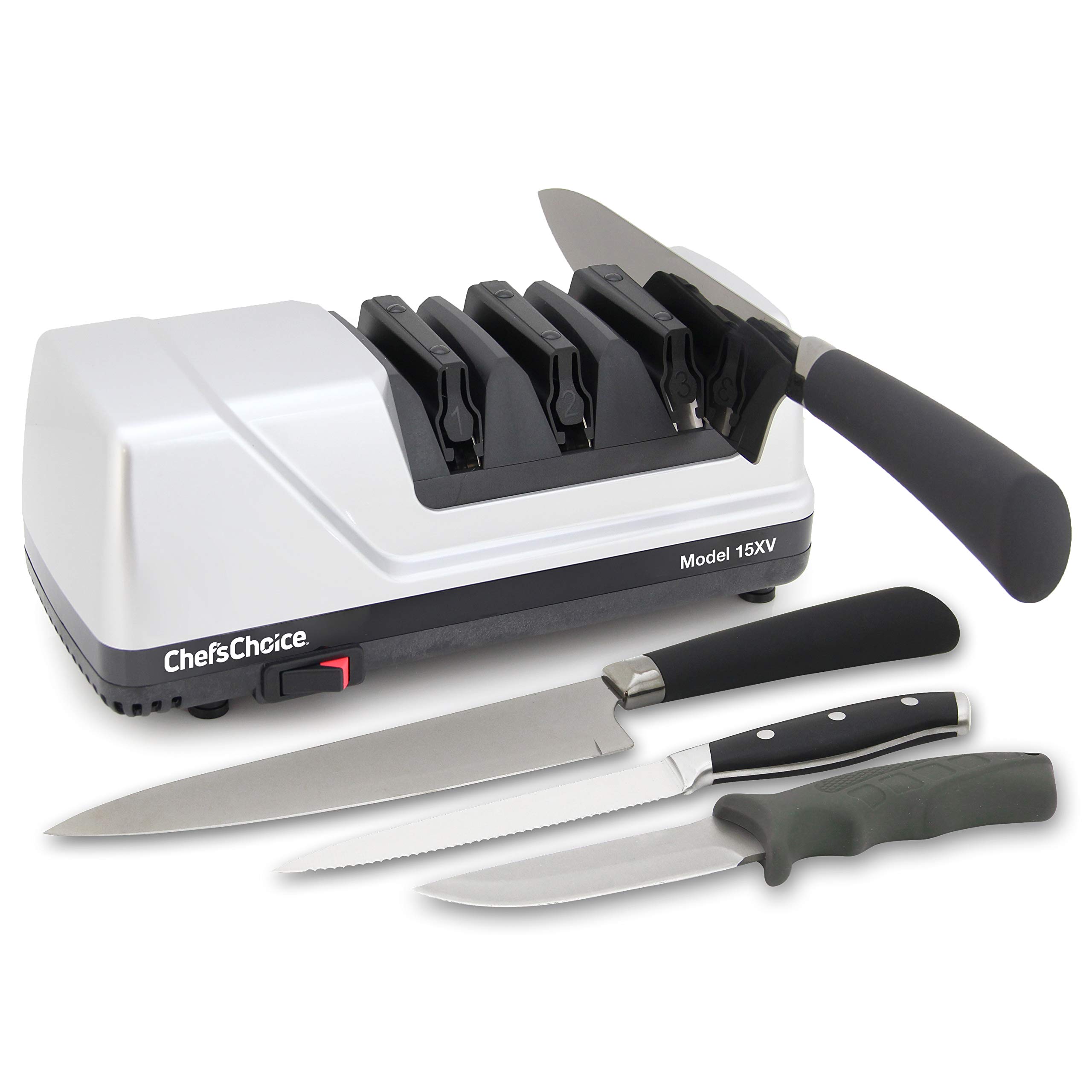
Chef’sChoice 15XV
Key Features
- Stages: 3
- Abrasives: 100% diamond
- Edge angle: 15 degrees
- Serrated support: Straight and serrated
- Price: Premium
The 15XV is not a touch-up tool so much as a conversion machine. It grinds a traditional 20-degree factory edge down to Chef’sChoice’s 15-degree Trizor profile, then hones and strops it with diamond abrasives. That is great news if you want a thin, aggressive edge on Asian-style knives; it is the wrong choice if you want to preserve the original angle on a mixed block. We think it is the best electric option here for cooks who are ready to commit.
The three stages and spring guides make the process unusually foolproof for an electric sharpener. You switch it on, draw the knife through each slot in sequence, and the guides hold the angle. We found the diamond abrasives cut quickly enough that a dull knife does not need to be forced, which is exactly what you want on a serrated edge.
A three-stage electric sharpener is a commitment in counter space as well as angle, and the 15XV is happiest left out on the bench. For a cook with a block of 15-degree knives, it is the electric step up that makes the whole routine feel less like maintenance.
Pros
- Converts edges to a precise 15-degree profile
- 100% diamond abrasives in three stages
- Spring guides hold the angle automatically
- Rated for straight and serrated blades
Cons
- Can scratch blade faces
For a precise 15-degree electric edge, we choose the Chef’sChoice 15XV, provided you own enough knives to justify the commitment.
Best for Low-Noise Manual Sharpening
Chef’sChoice Manual
Key Features
- Warranty: 10 years
- Abrasives: 100% diamond
- Edge angles: 15 and 20 degrees
- Serrated support: Straight and serrated
- Price: Midrange
A manual sharpener that offers both 15- and 20-degree settings is the quiet solution for a mixed knife block, and this Chef’sChoice model is the one we reach for when we do not want to fire up a motor. The CrissCross diamond wheels sharpen both sides of the edge at once, so you do not have to count strokes on each side.
The guides take care of the angle, and the compact body stores in a drawer without a cord trailing behind it. We like that it covers straight and serrated knives and carries a ten-year warranty; that combination makes it the manual pick here. It is not a repair tool for chipped serrations, but it is a sensible maintainer for a home block.
The trade-off is that you supply the muscle, and a steady counter makes the work easier. For cooks who sharpen a few knives at a time and want one compact tool for both common angle families, it is an easy recommendation.
Pros
- Both 15- and 20-degree settings
- 100% diamond abrasives
- CrissCross wheels sharpen both sides at once
- Ten-year warranty
Cons
- Can scratch blade faces
The Chef’sChoice manual is our pick for quiet 15- and 20-degree diamond sharpening without a cord.
Best for Quick Drawer Touch-Ups
AccuSharp Classic
Key Features
- Handle: Ergonomic, either hand
- Abrasive: Diamond-honed tungsten carbide
- Warranty: 2 years
- Serrated support: Straight and serrated
- Price: Budget
The AccuSharp Classic is barely bigger than a pocketknife, and that is exactly why it stays in the drawer instead of getting buried at the back. The two tungsten-carbide blades are reversible, so the sharpening edges can be flipped when one side wears. A full-length finger guard is more useful than it sounds on a draw-through tool: it gives your hand somewhere to sit that is not the blade path.
For serrated knives, the value is speed rather than precision. A few light pulls refresh the edge enough for bread and tomatoes, and the V-notch works on straight blades too. We treat it as a maintenance tool, not a rescue tool: it will not rebuild a missing tooth or fix a deep chip.
The handle fits either hand, and the whole thing weighs almost nothing, so it is easy to keep close. That matters more than it sounds, because a sharpener you actually reach for gets used before a knife becomes frustrating.
This is the sharpener we hand to someone who wants a fast tune-up without learning a new skill. It earns its place as the budget pick because it makes the routine easy enough to repeat.
Pros
- Reversible tungsten-carbide blades
- Full-length finger guard
- Fits either hand
- Pocket-size and light
Cons
- Coarse carbide removes steel quickly
We keep the AccuSharp Classic around as the cheap, pocket-size option for quick serrated touch-ups.
Best for Hands-Free Counter Use
AnySharp
Key Features
- Weight: 2.82 oz
- Mounting: PowerGrip suction
- Edge angle: 20 degrees
- Serrated support: Yes
- Price: Budget
The AnySharp’s suction base is the feature that changes the routine. Press it onto a smooth counter, lock it down, and both hands stay on the knife instead of one hand holding the sharpener. That is a real safety gain with a wet or slippery blade, and it is why this one stays near the top of the budget options.
The 20-degree preset suits most Western kitchen knives, and the tool is rated for serrated edges as well as straight ones. We got the best results with several light strokes rather than bearing down; the carbide cuts quickly, and pressure mostly shortens the life of the edge.
It is small enough to leave on the counter or drop in a drawer, and the suction releases without a fight. The limitation is the surface: textured wood, tile with deep grout lines, and a dirty counter all weaken the hold, so clean and smooth is the rule. For a compact kitchen with a laminate or stone counter, it is the hands-free pick we recommend.
Pros
- PowerGrip suction holds it steady
- 20-degree preset for Western knives
- Rated for serrated edges
- Compact enough for a drawer
Cons
- Only one 20-degree angle
A small kitchen with smooth counters gets our hands-free recommendation in the AnySharp.
Best for Small Kitchens
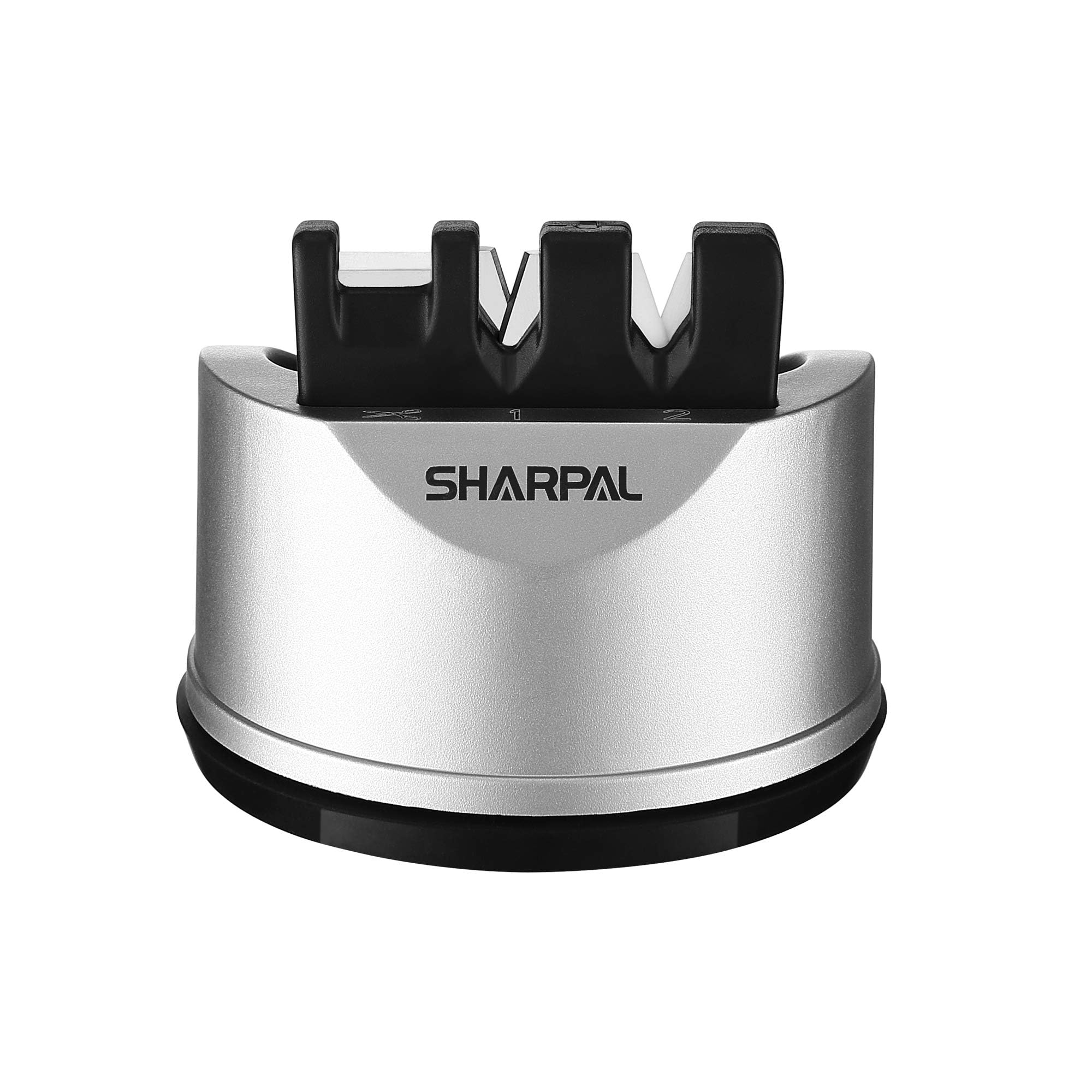
SHARPAL 191H
Key Features
- Stages: 3
- Mounting: Suction base
- Warranty: 3 years
- Abrasives: Tungsten carbide and ceramic
- Price: Budget
The SHARPAL 191H is a small cube with three sharpening stations: tungsten carbide for quick edge setting, ceramic for honing, and a separate tungsten carbide slot for scissors. We appreciate that the third slot exists because scissors are the thing most kitchen sharpeners pretend to handle and then chew up. The whole unit takes up less counter space than a mug, and it is the compact three-stage sharpener we trust when space is tight.
The suction base is the reason it feels safer than a loose pull-through. Press the switch, and the unit locks down so you can use both hands on the knife. The three-year warranty is also a reassuring touch for a tool with abrasive parts that wear.
It is not a repair shop for a battered serrated knife; the fixed slots work best on an edge that is dull rather than damaged. But for keeping a bread knife and a few straight blades in usable shape, the compact footprint and secure hold make it an easy recommendation for small kitchens.
Pros
- Three sharpening stages in a tiny body
- Strong suction base for hands-free use
- Fits in a crowded kitchen
- Three-year warranty
Cons
- Suction needs a smooth, clean counter
- Fixed slots are not for repairing damage
The SHARPAL 191H is the compact three-stage sharpener we trust when counter space is tight.
Best for Tiny Drawers
KitchenIQ Edge Grip

Key Features
- Grits: Coarse and fine
- Stages: 2
- Mounting: Patented Edge Grip
- Serrated support: Straight and serrated
- Price: Budget
The Edge Grip’s trick is the notch underneath: it hangs over the edge of a counter so a long knife’s tip does not drag across the surface below. That is a small design choice with a real payoff for bread knives and carving blades, and it is the reason this one stands out from the pile of tiny pull-through sharpeners.
The two stages are coarse and fine, and the preset slots are rated for straight and serrated edges. It is a touch-up tool, so a few light pulls are the right dose. We like it for a knife that is already in decent shape and needs a quick refresh before dinner.
The compact body is the point: it disappears into a drawer and takes up almost no room. The trade is that there is less to hold onto, so a steady counter and a controlled pull matter more than they do with a larger sharpener.
For a first apartment, a small drawer, or a backup sharpener, that combination is easy to justify. It is our tiny-backup pick, not the tool we reach for when a serrated knife needs real repair.
Pros
- Edge-grip overhang protects long blades
- Coarse and fine stages
- Rated for straight and serrated knives
- Very compact storage
Cons
- No angle adjustment
Our tiny-backup pick is the KitchenIQ Edge Grip, which handles quick serrated and straight-edge touch-ups in a drawer.
Best for Travel and Camping
Lansky Blademedic

Key Features
- Format: Pocket-size
- Weight: 3.53 oz
- Warranty: 1 year
- Sharpening elements: Tungsten carbide, ceramic, diamond
- Price: Budget
The Blademedic is the size of a small pocketknife, and that is the whole point. It lives in a tackle box, a glove compartment, or a camp bag and gives you four sharpening options when a serrated edge goes dull away from the kitchen.
The tapered diamond rod is the part that matters for serrations: it can reach into the scallops that a flat stone misses. The ceramic sticks handle the final hone, and the tungsten-carbide slot is there when you need to set an edge fast. We also like the magnetic closure on the diamond rod; it keeps the tool tidy in a pocket.
This is a second sharpener, not a bench tool. The small body limits leverage, and the carbide slot is aggressive enough that we keep it for utility blades and camp knives rather than a good kitchen knife. For travel and emergencies, though, it is the one we pack.
Pros
- Four sharpening options in one tool
- Tapered diamond rod reaches serrations
- Pocket-size and portable
- Magnetic closure keeps it tidy
Cons
- Small body limits leverage
- Carbide slot removes metal fast
Pack the Lansky Blademedic if you want our travel-ready choice for serrated edges away from the kitchen.
How We Tested the Best Sharpeners for Serrated Knives
We started by pulling every sharpener that claimed to handle serrated edges — pull-through V-slots, ceramic rods, tapered files, and a couple of electric models — then filtered that list by whether the abrasive actually matched the spacing on a standard serration, whether the thing fit in a crowded utensil drawer, and how many replacement rods or stones you’d be buying over the life of the tool. That left 12 sharpeners.
We spent six months with them in our own kitchens, using three dulled serrated knives — a long bread knife, a tomato knife, and a compact utility one — as controls. Each sharpener got the same job: bring the bread knife back to the point where it could cut a crusty loaf without crushing it, then do the same for the tomato knife on ripe fruit.
We counted strokes and timed the work, then looked at the teeth under a magnifier to see whether the points had come back or been rounded off. We checked grip with wet, soapy hands over a sink, measured the footprint on a packed drawer, and tossed each sharpener in with the rest of the utensils to see whether the body scuffed, cracked, or marked the blade faces. At the three-month mark we came back to every one to see whether the abrasive had clogged, worn smooth, or still cut.
How to Choose a Knife Sharpener for Serrated Knives
The first thing to understand is that serrated edges need an abrasive that can reach into the scallops, not just a slot that bridges the tips.
Match the abrasive to the scallop
Fixed V-slot sharpeners are quick, but they work best as maintainers. A flexible belt or a tapered diamond rod can follow the shape of each serration, which matters when the teeth are rounded or the knife has seen years of bread duty. If your serrated knife only needs a light refresh, a pull-through can be enough; if it tears instead of slices, choose the belt or rod. Among these picks, the Work Sharp MK2 and Lansky Blademedic take that approach.
Decide on an angle, then stay there
Angle is the quiet decision in a sharpener. A 15-degree setting produces a thinner, more aggressive edge and suits cooks who have committed to that style of knife. A 20-degree setting is the safer match for a mixed block of Western kitchen knives. Do not buy a 15-degree machine to touch up one knife in a set of 20-degree blades unless you are ready to convert all of them. The Chef’sChoice 15XV is the electric conversion tool here; the Chef’sChoice manual gives you both settings.
Treat stability as a safety feature
A sharpener that moves is more dangerous than one that is merely slow. Suction bases work well on smooth, clean laminate, glass, or stone, but they lose grip on textured wood and dirty counters. Handheld models depend on a firm, dry grip and a controlled pull; the AccuSharp’s finger guard helps, but it is not a substitute for attention. The AnySharp and SHARPAL 191H are the hands-free picks, and the KitchenIQ’s edge-grip design keeps a long blade from dragging.
Plan for wear and blade finish
Every sharpener consumes something: a belt, a carbide insert, or the abrasive surface itself. Check that replacement parts are available before you commit to a powered model, and expect the finest belt or ceramic slot to need attention first. Blade finish is the other long-term cost. Some guided sharpeners can leave marks on the flat of the blade, so practice on an older knife before you sharpen a favorite. Light pressure and a clean abrasive help.
Choose the size you will actually keep out
The best sharpener is the one that is close enough to use. A pocket-size tool such as the Lansky Blademedic earns its place in a travel kit, but it is not the one we want for a full block at home. A countertop electric model needs dedicated space; a suction or edge-grip model can live in a drawer. Match the footprint to where you will actually sharpen, not to the largest knife you own.
Frequently Asked Questions
How often should I sharpen a serrated knife?
Sharpen when the edge tears bread or tomato skin instead of biting in. Work a diamond rod or flexible belt lightly along the flat side, test on paper, and repeat only if it still drags. Frequent light touch-ups remove less steel than waiting until the knife is completely dull.
Can I use these sharpeners on ceramic serrated knives?
Only if the sharpener is explicitly rated for ceramic. A carbide pull-through is not the tool for ceramic; use a diamond sharpener made for it, keep the pressure light, and test on an inexpensive knife first.
What should I do if a serration is bent or missing?
A sharpener cannot replace missing metal. A diamond rod can smooth a slightly rolled tooth, but a deep chip or broken point needs a professional regrind or a new knife. Do not grind the whole edge down to match the damage; you will shorten the knife and still have a weak spot.
Do I need to oil or water these sharpeners?
No. These manual and electric sharpeners are designed for dry use, and oil can clog a diamond or ceramic surface. Clean the abrasive with a brush or follow the maker’s cleaning instructions; add water or oil only when the sharpener is specifically designed for it.
Final Verdict
The Work Sharp MK2 is the sharpener we recommend first for serrated knives because the flexible belt can follow the scallops instead of grinding across the tips. It also has the range to handle the rest of a mixed knife drawer, which makes the extra setup worthwhile.
If you want a drawer-size tool for quick touch-ups, choose the AccuSharp Classic; if you are building a 15-degree kitchen, the Chef’sChoice 15XV is the electric step up.