This post contains affiliate links. We may earn a small commission when you buy through our links — at no extra cost to you.
Japanese knives hold an edge longer than most, but only if the cutting board doesn’t work against them. Many boards marketed as ‘knife-friendly’ are too hard and dull blades faster than you’d expect. The real difference comes down to material structure – end-grain wood, soft cypress, or purpose-built rubber composites that give way under the blade instead of fighting it.
The trade-off is maintenance. Softer, more protective surfaces often require hand-washing and occasional oiling, while low-maintenance composites sacrifice some self-healing ability. The right board balances how much care you’re willing to give with how much you value keeping that razor edge.
That’s what this guide cuts through: matching the material’s strengths to your daily prep routine.
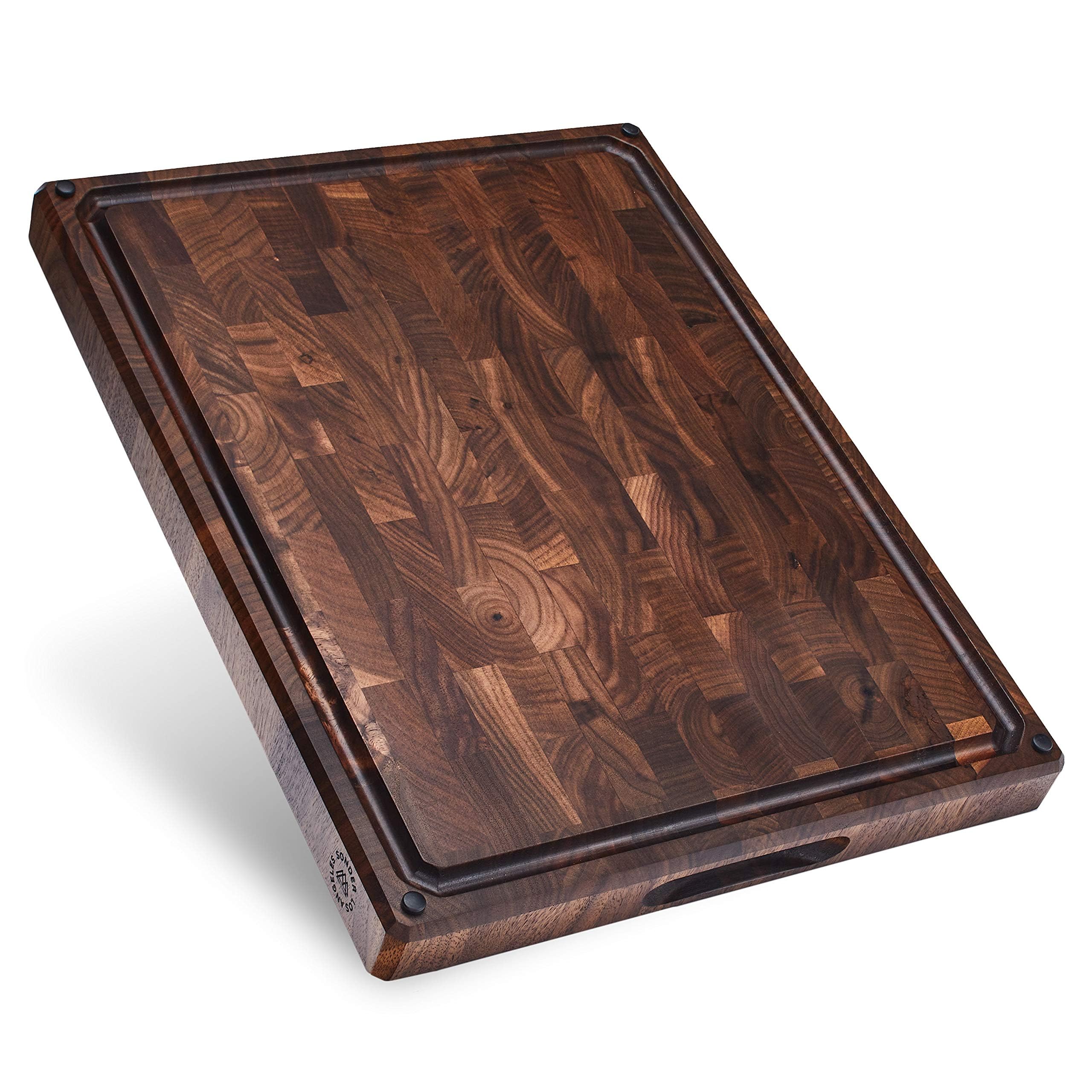


Best for Premium End-Grain
Sonder LA Alfred Walnut
Key Features
- Material Type: Black Walnut End Grain
- Thickness & Weight: 1.5 in, 7.5 lb
- Maintenance: Hand wash, oil 2-3 weeks
- Size: 17 x 13 in
- Edge Protection: End-grain self-healing
- Price: $$$
The Sonder Los Angeles Alfred Cutting Board uses a thick black walnut end-grain construction that absorbs knife impact rather than dulling edges. Whether slicing a ripe tomato or mincing herbs, the board’s 1.5-inch thickness and 7.5-pound weight keep it planted on the counter, while the built-in juice groove and three sorting compartments make it practical for prep. It also works as a cheese or charcuterie platter without looking out of place at the table.
This board asks for regular care: hand-washing and a mineral oil treatment every two to three weeks to prevent the wood from drying or cracking. That routine suits home chefs who already maintain wooden utensils and want a showpiece that preserves their Japanese knives. The weight (7.5 lb) may feel awkward when moving from counter to sink, so a large basin or two-handed carry helps. Owners who prefer dishwasher-safe shortcuts should look at composite alternatives like the Epicurean board.
Pros
- End-grain construction protects knife edges and shows minimal wear over time.
- Sturdy build with non-slip feet keeps the board stable during heavy chopping.
- Attractive walnut surface doubles as a serving platter for cheese or charcuterie.
Cons
- Requires hand-washing and oiling every 2-3 weeks to prevent drying and cracking.
- At 7.5 lb, the board can be cumbersome to lift and wash for some users.
For home cooks who value knife longevity and are willing to adopt a simple oiling routine, this walnut end-grain board delivers both protective performance and a presentable serving surface.
Best for Low-Maintenance
Epicurean Kitchen Series
Key Features
- Material Type: Richlite paper composite
- Thickness & Weight: 0.25 in, 1.6 lb
- Maintenance: Dishwasher safe
- Size: 14.5 x 11.25 in
- Edge Protection: Composite, knife-friendly
- Price: $
This paper-composite board keeps Japanese knife edges safe without any care rituals: it’s dishwasher safe, lightweight enough to slide into a drawer, and won’t dull blades like harder plastic or glass surfaces. The tradeoff is purely cosmetic — the surface collects visible knife marks over time, and some units may carry a temporary chemical smell that fades after a few washes. That makes it ideal for cooks who value convenience over appearance and want a dedicated board for Japanese knives without the upkeep of wood or rubber.
Pros
- Dishwasher-safe — no hand-washing or oiling needed.
- Knife-friendly composite surface preserves blade edges.
- Lightweight and thin enough to store in a drawer.
Cons
- Surface shows scratches and cut marks over time — cosmetic only.
- Some units may emit a chemical smell initially that fades after a few washes.
The Epicurean is the smart pick for anyone who wants Japanese‑knife edge protection without the maintenance — just accept that looks won’t last.
Best for Traditional Cypress
Shun Hinoki Medium
Key Features
- Material Type: Hinoki (Japanese cypress)
- Thickness & Weight: 0.5 in, 0.05 kg
- Maintenance: Hand wash, dampen before use
- Size: 15.75 x 10.75 in
- Edge Protection: Soft wood, gentle
- Price: $$
The Shun Hinoki board uses the same Japanese cypress found in traditional sushi kitchens, offering the softest possible surface for preserving knife edges. This lightweight board with its natural cedar scent suits light slicing tasks but requires prompt drying and periodic oiling to avoid warping and denting. It’s best for Japanese knife owners who prioritize edge protection over durability and are comfortable with a hand-wash, air-dry routine.
Pros
- Extremely gentle on knife edges – hinoki’s softness protects edge integrity better than hardwood boards.
- Lightweight and easy to handle – convenient to move and store compared to thick hardwood boards.
Cons
- Prone to warping and denting when exposed to moisture – must be kept dry and oiled regularly.
For Japanese knife owners who value edge protection above all and don’t mind a care routine, this hinoki board delivers an authentic, gentle cutting surface.
Best for Zero-Maintenance
Asahi Rubber LL
Key Features
- Material Type: Synthetic rubber
- Thickness & Weight: 0.5 in, 3.3 lb
- Maintenance: Hand wash only
- Size: 16.5 x 9.8 in
- Edge Protection: Rubber, very soft
- Price: $$$
The Asahi Cookin Cut is a synthetic rubber board that stays flat without oiling and won’t warp or crack like wood. Its softer surface protects Japanese knife edges better than most hardwoods, and the non-porous material resists odors and bacteria – a professional choice for sushi chefs.
This board suits serious home cooks and professionals who want zero-maintenance knife protection. Be prepared for cosmetic staining from beets or turmeric – these marks are permanent but don’t affect performance. The board also shows cut marks over time, a tradeoff for its softness.
Pros
- Superior edge protection for Japanese knives – softer than most wooden boards.
- No oiling needed – a quick wipe down keeps it clean.
Cons
- Hand wash only – not dishwasher safe, but rinses easily.
- Stains permanently from colorful foods like beets or turmeric.
For anyone who prioritizes edge preservation over aesthetics and wants to skip wood maintenance, this rubber board is the practical alternative to the top pick’s walnut end-grain.
Best for Large Value
SHUMARU Mahogany 20"
Key Features
- Material Type: Indonesian Mahogany End Grain
- Thickness & Weight: 1.6 in, 8.5 lb
- Maintenance: Hand wash, oil 3-4 weeks
- Size: 20 x 13 in
- Edge Protection: End-grain, soft
- Price: $$
The SHUMARU mahogany board gives home cooks a large 20×13 inch end-grain work surface that’s gentle on Japanese knife edges, rivaling more expensive walnut options. Handmade in Bali, each board has character but may arrive with a slightly rough texture that benefits from light sanding and extra oiling. The mahogany is softer than walnut, so it can show dents from heavy chopping over time — a tradeoff for the generous prep space and mid-range price.
Pros
- Large 20×13 inch surface accommodates family-sized prep without the premium price.
- Handcrafted mahogany end-grain protects knife edges and adds a unique tropical look.
- Non-slip feet keep the board steady during heavy chopping.
Cons
- Surface may arrive rough and require sanding or additional oiling before first use.
- Mahogany is softer than walnut and may show dents from heavy chopping over time.
For buyers willing to spend a few minutes sanding and oiling, this is the most affordable way to get a large, knife-friendly end-grain board.
Best for Eco-Friendly
Belwares Wood Composite
Key Features
- Material Type: Compressed wood fiber composite
- Thickness & Weight: 0.25 in, 1 lb
- Maintenance: Dishwasher safe
- Size: 14.5 x 11.25 in
- Edge Protection: Composite, knife-friendly
- Price: $
The Belwares cutting board is made from compressed wood fiber, a BPA-free material that avoids microplastics and is dishwasher safe for effortless cleaning. At 14.5 x 11.25 inches, it offers sufficient surface for everyday chopping, yet weighs just 1 pound for easy handling. While it doesn’t match the knife-friendliness of end-grain wood, it is gentler on Japanese knife edges than glass or hard plastic boards. Unlike end-grain boards that require regular oiling and hand washing, this composite needs no maintenance beyond a dishwasher cycle. This board suits budget-conscious cooks who prioritize easy cleanup and want to reduce plastic use, but note that the surface scratches visibly over time and the thin profile may warp if left on wet surfaces.
Pros
- Affordable and dishwasher safe for effortless cleaning
- Non-plastic material avoids microplastics and is BPA-free
Cons
- Surface scratches easily and shows wear over time
- Thin profile may warp if left on wet surfaces
A practical, budget-conscious choice for those who want a knife-safe board that goes in the dishwasher, acknowledging that scratches and potential warping are acceptable tradeoffs.
Best for Budget Set
Freshware Set of 2

Key Features
- Material Type: 80% pine wood fiber composite
- Thickness & Weight: 0.2 in, 1 lb total
- Maintenance: Dishwasher safe
- Size: 15 x 11.25 in (large)
- Edge Protection: Composite, knife-friendly
- Price: $
Two dishwasher-safe composite boards give budget-minded households a convenient way to separate meat and vegetables. The thin 0.2-inch construction flexes under heavy chopping, making it more suitable for light prep than for substantial knife work — it lacks the thickness and durability of pricier composite boards like Epicurean.
Pros
- Two sizes included at a budget-friendly price
- Dishwasher safe and lightweight for easy maintenance
Cons
- Scratches easily from knife use
A practical choice for budget-conscious households that want separate boards for meat and veggies and value dishwasher convenience over pristine appearance.
Best for Ultra-Soft Plastic
Yoshihiro Hi Soft M

Key Features
- Material Type: LDPE soft plastic
- Thickness & Weight: 0.8 in, 4.75 lb
- Maintenance: Hand wash only
- Size: 17.3 x 9.8 in
- Edge Protection: Ultra-soft plastic
- Price: $$$
This cutting board’s soft LDPE surface is purpose-made for protecting expensive Japanese knives, and its weight keeps it planted on the counter. The tradeoff: it costs as much as a good wood board yet shows cut marks, scratches, and stains over time, with surface flaking possible under heavy use. For users who want zero maintenance and maximum edge safety—and accept that the board will wear visibly—it’s a functional choice.
Pros
- Extremely gentle on knife edges—minimal wear during slicing
- Heavy and non-slip; stays put during prep
Cons
- Premium-priced for a plastic board—costs as much as wood alternatives
Best suited for knife-obsessed cooks who value edge preservation over aesthetics and are willing to replace a visibly worn board every few years.
Best for Chemical-Free Rubber
noboda Rubber L

Key Features
- Material Type: Synthetic rubber
- Thickness & Weight: 0.3 in, 0.02 kg
- Maintenance: Hand wash only
- Size: 14.6 x 9.6 in
- Edge Protection: Rubber, self-healing
- Price: $$$
This compact 14.6×9.6 inch board uses a non-porous rubber that protects knife edges without requiring oiling or special care. The material contains no PFAS or microplastics, making it a clean choice for health-conscious cooks. However, the small surface area can limit prep for larger tasks, and the board may stain from colorful foods like beets or turmeric. It also needs hand washing. For Japanese knife owners with limited counter space who value edge safety and material purity above all, this board delivers — just don’t expect room to spread out.
Pros
- Very soft surface preserves sharp Japanese knife edges
- Chemical-free material — no PFAS or microplastics
Cons
- Small 14.6×9.6 inch surface can limit prep space for larger tasks
Best for Japanese knife owners with limited counter space who prioritize knife safety and non-toxic materials over prep capacity.
Best for Large Maple
Boos Chop-N-Slice 20×14

Key Features
- Material Type: American hard maple edge-grain
- Thickness & Weight: 1.25 in, 10 lb
- Maintenance: Hand wash, regular oiling
- Size: 20 x 14 in
- Edge Protection: Edge-grain, less forgiving
- Price: $$
Offers a spacious 20×14-inch work surface with stable weight that stays put during heavy chopping, made from US-sourced maple with a reputation for durability. The edge-grain construction is less protective of delicate knife edges than end-grain or softer woods, and even with regular oiling the board can warp or crack over time.
Pros
- Large prep area (20×14 inches) provides ample room for big cutting tasks.
- Heavy and stable; doesn’t slide during use.
Cons
- Edge-grain is harder on knife edges than end-grain or softer woods.
Works well for heavy general prep if you don’t baby your knives, but skip it if maintaining a razor-sharp Japanese edge is a priority.
Best for Popular Maple
Boos Chop-N-Slice 18×12

Key Features
- Material Type: American hard maple edge-grain
- Thickness & Weight: 1.25 in, 8 lb
- Maintenance: Hand wash, regular oiling
- Size: 18 x 12 in
- Edge Protection: Edge-grain, less forgiving
- Price: $$
This maple board provides a large, stable surface at a budget-friendly price, ideal for occasional prep. However, splitting and warping can develop over time, and the surface may require sanding out of the box. It is best suited as a secondary board or for users who prioritize affordability over longevity.
Pros
- Popular size fits most kitchens for daily prep work
- Sturdy and heavy enough to stay put during use
Cons
- Splitting and warping can occur over time even with proper care
Suitable as a secondary board for occasional use or for budget buyers who accept the risk of warping.
Best for Compact Juice Groove
Boos Prestige 16×10

Key Features
- Material Type: Maple edge-grain
- Thickness & Weight: 1.25 in, 5.4 lb
- Maintenance: Hand wash, oil regularly
- Size: 16 x 10 in
- Edge Protection: Edge-grain, less forgiving
- Price: $$
This 16×10 inch maple board brings a juice groove and American craftsmanship to smaller kitchens. The edge-grain construction, however, is less protective of Japanese knife edges compared to end-grain or softer materials, and some units can warp or crack within the first year. It works as a secondary board for meats or a serving piece, not a daily knife companion.
Pros
- Juice groove helps catch meat juices and fruit drips.
- Compact size suits limited counter space.
Cons
- Edge-grain is less gentle on Japanese knife edges than end-grain or soft wood alternatives.
Best suited for occasional use as a charcuterie board or secondary board for meats, not as a primary board for Japanese knives.
Best for Cypress Alternative
Kai Cypress 17.7"

Key Features
- Material Type: Japanese cypress
- Thickness & Weight: 0.8 in, 2.8 lb
- Maintenance: Hand wash only
- Size: 17.7 x 11.8 in
- Edge Protection: Soft cypress, gentle
- Price: $$
This 17.7 x 11.8 inch cypress board from Kai provides the soft cutting surface that protects Japanese knife edges, similar to traditional hinoki. The soft wood will dent and may warp with moisture, so it suits those who accept maintenance and cosmetic wear in exchange for blade gentleness.
Pros
- Soft cypress wood preserves Japanese knife edges longer than harder materials.
- Generous surface area accommodates most meal prep tasks without crowding.
Cons
- Soft wood will dent and may warp with moisture, requiring careful drying and oiling.
A reasonable pick for Japanese knife owners who want a large cypress board and are willing to manage the upkeep and surface changes that come with soft wood.
How to Choose
The material of your cutting board determines how long your Japanese knife stays razor-sharp – choose based on the trade-off between protection and maintenance.
Material Type
End-grain wood (like walnut or mahogany) has fibers running perpendicular to the surface, so knife edges sink between them rather than cutting through. This self-healing property keeps your blade sharp longer but requires oiling to prevent drying and cracking.
Soft woods like hinoki and cypress are even gentler on edges but dent more easily. Rubber composites offer similar softness without maintenance, while paper composites (Richlite) are dishwasher-safe but show scratches over time.
Thickness and Weight
Thicker boards (1.25 inches or more) stay put on the counter without sliding and absorb impact better, reducing noise and knife shock. The downside is weight: a 10-pound board is cumbersome to lift and clean.
Thin boards (0.25–0.5 inches) are easy to store and light to handle, but they can flex under heavy chopping and may warp if left wet. A 1-inch thickness is a practical middle ground for most home cooks.
Maintenance Requirements
Wood boards need periodic oiling (every 2–4 weeks) to keep the fibers hydrated and prevent cracking. Hand-washing is required – never put them in the dishwasher, as heat and moisture cause warping and splits.
Rubber and composite boards eliminate oiling entirely. Some are dishwasher-safe, making them the lowest-maintenance option. However, they can stain from colorful foods and develop visible cut marks that don’t self-heal.
Size
A larger board (18–20 inches long) provides ample space for prepping whole vegetables, carving roasts, or working with multiple ingredients. It doubles as a serving platter but may dominate a small counter.
Compact boards (14–16 inches) fit easily in shallow drawers and are quick to wash. They work fine for solo cooking but can feel cramped when prepping for a family or several dishes at once.
Edge Retention and Self-Healing
End-grain wood and soft rubber allow the knife blade to sink slightly, reducing friction and wear on the edge. This ‘self-healing’ quality means cut marks close up over time, keeping the surface smooth.
Edge-grain hardwoods and hard composites (like bamboo) force the blade to cut across grain, accelerating dulling. For Japanese knives, prioritize a board that yields – not one that fights back.
FAQ
Is a hinoki cutting board too soft for heavy chopping with a Japanese knife?
Yes, hinoki cypress is best for slicing, light prep, and delicate ingredients. Heavy chopping or repeated meat cutting will leave deep dents and may cause splintering. Reserve it for vegetables, herbs, and fish.
Why does my rubber cutting board stain from beets and turmeric?
Rubber is non-porous but still absorbs pigments from strongly colored foods. The stains are cosmetic only and do not affect hygiene or knife protection. A paste of baking soda and water can lighten them, but some discoloration may remain permanently.
Can I put a walnut end-grain cutting board in the dishwasher?
Never. Dishwasher heat and moisture will cause walnut end-grain boards to warp, crack, and lose their protective oil finish. Always hand wash with mild soap and dry immediately, then re-oil every 2–3 weeks.
How often should I oil a maple cutting board to prevent warping?
Maple edge-grain boards, especially from John Boos, are prone to warping if not oiled regularly. Apply food-grade mineral oil every 2–4 weeks, and more often if the board looks dry or if you live in a dry climate. Neglecting oiling is the leading cause of cracks and splits.