This post contains affiliate links. We may earn a small commission when you buy through our links — at no extra cost to you.
Home coffee roasting promises fresh beans on demand, but the path is littered with cheap drum roasters whose stirring arms seize up after a few months. The smoke, chaff, and uneven roasts only add to the frustration. The real culprit isn’t bad luck—it’s design choices that prioritize low price over longevity.
The best machines in this category either use air roasting to eliminate the stirring mechanism entirely or rely on manual methods that give you full control. Others manage smoke with dedicated exhaust systems. The trade-off is clear: you can spend less now and risk early failure, or invest a bit more in a roaster built to deliver consistent batches for years.
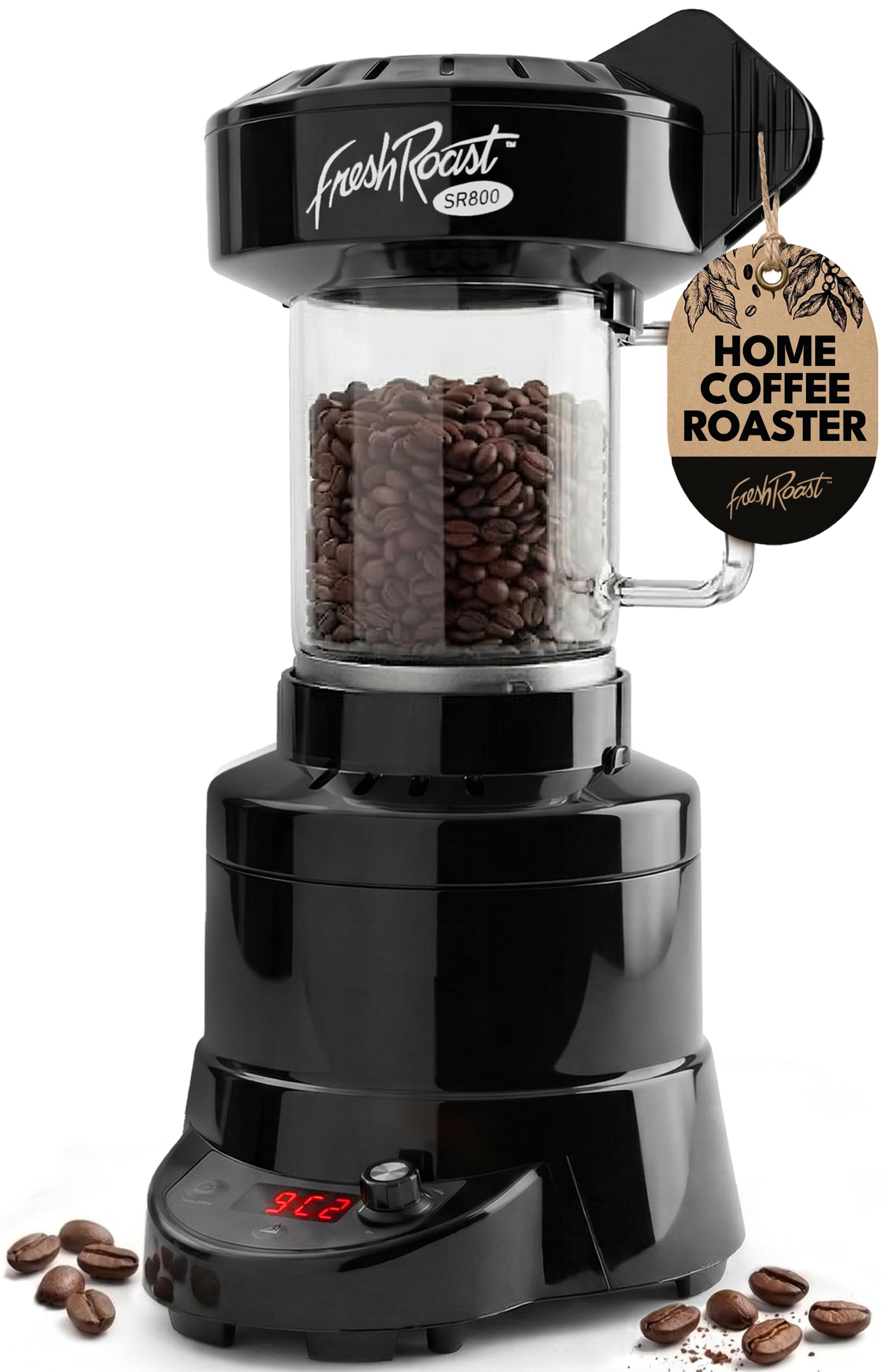


Best for Hands-On Enthusiasts
Fresh Roast SR800
Key Features
- Batch Capacity: 6-8 oz
- Roast Type: Air roaster
- Build Quality: Plastic/metal
- Price: $$
The SR800’s air roasting design puts heat and fan speed adjustments at your fingertips, making it possible to dial in specific roast profiles from light to medium-dark. The digital display and simple knob interface keep operation clear even for first-time users, while the fluid motion bed ensures even heat distribution across each batch.
This roaster is best suited for home enthusiasts who enjoy the hands-on process and want to fine-tune every batch. If you need a set-and-forget machine or more than 8 oz per cycle, this isn’t the right fit. The plastic top and chaff collector have been noted to crack over extended use — buyers comfortable with occasional part replacement will get the most out of this unit.
Pros
- Heat and fan adjustments allow precise roast control for light to medium-dark profiles
- Simple knob and digital display make operation intuitive without a steep learning curve
- Cost-effective for regular home roasting, saving money over buying pre-roasted beans
Cons
- Temperature ceiling may not reach second crack for very dark roasts — stick to medium-dark maximum
- Plastic top and components may crack over time; periodic inspection recommended
For home roasters who value direct control and consistent results in small batches, the SR800 delivers without unnecessary frills.
Best for Solo Drinkers
Nuvo Eco Ceramic
Key Features
- Batch Capacity: 70g
- Roast Type: Manual ceramic
- Build Quality: Ceramic/cowhide
- Price: $
The Nuvo Eco Ceramic uses a simple stovetop design and sturdy ceramic construction to deliver consistent small-batch roasts once you get the hang of the manual heat control. Best suited for solo drinkers, campers, or anyone who enjoys the craft of roasting — the 70g batch yields about two cups, too small for households or heavy daily use.
Pros
- Consistent small-batch roast quality at a budget-friendly price.
- Portable and durable ceramic design with a comfortable cowhide handle.
Cons
- Manual temperature control can be imprecise and may take practice to avoid scorching beans.
For solo roasters who want an affordable, portable manual option, the Nuvo Eco Ceramic delivers rewarding results without the complexity of electric machines.
Best for Automation Seekers
NIASIA PKF-500g
Key Features
- Batch Capacity: 500g
- Roast Type: Drum, auto/manual
- Build Quality: Metal/plastic
- Price: $$$
One-button roast profiles and an integrated exhaust system set this drum roaster apart from air roasters that require manual fan adjustments and separate venting. While the automation works well for light to medium batches, the heating element has been noted to stop heating after several months of heavy use — a tradeoff to consider if you roast frequently. This machine suits home roasters who value set-and-forget convenience, roast in moderate volumes (350–400g batches), and want smoke control without major setup changes.
Pros
- Automatic profiles deliver consistent roast color and flavor across batches, especially for light to medium roasts.
- Solid materials and thoughtful design for the price point.
- Impressive value compared to higher-end drum roasters with similar automatic features.
Cons
- In dark roasts, the smoke filter may not fully contain odors, which can linger and affect bean flavor.
Best for home roasters who want automated drum roasting with good smoke management, provided roasting stays at moderate frequency and avoids very dark profiles.
Best for Gas Roasting Hobbyists
DYVEE G400
Key Features
- Batch Capacity: 400g
- Roast Type: Gas drum, quartz glass
- Build Quality: Stainless/wood
- Price: $$$
The DYVEE G400 uses a transparent quartz glass drum that lets you watch beans transform from green to brown in real time — a rare visual feature for a gas burner home roaster. It requires a separate heat source like a gas stove or camp burner and produces noticeable smoke, so outdoor use is recommended. With a maximum batch size of 400g (practical 200-300g), this is best for hobbyists who enjoy the hands-on manual roasting process and don’t mind the extra setup. Build quality is sturdy with 304 stainless steel and a wooden handle.
Pros
- Transparent quartz glass drum for real-time roast monitoring
- Sturdy 304 stainless steel and wooden handle construction
- Delivers even roasts with consistent results
Cons
- Premium-priced for a 400g capacity; value per roast may not match electric alternatives
- Requires a separate gas burner and produces smoke — best used outdoors or with strong ventilation
The DYVEE G400 suits coffee hobbyists who want a manual gas roaster with visual feedback. If you prefer electric convenience or larger batches, the top pick air roaster is a better fit.
Best for Entry-Level
JIAWANSHUN Upgraded
Key Features
- Batch Capacity: 800g
- Roast Type: Electric drum
- Build Quality: Plastic/metal
- Price: $
This JIAWANSHUN model is the best-selling budget electric roaster for its straightforward one-button timer and temperature controls. However, the stirring arm—which rotates beans during the roast—may cease spinning after several months of use, leading to uneven roasts or burnt spots. This makes it a reasonable entry point for someone roasting a few pounds a month, but not for daily users who need consistent reliability.
Pros
- Simple dial-based timer and temperature adjustment make first-time roasting approachable.
- Produces enjoyable coffee flavor for the price, with many users pleased with the roast results.
Cons
- Stirring arm may stop rotating after a few months, requiring manual shaking or replacement.
- Roast evenness can vary between batches, especially when the stirring arm slows down.
A reasonable budget starter if you roast infrequently, but plan for possible stirring arm maintenance or replacement within the first year.
Best for Outdoor/campers
CAFEMASY Mesh Pan
Key Features
- Batch Capacity: 120g
- Roast Type: Manual mesh pan
- Build Quality: Stainless steel
- Price: $
This stainless steel mesh pan with a long wooden handle and built-in thermometer takes you back to basics. It’s lightweight, packs flat, and cleans up with a quick wipe — ideal for camp stoves or grill grates. The tradeoff is unavoidable smoke: you’ll need to use it outdoors or under a powerful hood. Roast evenness also depends on your shaking technique; beginners may get uneven results until they develop a rhythm.
Best suited for campers, hikers, and anyone who wants to roast a single 120g batch away from the kitchen. If you value zero electricity and maximum portability over repeatable precision, this is a sensible option. Expect to practice a few times before dialing in your preferred roast level.
Pros
- Lightweight and easy to clean — packs down small for travel or storage.
- Manual roasting is simple with practice, producing decent results over an open flame.
Cons
- Smoke production requires outdoor or very well-ventilated space — not suitable for indoor kitchens.
- Achieving an even roast demands consistent shaking technique; results can vary without experience.
A great companion for campsite coffee, but not the tool for controlled repeatable home roasts.
Best for Budget Beginners
JIAWANSHUN 1.1lb

Key Features
- Batch Capacity: 800g
- Roast Type: Electric drum
- Build Quality: Plastic/metal
- Price: $
This budget drum roaster costs less than the more popular NIASIA model while sharing the same basic design. That design also carries the same motor and stirring arm vulnerabilities, which may lead to uneven roasts or a short lifespan. Best for casual users who roast small batches infrequently and accept possible inconsistency.
Pros
- Decent entry-level performance for beginners on a budget
- Lower price than the similar upgraded drum roaster
Cons
- Motor and stirring arm may stop working after a few months of use
Only worth it if you catch a sale and are comfortable with the possibility of early failure — fine for a low-commitment introduction to home roasting.
Best for Occasional Users
GIVEROO 500g

Key Features
- Batch Capacity: 800g
- Roast Type: Electric drum
- Build Quality: Plastic/Teflon
- Price: $
This is the most affordable electric drum roaster for home use, with simple controls and easy cleanup. However, the stirring mechanism may seize up after limited use, and roast results can vary. It suits those who roast only occasionally and accept the possibility of early replacement.
Pros
- Easy to clean and simple to operate.
- Budget-friendly entry into electric drum roasting.
Cons
- Stirring arm can become inoperable after a few uses.
Best for someone who roasts only occasionally and is comfortable with the possibility of early replacement.
Best for Tinkerers
LUEUR Electric

Key Features
- Batch Capacity: 800g
- Roast Type: Electric drum
- Build Quality: Plastic/metal
- Price: $
This model offers sturdy construction and useful features like temperature control at a budget-friendly price. However, documentation is nearly nonexistent, and some units may develop stirring or heating issues over time. It’s a reasonable option for tinkerers who can work around the lack of guidance, but not for buyers seeking a straightforward, long-lasting machine.
Pros
- Sturdy construction with simple controls at a budget price.
- Affordable alternative with temperature control and non-stick pan.
Cons
- Instructions are minimal or missing, requiring trial and error to learn.
A decent entry if you’re willing to troubleshoot, but consider a better-tested option like the top pick for consistent results.
Best for Curious Tinkerers
lpylxingyan Glass

Key Features
- Batch Capacity: 50-80g
- Roast Type: Manual glass
- Build Quality: Borosilicate glass
- Price: $
The clear glass drum offers a front-row seat to your roast, from yellowing to first crack. It requires a stovetop and careful attention to heat. However, performance outside manufacturer claims remains unconfirmed, making this an experimental curiosity rather than a reliable daily roaster.
Pros
- Visual monitoring of roast progression through clear glass
- Budget-friendly entry into manual stovetop roasting
Cons
- No external validation of roast consistency or component longevity
Best for experimental tinkerers who enjoy hands-on stovetop roasting and want visual feedback — treat it as a project, not a tool.
How to Choose
The single most important factor in home coffee roaster longevity is whether the stirring mechanism is robust enough to handle repeated heat cycles.
Batch Capacity
Batch size determines how often you’ll roast. A 4-ounce capacity yields about 2-3 days of coffee for one person; 8 ounces stretches to a week. Larger drums (800g+) sound appealing but often require smaller loads for even roasts—loading them full increases the risk of scorching the outer beans while the center stays underdeveloped.
Match capacity to your weekly consumption. If you drink one 12-ounce cup daily, a 6-ounce roaster means roasting every 3-4 days. That frequency is fine for most, but heavy households may prefer a larger machine even if it means using partial loads.
Roast Type
Air roasters suspend beans in hot air, eliminating the stirring arm that often fails in drum models. They produce even roasts by design but can struggle with very dense beans. Drum roasters use a rotating barrel with or without internal paddles; the stirring rod is the #1 failure point in budget electric drums.
Manual roasters (ceramic, mesh pan, or gas drum) remove motorized parts entirely. They require more attention but offer complete control and typically last decades if cared for. Your choice comes down to convenience versus long-term durability.
Temperature Control
Precise temperature control lets you replicate a roast profile batch after batch. Most electric drum roasters offer a dial from 0-240°C, but actual accuracy varies widely. Air roasters use heat levels (often 1-9) that correspond to wattage rather than exact degrees—this is fine once you learn your machine.
Gas roasters rely on your burner’s flame adjustment, which gives infinite variability but no repeatability without a thermometer and careful logging. For beginners, a machine with clear heat settings (not just a vague dial) reduces the learning curve significantly.
Smoke Management
Roasting produces visible smoke and chaff regardless of the machine type. Air roasters blow chaff into a separate collector, but smoke still escapes. Drum roasters with built-in filters and exhaust pipes can reduce indoor odor, but none eliminate it entirely for dark roasts.
Plan to roast near an open window or under a range hood. Manual roasters and mesh pans produce the most smoke and are best used outdoors. If you absolutely must roast indoors, prioritize a machine with a sealed smoke path and carbon filter—but still expect some lingering smell.
Build Quality
Plastic housings and stirring rods are the weakest links in budget roasters. Repeated heating cycles cause plastic parts to warp or crack, and stirring mechanisms seize when gears or motors degrade. Stainless steel, ceramic, and borosilicate glass hold up far better under thermal stress.
Look for roasters with metal internal components, reinforced seams, and user-replaceable parts. The Fresh Roast SR800, for example, has a community of users who replace the plastic top with aftermarket metal ones. If the manufacturer doesn’t sell spare parts, assume the machine is disposable.
FAQ
Why does my coffee roaster stop stirring after a few uses?
The stirring arm is powered by a small motor and plastic gears. Under heat, the gears soften or warp, causing the arm to slip or seize. This is the most common failure mode in budget electric drum roasters. Choosing an air roaster or a manual model avoids this entirely.
Can I use a home coffee roaster indoors without setting off the smoke alarm?
Even roasters with smoke filters produce enough smoke to trigger nearby alarms, especially during second crack. Roast near an open window or under a range hood. For dark roasts, consider outdoor roasting with a manual pan or gas drum. No home roaster is truly smoke-free.
How much green coffee should I roast to get a pound of roasted beans?
Green coffee loses 15-20% of its weight during roasting due to moisture loss. To end up with one pound of roasted beans, start with roughly 1.2 pounds (540g) of green coffee. Most home roasters list capacity in green weight, so factor this loss into batch planning.
What is the difference between an air roaster and a drum roaster for home use?
Air roasters use hot air to tumble beans, producing even roasts without moving parts—more durable and easier to clean. Drum roasters rotate a cylinder over a heat source; they can produce deeper caramelization but rely on stirring mechanisms that often break. Air roasters are generally more beginner-friendly and reliable.