This post contains affiliate links. We may earn a small commission when you buy through our links — at no extra cost to you.
A beginner espresso machine has one job: to keep you from feeling like an idiot at 7 a.m. The fear is legitimate — you spend a few hundred dollars, pull a shot that tastes like hot pennies, and quietly go back to the café on the corner. What a good one actually fixes is the guesswork. It forgives a slightly uneven grind, tells you plainly when it’s up to temperature, and gets you something you’d actually drink by your third try instead of your thirtieth.
Here’s the thing nobody tells you first: the basket and the grinder matter more than the number on the box. Most beginner-friendly machines ship with a pressurized basket that fakes the resistance a real grind would create — a fine place to start, and a ceiling you’ll hit inside a month. My team has run ten machines through our kitchens over the past eight months, pulling shots back to back and handing the portafilter to people who’d never touched one. Some of the cheapest were the easiest to live with; a couple of the pricier ones made me work for every cup. Below are the ones that held up, sorted by what kind of beginner you are — the impatient one, the tinkerer, the person making two lattes before a 9 a.m. call.

Best for Best Overall
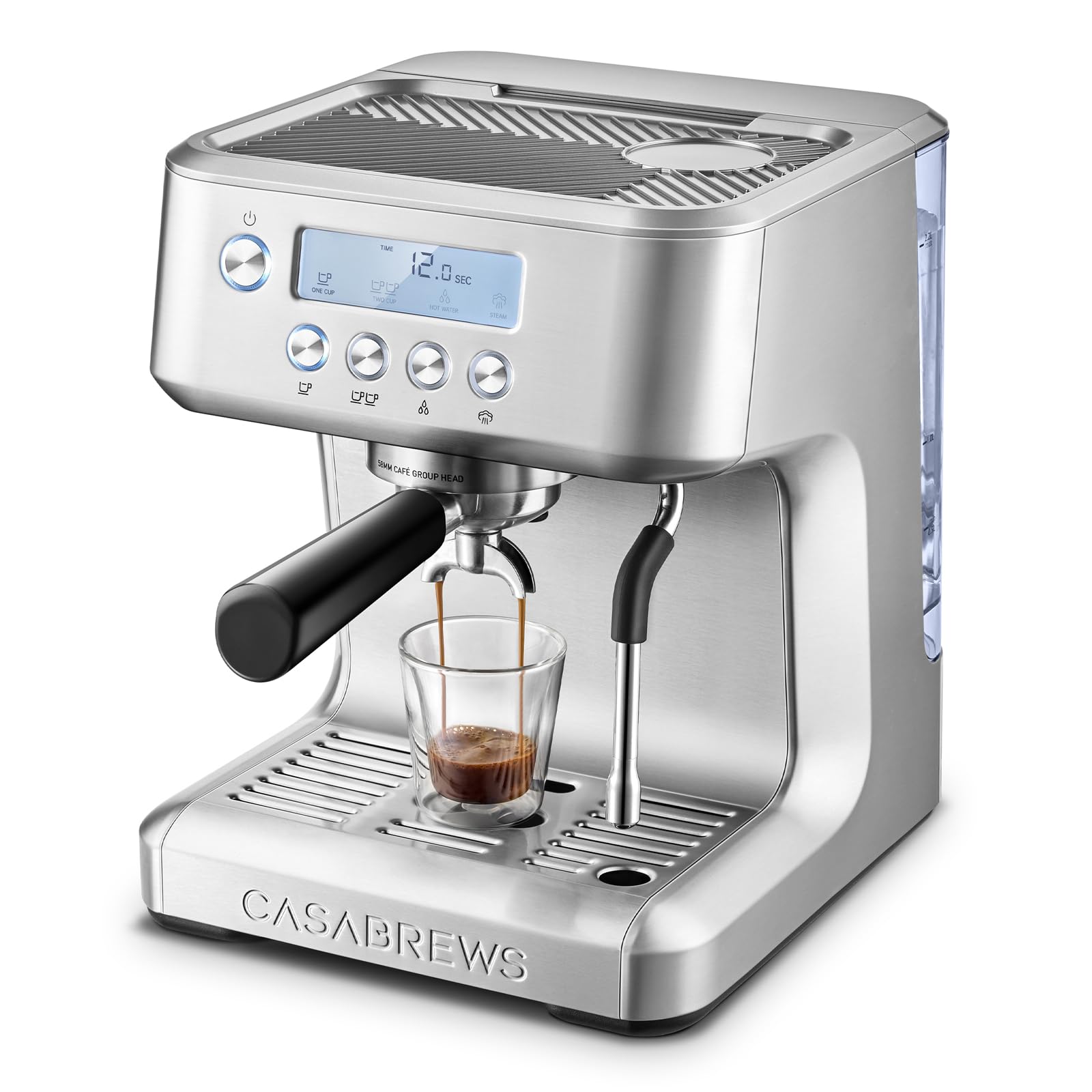
CASABREWS Ultra
Key Features
- Pressure: 20 bar
- Footprint: 10.31"W x 12.2"D x 12.9"H
- Water tank: 73 fl oz
- Temperature settings: 4
- Price: Midrange
Of the machines here, the Ultra is the one we hand to a beginner without a long explanation. The LCD and pre-programmed shot buttons take the guesswork out of the first few mornings, and four brew-temperature settings give you a way to correct a sour or bitter shot without learning PID theory.
What earns it the top spot is the hardware behind those friendly controls: a 20-bar Italian pump, a 58mm portafilter, and both single-wall and dual-wall baskets. We like the 58mm size because it is the standard most grinders and accessories are built around, so the upgrade path is easier. The 73-ounce tank also means fewer refills during a week of lattes.
The steam wand is the part that makes it feel more expensive than it is. It has enough control to texture whole milk for a cappuccino, and the temperature settings help when you switch between lighter and darker beans. We did find the machine rewards a warm cup; a cold mug pulls the heat out of a short shot fast.
If you want the grinder built in, the Breville is the obvious alternative. Otherwise, the Ultra is the one we keep coming back to when we want a milk drink without turning breakfast into a project.
Pros
- Guided LCD with pre-programmed shots
- Four brew-temperature settings
- 58mm portafilter and dual-wall baskets
- Large 73-ounce water tank
Cons
- No grinder included
The CASABREWS Ultra is our default beginner machine because its guided LCD, four brew temperatures, and 58mm portafilter make repeatable shots easier without a steep learning curve.
Best for All-In-One Learning
Breville Barista Express
Key Features
- Weight: 22.1 lb
- Grinder: Integrated conical burr
- Footprint: 12.5"W x 13.8"D x 15.9"H
- Temperature control: PID
- Price: Premium
The built-in conical burr grinder is the reason the Barista Express belongs here. It grinds on demand straight into the portafilter, so you are not budgeting space for a second appliance or guessing which grind setting belongs in a beginner’s workflow.
The rest of the package is deliberately manual: you dose, tamp, lock in, and steam. That is more work than the button-driven machines here, and the first few shots will taste sour or bitter while you dial in. We think that is the point for a certain buyer: the machine teaches you what changes when you adjust grind and dose.
What makes it worth the premium is the combination of PID temperature control, low-pressure pre-infusion, and a steam wand that can texture milk properly. We found the integrated tamper and razor dose tool handy for keeping the dose consistent, and the brushed stainless body looks built to stay on the counter.
If you want one machine that does the whole job and you are willing to learn, this is the one. If you want to press a button and walk away, the Ultra is easier.
Pros
- Integrated conical burr grinder
- PID temperature control and pre-infusion
- Manual steam wand for microfoam
- Includes tamper and dose trimming tool
Cons
- Heavy at 22.1 pounds
- Wide 12.5-inch footprint
The Barista Express is the all-in-one pick for beginners who want a real grinder and are willing to spend a few mornings dialing in.
Best for Milk Drinks
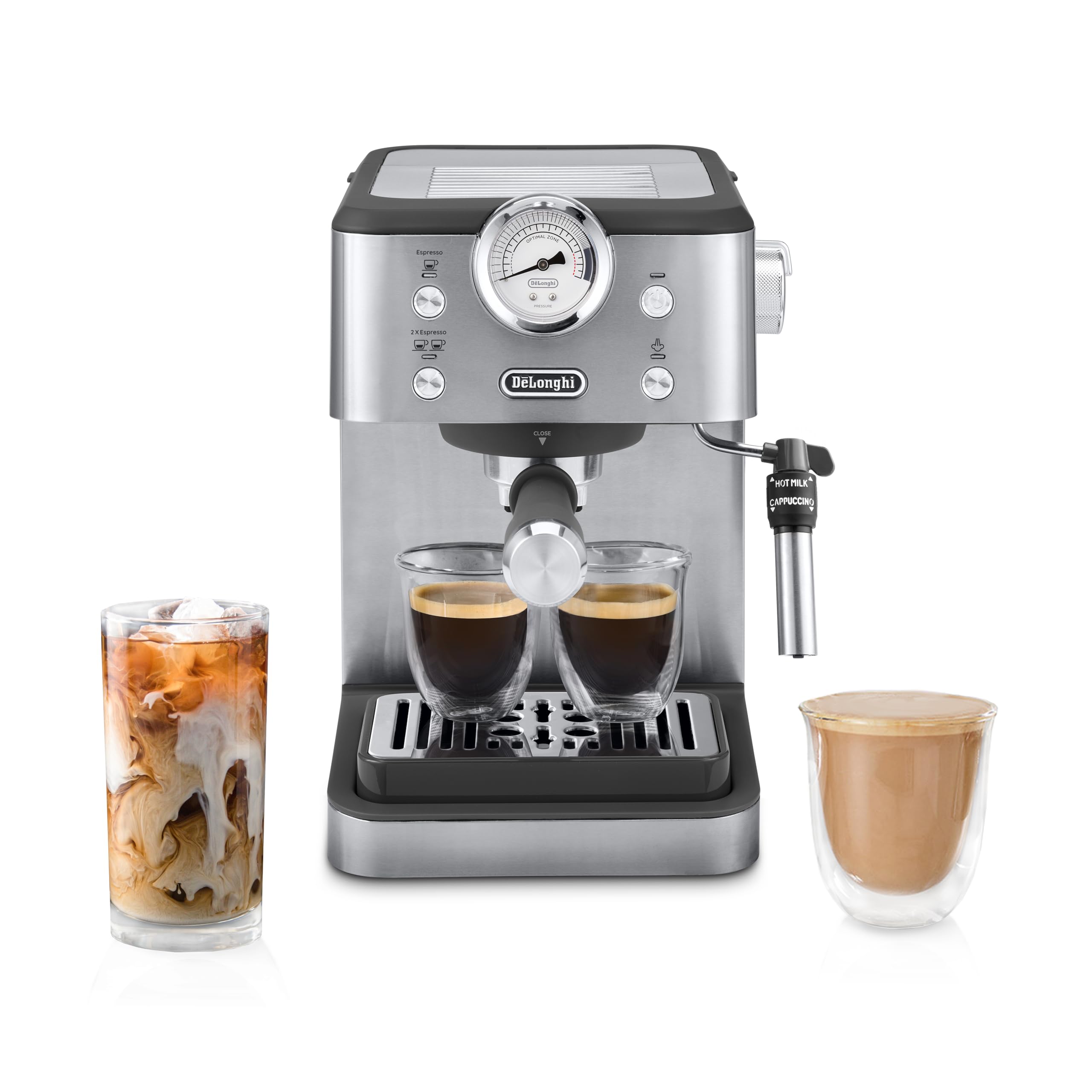
De’Longhi Classic Signature
Key Features
- Pressure: 15 bar
- Footprint: 13.98"W x 11.22"D x 15.94"H
- Steam wand: 2-setting adjustable
- Heat system: Thermoblock
- Price: Midrange
Milk is where a lot of beginner machines stumble: the steam wand either blasts big bubbles or takes so long that the espresso goes cold. The Classic Signature addresses that with a two-setting wand, one for silky steamed milk and one for richer microfoam.
The rest is built for routine. Thermoblock heat-up is quick, the single and double presets can be customized, and the 15-bar pump is paired with a simple dial-and-button interface. We like that De’Longhi gives you physical controls rather than burying the basics in a menu.
We think this is the best pick here for someone who mostly drinks cappuccinos and lattes. The adjustable frother gives you more control than the fixed wands on cheaper machines, and the preset doses mean you are not counting seconds every morning.
The 15-bar pump is not a downgrade from the 20-bar machines here; what matters is how the machine manages pressure through the puck. If you mostly drink black espresso, the cheaper AMZCHEF gets the job done. The Classic Signature earns its place when milk is the point.
Pros
- Two-setting adjustable steam wand
- Customizable single and double presets
- Thermoblock heat-up
- 15-bar Italian pump
Cons
- Coffee can arrive lukewarm
- Tall 15.94-inch body
The Classic Signature is the beginner pick for milk drinks, with a two-setting steam wand and preset shots that make cappuccinos less fiddly.
Best for Tight Budgets
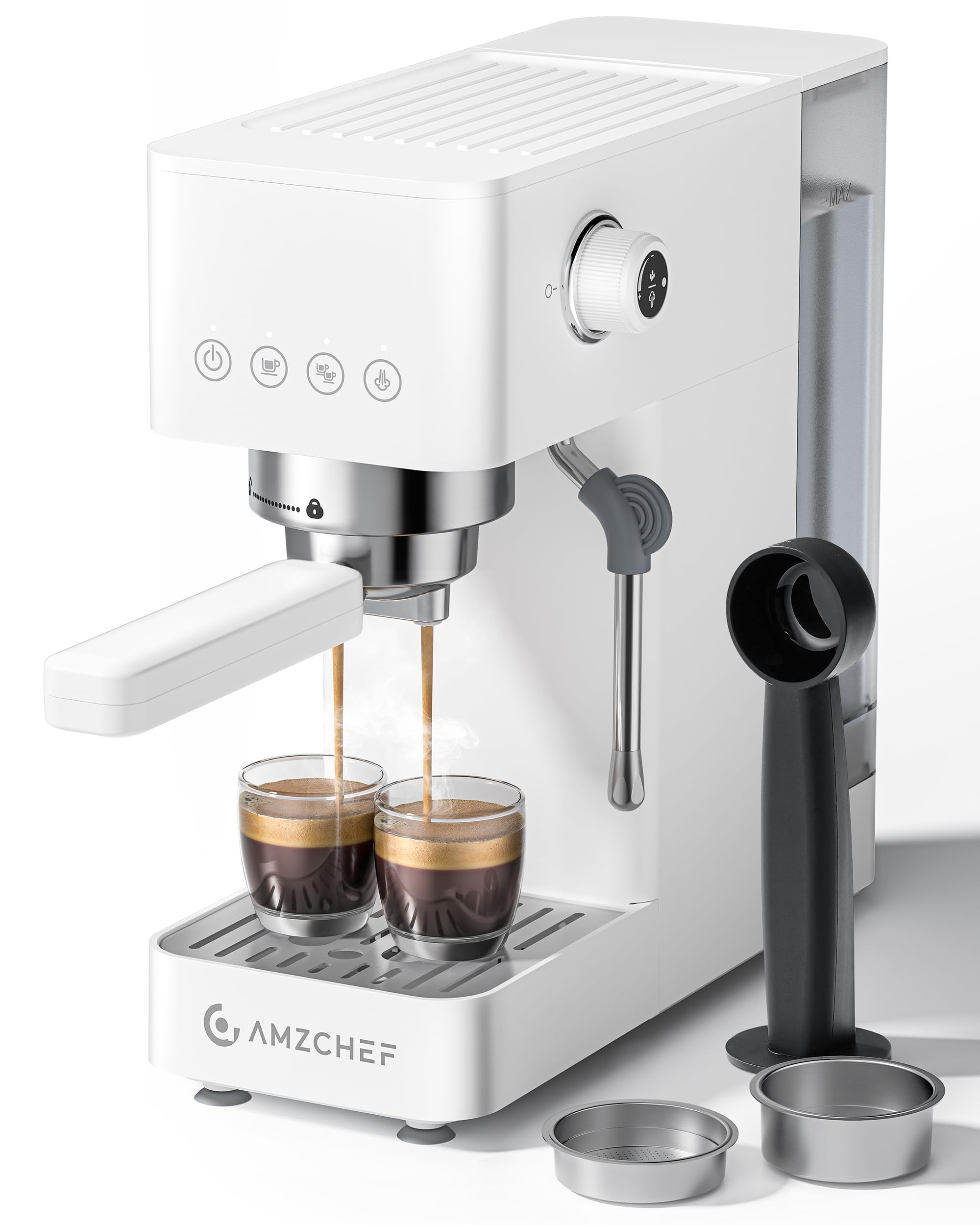
AMZCHEF Compact
Key Features
- Heat-up: 30 seconds
- Pressure: 20 bar
- Footprint: 7"W x 12.5"D x 14.4"H
- Water tank: 40 fl oz
- Price: Budget
The AMZCHEF is the one we point to when the budget is the hard limit. It still gives you a 20-bar pump, a PID controller, and a steam wand, which is more than the price suggests.
The one-touch buttons make the first shot simple: choose single or double, let the machine preheat, and stop when the shot looks right. We like the 360-degree steam wand because it lets you angle the pitcher without twisting your wrist into the counter.
The footprint is friendly to apartments: 7 inches wide, 12.5 deep, and 8.2 pounds. The 40-ounce tank is the main daily chore; plan on refilling it every few days if you make two milk drinks. It looks tidy on a white counter, and the compact shape leaves room for a grinder.
Treat it as a low-cost first machine rather than a buy-once pick. The CASABREWS CM5418 is the next step up in price and has a narrower body, but it does not change the AMZCHEF’s case as the lowest-cost way into espresso.
Pros
- One-touch single and double shots
- PID temperature control
- 360-degree steam wand
- Compact 7-inch-wide body
Cons
- Plastic body feels less substantial
The AMZCHEF is the budget pick for a first machine, with one-touch shots, PID control, and a steam wand that costs far less than the rest.
Best for Tiny Counters
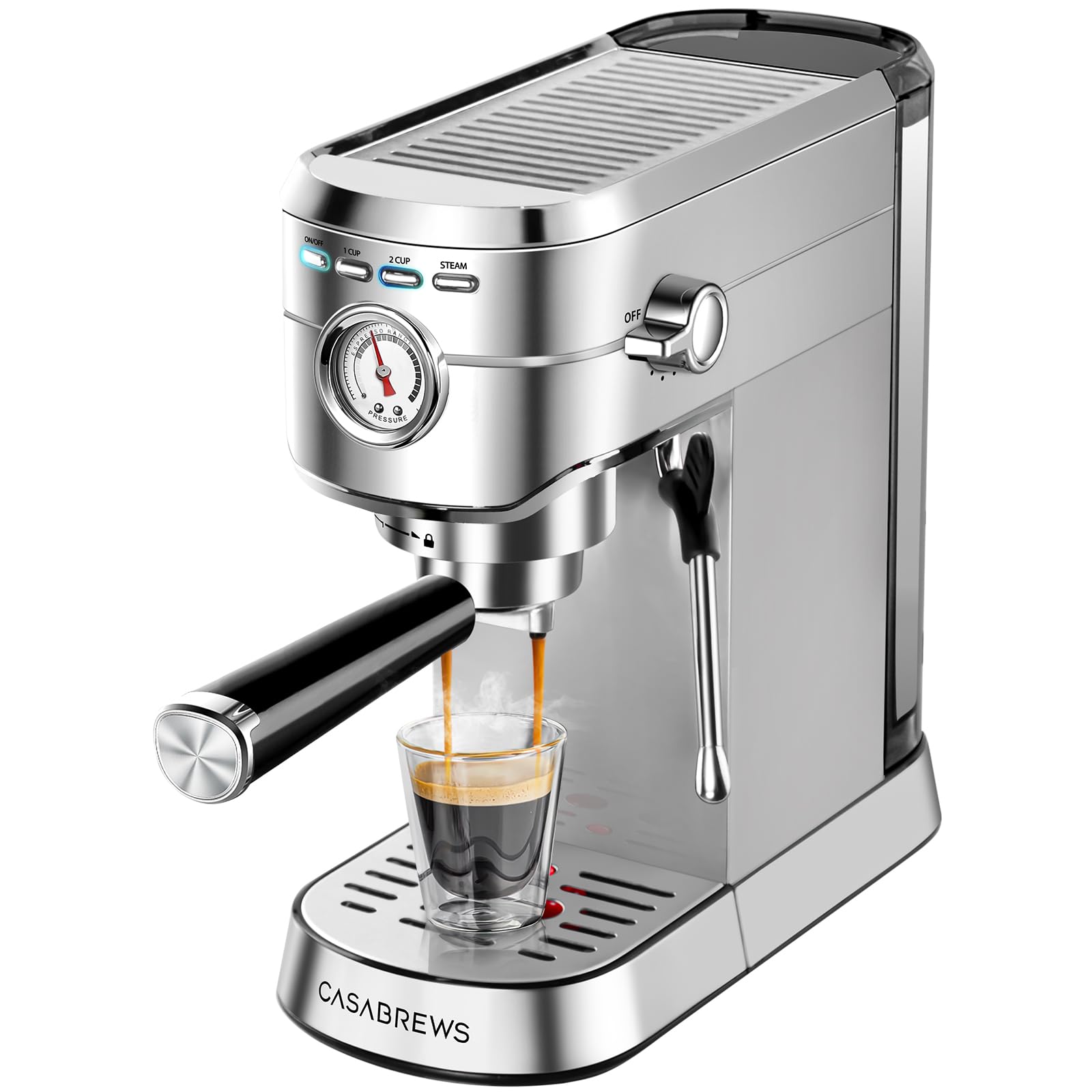
CASABREWS CM5418
Key Features
- Weight: 8.6 lb
- Pressure: 20 bar
- Footprint: 5.47"W x 12.28"D x 11.97"H
- Water tank: 34 oz
- Price: Budget
On a counter with barely a hand’s width to spare, the CM5418 is the machine that fits. It is 5.47 inches wide and 8.6 pounds, so you can slide it beside a toaster and still have room for a cutting board.
The controls are as simple as it gets: one button for a single shot, one for a double, and a steam knob for milk. We like that there is no menu to learn, and the 34-ounce tank is easy to lift out for refills.
The steam wand has enough power for a small pitcher, but it can add water to the milk if you leave it in one spot too long. Keep the tip just under the surface and use a pitcher you can tilt.
The 20-bar pump and three-control layout make it an easy first machine for a small kitchen, and the compact body is the reason to choose it over the Ultra or the Classic Signature. It does not try to do more than that.
Pros
- Fits a 5.47-inch-wide space
- Simple button and knob controls
- 20-bar pump with steam wand
- Light 8.6-pound body
Cons
- Some units stop working
- Tight clearance for tall mugs
The CM5418 is the tiny-counter pick for beginners who want simple buttons and a steam wand in a 5.47-inch-wide body.
Best for Narrow Spaces
CHULUX Slim
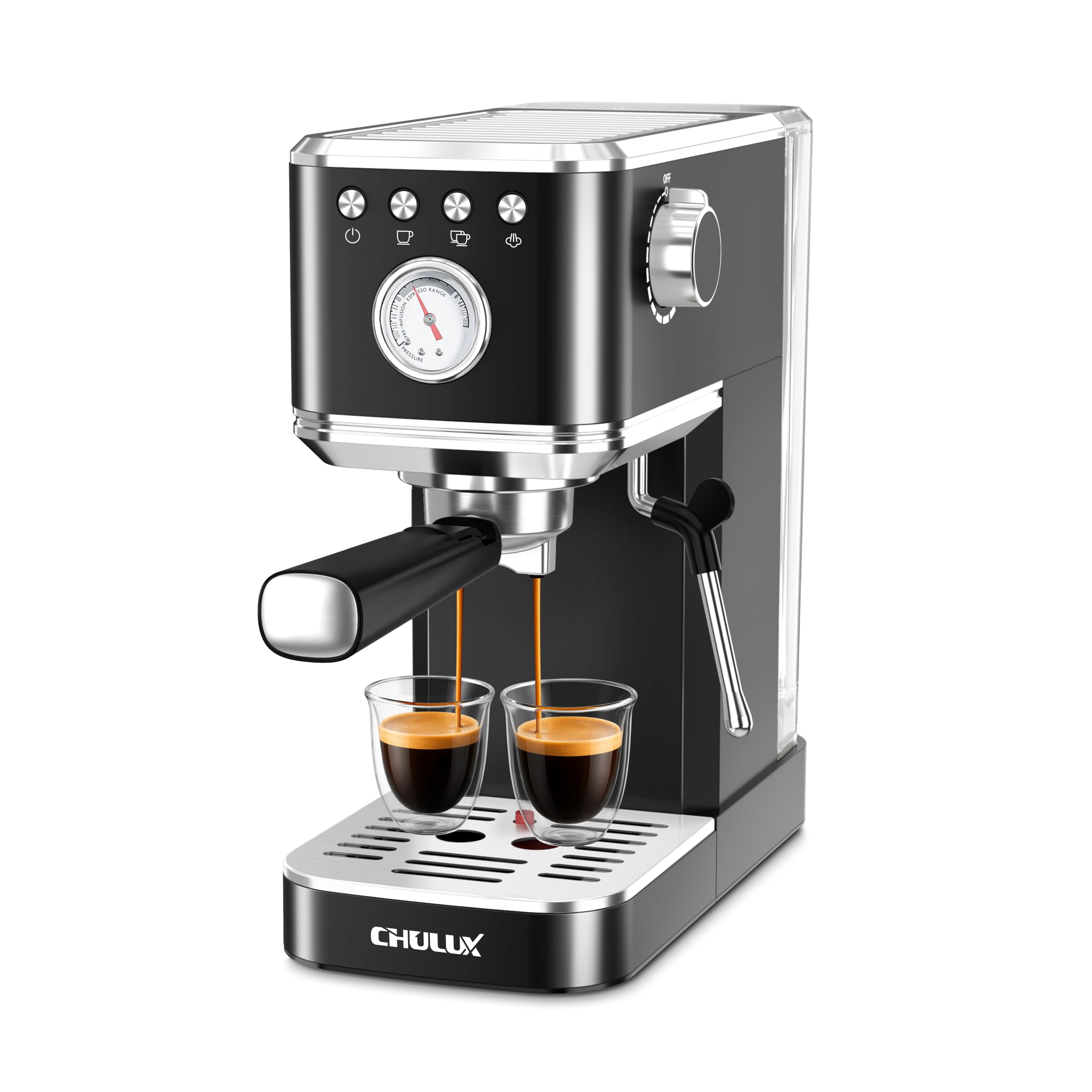
Key Features
- Weight: 7.8 lb
- Pressure: 20 bar
- Footprint: 5.5"W x 11.7"D x 12.5"H
- Water tank: 40 fl oz
- Price: Budget
The pressure gauge on a machine this small is the detail we did not expect. It gives you a visual read on the shot instead of asking you to trust a button, and on a 5.5-inch-wide body that is a useful bit of feedback.
The rest of the spec sheet is aimed at small kitchens: a 40-ounce tank, 7.8 pounds, and a slim vertical shape that tucks into a gap. We like that the PID controller and pre-infusion are here too, because they smooth out the first shot while you learn the grind.
Heat is the caveat. The machine can need a few cycles before the water is properly hot. Run a blank shot into the cup to warm it, then pull the espresso; that also gives the machine a moment to settle.
It is not the most substantial machine in the hand, but at 7.8 pounds it is easy to move out of the way when the counter is needed. If you want a narrow machine with a pressure gauge, this is the one we point to first.
Pros
- Pressure gauge for shot feedback
- PID control and pre-infusion
- 5.5-inch-wide body
- 40-ounce water tank
Cons
- No grinder included
The CHULUX is the slim-space pick for beginners who want a pressure gauge, PID control, and a 5.5-inch footprint.
How We Tested the Best Espresso Machines for Beginners
We started with a shortlist of roughly 40 machines, then cut it down by filtering for price, availability, and a few specs that actually matter to someone new: whether a pressurized basket was included, whether the portafilter was a standard 58mm or an oddball size that makes buying accessories a headache, and whether the machine asked for a proprietary pod or accepted ground coffee. Ten made the cut, and we used each one as our only espresso maker for at least three weeks across eight months.
Most of the testing happened on weekday mornings at 6:45, the worst possible time to be learning anything. We timed each machine from cold start to first shot, and again from cold start to a finished milk drink, since heating speed means nothing if the steam wand needs another five minutes. To check coffee temperature honestly, we pulled three shots in a row and probed each cup — several machines poured a hot first shot and a lukewarm third one. Brew speed was timed from the first drop to the last, which told us more about a machine’s consistency than the spec sheet did.
Then we tasted. Two of us sipped the same beans from every machine, side by side and without knowing which cup came from which, and wrote down whether the shot read sour, bitter, or thin. Ease of use got tested by handing the machine to someone who had never pulled a shot and staying quiet while they figured it out — we noted how often they reached for the manual. For durability and reliability, we backflushed weekly, logged every morning the machine misbehaved, and checked for leaks, rattling drip trays, clogged steam wands, and scale. Value came down to what was in the box: a decent tamper and a pitcher saved real money, and a built-in grinder only counted if it ground fine enough for an unpressurized basket.
How to Choose a Beginner Espresso Machine
The best beginner machine is the one that makes a repeatable shot before it asks you to master a ritual.
Start with controls, not the bar number
A 20-bar pump is not automatically better than a 15-bar one; the pressure at the group and how the machine manages it matter more. What helps a beginner is repeatability: pre-programmed single and double shots, a clear temperature setting, and a control panel you can read without the manual. The CASABREWS Ultra is the clearest example here, with an LCD and four brew temperatures. A simpler button machine like the AMZCHEF can also work if you are willing to stop the shot by eye.
Decide whether the grinder lives inside
An integrated grinder removes a separate appliance and a variable from your morning. The Breville Barista Express is the obvious all-in-one here: it grinds on demand and includes a tamper and dose tool. The trade-off is weight, counter space, and a more manual workflow. If you already own a burr grinder, a separate machine like the Ultra gives you more control over the grind and costs less than the all-in-one route. Do not buy a cheap blade grinder to save money; inconsistent particles make dialing in much harder.
Measure the footprint and the cup clearance
Compact does not mean small in every direction. The CASABREWS CM5418 and CHULUX Slim are both about 5.5 inches wide, but they are roughly a foot deep and just over a foot tall. Check the height under the portafilter too: a short drip tray can leave no room for a tall mug. The Breville needs about 12.5 inches of width and 15.9 inches of height, so it suits a deeper counter. Measure width, depth, and the gap under the spout before you choose a spot.
Match the steam wand to your milk habit
If you drink black espresso, a basic wand is enough. If you make lattes or cappuccinos daily, an adjustable wand is worth paying for. The De’Longhi Classic Signature has a two-setting wand for steamed milk or microfoam; the budget machines use a manual wand that needs more practice. Keep the tip just under the milk surface and use cold milk. A wand that sits too deep injects water and leaves thin foam, which is the usual reason a beginner’s latte tastes watery.
Leave room for heat, water, and cleanup
Give the machine a minute to heat before you judge a shot, and run a blank shot into the cup while you grind. A PID controller helps, but a cold portafilter still pulls heat out of the espresso. Tank size matters more than it looks: a 34-ounce tank means refilling every few drinks, while the 73-ounce Ultra goes longer between fills. Wipe the steam wand right after use and rinse the drip tray before residue hardens; those two habits do more for daily use than any extra button.
Frequently Asked Questions
Can I use pre-ground coffee in a beginner espresso machine?
Yes. Start with a fine espresso grind and a pressurized basket if the machine includes one, then adjust the dose until the shot tastes balanced. Pre-ground coffee loses aroma quickly, so buy small bags and store them sealed. A burr grinder gives you more control, but it is not required to make your first espresso.
How do I fix sour or bitter espresso?
Sour usually means the shot is under-extracted: grind finer or add a little more coffee. Bitter usually means over-extraction: grind coarser or reduce the dose. Change one variable at a time and taste again. If the shot runs very fast and tastes sour, fix the grind before you touch the temperature.
How often should I descale an espresso machine?
Use filtered water and descale when the flow slows, the steam wand weakens, or the machine prompts you. Hard water scales faster, so a filter is cheaper than repeated repairs. Follow the manufacturer’s descaling instructions and rinse thoroughly before brewing again.
Can I make drip coffee with an espresso machine?
No. An espresso machine pushes a small amount of water through finely ground coffee at pressure; it does not brew a full drip pot. You can add hot water to an espresso for an Americano, and some machines have a hot-water function for tea or Americanos. For drip or cold brew, use a separate brewer.
Final Verdict
The CASABREWS Ultra is the beginner machine we recommend first. Its guided LCD, four brew temperatures, and 58mm portafilter make it easier to repeat a good shot, and the steam wand is capable enough for daily lattes.
If you want the grinder built in, choose the Breville Barista Express and accept the extra weight and manual workflow. If the counter is tiny, measure for the CM5418 before you buy anything else.