This post contains affiliate links. We may earn a small commission when you buy through our links — at no extra cost to you.
The day I swapped the whirring blade grinder on my counter for a burr grinder, my coffee stopped tasting like a different drink every morning. Blades chop, and chopping means boulders and dust in the same batch, which is why one cup tastes bright and the next tastes muddy. Burr grinders crush beans between two abrasive surfaces set a fixed distance apart, so the particle size stays repeatable — and repeatable particles are what let you dial in a recipe instead of guessing at it.
Over the past nine months, my team has put 12 burr grinders through our daily routines, and the differences showed up within a week. One thing first-time buyers miss: the number of settings on the box matters far less than whether the fine end is actually usable. A grinder that leaps from espresso to drip in three clicks is harder to live with than one with fewer, better-spaced steps. The picks below are the ones we kept reaching for — plus a couple that surprised us.




Best for Espresso and Drip
Breville Smart Grinder Pro
Key Features
- Weight: 6.4 lb
- Capacity: 1.1 lb
- Grind settings: 60
- Timer precision: 0.2-second increments
- Price: Premium
The 60-setting dial is the first thing we reach for on the Breville Smart Grinder Pro. Twist it from espresso-fine to French-press coarse, lock in a time in 0.2-second increments, and grind straight into a portafilter or the included container. For a household that switches brew methods, that versatility is the whole point.
We think this is the best all-round electric burr grinder here for most people because it removes the guesswork from dosing without narrowing the grind range. The digital timer is repeatable, the portafilter cradles fit common basket sizes, and the 1.1-pound hopper means fewer refills. It is not the quietest or most solid-feeling machine in this group, but it earns its place by making espresso and drip feel like one workflow.
In use, we appreciated the direct-to-portafilter setup more than we expected; it saves the step of pouring from a bin and keeps the counter tidier. The included brush and removable grinds container make cleanup straightforward. We did notice static cling at the finest settings, especially with darker beans, so a light tap and a quick brush help.
The size is worth checking before you commit: it is tall enough that a low cabinet can be a problem. We still recommend it as the default for a mixed-use kitchen, especially if you pull espresso and brew drip in the same week.
Pros
- 60 settings cover espresso through French press
- Digital timer doses by time precisely
- Grinds directly into a portafilter
- Large 1.1-pound hopper
Cons
- Tall body needs clearance
- Mixed long-term reliability
Our default electric for espresso and drip is the Smart Grinder Pro: repeatable dosing and a direct portafilter workflow make it the easiest all-rounder here.
Best for Pour-Over Precision
Baratza Virtuoso+
Key Features
- Timer: 40-second digital timer
- Weight: 6.9 lb
- Capacity: 8.11 oz
- Grind settings: 40
- Price: Premium
The Baratza Virtuoso+ asks for premium money, and the first question is whether the grind quality earns it. We think it does for pour-over and brew-method coffee: the 40 settings are easy to move between, the 40-second digital timer adjusts in tenths of a second, and the backlit grounds bin helps you dose by eye when you are dialing in a new bag. This is the grinder we reach for when consistency matters most in brew-method coffee.
The Virtuoso+ is a brew-method grinder first. For Aeropress, V60, Chemex, and French press, the range feels generous rather than fussy, and the simple grounds path keeps retention low. The metal top and base look like a piece of coffee equipment rather than an appliance, which is a small pleasure on a counter.
We liked the sculpted design and the control layout. It suits someone who has already decided that grind consistency is the upgrade they want. If you need one machine to grind straight into an espresso basket, the Breville is the easier buy.
Pros
- 40 settings with precise digital timer
- Consistent grind for pour-over
- Repairable, serviceable design
- Backlit grounds bin aids dosing
Cons
- No portafilter cradle
- Loud at full speed
When pour-over consistency matters more than portafilter convenience, the Virtuoso+ is the premium grinder we choose.
Best for Quiet Daily Brewing
KitchenAid KCG8433
Key Features
- Dosing: Smart Dosing
- Weight: 6.5 lb
- Capacity: 10 oz
- Grind settings: 70
- Price: Premium
The quiet, low-mess operation is what surprised us first on the KitchenAid KCG8433. It has a soft, low hum rather than the grinding racket we expect from an electric burr grinder, and the grounds tray catches what falls instead of scattering it across the counter. In a kitchen where coffee happens before anyone else is awake, that matters.
The 70 settings give it more range than most people will ever use, but the useful part is how quickly you can move between drip and espresso. Smart Dosing automatically selects an amount based on the drink you choose, and the twist-and-lift hopper comes off for swapping beans without flipping the machine over. The 10-ounce capacity is sensible for a daily household without turning the hopper into a stale-bean storage bin.
The matte black finish looks good on a counter, and the controls are intuitive enough that we did not need the manual for basic grinding. It is not a commercial-style espresso grinder; the 10-ounce hopper makes that clear.
We think this is the quiet electric pick for daily drip and occasional espresso because it keeps the workflow clean and the sound low. One detail we noticed: the display stays lit, which is a small annoyance in a dark kitchen. Otherwise, the KitchenAid is the one we choose when we want quiet, clean grinding without a lot of fuss.
Pros
- 70 settings for fine to coarse
- Quiet operation for early mornings
- Smart Dosing limits mess
- Removable hopper simplifies swaps
Cons
- Plastic body feels less premium
- Can stop working after 16 months
For quiet, low-mess daily brewing, we recommend the KitchenAid; it has enough settings for drip and occasional espresso.
Best for Static-Free Budget
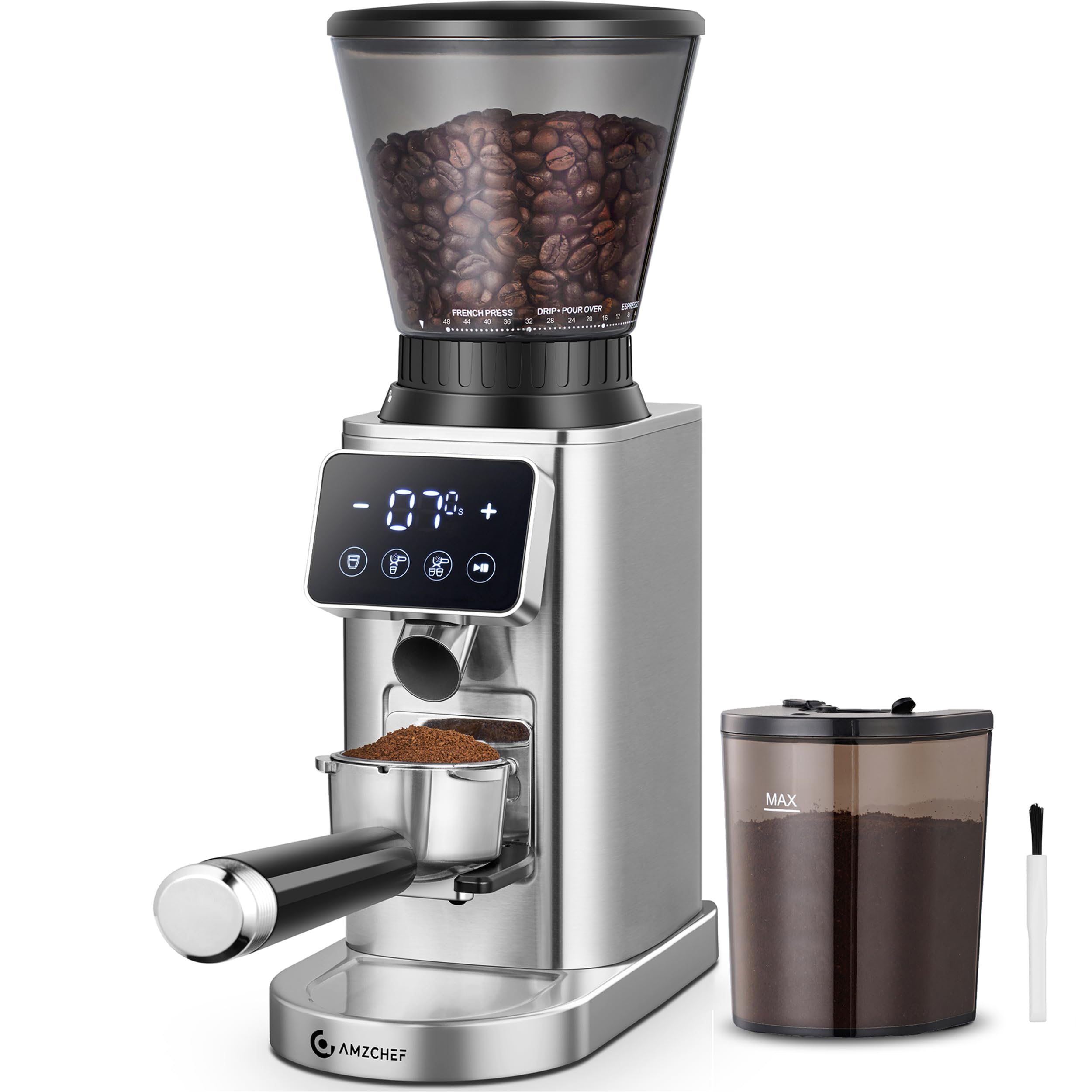
AMZCHEF Burr Grinder
Key Features
- Timer: 0.5-second steps
- Weight: 5.4 lb
- Capacity: 10.6 oz
- Grind settings: 48
- Price: Midrange
The anti-static container is the feature that makes the AMZCHEF Burr Grinder feel more expensive than its budget price. Grounds slide out in a tidy stream instead of clinging to the walls, and the stainless container wipes clean without the usual static dusting. For anyone who has chased coffee dust around a counter, that is a small daily win.
We think this is the best budget electric here because it covers the basics without making you fight the machine. The 40mm conical burrs and 48 settings move from espresso-fine to French-press coarse, and the touchscreen lets you set a dose by cup count or time in 0.5-second steps. The 10.6-ounce hopper is generous for the footprint, and the UV-blocking tint is a sensible touch for beans stored on a counter.
The grind is consistent for drip and espresso at this level, though it is not a fine-tuning tool for light-roast espresso. If you want anti-static grounds and a wide range on a budget, this is the one to shortlist.
Pros
- 48 settings from espresso to cold brew
- Anti-static container reduces mess
- 0.5-second timer for repeat doses
- Large 10.6-ounce hopper
Cons
- Touch controls can be fussy
The AMZCHEF is our budget electric pick for anti-static grounds and a wide grind range, as long as touch controls do not bother you.
Best for Travel and Pour-Over
TIMEMORE Chestnut C3S Pro
Key Features
- Handle: Foldable
- Weight: 15.2 oz
- Capacity: 0.88 oz
- Grind settings: 36
- Price: Midrange
The foldable handle and all-metal body are the reasons the TIMEMORE Chestnut C3S Pro earns a place in a travel kit. Fold the crank down and the grinder slips into a bag without snagging on clothes; the aluminum body feels solid enough to survive being packed next to a camera or water bottle. It is a manual grinder, so quiet is part of the deal.
The S2C660 conical burr and 36 clicks cover fine to coarse, and the adjustment dial is easy to read once you get used to the dots. The 25-gram capacity is enough for one or two cups, not a full pot. We liked that the bottom container doubles as a measure cup and fits into the top opening, which keeps the workflow simple at a campsite or a desk. The metal body also gives the crank a steady feel, so the grinder stays planted on a counter or picnic table.
We think this is the best manual here for pour-over and travel because it balances packability with a grind that feels even in the cup. For a single brewer who wants a quiet, packable grinder, the C3S Pro is the one we reach for.
Pros
- Foldable handle packs easily
- 36 clicks cover fine to coarse
- All-metal body feels solid
- S2C burr grinds evenly
Cons
- 25 g capacity limits batches
- Hand grinding takes effort
We pack the C3S Pro for travel and pour-over because the foldable handle and even grind make a quiet, compact manual setup.
Best for Manual Espresso
KINGrinder K6
Key Features
- Burr: Stainless steel
- Weight: 1.39 lb
- Capacity: 1.06 oz
- Adjustment: 16 microns per click
- Price: Midrange
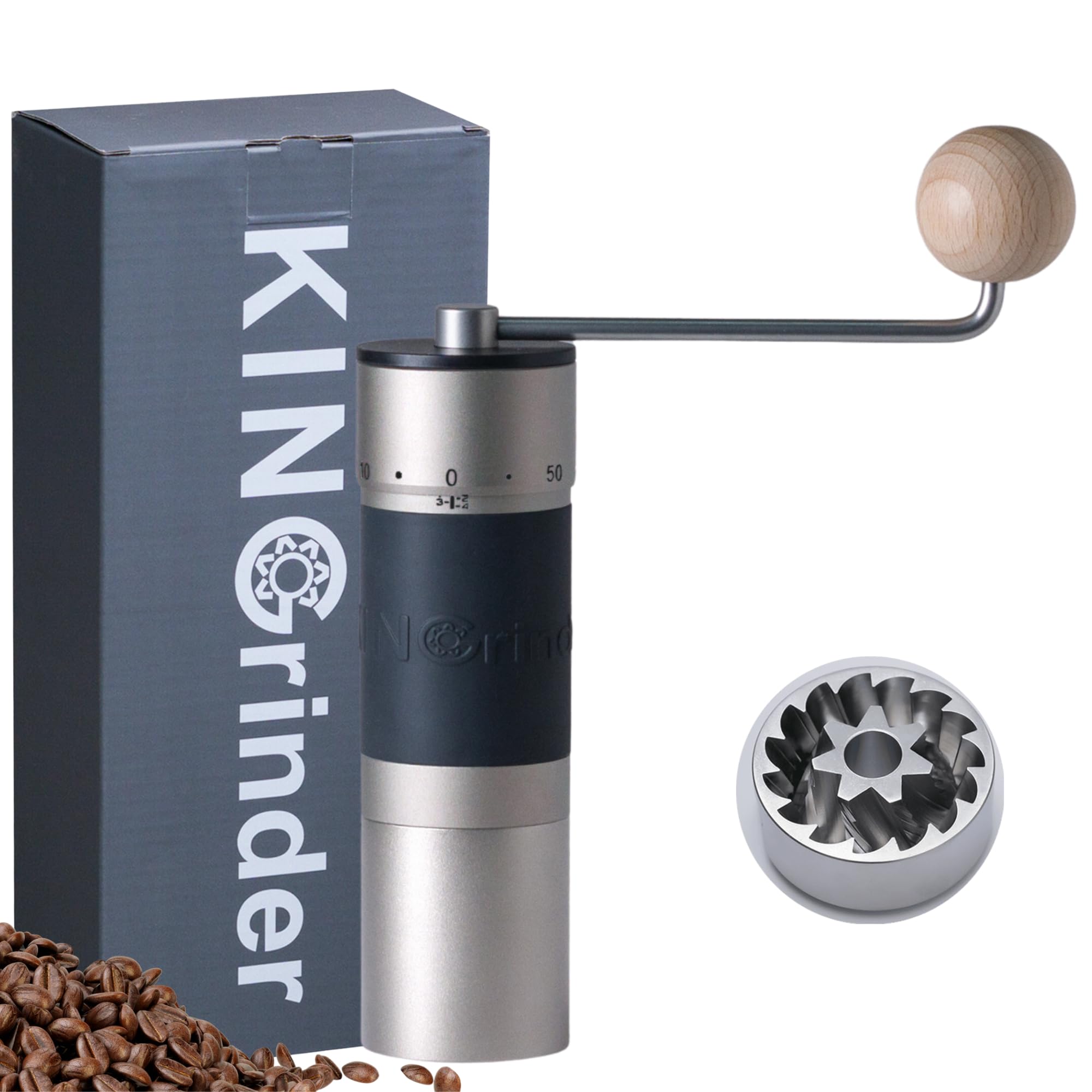
The 16-micron adjustment clicks are what make the KINGrinder K6 a serious manual espresso option. Each click is fine enough to move a shot without throwing the setting far off, and the external adjustment nut is easy to reach without dismantling the grinder. That is the detail that separates it from cheaper hand grinders with vague, stepped dials.
The stainless steel burrs and aluminum body give it a solid feel in the hand. The 30-gram hopper holds enough for a double shot, and the straight handle is comfortable to turn.
For espresso, the K6 gives you the precision to dial in a new bean without guessing at broad steps. For pour-over, it is more grinder than you need. The external adjustment makes it easy to return to a setting you liked. We also appreciated that the adjustment ring clicks firmly, so a setting does not drift between sessions.
We think this is the best manual for espresso because the adjustment range is genuinely useful, not just a long click count. If you make espresso at home and want a quiet, repairable backup or a travel setup, the K6 is the one we choose.
Pros
- 16-micron clicks dial in espresso
- Stainless burrs cut consistently
- 30 g capacity for two shots
- External adjustment is easy
Cons
- 630 g is heavy for travel
- Manual cranking limits larger batches
Manual espresso is where the K6 earns our recommendation: 16-micron clicks and a 30-gram dose make it the precise hand grinder here.
Best for Ultra-Budget Travel
CEVING Mini Manual Grinder
Key Features
- Burr: Ceramic conical
- Weight: 11.5 oz
- Capacity: 1.06 oz
- Grind settings: 40
- Price: Budget
The tiny price and 40 external settings are the hook on the CEVING Mini Manual Grinder. It is the least expensive grinder here, yet the adjustment ring is on the outside where you can see it, and the 30-gram bean capacity is enough for a generous single serving. We think that combination makes it the ultra-budget travel pick.
The ceramic conical burr is a sensible choice at this price: it generates less heat than a steel burr and stays quiet while you crank. The grinder breaks down into a few main parts for cleaning, and at 325 grams it disappears into a daypack. The 6.7 by 2.3 by 7.4-inch body is compact enough for a kitchen drawer, too.
The catch is the handle. It is the part that can let the whole package down, with the knob working loose or the arm breaking after a few weeks in some cases. If you want a cheap, compact grinder for occasional travel and you accept that risk, the CEVING is a useful little tool.
Pros
- 40 external settings for the money
- 30 g capacity for travel
- 325 g is easy to pack
- Ceramic burr limits heat
Cons
- Slow for larger doses
CEVING earns our ultra-budget travel nod for one-cup brewing, provided you accept the handle risk.
Best for Lightweight One-Cup
JavaPresse Manual Grinder
Key Features
- Burr: Ceramic conical
- Weight: 9.4 oz
- Dimensions: 1.8"L x 1.8"W x 7.5"H
- Grind settings: 18
- Price: Budget
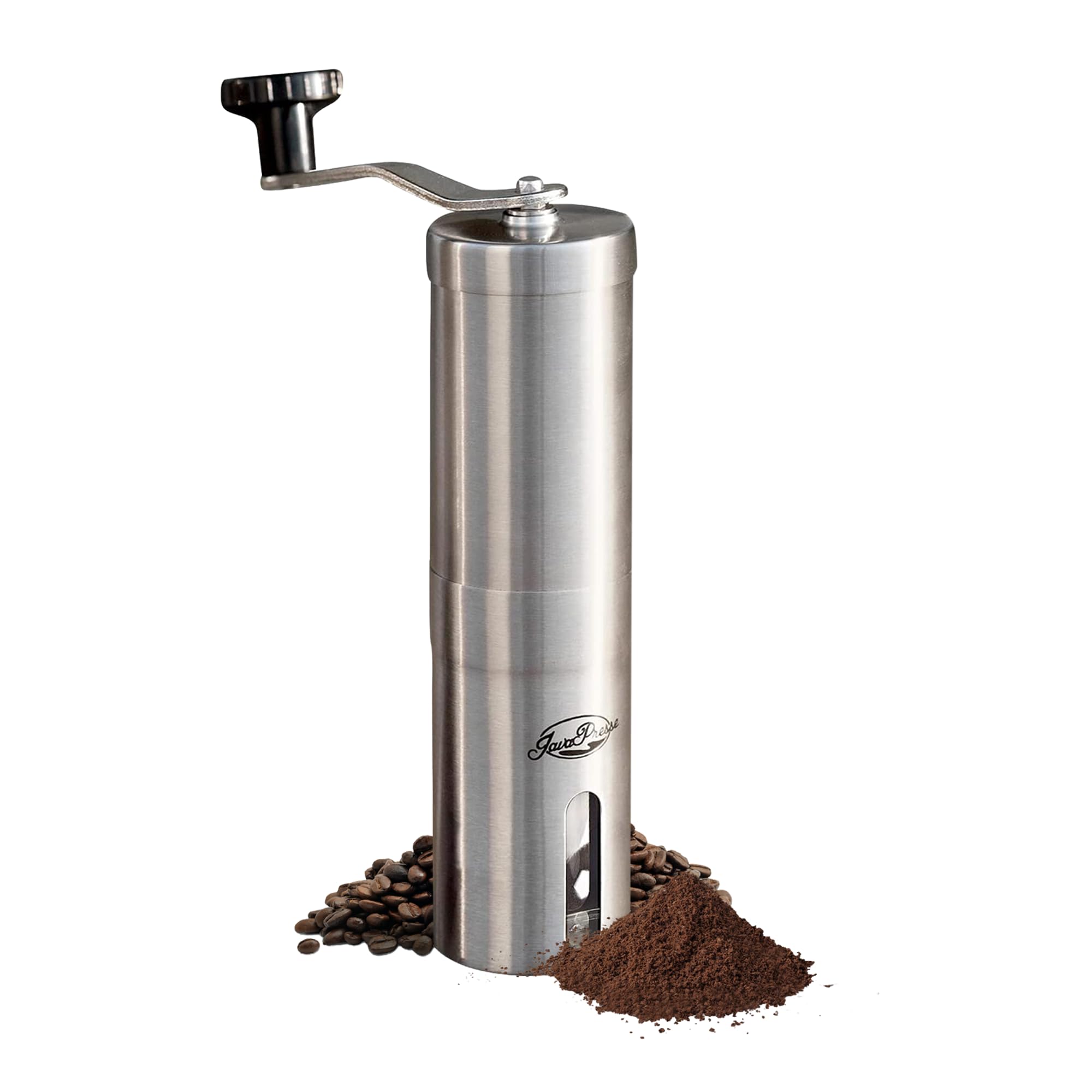
The lightweight stainless body and simple hand-crank ritual are what we notice first about the JavaPresse Manual Grinder. At 9.4 ounces, it is easy to toss in a bag, and the narrow 1.8-inch body takes up almost no counter space. This is a grinder for someone who wants one fresh cup without plugging anything in.
The ceramic conical burr and 18 settings cover drip, Aeropress, and French press, and the adjustment ring is simple to turn. We liked the smooth crank and the way the parts fit together; it feels more substantial than the price suggests. The crank arm is smooth enough that a single cup does not feel like a workout. Cleaning is straightforward once you learn the order of the pieces.
We think this is a good ultralight option for one-cup brewing. It is simple to pack, easy to crank, and the ceramic burr keeps the ritual quiet. For travel, a desk, or a backup grinder, the JavaPresse earns its place as a light manual.
Pros
- 9.4-ounce body travels easily
- 18 settings cover drip to French press
- Ceramic burr is quiet
- Simple to disassemble and clean
Cons
- Slow for more than one cup
- Espresso grind lacks precision
The JavaPresse is our light one-cup manual for drip and French press, not a precision espresso grinder.
How We Tested Burr Grinders, Cup After Cup
We started with every burr grinder a normal person might realistically buy, then narrowed the field by burr type, hopper size, counter footprint, and whether replacement burrs were available and affordable. Price mattered, but we cared more about whether the money went into the burrs than into a screen. Twelve made it into the kitchen.
For nine months, each grinder took a turn as the only grinder in the house — weekday 6 a.m. single doses before work, weekend espresso dialing, French press for a full table at brunch, and cold brew batches that demanded an even coarse grind. We weighed every dose on a scale, timed the grind, then reweighed the grounds to see how much stayed behind in the chute. To judge grind consistency, we ran the same beans fine and then coarse and sifted each batch to see how much dust and how many boulders slipped through. For adjustability, we counted the clicks from espresso to pour-over, then tried to land back on the original setting.
Ease of use we judged by action, not spec sheet: did we need one hand on the portafilter and the other on a stiff dial, and could we manage it half-asleep? We also handed each grinder to a houseguest who had never used one and watched where they hesitated — a hidden start button showed up fast. Durability and reliability came from months of cleaning: popping off hoppers, brushing burrs, checking whether the burr carrier wobbled and whether the motor’s pitch changed. Value was the last question — did the cup improve in step with the price? The grinders that made the final cut were the ones we stopped thinking about, pouring the same cup on a Sunday as they had three months earlier.
How to Choose a Burr Grinder
The most useful way to choose a burr grinder is to start with the coffee you make most often, then decide how much daily fiddling you will tolerate.
Start with the brew method, not the burr count
Espresso needs the finest adjustment because small changes in particle size change the shot. Drip, pour-over, and French press are more forgiving, but a wide range still helps if you switch methods. We look for fine steps and a clearly marked dial rather than a big number on the box. The Breville’s 60 settings and the KitchenAid’s 70 settings are useful because they cover the whole range, not because more is automatically better. If you only brew drip, a simpler 30-to-40-setting grinder is enough.
Dosing and workflow matter more than hopper size
If you pull espresso, direct-to-portafilter grinding saves a step and reduces mess. The Breville includes cradles for common basket sizes; the Baratza does not, so you grind into its bin and transfer. For drip, a timed dose or a marked container is enough. A large hopper is convenient for a household that drinks the same beans all week, but it exposes beans to air. Single-dose brewers do better with a smaller hopper or a grinder that empties cleanly.
Noise, static, and cleaning are daily costs
Electric burr grinders are loud, and the finest espresso settings are usually the loudest. If you grind before dawn, the KitchenAid is the quietest electric here, while the Breville and Baratza make more of a statement. Static is the other daily annoyance: dark, oily beans cling to plastic and stainless alike. An anti-static container like the AMZCHEF’s helps, but a light tap and a brush still earn their place. Clean the grounds path often enough that old coffee does not flavor the next cup.
Choose manual for quiet and portability, electric for speed
Manual grinders are quiet, compact, and easy to travel with, but they ask for effort. The TIMEMORE C3S Pro folds down and handles one or two cups; the KINGrinder K6 has finer adjustment for espresso but weighs more. Electric grinders win when you brew a pot or pull shots every morning. If you drink one cup and value quiet, a manual is not a compromise. If you make espresso for two and hate cranking, pay for the electric workflow.
Frequently Asked Questions
Do burr grinders really make better coffee than blade grinders?
Yes, for brewed coffee. A burr grinder crushes beans into similarly sized particles, so water extracts them evenly. A blade grinder chops a mix of dust and chunks, which can taste bitter and sour at once. The upgrade is most obvious with fresh beans and a drip or espresso setup; for pre-ground coffee, the grinder is not the missing piece.
How do I dial in espresso without wasting a bag of beans?
Change one thing at a time. Start with a dose that fits your basket, then adjust the grind in single clicks. If the shot runs fast and tastes thin, go finer; if it chokes, go coarser. Keep the dose steady until the flow looks right, then fine-tune by taste. Small adjustment steps make this much easier than broad dials.
Will an electric burr grinder fit under my kitchen cabinets?
Measure the clearance first. The electric models here run about 13.4 to 15.3 inches tall, so a low shelf can rule out the tallest. Leave extra room to lift the hopper for refills. The Breville and KitchenAid are around 15 inches tall, while the Baratza and AMZCHEF are closer to 13.4.
Final Verdict
The Breville Smart Grinder Pro is the one we recommend first for most kitchens: it moves from espresso to drip, doses by time, and grinds straight into a portafilter. If pour-over consistency is the priority and you do not need a portafilter cradle, the Baratza Virtuoso+ is the better grinder. For a quiet manual travel setup, the TIMEMORE C3S Pro is the one we pack.