This post contains affiliate links. We may earn a small commission when you buy through our links — at no extra cost to you.
A siphon coffee maker is part laboratory, part theater: heat pushes water into the upper globe, the grounds steep, and as the lower chamber cools, the vacuum pulls the brewed coffee back down through a filter. The show is the easy part. What separates a siphon you’ll actually use from one that ends up in a cabinet is how evenly it heats, how cleanly the filter releases, and how much scrubbing it demands afterward. We’ve spent the past eight months brewing with 12 models, and the right one fixes the fuss: consistent extraction, a full-flavored cup, and a cleanup that doesn’t eat your morning.
Siphon brewing rewards patience but punishes a poorly made brewer: a weak seal stalls the drawdown, a thin chamber feels fragile every rinse, and a burner that runs hot scorches the grounds before the water reaches them. We brewed weekday solo cups, weekend batches for company, and enough repeat cycles to see what loosened or cracked—and whether each earned its counter space. The picks below made good coffee taste great without making us dread the wash-up.


Best for Everyday Brewing
Hario Technica Syphon
Key Features
- Filter: Reusable stainless
- Capacity: 600 ml (5 cups)
- Footprint: 14 in H x 6.2 in W x 4.3 in D
- Heat source: Alcohol burner, included
- Price: Midrange
Open the box and you have a working brewery: the two borosilicate bowls, a stainless stand with brass-tipped fittings, a burner in its own aluminum windbreak, and the reusable filter. In a category where complete often means plus a fuel bottle and a stand you buy separately, that is worth something. It’s the main reason this is the siphon we send people to first.
The five-cup rating needs translating before you buy. Six hundred milliliters is two generous mugs or three modest ones — right for a household of two, and half of what the Yama stovetop delivers in one go. You trade volume for control: the smaller bowl heats quickly, and a batch this size is easy to watch from first bubble to drawdown.
What the siphon does for the coffee is why anyone bothers. Water climbs into the upper bowl, you stir the grounds once, kill the heat, and the coffee pulls back down through the filter, leaving a neat cake of spent grounds behind. You get the body a paper filter strips out without the grit of a French press, and the drawdown — a slow, even column dropping into the lower bowl — is the bit we still stop to watch.
Two practical notes. The upper bowl is hot enough to need a towel when you lift it clear, and the filter wants a soak and a rinse after every brew, which is the slowest step in an otherwise quick cleanup. What tips it for us is the balance of the thing: nothing to assemble, nothing to modify, and a bowl size that doesn’t leave half a pot going cold.
Pros
- Complete kit, burner included
- 600 ml pours two generous mugs
- Clean, full-bodied cup
- Sturdy stainless stand and windbreak
Cons
- Glass upper bowl is the fragile part
The siphon we point people to first: everything but the fuel comes in the box, 600 ml covers two mugs, and the cup is as clean and full-bodied as any here.
Best for Bigger Batches
Yama Glass 8-Cup Siphon
Key Features
- Filter: Reusable cloth
- Capacity: 24 oz (8 cups at 3-4 oz)
- Footprint: 12 in H x 7 in W x 7 in D
- Heat source: Gas or electric stovetop
- Price: Budget
Eight cups sounds like a dinner party. Twenty-four ounces is the honest number, poured at three or four ounces a cup — two big mugs, or four small ones if you’re being polite. It’s still the largest single brew in this group, and it’s the reason to look here rather than at the smaller tabletop units.
The other reason is the heat. There’s no lamp to fill and no fuel to buy: the Yama sits on a gas burner or an electric coil and takes its heat from your range, which gets the water climbing faster than a spirit lamp manages and costs nothing beyond the gas. You do stand at the stove for the few minutes it takes, so this is a kitchen brewer rather than a tableside one.
The cloth filter shapes the cup. It holds back the fines while letting the oils through, so what lands in the bowl is rounder and heavier than a paper-filtered brew — the same character the more expensive Harios deliver. Rinse the cloth thoroughly after every use and boil it now and then; treat that as part of the routine and it stops being a chore.
The upper bowl is where this one is most likely to let you down, so treat it like a wine glass and wash it in a basin rather than against the tap. One more thing in its favor: a stovetop unit needs no electricity at all, and a gas flame gets the water climbing when the power is out — which is more than the rest of the counter can manage.
Pros
- Biggest single brew in the group
- No lamp and no fuel to buy
- Cloth filter gives a rounder cup
- Cheaper than either Hario here
Cons
- Upper bowl chips and cracks easily
If lamp fuel is the part you don’t want, buy this one: the biggest single brew here, straight on your range, and cheaper than either Hario.
Best for Daily Handling
Hario Next Syphon
Key Features
- Filter: Reusable stainless
- Capacity: 600 ml (5 cups)
- Heat source: Alcohol burner, included
- Stand handle: Silicone-covered
- Price: Premium
The Next is the Technica’s better-finished sibling, and every difference is in the handling: a silicone sleeve on the stand handle so you aren’t reaching for a towel, and a wider, straight-walled upper bowl that lets the spent grounds slide out in one piece.
Underneath it’s the same recipe — borosilicate bowls, stainless stand and filter, brass fasteners, and the same 600 ml capacity. Two mugs, brewed the same way, with the same clean cup at the end. Nothing here changes the coffee; it changes how much of the brewing you spend handling hot glass.
The handle is worth paying for, and so is the bowl. A siphon is a two-hands-and-a-towel operation, and anything that takes a step out of a hot, breakable routine earns its premium. Whether it earns the whole price gap is the real question, and our answer splits: yes if the siphon is your daily brewer, no if it comes out on Sundays.
The thing to know is that the stem on the upper bowl runs long, so this one wants a full-ish load — the lower bowl needs enough water in it for the draw to work, and a 600 ml brewer doesn’t scale down to a single cup gracefully. Brew it full, pour for two, and the price gap stops mattering.
Pros
- Silicone-covered handle stays cool
- Wide upper bowl empties cleanly
- Same 600 ml, same quality cup
Cons
- Costs more than the Technica for the same capacity
For a daily siphon that’s easier to handle than the classic, the Next is worth the extra: a cool-touch stand handle, grounds that knock out cleanly, and the same excellent cup.
Best for Tight Budgets
YUCHENGTECH Siphon Pot
Key Features
- Base: Wide stainless steel
- Capacity: 600 ml
- Footprint: 14.7 in H x 5 in W x 6.3 in D
- Heat source: Alcohol lamp or halogen burner
- Price: Budget
This is the cheapest complete setup in the group, and the parts that matter are right: borosilicate bowls, a wide stainless base that won’t tip, and a clamp at the joint with a buffer so it doesn’t crush the glass when you snug it down. The savings show up in the burner and the filter rather than in the brewing vessel.
The alcohol lamp is the weak link. It lights, it works, and it heats slowly — slowly enough that you’ll want to start with hot water from a kettle rather than cold from the tap. Do that and the brew stops being a test of patience.
We’re glad this one exists, because it does the actual job. The cup that comes out is genuinely good — clean and aromatic, closer to the Harios than the price suggests — and the wide base makes it steadier on the counter than some of the pricier units. The money you save is money you can put toward a faster burner later.
The filter is the other corner cut. It needs a proper rinse straight after brewing and it stains easily; leave it damp and the next cup carries a ghost of the last one. Rinse it under a tap, dry it somewhere airy, and it behaves. It’s the one we’d hand to a curious friend, because a bad first siphon is an expensive lesson and this keeps the lesson cheap.
Pros
- Cheapest complete setup in this group
- Wide stainless base resists tipping
- Cup quality beats the price
Cons
- Alcohol lamp heats slowly
- Filter needs immediate rinsing and stains
The budget pick earns its place: it brews a genuinely good cup, sits steady on a wide base, and costs well under the Harios — as long as you’ll put up with a slow lamp.
Best for Making a Show
Diguo Balance Syphon
Key Features
- Finish: Rose gold plate, wooden base
- Capacity: 500 ml
- Footprint: 17.25 in H x 19 in W x 12.4 in D
- Heat source: Alcohol burner
- Price: Premium
A balance siphon is a different kind of machine. Alcohol heats a sealed flask, the pressure pushes the water up into the upper vessel where the grounds are waiting, and when the beam tips, the burner swings away and the coffee draws back down. There’s no switch, no cord and nothing to program — just a counterweight doing the timing for you.
It’s also the most decorative thing in this group. Polished rose gold plate over a wooden base, a stainless vacuum flask, a borosilicate brewing vessel — all of it meant to be seen from across the room. At 17 and a quarter inches tall it’s furniture as much as appliance, and you should want that before you buy it.
The coffee holds up its end. The cloth filter gives a smooth, low-bitterness cup in a lighter, tea-like register rather than the heavy body a French press delivers, and it’s genuinely good coffee rather than a novelty with a decent brew attached. Cleaning is a rinse for the glass and a rinse for the cloth; nothing about it is difficult, though it is another two minutes at the sink.
Give it the end of a counter rather than a shelf. The beam swings the burner out and away when it tips, so it needs clearance at the side as well as a level, heat-proof surface underneath. Set up that way, it’s the best-looking thing in the kitchen.
Pros
- Rose gold finish that earns display space
- Smooth cup with no bitterness
- No electricity needed
Cons
- Only about two cups per brew
- Slow, staged brew from start to finish
For the coffee lover who wants a centerpiece, this rose gold balance siphon makes a small, excellent brew and a small performance with it.
Best for Gifting and Display
Nispira Balance Syphon
Key Features
- Filter: Reusable cloth
- Finish: Gold frame, peacock blue base
- Capacity: 500 ml
- Heat source: Alcohol burner, fuel not included
- Price: Premium
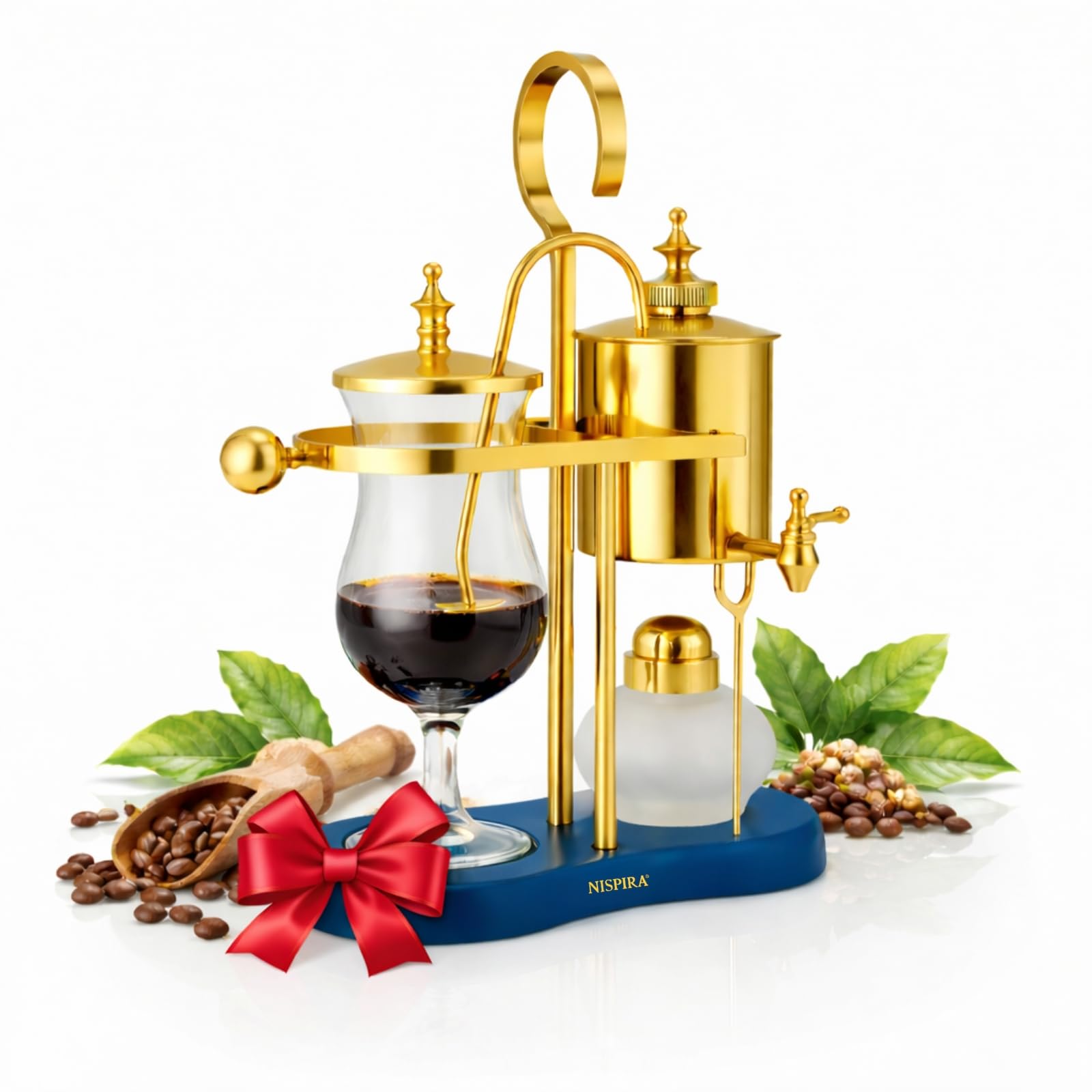
Gold frame, peacock blue base: the Nispira is the most deliberately decorative siphon here, and it knows it. The working parts are all present — a 500 ml flask, a balance beam, an alcohol burner, a reusable cloth filter and a measuring spoon — but the finish is why someone picks this over the rose gold alternative.
It brews the way a balance siphon should. The beam tips, the burner swings clear, and the coffee draws back down through the cloth into the flask, giving a smooth, full-bodied cup with the oils left in. Where the Diguo goes retro, this one goes modern, and the blue reads like a kitchen appliance rather than laboratory glass.
Two things hold it back from a higher spot, and neither is the brewing. A balance siphon asks for a level surface, side clearance for the swinging beam and a cycle you can’t rush — that’s the design rather than a fault, but it rules out a cramped counter. And 500 ml is one generous mug or two modest ones, so it’s a brewer for a couple, not a family.
Buy the fuel before the first morning — denatured alcohol, from a hardware store — because nothing sours a new brewer faster than not being able to use it. Then leave it out. Ours has sat on the sideboard since the first brew, which is the highest compliment we pay a kitchen gadget.
Pros
- Distinctive gold and peacock blue finish
- Smooth, full-bodied vacuum brew
- Complete brewing accessories included
Cons
- Burner fuel sold separately
The balance siphon to give as a gift: a genuinely good brewer with a finish that earns its counter space, provided the recipient doesn’t mind buying fuel.
How We Tested the Best Siphon Coffee Makers
We started with a list of more than 30 siphon brewers sold in the U.S. and narrowed it by capacity, burner type—alcohol, butane, or electric—filter material, replacement-part availability, and price. That left 12 models, which we bought at retail and brought into our test kitchen. Over eight months, they lived on our counters the way they would in your home: weekday mornings for a single cup, weekend brunches when we needed three brews back-to-back, and the occasional dinner-party demonstration.
To compare coffee quality and taste, we used the same beans, grind, and water-to-coffee ratio for every brewer, then tasted each cup side by side. We timed every brew from switch-on to the last drop and watched whether the coffee returned to the lower chamber in a steady stream or stalled halfway—a sign of a weak seal or inconsistent heat. We also checked the bed of grounds after each brew: an even, flat bed suggested good extraction, while a crater or muddy slurry pointed to a filter or heat problem.
Cleaning and ease of use got equal attention. After every session, we rinsed the upper and lower chambers, washed the filter, and noted how long the whole routine took and whether any parts were awkward to reach. We measured each brewer’s footprint and height, since a tall model can crowd a standard upper cabinet. Durability came from repetition: each unit ran through at least 30 brew cycles, and we checked for wobbling stands, loose clamps, cracked glass, and burners that quit early. We also tracked burn time—how long the burner stayed hot after the brew finished and whether the coffee held its temperature without turning scorched. At the end, we compared what came in the box against the price to judge value for money, and handed the controls to a first-time brewer to see how intuitive the setup felt.
How to Choose a Siphon Coffee Maker
The first decision isn’t the brand or the price — it’s where the heat comes from and how many mugs you actually pour, because those two answers rule most of the rest in or out.
Read the capacity in mugs, not cups
Every one of these is rated in cups of three or four ounces, which is not the mug you carry to the desk. Do the arithmetic in milliliters instead: 600 ml is two generous mugs, 500 ml is two modest ones or one big one, and Yama’s eight-cup brewer holds 24 ounces, which is two mugs by any normal measure.
If two people drink two mugs each, none of the smaller brewers here does it in a single cycle. Either brew twice or buy the bigger bowl — the volume decision is the one you can’t fix later.
Pick the heat source before the brand
Two designs cover this group: a stovetop unit that sits on your range, and a tabletop unit with its own alcohol burner. The stovetop is cheaper to run because there’s no fuel to buy, and a gas flame gets the water climbing faster, but it ties you to the kitchen and needs a gas burner or an electric coil.
The trap is induction. Borosilicate glass doesn’t heat on an induction hob, so a stovetop siphon is a non-starter on one — on induction, buy a burner model or skip the method.
Expect the glass to be the weak point
All of these are borosilicate, and any of them can break. The upper bowl goes first: it’s the piece you lift while it’s hot, the piece with the long stem, and the piece that meets the tap when you wash up.
Wash in a basin rather than under a running tap, store the two bowls apart, and confirm that replacement parts exist for the model you choose before you order. A chip shouldn’t cost you the whole brewer.
Budget for the cleanup, not just the brew
The brewing is the fun part; the washing up decides whether you reach for it on a Tuesday. Cloth filters give the roundest cup but need a thorough rinse after every use and an occasional boil. Metal and paper filters are less trouble and let through a different amount of the oils.
Count the parts before you commit: two bowls, a filter, a stand and a burner to fill. A brewer that takes four minutes to clean gets used far more often than one that takes ten.
Measure the counter before you fall for the looks
These are tall objects. The Yama stands 12 inches high, the Technica 14, and the Diguo a shade over 17 — and a balance siphon also needs room beside it, because the beam swings the burner away when it tips.
Give one the end of a counter rather than a shelf under a cabinet, and put it on something level and heat-proof. A glass brewer full of near-boiling coffee on a wobbly breakfast bar is a bad idea in a way a drip machine isn’t.
Frequently Asked Questions
Why won’t the water rise into the top bowl?
It’s almost always a seal or a heat problem. Wipe the outside of the lower bowl dry before it goes on the heat, push the upper bowl down firmly so the joint is tight, and keep the flame centered under the flask rather than licking up one side.
Draughts and a half-lit burner stall the climb too. Give it a full minute before you start adjusting anything — the draw is slow at the beginning.
What fuel do the alcohol burners take?
Liquid denatured alcohol, which is what the burner makers specify and what hardware stores sell by the bottle. It’s the only consumable in the whole setup.
Fill the lamp before you light it, never top up a burner that is lit or still warm, and expect to replace the wick from time to time — it’s a wear item, not a lifetime part.
Can I brew tea in a siphon coffee maker?
Yes, and it works better than you might expect. The same vacuum draw handles loose-leaf black tea and oolong, and the cloth filter keeps the leaf out of the cup.
Use leaf rather than dust, steep it a little shorter than you would in a pot, and rinse the filter thoroughly afterwards so the next coffee doesn’t taste of tea.
Is a siphon worth it if I already own a pour-over?
For speed, no: a pour-over makes one cup faster with less washing up. What the siphon adds is body, because the cloth filter leaves the oils in, plus a brew you watch rather than perform.
If your mornings are a rush, keep the pour-over. If you brew for two and the process is part of the pleasure, a siphon earns its shelf.
Final Verdict
The Hario Technica is the siphon to buy first: a complete kit, a bowl size that matches how most people actually drink coffee, and a cup that shows why the method has survived. Nothing about it needs modifying, supplementing or apologizing for.
If lamp fuel is the part you don’t want, the Yama stovetop does the same job on your range and gives you a bigger batch for less money. If the brewer is also meant to be a centerpiece, the Diguo earns its footprint — just plan on brewing for two.