This post contains affiliate links. We may earn a small commission when you buy through our links — at no extra cost to you.
A burr grinder does one job: it feeds beans between two abrasive surfaces set a precise distance apart, and that distance decides whether you get a syrupy espresso shot or a gritty French press. Blade grinders can’t hold that distance — they pulverize some beans and leave others whole, which is why the same bag can taste different every single morning. What a good grinder actually fixes is repeatability: you dial it in once, and the next forty mornings taste like the first one did.
Over the past 10 months, my team and I ran 12 grinders through espresso on weekend mornings, big French press batches for company, and enough cold brew to keep the fridge stocked. We timed doses, listened for the shriek that wakes the house, and wiped up the stray grounds that cling to everything. Here’s a thing nobody tells a first-time buyer: the numbers on a grind dial only mean something inside a single machine, so ignore the setting another owner swears by and dial in your own. The picks below favor grinders that are consistent, easy to live with, and worth the money.



Best for Dialed-In Espresso
Breville Smart Grinder Pro
Key Features
- Dose timer: 0.2-second increments
- Grind type: Conical burr
- Grind settings: 60
- Hopper capacity: 1.1 lb
- Price: Premium
Sixty is the number that explains the price. The Smart Grinder Pro is a conical burr grinder with 60 settings and a digital timer that doses in 0.2-second steps, and it grinds straight into a portafilter, with two cradles in the box sized for 50–54 mm and 58 mm baskets, or into its own lidded container.
That combination is why we recommend it first. On a blade grinder, grind size is a guess you correct by pressing the button again; here it is a setting you can return to, and the timer repeats the dose shot after shot. If one person in the house drinks espresso and another drinks drip, this is the only machine here that covers both properly, and it is the one we trust at the fine end, where a grinder’s consistency shows up first.
What you pay for that is money and counter space. It is the most expensive grinder in this group by a wide margin, and at 15.3 inches tall it needs clearance under the cabinets, so check that before you fall for it. Fresh grounds also carry static, and a few will jump out of the container when you open it, which is a small annoyance rather than a problem. Buy it if better coffee is the point of the purchase.
Pros
- 60 settings cover espresso to French press
- Programmable dose repeats to 0.2 seconds
- Grinds straight into a portafilter
- Comes apart for thorough cleaning
Cons
- Tall body needs cabinet clearance
- Mixed record on long-term reliability
If you want one grinder that handles espresso through French press and repeats the same dose tomorrow, this is the one we recommend, as long as the price doesn’t put you off.
Best for Burr on a Budget
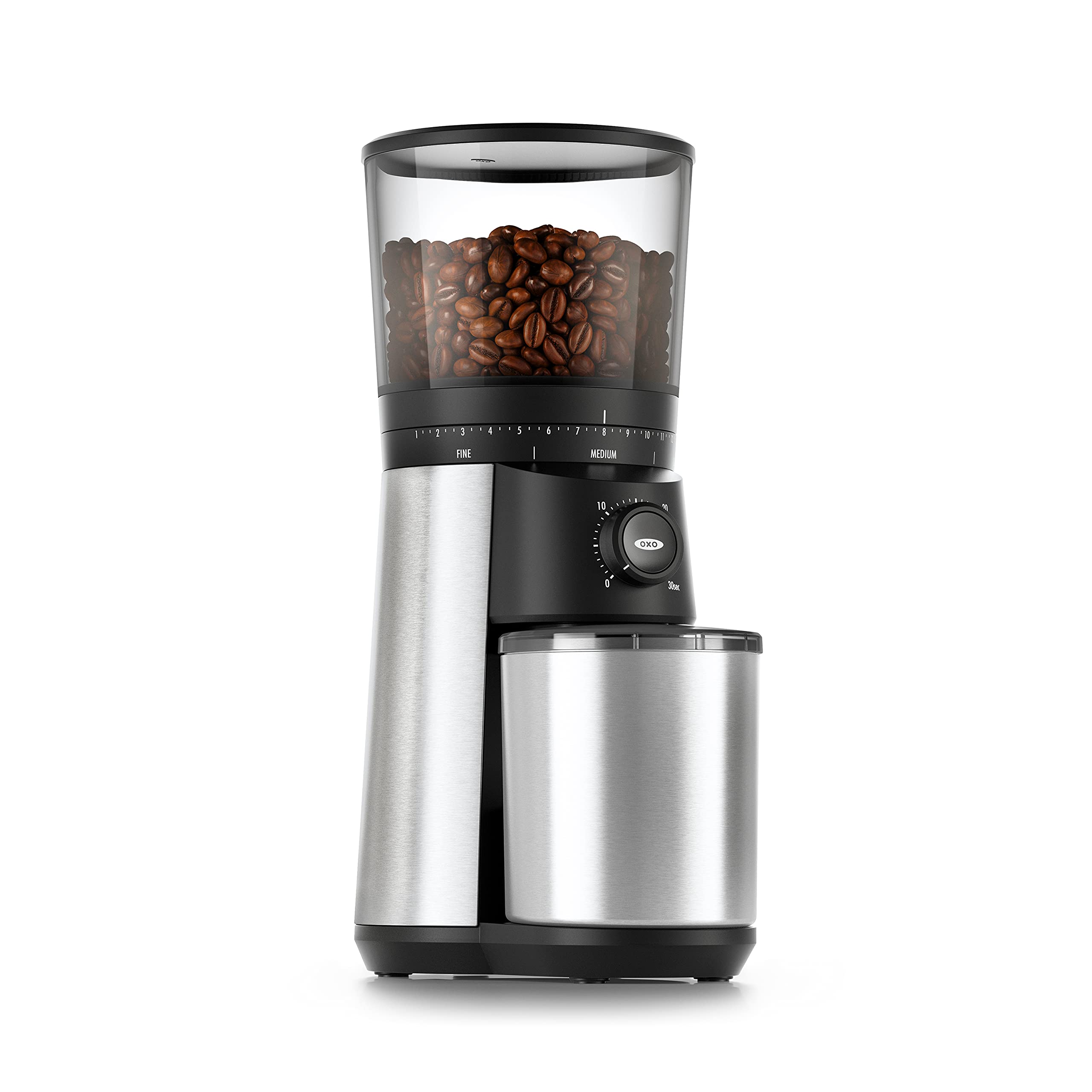
OXO Brew Conical Burr Grinder
Key Features
- Warranty: Two years
- Grind type: 40 mm conical burr
- Grind settings: 15 plus 43 micro-adjustments
- Hopper capacity: 12 oz
- Price: Midrange
The OXO Brew is the grinder we point people to when the Breville is more machine than they want to pay for. It is a conical burr grinder with 40 mm stainless burrs, 15 main grind settings plus 43 micro-adjustments, and a 12-ounce hopper tinted to block UV light. It runs about half the money of our top pick.
What you get for that is a simpler machine that still does the important thing: uniform grounds across the range from espresso-fine to French-press coarse, with a one-touch start that remembers where you left the setting. The hopper holds most of a bag, so you are not refilling every other day, and the tint is a genuinely thoughtful touch for beans that sit in a sunny kitchen. It grinds into its own container rather than a portafilter, which matters only if you are pulling shots.
The catch is maintenance. Fine, oily grounds, dark roasts especially, can pack into the chute and clog the works, so plan on brushing it out regularly rather than once a season. Keep that in mind and it is a sensible burr upgrade for drip, pour-over and press drinkers; if you want to load beans and never think about the machine again, this is not the one.
Pros
- Burr consistency for about half the top pick’s price
- Remembers the last grind setting
- 12-ounce UV-blocking hopper
- Quiet for a burr grinder
Cons
- Hopper suits stored beans, not single dosing
- Some units fail early
We recommend the OXO to anyone who wants burr consistency without the top pick’s price and doesn’t mind brushing it out now and then.
Best for Everyday Drip Coffee
KRUPS F203 Electric Grinder
Key Features
- Motor: 200 watts
- Capacity: 3 ounces (85 g)
- Warranty: One year
- Grind type: Stainless steel blade
- Price: Budget
There are two kinds of grinder buyers: the ones dialing in a recipe and the ones who want fresh grounds before the school run. The F203 is squarely for the second group. It is a 200-watt blade grinder with a 3-ounce chamber, one button under the lid, and a safety switch that keeps the blades still unless the lid is seated.
We keep recommending it because it gets the job done quickly. Beans go from whole to fine in seconds, the single button gives you all the control a blade grinder can offer, longer for finer, and it is one of the least expensive machines here. For drip and French press, where a little unevenness gets filtered out and forgotten, that is all the grinder most people need.
Two things to accept before you buy. The chamber does not lift out, because the blade shares its base with the motor, so cleaning means a brush and a dry cloth worked around a fixed blade rather than a rinse under the tap. And it is loud enough that we plan around it instead of grinding while someone is on a call. Neither is a dealbreaker at this end of the market, and if either would bother you, the KitchenAid’s removable bowl and the Silent Vortex solve both.
Pros
- Fast enough for a weekday morning
- One-button control with a lid safety switch
- Small enough for a cupboard
Cons
- Fixed chamber can’t be washed
- Loud in a quiet kitchen
Our value pick: fast, simple and forgiving of the uneven grind a blade leaves, which is all drip and French press drinkers really need.
Best for Mess-Free Transfer
KitchenAid BCG111 Blade Grinder
Key Features
- Bowl: Removable stainless steel
- Warranty: 1 year replacement
- Grind type: Stainless steel blade
- Bowl capacity: 4 oz
The bowl comes out. That sounds like a small thing until you have tipped a fixed grinding chamber toward a filter and watched half the grounds stay behind. KitchenAid’s 4-ounce stainless bowl lifts out, carries markings for 4, 8, 10 and 12 cups inside it, and travels to the brewer like a measuring cup.
Underneath it is a conventional 160-watt blade grinder: press down on the clear cover to grind, release to stop, and use short pulses for anything coarser than fine. The measurements are the sort of detail that quietly changes a morning, because you stop guessing how much to pour in. It is also the best-looking grinder in this group, in a red finish with a stainless bowl that you will not mind leaving out.
Blade grinding is still blade grinding, though. Grounds pack into the base of the bowl and need scraping out, and the grind runs uneven unless you shake the machine mid-cycle. That is the trade for a bowl you can lift, and we take it: compared with the KRUPS F203 this is the tidier machine, and compared with the Cuisinart it simply holds more.
Pros
- Removable, marked stainless bowl
- Grinds enough for 12 cups
- Best-looking grinder in this group
Cons
- Uneven grind without shaking mid-cycle
The removable, marked bowl is why we picked it: it makes the trip from grinder to filter easier than any fixed chamber here.
Best for Full Pots
Mr. Coffee 12-Cup Grinder
Key Features
- Wattage: 150 watts
- Capacity: 4 to 12 cups
- Grind type: Stainless steel blade
- Cord length: 36 inches
- Price: Budget
A full pot is the promise, and it is the reason this one earns a place: fill the chamber, grind once, brew twelve cups. Plenty of blade grinders claim it and then need two batches, so the 4-to-12-cup capacity is what puts the Mr. Coffee here rather than a smaller chamber with a nicer finish.
Otherwise it is a straightforward machine: a 150-watt motor, a press-and-hold lid, a safety switch and a 36-inch cord that actually reaches the outlet behind the counter. We recommend it to households that brew a pot at a time rather than a cup at a time, because that is the case it is built for and the case where its size stops mattering. Under four inches square, it also tucks into a crowded corner.
The compromises are ordinary ones. The chamber is fiddly to clean, with grounds finding the seam where the lid meets the bowl, and there is no cord storage, so the lead hangs loose behind the machine. Budget motors do fail, and this is not the grinder you hand down; it is the one you use hard for a few years and replace without regret.
Pros
- Grinds enough for a 12-cup pot
- Fast, simple press-and-hold lid
- Narrow footprint for tight counters
Cons
- Chamber is fiddly to clean
- No cord storage
We reach for this one when a full pot is the job: one fill, one button, twelve cups.
Best for Early Mornings
KRUPS Silent Vortex Grinder
Key Features
- Bowl: Removable, dishwasher-safe
- Yield: Up to 12 cups
- Grind type: Stainless steel blade
- Bowl capacity: 3 oz
- Price: Midrange
Grinding coffee at six in the morning is a social act, because everyone in the flat hears it. The Silent Vortex is built around that problem, and it is the quietest grinder here by a clear margin: the motor sits in an oval housing that takes the edge off the racket, and the difference is obvious next to the KRUPS F203.
The quiet is the reason to pay for it, but the bowl is the reason we like it. Three ounces of stainless steel lift out of the base, take a lid, and go in the dishwasher, so you can grind a batch, seal it and put the whole thing away, or tip it straight into the filter without scraping. It handles a 12-cup batch in one go, and the single-button operation is as simple as this category gets.
One caveat, and it is a live one: the bowl can jam in its base and be awkward to free, which is irritating when you are half awake. That is the trade for a bowl you can carry to the sink and put in the dishwasher, and for the quiet, we take it.
Pros
- Quietest grinder in this group
- Removable, dishwasher-safe bowl with a storage lid
- Grinds up to 12 cups in one batch
Cons
- Bowl can jam in the base
- Lasting record is weaker than the price suggests
The grinder we recommend to anyone who grinds before sunrise or shares a wall with a neighbour: quiet, easy to empty, and worth paying more for.
Best for Small Kitchens
Cuisinart DCG-20BKN Grinder

Key Features
- Wattage: 150 watts
- Capacity: 2.5 oz
- Warranty: 18 months
- Grind type: Stainless steel blade
- Price: Budget
The detail we appreciate here is a small one: the clear cover is marked, so you fill to a line instead of eyeballing it, and the whole machine is short enough to live in a drawer. Two and a half ounces of beans, 150 watts, one button, and a bowl that wipes out.
In use it is quick and unremarkable in the way a basic blade grinder should be: a few seconds of holding the button, a shake, a few seconds more. It is compact enough for a tiny kitchen and it stores its cord, which is more than the Mr. Coffee manages.
Two things we noticed. The lid has an inner cup that traps grounds and takes some picking to clean, and the motor warms if you grind batch after batch, so a long breakfast needs a pause between fills. Neither is unusual for a blade grinder at this end of the market.
We put it in also-consider rather than among the picks because it does not win anything outright: the KRUPS F203 grinds more per batch, and the KitchenAid’s removable bowl is easier to live with. If you brew a cup or two and want the smallest thing that works, it is a good choice.
Pros
- Marked cover helps portion beans
- Compact enough for a drawer
- Fast, one-button operation
Cons
- Motor warms during back-to-back batches
- Lid’s inner cup traps grounds
We think it’s a decent small-batch grinder, though the KRUPS and the KitchenAid give you more to work with.
Best for Small Batches
BLACK+DECKER One Touch Grinder

Key Features
- Wattage: 130 watts
- Capacity: 2/3 cup (56.6 g)
- Warranty: 2 years
- Grind type: Stainless steel blade
- Price: Budget
Two things stand out before you grind a single bean: the lid locks, so the blades will not turn until it is seated properly, and the warranty runs a full two years, as long as anything here. For a small appliance that lives near water and gets used half asleep, both are worth more than a nicer finish.
In use it is a standard stainless blade grinder: press the button, hold, release, with a 2/3-cup chamber and a bowl that wipes out easily between fills. The push-button control is satisfying in a way we did not expect at this price.
The catch is size. It is smaller than a real pot of coffee needs, so a twelve-cup morning means two batches, and that is the sort of thing that decides whether this is your grinder or someone else’s.
Where it lands: a one- or two-cup household that wants a locking lid and a long warranty without paying for capacity it will not use. We like it for that job, and a twelve-cup morning is not its work.
Pros
- Lid lock keeps blades still until seated
- Two-year warranty, as long as any here
- Stainless bowl wipes clean
Cons
- Motor life is the weak point
We rate it on the locking lid and the two-year warranty, not on capacity, because a full pot takes two batches.
How We Chose and Tested the Best Coffee Grinders
We started with more than 30 models sold at major retailers, then narrowed the field by burr type, how finely and how widely the grind could be adjusted, whether replacement burrs and parts were available, and how the price lined up with what the machine actually offered. That left 12 grinders, spanning flat and conical burrs, stepped and stepless adjustments, and a mix of espresso-focused and all-purpose designs.
Each machine moved into a real kitchen and got used the way a grinder actually gets used. We dosed 18 grams for espresso and 60 grams for drip, timing each from the moment the motor started, then sifted batches through a fine sieve to see how uniform the particles were and whether fines clumped at the bottom. We pulled shots and brewed pots with each setting, then jumped from coarse back to fine to see how much old coffee stayed trapped in the chute and whether returning to a setting was repeatable. Anyone who has emptied a catch cup knows the static problem, so we noted how far grounds flew, how much clung to the plastic, and whether a drop of water on the beans helped.
Cleaning got its own pass: we disassembled each grinder as the manufacturer instructed, brushed out the burrs, and checked how much stale coffee stayed behind in corners you can’t reach with a finger. A decibel meter at counter height recorded noise during a full dose, since a grinder loud enough to wake the house gets used less often than one you don’t dread. Ten months of daily grinding gave us the reliability picture — burr wear with light roasts, buttons and dials that loosened up, and the occasional machine that started stalling on a fine setting. Weighed against the price, the winners were the ones that ground the same way on day 300 as they did on day three.
How to Choose a Coffee Grinder
The grinder changes your coffee more than the brewer does, and the first decision, burr or blade, settles almost everything that follows.
Burr or Blade: What You’re Actually Buying
A blade grinder works like a blender: a spinning blade shatters beans into a mix of powder and gravel, and no amount of shaking evens that out. A burr grinder crushes beans between two abrasive surfaces set a fixed distance apart, so the particles come out closer to one size, which is what even extraction needs.
Our advice: if you brew drip or French press and drink it within a few minutes, a blade grinder is a fair place to start. If you’re chasing espresso, or you want tomorrow’s cup to taste like today’s, go burr. The trap is assuming every burr grinder is automatically better, because a loose one is more frustrating than a good blade.
Match the Settings to How You Brew
A drip-only household needs coarse and medium and little else. Espresso needs steps fine enough to change a shot by a second or two, which is where the Breville’s 60 settings and the OXO’s micro-adjustments earn their keep.
If you never plan to pull a shot, don’t pay for that resolution; put the money into capacity, quiet, or a bowl you can lift out. If you do, buy the finest adjustment you can afford, because the difference between a gusher and a decent shot is often a single click.
Cleaning, Static and Where the Grounds End Up
Ground coffee is oily and carries static, so every grinder holds onto some of it. The design question is whether you can reach the chamber. A bowl that lifts out, as on the KitchenAid, the Silent Vortex and the Breville’s container, is much easier to empty and wash than a fixed chamber with a blade at the bottom, and that difference shows up every single morning.
If you grind dark, oily beans, build in a brush and a minute of your time whichever grinder you choose.
Capacity, Noise and the Counter
Capacity is about how many cups you brew at once: if a pot is the normal job, a chamber that holds the whole batch saves you a second grind and a second cleanup. Noise is the cost that never makes it onto the box, and it’s the main reason to pay more, because a six o’clock grind carries through a flat.
Measure the spot before you commit, since burr grinders are tall. The Breville stands over fifteen inches, so check the clearance under your cabinets, and decide whether you want the cord hidden or just tidy.
Frequently Asked Questions
How long should a coffee grinder last?
Longer than most budget models manage. A cheap blade grinder is usually a few-years appliance, and the motor is what goes first; burr grinders cost more but are built to be kept. Check the warranty before you buy, because among our picks it runs from one year to two, and grind in short bursts rather than long runs, which is kinder to any motor.
Can I grind spices in the same machine as my coffee?
You can, and you’ll smell it in your coffee for weeks afterward. Spice oils linger in a chamber that only gets wiped out, so either keep a second, inexpensive grinder for spices or choose one with a removable, dishwasher-safe bowl you can actually wash. Among our picks that means the KRUPS Silent Vortex; a fixed-chamber blade grinder is the wrong tool for cumin.
Is it worth grinding a week’s beans in one go?
It beats buying pre-ground, but it’s a compromise, since ground coffee loses its best aromatics within days. Grinding three or four days’ worth and storing it airtight and out of the light is a reasonable routine. If you brew a pot a day, that is the case for a large chamber like the Mr. Coffee’s; if you brew a cup, grind to order.
Final Verdict
The Breville Smart Grinder Pro is the grinder we point most people toward, and the reason is range: 60 settings and a repeatable dose cover espresso, drip and French press in one machine, which none of the blade grinders here can claim. It is the most expensive pick in this group, and you should want the consistency enough to pay for it.
If that is more grinder than you need, the OXO Brew gets you burr grinding for about half the money, provided you will brush it out. And if you brew drip, drink it quickly and want to spend as little as possible, the KRUPS F203 is the honest budget answer.