This post contains affiliate links. We may earn a small commission when you buy through our links — at no extra cost to you.
The first time you roast coffee at home, the kitchen smells less like coffee and more like toasted bread and hay—then the first crack hits and it suddenly turns. That moment is why I got into roasting, and it’s also where weak machines show themselves: uneven heat, vague controls, or a batch so small it barely fills a pour-over. A good home roaster fixes that by giving you fresher coffee, real control over roast level, and repeatable results without turning every batch into a science project.
We spent eight months with eight home roasters, and the lesson was not about feature count: temperature control and adjustability matter more than a crowded control panel, while roast capacity and roast time decide whether a machine fits your morning routine. Ease of use, build quality, and reliability separate the ones you’ll keep from the ones you’ll resell. The picks below are the machines that got the fundamentals right—and didn’t make me babysit every batch.



Best for First Home Roaster
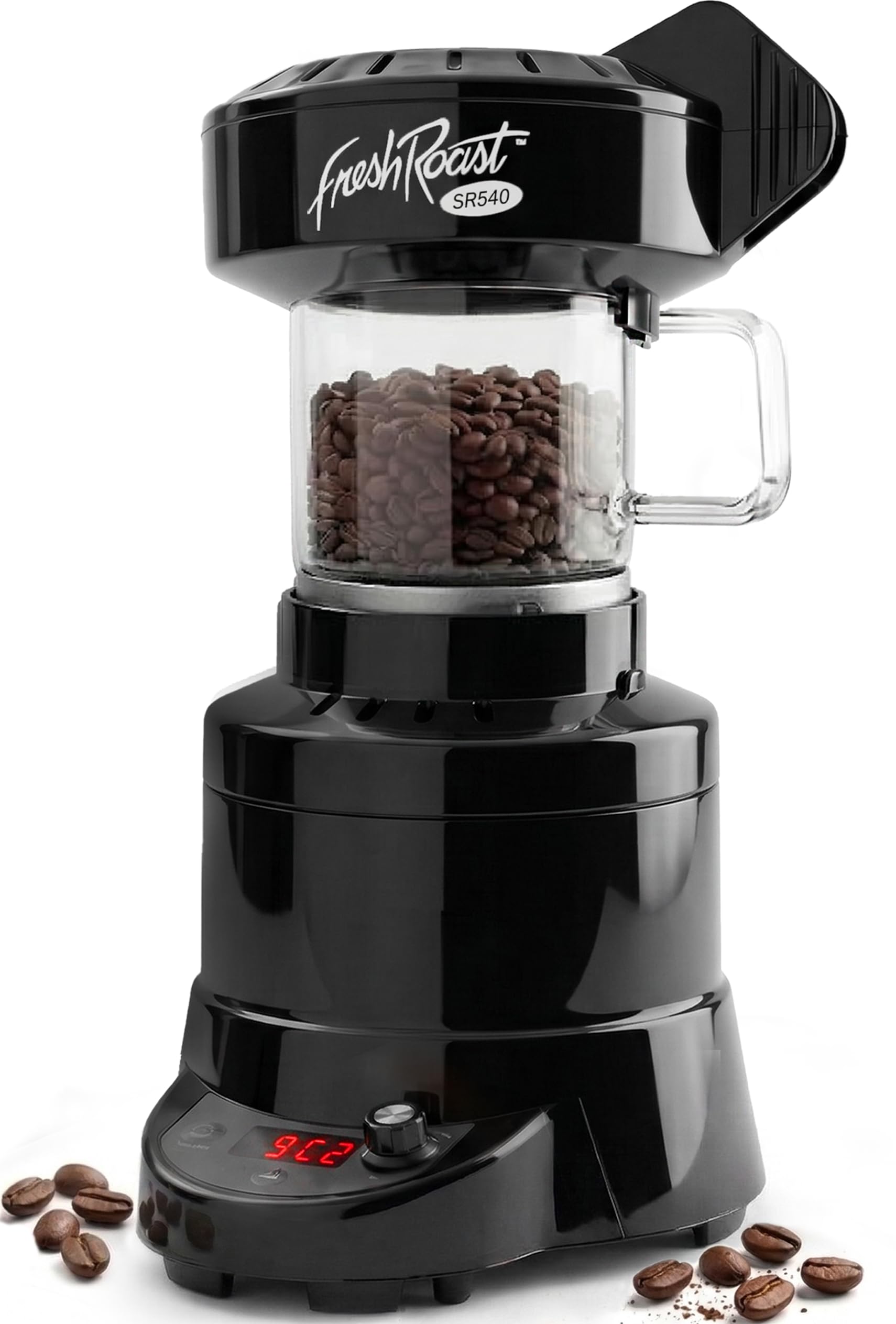
Fresh Roast SR540
Key Features
- Chamber: Glass with chaff basket
- Controls: 9 power levels plus fan speed
- Batch capacity: 4.23 oz
- Temperature display: Real-time readout
- Price: Midrange
Four scoops of green beans is the whole recipe. That’s 120 grams, which the maker turns into seven to fourteen cups of brewed coffee in under ten minutes — roughly a week of mornings for one or two people. Small batches look like a limitation until you’ve roasted a few, because they let you take one bean, roast it three ways in an evening, and taste the difference on Thursday.
The controls are why it holds the top spot. Nine power levels and a separately adjustable fan give you two things to steer with, and that matters more than the temperature readout suggests: on an air roaster you’re setting power and airflow rather than holding a target number, so you watch color through the glass, listen for first crack, and nudge. The chaff basket is the quiet luxury here — the chaff collects instead of snowing over the counter, and the glass chamber lifts off for a rinse.
Throughput is better than the batch size implies. Back-to-back roasts will work through a pound of green coffee in well under an hour, and because each one is small, a mistake costs you a few days of coffee rather than a month of it. We got steadier results from a fixed fan setting and a slow climb through the heat levels than from chasing a profile, which is the sort of thing this machine rewards.
The balance is what tips it for us: enough control to taste what a fan adjustment does, enough capacity to keep a household in coffee, and a chamber that comes apart for cleaning in a couple of minutes. This is the roaster we hand to someone who wants to understand roasting rather than outsource it.
Pros
- Separate fan control and nine power levels
- Glass chamber keeps the whole roast visible
- Chaff basket contains the mess
- Small batches make experiments cheap
Cons
- Lid and top assembly go brittle with heat
We recommend the SR540 first for anyone new to roasting: 120-gram batches, a fan and nine power levels to steer with, and a glass chamber that hides nothing.
Best for Weekly Large Batches
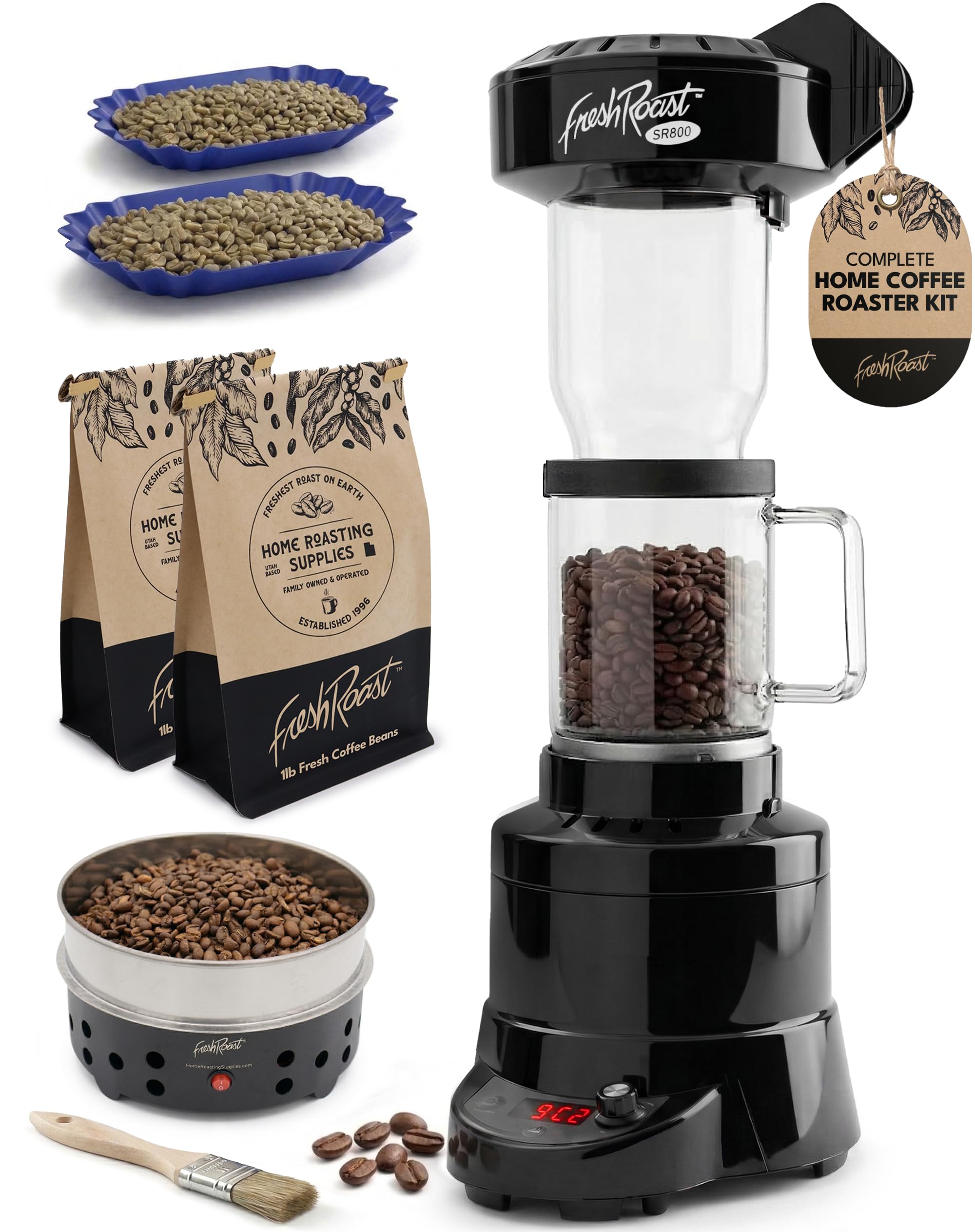
Fresh Roast SR800 Bundle
Key Features
- Power: 1750 W
- Controls: Adjustable heat and fan
- In the box: Extension tube, bean cooler, green beans
- Batch capacity: 8 oz (226 g)
- Price: Premium
Twice the batch of the SR540 is the headline: 226 grams of green beans instead of 120, with the same separately adjustable heat and fan. The bundle adds the two accessories that actually matter at that size. A glass extension tube keeps more heat in the chamber and keeps the beans moving, and a separate bean cooler lets you dump a hot batch and pull the temperature down hard.
That cooler is worth more than the extra capacity. Beans keep cooking from their own heat after you cut the power, and on a large batch that carryover is the difference between the roast you planned and one that drifted a shade darker while you were disconnecting the chamber. At 1750 watts it draws more than anything else here, so give it an outlet that isn’t sharing with a kettle. We think it’s the right step up for a household going through a pound a week; for one person roasting now and then, it’s more machine than the job needs.
Pros
- 226-gram batches, nearly double the SR540
- Extension tube improves heat retention and bean movement
- Bean cooler included, so big roasts stop on command
Cons
- Top-heavy chamber is awkward to load
Twice the batch of our top pick, plus the extension tube and cooler that make a bigger roast finish where you aimed it.
Best for Indoor Setups
NIASIA PKF-500g
Key Features
- Modes: Automatic presets and manual
- Cooling: Separate tray and fan
- Batch capacity: 500 g (350–400 g best)
- Smoke handling: Filter plus vent pipe
- Price: Premium
Smoke is what decides where a roaster can live, and this is the only machine here with an answer built in: a smoke purifier for light roasts and a vent pipe you can run outdoors for medium and dark ones. That’s why we recommend it first to anyone roasting in a kitchen rather than a garage. It’s also the biggest step up in this group — a stainless drum that takes 500 grams, automatic profiles for when you don’t want to think, and full manual control when you do.
The automation is more usable than most. Nine presets run an entire roast including the cool-down, and an assist mode lets you nudge a profile you mostly like instead of rebuilding it from scratch. The drum is happiest at 350 to 400 grams rather than filled to its ceiling, and at that load the beans turn consistently enough that the presets land close to the mark.
The separate cooling tray is the detail we appreciated most. Dumping 400 grams of just-roasted beans into a tray with its own high-speed fan stops the roast in a way a pan roaster can’t, and it’s the difference between the medium you aimed at and a medium-dark you didn’t. Add the temperature probe and the intelligent hold, and this is a machine that rewards a little setup with a lot of repeatability.
Pros
- Smoke filter plus vent pipe for indoor use
- Separate cooling tray stops the roast fast
- Presets, assist mode, and full manual control
- 500-gram stainless drum
Cons
- Twenty-inch height needs clearance above it
Smoke decides where a roaster can live, and this is the only machine here with a built-in answer — plus presets, a cooling tray, and a 500-gram drum.
Best for Watching the Roast
DYVEE KAKA-G400
Key Features
- Drum: Quartz glass
- Motor: 12 V with adapter
- Heat source: Gas burner
- Batch capacity: 400 g max (200–300 g best)
- Price: Midrange
The drum is the whole idea. A quartz glass cylinder turns over a burner, and because you’re watching the beans rather than a readout, you learn what a roast looks like at every stage — the yellowing, the first crack, the moment the surface goes smooth. Nothing else here teaches that as directly, and the 304 stainless frame cradles the drum on rollers so it turns without fuss.
We think it’s the best second roaster in this group, and a genuinely good first one if you already cook with gas. It’s manual in the fullest sense: you supply the heat, you decide when to cut it, and a 12-volt motor just keeps the drum turning. Treat 400 grams as a ceiling; 200 to 300 grams is where the drum turns the load properly and you can still follow the color against the glass.
The thermometer is the weak link. The probe is genuinely useful — it’s the only way to know what the chamber is doing — but mounting it on the frame takes more fumbling than the rest of the machine deserves. Give it an evening before you judge a roast; the first batch through a new drum is a calibration run, not a verdict.
Pros
- Quartz drum shows every color change
- Stainless frame with a 12-volt motor
- Small batches are easy to control by eye
Cons
- No burner included; heat and venting are yours
For a cook who already has gas, this is the most instructive roaster here: a quartz drum you watch directly, for less than the automatic drums.
Best for Budget Big Batches
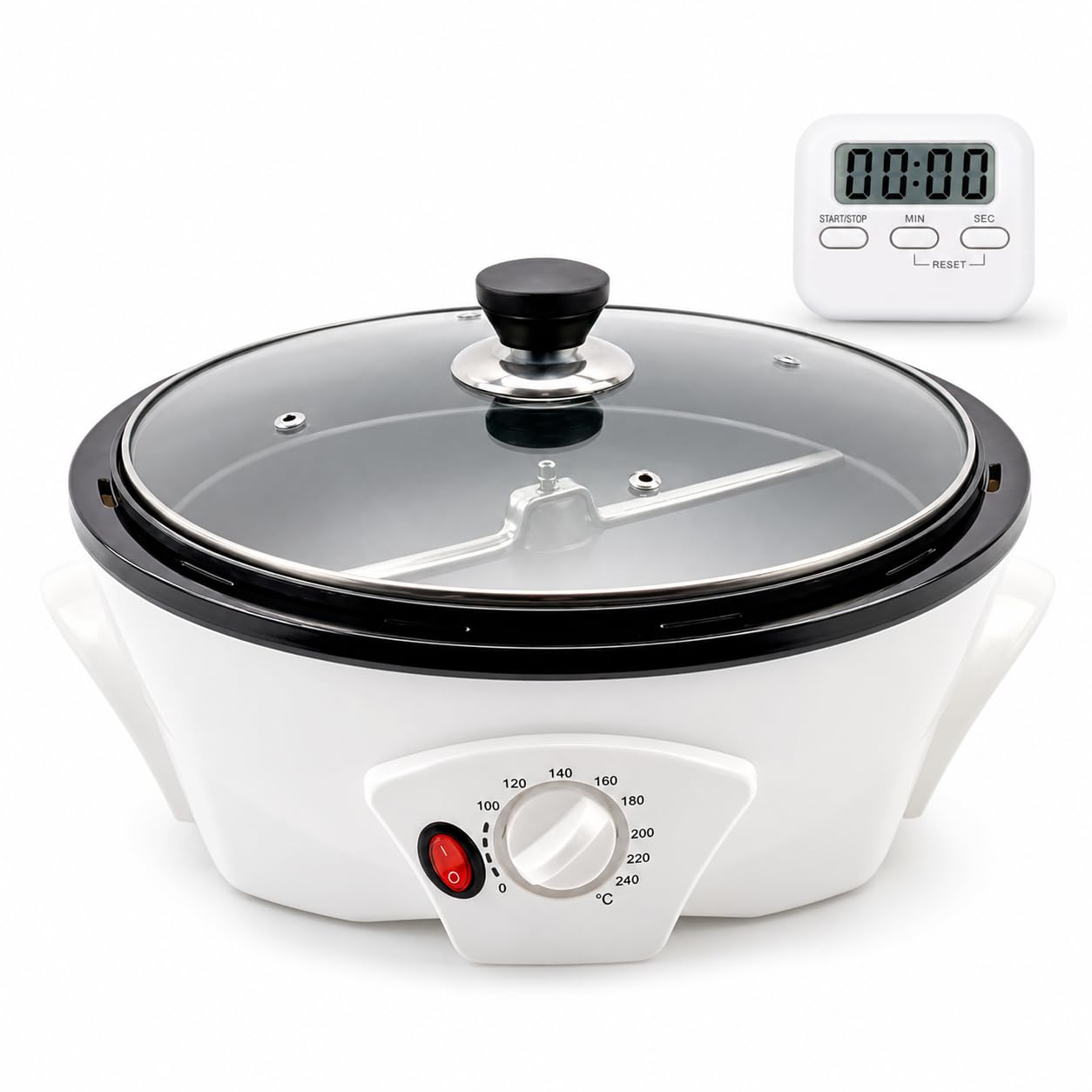
GIVEROO Coffee Roaster
Key Features
- Lid: Transparent glass
- Power: 800 W
- Batch capacity: 800 g max (400–500 g best)
- Temperature range: 0–240 °C
- Price: Budget
Volume is what this one sells, and it sells it more cheaply than anything else here: an 800-gram pan with a stirring arm that will take a full pound of green coffee in one go. We think that’s the right buy for a household that drinks a lot and doesn’t want to stand over three batches in a row. What it isn’t is a drum roaster — the beans sit in a hot pan and get turned, so the roast is driven by pan temperature rather than airflow, and the cup shows that difference.
One habit separates good batches from disappointing ones: sift the green beans before they go in. Small or damaged beans can wedge under the arm and stall it, and the maker’s own guidance says as much — a thirty-second sort saves you a jammed roast and a scrapped batch. Beyond that it’s pleasantly uneventful, with a glass lid for watching color and a non-stick base that wipes out.
Pros
- Takes a full pound of green beans
- Glass lid and non-stick base clean up easily
- Stirring arm does the work for you
Cons
- Wants a 400-gram load to roast evenly
Volume is what you’re buying: a stirring pan that takes a full pound at once, provided you load it heavy and sort the beans first.
Best for Learning by Hand
Nuvo Eco Hand Roaster
Key Features
- Interior: Waffle-shaped
- Material: Ceramic with cowhide grip
- Batch capacity: 2.47 oz
- Roasting method: Manual, hand-held
- Price: Budget
You hold it. That’s the entire proposition — a ceramic pot with a cowhide grip and a waffle-patterned interior, worked over a burner while the beans tumble against the ridges. No cord, no display, no fan, and no automation to hide behind. There’s a hole at the back so you can hear the crack clearly, which turns out to be more informative than a temperature readout.
The ceramic earns its place. The waffle interior keeps the beans rolling against a hot surface instead of sitting in one spot, and that direct contact means the roast develops at a pace you can follow by smell and sound rather than by numbers. It’s also hard to break in a way that matters — there’s nothing electrical to fail, and the body wipes clean.
We recommend it to two buyers: someone who wants to find out whether home roasting is for them before committing to a machine, and someone who already knows and wants a small, quiet ritual. Neither will mind that the roast demands your arm the whole way through, because that attention is the product. Steady swirling teaches you more about first crack than a month of reading about it.
Pros
- Waffle interior keeps beans turning evenly
- Rear hole lets you hear first crack
- Nothing electrical to break
Cons
- Short handle keeps your hand near the flame
- Seventy-gram batches make only a couple of cups
The slowest, least expensive way in: a ceramic hand roaster that turns a bag of green beans into a real education in roast.
Best for Timed Large Batches
JIAWANSHUN FBA066

Key Features
- Lid: Glass with four vents
- Power: 1200 W
- Batch capacity: 800 g max (300–500 g best)
- Temperature range: 100–240 °C
- Price: Budget
The useful number isn’t the 800-gram ceiling in the title; it’s 300 to 500 grams, the range where the arm can keep the whole load turning and the beans brown at the same rate. Treat it as a half-kilo roaster and it behaves. Fill it to the top and the beans at the edge of the arm’s sweep get left behind, and you end up with a batch that browns at two different speeds.
The rest of the pitch is convenience: a dial from 100 to 240 °C, a timer so you can step away for a few minutes, a glass lid with four vents for watching color, and a honeycomb non-stick interior that wipes out. Against the GIVEROO you’re paying a little more for more power and a timer; the two are otherwise the same idea in different housings.
Where it lands for us is a second machine, or a big-household machine. This isn’t the one to learn on, because the roast rewards close attention to load size and the results swing with it. But if you already know you’ll go through a pound a week and you want a timer doing the watching, it earns its place on the counter.
Pros
- Timer plus a 100–240 °C dial
- Glass lid with four vents to watch color
- Non-stick interior wipes clean
Cons
- A stray bean can stall the stirring arm
Treat the 800-gram headline as marketing and it’s a decent big-batch pan roaster with a timer, a dial, and a glass lid.
How We Tested Home Coffee Roasters
We built the shortlist by comparing published batch capacities, heat sources, control types, and replacement-part availability, then ruled out machines with vague temperature claims or no clear capacity rating. From that group, we tested eight roasters over eight months, with each machine getting at least six weeks of regular use. We looked for machines that could hold a repeatable roast, not just hit a high temperature once.
Testing happened on a kitchen counter, not a lab bench. I roasted on weekend mornings and weeknights, weighing green beans to each machine’s stated capacity and just under it, then logging time to first crack and total roast time. I ran back-to-back batches for espresso and single batches for pour-over, let the beans rest for several days, and tasted them side by side. We also timed setup, preheat, and cleanup, and noted whether the manual made the first roast feel doable or like a troubleshooting exercise.
For temperature control and adjustability, I stepped heat and fan settings in small increments and watched whether the roaster responded promptly or drifted. An external probe let me check the displayed temperature against the actual bean mass, and I noted whether those changes were repeatable from batch to batch. Durability and reliability got the unglamorous test: repeated roasting, emptying chaff, wiping surfaces, and checking switches, drums, and lids after weeks of use. Functionality counted only where it changed the roast; we compared each machine’s results and build against its price to judge value. We’ll keep using these for longer-term updates.
How to Choose a Home Coffee Roaster
The machine matters less than the room it sits in and the batch size you’ll actually roast — settle those two and the rest is preference.
Decide where it will roast before you decide what to buy
Every machine here makes smoke, and only one arrives with anything to do about it. Air roasters push exhaust and chaff straight out of the top; pan roasters and drums leak smoke around the lid. A hood that vents outdoors, a window with a fan, or a table on a porch shapes your first year of roasting more than the brand on the box does.
Note the catch on the NIASIA: its filter is built for light roasts, and the moment you go darker you’re on the vent pipe or back outside. No filter here makes a dark roast indoor-friendly.
Pick a batch size you’ll actually use
A 120-gram batch yields seven to fourteen cups; a half-kilo drum gets you closer to a pound, minus what the roast drives off. Small batches aren’t the compromise they look like — they let you roast one bean several ways in an evening and compare them side by side, which is the fastest way to learn.
If you already know you’ll roast weekly and drink a lot, buy capacity once and accept the longer heat-up. If you’re still working out what you like, buy small and roast often; the feedback loop is worth more than the throughput.
Learn what the dials really adjust
This is where buyers get caught. On an air roaster, the heat setting is a power level and the fan decides how long the beans stay in the hot air — the display tells you the temperature, it doesn’t hold one for you. A pan roaster cycles a thermostat while an arm stirs. Only a drum with a probe and presets behaves like an oven.
One machine here, the DYVEE, has no heating element at all: you set it on a gas burner you already own. Decide whether you want to steer a roast or set it and walk away, then buy accordingly.
Cooling, chaff, and what wears out
Beans keep cooking off their own heat after you cut the power, so cooling speed decides whether the cup matches the roast you planned. A separate cooling tray beats a colander and a fan, which beats leaving the batch in the chamber. Chaff handling matters too — a basket or a vented lid keeps it out of your kitchen instead of over it.
On longevity: glass chips, non-stick coatings wear through, and the plastic tops on air roasters go brittle with repeated heat cycles. Treat any of these as an appliance rather than an heirloom, and budget for replacing it eventually.
Frequently Asked Questions
Can I roast coffee in a popcorn popper or on a sheet pan instead?
You can, and an air popper moves beans through hot air much the way an air roaster does. What you give up is control: no separate fan setting, no temperature readout, chaff blowing across the kitchen, and a plastic housing that wasn’t built to run hot for ten minutes at a stretch. A dedicated roaster buys repeatability — the same load and the same settings twice in a row.
How long should freshly roasted beans rest before brewing?
Give them a day. Beans straight off a roast release gas for hours, and brewing inside that window gives a flat, foamy cup, especially under espresso pressure. Light roasts often hit their best somewhere between two days and a week; darker roasts peak sooner and fade faster. Taste the same batch on day one, day three, and day seven and you’ll find your own window quickly.
Will a home roaster trip my breaker?
It can, if it shares a circuit. The electric machines here run from 800 to 1750 watts, and at 120 volts the biggest pulls close to 15 amps — effectively a circuit to itself. Run a roast with nothing else heavy on that outlet, and feel the plug and cord after the first few batches to make sure nothing is warming up.
Can these machines roast nuts and grains too?
The stirring-pan models list peanuts, chestnuts, barley, and popcorn alongside coffee, and they handle those without much fuss. Air roasters are fussier, since nut oils and hulls end up in the chamber and the fan. If dual use matters, pick a pan roaster with a non-stick interior and clean it thoroughly before the next coffee batch.
Final Verdict
The SR540 is the roaster we tell most people to buy, because it does the two things that matter: it shows you what is happening, and it gives you enough control to act on what you see. If 120 grams is too small for your household, the SR800 doubles the batch and adds the cooler that makes a bigger roast land where you aimed.
If the machine has to live indoors and you want presets and a cooling tray doing the work, the NIASIA is the one. And if you want to learn by hand for very little before committing, start with the Nuvo.