This post contains affiliate links. We may earn a small commission when you buy through our links — at no extra cost to you.
A freezer full of bargain steaks and late-summer tomatoes is a great idea until, three months later, everything tastes faintly of frost and regret. A vacuum sealer is the fix: it pulls the air out of the bag, which is what causes freezer burn, ice crystals, and that dried-out texture. The good ones also earn their counter space in other ways—portioning bulk meat, keeping coffee beans fresh, and making sous vide setups less fussy. But a weak pump or a fussy lid can turn a quick chore into a wrestling match.
I’ve spent the past eight months living with 12 vacuum sealers, from compact handhelds to countertop models, and the differences aren’t subtle. The best ones sealed wet marinades without a hiccup, locked shut with one hand, and tucked into a drawer when I was done. Some were faster, some were quieter, and a few made me appreciate why value matters more than a long feature list. The picks below are the ones that earned a permanent spot in my kitchen—and kept the freezer burn at bay.



Best for Weekly Meal Prep
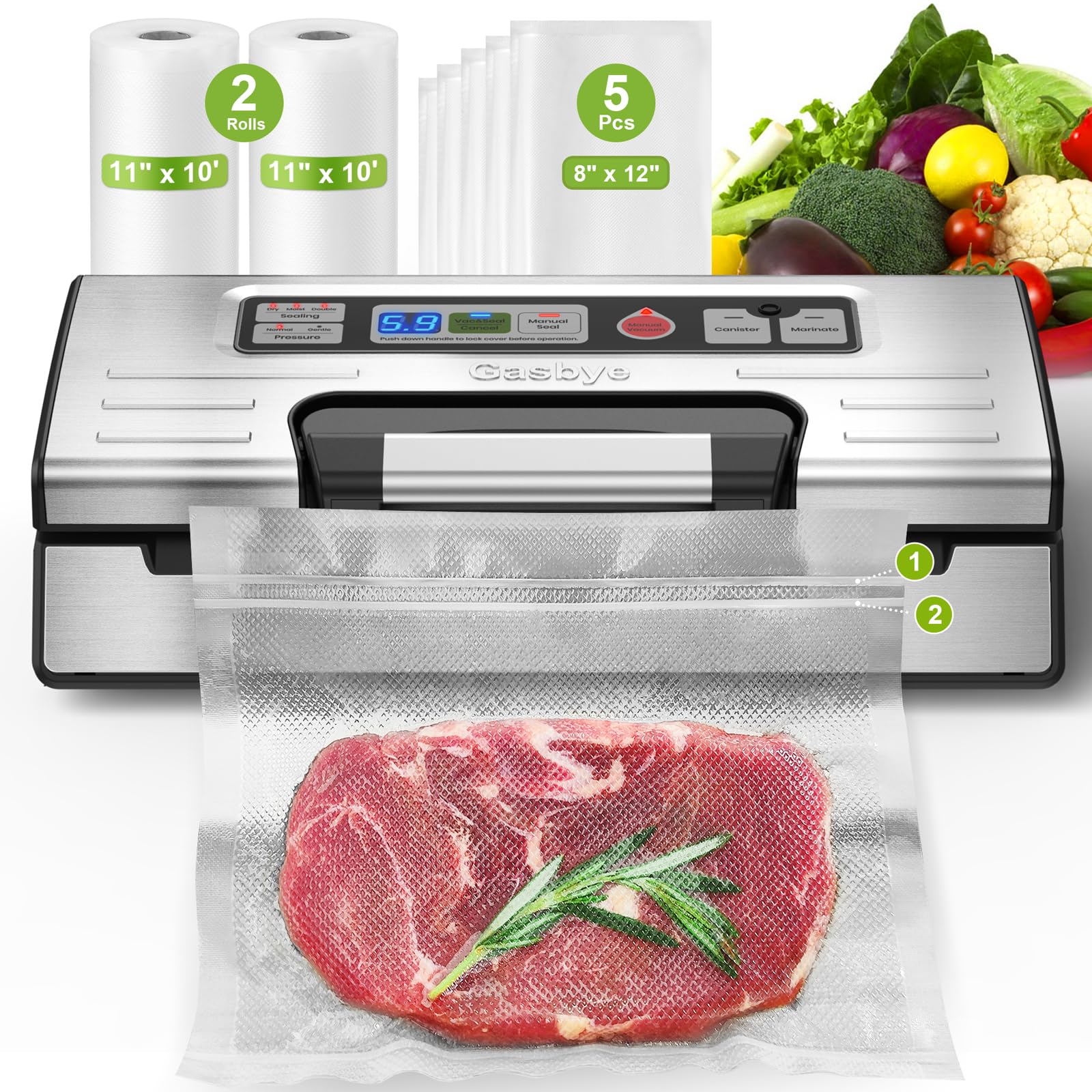
Gasbye VS5166 Vacuum Sealer
Key Features
- Weight: 6.5 lb
- Sealing: Double heat seal
- Bag handling: Built-in roll storage and cutter
- Suction power: 95kPa
- Price: Premium
The mess is what separates a sealer you keep on the counter from one that ends up at the back of a cupboard. Marinated chicken, a half batch of chili, anything with liquid in it pulls toward the bag mouth, and on most machines you end up wiping out the channel and starting over with a fresh bag. The Gasbye is the one here that expects that to happen: pulse control lets you draw vacuum in bursts and stop before the liquid reaches the seal, and the drip tray lifts out for the bag that gets away from you.
The hardware behind it is more than the usual one-button box. Two sealing strips lay down a double heat seal, which is the difference between a bag that stays shut until you want it open and one that works loose and gives you freezer burn. The 95kPa pump pulls hard and quickly, the display tracks the cycle, and the locking handle clamps the lid in one motion instead of asking you to press both corners down and hope.
Bag handling is the part we appreciated most. A roll lives inside the machine and the cutter is built into the lid, so an awkward portion gets its own bag instead of wasting a big pre-cut one, and the two rolls and quart bags in the box get you started. The external hose pulls air from containers and jars, which is how you seal a marinade without dragging liquid through the bag channel. Gasbye also sells replacement gaskets and a spare drip tray, and there are two spare gaskets in the box — a small thing that decides whether a good sealer becomes a useless one in year three.
At 6.5 pounds and nearly 16 inches wide, it wants a home on the counter or a wide shelf, and it costs more than most of the machines here. What that buys is fewer failed seals on the food you actually cook, not just on dry chicken breasts. If you’ll seal something most weeks, this is the machine we point you to. If you’ll seal a few times a year, the Fresko gets you most of the way for considerably less.
Pros
- Pulse control plus a lift-out drip tray for wet food
- Double heat seal holds through freezer storage
- Built-in roll storage and cutter cut bag waste
- External hose seals containers and jars
Cons
- Counter-bound at 6.5 pounds and 15.7 inches
This is the one we recommend to anyone sealing real food weekly: pulse control and a drip tray handle wet marinades, the double seal holds, and the bag system pays for itself.
Best for Budget Freezer Prep
Fresko V2 Vacuum Sealer
Key Features
- Weight: 4 lb
- Sealing: 0.2-inch widened heating strip
- Operation: Automatic bag detection
- Suction power: 95kPa
- Price: Midrange
Fresko’s V2 is the machine we hand to someone who wants a serious sealer without paying serious money. Two pumps and a 140W motor give it a 95kPa rating, the same headline number as machines that cost far more, and it reaches it with automatic bag detection: slide the bag in, close the lid, and the machine runs the cycle without you holding a button down.
What earns it a place here is how much fiddling it removes. The bag-mouth clamp holds the bag still so it can’t drift out of the seal bar halfway through, the widened heating strip lays a broader seal across a bag edge that isn’t perfectly straight, and the extended-seal button gives you a second pass when a seam looks thin. Pulse vacuum is there for soft food — bread, berries, a burger patty you don’t want pressed into a disc.
Nothing about it feels premium: the body is light ABS, and the four-pound weight means it can live in a cupboard rather than earning permanent counter space. Treat it as an everyday machine for portioned meat, leftovers, and batch cooking and it earns its keep; hand it a chest freezer’s worth of bulk buys and you’ll want the Gasbye.
Pros
- Automatic bag detection at a mid-range price
- Pulse vacuum and extended seal for soft food
- Widened heating strip makes a broader seal
- Four-pound body stores in a cupboard
Cons
- Pockets of air can remain in moist or bulky loads
- Starter kit is pre-cut bags only
Buy this if you want automatic sealing and pulse control without a premium price; it does the everyday work and only asks that you keep the bag mouth clean.
Best for Tiny Kitchens, Travel
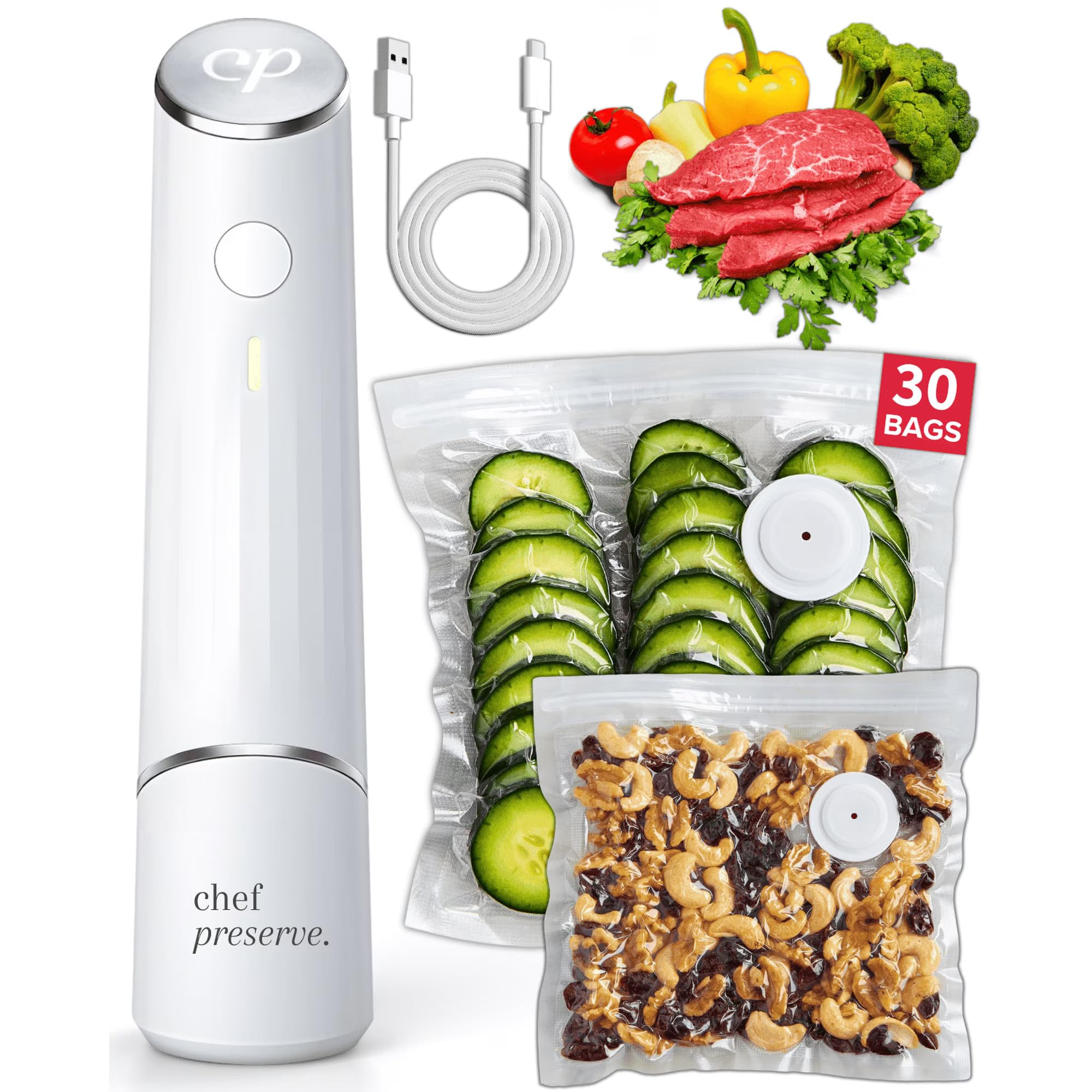
Chef Preserve Compact Sealer
Key Features
- Power: Rechargeable battery
- Weight: 2.2 lb
- Cycle time: 5 seconds
- Included bags: 30 reusable bags
- Price: Midrange
There’s no lid to clamp and no heat strip to wait for. The Chef Preserve is a 2.2-pound handheld that you press onto the valve of a zipper bag, hold for a few seconds, and drop back in the drawer. In a kitchen where a 15-inch countertop machine would either live permanently on the counter or not at all, that difference is the entire purchase.
It’s also the pick for resealing rather than preserving in bulk. Take a portion of frozen mince out of the bag, zip it, press, and the rest goes back in the freezer without a new bag or a new seal. The thirty reusable bags in the box are dishwasher, freezer, and microwave safe, and there’s no cord to hunt for — Chef Preserve rates a charge at around a thousand bags, far more than most kitchens will use between charges.
The catch is the bag, not the machine. A zipper bag needs a clean, flat zip to hold; a smear of marinade or a folded edge and the vacuum leaks back in, so you’ll be wiping and resealing. For small kitchens, campers, and anyone who reseals more than they preserve, that’s a fair trade, because this is the machine that actually gets used. For a season’s worth of raw meat headed into a chest freezer, it isn’t.
Pros
- Fits in a drawer instead of owning counter space
- Rechargeable, so no cord or outlet needed
- Five-second cycle with automatic shutoff
Cons
- Reusable bags wear out and add a running cost
- No heat seal, so bulk raw meat needs another machine
For small kitchens, campers, and anyone resealing frozen portions, this handheld earns its drawer space — just don’t expect it to replace a heat sealer for bulk meat.
Best for Jars and Containers
FoodSaver FM2100
Key Features
- Weight: 6.6 lb
- Sealing: Dual heat sealing strips
- Accessories: Accessory port and hose
- Bag handling: Built-in roll cutter
- Price: Premium
If your vacuum sealing is mostly about containers, jars, and marinades, this is the FoodSaver worth buying. It’s the machine here with a dedicated accessory port and a hose in the box, so you can pull air from a canister or a jar attachment without threading a wet piece of meat into a bag, and it carries one of the longer warranties in this group at five years limited.
Two heat strips make the seal, and the roll lives inside the machine with a cutter built into the lid, so you can size a bag to a leftovers container instead of folding a gallon bag around it. At 6.6 pounds and a little over 16 inches wide it’s a counter or shelf machine rather than a drawer one, and the bags it ships with cover quart and gallon sizes plus a roll.
What you’re paying for is the accessory system and the coverage rather than raw suction. Against the Gasbye it gives up pulse control and the stainless body, but for jars, canisters, and dry portioning it’s the simpler tool, and the automatic cycle means you can load it and walk away. If your freezer work is mostly dry and portioned, it’s a straightforward machine to live with.
Pros
- Accessory port and hose for jars and canisters
- Five-year limited warranty
- Built-in roll cutter makes custom bag sizes
- Dual heat sealing strips
Cons
- Seal can fail on a wet or bulky bag mouth
- Pump failures have happened inside the first year
Our pick for jars, canisters, and marinades: the accessory hose and long warranty make it the FoodSaver worth buying here, provided your food goes in dry.
Best for Light-Duty Sealing
MZROT 301E Vacuum Sealer
Key Features
- Modes: Dry, moist, external vacuum
- Display: Digital countdown timer
- Included: 10 bags and spare gasket
- Suction power: 75kPa
- Price: Budget
A countdown timer on a vacuum sealer sounds like a gimmick until you’ve stood over one guessing whether the cycle has finished. The MZROT puts the countdown on the front, so you can see how much vacuum is left and whether a bag needs another pass. It’s a small clarity that plenty of machines here don’t bother with.
That timer is the reason it’s our budget pick rather than just the cheapest thing on the page. It runs dry and moist modes, has a manual control for soft food, takes an external hose for jars, canisters, and wine stoppers, and runs quietly enough to use while someone is on the phone. For portioned meat, leftovers, and dry goods, it covers the job without feeling stripped down.
The kit is honest: ten bags in two sizes, a spare gasket, and the external hose, so you can seal the day it arrives. The compact body fits on a cupboard shelf. If you’re sealing a couple of portions a week and don’t want to spend much finding out whether you’ll keep doing it, this is where to start.
Pros
- Countdown timer shows the cycle ending
- Dry, moist, and external vacuum modes
- Ten bags and a spare gasket included
- Quieter than the price suggests
Cons
- Lowest suction rating in this group
- Slow to finish on large loads
A first sealer that won’t embarrass itself: the countdown timer, dry and moist modes, and external hose make it the best-equipped machine at the bottom of the range.
Best for Occasional Use
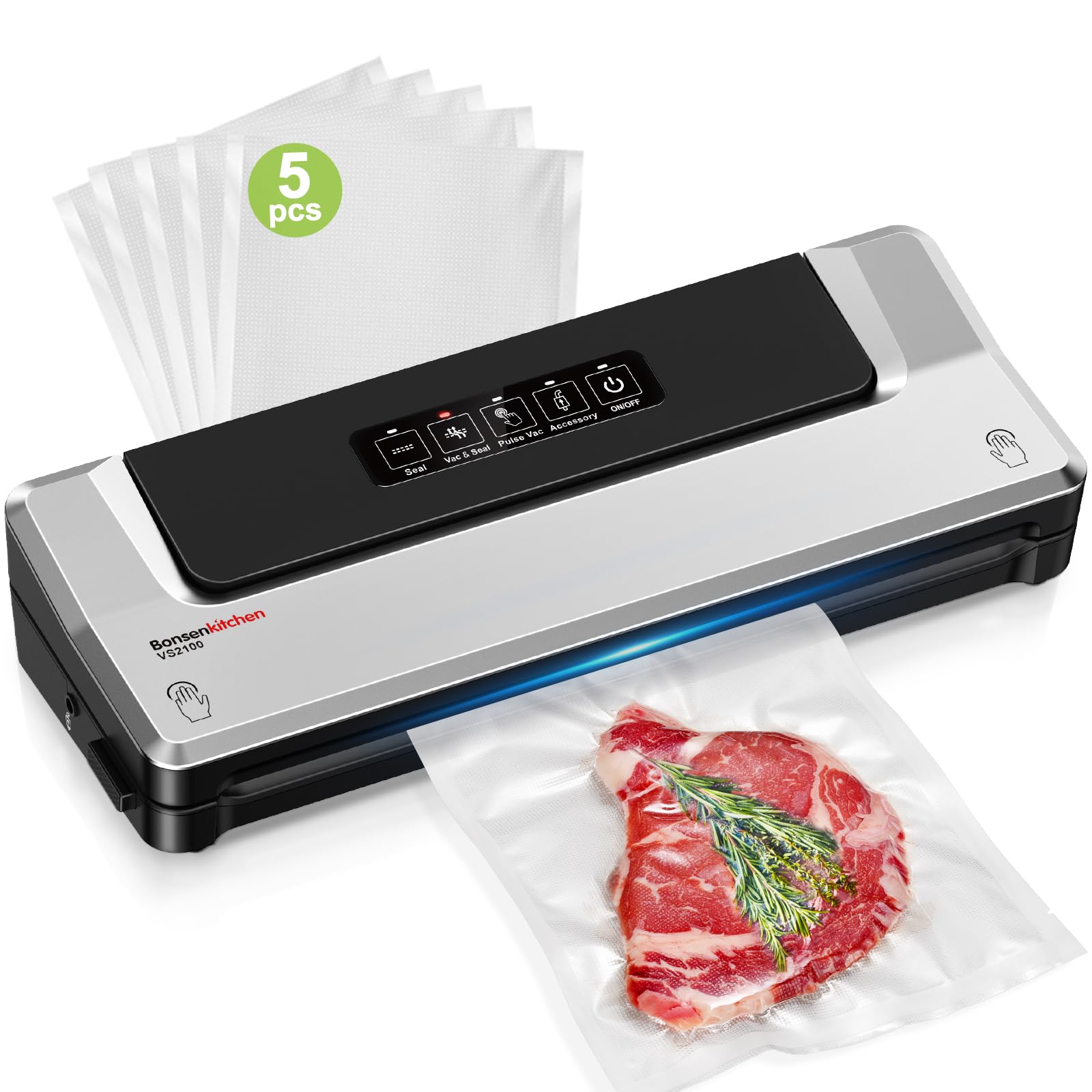
Bonsenkitchen VS2100
Key Features
- Modes: Four, including pulse vacuum
- Weight: 2.7 lb
- Included: 5 bags and suction hose
- Price: Budget
One of the cheapest machines here, and the one to buy if you’re not yet sure the habit will stick. You get automatic vacuum and seal, a manual pulse for soft food, and an external setting for jars and containers with the hose in the box — all in a body that weighs under three pounds and stores on a shelf.
Five bags come in the box, enough to find out whether you’ll keep at it and not much more, so budget for bags. Bonsenkitchen rates the machine at thirty bags in a row without a rest, which covers a bulk pack of chicken in one sitting, and the external interfaces mean the same hose handles a jar of coffee or a container of soup.
The sealing bar wants a clean, flat bag mouth. Wipe the inside of the bag, keep the fill line low, and it closes reliably; rush a wet bag through and you’ll be trimming the end off and running it again. The three-year coverage is unusually long for the price, and worth registering, because a cheap machine is exactly where a warranty earns its keep.
Pros
- Four modes including manual pulse
- Hose and two external interfaces for containers
- Light 2.7-pound body stores easily
Cons
- Suction falls short on large or wet loads
We suggest this one only as a low-cost trial: it handles portioned dry food and struggles with anything bulky or wet.
Best for Small-Batch Prep
JLHSWENND VS9312

Key Features
- Noise: Under 70dB
- Sealing: Double heat seal
- Included: 10 vacuum bags
- Suction power: 95kPa
- Price: Midrange
On paper this is the most complete machine in the middle of this group: 95kPa of suction, two heat wires for a double seal, a cutter and roll storage built into the body, and a noise claim under 70dB. That’s the same core specification as our top pick, at a lower price.
The details are thought through. Dry food seals in about nine seconds and moist food in around thirty, which is the slow, careful end of the range and the right approach for a wet bag. The second wire lays a parallel seam so one pinhole doesn’t open the bag, and the roll chamber means you cut to length instead of hunting for a pre-cut bag that fits a leftover half onion.
What you give up is certainty. This is a newer name with a one-year warranty, shorter than the coverage on the Gasbye or the FoodSaver, and there’s no long history behind it to lean on — how the pump behaves in year three is a genuine unknown. If you want the feature set without the premium and you’re comfortable being an early adopter, it’s the value play in this bracket. If buying once matters more than saving, the Gasbye is the safer spend.
Pros
- Double heat seal with two wires
- Built-in cutter and roll storage
- 95kPa suction at a mid-range price
- Rated under 70dB
Cons
- One-year warranty is on the short side
The spec sheet is the strongest in the middle of the range — double seal, cutter, roll storage — and the short warranty is what keeps us from ranking it higher.
Best for Bulk Batch Prep
ROUUO VS-6566

Key Features
- Motor: 230W
- Weight: 5 lb
- Sealing: Single or double heat seal
- Suction power: 95kPa
- Price: Midrange
230 watts is the biggest motor number in this group, and it’s the number to ignore. The rating that matters, 95kPa, is identical to what the Gasbye and the Fresko claim. What this one has that they don’t is a proper supply of bags: three rolls and ten pre-cut bags in the box, which is a starter kit rather than a sample.
The rest of the design is aimed at repeat use. A lockable handle clamps the lid in one motion instead of making you press two corners, the cutter is built in, and the rolls live inside the machine, so portioning a bulk pack doesn’t turn into a hunt for scissors and a bag that fits. An external hose handles jars and containers when you want to seal something that isn’t going in a bag at all.
The single-or-double seal setting is more useful than it sounds. Run one seam on a small bag and a double seam on anything headed for the freezer, and you spend bag material where it does some good — a double seam needs a little more bag at the opening, which is worth knowing when you’re cutting rolls to length.
For the money, this is the best-equipped machine in the bracket below our top pick, and the bag kit alone saves a purchase. The caution is the brand: it’s a newer name, and how the pump holds up over a few years of regular sealing is the open question. Buy it for the features and the starter kit; that’s where the value sits.
Pros
- Three rolls and ten bags in the box
- Easy-lock handle clamps the lid in one motion
- Single or double heat seal, your choice
- 230W motor and a 95kPa rating
Cons
- Counter-bound at 5 pounds and 16 inches
If you want the biggest starter kit and the fullest feature set below our top pick, we think this is the value buy — just accept that the brand is new.
How We Tested the Best Vacuum Sealers
We started by pulling every vacuum sealer we could find from brands we already trust and a few challengers, then filtered the list by price, bag compatibility, footprint, and whether replacement bags and rolls were easy to buy. That left 12 models, from handheld battery-powered units to countertop machines, and we ran them through eight months of normal kitchen life.
In my kitchen, that meant sealing weekly batches of chili and chicken thighs, breaking down bulk purchases from the warehouse store, portioning coffee beans, and prepping vegetables for sous vide. I timed how long each machine took from loading the bag to the final seal, counted how many tries it took to get a wet marinade sealed without a leak, and checked the bag a day later for loose air pockets or creeping frost. I also noted whether the lid needed two hands, whether the machine slid across the counter, and whether the controls made sense without the manual.
Every sealer stayed out on the counter for at least a month so I could judge how it fit in a real kitchen—some were slim enough to leave out, others went straight into a cabinet. I ran each one through repeated cycles to see if the pump weakened, the seal bar stayed clean, or the latch loosened. A good vacuum sealer should feel solid, seal fast, and make you want to use it, not dread hauling it out. The ones that scored best were the ones that did all three without asking for much money or counter space.
How to Choose a Vacuum Sealer
The number that decides whether you keep using a vacuum sealer isn’t the suction rating on the box — it’s how the machine behaves with the food you actually cook.
Start with liquid, not suction
Most failed seals start wet. A marinade, a stew portion, or a piece of fish pulls moisture toward the bag mouth, and once liquid reaches the heat strip the seam is compromised no matter how strong the pump is. Machines with pulse control let you draw vacuum in bursts and stop before the liquid arrives; a removable drip tray catches what gets through.
If you mainly seal dry cuts and blanched vegetables, this matters less and you can save the money. If you cook with sauce, braise, or marinate, it’s the feature worth paying for — the Gasbye builds its whole case on it.
The bag system decides your running cost
Pre-cut bags are convenient and cost more per bag. Rolls with a built-in cutter let you size each bag to the job, which matters for odd shapes, single portions, and anything you’d otherwise fold a gallon bag around. Over a year of regular use, that difference adds up faster than the price gap between machines.
Check the width the sealing channel accepts before you order bags in bulk — a bag that’s too wide won’t seal, and a roll you’ve already bought is wasted. Reusable zipper bags, the kind the Chef Preserve uses, invert the math entirely: more upfront, but you wash and refill rather than restock.
Read the seal, not the wattage
Motor wattage tells you about power draw, not seal quality. A 95kPa rating turns up on machines at every price in this group, and the practical differences come from the sealing hardware instead: two heat wires lay down a double seam that survives the freezer better than one, a wider heating strip forgives a slightly uneven bag mouth, and a locking handle holds the bag still through the whole cycle.
Those are the things to compare on the shelf. A big motor number with a single narrow seal is a worse buy than a modest one with two wires and a proper clamp.
Plan for where it will live
Countertop sealers here run 15 to 16 inches wide and 4 to 7 pounds. That’s a permanent strip of counter or a wide shelf, not a drawer, so measure before you buy and decide honestly whether you’ll leave it out. A machine that has to be unpacked every time won’t get used.
If space is genuinely tight, a rechargeable handheld stores in a drawer and covers resealing and small portions. It won’t replace a countertop machine for bulk work, but it beats a better sealer you never take out.
Warranty and the parts behind it
Coverage in this group runs from one year to five, and the length isn’t the whole story. A long warranty from a maker who sells gaskets, drip trays, and sealing strips keeps a machine in service; a long warranty on a name nobody has heard of is harder to cash in.
Check whether you need to register, whether the pump is covered or only the electronics, and whether consumables are easy to find. Those three answers tell you more about year three than any feature list.
Frequently Asked Questions
Do I have to use the manufacturer’s own bags?
Usually not, but the bag has to fit the machine. Most channel-style sealers take standard textured vacuum bags as long as the bag sits inside the sealing width and the channel closes on it cleanly.
Measure the seal bar and the channel before you order a box of bags in bulk; that number, not the brand name, is what decides compatibility.
How long does vacuum-sealed food keep in the freezer?
Longer than wrap, not forever. Lean meat and poultry sealed and held at 0°F keep good quality for roughly a year to eighteen months, while fatty fish and cured meats are better inside three to six months because the fat oxidizes regardless of the seal.
Write the contents and the date on every bag. A vacuum bag looks identical from the outside, and unidentified bricks are the failure people actually run into.
What maintenance does a vacuum sealer need?
Wipe the sealing bar and the area around it after anything wet, empty the drip tray if yours has one, and leave the lid unlatched between uses so the gasket doesn’t take a permanent set.
When bags that used to seal start failing, change the foam gasket before you blame the pump — it’s the cheapest fix and the most common one.
Final Verdict
Buy the Gasbye if you’ll use a sealer most weeks. Pulse control and a lift-out drip tray are what make wet food practical, the double seal holds, and the built-in cutter and roll storage turn a bulk pack into neat portions without a second gadget on the counter.
If the budget is tighter, the Fresko gets you automatic sealing, pulse control, and a wide heat strip for considerably less. And if there’s no counter to spare, a Chef Preserve in a drawer will get used more than a better machine left in a cupboard.