This post contains affiliate links. We may earn a small commission when you buy through our links — at no extra cost to you.
You buy a whole pork loin because it’s on sale, portion it out, and three months later you’re sawing frost off a chop that tastes like the freezer. A vacuum sealer fixes that: it pulls the air out before fusing the seam shut, which is the difference between meat that keeps for a year and meat that’s ruined by February. What separates one machine from another isn’t the suction number on the box — it’s whether the seal holds on a wet, juicy cut of raw chicken, and how long you have to hold the lid down. My team and I ran 11 sealers through our own kitchens over seven months, and the pattern showed up fast.
The surprise was how often the least expensive machines beat the pricier ones. A sealer that needs two hands, a firm press, and a countdown before it locks is one you’ll stop dragging out by week three, no matter how strong the pump. Reliability, not raw suction, is what you’re really shopping for. Below are the ones we’d buy again, sorted by what they’re good at.


Best for Weekly Meat Sealing
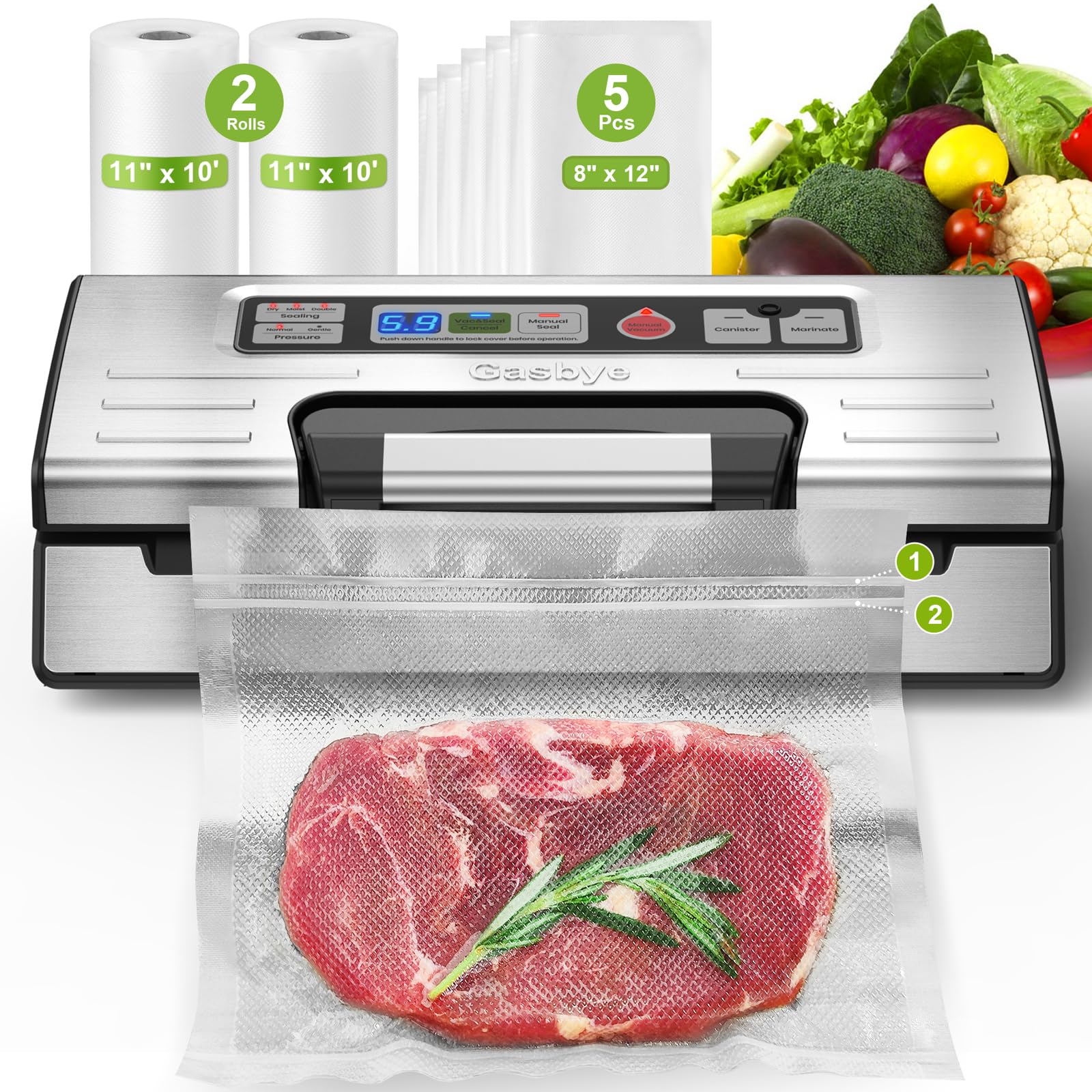
Gasbye VS5166
Key Features
- Sealing: Double heat seal
- Suction: 95 kPa
- Footprint: 15.7"L x 7.8"W
- Bag system: Roll storage and built-in cutter
- Price: Midrange
Two specifications decided this for us: a 95 kPa twin pump and a double heat seal that lays down two strips of plastic instead of one. Sealing raw meat is a bet that the bag will still be airtight in March, and that second strip is cheap insurance against a bag that weeps. Plenty of machines here manage one of those two things; this one manages both, and adds a lock handle, a progress display and a removable drip tray on top.
The drip tray turned out to be the detail we appreciated most. It catches what a wet bag gives up before any of it reaches the pump, and it lifts out for a rinse, so cleanup between a chicken run and a steak run stays short. It and the foam gasket are sold as replacement parts, and a worn gasket is the usual reason suction fades on any of these machines — being able to buy one is the difference between a five-minute fix and a new sealer.
Pulse mode gives you a manual override for marinated cuts: hold the button, watch the bag, stop before liquid climbs into the channel. Gasbye’s vacuum containers take a wet marinade out of the bag entirely, which is the cleaner answer for anything sitting in sauce.
What it costs you is counter space and money — at 15.7 inches long and 6.5 pounds it’s among the biggest machines we kept, and it’s priced above most of them. Neither bothered us much, because the roll storage and cutter are built in, so the space it occupies is space you otherwise spend on scissors and a box of bags.
Pros
- Double heat seal backs up every bag
- 95 kPa twin pump with pulse control
- Gasket and drip tray sold as parts
- Roll storage and built-in cutter
Cons
- Large footprint for a countertop machine
We recommend the Gasbye for anyone sealing raw meat week in and week out: 95 kPa of pull, two seal strips and a cutter that keeps bags tight.
Best for Tight Budgets
FRESKO V2
Key Features
- Weight: 4 lb
- Suction: 95 kPa
- Dimensions: 6.65"L x 15.04"W x 3.88"H
- Seal strip: 0.2-inch widened strip
- Price: Budget
This is the cheapest machine we recommend, and it doesn’t behave like one. Twin pumps are rated at 95 kPa, the motor at 140 W, and the heating strip is widened to 0.2 inches, so the seal spreads across more of the bag edge than most of this group manages. At 3.88 inches tall it’s also the shortest machine here, which means it lives under a cabinet or in a drawer without complaint.
What we appreciate most is how it copes with a wet bag. A bag-mouth clamp holds the edge steady while the pump works, and the extended seal button runs the strip longer when there’s moisture in the channel. Those two details decide whether a raw chicken breast seals on the first attempt or the third. Add pulse vac for anything delicate and you have the value call of this group for a household sealing a few packs a week.
Build is where the savings show. At 4 pounds it’s the lightest machine we kept, which is lovely when you’re lifting it out of a cupboard and the reason it feels less planted on the counter than the Gasbye. The starter kit is modest — ten pre-cut bags and two accessories — so plan on buying rolls.
Pros
- Twin-pump 95 kPa suction at a low price
- 0.2-inch widened strip for moist edges
- Bag-mouth clamp holds the edge steady
Cons
- Wet bags can keep pockets of air
Our value pick: twin-pump suction, a widened seal strip and a small body make it the sensible first sealer for a household packing a few meals a week.
Best for Big Batch Sessions
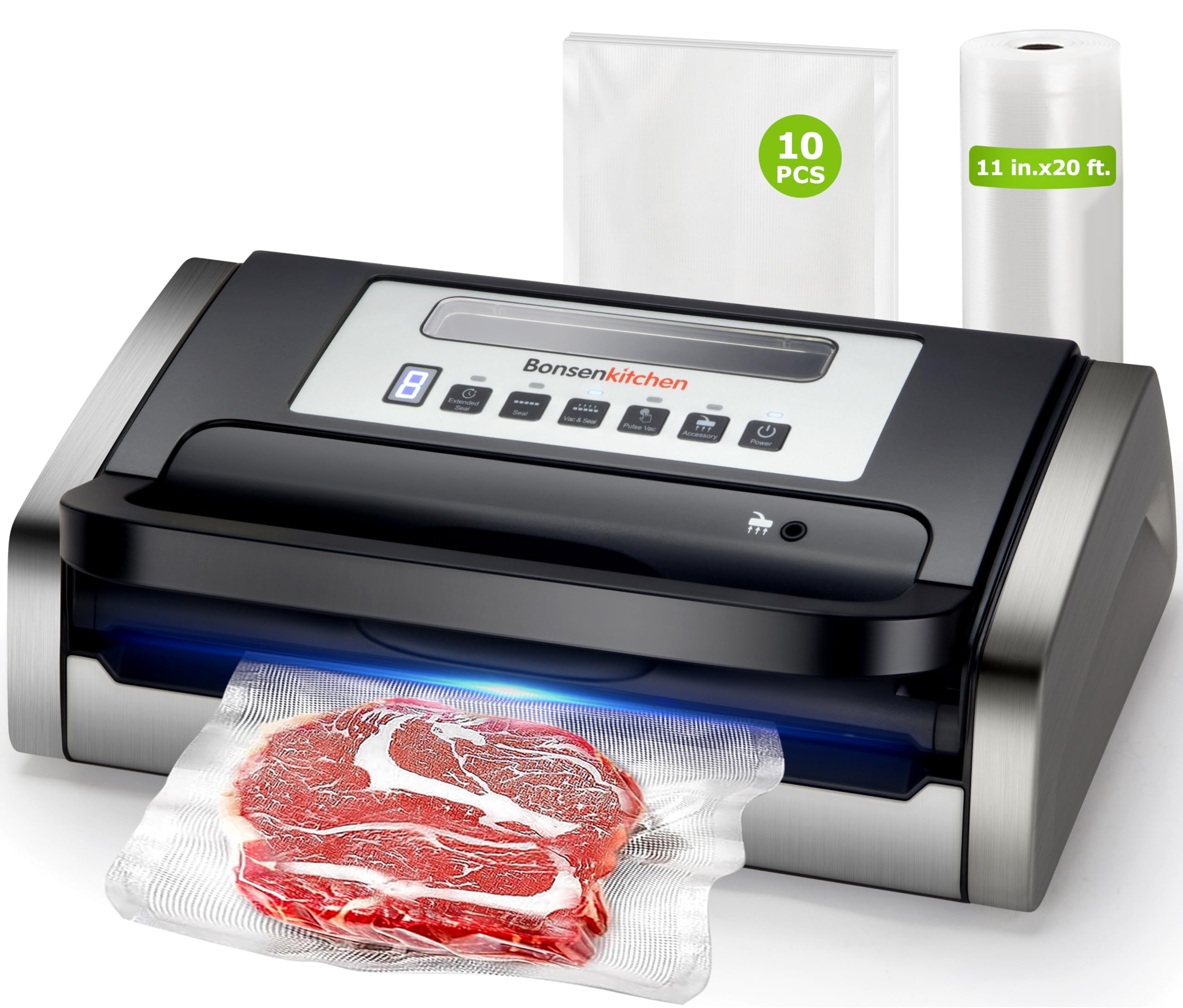
Bonsenkitchen VS4100
Key Features
- Noise: 65 dB
- Power: 135 W
- Pumps: Four vacuum pumps
- Bag system: Built-in cutter and storage
- Price: Midrange
A case of chicken thighs from a warehouse run is a different job from a single steak, and this is the machine built for it. Four pumps sit behind the suction, the handle locks one-handed so you can hold a bag with the other, and the cutter and bag storage are on board. Bonsenkitchen’s own figure is 50 bags in 20 minutes, and its 65 dB rating is the lowest number quoted in this group.
That noise figure matters more than it sounds. A bulk session runs long, and a machine that shrieks through forty bags is a machine you stop using. The handle lifts the lid rather than making you haul the whole top up, and after fifty bags that difference is real. The stainless-topped body carries enough weight to stay put while you feed it.
Where it asks something of you is the bag edge. A wet mouth is the enemy: wipe it dry, then run the extended seal rather than the standard cycle, and the seal takes. Skip that on a saucy batch and you’ll be cutting the bag open and starting again. For bulk work we reach for this one first, and the three-year quality commitment is real comfort on a machine that runs hot for twenty minutes at a stretch.
Pros
- Four pumps for long bulk sessions
- 65 dB, the quietest machine here
- One-handed lock handle and cutter
Cons
- Takes up serious counter space
We keep this one for bulk days: four pumps, a one-handed handle and the lowest noise rating here make short work of a chest freezer’s worth of portions.
Best for Long-Term Ownership
Potane VS5736
Key Features
- Weight: 4.6 lb
- Warranty: 5 years
- Bag storage: Up to 20 ft with cutter
- Sealing element: 8 mm
- Price: Premium
Five years of manufacturer coverage is unusual enough on a kitchen appliance that it caught our attention first, and it’s a big part of why the VS5736 made this list. The other part is the sealing element: an 8 mm strip instead of the 3 mm ones most machines here use, which puts heat across a wider band of the bag and leaves a broader seal behind.
The rest of the design is built for repetition. Bag storage swallows up to 20 feet of roll with a cutter on board, the chamber is half-wrapped so the lid locks with one hand, and an accessory port plus hose take jars, containers and bottle stoppers. It runs quietly too, which we don’t take for granted in this category.
One thing to know before you commit: the cutter slot is narrow enough that thicker third-party rolls can bind on the way through, so match your rolls to the machine and keep the offcuts for small jobs. That’s the only fuss we found. Everything else about it is quietly competent rather than clever, which is exactly what a machine you’ll use every week should be.
Pros
- Five-year manufacturer coverage
- 8 mm sealing element, wider than most here
- 20 feet of roll storage with a cutter
Cons
- Premium price for the set
For anyone planning to keep sealing for years, we point to the VS5736: five years of coverage, an 8 mm sealing element and 20 feet of bag storage.
Best for Freezer Organization
Beelicious Pro VSP801
Key Features
- Extras: Built-in label printer
- Weight: 5.9 lb
- Sealing: Double heat seal, widened strips
- Suction: 98 kPa
- Price: Premium
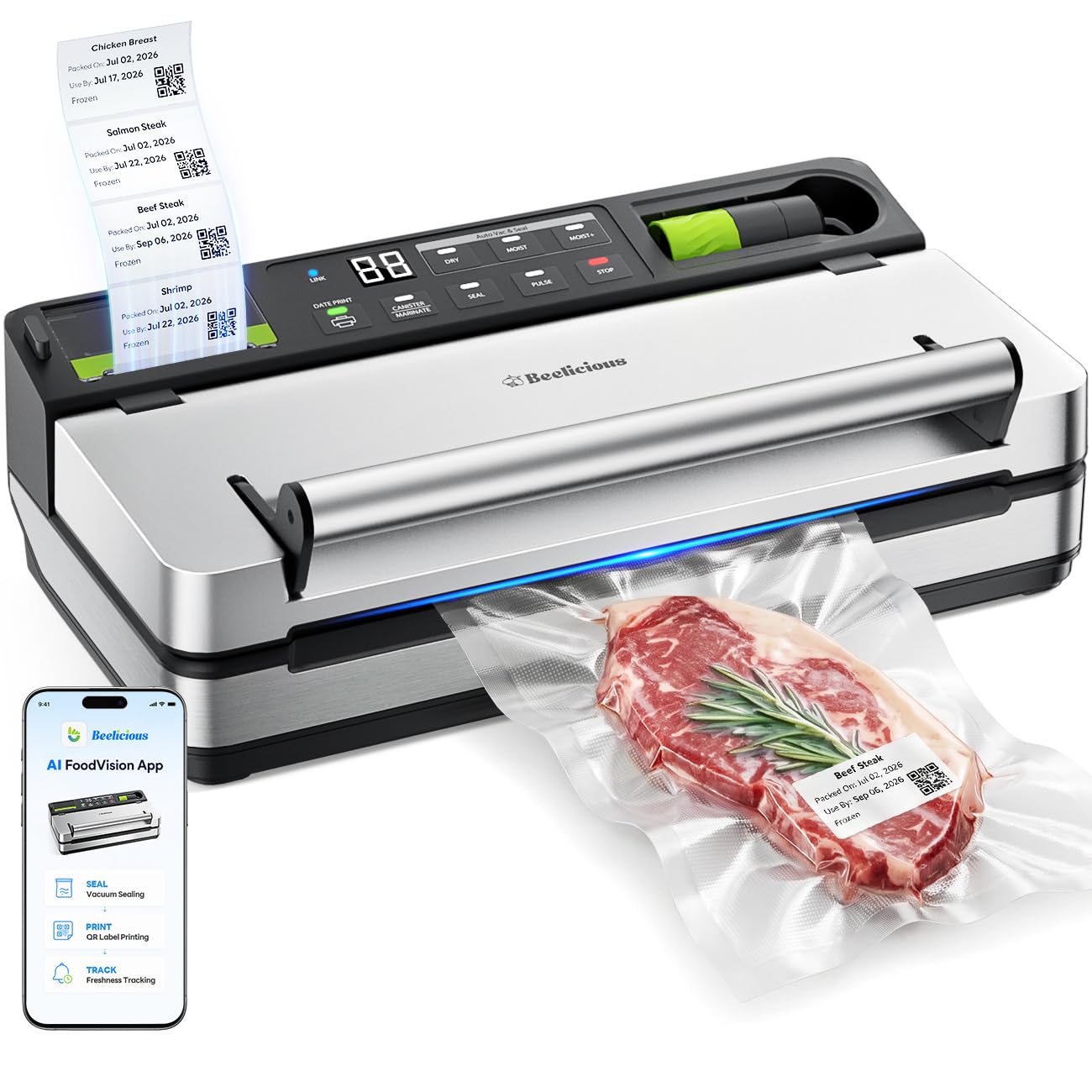
A label printer on a vacuum sealer sounds like a solution in search of a problem until you’ve stood in front of a chest freezer holding an unlabeled brick. The VSP801 prints a date, contents and a scannable code for each bag, and the app keeps the running list, so the question stops being whether the seal held and becomes what’s for dinner.
Under the gimmick is a serious machine. Twin pumps rated at 98 kPa give it the highest suction figure in this group, the heat seal is doubled and widened, and the extra-moist mode adds a moisture sensor that stops the pull before liquid reaches the channel, lets the bag settle, then seals. For raw meat and marinades, that pause is the difference between a clean seam and a channel full of chicken juice.
Footprint is the one thing to plan for. At 15.7 inches long and 5.9 pounds it wants a permanent home rather than a drawer, and the wide easy-lift handle needs headroom above it if it sits under a cabinet.
Where we land: in a house with one cook and one sharpie, labeling is optional. In a house with a chest freezer, two cooks and a bulk meat order, it turns a chore into a habit, and nothing else here does the bookkeeping.
Pros
- Prints dated labels and tracks them in an app
- 98 kPa dual pump with moisture sensor
- Extra-moist mode for marinated cuts
Cons
- Costs the most of any pick here
- Slower cycle than the quickest here
The one we hand to anyone whose freezer is a mystery: it labels every bag, and the 98 kPa pump with a moisture sensor handles wet meat without drama.
Best for Small Kitchens
JLHSWENND VS9312

Key Features
- Noise: Under 70 dB
- Sealing: Double heat seal
- Suction: 95 kPa
- Included: 10 vacuum bags
- Price: Midrange
Ninety-five kilopascals, a double heat seal, a built-in cutter with roll storage and a touch display: on paper this is the closest thing here to our top pick, and it asks less for it. The gunmetal finish looks better than most of the group, ten bags come in the box, and the machine is rated at under 70 dB — quiet enough not to dominate a small kitchen.
What keeps it out of the top tier is the depth behind it. This is the newest design we kept, with the least history to lean on, and for a machine that will handle a family’s meat supply year after year that counts for something. As a second sealer for a vacation house, a small kitchen or a first venture into vacuum sealing, the feature list is hard to argue with; as the only sealer in a household that runs one every Sunday, we point to the Gasbye.
Pros
- 95 kPa and a double seal for less
- Built-in cutter with roll storage
- Rated under 70 dB
Cons
- Starter kit runs out fast: 10 bags
We see this as the second-machine pick: 95 kPa, a double seal and a built-in cutter for less than our top pick, from a design with less history behind it.
Best for Accessory Add-Ons
FoodSaver FM2100

Key Features
- Sealing: Dual heat strips
- Warranty: 5-year limited
- Bag system: Roll storage and cutter
- Accessories: Accessory port and hose
- Price: Premium
FoodSaver’s advantage isn’t the box on the counter; it’s everything that fits it. The FM2100 takes the accessory hose and works with the brand’s containers, jar sealers and handheld attachments, and its bags and rolls are widely stocked. If you want one system for bags, jars and containers, that breadth is worth more than a suction figure.
The machine itself is plain in a good way: dual heat strips, one-touch sealing, roll storage with a cutter, and a lid that clamps without the small plastic tabs that snap off on cheaper designs. There’s a five-year limited warranty, and the bags are rated for up to three years in the freezer.
Seal consistency is where our enthusiasm cools. Dry, flat cuts seal cleanly; a wet, uneven piece of meat is where this machine needs the most help, and a bag that isn’t seated squarely can run a full cycle without sealing. At this price we recommend it for the accessory range and the warranty, not as the best pure meat sealer in the group.
Pros
- Works with the full FoodSaver accessory range
- Five-year limited warranty
Cons
- Bulky at over 16 inches long
Buy it for the ecosystem: every FoodSaver bag, roll, jar sealer and container fits, and a five-year limited warranty backs a simple machine.
How We Tested 11 Vacuum Sealers on Real Meat
We started with a list of about 40 machines and cut it down on specs that matter for meat: a moist setting or manual seal button, whether it takes generic rolls or only proprietary bags, seal bar width, and whether the gasket is a replaceable part. Consumable cost eliminated a few otherwise good units — a sealer that only accepts its own bags gets expensive once you’re buying meat in bulk. That left 11 machines, run for seven months.
Testing happened where these machines actually live: on kitchen counters beside the cutting board, usually right after a big shop. We portioned a pork shoulder into meal-size bags, sealed raw chicken thighs with the juices still on them, packed marinated flank steak, and flattened family packs of ground beef into bricks.
We judged air removal by eye and by hand — did the plastic pull tight around a bone, or did air stay trapped in a fold? Seal integrity meant inspecting each seam for wrinkles, gaps, and juice under the strip, then checking the bags at two weeks, six weeks, and three months in the freezer for frost forming inside. We timed every cycle with a stopwatch, lid closed to ready light, on a single chop and on a full bag — 30 seconds is fine once and tiresome at bag 20.
Ease of use came down to small things: whether the lid needed two hands, whether the machine slid across the counter mid-cycle, whether the latch felt like it would survive a thousand closes. For durability and reliability we ran each machine through 10 consecutive bags in one sitting to see which ones stalled to cool, and we watched gaskets and latches for wear. Value we weighed last: what each machine cost against how often we reached for it, and what a year of its bags would add.
How to Choose a Vacuum Sealer for Meat
The pump gets the attention, but the seal decides whether the meat survives the freezer, so buy for both and don’t pay extra for a suction figure the bag can’t use.
What suction figures actually tell you
The machines we kept run from 80 to 98 kPa, and the useful threshold sits around 95: at that level a dry cut pulls tight and stays tight. The last few kilopascals are bragging rights, and nobody feels the difference between 95 and 98. What really decides whether a bag evacuates is the foam gasket, the bag’s air channel and how full you fill it. A bag loaded to the seam traps air no matter which pump sits behind it, so buy 95 kPa or better and then judge the seal.
Why the seal strip matters more than the pump
A single narrow strip is fine until the day it isn’t. A double seal lays two bands of plastic across the bag, so a wrinkle or a nick in one leaves the other intact, and a wider strip — 0.2 inches on the FRESKO, an 8 mm element on the Potane — spreads the heat across more of the edge. For freezer storage and sous-vide, where a weeping bag means a ruined cut, we treat a double seal as close to mandatory.
Wet meat, marinades and the moist mode
Raw meat and marinades are where cheap sealers embarrass themselves. A moist setting on its own doesn’t stop liquid; what helps is pulse control you operate by hand, or a moisture sensor that pauses the cycle before juice reaches the channel, plus a removable drip tray to catch whatever gets through. Even then, the setting isn’t permission to seal a bag of liquid. Freeze sauces first, or use a vacuum container, which keeps the mess out of the machine entirely.
Bags, rolls and the cost after you buy
The machine is the cheap part. Every sealer here needs textured channel bags, and a smooth storage bag won’t evacuate at all. Pre-cut bags suit portioning the same cut over and over; a roll with a built-in cutter costs less per bag and lets you size the plastic to the meat, which is why we favor machines with storage and a cutter on board. If you buy in bulk, budget for rolls the way you budget for freezer paper.
Footprint, noise and where it lives
Most of these run 15 to 16 inches long and 4 to 7 pounds, which makes placement a counter decision rather than a drawer one. If it goes in a cupboard, weight matters; if it stays out, noise does — the quietest here is rated 65 dB, and anything approaching 70 is noticeable in a kitchen. Leave the lid unlatched between sessions so the gasket keeps its shape, and wipe down wherever juice collects.
Frequently Asked Questions
How long can vacuum-sealed meat stay in the freezer?
At 0°F, a well-sealed, bone-free cut holds good quality for six to twelve months. It stays safe well beyond that, but texture and flavor drift. Air is only half the problem; moisture and temperature swings do the rest. Date every bag as it goes in and rotate the oldest forward.
Do I still need to refrigerate vacuum-sealed meat?
Yes. Pulling the air out slows oxidation but doesn’t make food shelf-stable, and the low-oxygen environment inside a sealed bag can favor anaerobic bacteria, including the ones behind botulism. Keep sealed raw meat at 40°F or below, or frozen, and cook it within the same window you’d use for any raw meat. Vacuum sealing buys time, not permission.
How do I stop bones from puncturing the bag?
Two moves. Fold a small square of paper towel over rib ends and knuckle bones before the bag goes in, or double-bag those cuts. For very bony pieces such as ribs or a whole poultry frame, a vacuum container is a better home than a bag, since there’s no film to pierce.
Can I use one of these sealers for sous-vide?
Yes, as long as the seal is sound and the bag stays clipped below the waterline. Double-sealed bags are the safer bet for long cooks; a single seal on a wet cut is where failures start. Check the seam after the cook before you trust it with another piece of meat.
Final Verdict
If you seal meat more than once a month, buy the Gasbye. Two pumps, two seal strips and a cutter that keeps the bag tight are the three things that decide whether a bag survives until March, and it gets all three right while keeping gaskets and trays on the shelf.
For a tighter budget, the FRESKO does most of the same work in a lighter body. If your freezer needs a librarian more than a workhorse, the Beelicious prints the label.