This post contains affiliate links. We may earn a small commission when you buy through our links — at no extra cost to you.
The air fryer earned its permanent counter spot the first night it turned frozen fries shatteringly crisp in under twelve minutes — no preheating, no oven, no sheet pan to scrub. In practice, the gap between a great one and a so-so one shows up fast: fries that steam instead of crisp, a basket that’s a misery to scrub, a fan loud enough to drown out a phone call. What you’re actually buying is even browning and a basket you won’t dread washing.
I’ve cooked in these things for years, and my team has spent the past six months putting 14 air fryers through the meals we actually make — chicken thighs on a Monday, reheated pizza, a lot of frozen fries. The ones that rose to the top were quick, easy to use without the manual, and honest about what they deliver for the money. A tip before you shop: wattage matters less than basket shape — a wide, shallow basket browns more evenly than a deep, narrow one. The picks below earned their spots through repeat cooking.




Best for Most Kitchens
Cosori TurboBlaze 6 Qt
Key Features
- Capacity: 6 quarts
- Basket coating: PFAS-free ceramic
- Max temperature: 450 °F
- Dimensions (D x W x H): 14.4" x 11.8" x 11.9"
- Price: Midrange
Six quarts and a 450 °F ceiling is the pairing that puts the TurboBlaze at the top of this list. Capacity alone doesn’t win anything — the Ninja DualZone holds more — but the Cosori is the one that puts a genuinely family-sized square basket, one of the highest sustained temperatures here, and a body that still fits a normal counter into the same machine. That balance, more than any single number, is why it’s the one we point people to first.
Five fan speeds is the specification most shoppers skip, and it turned out to be the one we used most. Temperature sets how hot the element gets; fan speed sets how hard the air pushes, and being able to drop it is what stops a tray of vegetables from crisping to a shatter before the middle is tender. The 90 °F floor covers dehydrating and proofing dough, which is more range than most people will ask of an air fryer, but it’s there when you want it.
The PFAS-free ceramic coating on the basket and crisper plate is what makes it easy to keep using. Nothing sticks hard enough to need soaking, both pieces are dishwasher safe, and the touch panel is a flat strip you can wipe with the same cloth. Cosori backs it with a two-year warranty, which is the sort of detail you only think about in month thirteen.
The reality check is what six quarts actually holds: a single layer that feeds four as a side or two as a main, not six quarts of anything you like. Pile fries above the rim of the crisper plate and you’re steaming the top layer instead of frying it. That’s true of every basket here, but it’s worth saying before you plan a party around one.
Pros
- 450 °F ceiling browns frozen food properly
- Square 6-quart basket takes a full family batch
- Ceramic coating wipes clean and is dishwasher-safe
- Two-year manufacturer warranty
Cons
- No window; browning means pulling the basket
Our pick for most kitchens: a 6-quart square basket, a 450 °F ceiling, and a ceramic coating that wipes clean make it the easiest air fryer here to live with every day.
Best for Two-Dish Dinners
Ninja Foodi DualZone 10 Qt
Key Features
- Capacity: 10 quarts (two 5-quart baskets)
- Cooking zones: Two independent baskets
- Max temperature: 450 °F
- Dimensions (D x W x H): 17.1" x 14.65" x 12.87"
- Price: Premium
A protein in one basket and the vegetables in the other, at different temperatures, landing at the same moment: that’s the trick the DualZone performs, and it isn’t a gimmick. Smart Finish staggers the two timers so they finish together, and Match Cook runs them identically when you’re doing two trays of the same thing. We stopped cooking in sequence once this one was on the counter.
Ten quarts sounds enormous until you divide it: each basket is 5 quarts, which is a 6-pound chicken in one and a full tray of vegetables in the other. That’s a family dinner in a single pass, and it’s the reason two-dish cooks should come here rather than to the Cosori. The 450 °F ceiling matches the best in this set, and IQ Boost shifts power between the baskets when you’re running both without a synced finish.
What the trick costs you is in the sink afterwards. Each side is a drawer plus a crisper plate, so a two-dish dinner leaves four pieces to wash rather than two. They’re nonstick and rinse quickly, but if you hate dishes, that’s the honest trade for cooking two things at once.
Pros
- Two zones at different temperatures, finishing together
- 450 °F ceiling matches the best here
- Easy-clean nonstick baskets
- 10 quarts total for big households
Cons
- Bulky 18.7-pound body needs real counter space
Buy this if dinner regularly means two different dishes at different temperatures — nothing else here finishes a protein and a side together so cleanly.
Best for Big Batches
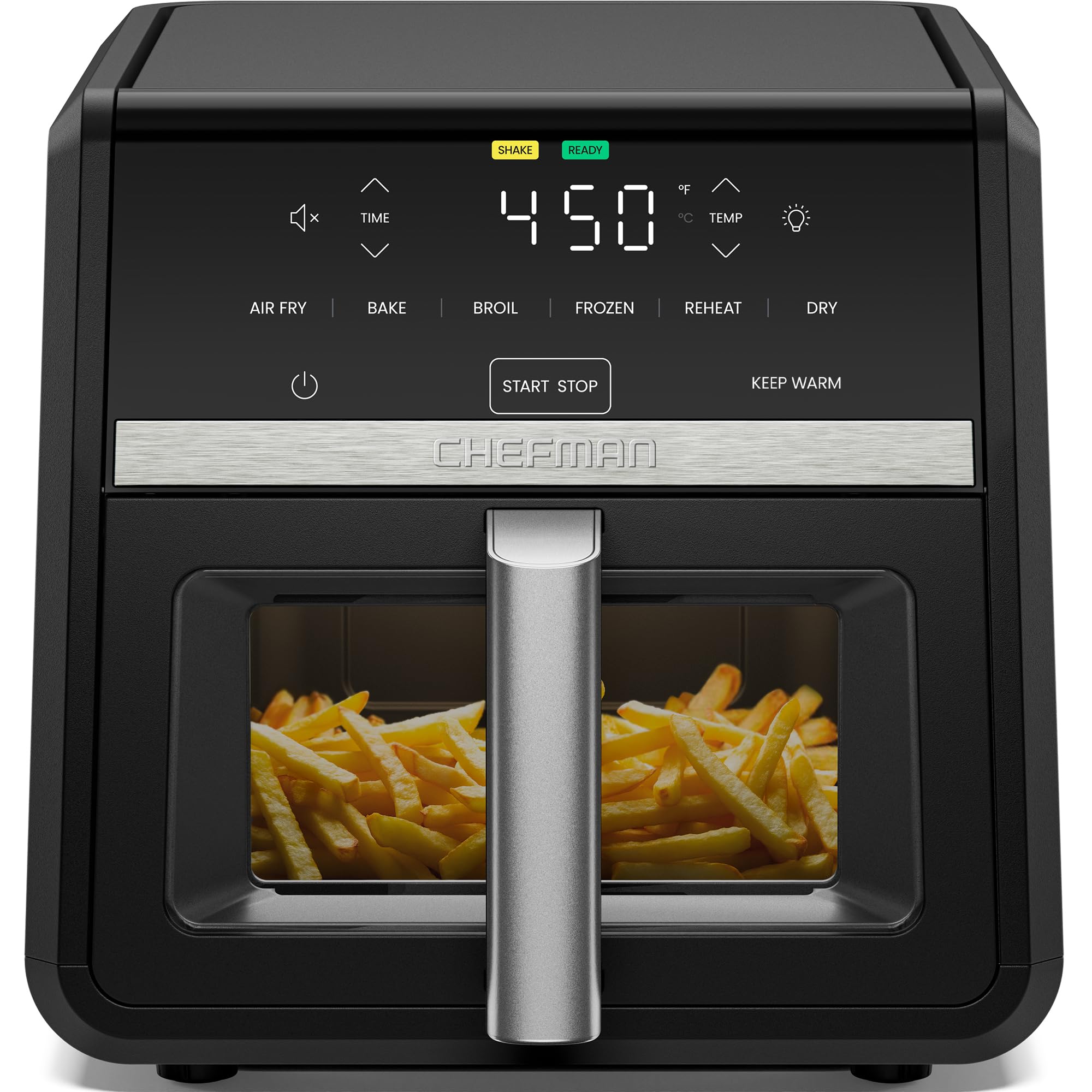
Chefman TurboFry 9 Qt
Key Features
- Capacity: 9 quarts
- Viewing window: Yes
- Max temperature: 450 °F
- Dimensions (D x W x H): 15.75" x 11.81" x 11.42"
- Price: Midrange
Nine quarts, a 450 °F ceiling and a window in the front of the basket, for less money than our top pick. That’s the whole pitch, and it holds up: this is the most capacity you can get here without paying dual-zone money.
The window is the detail we kept appreciating. On most air fryers, checking whether the wings have browned means pulling the drawer, which dumps heat and adds time; here you can watch it happen. The Frozen setting ramps up from a lower temperature so frozen food thaws and crisps rather than scorching outside while staying cold in the middle, and Keep Warm is a genuinely useful extra in a house where people eat at different times.
Where it earns its place is the big single batch. Nine quarts of wings for game day, a week of meal-prepped chicken and vegetables, a whole cauliflower broken into florets — this is the machine that does those in one pass, at a price that undercuts the premium picks here. It’s what we’d hand a big household that wants capacity without paying for two baskets.
Pros
- 9-quart basket for genuine batch cooking
- 450 °F ceiling and 1750 W heating
- Basket window lets you check without opening
- Keep Warm and Frozen modes
Cons
- Deep body needs a roomy counter
- One chamber only, no dual-zone cooking
For big single-batch cooking on a tighter budget, this is the one: nine quarts, 450 °F, and a window that saves you from opening the basket.
Best for Simple Everyday Cooking
Ninja Air Fryer Pro 5 Qt
Key Features
- Capacity: 5 quarts
- Max temperature: 400 °F
- Cooking functions: 4 (air fry, roast, reheat, dehydrate)
- Dimensions (D x W x H): 14.84" x 11.29" x 10.39"
- Price: Premium
Four functions and no window: the Air Fryer Pro is the least complicated machine on this list, and for a lot of kitchens that’s the point. Ninja didn’t clutter it — air fry, roast, reheat, dehydrate, one touch panel, and a basket that pulls out.
Five quarts is the sensible middle of this set. It’s rated for 4 pounds of fries or 5 pounds of wings in a single layer, which is dinner for three or four without the counter cost of the DualZone, and 1750 watts brings it back up to temperature quickly between batches. Ours ran without fuss, cleaned up with a sponge, and the basket went in the dishwasher.
Test the noise early. Fan sound is the one point that splits on this model, quiet in some kitchens and an audible buzz in others, so run a full batch in the room where it will live before the return window closes. Everything else about it is deliberately unremarkable, and after a few weeks that reads as a compliment.
Pros
- Simple four-function touch panel
- 5-quart basket rated for 4 lbs of fries
- Heats fast and cleans easily
Cons
- 400 °F ceiling limits fast browning
We recommend it to anyone who wants one basket, four buttons and no fuss — just go in knowing the 400 °F ceiling costs you a little browning speed.
Best for Tiny Counters
bella Slim 4 Qt
Key Features
- Width: 8.22 inches
- Capacity: 4 quarts
- Basket coating: PFAS-free ceramic
- Max temperature: 400 °F
- Price: Budget
A fraction over eight inches wide is the number that earns the bella its place, because it’s the difference between an air fryer that lives on the counter and one that lives in a cupboard. Nothing else here comes close on width — the next narrowest pick is nearly two inches wider — and it manages that without shrinking the basket to a toy.
Four quarts holding up to 3.3 pounds is a real batch: six to eight chicken thighs, a tray of vegetables for two, a pile of fries that fits in one layer. The PFAS-free ceramic coating is the other thing we rate. It wipes clean without the tacky residue that builds up on older nonstick, so it stays pleasant to use instead of turning into a chore. Four quarts still means two rounds for a family of four, which is the honest limit of a body this narrow.
Pros
- Narrowest body here at 8.22 inches
- PFAS-free ceramic coating wipes clean
- Cheapest pick in this set
- Six presets including dehydrate
Cons
- Small, dim control panel
- 1300 W is the least heating power here
The narrowest air fryer here is also the cheapest, and it still holds a real 3.3-pound batch — the small-kitchen pick.
Best for Singles and Couples
Chefman Compact 4 Qt

Key Features
- Presets: 4
- Wattage: 1500 watts
- Capacity: 3.7 liters
- Max temperature: 400 °F
- Price: Budget
A shake reminder halfway through and a two-minute blast of 450 °F at the end are the two details that separate this Chefman from other small fryers, and they’re the two we actually noticed. The reminder is an audible alarm rather than a silent timer, which matters when you’ve walked away; the Hi-Fry burst is the finishing crunch on a batch of frozen fries.
The rest is sensible. Four presets and a touch panel cover the basics, the basket and crisper plate are both dishwasher safe, and at 7.5 pounds it lifts off the counter without a second thought. 1500 watts in a basket this size heats quickly for a single serving, which is the job it’s built for.
The Hi-Fry deserves the caveat: 450 °F is a finishing boost, not a working ceiling — the machine runs at 400 the rest of the time, so plan your cooking temperature around that and save the burst for the last two minutes. Set up that way, it crisps a serving of fries or two chicken breasts in about the time it takes to set the table.
Pros
- Shake reminder halfway through cooking
- 450 °F Hi-Fry finishing burst
- Basket and rack are dishwasher-safe
- Light 7.5-pound body moves easily
Cons
- Smallest basket here at 3.7 liters
A sensible first air fryer for one or two people: quick, light and easy to clean, as long as you’re not feeding a family from it.
How We Tested 14 Air Fryers Over Six Months
We started with every air fryer we could find from brands we’d trust in our own kitchens, then narrowed by capacity, wattage, and how much machine you get for the money. Models with a pattern of complaints about flaking nonstick or a drawer that won’t fit in a dishwasher got cut early. That left 14 fryers, and each one lived on a counter for six months.
Every machine went through the same stretch of real use: chicken thighs and sliced potatoes on a weeknight, leftover pizza reheated at lunch, a full basket of frozen fries, and a weekend batch of bacon. We timed preheat and total cook time with a stopwatch and checked whether the fries came out evenly browned or pale in patches, especially when the basket was crowded.
Cleaning got its own pass. We hand-washed each greasy basket with a sponge to see whether food caught in the corners or the coating needed soaking first, and the dishwasher-safe ones ran through a full cycle. We also cooked in a dim kitchen to find out whether the buttons and dials made sense without the manual, and stood across the room to judge whether the fan was conversation-loud or just background hum.
At the end, we weighed what each machine actually gave us — basket size, evenness, how much it annoyed us at 6 p.m. — against what it asked us to spend. The ones that made the list earned it on repeated performance, not one lucky batch.
How to Choose an Air Fryer
Most air fryer disappointment comes down to two measurements — how much food the basket holds in one layer and how much counter the body eats — so start there and treat the feature list as a tiebreaker.
Match the basket to the portions you actually cook
Quartage is a rough guide, and shape matters as much as the number. A square basket uses the corners of the box, so the same capacity fits a wider flat layer than a round one, which is part of why the Cosori’s 6 quarts goes further than the figure suggests.
As a working rule, 4 quarts suits one or two people, 5 to 6 quarts covers three or four, and 9 quarts or a pair of baskets is for batch cooking or a family eating at once. Count the portions you cook on an ordinary weeknight and buy for that, not for the one holiday a year.
Measure the counter, not the cupboard
Depth decides whether you love an air fryer. The picks here run from 13.8 to 17.1 inches front to back, and the drawer needs clear travel to slide out plus a little room behind for the vent. Measure from the backsplash to the counter edge and subtract two inches before you choose a spot.
The trap is the word compact. It usually means narrow rather than shallow: the bella is 8.22 inches wide but still 14.56 inches deep, and the Ninja DualZone needs 17 inches of depth no matter how much width you have spare.
Decide how much the top temperature matters
Most air fryers top out at 400 °F, and the best here reach 450 °F. That extra 50 degrees is what turns frozen food crisp rather than pale, and it’s why the Cosori, the Ninja DualZone and the Chefman 9-quart brown faster than the 400 °F machines in this set.
Read the claim carefully, though: check whether the number is a sustained setting or a short finishing boost at the end of the cook. For fresh vegetables, reheating and anything you’d cook at a moderate oven temperature, 400 °F is plenty and you can save the money.
Choose one big basket or two zones
Two independent baskets solve one specific problem: a protein and a side that want different temperatures and different times. Smart Finish on the Ninja DualZone staggers the timers so both land together, and that’s worth paying for if it describes your cooking four nights a week.
If your meals are usually one thing at a time, a single larger basket is the better buy. You get more usable room in one layer, only one drawer to wash, and a narrower body — but two zones also means two crisper plates and a much bigger footprint.
Look at what you’ll be washing
Every basket here is nonstick or ceramic-coated, and both want the same treatment: soft sponge, no metal tongs, and a rinse before the residue sets. The PFAS-free ceramic on the Cosori and the bella wipes clean without scrubbing, which is the difference between using it on a Tuesday and leaving it for the weekend.
Check that the drawer and the crisper plate are both listed as dishwasher safe, because they’re separate pieces and the plate is the one that collects the grease. Fewer pieces means faster cleanup, and at 9 pm that decides how often the machine actually gets used.
Frequently Asked Questions
Do you need to preheat an air fryer?
Usually not. These baskets come up to temperature in a couple of minutes and most frozen foods go in cold with good results. Preheating earns its time when you’re chasing browning on something delicate, like a piece of fish or a pastry, and three minutes at the cooking temperature is enough.
The Cosori has a preheat setting built in. On the others, run the empty basket for three minutes while you season the food and you’ve done the same thing.
How much electricity does an air fryer use?
These draw between 1300 and 1750 watts, so twenty minutes at full power works out to roughly half a kilowatt-hour. There’s no oven-sized cavity to heat, which is why a small batch usually costs less to cook than firing up a full-size oven for the same job.
The savings shrink when you run two batches back to back. If you’re cooking for four, size the basket so it all fits in one layer rather than planning on two rounds.
Can you put foil or parchment in an air fryer?
Yes, as long as you weight it down. Loose foil or a curling sheet of parchment can lift into the heating element, so press it flat against the basket and never preheat with an empty liner sitting in there.
Remember that a liner blocks the perforated plate the air comes up through. Use one for messy things like marinated chicken, and skip it when you want the underside of a batch of fries to crisp.
Why do frozen fries come out soggy?
Crowding or temperature, almost every time. A single layer with space between the pieces is the difference between crisp and steamed, and shaking halfway through lets the hot air reach the underside — the Chefman models sound an alarm to remind you.
Use the highest setting the machine offers, 450 °F if it has one, and don’t add oil to frozen fries that are already coated. If your basket can’t take the whole bag in one layer, cook two smaller batches rather than one deep one.
Final Verdict
Start with the Cosori TurboBlaze. It gets the fundamentals right — 6 quarts, 450 °F, a ceramic basket that goes in the dishwasher — and it does that in a body that still fits a normal counter, which several fryers here don’t manage. For most people that’s the whole decision.
Change the recommendation only for a specific reason. The Ninja DualZone if two dishes at different temperatures are your normal dinner, the Chefman 9-quart if you want maximum batch size for the least money, and the bella if your counter is genuinely narrow.