This post contains affiliate links. We may earn a small commission when you buy through our links — at no extra cost to you.
Nothing deflates a batch-cooking Sunday like pulling a package of ground beef out of the freezer three weeks later and finding it gray and furred with ice. Vacuum food bags are supposed to buy you months, not weeks, but the difference between a set that holds and one that quietly gives up is invisible on the box. It comes down to how the seal behaves once it’s under a stack of frozen bricks, how thick the plastic really is, and whether the sizes inside actually match the food you cook. A good set keeps air out of the equation entirely — no freezer burn on the meat, no stale coffee beans, no chili lost to a torn corner.
I’ve run 15 sets through the past four months, rotating them through the freezer, the pantry, and a chest freezer that gets opened a dozen times a day. The good ones survived bones, sharp corners, and being snipped open and resealed again. One piece of advice that took me too long to learn: buy for the sizes you’ll actually use, not the piece count on the label, because 30 sandwich-sized bags won’t help you freeze a whole chicken. The sets below are the ones that held — and a few are cheap enough that restocking them doesn’t sting.




Best for Mixed-Size Meal Prep
Syntus 150-Piece Vacuum Bags
Key Features
- Bag type: Precut bags
- Thickness: 4 mil
- Compatibility: Traditional desktop sealers
- Size assortment: 6 x 10, 8 x 12, 11 x 16 in
- Price: Budget
Three sizes in one box is the reason this set is our default. The Syntus pack gives you 50 pint, 50 quart, and 50 gallon bags, all precut and ready to seal. That mix covers the jobs that actually fill a freezer: single portions, meal-size packs, and larger batches of stock or produce. We reach for the quart size most, but the pint and gallon bags keep us from cutting a roll down to fit a smaller job.
The film is 4 mil with a textured side for air channels, and it is BPA-free for freezer, microwave, boiling, and sous-vide use. We like the puncture-resistant feel for bone-in chicken and ribs, though the bag still needs a clean, dry edge to seal properly. The textured face gives the sealer something to pull against, which matters on clamp-style machines.
Compatibility is broad: the bags are designed for traditional desktop vacuum sealers, so most home machines can use them without a special mode. Run one test bag before you fill a whole batch, especially with moist foods or a sealer that runs hot. That single check tells you more than any box claim.
For most kitchens, the combination of three sizes, 150 bags, and wide compatibility is why it tops the list. The quart bag is the one we reach for first, and the other two sizes keep the box useful beyond one job. It is the set we point to first when someone wants one purchase to cover everyday vacuum sealing.
Pros
- Three precut sizes cover mixed jobs
- 4-mil textured film aids suction
- Broad desktop-sealer compatibility
- Long 150-bag supply
Cons
- Sealing varies with machine and fill
- Film feels lighter than premium bags
For most freezer and meal-prep jobs, we recommend the Syntus 150-piece set: three useful sizes, 4-mil film, and broad sealer compatibility in one box.
Best for Foodsaver Machines
FoodSaver Custom-Length Rolls
Key Features
- Bag type: Rolls
- Roll count: 5 rolls
- Roll sizes: 8 in and 11 in widths
- Compatibility: FoodSaver systems
- Price: Premium
If you own a FoodSaver, the brand-match question is the first one to settle. These rolls are made for FoodSaver systems, so you are not gambling on whether a third-party film will feed or seal in your machine. The five-roll multipack gives you both 8-inch and 11-inch widths, and you cut each bag to the length you need. That is useful for whole cuts, long loaves, and odd-shaped packages that a precut bag cannot wrap neatly.
We think the assurance is the reason to buy. You pay a premium for brand-matched film, but you get a multi-ply BPA-free bag that is rated for freezer, refrigerator, microwave, and dishwasher use, and the rolls are made in the USA. The 8-inch roll handles everyday portions; the 11-inch roll is the one for larger cuts. Even here, a wet or overfilled bag can defeat the seal, so keep the edge clean and leave headspace. Against the Syntus set, you trade size variety and bag count for custom lengths and a familiar fit.
For anyone with a FoodSaver who has had a bad run with generic rolls, that reduced risk is worth the premium. If your machine is less fussy, the Syntus box gives you more sizes for less. The FoodSaver rolls are the safer buy when brand fit matters more than squeezing out the lowest cost per bag.
Pros
- Custom lengths reduce wasted film
- Made for FoodSaver systems
- Multi-ply BPA-free film
Cons
- Premium price for brand-matched film
If your sealer is a FoodSaver, these rolls are the low-risk choice: custom lengths, familiar fit, and strong brand support.
Best for Bulk Quart Portions
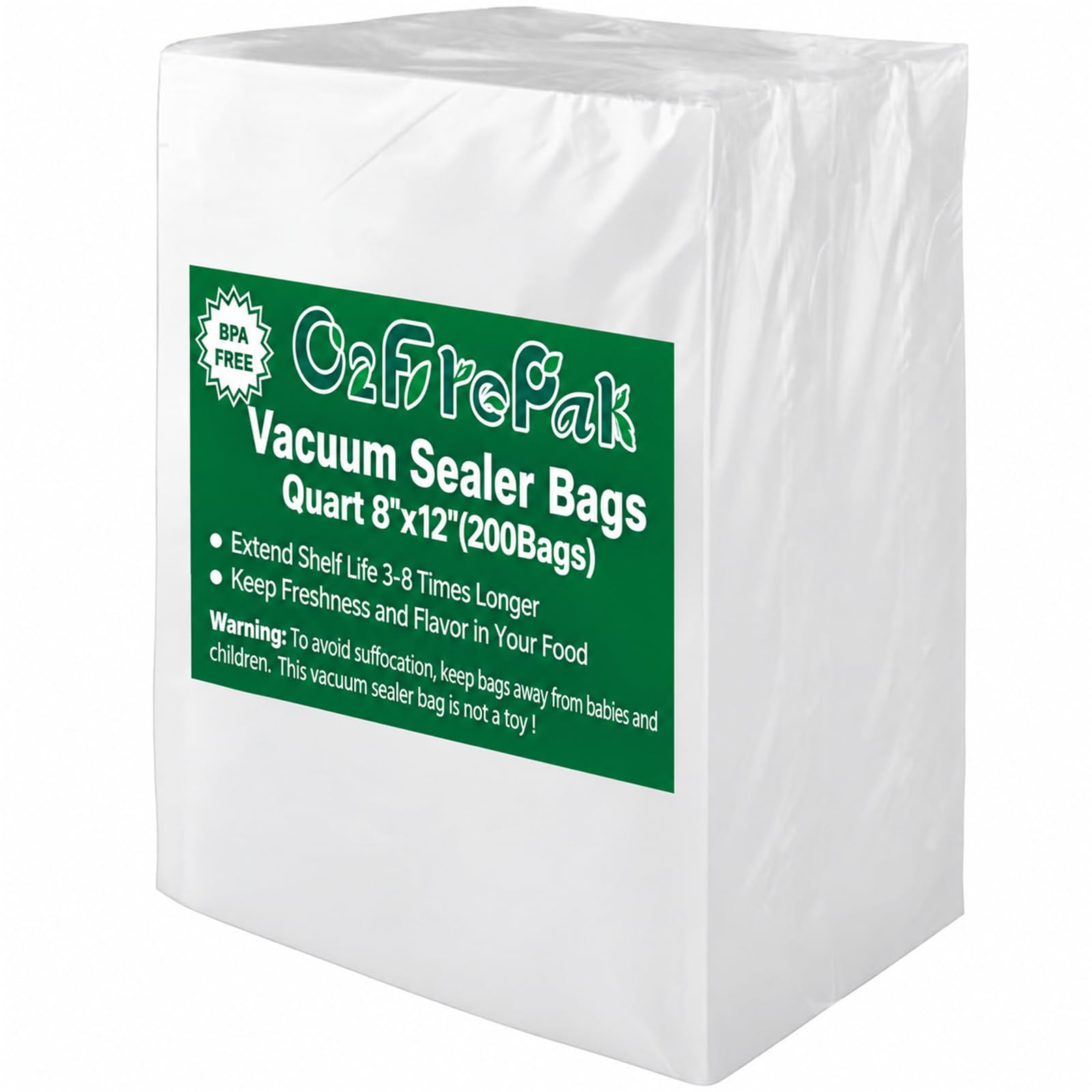
O2frepak Quart 200-Count
Key Features
- Size: 8 x 12 in
- Bag type: Precut quart bags
- Thickness: 3.5 mil front, 4 mil back
- Compatibility: Clamp-style sealers
- Price: Midrange
A 200-count box of one quart size is either exactly the shortcut you want or too much of the same thing. The O2frepak bags are 8 x 12 inches, precut, and designed for clamp-style vacuum sealers. If you portion ground beef, chicken breasts, leftovers, or single servings for the freezer, the uniform size stacks neatly and removes the daily decision of which bag to grab.
The film has a 3.5-mil front panel and a 4-mil textured back, with embossed channels and bone guards. We like the textured back for suction and the smooth front for writing a date with a marker. The listed width includes the seal zone, so the usable space is a little narrower than 8 inches; pack flat rather than stuffing a thick block into the bag. That also helps the bag freeze into a tidy stack.
For a household that mostly packs quart portions and wants a long supply, the O2frepak box is the straightforward choice. It is the bulk quart pick we reach for when the freezer is filling fast and we do not want to measure. The uniform size is the point, not a compromise.
Pros
- 200-count quart supply
- Textured 4-mil back panel
- Bone guards for puncture resistance
Cons
- Single size limits large and tiny portions
Buy the O2frepak box if you portion in quart-size batches and want a long, uniform supply.
Best for Custom-Length Jobs
Wevac 8-Inch Rolls
Key Features
- Bag type: Rolls
- Roll size: 8 in x 50 ft
- Roll count: 2 rolls
- Compatibility: Suction heat sealers
- Price: Budget
Two 50-foot rolls look like a lot until you realize they may not fit inside your sealer. The Wevac rolls are 8 inches wide, and each one is a long continuous length you cut to size. If your machine has a built-in roll compartment, measure the width and the roll diameter before ordering; a big roll can live in a drawer instead, but it will not live inside a small sealer.
The payoff is custom sizing. We like rolls for ribs, whole fish, long vegetables, and any cut that makes a precut bag feel wasteful. The embossed channels give the sealer a path for air, and the film is designed to work with suction heat sealers from FoodSaver, Seal a Meal, Nesco, Weston, Cabela’s, and Ziploc. You cut only what you need, so there are fewer orphaned bag ends in the drawer.
The 8-inch width suits single portions, burgers, chicken breasts, and sous-vide bags for two. It is an efficient size for a small freezer, and it keeps the roll compact enough to handle.
We reach for this roll when we want a bag to fit the food rather than the other way around. It is the value route to custom lengths, and the 100 feet total goes a long way. For a small freezer and a sealer that sits on the counter, it is a practical way to keep film on hand without a cabinet full of precut boxes.
Pros
- 100 feet of custom-length film
- Fits many suction sealers
- Embossed channels for air removal
Cons
- 8-inch width is narrow for large cuts
We recommend the Wevac rolls for cooks who want custom lengths; they are the value route to odd-size packaging.
Best for Simple Precut Sealing
MEGAWISE 110 Precut Bags
Key Features
- Size: 8 x 12 in
- Count: 110 bags
- Texture: Double-sided embossed
- Bag type: Precut bags
- Price: Budget
Double-sided texture is the quiet advantage here: you do not have to hunt for the right face before sealing. The MEGAWISE bags are 8 x 12 inches, precut, and embossed on both sides, so the sealer finds air channels whichever way the bag goes into the machine. We like that for quick sessions when the counter is full and you are sealing one bag after another.
The 110-count box is all quart size, the workhorse for a pound of meat, a meal for two, or a block of cheese. The bags are BPA-free and rated for freezer and sous-vide use when you follow the package temperature guidance. Sealing is the area where this one gave us the least pause in the group; the double texture helps, but a clean, dry edge still matters.
For everyday portioning, the simplicity is the point. You reach for the same bag, fill it, seal it, and stack it flat. The box stays tidy, and you are not sorting through sizes when the freezer is already full.
Pros
- Double-sided texture simplifies loading
- 110 precut quart bags
- Freezer and sous-vide rated
Cons
- Only one size
MEGAWISE is our pick for fuss-free everyday sealing: double-sided texture, a workhorse quart size, and a generous precut box.
Best for Large Quart Batches
Bonsenkitchen 200 Quart Bags
Key Features
- Size: 8 x 12 in
- Count: 200 bags
- Bag type: Precut bags
- Thickness: 4 mil
- Price: Midrange
Batch cooking is the job this box was built for, and the Bonsenkitchen set makes the commitment easy to live with. Each bag is 8 x 12 inches, precut, and made from 4-mil film with embossed air channels. The box is built for portioning: fill, seal, stack, and repeat until the freezer is full.
We like the easy-tear notches more than we expected. Opening a frozen bag without scissors is a small thing that becomes a daily convenience. The 4-mil film is in the same range as our top pick, and the quart size is right for a pound of meat or a meal for two.
This is the box we reach for when the freezer is getting a big batch. It keeps the process simple: fill, seal, stack. The easy-tear notches and flat front make labeling and stacking quick, and the 200-count supply lasts through a busy season.
Pros
- 200-count quart box
- 4-mil embossed film
- Easy-tear notches
Cons
- Single-size box limits variety
For quart-size batch cooking, the Bonsenkitchen 200-count box is a sensible bulk buy: thick precut film and no measuring.
Best for Reusable Meal Prep
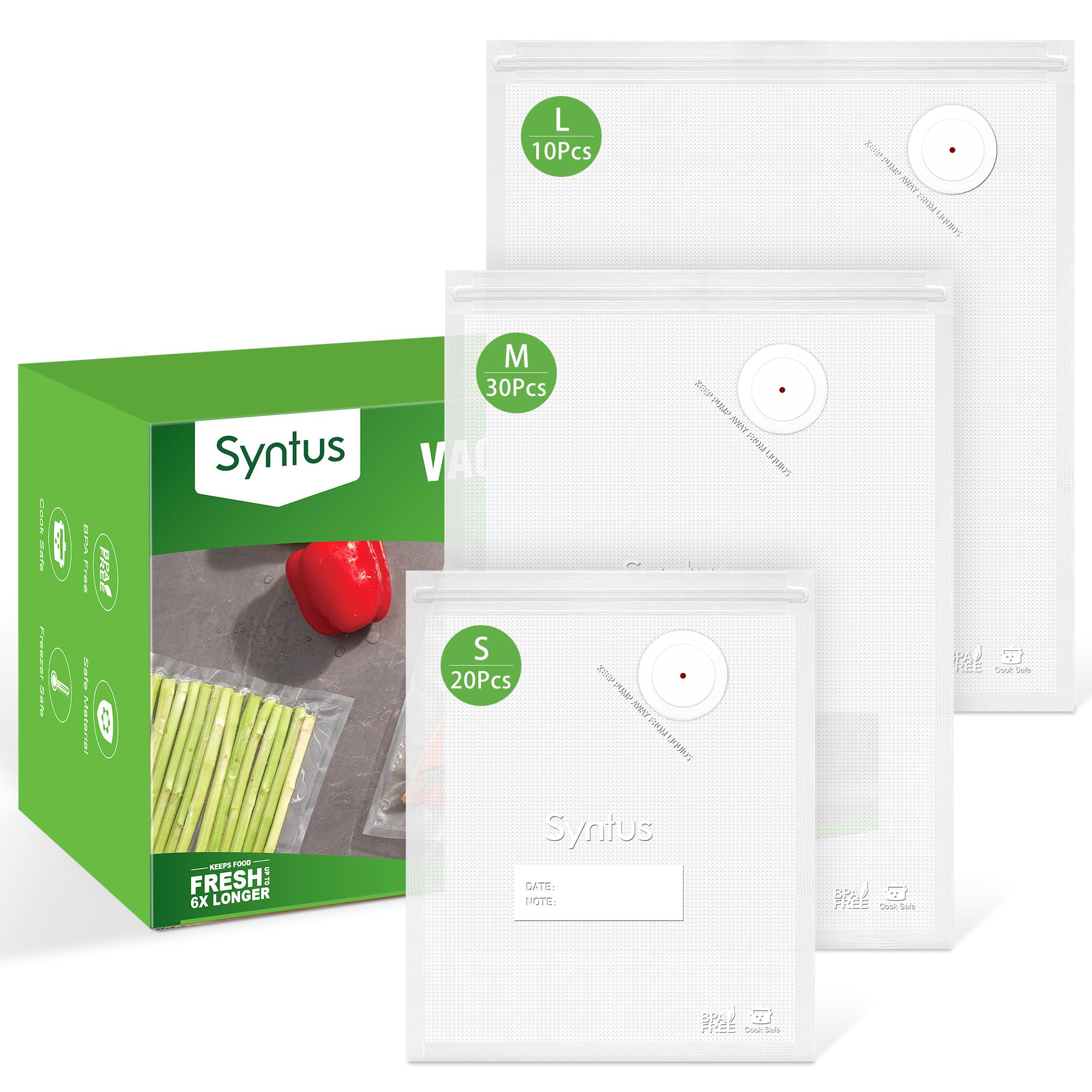
Syntus 60-Piece Reusable Set
Key Features
- Count: 60 bags
- Closure: Double zipper with valve
- Bag type: Reusable zipper bags
- Size assortment: 8 x 10, 10 x 13.8, 11.8 x 13.8 in
- Price: Premium
The case for reusable bags is not just waste; it is being able to reseal the same bag after opening coffee, nuts, or a block of cheese. The Syntus set gives you 60 zipper bags in three sizes, with a double zipper and a silicone air valve. You fill, zip, pull the air out with a compatible pump, and the bag goes back in the fridge or pantry.
We like the size range because it covers both small leftovers and larger batches. The 8 x 10 bags suit snacks and single portions; the 10 x 13.8 and 11.8 x 13.8 bags hold more. The valve is designed for standard calibers and works with traditional vacuum sealers and handheld pumps, though a brand-specific connector can be the sticking point. Check the pump fit before you commit to a whole set.
For coffee, cheese, vegetables, and marinades, the routine is worth it. The bags open and reseal repeatedly, and the set replaces a lot of film. For raw meat and long freezer storage, disposable bags are still simpler. That is the boundary: reusable shines for frequent access, not for every job.
Pros
- Reusable double-zipper bags
- Three practical sizes
- Standard valve compatibility
- Silicone valve for sous vide
Cons
- Requires washing and full drying
For low-waste, resealable storage, the Syntus reusable set is our pick for households that open and reseal the same foods often.
Best for Three-Size Option
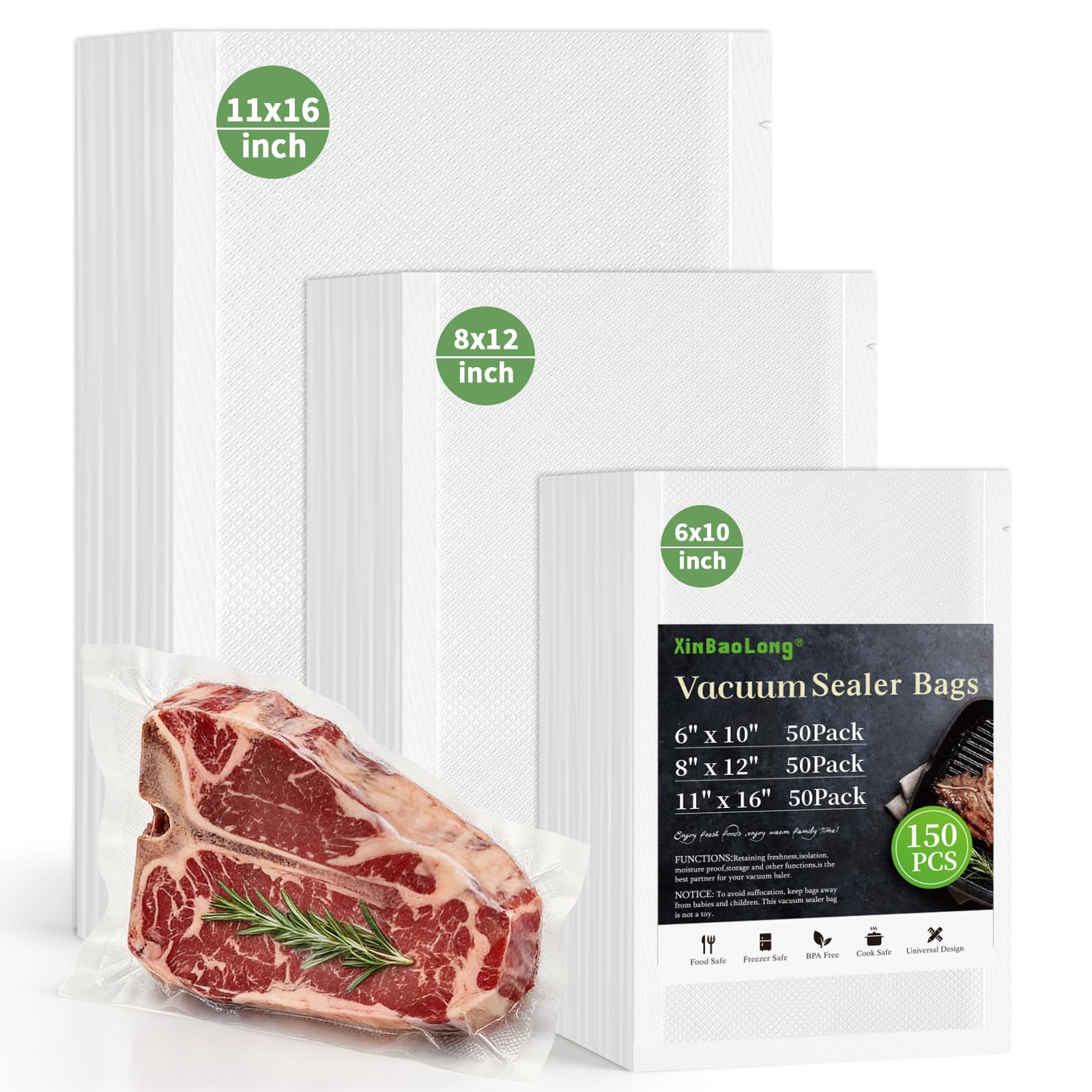
Xinbaolong 150-Piece Set
Key Features
- Count: 150 bags
- Bag type: Precut bags
- Compatibility: Major-brand sealers
- Size assortment: 6 x 10, 8 x 12, 11 x 16 in
- Price: Midrange
This is the closest thing to our top pick on paper: the same three-size, 150-bag mix. The Xinbaolong set gives you 50 pint, 50 quart, and 50 gallon bags, all precut and BPA-free. If you want the convenience of three sizes in a different brand, it is worth a look.
The film is called heavy duty, and the bags are ready to use. Test one bag with your machine before filling a batch. The three-size mix is the main draw here, and it keeps you from buying a single-size box before you know how you cook.
The three-size mix is genuinely useful, and the bags are ready to use. It is a practical starter box for a first sealer. For dry goods, snacks, and quick freezer portions, it covers the basics.
We rank this as an also-consider rather than a runner-up because the basics are right, but it does not displace the top pick. If you want a second three-size option, it is a reasonable choice. For the toughest jobs, the Syntus is the stronger choice.
Pros
- Three-size 150-bag mix
- Precut and ready to use
- BPA-free material
Cons
- No stated film thickness
- Seal less certain with moist foods
The Xinbaolong set is a reasonable starting point for a first vacuum sealer, with three useful sizes and 150 precut bags.
How We Tested Vacuum Food Storage Bags
We started by gathering every set sold specifically for food — not the sweater bags from the hall closet — and filtered the list by what was actually in the box, whether the bags worked with a pump, a handheld vacuum, or a standard hose, and whether replacement bags or parts were available for a second order. That left 15 sets spanning flat roll-style bags, stand-up pouches, and zip-top designs.
Each set went through the same run. We packed ground beef, bone-in chicken thighs, a ladle of leftover chili, and a scoop of coffee beans, sealed everything per the instructions, and stacked it into the freezer the way a real freezer gets stacked — jammed in and dug through, not laid out neatly. We checked at one week, one month, and two months: frost forming inside the bag, gray patches on the meat, whether the vacuum pulled tight and stayed tight, and whether the seam puckered or lifted after the bag was cut open and resealed.
Thickness announced itself fast. Bags that felt like a produce sack punctured on the first chicken bone or the corner of a frozen block, and a puncture you can’t see is a bag quietly taking on air. We washed and reused every bag we could, two or three rounds each, noting which ones still held a seal on the second and third pass and which ones we’d have to repurchase — because a set that works once isn’t value, it’s a subscription.
Size variety got its own pass. We recorded which sets could hold a whole chicken or a two-pound roast flat enough to stack, and which ones were all small bags that couldn’t manage a single portion of chili. The picks below came out of four months still sealed, still intact, and worth buying again.
How to Choose Vacuum Storage Bags for Food
The bag is not the whole seal: your machine, the bag’s texture, and how full you pack it decide whether the vacuum holds.
Match the bag to your sealer first
We put compatibility first because a bag that does not fit your machine is the wrong bag, however good the film. Clamp-style and external-suction sealers need textured or embossed channels to pull air; chamber sealers use a different bag altogether; reusable valve bags need a handheld pump or a sealer with a valve port. Check the machine’s manual before you buy a box. If you use a FoodSaver with an onboard roll holder, measure the compartment too, because a long roll can be more convenient on the counter than inside the machine.
Precut bags and rolls solve different problems
Precut bags win on speed: grab one, fill, seal, label. Rolls win on odd shapes and large cuts, and they let you cut exactly the length you need. The trap is storage. A 50-foot roll may not fit a sealer’s built-in compartment, so check the roll diameter and width before ordering. If most of your food goes into quart portions, a precut box is the calmer choice; if you regularly pack ribs, whole fish, or long loaves, rolls earn their space.
Buy a size mix, not just one bag
The 8 x 12 quart bag is the workhorse for a pound of meat, a meal for two, or a block of cheese. Pint bags suit snacks and single portions; gallon bags hold roasts, whole chickens, or big batches of stock. We reach for the quart size most, but a mix keeps you from wasting film on small jobs. Leave an inch of headspace and keep the sealing strip clean and dry; moisture or crumbs across the seam are the usual reason a bag fails to hold. The listed width also includes the seal zone, so pack flat rather than stuffing.
Thickness and texture work together
Thickness is not a score. A 3.5- to 4-mil bag with good embossed channels often seals more reliably than a stiff, thicker bag that your machine struggles to pull down. Texture gives air a path to the pump; a smooth bag needs a different machine or a special mode. Bone guards and a puncture-resistant back panel matter for ribs and frozen joints. If your sealer is modest, start with a thinner textured bag rather than assuming the heaviest film is best.
Reusable bags trade film waste for upkeep
Reusable valve bags make sense if you open and reseal the same foods often: coffee, nuts, cheese, cut vegetables, marinades. They need a compatible pump, a clean zipper track, and thorough drying before storage. The valve is the part to check: a standard-caliber valve fits many handheld pumps, but some brand-specific connectors do not. For raw meat and long freezer storage, disposable bags still have the simpler cleanup. For low-waste routine storage, reusable earns its keep.
Frequently Asked Questions
Why use vacuum sealer bags instead of regular zip-top freezer bags?
Vacuum bags pull air out of the package, which limits freezer burn and keeps stacks flatter than a bulging zip-top bag. They are most useful for food you plan to keep for weeks or months, not for a snack you will open tomorrow. Press the air out of a zip-top bag first if that is what you have; the vacuum bag earns its cost on longer storage and better stacking.
Can I reseal a vacuum sealer bag after opening it?
Yes, if enough film remains below the old seal. Cut the bag open near the seal, empty or remove what you need, wipe the inside of the edge dry, and run a new seal. Keep raw meat bags out of the reuse pile for ready-to-eat food. A bag that held raw meat can be used again only for another raw meat portion, and only after a thorough wash if the film is sturdy enough.
Can vacuum sealer bags go in the microwave or boiling water?
Only when the bag is rated for it. BPA-free does not automatically mean microwave-safe or boil-safe, and reusable zipper bags may have lower temperature limits than disposable film. Check the package for microwave, boiling, and sous-vide guidance. If the rating is missing, use a zip-top bag in a water bath or move the food to a pot; do not guess with a sealed bag.
How can I tell if a vacuum-sealed bag has lost its seal?
Look for loose film, a soft package, frost or ice crystals inside, or a seam that peels when you press it. Check bags a day after sealing and again before you thaw them. If the seal has failed, use the food soon rather than refreezing it blindly, and reseal only a clean, dry edge. A marker date on the bag makes that check quick.
Final Verdict
Start with the Syntus 150-piece set if you want one box that covers most freezer, meal-prep, and sous-vide jobs. The three sizes, 4-mil film, and broad desktop-sealer compatibility make it the easiest recommendation for a mixed kitchen.
If your machine is a FoodSaver, the FoodSaver custom-length rolls are the lower-risk fit. If low waste matters more than disposability, choose the Syntus reusable set after confirming your pump uses a standard valve. Those are the two forks in the road; everything else here is a specialization.