This post contains affiliate links. We may earn a small commission when you buy through our links — at no extra cost to you.
The perfect skillet is the one you reach for without thinking—until the nonstick starts flaking, the stainless steel grabs your eggs, or the cast iron rusts because someone left it in the sink. A good skillet should heat evenly from edge to center, release food without a fight, and clean up in less time than it took to cook. We spent six months cooking with 12 skillets—budget nonstick, stainless, carbon steel, and cast iron—to find the ones that actually hold up.
I’ve learned that size matters as much as material: an 8-inch is perfect for a single fried egg but cramped for two pork chops, while a 12-inch can feel like a barbell after a long day. We also paid attention to the small stuff—how a pan felt in hand, whether a metal spatula scratched the surface, and how each one looked after a few weeks of daily duty. The best skillets earned their spot by being easy to live with and worth the money—not just easy to cook with.




Best for Everyday Nonstick Cooking
T-fal Ultimate 2-Pack
Key Features
- Care: Dishwasher safe
- Cooktop: Gas, electric, ceramic; not induction
- Oven safe: 400 °F
- Set contents: 10 in and 12 in fry pans
- Price: Midrange
Ten and twelve inches is the pair we keep coming back to, and it’s the reason this set sits at the top of our list. The ten-inch handles two eggs or a single pork chop; the twelve-inch takes four chicken thighs or a pile of vegetables without crowding them into steam. Both are hard-anodized aluminum with a titanium-reinforced nonstick coating, riveted silicone handles, and a Thermo-Spot ring in the middle that turns solid red once the pan is properly preheated.
What separates it from the other coated pans here is consistency. Heat spreads across the base without the hot ring that browns pancakes in patches, and the release holds: eggs slide, fish comes off whole, and cleanup is a wipe rather than a soak. We also like that neither pan is heavy enough to make tossing vegetables a chore — a set that lives on the stove only earns its space if you don’t dread picking it up.
The oven ceiling is 400°F, which is fine for finishing chicken but not for a broiler blast; do that in cast iron. The preheat indicator is more useful than it sounds, too. We wait for the ring to go red before the oil goes in, and we get noticeably less sticking when we do.
Pros
- Two useful sizes in one box
- Release holds up for eggs and fish
- Even heating without hot spots
- Dishwasher safe and oven safe to 400°F
Cons
- Not induction compatible
- Coating scratches with metal or rough use
The nonstick pair we recommend first: ten and twelve inches, even heat, and release that survives daily eggs, with money left over for a cast iron pan.
Best for Searing and Baking
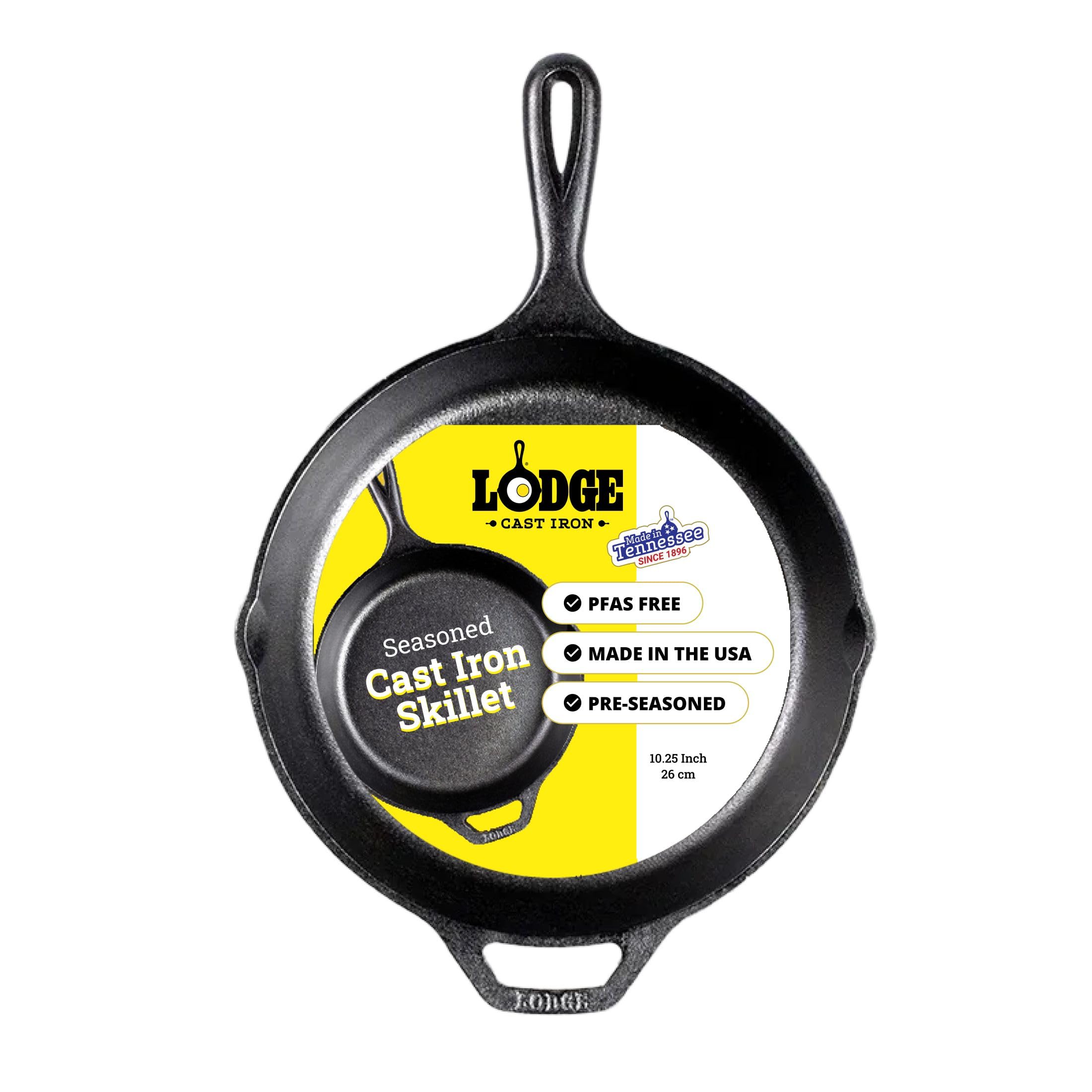
Lodge 10.25-Inch Cast Iron
Key Features
- Care: Hand wash only
- Weight: 5.4 lb
- Diameter: 10.25 inches
- Oven safe: 500 °F
- Price: Budget
"Pre-seasoned" is the phrase that trips people up. It means the pan left the foundry with a coat of oil baked onto it so it won’t rust on the shelf — not that your first fried egg will slide around. We found the factory seasoning is a starting point: expect a few weeks of cooking with a little more fat than you’d use in a nonstick pan while the surface darkens and fills in.
What the pan is genuinely great at is heat. Ten and a quarter inches of cast iron holds its temperature when a cold steak lands on it, which is why the crust comes out deeper than what a thin aluminum pan produces, and it moves from the burner to a 500°F oven to a grill or a campfire without complaint. It’s induction compatible too, which matters on a magnetic range.
We keep reaching for it for the jobs that ruin other pans: steak finished in the oven, cornbread, a whole roast chicken, smashed potatoes with the heat cranked up. There’s no coating to flake and no nonstick surface to baby, so the only thing that changes over the years is the seasoning, and that’s replaceable in an afternoon. That’s what earns it a place beside the nonstick set rather than instead of it.
Two practical notes. The handle is cast iron as well, so it gets as hot as the pan does — a mitt or a silicone grip stays within reach. And searing at this temperature smokes up a kitchen, so run the hood.
Pros
- Sears hard and holds heat under cold food
- Oven, grill, campfire, and induction safe
- No coating to chip or wear out
- Pre-seasoned and ready to cook
Cons
- Heavy at 5.4 pounds
- Rusts when put away wet
A cast iron pan belongs in every kitchen, and this is the one we point to: it sears, bakes, and outlives every coating here.
Best for Big-Batch Frying
Tramontina Professional 12-Inch
Key Features
- Care: Dishwasher safe
- Cooktop: Gas, electric, ceramic glass; not induction
- Diameter: 12 inches
- Oven safe: 400 °F
- Price: Midrange
NSF certification is a restaurant-kitchen credential most home pans don’t carry, and it’s the first thing worth knowing here: heavy-gauge aluminum, a reinforced nonstick coating, and a twelve-inch surface that ties for the widest in this group. It’s built for a line cook to work hard for eight hours straight.
We reach for it when the ten-inch pan is a compromise — four pork chops, a cut-up chicken, a pile of onions that needs to brown rather than steam. Heat is even across the base, the release is good enough that a fillet comes out in one piece with a thin film of oil, and the silicone handle stays cool through a long sear. It’s dishwasher safe and oven safe to 400°F, which makes it the least fussy big pan here.
Two catches. The long handle makes the pan handle-heavy when it’s empty, and it will tip on a burner if you set it down off-center. Size cuts both ways as well: a twelve-inch pan wants a large burner, and on a small coil the outer inch never gets properly hot. Both are manageable once you know — set it down square, and use the big burner.
Pros
- Restaurant-grade build with a wide 12-inch surface
- Even heat across the whole base
- Dishwasher safe and oven safe to 400°F
- Release holds for fish and omelets
Cons
- Can scratch glass and ceramic cooktops
- Coating wears under high heat
Our pick for feeding a crowd: restaurant-grade build, a twelve-inch surface, and even heat, with one caveat for glass cooktops.
Best for Searing and Deglazing
All-Clad D3 12-Inch
Key Features
- Care: Hand wash only
- Diameter: 12 inches
- Oven safe: 600 °F
- Construction: Tri-ply stainless with aluminum core
- Price: Premium
There’s no coating on this pan, and that’s the whole argument: nothing to flake, nothing to scratch, and a tri-ply stainless-and-aluminum body that takes 600°F without complaint. It’s the pan we grab when we want real browning — a steak, a pork chop, a chicken thigh with the skin on — and the fond it leaves behind is the beginning of a sauce rather than a scrubbing job.
Twelve inches gives you room to brown in batches instead of steaming, and the lid turns it into a shallow braiser for a whole chicken or a pot of beans. The bonded base works on induction and gas, and that 600°F limit is the highest in this group.
The honest trade-off is eggs. An uncoated pan sticks unless it’s properly hot, there’s fat in it, and you leave the food alone until it lets go — do that and a fried egg slides; rush it and you’re scraping. That isn’t a defect, it’s the deal you make for a pan with nothing to wear out. Give it a week or two to find the sweet spot on your burners; after that it’s the least demanding pan here, because there’s nothing to protect.
Pros
- No coating to flake or wear out
- Oven safe to 600°F
- Leaves fond for pan sauces
- Lid included for braising
Cons
- Hand wash only
- Heavy at 4.7 pounds
The pan we grab when we want a crust: no coating to wear out, 600°F of oven tolerance, and fond that turns into a pan sauce.
Best for Induction Nonstick Sets
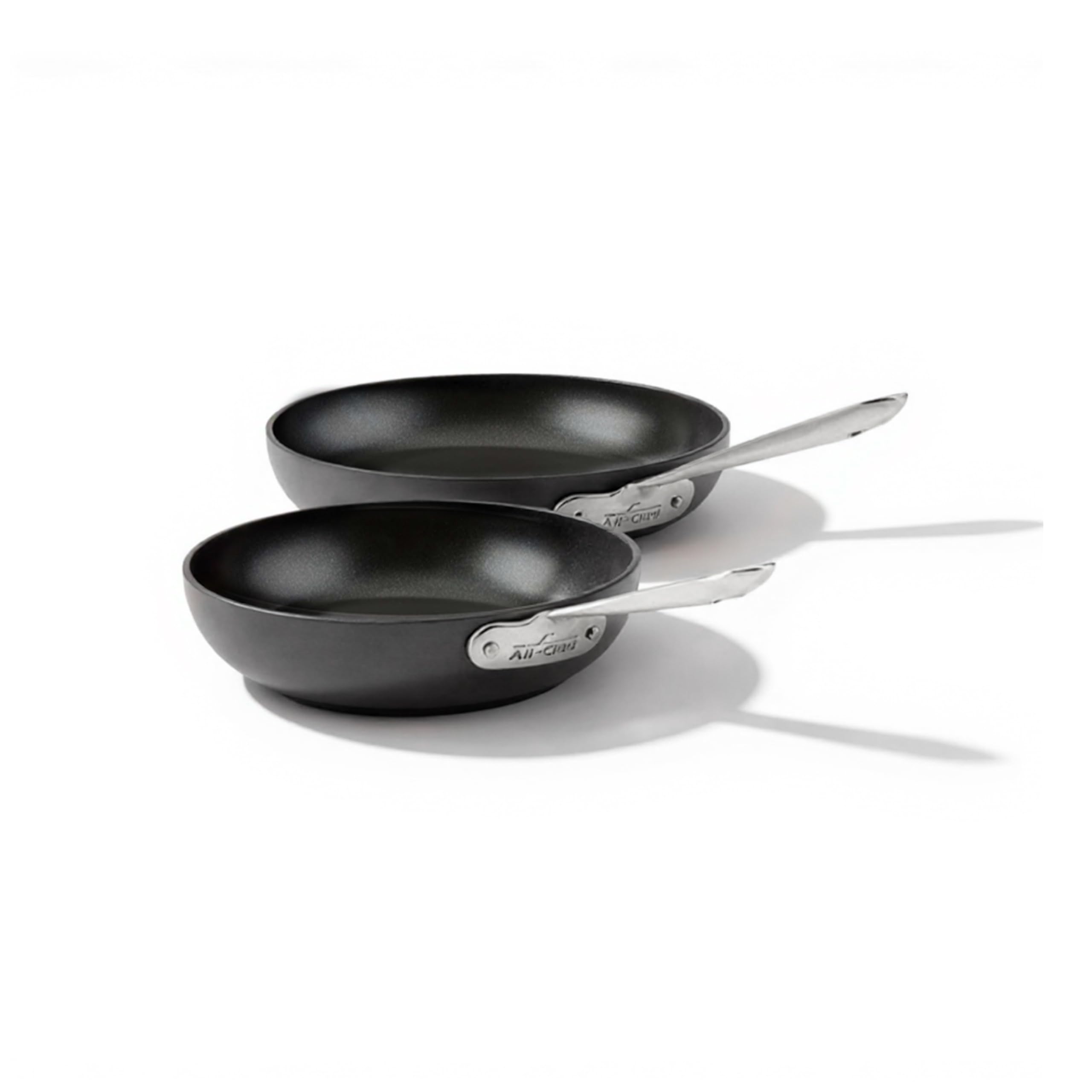
All-Clad HA1 2-Piece
Key Features
- Care: Dishwasher safe
- Cooktop: All stovetops, including induction
- Oven safe: 500 °F
- Set contents: 8 in and 10 in fry pans
- Price: Premium
If your range is induction, the T-fal set we recommend for most kitchens is out — its base isn’t magnetic. This All-Clad pair is the answer: hard-anodized aluminum with a stainless base built for induction, in eight- and ten-inch sizes that heat evenly on a magnetic hob.
The sizes are the point. Eight inches is a two-egg pan or a single grilled cheese; ten inches covers dinner for two. If you routinely cook for four they’ll feel small, and the twelve-inch pans here are the better fit. Both are oven safe to 500°F and dishwasher safe, with a PTFE nonstick coating that’s PFOA free.
They’re handsome in a plain way — dark anodized exteriors, stainless handles, a flared rim that pours without dribbling — and they’ve held their looks through steady use in a way coated pans often don’t.
Five pounds for the pair makes them steadier than the aluminum pans here but slower to flip one-handed. For an induction kitchen this is the pair we hand people. Buy both rather than the ten-inch alone: the eight-inch is the one that ends up on the stove every morning.
Pros
- Works on induction and every other cooktop
- Oven safe to 500°F and dishwasher safe
- Even heat from the bonded base
- Looks good enough to leave out
Cons
- Coating can wear within a year
- Narrow handles are awkward for large hands
If your range is induction, this is the pair to buy — two sizes, even heat, and a base that actually works on a magnetic hob.
Best for Budget Everyday Skillet
CAROTE 10-Inch
Key Features
- Care: Hand wash only
- Cooktop: Gas, electric, induction
- Capacity: 2.5 quarts
- Diameter: 10 inches
- Price: Budget
Eggs are the test we run first on any nonstick pan, and this is where they come out cleanest for the least money. The granite-finish coating releases a fried egg with a teaspoon of butter, the Bakelite handle stays cool enough to grab bare-handed, and ten inches is the right size for two people. It’s the least expensive pan in this group, and it’s the one we point new cooks toward.
The depth is the detail that surprised us. At two and a half quarts it holds a batch of breakfast potatoes or a shallow fry without oil climbing the walls, which most ten-inch pans this thin can’t manage. The base is induction compatible as well as gas and electric, and it heats quickly — faster than cast iron, though it doesn’t hold that heat the same way.
The speckled finish is the other reason it sells: it hides the brown staining that makes plain nonstick look old after a month, and it’s presentable enough to carry to the table. If you cook for four, though, treat this as a side pan rather than the main one.
Pros
- Eggs release with almost no fat
- Handle stays cool on a long cook
- Induction, gas, and electric compatible
- Deep 2.5-quart sides hold a batch
Cons
- Hand wash only
- Coating can flake after months of use
The pan we hand new cooks: eggs release with almost no fat, the handle stays cool, and it works on induction for very little.
Best for Starter Pan Sets
Utopia Kitchen 3-Piece Set

Key Features
- Care: Hand wash and dry
- Handle: Riveted bakelite
- Coating: Nonstick, PFOA free
- Set contents: 8 in, 9.5 in, and 11 in fry pans
- Price: Midrange
Three pans — eight, nine and a half, and eleven inches — for roughly what the other picks here charge for one. That’s the pitch, and it holds up better than the price suggests: light aluminum bodies, riveted bakelite handles that stay cool, and nonstick release good enough that pancakes and eggs come off clean.
The eleven-inch is the workhorse and the one that earns the set; the eight-inch is an egg pan, and the middle size is the one we forget we own. Heat is even across the base on gas and electric, and the pans are light enough that a full eleven-inch doesn’t turn into a two-hand lift.
Where it gets murky is induction. One line in the listing claims an induction bottom while the compatibility details list electric, so don’t count on it — with an induction range, buy a set that says so plainly and pay the difference. For a gas or electric kitchen, a first apartment, or a set to leave at the cabin, it’s the best value in this group.
Pros
- Three sizes for about the price of one pan
- Even heat on gas and electric
- Riveted handles stay cool
- Light enough to lift one-handed when full
Cons
- Coating peels after months of daily use
Three useful pans for the price of one, light enough to handle and even on gas or electric — just don’t count on induction.
Best for Metal-Utensil Cooking
HexClad 6-Piece Set

Key Features
- Care: Dishwasher safe
- Cooktop: Gas, electric, induction
- Oven safe: 900 °F
- Set contents: 8 in, 10 in, and 12 in pans with lids
- Price: Premium
Metal utensils on a nonstick pan is the claim HexClad built its name on, and it’s the part we paid most attention to. The design backs it up: a laser-etched hexagonal pattern leaves stainless steel exposed between islands of ceramic coating, so tongs and whisks meet steel rather than a coating that gouges.
What you get is six pieces — eight-, ten-, and twelve-inch pans, each with a tempered glass lid — that sear like stainless, go into a 900°F oven, work on induction, and can go in the dishwasher. That combination is why it’s the only set here that can take a steak, a braise, and a metal spatula in the same evening.
Release is where expectations need calibrating. This isn’t a slide-an-egg-out-with-no-fat pan; it wants butter or oil and a proper preheat, and even then some foods grab where a plain nonstick pan wouldn’t. What it gives back is durability under metal and a sear a coated pan can’t match.
So who is it for? Someone who cooks hard, uses metal tools, and would rather buy one set than three pans over five years; we think the hybrid surface is worth the premium for that buyer. If you want an egg to slide with a pat of butter, the CAROTE does it for a fraction of what this costs.
Pros
- Metal utensils won’t gouge the surface
- Oven safe to 900°F
- Three pans, each with a glass lid
- Sears like stainless steel
Cons
- Coating can flake after months of hard use
This is the set we recommend to anyone who wants one do-everything pan: metal tools, 900°F of oven, a lid for each size.
How We Tested 12 Skillets Over Six Months
We started by researching the most-reviewed skillets from brands we’ve trusted in the past and newer direct-to-consumer options, then filtered by material, size, and price. That left us with 12 skillets: nonstick, stainless steel, carbon steel, and cast iron, in 8-, 10-, and 12-inch sizes.
For six months, these pans lived on our stoves. We cooked breakfast eggs and pancakes, seared steaks, sautéed vegetables, and simmered tomato sauce. We watched how evenly pancakes browned from center to edge, whether eggs released without a slick of oil, and how much scrubbing a sticky glaze required. We also cooked for one and for a family of four to see which sizes felt useful versus unwieldy.
Durability got its own round of abuse: we used metal spatulas and whisks on every surface to check for scratches, left cast iron and carbon steel wet in the sink overnight to see what rusted, and inspected handles and rivets after each wash. At the end, we compared each pan’s performance against its price to judge value. The ones that scored best weren’t always the most expensive—they were the ones that still felt solid after six months of daily cooking.
How to Choose a Skillet
Three things decide the right skillet before brand ever enters: what your cooktop will accept, how many pans you actually rotate through, and whether you want a surface that releases food or one that never wears out.
Start with your cooktop
Induction is the first thing to check and the easiest to get wrong, because "works on all stovetops" often means gas, electric, and ceramic, not induction. A pan needs a magnetic base to heat on an induction hob. If a listing doesn’t say induction outright, don’t assume it — buy one that names it. The T-fal set we recommend for most kitchens won’t work on induction at all, while the All-Clad HA1 and the CAROTE pan both state it plainly. Gas and electric cooks can skip the whole question.
A set or a single pan
Two pans, ten and twelve inches, cover almost everything: the small one for eggs and a single chop, the large one for a family dinner. Buy a set if you’re starting from nothing. If you already own a decent ten-inch, put the money into a twelve instead of duplicating what you have. Match the pan to your burner, too — a twelve-inch skillet on a small electric coil leaves the outer inch lukewarm, so measure against your biggest burner. A three-piece set adds an eight-inch egg pan, which is pleasant to own and rarely essential.
What a coating buys, and what it costs
Every coated pan releases food easily for a while; the question is what happens after. Nonstick coatings — hard-anodized, granite-finish, ceramic — give you eggs and fish without technique, and they wear out. Uncoated stainless and cast iron are the reverse: nothing to wear, but you supply the fat, the heat, and the patience. Ceramic coatings are the pick for anyone avoiding PTFE, with the caveat that their release tends to fade soonest. Choose the coating around your most common meal, not your most ambitious one.
Weight and handle balance
A cast iron skillet weighs about five and a half pounds; a two-pan nonstick set weighs roughly three and a half for both. That difference decides whether you toss vegetables one-handed or reach for a spatula. Handle material matters as much: cast iron and stainless carry heat to the grip, bakelite and silicone don’t. Pick the pan up before you commit. A heavy pan with a short handle is a wrist strain, and a light pan with a long one tips on an empty burner.
Care is part of the price
Care is the cost nobody budgets time for. Dishwasher-safe nonstick is the least work; hand-wash-only pans add a minute per meal; cast iron adds drying it on a low burner and wiping on a thin film of oil before it goes away. None of that is difficult, but it’s why a cheap pan can demand more attention than an expensive one. If you know you’ll leave a pan in the sink overnight, buy the one that survives it.
Frequently Asked Questions
Is a cast iron skillet worth it if I already own nonstick pans?
Yes, if you sear, roast, or bake in the pan. Cast iron goes from the burner into a 500°F oven, holds its heat when cold food lands on it, and has no coating to wear out. It’s heavy and it wants drying, so it works best as the second pan rather than the only one.
If your weeknights are eggs and stir-fries, a ten-inch nonstick already covers it. Add cast iron when you want a crust you can’t get from a coated pan.
How long should a nonstick skillet last?
Treat the coating as the wear part, not the pan. With daily use, high heat, and metal utensils, release fades and the surface starts to dull. The signal to replace is eggs that catch even with butter in the pan — that’s the coating, not your technique.
Keep a mid-priced pan for everyday eggs and put the long-term money into cast iron or tri-ply stainless, which have nothing to flake off.
Why does my skillet wobble on the burner?
Almost always warping from thermal shock — a hot pan hit with cold water, or an empty pan left on a high burner. Thin aluminum pans are the most prone to it, and a warped base heats unevenly as well as rocking.
Let a pan cool before it goes in the sink, never plunge a hot one into water, and check a new pan on a flat counter: if it rocks when you press the rim, send it back before you cook in it.
Final Verdict
Start with the T-fal two-pack. Ten and twelve inches, even heat, and release that handles daily eggs make it the set most kitchens will actually use, and it costs less than a single premium pan.
If your range is induction, buy the All-Clad HA1 instead — same idea, a magnetic base, and a higher oven limit. Add the Lodge cast iron when you want a pan for steak, cornbread, and the campfire; it’s the one here with no coating to wear out.