This post contains affiliate links. We may earn a small commission when you buy through our links — at no extra cost to you.
A nonstick pan earns its keep at breakfast, then quietly quits on you by summer. The same coating that lets a fried egg slide out makes the pan less forgiving than cast iron or stainless: heat it too hard, scrub it too soon, stack another pan on top, and the surface starts to dull, scratch, or stick. I’ve made all three mistakes. What a good one fixes is the everyday friction of cooking: eggs that release cleanly, a quick wipe instead of a soak, and a pan light enough to lift with one hand.
We cooked with 14 nonstick pans over six months, from small omelet sizes to wide skillets. Size matters: an 8-inch pan is right for one egg and useless for a family stir-fry, while heat distribution decides whether pancakes brown evenly or char in the middle. We watched how each surface held up after repeated washing, whether normal utensils left marks, and whether the price felt fair for a pan that won’t last forever. The picks below are the ones that made that trade-off easiest.



Best for Everyday All-Round Cooking
T-fal Ultimate 2-Piece Fry Pan Set
Key Features
- Care: Dishwasher safe
- Cooktop: Gas, electric, ceramic (not induction)
- Oven safe: 400°F
- Set contents: 10 in and 12 in fry pans
- Price: Midrange
Ten and twelve inches is the pair that actually covers a week of cooking: the small one for two eggs and a piece of fish, the big one for a family stir-fry or four pork chops. We made this our top pick because nothing else here balances heat, release, and money as neatly. The hard-anodized body spreads heat across the base instead of ringing it around the middle, and at about 3.4 pounds for both pans it is light enough to lift and shake with one hand.
The detail we ended up relying on is the Thermo-Spot. The pattern in the center goes solid red once the pan is properly preheated, which removes the guesswork from the one thing that kills nonstick coatings fastest: dumping food into a pan that is either cold or screaming. We wait for the red before the butter goes in, and eggs release more cleanly for it.
The titanium-reinforced coating is PFOA-free and genuinely slippery, and cheese sauce or fried rice wipes out with a sponge. It behaves best the way every nonstick pan does: medium heat, silicone or wooden utensils, nothing sharp and nothing empty over a flame. Both pans are dishwasher safe and oven safe to 400°F, which is enough for a frittata but short of the 500°F headroom the All-Clad set offers.
Watch the size on a small burner. The 12-inch is a wide pan, and the outer inch will not brown evenly on a ring that is too narrow, so give it the biggest one you have. The riveted silicone handles stay comfortable through a long session, and the whole thing cleans up with a sponge and warm water before it ever reaches the dishwasher. Seasoned cooks will find it unexciting; anyone cooking dinner on a Tuesday will find it hard to argue with.
Pros
- Two sizes cover most weeknight cooking
- Thermo-Spot shows when the pan is preheated
- Even heat from a hard-anodized body
- Dishwasher safe and oven safe to 400°F
Cons
- Not compatible with induction cooktops
This is the pair we tell most people to buy: two useful sizes, even heat, and a coating that lets eggs slide, all for less than one premium skillet.
Best for Induction Cooktops
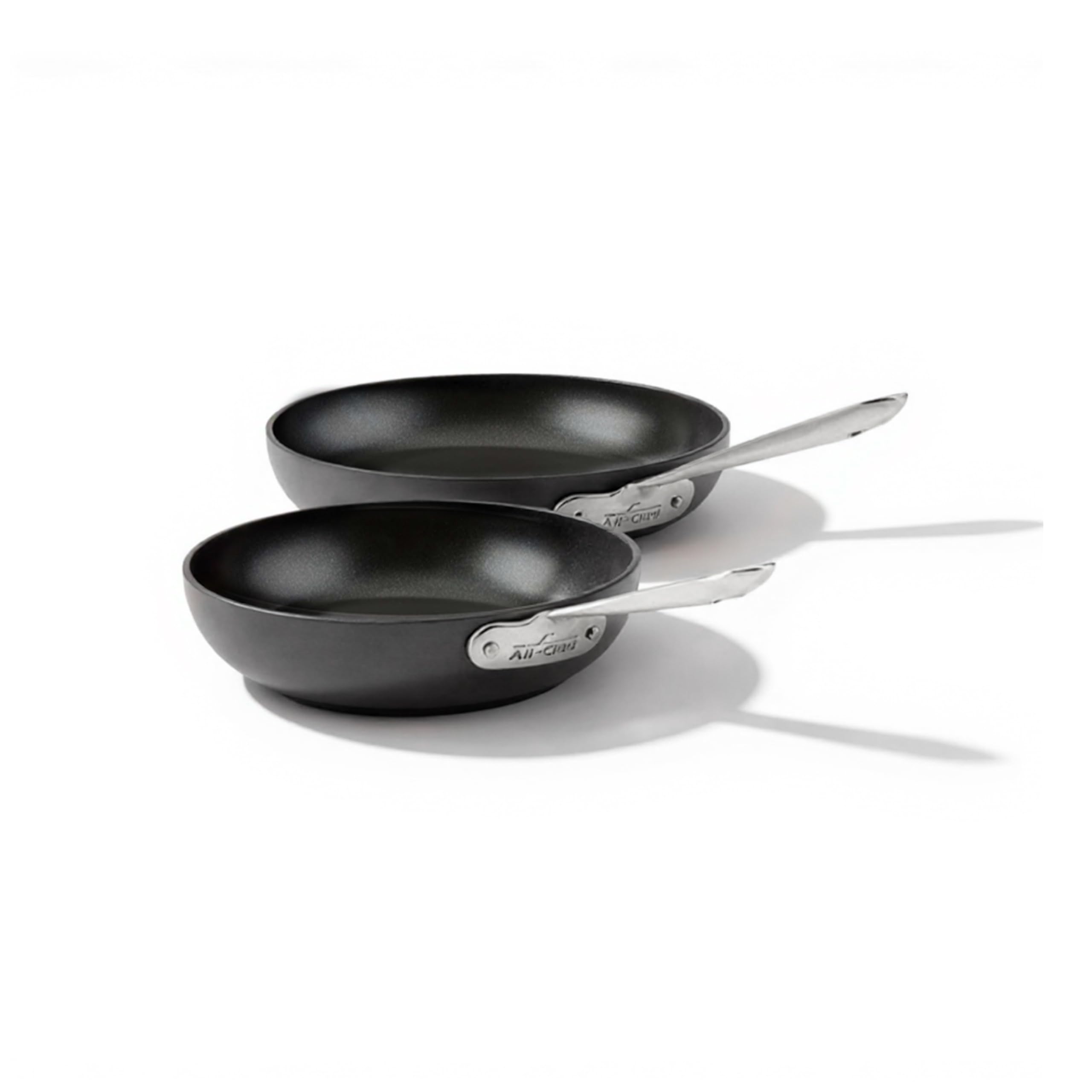
All-Clad HA1 2-Piece Fry Pan Set
Key Features
- Weight: 5 lb
- Cooktop: All, including induction
- Oven safe: 500°F
- Set contents: 8 in and 10 in fry pans
- Price: Premium
A magnetic stainless base bonded to hard-anodized aluminum is the reason these two pans cost what they do. It is what lets them sit flat and heat evenly on an induction cooktop, and what lets them go into a 500°F oven when the T-fal set stops at 400°F. If your range is induction, this is the pair the rest of the roundup gets measured against.
We rate it the best of the sets here for anyone who wants one pan to go from stovetop to oven without a second thought. Eight and ten inches is a tighter pair than T-fal’s ten and twelve, which is better for a small kitchen and smaller portions, and worse if you routinely cook for four in one pan. Heat is even and steady, food releases cleanly, and the flared side walls make plating easier.
The double-riveted stainless handles are secure and stay cool on the stovetop, though they are slim, more of a pinch grip than a fistful, and the edges make themselves known during a long session at the stove. A silicone sleeve fixes it. Set on a grate, the pans sit dead still, which is exactly what you want when you are searing.
The nonstick is PTFE and PFOA-free and releases eggs as well as anything in this group, but it is the part that ages. Hand washing and wooden or silicone utensils are the cheap insurance, while the dishwasher is convenient and unkind to coatings. The exterior shrugs off scratches, so the pans keep looking good long after the interior has started to dull.
Pros
- Works on induction and every other cooktop
- Oven safe to 500°F
- Even, steady heat from a steel-reinforced base
- Secure double-riveted stainless handles
Cons
- Heavy at 5 lb for the pair
Buy this pair if your range is induction or you finish pans in a hot oven; the steel base and 500°F rating are what the extra money buys.
Best for Small, Hot Searing
Tramontina Professional 8-Inch
Key Features
- Size: 8 in
- Cooktop: Gas, electric, ceramic glass (not induction)
- Oven safe: 400°F
- Certification: NSF certified
- Price: Budget
NSF certification is a restaurant-kitchen credential, and it shows here: heavy-gauge aluminum, a riveted handle you can sleeve in silicone, and a plain spun body with no decorative nonsense on it. We like it as the small pan for anyone who cooks hot and fast. The 8-inch comes up to temperature quickly and gives a chop or a piece of fish a sear out of proportion to its size.
Pull off the silicone sleeve and the whole pan goes into a 400°F oven, which is more than most 8-inch skillets offer and enough for a frittata or a pan-roasted pork chop. The reinforced coating releases eggs and fish cleanly and wipes out with a sponge. It is also the least fussy pan in this group: no indicator dot, no granite pattern, nothing to think about but the heat.
Two boundaries are worth knowing before you order. It is handle-heavy, so set it down empty and off-center on a grate and the handle end lifts the pan; keep a hand on it. And eight inches is a two-egg, two-chop pan, not the one you reach for to feed four. Within those limits it is a workhorse, and the lifetime warranty is a longer promise than most pans here come with.
Pros
- Restaurant-grade build with NSF certification
- Oven safe to 400°F with the sleeve off
- Fast, even heat in a small pan
- Lifetime warranty
Cons
- Can scratch glass-top ranges
For high-heat searing in a small pan, this is the one we reach for: restaurant-grade aluminum with a lifetime warranty behind it.
Best for Budget Egg Pan
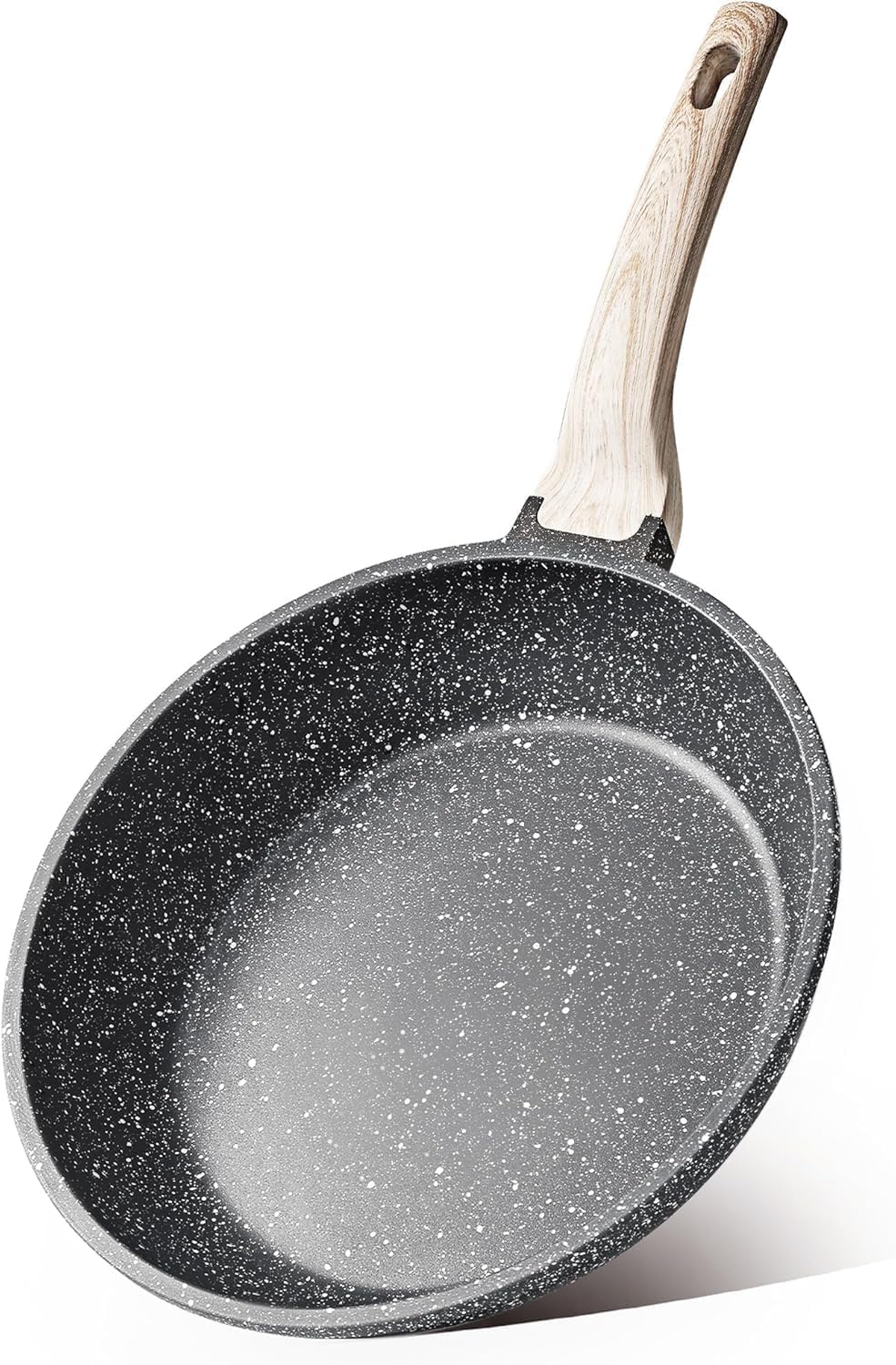
CAROTE 8-Inch Classic Granite
Key Features
- Size: 8 in
- Weight: 1.3 lb
- Cooktop: All, including induction
- Max temperature: 482°F
- Price: Budget
An eight-inch pan earns its keep between seven and nine in the morning. Two eggs, a folded omelet, a grilled cheese, one salmon fillet: the CAROTE does all of it in a body light enough to shake one-handed over the burner. It is the least expensive way into a decent nonstick skillet in this roundup, and it does not feel cheap in the hand.
The granite-flecked coating is PFOA- and PFOS-free and releases eggs with a smear of butter, while the wood-look Bakelite handle stays cool through a long breakfast. A magnetic stainless base means it works on induction as well as gas and electric, and the listed maximum temperature of 482°F is high for this class. The walls have some height to them, which helps an omelet hold together and keeps oil from spitting.
We think it is the best value in this set for a small pan. The honest limit is size: two chicken thighs will crowd it and steam rather than brown, so treat it as the breakfast-and-sides pan rather than the only one you own. Keep metal utensils out of it and the finish holds up the way a coated pan should.
Pros
- Light enough to shake one-handed
- Works on induction and all other cooktops
- Easy to clean
Cons
- Coating may flake with heavy use
The best-value small pan here: light, induction-ready, and slippery enough that breakfast stops being a chore.
Best for One-Pan Dinners
SENSARTE 10-Inch Deep Saute Pan
Key Features
- Lid: Tempered glass included
- Size: 10 in diameter, 2.7 in deep
- Cooktop: All, including induction
- Capacity: 3.5 qt
- Price: Midrange
Two and seven-tenths inches of wall and a tempered glass lid turn a skillet into something closer to a sauteuse. That depth is what makes this the pan for a curry, a shallow braise, a batch of pasta sauce, or a stir-fry that would climb out of a flat skillet. The pour spout on the rim does more than it sounds like: you can tip off fat or sauce without a ladle and without it running down the outside.
Of the deep pans here, this is the one we hand a cook who wants a single vessel for a weeknight dinner. Three and a half quarts is family-sized without being unwieldy, the magnetic stainless base works on induction as well as gas and electric, and the pan is light enough to lift with one hand while you stir with the other. The woodgrain Bakelite handle stays cool through a long simmer.
Cleaning is where the design earns its keep. There are no rivets inside, so nothing collects around the handle mount, and the coating wipes out with a sponge and warm water. The handle screws on and off, which means the pan stows flat in a tight cabinet instead of hogging a shelf.
Pros
- Deep 3.5-quart body with a glass lid
- Pour spout makes tipping off fat easy
- Rivetless interior cleans without crevices
Cons
- Hand wash only
If dinner happens in one pan, sauce, stir-fry or a shallow braise, this is the deep skillet we hand people first.
Best for Starter Kitchens
Utopia Kitchen 3-Piece Set

Key Features
- Weight: 1.1 lb
- Coating: PFOA, lead, and cadmium free
- Handles: Riveted Bakelite
- Set contents: 8 in, 9.5 in, and 11 in fry pans
- Price: Budget
Eight, nine and a half, and eleven inches for roughly what one branded skillet costs: that is the pitch, and for a first apartment or a rental kitchen it is a sound one. The three sizes cover eggs, a two-person saute, and a family stir-fry without any of them being redundant. The riveted Bakelite handles are comfortable in the hand and stay cool over a burner.
Heat is even enough for pancakes and quick sauces, and the nonstick layer releases cleanly while it is new. The pans are light, with the set listed at just over a pound, which makes them easy to handle and also means they do not hold heat the way the hard-anodized pans here do. Expect to cook a notch lower than you think and to give the pan a moment to recover after cold food goes in.
We think it is the best value here for filling three burners at once, with one check first. Induction is the murky part, since Utopia lists these as electric and gas pans, so put a magnet on the base before you commit. There are no lids in the box either, so plan on buying one if you like to cover a pan.
Pros
- Three graduated sizes at a value price
- Even heat for quick everyday cooking
- Riveted Bakelite handles stay cool
Cons
- Coating can peel with daily use
The value pick here: three useful sizes for a starter kitchen, provided you check the base before you commit.
Best for Oven-To-Table Cooking
T-fal x Jamie Oliver 3-Piece Set

Key Features
- Care: Dishwasher safe
- Cooktop: All, including induction
- Oven safe: 500°F
- Set contents: 8 in, 9.5 in, and 11 in fry pans
- Price: Premium
A stainless steel exterior with a nonstick interior and a 500°F oven rating is the combination that sets this set apart from the hard-anodized pans here. The stainless outside takes the knocks a stovetop deals out and still looks presentable on an open shelf, while the inside is a titanium-reinforced nonstick that releases eggs and wipes clean with a sponge.
Three pans at 8, 9.5, and 11 inches is the widest spread in this roundup, and between them they cover nearly everything: the small one for eggs, the middle for a two-person saute, the big one for a family stir-fry or a run of pancakes. The Thermo-Signal dot turns solid red at preheat, the same useful trick as the Thermo-Spot on our top pick, and the induction base makes the set work on any cooktop.
The cast stainless handles are riveted and comfortable in a full grip, and on the stovetop they stay cooler than bare aluminum. These are substantial pans, with the set running about six pounds, so tossing vegetables one-handed takes some wrist. They are also the best-looking pans in this group, which matters if your cookware lives on a rack rather than in a drawer.
Here is the honest position. This is the most expensive way here to get three nonstick frying pans, and the coating will wear the way every nonstick coating wears. What you are buying is the oven headroom, the induction base, and a set that looks like it cost more than it did. If you sear, roast, and finish in the same pan through the week, that is a fair trade. If you mostly fry eggs, the T-fal hard-anodized pair does the job for a lot less.
Pros
- Three pans from 8 to 11 inches
- Induction base plus 500°F oven rating
- Dishwasher safe
Cons
- Metal handles get hot in a 500°F oven
The set for induction owners who want three sizes and a 500°F oven rating; you pay for the stainless outside, and it shows.
Best for Family-Size Batches
CAROTE 12-Inch Deep Pan with Lid

Key Features
- Care: Hand wash only
- Size: 12 in diameter
- Cooktop: All, including induction
- Pour spouts: Two, left and right
- Price: Midrange
Twelve inches across and deep enough to hold a braise, this is the biggest pan in the roundup, and the size changes what you can do in a skillet. A family stir-fry, a pot of Sunday sauce, a batch of poached fish: things that need surface and depth at the same time and will not fit in a 10-inch pan without a mess.
The details are better than the price suggests. Two pouring spouts, one on each side, so left-handed cooks get the same easy pour as everyone else. A tempered glass lid lets you watch a simmer without lifting it, and the rivetless interior leaves no crevice around the handle mount to scrub. The enlarged induction base gives it quick, even heat on any cooktop, induction included.
Give it your widest burner. The outer inch of a 12-inch base does not get the heat on a small ring, and the edges of a stir-fry brown unevenly for it. Check the glass lid when the box arrives as well, since it is the part most likely to take a knock in transit.
We like it as the second pan for a household that cooks big: not the thing you reach for to scramble two eggs, but the one that replaces both a skillet and a pot on pasta night. It is a lot of pan for the money, so measure the cabinet shelf before it arrives.
Pros
- 12-inch depth handles family batches
- Two pour spouts for either hand
- Induction base on all cooktops
Cons
- Hand wash only
- Heavy at 2.54 kg
For big batches and saucy one-pan cooking, this is the widest thing here: a skillet that moonlights as a pot.
How We Tested Nonstick Pans
We began with a shortlist of 14 pans in the sizes people actually cook with, from 8-inch skillets for eggs to 12-inch pans for family dinners, and filtered out anything with vague coating claims or a handle that felt loose in the store. We bought each pan at retail and cooked with it the way a home cook would, not on a lab bench.
For six months, the pans stayed in rotation on our home stoves. We fried eggs and folded omelets on weekday mornings, made pancakes on weekends to watch how evenly the surface browned, seared chicken and built quick pan sauces at night, and used the widest pans for four-portion stir-fries. We noted whether eggs slid free with a nudge or clung and tore, and whether pancakes showed a pale center, a dark ring, or an even golden finish.
After each use, we let the pan cool, washed it by hand with a sponge and mild soap, and recorded whether residue lifted in one pass or needed soaking. We used silicone, wood, and metal utensils as each manufacturer allowed, then checked the surface for scuffs, scratches, and any drop-off in release. At the start, at three months, and at the end, we compared browning, cleaning effort, handle comfort, and the price against how often we reached for that pan. The best ones earned their cabinet space; the disappointing ones made that obvious before the six months were up.
How to Choose a Nonstick Pan
The pan matters less than the burner underneath it and the way you treat the coating, so settle those two first and the shopping gets short.
Start With Your Cooktop
Nonstick aluminum only works on an induction range if there is magnetic steel in the base, and no coating makes up for a pan that will not heat. The T-fal hard-anodized pair, our top pick, is the clearest example: excellent on gas, electric, and ceramic, and simply not an induction pan. The All-Clad HA1 and both CAROTE pans carry a magnetic base and work anywhere.
Before you order anything for an induction range, set a magnet on the underside. If it does not grab, the pan will not either, whatever the listing says.
Match the Size and Depth to the Job
An 8-inch pan is an egg pan: two eggs, a folded omelet, one chicken breast. Ten inches is the workhorse that covers most weeknight cooking for two or three people. Twelve inches, or a pan with two and a half to three inches of wall, is what a family stir-fry or a braise actually needs, and the SENSARTE deep pan and the CAROTE 12-inch are built for exactly that.
Buying a first pan? Ten inches. Buying two? Eight and ten, or ten and twelve, covers more ground than two pans of the same size ever will.
The Base Decides How It Heats
Thin stamped aluminum heats fast and hot-spots just as fast. A heavier body, whether hard-anodized aluminum or aluminum over a bonded steel base, spreads heat across the base and holds it when cold food goes in. The trade is weight: the All-Clad pair runs about five pounds, the Utopia set just over one.
Heavy pans sear better and sit still on the grate. Light pans are easier to shake and kinder to a tired wrist. For eggs, light wins; for a steak, heavy does.
Handles, Ovens, and the Rating That Matters
Stay-cool handles are a stovetop feature, not an oven one. Bakelite and silicone handles stay comfortable over a burner but cap the pan somewhere around 400°F, while stainless handles take 500°F and then need a dry towel. Check the number against your hottest move. If you finish a frittata at 425°F, a 400°F pan stays on the cooktop.
Lids usually rate lower than the pan they came with, so pull them out before anything goes in the oven.
The Coating Is the Part That Ages
Treat every nonstick surface as a wear part and the decision gets clearer. Expect a few years of daily cooking rather than a decade, and spend accordingly: the body, the base, and the handle are what you keep, while coating claims are a tiebreaker rather than a reason to pay double.
The pans that justify their price here are the ones with a solid base and a comfortable grip, not the ones with the most exotic coating name. Replace the pan when food starts sticking, not before.
Frequently Asked Questions
Why has my nonstick pan stopped releasing food?
Almost always heat or abrasion rather than a defective pan. Nonstick coatings degrade quickly when an empty pan sits on high heat, and metal utensils and scouring pads take the surface off mechanically. Aerosol cooking sprays leave a varnish that builds up until nothing slides.
Cook at medium, use a teaspoon of oil rather than spray, and wash with a soft sponge once the pan has cooled.
Is a scratched nonstick pan still safe to use?
It is a worn pan rather than an emergency, but it is not one to keep. Flakes of coating in dinner are unpleasant, and every pan in this roundup is listed as PFOA-free.
The useful signal is release: when eggs need oil and a spatula to come free, the coating has stopped doing its job. Retire it then, and never keep cooking with a flaking pan over high heat.
Can nonstick pans go in the dishwasher?
Some can, and the pans marked dishwasher safe will survive it, but detergent and the drying cycle are hard on coatings and exterior finishes. Hand washing takes about thirty seconds with a soft sponge and warm water.
Let the pan cool for a minute first, since cold water on a hot pan can warp a thin aluminum base, and skip the heated dry if you do load it.
Final Verdict
The T-fal Ultimate hard-anodized pair is the set we point most people to: 10 and 12 inches, even heat, a genuinely slippery coating, and a preheat indicator that teaches you to cook at the right temperature. It is not an induction pan, and that single fact should send you elsewhere if your range is induction.
In that case, buy the All-Clad HA1 pair instead: the same two-pan idea with a bonded steel base, a 500°F oven rating, and a lot more heft in the hand. For one deep pan that handles dinner and the leftovers, the SENSARTE saute pan is the better second purchase.