This post contains affiliate links. We may earn a small commission when you buy through our links — at no extra cost to you.
Glass stovetops demand a perfectly flat pan bottom for consistent heat and to avoid scratches. Many nonstick sets look practical but warp or lose their coating within a year, leaving you with uneven cooking and a stained surface.
Induction compatibility adds another layer of confusion — not every pan labeled ‘induction ready’ heats evenly or maintains a flat base after repeated use. The material and construction quality determine whether your cookware will stay stable over time.
The right choice for your glass stove depends on one trade-off: the convenience of nonstick versus the decades-long durability of stainless steel. Matching that to your cooking style and budget is the focus here.



Best for Induction Stainless
Cuisinart MultiClad Pro 12pc
Key Features
- Induction Ready: Yes
- Core Material: Tri-ply Stainless Steel
- Oven Safe Temp: 500°F
- Surface: Stainless Steel
- Price: Premium
The Cuisinart MultiClad Pro delivers even heat across all glass stovetops thanks to its tri-ply construction with an aluminum core. The flat bottoms sit flush without warping, and the set works on induction, electric, and gas cooktops.
Pans heat quickly and respond well to temperature changes. The stainless surface requires technique: preheating and oil are necessary to prevent sticking – standard for this material. Handles and lid knobs can become warm during longer cooking, something to keep in mind for extended simmering.
This set suits home cooks who want induction-compatible stainless steel built to last decades. It works for those comfortable with stainless cooking or willing to learn. If you prefer nonstick convenience or a lightweight set, consider other options.
Pros
- Even heat distribution across the pan surface
- Heavy-duty build that resists warping over time
- Compatible with induction, gas, and electric cooktops, oven safe to 500°F
Cons
- Handles and lid knobs can get hot during extended cooking
For a glass stovetop, this set offers lasting performance with proper technique – a benchmark worth the investment.
Best for Induction Nonstick
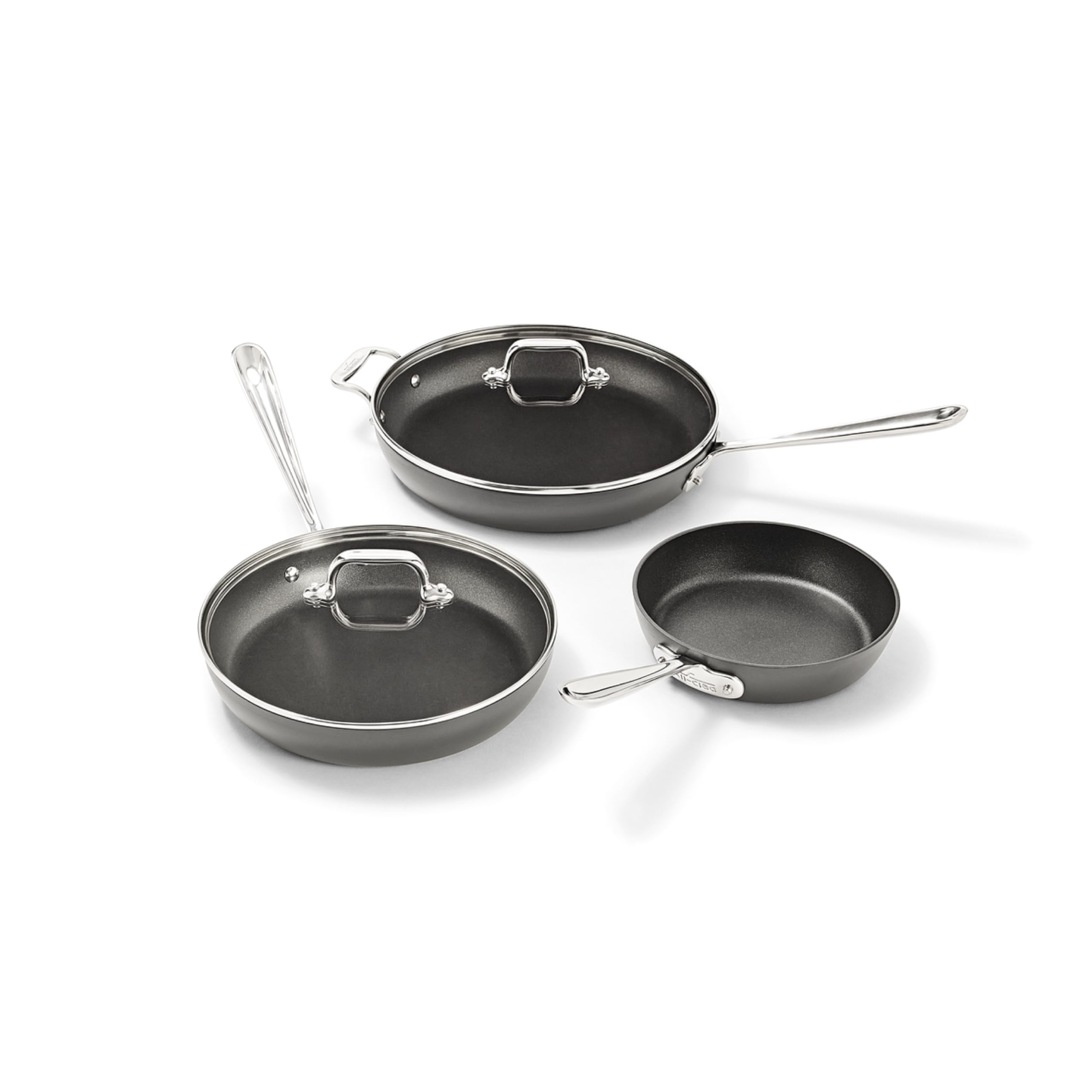
All-Clad HA1 Fry Pan Set
Key Features
- Induction Ready: Yes
- Core Material: Hard Anodized Aluminum
- Oven Safe Temp: 500°F
- Surface: Nonstick
- Price: Premium
This five-piece set provides three fry pans (8, 10, 12 inches) with a hard-anodized aluminum body and flat stainless steel base that stays stable on glass and induction cooktops. The nonstick coating releases eggs, fish, and sticky sauces cleanly, and heat distributes evenly for consistent browning. Oven safety to 500°F (lid 350°F) adds flexibility. The tradeoff: the concave handle shape can press into your palm during longer cooking – a known limitation that some address with silicone covers or a towel. This set suits home cooks who prioritize nonstick performance and are willing to manage the handle ergonomics, or plan to use an aftermarket grip.
Pros
- Nonstick coating releases food easily – eggs, fish, and pancakes slide right off.
- Flat, induction-ready base ensures even heating on glass stovetops without scratching.
- Oven safe to 500°F, allowing stovetop-to-oven recipes for searing and finishing.
Cons
- Concave handle shape may cause discomfort during extended cooking – silicone covers or a towel can reduce pressure.
If nonstick performance and glass-stovetop compatibility are your priorities, this set delivers – just plan for the handle shape or add a grip.
Best for Budget Induction
SENSARTE Ceramic 13pc
Key Features
- Induction Ready: Yes
- Core Material: Cast Aluminum
- Oven Safe Temp: 550°F
- Surface: Ceramic Nonstick
- Price: Budget
This 13-piece ceramic set delivers induction compatibility and high oven safety for a fraction of the cost of stainless alternatives. Unlike tri-ply sets that require preheating and oil to prevent sticking, this nonstick surface lets eggs slide off from day one. However, the coating and handles have limited longevity; heavy daily use may cause handles to crack and nonstick performance to fade within months.
The SENSARTE set suits first-time induction cooktop owners or small families on a tight budget who want non-toxic cookware for light to moderate cooking. If you cook daily or expect the set to stay pristine after a year, the durability limitations will be noticeable.
Pros
- Very affordable for a 13-piece ceramic set with induction compatibility
- Good nonstick initially – eggs slide off with little oil
Cons
- Handles may crack and coating can chip under heavy daily use
- Nonstick performance may decline after several months, requiring more oil
A pragmatic starter set for glass stovetops if you need induction-ready nonstick on a budget, but expect to replace it within a couple of years.
Best for Cast Iron
Lodge Cast Iron Skillet Set
Key Features
- Induction Ready: Yes
- Core Material: Cast Iron
- Oven Safe Temp: 550°F
- Surface: Seasoned Cast Iron
- Price: Budget
Three seasoned skillets (8, 10.25, and 12 inches) for under $70 that will outlast any nonstick set. Cast iron’s heat retention locks in crusts and evenly browns cornbread, and the set works on any stove type including induction. On glass stovetops, the weight (over 17 lbs for the set) means you’ll need to lift rather than slide each pan to avoid scratching the surface. The preseasoned coating provides a decent nonstick start, but food release improves with continued seasoning — a tradeoff that rewards cooks willing to learn the maintenance routine.
This set is for home cooks who prioritize durability and heat performance over lightweight convenience. If you’re comfortable with the weight and occasional seasoning touch-ups, you get a lifetime of campfire-to-oven versatility. Those who want grab-and-go cooking or a maintenance-free nonstick surface should look to the top-pick stainless steel set instead.
Pros
- Exceptional heat retention for searing, baking, and frying
- Works on stove, oven, grill, and campfire without limits
- Three skillets at a price that undercuts most single pans
Cons
- Heavy: each skillet adds up; lifting required on glass stovetops to avoid scratching
- Not naturally nonstick; relies on seasoning and proper preheating to prevent sticking
For home cooks who value heat retention and longevity over weight and convenience, this set delivers exceptional value on glass stovetops when handled with care.
Best for Value Stainless
Farberware Classic 15pc
Key Features
- Induction Ready: Yes (except pans)
- Core Material: Aluminum Core Stainless
- Oven Safe Temp: 350°F
- Surface: Stainless Steel
- Price: Mid-Range
This Farberware set delivers the core pieces needed for induction glass stoves without the premium price of tri-ply sets. The pots and saucepans are induction-ready, though the frying pans are not. Stainless steel requires preheating and oil to prevent sticking – a technique adjustment for those used to nonstick. While the top-pick Cuisinart MultiClad Pro offers more precise heat distribution and 500°F oven safety, this set provides a practical alternative at roughly half the cost. Best for home cooks who want stainless steel durability and a large stockpot for soups or stocks, and are comfortable with occasional handle tightening.
Pros
- Classic stainless steel build with even heating across pots and saucepans.
- Complete 15-piece set at a value that fits a mid-range budget.
- Induction-compatible pots and saucepans – works on glass induction cooktops.
Cons
- Handles can loosen over time, requiring periodic tightening.
- Stainless steel surfaces need preheating and oil to prevent food sticking.
A practical stainless steel starter set for glass stovetops that delivers the essentials without the high cost – just be ready to tighten handles and learn the preheating technique.
Best for Premium Hybrid
HexClad 6-Piece Pot Set
Key Features
- Induction Ready: Yes
- Core Material: Tri-ply Hybrid
- Oven Safe Temp: 900°F
- Surface: Hybrid Nonstick
- Price: Luxury
The laser-etched nonstick surface over stainless steel allows metal utensils and high heat – oven safe to 900°F with lids to 400°F. The tri-ply construction ensures flat, even heating on any glass stovetop. Backed by a lifetime warranty, this set bridges nonstick convenience and stainless searing.
This pot set suits enthusiast home cooks who want one set for all cooking – from nonstick eggs to high-heat searing and oven finishing. The premium price reflects the build quality and warranty. Note that maintaining nonstick requires occasional seasoning; without it, food can stick.
Pros
- Hybrid nonstick + stainless searing in one pan
- Heats evenly and handles oven use up to 900°F
- Dishwasher safe and quick to wipe clean
Cons
- Premium price – a significant investment for 3 pots
- Nonstick performance requires occasional seasoning to prevent sticking
For serious cooks who want a single set that can sear, simmer, and go in the oven with a lifetime warranty – this is a capable option if you’re willing to season it.
Best for Radiant Nonstick
T-Fal Ultimate 14pc Set

Key Features
- Induction Ready: No
- Core Material: Hard Anodized Aluminum
- Oven Safe Temp: 400°F
- Surface: Nonstick
- Price: Mid-Range
This 14-piece set delivers an easy-clean nonstick experience on radiant glass cooktops, with even heat distribution from the Thermo-Spot indicator. However, the manufacturer explicitly excludes induction cooktops despite conflicting listing details, so induction owners should look elsewhere.
Pros
- Nonstick coating releases food with minimal effort for quick cleaning.
- Thermo-Spot indicator confirms when pan is preheated for even cooking.
Cons
- Not compatible with induction cooktops despite listing ambiguity – a dealbreaker for induction owners.
Best for radiant glass stovetop owners who want a full set with strong nonstick performance; avoid if you cook on induction.
Best for Loaded Nonstick
Cuisinart Hard Anodized 17pc

Key Features
- Induction Ready: Yes
- Core Material: Hard Anodized Aluminum
- Oven Safe Temp: 500°F
- Surface: Nonstick
- Price: Premium
This 17-piece set covers everything from frying to steaming, with induction compatibility and 500°F oven safety. The nonstick surface releases food easily. However, handles get very hot during use, and the outer coating may chip after months. For a more reliable glass stovetop choice, the stainless MultiClad Pro offers better durability.
Pros
- Comprehensive 17-piece set includes steamer insert for versatile cooking.
- Oven safe to 500°F (lids 450°F) with even heat distribution.
Cons
- Coating may peel or chip over time, affecting appearance and performance.
Best suited for users who want a complete nonstick induction set and are willing to hand-wash and accept that the coating will degrade faster than stainless alternatives.
Best for Aesthetic Non-Toxic
Caraway Ceramic 12pc

Key Features
- Induction Ready: Yes
- Core Material: Ceramic-coated Aluminum
- Oven Safe Temp: 550°F
- Surface: Ceramic Nonstick
- Price: Luxury
The Caraway set’s magnetic racks and lid holder keep the kitchen tidy, and the ceramic coating avoids PTFE and PFAS. The nonstick surface can lose effectiveness after a year, making this set better for occasional cooking than daily use. The high price relative to that lifespan limits its value for heavy users.
Pros
- Beautiful design and appealing color options
- Non-toxic ceramic coating free of forever chemicals
Cons
- Nonstick performance can decline after a year, leading to food sticking in some cases
This set works well for light cooking in a styled kitchen, but its premium price and limited nonstick lifespan make it a poor choice for heavy daily use.
Best for Large Family
CAROTE 21pc Nonstick Set

Key Features
- Induction Ready: Yes
- Core Material: Die-cast Aluminum
- Oven Safe Temp: No
- Surface: Granite Nonstick
- Price: Mid-Range
This 21-piece set supplies enough nonstick cookware and utensils to outfit a large kitchen on a budget. The induction-compatible base works on glass stovetops, and food releases easily. However, the light-colored pans stain with use, and the coating may peel under heavy cooking — better suited for gentle, occasional use than daily high-heat work.
Pros
- Food residue wipes away without scrubbing
- 21 pieces including utensils at a reasonable price
Cons
- Light interior may show discoloration from oils and spices over time
Best for infrequent cooks or large households who prioritize upfront value and easy cleanup over long-term appearance — plan to replace within a year or two.
Best for Premium Saucepan
HexClad Hybrid 3-qt Saucepan

Key Features
- Induction Ready: Yes
- Core Material: Tri-ply Hybrid
- Oven Safe Temp: 900°F
- Surface: Hybrid Nonstick
- Price: Premium
This hybrid nonstick saucepan delivers even heating and easy cleanup on glass stovetops, with a flat tri-ply base that won’t scratch. Its laser-etched surface allows metal utensils and high heat without sticking. However, at a premium price for just one pot, it makes more sense as a specialty piece than a set replacement—the full HexClad pot set offers better value if you need multiple sizes.
Pros
- Sears and releases food well while being easy to clean by hand or dishwasher.
- Heats quickly and evenly with no hot spots, ideal for sauces and grains.
Cons
- Cost is steep for a single saucepan when other brands offer full sets at similar prices.
Best for the cook who needs one premium saucepan for sauces and grains and isn’t building a full set.
How to Choose
The most critical factor for glass stovetops is a perfectly flat pan bottom that maintains full contact with the cooking surface.
Induction Compatibility
Induction glass cooktops require pans with a magnetic base. A simple magnet test tells you if a pan will work — if it sticks, the pan is compatible. Non-magnetic materials like pure aluminum or ceramic won’t heat on induction coils.
Even among compatible pans, the magnetic layer thickness varies. Thin-bottomed induction pans can hotspot or warp over time, especially under high heat. Look for a full stainless steel or cast iron base rather than a thin disc bonded to the bottom.
Core Material and Heat Distribution
The core of the pan determines how evenly heat spreads. Tri-ply stainless steel (aluminum core sandwiched between stainless layers) is the standard for even, warp-free heating on glass stoves. Hard anodized aluminum also distributes heat well but may not last as long under daily use.
Cast iron retains heat superbly but heats slowly and unevenly if the pan bottom isn’t perfectly flat. Cheap nonstick sets often use thin aluminum that flexes, creating hot spots that can crack a glass cooktop’s surface.
Oven Safe Temperature
Oven-safe temperature matters if you use cookware for finishing dishes in the oven or broiler. Most nonstick sets top out at 400–500°F — exceeding that can degrade the coating and release fumes. Stainless steel and cast iron typically handle 500°F or higher.
Lids often have lower temperature limits than the pan because of plastic or glass components. Always check the lid’s max temperature separately to avoid warping or cracking during high-heat roasting.
Nonstick vs. Stainless Steel
Nonstick cookware releases food easily with less oil, making it ideal for eggs, fish, and delicate sauces. However, the coating has a finite lifespan — typically 2–5 years with careful hand washing — and is sensitive to high heat and metal utensils. Ceramic nonstick is PTFE-free but may lose release performance faster.
Stainless steel requires a bit of technique: preheat the pan before adding oil, then wait for the oil to shimmer before adding food. Once mastered, stainless pans are virtually indestructible and heat evenly. For glass stovetops, stainless steel’s flat bottom and resistance to warping are major advantages.
FAQ
Can I use cast iron pans on a glass stovetop without scratching?
Yes, as long as you lift the pan instead of sliding it. Cast iron has a naturally rough bottom that can scratch glass if dragged. Always set it down gently and avoid moving it across the surface. A flat-bottomed skillet is safe when handled carefully.
Why does my nonstick pan stain after a few uses even with gentle cleaning?
Light-colored nonstick surfaces, especially ceramic and granite coatings, discolor from oil residue and high heat. Even gentle cleaning won’t always prevent staining because fats polymerize into the micro-pores. Using moderate heat and wiping with a soft sponge after each use helps, but some discoloration is cosmetic and doesn’t affect performance.
Is stainless steel or nonstick better for a glass induction cooktop?
Stainless steel is the better long-term choice for glass induction because of its flat, warp-resistant bottom and full magnetic base. Nonstick sets often have a thin disc that can warp, causing uneven contact. If you prefer nonstick, choose hard anodized aluminum with a thick stainless steel base and moderate heat use to extend its life.
Do I need a special kind of cookware for a glass stove?
Yes, you need pans with a completely flat bottom — no dimples, ridges, or concave curves — to ensure even heat transfer and avoid scratching. Smooth-bottomed stainless steel, cast iron, and heavy-gauge hard anodized aluminum work well. Avoid pans with warped bases or those that rock when placed on a flat surface.