This post contains affiliate links. We may earn a small commission when you buy through our links — at no extra cost to you.
Every cookware set asks you to pick a side. The nonstick skillet that releases an omelet without a fight scratches if you look at it wrong, and the stainless pan that sears like a steakhouse will grab hold of fried rice and refuse to let go. What a good set fixes is that daily negotiation: the right pan is already in the cabinet, behaving the way you expect whether you’re browning meat or scrambling eggs. We cooked our way through a dozen sets over eight months, and the ones that stayed in reach are the ones I stopped thinking about mid-recipe.
Here’s what nobody tells a first-time buyer: piece count is mostly marketing. A 12-piece set is usually eight pans and four lids, and two or three of those pans will never leave the stack. What matters more is whether the sizes match how you actually cook, and whether a pan feels balanced when you lift it one-handed with dinner in it. The sets below earned their cabinet space night after night, and I’d happily hand any of them to someone starting from zero.
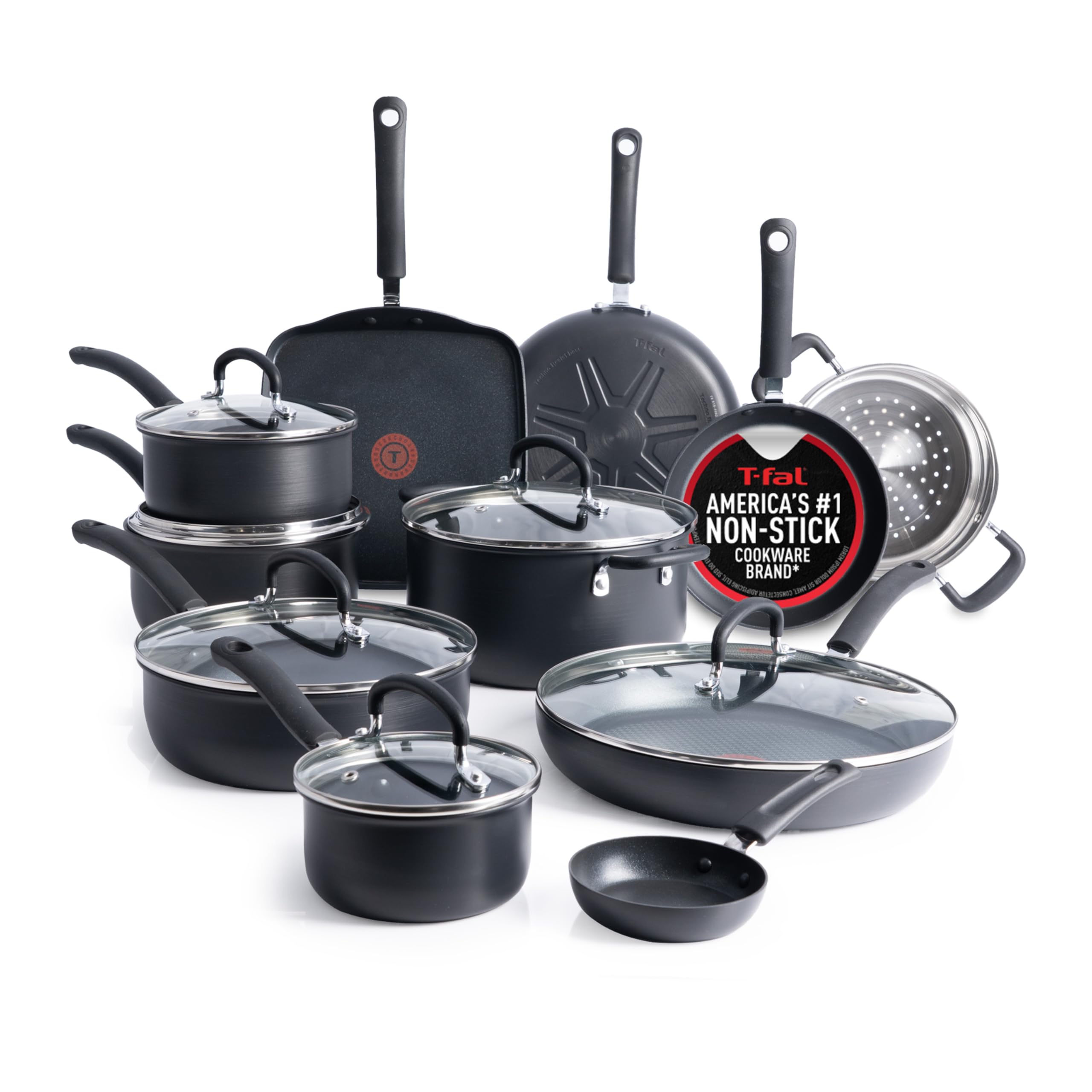


Best for Everyday Family Cooking
T-Fal Ultimate Hard Anodized 17-Piece
Key Features
- Pieces: 17
- Cooktop: All except induction
- Oven safe: 400°F, lids 350°F
- Set weight: 23.8 lb
- Price: Midrange
Seventeen pieces sounds like a marketing number until you read the list. Three covered saucepans, three fry pans — including a covered 11.5-inch one — plus a griddle, a sauté pan, a 5-quart Dutch oven, a steamer insert and a small egg pan. That is why it takes the top spot: not one standout pan, but eight pieces that cook, in sizes that fit a normal week. The two we reach for most, the 10-inch fry pan and the 3-quart saucepan, are the two a set can least afford to get wrong, and neither feels skimped.
The Titanium coating is the practical half of the story. Eggs and a cheese sauce release with a wipe, and the Thermo-Spot ring in the middle of the pan turns solid red once the surface is properly preheated — a small thing that heads off the most common way a nonstick pan gets ruined, which is food going in too early. The hard-anodized aluminum spreads heat evenly too: pancakes on the griddle browned right to the edge on a mid flame, with no pale ring in the middle.
Oven-safe to 400°F, with the lids rated to 350°F, covers finishing a frittata or holding a braise, and the vented glass lids let you watch without lifting. The silicone-wrapped handles stay comfortable through a long simmer, and at 23.8 pounds for the whole set it is noticeably easier to haul out of a low cabinet than the clad stainless alternative here.
The pieces that pad the count turn out to be ones a cook uses: the steamer insert, the griddle, the little egg pan. Nothing here feels like filler, which is not something we can say about every 17-piece box.
Pros
- Eight cooking vessels, not filler accessories
- Thermo-Spot shows when the pan is preheated
- Oven safe to 400°F, lids to 350°F
- 23.8 pounds, lighter than the clad stainless set
Cons
- Not compatible with induction cooktops
- Care instructions call for hand washing
The set we recommend to most kitchens: eight real cooking vessels, including a covered fry pan and a Dutch oven, with a coating that releases food cleanly.
Best for Long-Term Stainless
Cuisinart MultiClad Pro 12-Piece
Key Features
- Pieces: 12
- Cooktop: Induction, gas, electric, glass-ceramic
- Oven safe: 500°F, broiler safe
- Construction: Tri-ply clad to the rim
- Price: Premium
There is no nonstick surface on this set, and that is the whole argument. The tri-ply cladding — stainless, a pure aluminum core, stainless — runs up the sidewalls instead of stopping at the base, so the walls heat with the floor of the pan and you do not get the scorch ring a disk-bottom pan leaves on a gas burner. Nothing here can peel, flake or wear through, because the cooking surface is metal.
We rate it the best of these for anyone who cooks hard and is tired of the nonstick cycle. It also carries the highest heat rating in this group, oven and broiler safe to 500°F, which means a steak can go from the burner to the broiler in the same pan, and the riveted stainless handles stay put without a silicone sleeve to crack. What it asks in return is technique: heat the pan, add fat, leave the food alone until it releases. Expecting eggs to slide out of a cold stainless skillet is how people end up disappointed and back on coated pans.
Twenty-six pounds for twelve pieces is the other adjustment. A 3-quart saucepan of stock is a two-hand lift, and the pieces do not nest as forgivingly as coated ones. Cleaning is a soak and a scrub, with an occasional stainless cleaner to keep the polish even. What you get for the trouble is a set backed by a lifetime limited warranty that takes a metal whisk, a scouring pad and a dishwasher without a second thought.
Pros
- No coating to peel, chip or wear out
- Induction, gas, electric and glass-ceramic compatible
- Oven and broiler safe to 500°F, the highest here
- Dishwasher safe with a lifetime limited warranty
Cons
- Food sticks without fat and technique
- 26 pounds, the heaviest set here
The one to buy if you want to stop replacing cookware: tri-ply stainless with no coating to wear through, induction-ready and rated to 500°F.
Best for First Kitchens
T-Fal Signature 12-Piece
Key Features
- Pieces: 12
- Cooktop: All except induction
- Oven safe: 350°F
- Set weight: 11.5 lb
- Price: Budget
For a good deal less than the top pick you get 12 pieces: 7.75- and 11-inch fry pans, a 10.25-inch griddle, covered 1- and 2-quart saucepans, a sauté pan and a 5.5-quart Dutch oven. The ProGlide coating releases food cleanly and cleans up with a rinse, and the same Thermo-Spot ring tells you when the pan is ready to take food.
At 11.46 pounds it is the lightest full set here apart from the detachable-handle Carote, which matters when you are moving a Dutch oven from shelf to stove and back. It is dishwasher safe and oven safe to 350°F, enough for keeping a dish warm and not enough for broiler work or a high-heat finish.
The compromise is size. A 1-quart saucepan is a single serving of sauce, and the 7.75-inch fry pan holds two eggs and not much else, so if you cook for four most nights, the top pick’s extra capacity is worth the money. The 11-inch fry pan, though, is the piece that makes the set: big enough for a full pan of sausage and peppers and light enough to toss one-handed.
Pros
- Two fry pans, a griddle and a Dutch oven
- Dishwasher safe and oven safe to 350°F
- Light at 11.46 pounds
- Thermo-Spot preheat indicator
Cons
- Smallest pans are single-serving size
- 350°F oven limit, the lowest stated here
A sensible first set: two fry pans, a griddle and a Dutch oven for a lot less than our top pick, with the same easy-release coating.
Best for Induction Ranges
Carote Ceramic 21-Piece
Key Features
- Pieces: 21
- Coating: Ceramic, PFAS-free
- Cooktop: Induction, gas, electric coil
- Set weight: 22.3 lb
- Price: Midrange
Twenty-one pieces, eight of which cook: two frying pans, two saucepans, two stockpots, a sauté pan and an egg pan. The rest is four lids, a steamer, three utensils and four pan protectors — useful, but count the vessels before you decide this is twice the set of a 10-piece alternative, because it is not.
An extended base that works on induction as well as gas and electric coil is what earns it a slot here, since several sets in this group cannot say that, and the die-cast aluminum body keeps a full 21-piece box at 10.1 kg, light enough that the 6.5-quart stockpot is a one-hand lift when it is empty. We also like that the coating is ceramic and listed free of PFAS, PFOA and PFOS; if you are replacing a scratched set partly because of what was in the old coating, that is the reassurance you were shopping for.
The catch is how it ages. The cream finish browns inside the pans and discolors around the handles, and scrubbing does not bring the tone back, so take a darker colorway if you have the choice and keep metal tools out of the pans. That is cosmetic rather than functional, but it is the difference between a set that still looks new in a year and one that does not.
Pros
- Works on induction, gas and electric coil
- Eight cooking vessels plus steamer and utensils
- Ceramic coating listed free of PFAS, PFOA and PFOS
- Light for its size at 10.1 kg
Cons
- Light interior stains and discolors
- Hand washing is recommended
The induction-ready pick: eight cooking vessels plus a steamer in a ceramic set, as long as you can live with a finish that shows its age.
Best for Small Kitchens
Carote Detachable Handle 19-Piece
Key Features
- Pieces: 19
- Cooktop: Induction, gas, electric, oven
- Handles: 2 detachable, silicone
- Set weight: 10.2 lb
- Price: Budget
The reason to buy this set has almost nothing to do with cooking. Take the handle off and the five vessels nest into a stack barely taller than the sauté pan, which in a small apartment or a camper is the difference between owning cookware and having counter space. It is the set we point to when cabinet depth is the binding constraint.
Nineteen pieces, and again most of them are not pans: two saucepans, two frying pans and a 4-quart sauté, plus two detachable handles, glass lids, fridge storage lids, four utensils and pot protectors. The fridge lids are the detail that sold us — a pan of leftovers goes straight into the refrigerator with a lid on it, no transfer to a container and no extra dish. Cooking is unremarkable in the way you want: nothing sticks, a rinse does most of the cleaning, and the pans sit flat on an induction or gas burner with the handle clicked on only when you need to move one.
Two handles serve five pans, so one at a time means shuffling it as you cook — fine for a two-pan dinner, a nuisance when you are juggling three. Give it a tug before you lift a full pan; it seats with a click you can feel, and it is obvious when it has not. What we keep coming back to is the stack: five pans, two handles, and a cupboard shelf that still has room for the plates.
Pros
- Stacks flat with the handles off
- Five vessels, two handles, glass and fridge-storage lids
- Induction and oven compatible
- Dishwasher safe
Cons
- Two handles for five pans
- Coating durability is the weakest here
The space-saving answer: pull the handles off and five pans stack into the depth of one stockpot, which is what makes it work in a small kitchen.
Best for Style-Minded Kitchens
Rachael Ray Cucina 12-Piece
Key Features
- Pieces: 12
- Cooktop: Electric, glass-ceramic, gas
- Oven safe: 400°F
- Set weight: 17.1 lb
- Price: Midrange
People buy this set for the color, and that is a fair reason. The hard-enamel exterior in lavender purple is the one finish here that looks chosen rather than default, and the same body comes in quieter shades if purple is a step too far for your kitchen. What surprised us is that the pans behind the paint earn their place too.
It is aluminum with a hard-enamel skin, oven safe to 400°F, with silicone-wrapped handles that stay cool on the stovetop and four lids among the 12 pieces, two utensils rounding out the count. The nonstick surface releases cleanly and heats evenly across the base on gas, electric and glass-ceramic; ours came through a run of weeknight dinners without a hot spot anywhere.
The lids deserve their own mention: the rims sit a little wider than the pans, so a pour of pasta water runs back into the pot instead of down the outside. It is the kind of small thing you notice every week, and it fits the rest of the design, from the stay-cool handles to the included turner and spoon. Ours has lived on the stove since it arrived, which is the highest compliment we can pay a pan.
Pros
- Hard-enamel finish in real colors
- Even heating on gas, electric and glass-ceramic
- Lids sit wider to catch drips
- Oven safe to 400°F with stay-cool handles
Cons
- Not compatible with induction cooktops
- Coating can peel with metal utensils and high heat
The best-looking set here, and a good everyday nonstick — buy it if you want cookware you will not mind leaving on the stove.
Best for Budget Induction
Sensarte Ceramic 13-Piece
Key Features
- Pieces: 13
- Coating: Ceramic, PFAS-free
- Cooktop: Induction, gas, electric
- Largest pot: 4.7-quart casserole
- Price: Budget
Ceramic coatings and induction compatibility do not often turn up together at the bottom of a price list, and this set has both, which is why it is here despite a modest piece count.
What you get is a 9.5-inch frying pan, an 11-inch sauté with a lid, a 2.6-quart saucepan with a lid and a 4.7-quart casserole with a lid, plus two silicone utensils and pot protectors. The body is cast aluminum with a stainless base plate for induction, the coating is listed free of PFOA, PTFE, PFAS, lead and cadmium, and the woodgrain bakelite handles stay comfortable over a gas flame.
It arrives needing a little assembly, which took us by surprise: the handles bolt on, and the set ships with the screwdriver to do it. Ten minutes and you are cooking, though it is worth rechecking those screws once the set has been through a few wash cycles.
The surface is the part to manage. Ceramic is less forgiving of high heat than the granite-style coatings, and it loses its release faster once you scorch it, so medium is your ceiling for most cooking and the silicone tools in the box are there for a reason. Handled that way, it is a lot of pan for the money and the easiest way into induction-ready ceramic in this group.
Pros
- Works on induction, gas and electric
- Ceramic coating listed free of PFAS, PFOA, lead and cadmium
- Stay-cool handles and tempered glass lids
- Rivet-free interior wipes clean
Cons
- Only four cooking vessels
Budget ceramic that works on induction: four vessels, a PFAS-free coating and stay-cool handles, at the low end of this group.
Best for Budget Ceramic
Blue Diamond 14-Piece

Key Features
- Pieces: 14
- Coating: Diamond-infused ceramic
- Cooktop: Gas, electric, smooth-top
- Set weight: 16 lb
- Price: Midrange
The pitch is the coating: diamond-infused ceramic, advertised as metal-utensil safe and several times harder than a conventional nonstick. That is the reason to look at this set, and it is also the claim we trust least, because scratch resistance is the least settled thing about it and a metal whisk is still the fastest way to find out.
Six vessels, four glass lids, a stainless steamer and three nylon utensils make up the 14 pieces: 7- and 9.5-inch frying pans, 2- and 3-quart saucepans, a 5-quart stockpot and a 2.5-quart sauté. Sixteen pounds for the lot, dishwasher safe, and the blue exterior with the speckled interior is distinctive without being loud.
On the stove it heats fast, and fast means you will want to back off the burner rather than crank it, which is also what the coating wants. The handles are stainless and they get hot over a gas flame, so keep a towel within reach; that is ordinary for a metal-handled pan and worth knowing before you grab one bare-handed.
So it is an also-consider rather than a runner-up: the thing it leads with is the thing it is least reliable at, and the Carote ceramic gives you induction support and two more vessels for about the same money. Buy it if you have a gas or electric range, you want the steamer basket, and you will reach for the nylon tools in the box before the metal ones.
Pros
- 14 pieces including a steamer and three utensils
- PFAS-free diamond-infused ceramic coating
- Sixteen pounds, lighter than clad stainless
- Dishwasher safe
Cons
- Scratch resistance falls short of the claim
- Not induction compatible
A big ceramic set with a steamer, best for gas or electric cooks — just do not buy it for the metal-utensil claim it leads with.
How We Cooked Our Way Through a Dozen Cookware Sets
We started by gathering every set we could find from brands we trust and a few we were skeptical of, then narrowed to 12 based on what was actually in the box, whether the pieces were oven-safe to at least 400 degrees, whether they worked on induction, and what the set cost per usable piece rather than per item on the label.
Each set then lived in a home kitchen for a stretch of the eight-month run, doing the work sets actually do: Tuesday chicken thighs, Saturday pancakes, a Sunday sauce that simmered for two hours. We dusted flour across every skillet and set it over medium heat to see where the browning started first, timed how long a quart of water took to boil on the same burner, and grabbed handles bare-handed to check which ones stayed cool. We also weighed pans empty and loaded, and checked whether a full skillet felt steady one-handed, since a set that’s too heavy to lift is a set that stays in the cabinet.
Cleanup got equal scrutiny. We scrambled eggs in every nonstick pan without added fat to see what slid out and what needed soaking, let cheese and tomato sauce sit on the surface overnight, then washed by hand and ran the dishwasher-safe pieces through a full cycle to look for dulling and staining. We deliberately used metal tongs and whisks, stacked pans the way people really stack them, and noted which rims chipped first. Ratings came down to heat distribution, ease of cleaning, nonstick and stick-resistant performance, scratch resistance, how the finish held up after months of use, and value.
How to Choose a Cookware Set
The piece count on the box is the least useful number in the store; what decides whether a set earns its cabinet space is how many vessels you will actually cook in and what the cooking surface is made of.
Count the pans, not the pieces
Manufacturers count lids, utensils, steamer inserts and even felt pan protectors as pieces, so a 21-piece set can hold eight vessels and a 17-piece set can hold eight as well. Before you compare anything, list the vessels: you want at least a 10-inch fry pan, a 2- or 3-quart covered saucepan, and something in the 5- to 6-quart range for pasta and braises.
Our top pick and the Carote ceramic set both land on eight cooking pieces. The Sensarte set has four, which is why it reads as a starter set rather than the one box that outfits a family.
Coated or clad: pick the surface first
A nonstick coating gives you release with very little fat, and it gives it immediately, with no technique and no learning curve. Bare clad stainless does the opposite: it browns, it builds fond for a pan sauce, it takes metal tools and scouring pads, and it asks you to preheat properly and then leave the food alone until it releases.
If your weeknights are eggs, fish and quick sautés, buy coated. If you sear and deglaze and want a set you never replace, buy clad stainless. The Cuisinart here is our reference point for what that costs and what it demands.
Check your cooktop before you fall in love
Works on all stovetops usually comes with an asterisk, and the asterisk is induction. Induction needs a magnetic base, so a plain aluminum pan will not heat on it at all, and several sets in this group, including our top pick, are explicitly not induction ready.
If you have an induction range, make the compatibility list the first thing you read and prefer a set built around a stainless base plate, like the Carote ceramic or the Sensarte.
What oven-safe actually means
The pan rating and the lid rating are different numbers, and the lower one governs whenever the lid is on: our top pick’s pans are rated to 400°F but its lids only to 350°F. Handles matter just as much, since silicone-wrapped handles are comfortable on the stovetop and cap your oven temperature, while bare stainless can go under the broiler.
Decide whether you finish dishes in the oven before you shop. If you do, buy for that number rather than the one on the front of the box.
Weight, storage and the look in two years
A 6-quart pot full of chili weighs far more than the set weight on the spec sheet suggests, so lift the largest piece before you commit, especially if you have wrist or shoulder trouble. Storage is the other quiet decider: sets with detachable handles stack flat, and everything else needs a cabinet deep enough for the widest fry pan.
Then think about color. Light interiors and hard-enamel exteriors show browning and handle discoloration within months, and dark interiors hide the same wear.
Frequently Asked Questions
Is it cheaper to buy a cookware set or the pans individually?
Per piece, a set almost always wins, because the lids and the stockpot come bundled rather than added at full price. The saving shrinks if you will not use the griddle, the steamer insert or the four utensils that make up the count.
Write down the pans you would buy anyway, then compare that list against the set. If the set covers all of them, buy the set.
Can I use metal utensils in a nonstick pan?
On a conventional coating, no. A metal turner will score the surface and the damage is permanent, so wooden, silicone or nylon tools are the cheap insurance that decides how long a coated pan lasts.
A few sets now advertise metal-utensil-safe coatings. Treat that as a claim to test on a pan you do not mind marking rather than a licence to whisk gravy in your best skillet.
How long should a nonstick cookware set last?
A coated pan is a working surface, not a permanent one. With hand washing, medium heat and non-metal tools you can reasonably expect several years of daily cooking; dishwashing, high heat and metal utensils shorten that considerably.
The signal to replace is eggs that stick without fat, or a surface that has gone tacky or started flaking. At that point no amount of careful washing brings it back.
Will a cookware set scratch my glass-top stove?
It can. A rough or grit-covered base can mark a glass-ceramic surface, and sliding a full pot across the burner is the usual culprit.
Lift rather than slide, check that the base is flat and clean before you set it down, and match the pan to a burner of similar size instead of putting a wide skillet on a small ring.
Final Verdict
The T-Fal Ultimate is the set we recommend to most kitchens: eight vessels that cover a week of cooking, a coating that releases cleanly, and enough of a set that you will not be buying a sauté pan separately next month. If your range is induction, take the Carote ceramic instead, which is the set here that pairs eight vessels with induction support at a midrange price.
And if you are finished replacing coated pans every few years, the Cuisinart MultiClad Pro ends that cycle. It is heavier, it demands technique, and it is the last set on this list most people need to buy.