This post contains affiliate links. We may earn a small commission when you buy through our links — at no extra cost to you.
A moka pot makes coffee with nothing more than a flame and a little steam pressure: water boils in the base, gets forced up through a basket of grounds, and arrives in the top chamber as a dark, syrupy brew. It’s the closest most of us get to espresso without a machine that costs four figures and hogs half the counter. What you’re really buying is a cheap, compact, nearly indestructible morning ritual that produces a real cup before you’re fully awake. Twelve pots and four months of early mornings later, I can tell you they are not interchangeable.
Here’s what I wish someone had told me before my first pot: what comes out is not espresso, no matter what the box says. It brews at a fraction of the pressure, so a medium-fine grind and a level, untamped basket matter more than any accessory — and a pot labeled "3-cup" pours about five ounces, not three mugs. Size trips up more first-time buyers than anything else. The picks below earned their shelf space on taste, build, easy cleanup, and how little babysitting they need.


Best for Most Home Kitchens
Bialetti Moka Express
Key Features
- Cooktop: Gas and electric
- Capacity: 9 espresso cups (420 ml)
- Cleaning: Hand rinse; no detergent
- Material: Aluminum
Stamped aluminum, eight flat sides, a black handle and a lid you flip with a thumb: the Moka Express has barely changed in decades, and the first time you set it on a burner you understand why. Those flats are not decoration. They catch a gas flame and spread it, so the boiler heats evenly instead of hot-spotting, and the pot is light enough to lift one-handed when it is full. On an electric coil it is just as steady. We kept reaching for it because nothing about it gets in the way of the coffee.
The routine is short. The safety valve on the side of the boiler doubles as the fill line, the basket takes a level scoop of grounds without pressing, and the top screws down until it seats. Where the pot rewards attention is the final stretch: the moment it starts to gurgle, the brew is finished, and a pot left sitting on the burner goes bitter and thin. We found the basket wide enough to fill evenly without spilling grounds down the thread, a small thing that stops mattering only after you have used a narrower pot.
At 420 ml, the nine-cup version is the two-person pot. It fills two large mugs with room for milk, and the second half stays hot in the upper chamber while you drink the first. If you take a single espresso and nothing else, one of the smaller sizes in the same range suits you better — nine cups is a lot of coffee to make for one person.
Aluminum asks for one habit in return. Rinse it in warm water, wipe it dry, and leave the detergent and the dishwasher alone; both strip the oxide layer that keeps the metal from going patchy, and the maker says as much. No scrubbing, no soaking, no fuss — it becomes part of making coffee rather than a chore.
Pros
- Even, forgiving heat on gas and electric
- Nine-cup batch fills two large mugs
- Three parts that rinse in seconds
Cons
- Aluminum body rules out induction cooktops
- Handle and lid knob are the parts that fail first
If you cook on gas or electric, start here: the Moka Express is the archetype, it brews a full, honest pot for two, and it is the easiest of these to live with.
Best for Induction Cooktops
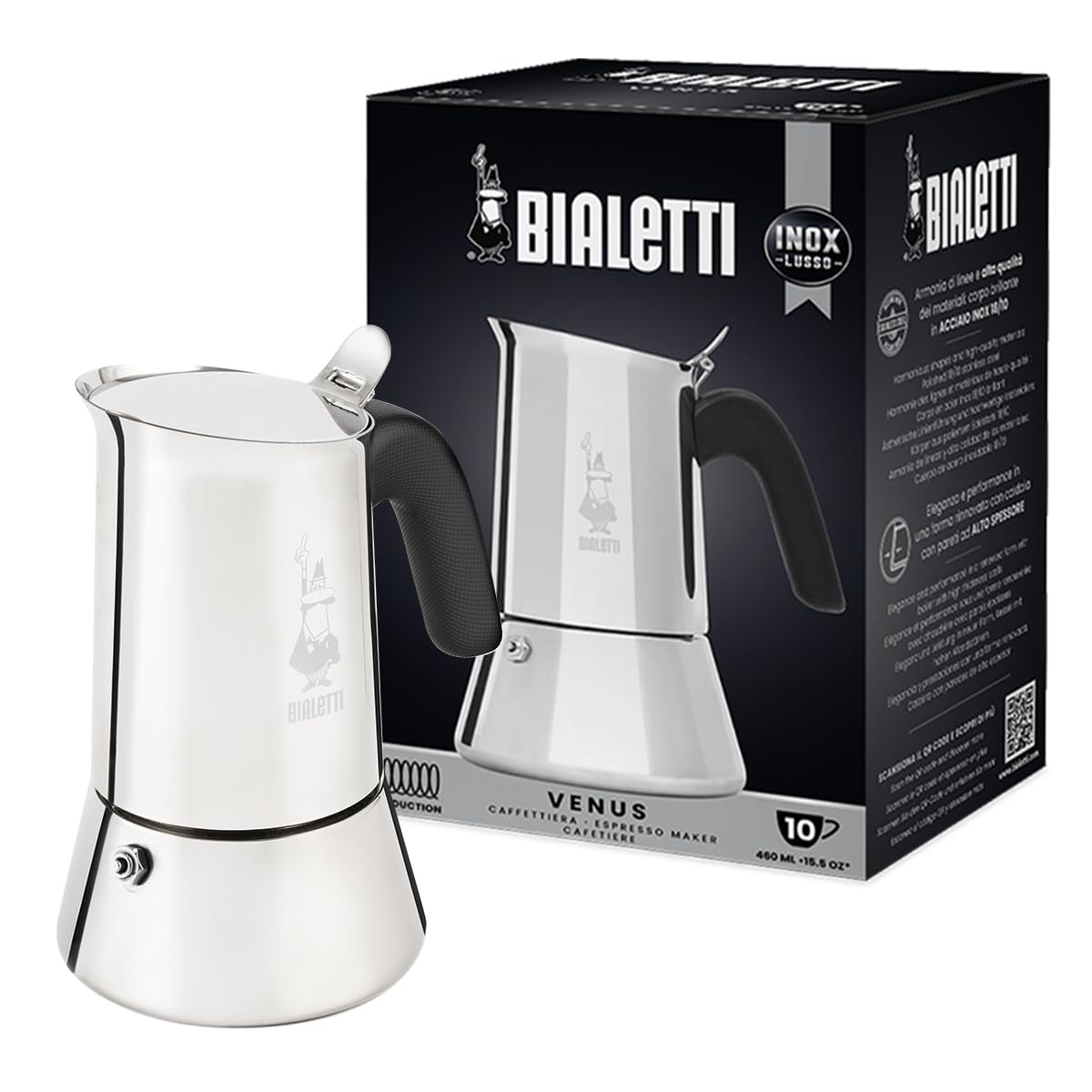
Bialetti Venus
Key Features
- Cooktop: All cooktops, including induction
- Capacity: 10 espresso cups (460 ml)
- Material: 18/10 stainless steel
- Price: Premium
Induction cooktops are the reason stainless moka pots exist, and the Venus is the one here that sits straight on a magnetic ring with no adapter plate underneath. It is 18/10 stainless through and through, so there is no aluminum in the brew path, and the shape is the familiar tapered octagon with the little mustachioed man stamped on the side.
Stainless does not behave like aluminum, and the surprise for us was the direction of the difference. This pot wants a higher flame and a longer warm-up than the aluminum ones — the opposite of what a heavier pan suggests. Give it that and it is docile: a wide base that sits squarely on the burner, a steady flow, and enough volume for two large mugs and a top-up from the ten-cup body.
The base is the part to watch. Water left standing in it is what leaves corrosion marks on stainless, so we rinse and dry ours as soon as it is cool enough to handle, lid off, and put it away open. That one habit is the difference between a pot that stays bright and one that goes grubby at the bottom.
For a household brewing a full pot every morning on induction, the extra weight and the slower start are a fair trade for never worrying about the cooktop again.
Pros
- Works directly on induction cooktops
- Ten-cup batch suits a household
- Stainless body resists taking on a patina
Cons
- Premium price for a stovetop pot
We point induction owners to the Venus: stainless all the way through, ten cups of room, and a base that sits flat on a magnetic ring.
Best for Tight Budgets
Bellemain Moka Pot
Key Features
- Cooktop: Gas and electric
- Capacity: 6 demitasse cups (2 oz each)
- Material: Cast aluminum
- Price: Budget
Bellemain’s pot sits at the budget end of this group, and we went in expecting to find where the corners had been cut. There are not many. It is cast aluminum in the classic eight-sided shape, with a stay-cool handle and knob and a safety valve in the base — the same recipe as pots that ask noticeably more.
Six demitasse cups works out to about twelve ounces, which is one generous mug or two small ones. The aluminum is thin enough to answer a flame change within seconds, so pulling it off the heat at the right moment is easy, and on both a gas burner and an electric coil it started flowing without drama. It makes exactly the small, strong, sweetened cup that Cuban coffee calls for, and it pours cleanly enough to build a latte on.
Where it gives ground is refinement rather than function. The finish is plainer than the Bialetti’s, the body feels lighter in the hand, and nothing about it says heirloom. None of that showed up in the cup, which is rather the point of a budget pot: it does the job and leaves the money for coffee.
Pros
- Brews convincing espresso-style coffee
- Thin aluminum responds fast to flame changes
- Stay-cool handle and knob
Cons
- Aluminum interior discolors over time
- Not for induction cooktops
The Bellemain is our budget pick for gas and electric kitchens: it brews as convincingly as anything here and keeps the ritual simple.
Best for Small Households
Easyworkz Diego

Key Features
- Cooktop: Induction, gas and electric
- Capacity: 4 espresso cups (200 ml)
- Included: Coffee reducer basket
- Material: 18/8 stainless steel
- Price: Midrange
The Diego is the smallest pot here and does not pretend otherwise: four espresso cups, which is one person’s short black or two people’s quick round. It is 18/8 stainless with a mirror polish, it works on induction as readily as on gas, and it is short enough to live in a cupboard instead of claiming counter space.
The detail we did not expect to use is the reducer. A small insert lets you brew a shorter dose without leaving the basket half full, so a single cup tastes like a single cup rather than a weak compromise. The hollow handle stays cool enough to grab, and the whole thing breaks down into the usual three pieces for a rinse.
What settled it for us is build. Most small pots feel like toys — thin walls, a wobbly hinge, a handle that flexes. This one has weight in the base and a lid that closes with a click, and it pours in a clean arc instead of dribbling down the side of the body.
Pros
- Induction-ready 18/8 stainless steel
- Reducer basket for shorter brews
- Small enough to store in a cupboard
Cons
- Threads take care to start square
- Base marks if stored with water inside
For one or two people on an induction cooktop, the Diego is the pot we reach for: compact, well built, and fitted with a reducer for a shorter cup.
How We Brewed Our Way Through Twelve Moka Pots
We started with roughly 30 moka pots on paper — Italian aluminum classics, stainless models, a few induction-compatible designs — and cut the list by capacity, material, whether replacement gaskets and filters are actually sold, and price against what comes in the box. Twelve made it to the stove, and we brewed with them for four months.
Every pot got the same treatment: the same medium-fine grind, weighed to fill the basket without tamping, water to just under the valve. We timed each brew from flame-on to the first gurgle and again to the last sputter, then tasted each one black and with milk to see whether the flavor landed sweet or scorched. Most brews happened on a gas burner before work; a few came from a coil stove at a cabin and a camping burner, which is where thin-gauge bodies and wobbly handles gave themselves away.
Between brews, we hand-washed and dried each pot, since aluminum doesn’t belong in a dishwasher, and watched the seams, threads, and the inside of the base for pitting or rust across the four months. We also logged leaks: seepage at the gasket where the halves meet, coffee that dribbled down the spout instead of into the cup, and lids that got harder to seat as the threads picked up grit. The pots that stayed in the running poured clean, wiped out in under a minute, and still tasted good at the end.
How to Choose a Moka Pot
The number printed on the box is not the number of mugs you get, and the metal decides which burners you can use — settle those two things and the rest is detail.
Cup Counts Are Demitasse Counts
Every moka pot is rated in espresso cups of roughly two ounces, so a six-cup pot gives you about twelve ounces in total: one big mug, not six. That mismatch is the single most common reason people end up disappointed with a pot that is working perfectly. Match the pot to what you actually pour into — a four-cup model for one short espresso or a small latte, six cups for one large mug, nine or ten for two people drinking together.
If you are torn between two sizes, go up. You can brew a smaller dose by using less water in the boiler, but there is no way to stretch a small pot into a second round without starting over.
Match the Metal to Your Cooktop
Aluminum is the traditional material and still the better conductor: it heats fast, answers a change in flame almost immediately, and costs less. It will not work on induction at all, and it is a hand-care item rather than something you can leave to soak. Stainless steel is heavier, slower to come up, and dearer, but it sits directly on a magnetic ring and resists taking on a patina.
So the decision is mostly made for you. Gas or electric coils: buy aluminum and put the savings into coffee. Induction, or a cooktop you might change in the next few years: buy stainless and accept the slower start. In this set that is the Moka Express on one side and the Venus or the Diego on the other.
Seals, Spouts, and the Leak Problem
A leak almost always starts in one of three places: the two halves not seated squarely, old grounds or grit on the gasket ring, or a boiler filled past the safety valve. Screw the top down firmly but without forcing it, rinse the gasket every time, and dry the seating surface before you reassemble. A gasket that has hardened is the first thing to replace and the last thing most people check.
The spout matters too. A shallow, wide pour lip dribbles coffee down the outside of the pot even when the seal is perfect — a trivial flaw that becomes irritating twice a day.
Handles, Gaskets, and the Long Haul
These pots die at the handle and the lid knob far more often than at the body. Keep the flame under the base rather than licking up the side, and the plastic survives for years; let it run high and the handle softens, then fails. A moka pot is not a pan to be blasted — medium heat and patience make better coffee anyway.
Treat a gasket as a consumable and buy a spare when you buy the pot, noting the size. Dry the pot fully before it goes away, lid off, and it will outlast the novelty of the thing.
Frequently Asked Questions
Do moka pots make real espresso?
No. A moka pot builds a bar or two of pressure where an espresso machine uses around nine, so what you get is a strong, concentrated coffee with body but no true crema. Treat it as its own drink: straight, lengthened with hot water, or poured over milk.
If crema is the whole point, save for a pump machine rather than a fancier pot — no stovetop model will produce it.
What grind should I use in a moka pot?
Medium-fine: finer than drip, coarser than espresso, roughly the texture of fine sand. Too fine and the pot struggles and turns bitter; too coarse and the water runs through thin. Fill the basket level and never tamp it down.
If your grinder is dialed in for espresso, back it off two notches before you try a moka pot.
Should I break in a new moka pot before using it?
Yes, briefly. Brew two or three pots and pour them away before the first drinkable one — that clears manufacturing residue and starts the oxide layer on new aluminum. After that it needs nothing more than a warm rinse and a wipe.
A dark patina inside the base is harmless, so leave it alone rather than scrubbing. Stainless pots skip the ritual; wash and dry them before the first brew.
Final Verdict
Start with the Moka Express if you cook on gas or electric. It heats faster than anything else here, the nine-cup body is the right size for two people, and its three pieces come apart for a rinse without any fiddling.
Buy the Venus instead only if your cooktop is induction, or if you brew for a household and want stainless. Between those two most kitchens are covered; the Bellemain answers a tight budget, and the Diego answers a one-cup habit on an induction ring.