This post contains affiliate links. We may earn a small commission when you buy through our links — at no extra cost to you.
You can make almond milk with a blender and a nut bag — I did it for years, and the milk was good. It was the squeezing I dreaded, all that pulp dripping down my wrist and then scraping the bag clean. A nut milk maker moves that mess inside a single pitcher: it grinds the nuts, heats the water, and strains the pulp through a built-in mesh, so the only thing you handle is milk. What it really fixes isn’t flavor so much as the friction that keeps you from making it twice.
The differences between models show up fast — grind fineness, noise, how much pulp bakes onto the mesh, and whether the milk tastes clean or faintly of scorched beans. My team and I have spent six months making weekly batches in 11 machines, and by the second round the standouts were obvious. One thing nobody tells you: homemade milk has no stabilizers, so it separates in the fridge and keeps about four days, not the two weeks a carton promises. The picks below are the ones still earning counter space.



Best for Best Milk Texture
NAMA M1
Key Features
- Capacity: 32 fl oz
- Warranty: 15 years
- Footprint: 8.7"W x 16.3"H
- Pulp handling: Separates dry pulp, no straining
- Price: Premium
Pulp is where the M1 separates itself from every other machine here, almost literally. It blends and separates in the same cycle, pushing the solids out as a dry, reusable pulp and leaving milk in the pitcher, so there’s no nut bag to wring over the sink. That single design decision is why it’s our top pick: it removes the step that makes people give up on homemade nut milk.
The milk itself is the richest in this group. Almond comes out creamy enough to drink straight, cashew thick enough to stand in for cream in a sauce, and the pulp left behind is dry enough to fold into granola rather than scrape into the bin. It doesn’t ask you to soak anything first, which matters more on a Tuesday night than it sounds.
Two things to accept before you buy. A batch tops out at 32 ounces, about four cups, and the machine stands 16.3 inches tall, so measure the gap under your cabinet before you commit counter space. At 8.7 inches wide it’s stable rather than sprawling, but it’s the tallest thing in this roundup.
What makes the price easier to say out loud is the warranty: 15 years, against 12 months on one of the picks below. A machine that lasts is cheaper than three that don’t, and this one also has no bag to lose, no filter to scrub, and a lidded pitcher that goes straight into the fridge door.
Pros
- Separates dry pulp, so no bag or straining
- Richest, creamiest milk in this group
- 15-year warranty on the machine
- Lidded pitcher goes straight to the fridge
Cons
- Caps at 32 oz per batch
- Premium price
We recommend the M1 to anyone who drinks plant milk most days: it makes the creamiest milk in this group and takes the straining out of the routine entirely.
Best for Best All-Round Value
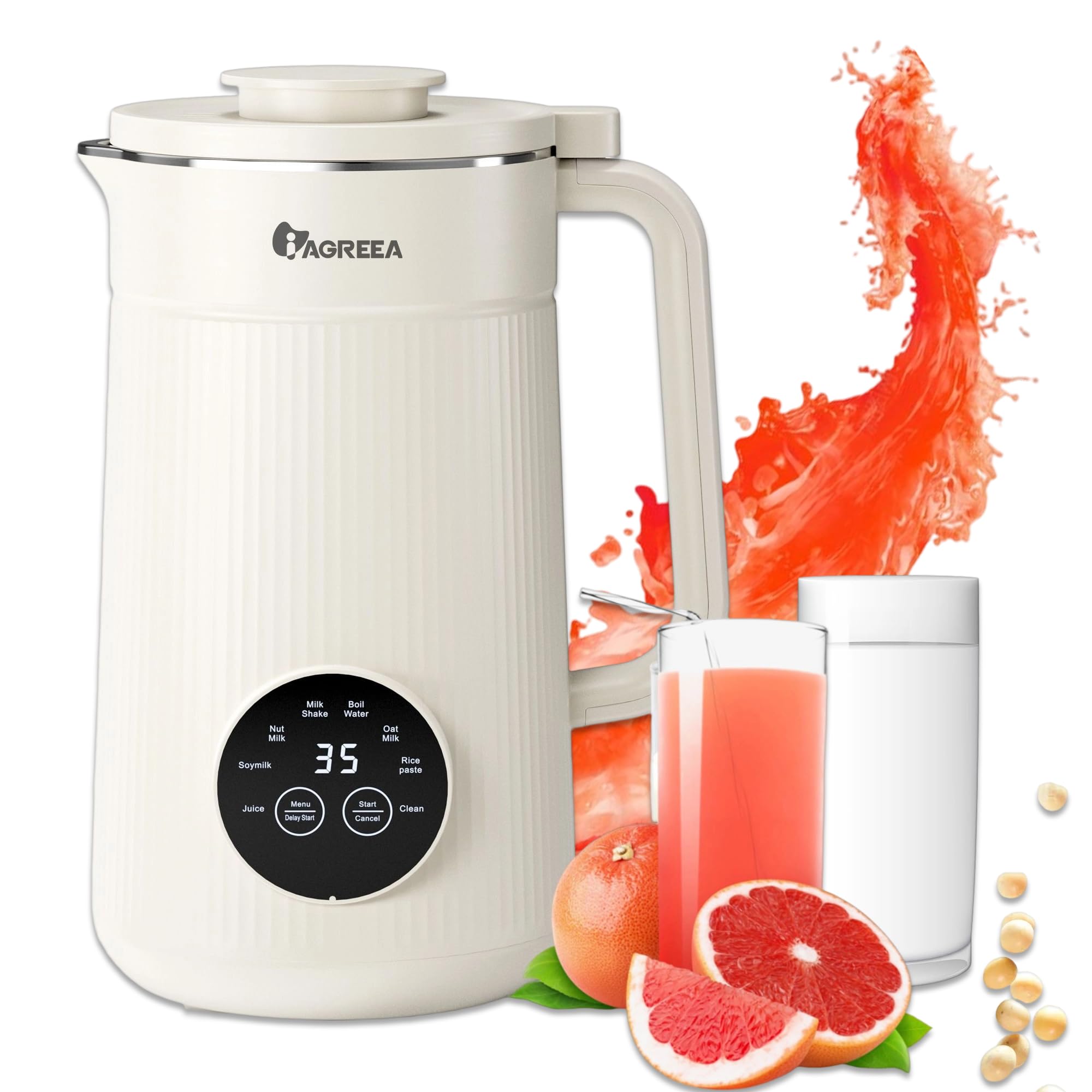
IAGREEA HB-B10KW1
Key Features
- Capacity: 35 oz
- Programs: 8 one-touch
- Footprint: 5.9"D x 5.9"W x 10.23"H
- Keep warm: 2 hours
- Price: Midrange
A two-hour keep-warm and an 11-minute self-clean rinse are the two features doing the most work on the IAGREEA, and they’re why it costs a little more than the bargain machines without costing much more. Around them sit eight one-touch programs, a nonstick interior, and a footprint of 5.9 inches square — smaller than most kettles, which is the whole reason a machine like this survives on a crowded counter.
For most kitchens this is the machine we point to, because the programs that matter are the ones that work. Soy, almond and oat come out smooth, the keep-warm holds a batch for two hours on the heated settings, and the self-clean rinse means you’re not scrubbing a chamber with a bottle brush every morning. At 35 ounces it makes about four cups, which is two days of coffee and cereal for one person.
The weak spot is everything bolted on around the milk. Juice and milkshake modes are where this machine loses its footing: fruit needs to be cut small, and the milkshake program doesn’t reliably deliver what the button promises. Treat those as bonuses that may not work and the machine underneath is a genuine bargain — eight settings where the first three earn their keep.
Pros
- 5.9-inch square footprint fits anywhere
- Two-hour keep-warm on heated programs
- 11-minute self-clean rinse
Cons
- Juice and milkshake modes are unreliable
Our pick for most kitchens: the milk programs work, the footprint is tiny, and two hours of keep-warm means the second cup is as warm as the first.
Best for Warm Morning Batches
TUECIAO CB02-NM
Key Features
- Chamber: Glass
- Capacity: 35 oz
- Keep warm: 140°F for 6 hours
- Delay start: 12 hours
- Price: Premium
A glass chamber changes the ritual: you watch the beans and nuts break down instead of guessing through frosted plastic, and you can see the moment a batch turns from slurry into milk. Here it’s paired with a genuinely smooth grind — soy comes out creamy with nothing left to strain — and that combination is why we keep this one at the top of the heated picks.
The morning math is the real selling point. Set the 12-hour delay before bed and the machine has a batch ready, holding at 140°F for up to six hours, when you come downstairs — long enough to cover a lie-in, short enough that you’re not drinking milk that’s been warm since dawn. One-touch self-clean after the pour keeps the glass from becoming a chore.
Thirty-five ounces is about four generous cups, and the price is the second-highest here. A household that goes through a quart a day will run it twice, which is the real cost of choosing the glass chamber over the bigger jars. For one person with a coffee habit, it’s a batch every other morning and nothing to think about.
Pros
- Smooth, grit-free soy and nut milk
- Holds at 140°F for six hours
- 12-hour delay for morning batches
- Glass chamber shows the whole batch
Cons
- Premium price
- 35 oz ceiling limits a big household
We keep it at the top of the heated machines because the milk is smooth, the delay is long, and the batch stays warm until you’re up.
Best for First Machine
BELVENA All-In-One Bundle
Key Features
- Blades: 10
- Capacity: 32 oz
- Programs: 8 functions
- In the box: Four 24 oz bottles, strainer bag, measuring set
- Price: Budget
Open the BELVENA box and you get the whole workflow: four 24-ounce storage bottles with labels and an erasable marker, a mesh strainer and a straining bag, five measuring cups, five spoons, a cleaning brush and a recipe book. For a first machine, that’s the difference between making milk once out of curiosity and making it part of the week.
We rate it as the best starter bundle here rather than the best machine, and the giveaway is in that accessory list. When a maker ships a straining bag, it’s telling you the blend isn’t fine enough to drink straight — you’ll be pouring through mesh, at least for almond and oat. The 10-blade head does a decent job on cashews and soy, and 32 ounces is about four cups, which is one bottle plus a glass.
Eight programs, one button, and a footprint under eight inches square is what you’re committing to. It’s the only machine here that hands you the bottles as part of the deal, and for a gift or a first apartment that counts for more than an extra preset.
Pros
- Four labeled storage bottles included
- Strainer, bag, and measuring set in the box
- Eight one-touch functions at a budget price
Cons
- Leaves pulp you still strain out
Treat it as a starter kit: we think the machine is competent, and the bottles and measuring set are what turn a first batch into a routine.
Best for Large Households
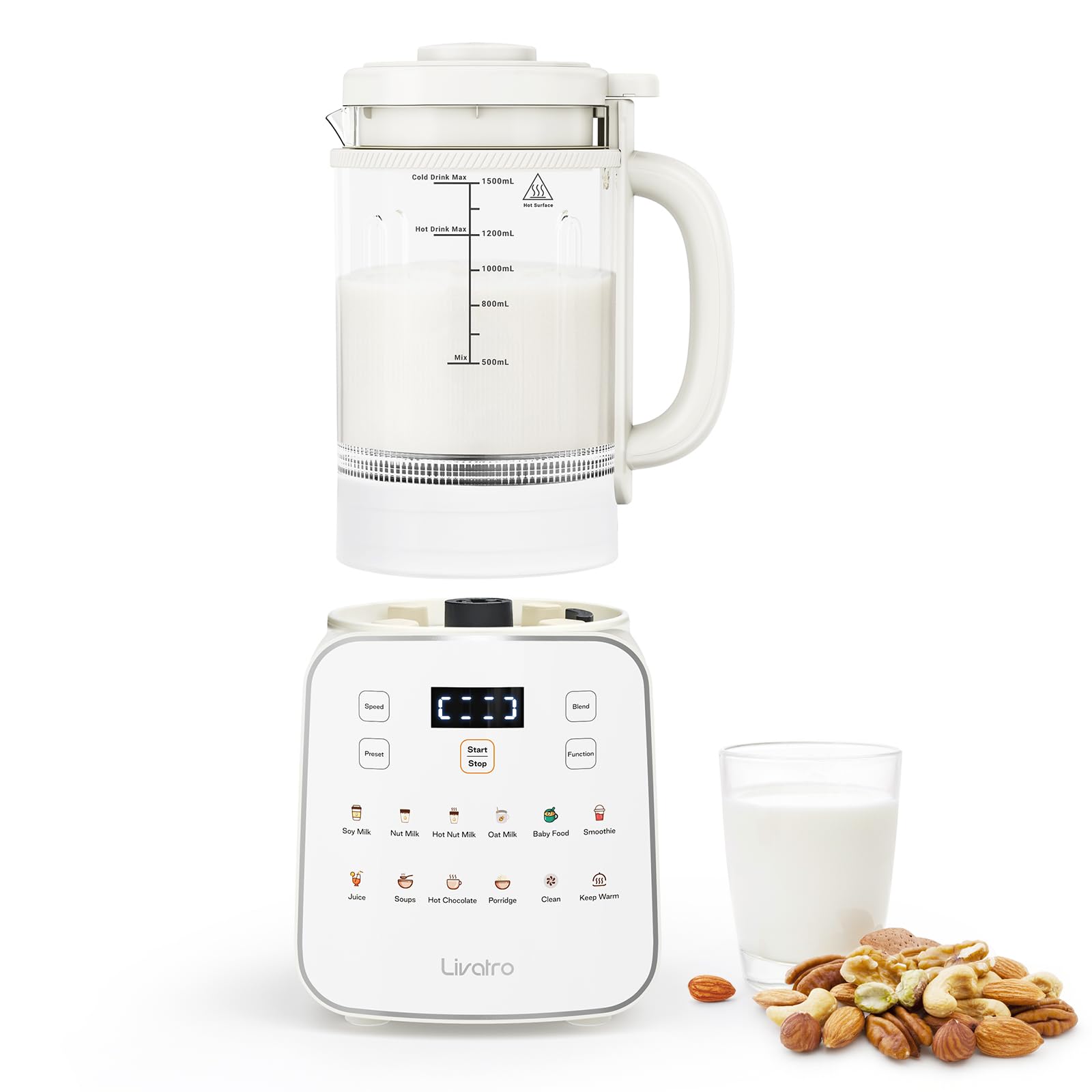
Livatro LVNM15001
Key Features
- Blade: Removable blade assembly
- Capacity: 50.73 fl oz
- Programs: 12 one-touch
- Delay start: 24 hours
- Price: Midrange
Fifty-odd ounces is the number that matters: a full 1.5-liter batch, roughly six cups, from a glass jar you can lift off the base and carry to the sink. That’s the biggest single batch in this group, and it’s why we point big households here first.
The design is built around cleaning. The jar detaches and the blade assembly comes out with it, so you can reach the underside of the blades instead of hoping a rinse cycle got there. There’s also an auto-clean program, a 24-hour delay and 12 one-touch settings from soy to porridge. None of that is decoration — a machine you can actually clean is a machine you keep using.
Where it lands is simple: most capacity, best cleaning access, and a motor to respect. The 150-watt rating is the lowest here, against 800 watts on the AlfaBot, so keep batches to what the jar holds and go easy on whole almonds and hard grains. Run it within those limits and the delay and keep-warm do their jobs, and the jar goes into the sink in one piece.
Pros
- Biggest batch here at 50.73 fl oz
- Detachable jar with removable blade
- 24-hour delay and 12 programs
Cons
- Six-cup batches outpace a small household
For a household that finishes a quart and a half before it turns, we think this is the best-equipped big-batch machine here.
Best for Yogurt and Grains
AlfaBot N2

Key Features
- Modes: 5, including yogurt
- Capacity: 35 oz
- Delay start: 12 hours
- Price: Midrange
The N2 is the only machine here with a yogurt setting, which tells you what kind of appliance it is: a 35-ounce countertop cooker that will ferment a batch as readily as it grinds soybeans. Five modes — nut, beans, yogurt, juice and grains — plus a 12-hour delay and a self-clean cycle sit around that, at a mid-range price.
What comes out is smooth and already warm, because the N2 grinds and heats in the same chamber, so there’s no second pot to wash. Soy and almond come out velvety, and the two filter baskets it ships with are there for when you want the pulp out rather than in. The yogurt mode is the reason to choose it over the IAGREEA: nothing else in this group does it.
Noise is the trade. It’s a loud machine, the kind you start before you get in the shower rather than while someone is still asleep, and a hot-plastic smell can appear during a run. If that happens, stop the cycle, unplug it, and let it cool before you use it again.
So the N2 earns its place with cooks who want yogurt and rice drinks as well as milk, and who don’t mind a machine that announces itself. For plain almond milk at breakfast, the quieter and cheaper IAGREEA is the easier recommendation.
Pros
- Only yogurt mode in this group
- Grinds and heats in one chamber
- 12-hour delay and self-clean
Cons
- Loud during the grind
- Hot-plastic smell can appear on a run
We rate it for the yogurt mode and the warm, well-ground milk; just expect to run it in another room.
Best for Cheapest Entry
Brezzolife 8-in-1

Key Features
- Blades: 12 stainless steel
- Capacity: 40 oz
- Delay start: 1-12 hours
- Price: Budget
Forty ounces from the least expensive machine here is the pitch, and it’s a real one: 1.2 liters is more than the NAMA makes, for a fraction of the money, with eight one-touch programs, a delay you can set from one to twelve hours, and a stainless chamber.
Some details are better than the price suggests. The blade count is the highest here at 12, the footprint is small enough to tuck against a backsplash, and the machine tells you what’s wrong instead of just stopping — if E4 shows on the display, the lid isn’t seated on the handle, and reseating it clears the error. That’s the sort of thing you usually learn the hard way.
What you accept is a light-duty build. It’s the cheapest motor here and the plastics feel it, and if a machine like this fails it fails early, so buy it as a first machine, a second one for the office, or a way to find out whether you like making nut milk before spending real money. We think that’s a fair trade at this price. Keep the receipt.
Pros
- 40 oz batch at the lowest price here
- 1-12 hour delay start
- 12 stainless steel blades
Cons
- Light-duty build for daily use
We suggest it for testing the habit: a big batch and a delay timer for the least money, with a build that asks for care.
How We Chose and Tested the Best Nut Milk Makers
We started with a list of about 30 nut milk makers, then trimmed it by reading specs and customer reviews and crossing off anything without a built-in strainer, anything under 30 ounces, and anything whose replacement parts weren’t sold separately. That left 11 machines, which my team and I ran for six months — almond milk on Sunday mornings, oat milk before work on weekdays, soy and cashew cream whenever a recipe called for it, always in batches of at least a quart so there were leftovers to check in the morning.
Every batch got the same treatment. I timed it from button press to pour, pushed the finished milk through a fine sieve to see what grit slipped past the machine’s own strainer, and tasted it plain and stirred into hot coffee, where thin milk curdles on contact. I weighed the pulp left behind, since a machine that throws away half the nut costs more per quart than the carton at the store. For cleanup, I rinsed the mesh under the tap right away, then let a second batch’s pulp sit for an hour to see how badly it set, checking the seals and base for anything that needed soaking or a brush.
Because most people run these before anyone else is up, noise got its own test: a 6 a.m. batch with a decibel meter beside it, then a walk to the far end of the house to hear what it sounded like from the next room. Odor got the same attention — any hot-plastic smell on the first few runs, and whether soy came out clean or smelling scorched, which usually means the heating element runs too hot. Six months of weekly use exposed the rest: leaks at the pitcher seal, motors that bogged down on unsoaked almonds, buttons that stopped registering, and whether a machine was still pleasant to use in month five.
How to Choose a Nut Milk Maker
The machine is the easy part; the straining is what decides whether you’ll still be making nut milk six months from now.
Straight to the glass, or through a bag
Every machine here grinds nuts into water. The difference is what happens to the solids. Most leave them suspended, which means grit in the bottom of the glass and a nut bag over a jug if you want it smooth. A machine that separates the pulp inside the cycle — the NAMA M1 is the clearest example — costs more and deletes that step entirely.
A straining bag in the box is the tell that you’ll be using one. That’s not a dealbreaker, but be honest about the sink work: if you won’t stand there squeezing, pay for separation instead of promising yourself you’ll do it.
Capacity, bottles, and where the milk goes
Batches run from 32 to 50 ounces, roughly four to six cups, so match the jar to the household rather than to the biggest number on the page. Thirty-two ounces suits one or two people who drink milk daily; fifty suits a family that empties a quart before it turns.
Look at what the milk goes into, too. A lidded pitcher that goes straight to the fridge door, as on the NAMA, or the four labeled bottles in the BELVENA bundle, changes daily use more than a ninth preset you’ll press once.
Heat, delay, and the morning you actually have
Some of these machines cook the milk — soy needs heat to lose its raw bean taste — and some blend cold. Heated models also hold a batch warm, from two hours on the IAGREEA up to six hours at 140°F on the TUECIAO, and the delay timer puts the whole cycle before your alarm.
If you drink cold almond milk in coffee and cereal, heating is money you don’t need to spend; a cold machine plus a lidded pitcher is simpler and cheaper. If hot soy milk is the point, buy for the heater and the hold time, not the program count.
Cleaning is the running cost
Every machine advertises a self-clean cycle, and every one still wants a rinse before the residue dries — a cycle run the next morning is mostly theater. What actually helps is access. The Livatro’s jar detaches and the blade assembly lifts out; the IAGREEA wipes clean around a nonstick interior; others expect a brush in a fixed chamber.
Rinse within a few minutes of pouring and most of the difference disappears. Leave a batch to sit until evening and no self-clean program saves you.
Buy for a few years, not a decade
These are small appliances with a motor and, on most models, a heater. Those are the parts that fail, and they usually fail inside the first year, so the warranty belongs in your price comparison. The NAMA M1 carries 15 years; the AlfaBot lists 12 months.
Where a machine’s term isn’t stated, ask the seller before you order, and keep the box and receipt until you’re past the first month. A short warranty on a cheap machine is a fair trade; a short warranty on an expensive one is the risk you’re paying for.
Frequently Asked Questions
Do I need to soak the nuts first?
Most of these machines take nuts straight from the bag, and that’s one of the real advantages over a blender. Soybeans are the exception worth making: a few hours in water softens them and takes load off the blades and motor, which are the parts that fail first. Oats need nothing at all.
If the recipe book in the box calls for soaking a particular ingredient, follow it for that machine — the timings are written around its blade design.
Can a nut milk maker replace my blender?
For milk and hot drinks, yes. These grind finer than a standard blender jar and the heated models cook the milk in the same cycle, which a blender can’t do. For frozen fruit, ice, and thick smoothies, no — the chambers are designed for liquid and the motors are sized for nuts and grains.
Most people who make milk regularly keep both and use the blender for everything that isn’t a drink.
How loud are these machines?
Loud for a few minutes: expect blender-level noise during the grind, not kettle-level. Heating is close to silent, so a heated model is quiet for most of its cycle and noisy for the short part that matters.
If the machine lives near a bedroom, skip the delay timer and start the batch yourself after you’re up, and stand it on a mat if your counter resonates.
Final Verdict
Start with the NAMA M1. It costs the most and does the least — no program list, no bag to scrub — but it makes the best milk here, and the straining it eliminates is the reason most home nut milk quietly stops after a month.
If that price is out of reach, the IAGREEA gives you heated milk, eight programs and a footprint small enough for a rental kitchen for a fraction of the money. If the draw is a warm batch already waiting when you come downstairs, go to the TUECIAO and accept the smaller jar.