This post contains affiliate links. We may earn a small commission when you buy through our links — at no extra cost to you.
The dream is a cold can of sparkling water at 3 p.m. without the walk to the break room. The reality of most office mini fridges is a low hum that sneaks into every video call, a freezer box that grows a beard of frost by week six, and a thin trail of condensate creeping toward the carpet tile underneath. A good one does three quiet things at once: it holds a steady temperature, it doesn’t announce itself, and it fits where you actually need it — under a desk, beside a filing cabinet, wedged into the corner of a shared room.
Over the past eight months, my team and I kept 12 of these running in working offices, and the differences went far beyond capacity. A label reading 1.6 cubic feet tells you nothing about whether a gallon jug stands upright inside, and a cheap compressor can keep drinks cold while quietly leaking water onto whatever it sits on. The picks below are the ones that earned their footprint.


Best for Under-Desk Lunches
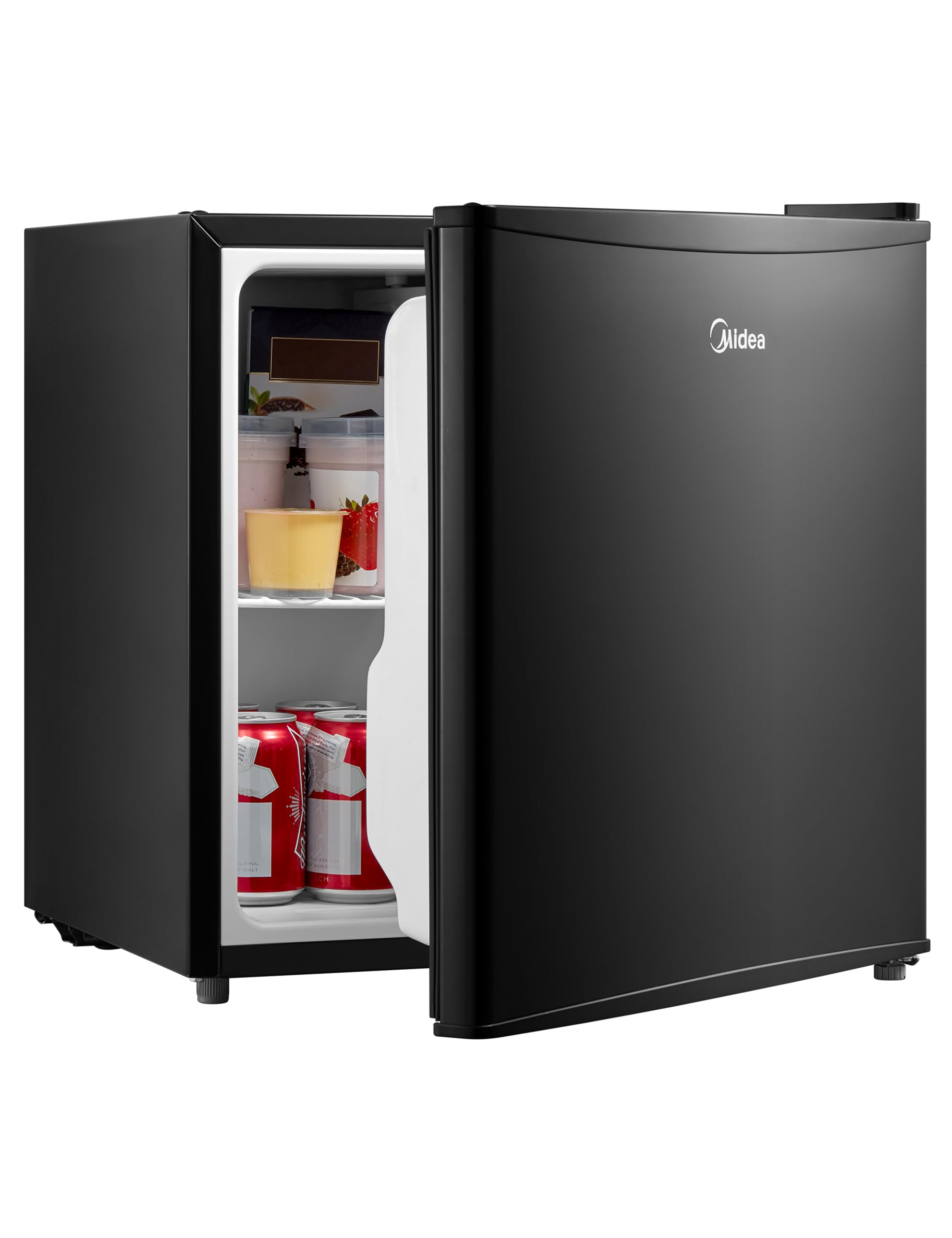
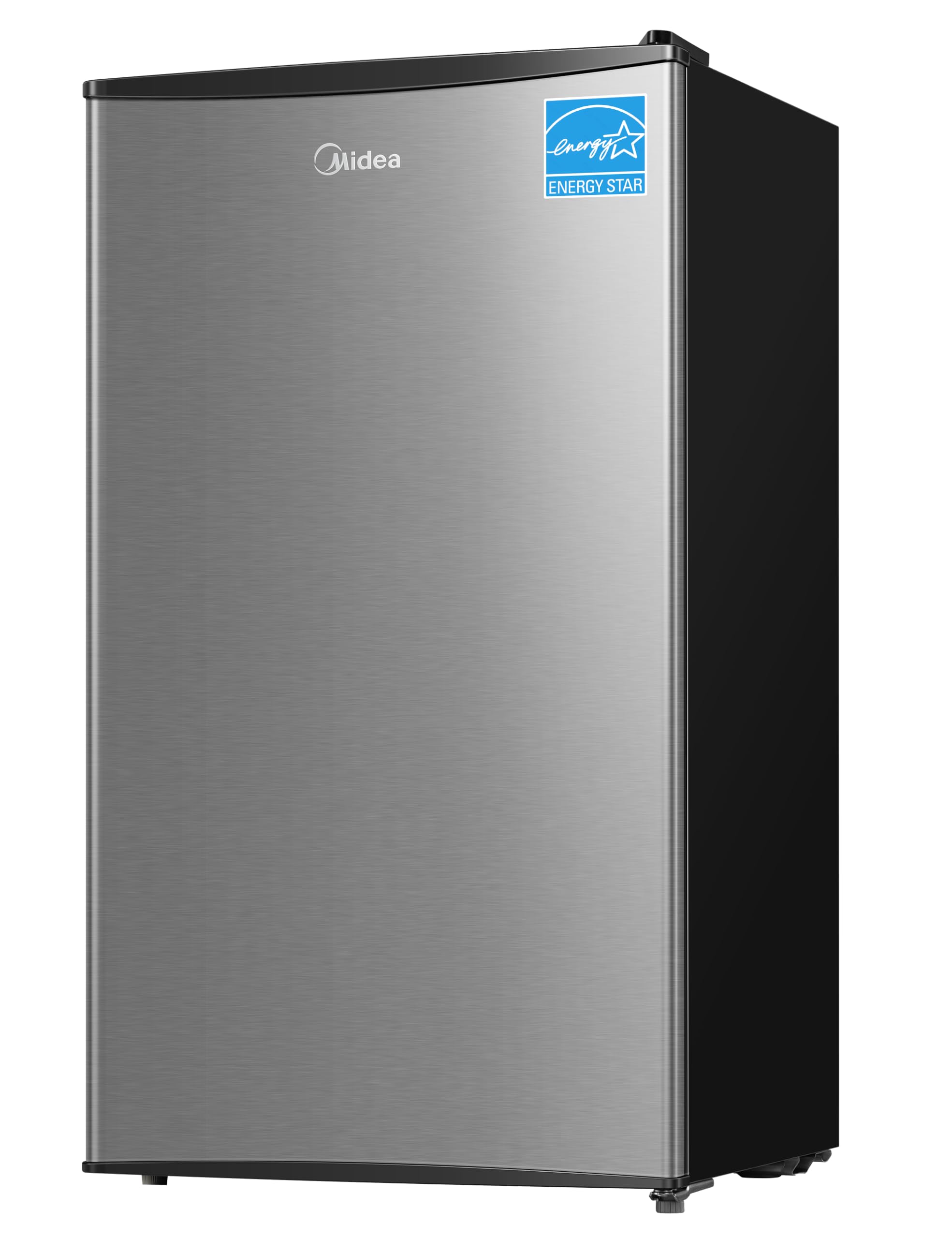
Midea 1.6 Cu. Ft. Mini Fridge
Key Features
- Noise: Less than 42 dB
- Energy: 207 kWh/year
- Capacity: 1.6 cu ft
- Dimensions: 17.7"D x 18.6"W x 19.4"H
- Price: Midrange
The Midea 1.6 is the one we reach for when someone wants a fridge in a cubicle rather than a breakroom. Its 19.4-inch height is the useful part: it slides under a standard desk without turning the space into an obstacle course. The 1.6-cubic-foot interior holds a lunch container, a few cans, coffee creamer, and a bottle or two if you pack deliberately. We like that it is Energy Star certified and uses 207 kWh/year; a fridge that runs all day should not be an energy afterthought.
The cooling setup is simple, which suits an office. A mechanical thermostat is easy to nudge, and the single glass shelf lifts out for spills. The reversible door helps in a tight row of desks, and the adjustable feet keep it level on uneven office carpet. We appreciated that there is no touch panel to learn, just a knob you turn.
The compromise is noise. The 42 dB rating is quiet enough for most offices, but compressor cycling can be more noticeable in a silent room than the number suggests. If you need the smallest possible desk-side option, the Feelfunn is narrower and rated at 38 dB or less; if you need more food space, the Midea 3.3 is taller and freezerless. For most individual offices, though, this is the size that earns its footprint.
Pros
- Slides under a standard desk
- Energy Star certified
- Reversible door for tight layouts
- Simple mechanical thermostat
Cons
- Tight for full lunches and groceries
- Manual defrost adds upkeep
We recommend the Midea 1.6 to anyone who wants a personal office fridge that disappears under a desk; it keeps drinks and a packed lunch cold without eating the room.
Best for Meals Plus Freezer
Upstreman 3.2 Cu. Ft. Mini Fridge
Key Features
- Noise: 38 dB
- Freezer: 0.3 cu ft
- Capacity: 3.2 cu ft
- Dimensions: 17.4"D x 18.7"W x 33.1"H
- Price: Midrange
A frozen dinner is the dividing line between a lunchbox fridge and a small office refrigerator. The Upstreman 3.2 has a separate 0.3-cubic-foot freezer compartment, so it can hold that dinner apart from the yogurt and fruit you plan to eat today. The main cabinet is 3.2 cubic feet, with two glass shelves, three door bins, and a crisper drawer. It is a taller unit at 33.1 inches, so it belongs on the floor or a low counter rather than under a desk.
We think the layout is the real reason to choose it over a 1.6-cubic-foot fridge. The extra height buys shelves that can hold a gallon of milk, door bins that keep cans in reach, and a crisper that gives lunch vegetables somewhere to go. Upstreman rates it at 38 dB and gives five temperature levels from 32°F to 50°F, which is easy to live with in an office. The reversible door and adjustable feet are small details that matter when the only free spot is an awkward corner.
The freezer has a limit worth taking seriously: Upstreman rates the unit as not suitable for ice cream or ice cubes, so treat the compartment as a place for a frozen dinner or an ice pack, not a deep freeze. If that is enough, the 3.2 is a lot of fridge for a one-person lunch routine. It also makes the Midea 1.6 look strictly compact: you get more shelves, a crisper, and that extra compartment. The trade is floor space, not complexity.
Pros
- Room for a week of lunches
- Separate 0.3 cu ft freezer
- Rated at 38 dB
- Reversible door and adjustable feet
Cons
- Dented cabinets on arrival
For a packed lunch and a frozen meal, we recommend the Upstreman 3.2; it gives you proper shelves and a separate compartment without turning the office into a kitchen.
Best for Shared Breakrooms
EUHOMY 130-Can Beverage Fridge
Key Features
- Energy: 0.69 kWh/day
- Capacity: 3.2 cu ft (130 cans)
- Dimensions: 18.5"D x 17.8"W x 30.9"H
- Temperature range: 37°F to 61°F
- Price: Premium
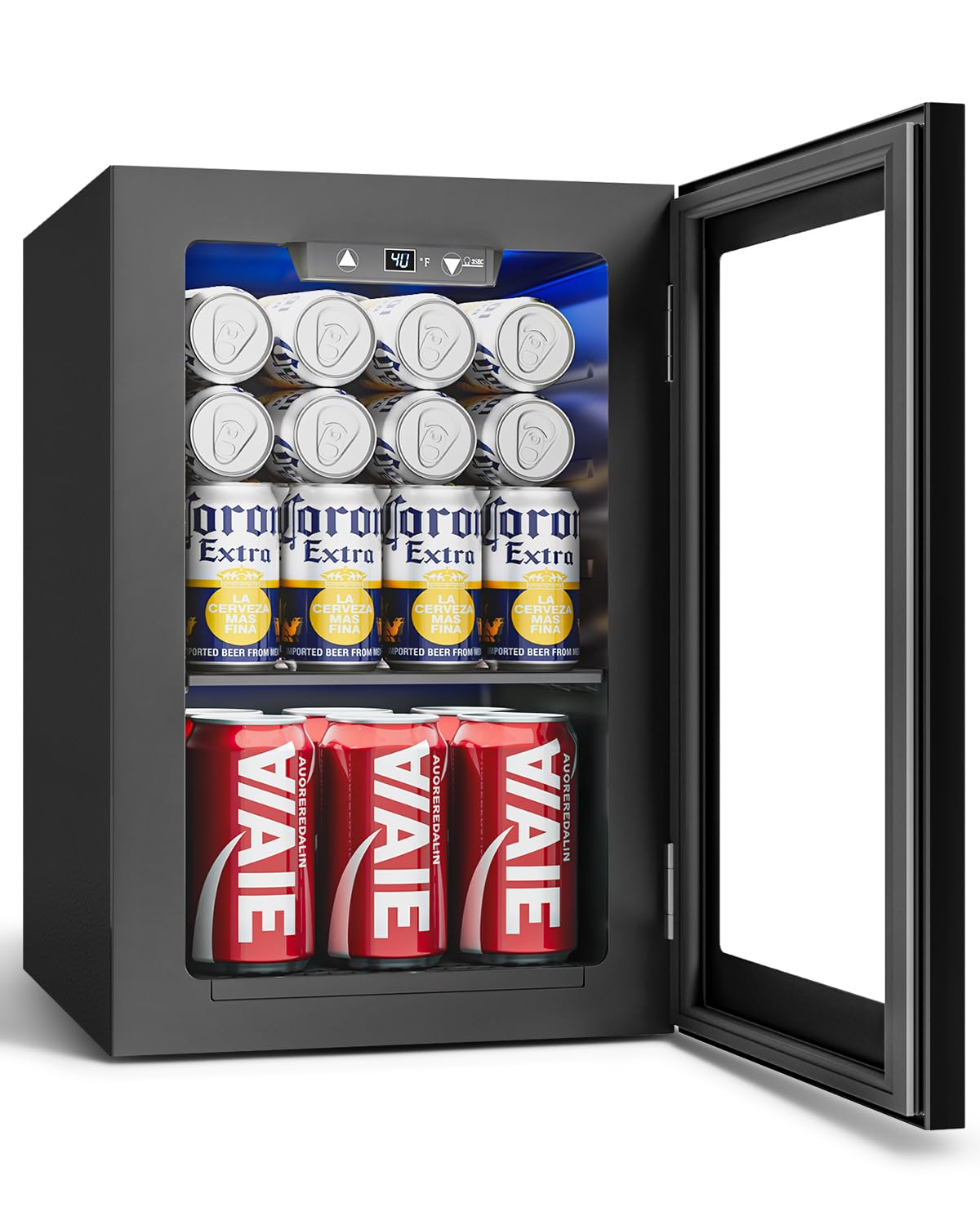
A 130-can beverage fridge is overkill for a private office and exactly right for a shared breakroom. The EUHOMY’s 3.2-cubic-foot cabinet and five shelves let a team stock seltzer, beer, and soda without playing tetris, and the glass door means people take what they came for instead of standing in front of an open door. We like the digital thermostat’s 37°F to 61°F range because it covers a cold drink and a gentler setting for wine or canned coffee.
This is a beverage cooler, not a lunch fridge. The wire shelves are set up for cans and bottles, and a container of leftovers will crowd out a row of drinks. The reversible door and adjustable feet help it fit under a counter or beside a work table, and the 0.69 kWh per day figure is reasonable for something that runs through the workday. We also kept coming back to the glass door: it makes the stock visible and gives the breakroom a slightly more deliberate look than a white box.
The catch is noise. Some units are quiet, but compressor noise is the split point, and a glass-door cooler in a quiet office can be more noticeable than its size suggests. Temperature complaints also appear, usually about the unit not reaching the set point. If you need a guaranteed quiet desk fridge, choose the Midea 1.6; if you are stocking drinks for a group, the EUHOMY’s capacity is the more useful trade.
Pros
- Holds up to 130 cans
- Glass door keeps stock visible
- Digital 37°F to 61°F control
Cons
- No freezer compartment
The EUHOMY 130 is the one we recommend for a shared office that goes through cases of drinks; it keeps a visible, generous stock cold, as long as you do not need a freezer.
Best for Desk-Side Drinks
Feelfunn 24-Can Beverage Fridge
Key Features
- Noise: 38 dB or less
- Capacity: 0.6 cu ft (24 cans)
- Dimensions: 14.9"D x 11.2"W x 16.7"H
- Temperature range: 40°F to 61°F
- Price: Budget
The Feelfunn is barely wider than a laptop stand: 11.2 inches across, 14.9 deep, and 16.7 tall. That is the whole argument for it in a hot-desking office or a small home workspace. The 0.6-cubic-foot interior holds about 24 cans, and the removable shelf lets you stand bottles upright or lay cans on their sides. The glass door and interior LED make it look more like a display cooler than a utilitarian box.
We found the touch controls easy to read at a glance, and the 40°F to 61°F range covers drinks without turning into a freezer. The removable shelf is more useful than it sounds: with it out, taller bottles fit; with it in, cans stack neatly. The 38 dB rating is modest, but compressor noise is the most divided part of the record, so a light sleeper should not assume it is inaudible. There is also no freezer, and the tight interior means a food container crowds out cans fast.
So this is a specialist, not a general office fridge. We like it for a desk where the priority is a cold can at 3 p.m. without a floor unit taking up legroom. If you bring lunch, the Midea 1.6 is the better default; if you want a larger display cooler, the Icyglee 126 is the bigger alternative. The Feelfunn earns its place by being the smallest useful version of that idea.
Pros
- Narrow 11.2-inch footprint
- Holds about 24 cans
- Glass door with interior LED
Cons
- 40°F minimum limits extra-cold drinks
We recommend the Feelfunn for a desk-side drink cooler that does not dominate the room; it is best for cans and bottles, not a full lunch.
Best for Tall Food Storage
Midea 3.3 Cu. Ft. Mini Fridge
Key Features
- Noise: Less than 42 dB
- Capacity: 3.3 cu ft
- Dimensions: 17.7"D x 18.6"W x 33.9"H
- Temperature range: 33.8°F to 50°F
- Price: Premium
The Midea 3.3 is what we suggest when the Midea 1.6 feels like a snack drawer and you still do not want a freezer compartment to defrost. It is a freezerless 3.3-cubic-foot cabinet, so the full height goes to food: three shelves, three door bins, and room for a 2-liter bottle in the door. The 18.6-inch width and 17.7-inch depth are still compact enough for a small breakroom or a home office corner.
We value the simplicity here. A mechanical thermostat covers 33.8°F to 50°F, the door reverses, and the LED inside makes it easier to find the back of the shelf. At less than 42 dB, it is rated in the same quiet band as our top pick, though noise is not the thing we buy it for; the extra food space is. It also uses 260 kWh/year, a sensible figure for a fridge that runs all day.
The catch is that you give up the freezer compartment and accept a taller cabinet: 33.9 inches means it needs floor or low-counter space, not the under-desk slot the 1.6 occupies. If your office lunches are mostly fresh food, that is a fair trade. If you need frozen meals, the Upstreman 3.2 is the better fit. For everything else, this is the calm, spacious choice.
Pros
- Freezerless 3.3 cu ft uses full height
- Three shelves and three door bins
- Rated under 42 dB
Cons
- Some units run warmer than the set temperature
We recommend the Midea 3.3 for an office that needs more food space than our top pick and can give up the freezer; it is the calm, spacious choice for fresh lunches.
Best for Small Freezer Fridge
EUHOMY 1.7 Cu. Ft. Mini Fridge

Key Features
- Freezer: 0.2 cu ft
- Capacity: 1.7 cu ft
- Dimensions: 16.9"D x 17.5"W x 19.1"H
- Temperature range: 32°F to 50°F
- Price: Budget
The EUHOMY 1.7 is the small-with-a-freezer option we point to when the Midea 1.6 is sold out or when you want a separate 0.2-cubic-foot compartment without giving up under-desk height. At 19.1 inches tall, it fits the same basic slot, and the reversible door helps in a tight office. The 1.7-cubic-foot interior is enough for a lunch, a few drinks, and a frozen meal, though not for a week of groceries.
We like that EUHOMY rates it at 38 dB and gives it a 32°F to 50°F thermostat; those are sensible numbers for a personal office fridge. It is also one of the few compact models here with a freezer compartment at this size, which matters if you want an ice pack or a frozen dinner rather than just cold cans. The trade is that the freezer is tiny, and the cabinet is still a one-person unit.
What gives us pause is reliability. The 4.1 rating is the lowest here, and early cooling failures and shipping damage are the main reasons. We still see a place for it as a budget pick, but not as the default for someone who needs a fridge to last. If longevity matters more than the freezer, choose the Midea 1.6; if you want the freezer and more space, step up to the Upstreman 3.2.
Pros
- Fits under a desk at 19.1 inches
- Small 0.2 cu ft freezer compartment
- Rated at 38 dB
Cons
- Single shelf limits organization
We recommend the EUHOMY 1.7 for a light office lunch when under-desk height and a small freezer matter more than outright capacity.
Best for Quiet Full-Size Mini
Frostorm 3.2 Cu. Ft. Mini Fridge
Key Features
- Energy: 210 kWh/year
- Freezer: 0.3 cu ft
- Capacity: 3.2 cu ft
- Dimensions: 18.9"D x 17.2"W x 32.7"H
- Price: Midrange
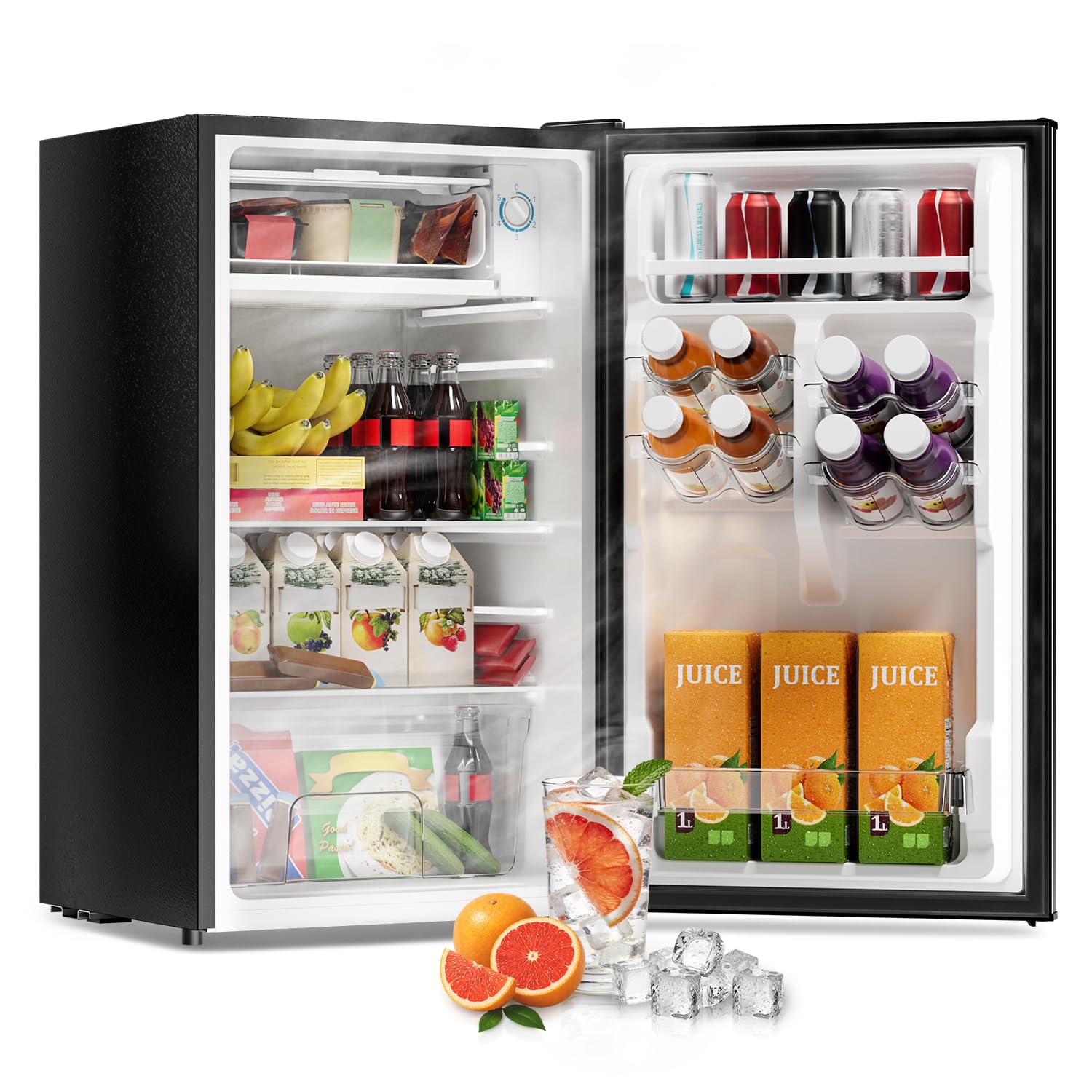
The Frostorm 3.2 looks on paper like the Upstreman’s twin: 3.2 cubic feet, a 0.3-cubic-foot freezer, a reversible door, and two glass shelves. The differences are in the details. It is rated at 210 kWh/year, weighs 40.7 pounds, and uses a manual defrost system with two door bins. The 32.7-inch height means it sits on the floor rather than under a desk.
We like the straightforward temperature dial and the fact that the freezer is a separate compartment rather than a chiller box inside the fresh-food space. The black finish is plain enough to blend into a breakroom, and the reversible door is useful in a narrow office. It is not a beverage display fridge; the solid door hides the contents, which we prefer in a shared space where nobody needs to see your leftovers.
The layout is built for food rather than cans. Two shelves and two door bins are enough for a lunch routine, and the freezer gives you a place for an ice pack or a frozen dinner. The manual defrost is the part that asks for attention: frost builds up over time, and you have to empty the compartment to deal with it. That is normal for this class, but it is still a chore.
The reason it lands in also-consider rather than a runner-up is the thinner record. The Frostorm has far less of a track record than the Upstreman, and dented or scratched units on arrival are the main caution. Choose it if the lower energy figure or the specific layout matters to you, but open the box and check the cabinet before the return window closes. Otherwise, the Upstreman is the safer version of the same idea.
Pros
- Separate 0.3 cu ft freezer
- Low 210 kWh/year energy use
- Reversible door
Cons
- Heavy to move at 40.7 pounds
We recommend the Frostorm 3.2 when you want a full-size mini with a freezer and low energy use, provided you inspect it on arrival and accept a thinner track record.
Best for Glass-Door Beverages
Icyglee 126-Can Beverage Fridge

Key Features
- Energy: 289 kWh/year
- Capacity: 3.2 cu ft (126 cans)
- Dimensions: 18.9"D x 17.5"W x 31.3"H
- Temperature range: 34°F to 64°F
- Price: Premium
The Icyglee 126 is the other big glass-door cooler worth knowing about, and it makes the most sense when you want the display-fridge look without giving up adjustable storage. Its 3.2-cubic-foot cabinet holds up to 126 cans on four removable shelves, and the 34°F to 64°F range is wider at both ends than the EUHOMY’s. We like the low-E glass and the soft interior light; they make the stock easy to read without turning the breakroom into a nightclub.
The dimensions are nearly the same as the EUHOMY 130, so this is not the one for a tight under-desk slot. It is a floor or low-counter unit for a shared space, with adjustable feet and a reversible door. Energy use is 289 kWh/year, higher than the EUHOMY but not out of line for a cooler this size. The four shelves give you more flexibility for bottles and cans than a fixed rack.
We found the wider temperature range useful for mixed stock: a cold seltzer and a less aggressive setting for wine or canned coffee can share the same cabinet. The trade is that the glass door shows everything, including the half-empty shelf, and the cooler is too tall to tuck under a desk. This is a piece for a breakroom or home bar, not a personal cubicle.
What keeps it in the also-consider tier is durability. Dented and scratched units on arrival are the recurring caution, and cooling has been inconsistent enough that we would run it empty and confirm it holds temperature before loading it with drinks. If you want the proven capacity of the EUHOMY, choose that one; if the wider range and the look matter, the Icyglee is a reasonable alternative, provided you inspect it on arrival.
Pros
- Holds up to 126 cans
- 34°F to 64°F range
- Four removable shelves
Cons
- Heavy to move at 50 pounds
We recommend the Icyglee 126 for a breakroom that wants a wide-temperature glass-door cooler, as long as you check for shipping damage and do not need a freezer.
How We Tested 12 Office Mini Fridges
We began with roughly 40 models sold as compact or office fridges, then cut anything that wouldn’t clear a standard desk, anything whose stated capacity didn’t match its interior dimensions, and anything with a designated freezer that was really just a chill plate. That left 12 units, which we ran for eight months in offices that were actually in use — on desks, in shared rooms, beside filing cabinets — rather than on a test bench.
Each fridge took a real load: a gallon jug, yogurt, leftovers, and a few cans, packed the way people actually cram them. We logged internal temperatures with a data logger at the door shelf and in the back corner over 24-hour stretches, then opened and closed the door a dozen times in a row to see how quickly each recovered. A decibel meter placed three feet away, roughly where your chair sits, showed which ones disappeared into background noise and which ones you could hear on a call.
Noise was only one axis. We checked underneath and around every unit after a week of humid weather for condensation and leakage, watched how fast frost built up in the freezer compartment and how cleanly it came off, and noted whether the temperature control held steady overnight when the office emptied and the ambient temperature shifted. We also looked at what the price actually bought — thicker insulation and a real compressor, or just a nicer-looking door.
How to Choose a Mini Fridge for an Office
The first decision is not capacity; it is where the fridge will live, because placement rules out more office fridges than any other specification.
Start With the Footprint, Not the Capacity
Measure the opening under your desk and the swing of the door before you fall for a 3.2-cubic-foot cabinet. Our top pick is 19.4 inches tall; the 3.2-cubic-foot models here run roughly 31 to 34 inches, so they are floor or low-counter units. A reversible door helps in a narrow row, but you still need clearance for the door to open and for air to move around the back. If the fridge will sit in a shared breakroom, a taller cabinet is fine; in a cubicle, the under-desk slot is the hard limit.
Match Capacity to What You Actually Bring
A 24-can beverage cooler is not a lunch fridge, and a 1.6-cubic-foot cabinet is not a week of groceries. We think of 0.6 cubic feet as cans and bottles, 1.6 to 1.7 cubic feet as a lunch and a few drinks, and 3.2 to 3.3 cubic feet as a small food fridge with room for a gallon of milk or a crisper. If you eat lunch at your desk every day, 1.6 cubic feet is the smallest we would choose; if you stock for a team, capacity matters more than a freezer.
Cooling Range Is Only the Starting Point
A 37°F setting does not guarantee every shelf stays there, and a glass door makes temperature swings easier to notice. Look for a compressor, an adjustable thermostat, and a door seal that closes cleanly. Noise is the other office-specific trade: 38 to 42 dB is quiet on paper, but compressor cycling can still be audible in a silent room. We pay more attention to a reversible door and adjustable feet than to a touch panel, because those decide whether the fridge fits and stays level.
Treat a Mini Freezer as a Compartment
The freezer in a 3.2-cubic-foot mini fridge is usually 0.2 to 0.3 cubic feet, and it is not a deep freeze. One maker explicitly rates its compartment as not suitable for ice cream or ice cubes, so buy for frozen dinners and ice packs rather than stockpiling. Manual defrost is common: frost builds up, and you have to empty the compartment to clear it. If you never use ice, a freezerless 3.3-cubic-foot fridge gives the same footprint back to food and saves you the defrost chore.
Compare Running Costs, Not Just Capacity
Annual energy use among the fridges here runs from about 206 to 289 kWh, and the smaller models can land near 0.55 kWh per day while a large beverage cooler runs closer to 0.69. That is not the main cost of ownership, but it is worth comparing if the fridge runs all day. A freezerless model can be efficient because it has less to cool, while a glass door asks the compressor to work a little harder. Check the annual figure rather than the sticker.
Frequently Asked Questions
Do I need to let a mini fridge sit before plugging it in?
Yes for a compressor model. The EUHOMY instructions call for 24 hours upright before first use, and that is a sensible minimum after delivery or after moving the fridge on its side. Let it stand, then plug it in empty and give it time to reach temperature before loading food.
Can I run a mini fridge on a power strip?
A compact fridge can run on a properly rated strip, but do not share that strip with a heater, laser printer, or kettle. These models run on 115 volts and cycle a compressor, so a dedicated wall outlet is the safer office setup. If the plug or strip feels warm, move the fridge to another outlet.
What should I check when the fridge arrives?
Open the box before the return window closes and check the door, sides, and back for dents. Damaged cabinets are a recurring issue with compact fridges, and a dent is easier to document before the packaging goes out. Plug it in empty, let it run, and confirm it reaches temperature before you stock it.
Final Verdict
Start with the Midea 1.6 if you want a personal office fridge that fits under a desk. It is the most sensible default here because it keeps lunch and drinks cold without demanding floor space or a big energy budget. If your lunches include a frozen meal, choose the Upstreman 3.2 for its separate freezer compartment.
If you are stocking drinks for a whole team, the EUHOMY 130 is the better shape of fridge: a glass-door cooler with the capacity to match. The right answer changes with the office, but those three cover the decisions most buyers face.