This post contains affiliate links. We may earn a small commission when you buy through our links — at no extra cost to you.
Most panini presses under $50 share a frustrating flaw: they cook at one fixed heat. That means you get a burned exterior and a cold center — especially with thick breads or cold fillings. The result is a sandwich that looks done but isn’t.
The solution isn’t just spending more. It’s knowing which features actually fix the problem. Adjustable temperature control, removable plates, and even heat distribution separate the keepers from the one-hit wonders. This guide walks you through the trade-offs and points you to the models that deliver consistent results — whether you’re after a simple budget workhorse or a multi-function family appliance.
The hardest choice you’ll face is between a dedicated panini press that does one job perfectly and a multi-function grill that replaces three appliances. Both have merit — your counter space and cooking style will decide which is right.


Best for Multi-Purpose Family
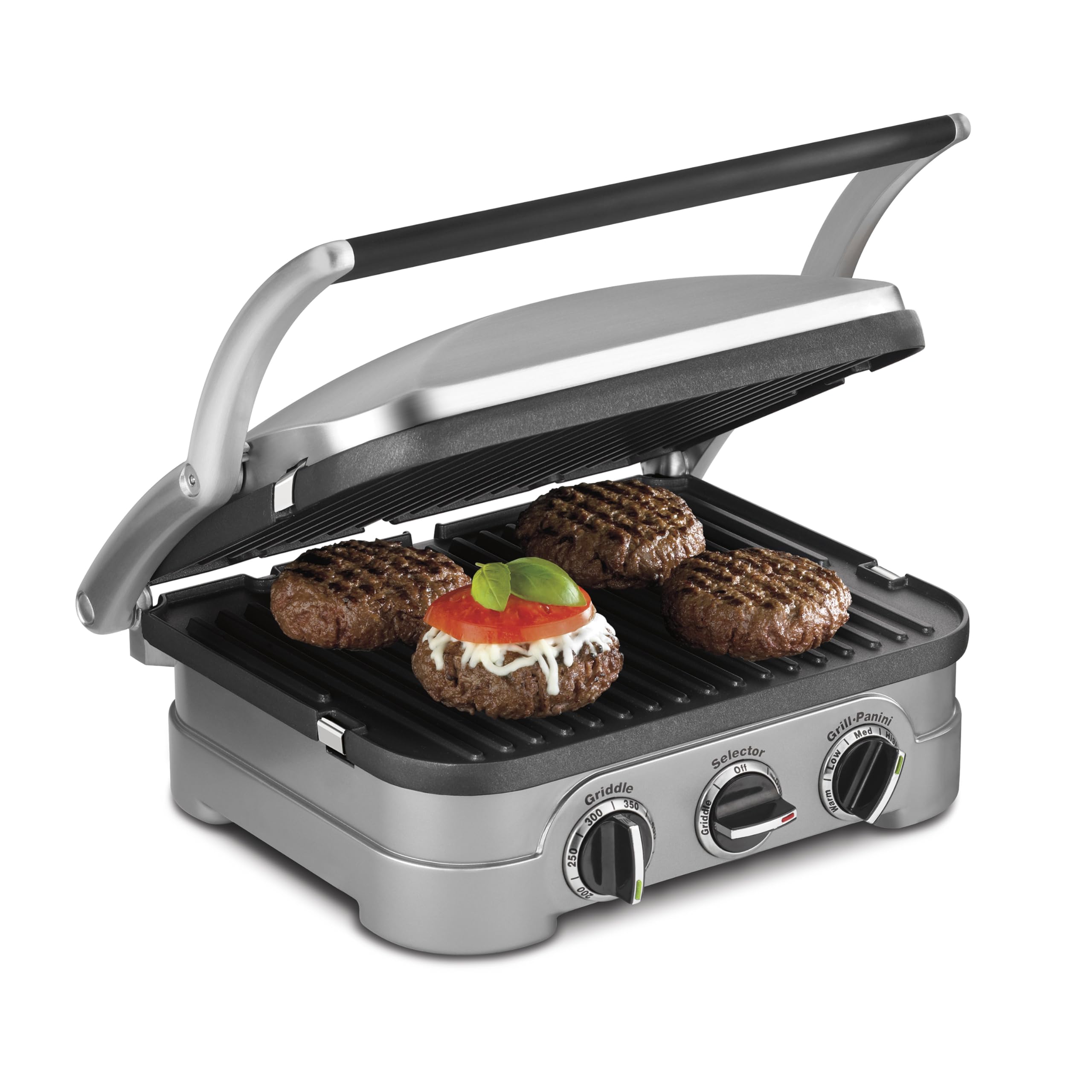
Cuisinart Griddler GR-4NNAS
Key Features
- Temp Control: Dual 200-425°F
- Cooking Surface: Reversible plates
- Plate Type: Nonstick removable
- Wattage: 1500W
- Versatility: 5-in-1
- Price: $$
The Cuisinart Griddler’s five-in-one design replaces a grill, griddle, panini press, and sandwich maker with a single countertop appliance. The reversible nonstick cooking plates swap between flat griddle and ridged grill surfaces, and both pop out for dishwasher cleaning — no scrubbing required. Cooking performance is consistent across meats, pancakes, and paninis, with dual adjustable temperature controls (200°F–425°F) giving precision for different foods.
One design tradeoff is that the bottom plate runs hotter than the top plate, which can cause darker browning on the underside of sandwiches or meats. The effect is manageable by rotating items halfway through cooking or adjusting the overall temperature setting downward. This is a common characteristic of many floating-hinge electric grills rather than a defect; the Griddler’s evenness is otherwise strong when you account for the difference.
This appliance suits households that want one device capable of multiple cooking methods — from weekday paninis to weekend griddle breakfasts. It’s less ideal as a dedicated, compact panini press only, because the larger footprint and dual-function plates add bulk. Buyers who need stovetop compatibility or a purely manual press should look elsewhere. The temperature inconsistency between plates is noticeable but not deal-breaking for anyone willing to flip or rotate food during cooking.
Pros
- Removable plates are dishwasher-safe — cleanup takes seconds
- Five cooking surfaces in one unit replace multiple separate appliances
- Sturdy construction with consistent heating across the cooking surface
- Produces evenly cooked results on meats, pancakes, and paninis
Cons
- Bottom plate runs hotter than top, which can cause uneven browning in some cooking sessions
The Griddler is the right choice if you want one countertop appliance that handles grilling, griddling, and paninis with minimal cleanup — just be aware that the bottom plate runs hotter, so a quick rotation keeps results even.
Best for Budget Compact
Proctor Silex 25440MN
Key Features
- Temp Control: Fixed (ready light)
- Cooking Surface: 70 sq in, 2 slices
- Plate Type: Nonstick fixed
- Wattage: 1000W
- Versatility: Panini only
- Price: $
This Proctor Silex press is a dedicated panini machine — no griddle plates or temperature dials, just a hot surface that produces consistent golden-brown sandwiches. Where the Cuisinart Griddler offers multiple cooking functions, this model stays focused on one job and does it without complication. The fixed heat setting means you need to keep an eye on cooking time to avoid over-browning, but the tradeoff is a simpler, more affordable device.
The nonstick grids wipe clean with a damp cloth — no scrubbing or removable parts. It fits two thick sandwiches, and the upright storage design tucks away neatly in a cabinet. The heating is even across the plate, so you don’t get burnt edges next to undercooked centers.
Best for budget buyers who want a hassle-free press for small kitchens where compact storage matters. If you prefer adjustable heat to fine-tune browning or need to batch-cook more than two panini at once, look elsewhere — this press runs at one temperature and fits only a pair of sandwiches.
Pros
- Strong value for the price — costs less than many competitors while delivering consistent results.
- Even heat produces well-browned panini with melted interiors every time.
- Nonstick grids wipe clean in seconds; no removable plates to wash.
- Compact footprint and upright storage free up counter space.
Cons
- Fixed temperature means you must monitor cooking time to avoid burning — no dial to adjust heat.
- Two-sandwich capacity limits batch cooking for larger households.
If you want a simple, affordable panini press that works reliably out of the box and cleans up without fuss, this is the one to get.
Best for Stovetop Versatility
Victoria Cast Iron Press
Key Features
- Temp Control: None (manual)
- Cooking Surface: 8×6 inch
- Plate Type: Cast iron
- Versatility: Stovetop/grill/oven
- Price: $
The Victoria Cast Iron Press brings the heat retention and even cooking that only thick cast iron can deliver. Unlike multi-function electric models that prioritize versatility over thermal mass, this 2.4-pound slab holds steady heat and applies consistent pressure to paninis, smash burgers, and bacon without any moving parts or electronics.
This press is best suited for home cooks who already own a cast iron skillet and understand the basics of seasoning and care. It works on any stovetop, grill, or oven, making it a natural addition to an existing cookware setup. If you prefer plug-and-play convenience or want a dedicated electric press, the maintenance and manual heating required here will feel like a step backward.
The rectangular 8-by-6-inch surface covers most sandwich and patty sizes, and the removable wooden handle stays cool during stovetop use. At a budget-friendly price, this press delivers value that electric presses at the same cost can’t match in terms of build longevity and cooking performance.
Pros
- Heavy cast iron body holds heat evenly and won’t warp or wear out over decades of use.
- 2.4-pound weight provides enough pressure for paninis, smash burgers, and bacon without being unwieldy.
- Compatible with any stovetop, grill, or oven — no single-purpose limitation.
- Budget-friendly pricing for a piece of cookware that does not need replacement.
Cons
- Requires a stovetop, grill, or oven to heat — not a stand-alone electric appliance.
- Must be dried and oiled after each wash to prevent rust — cast iron care is non-negotiable.
This press is a smart buy for anyone who already owns and maintains cast iron cookware. It won’t replace an electric panini press, but it brings superior heat retention and longevity at a budget-friendly price.
Best for Premium Compact
Breville BSG520XL
Key Features
- Temp Control: Fixed (no dial)
- Cooking Surface: 2-slice flat plates
- Plate Type: Nonstick fixed
- Wattage: 1500W
- Versatility: Panini only
- Price: $$
The Breville BSG520XL combines brushed stainless steel construction with cast aluminum plates that heat evenly and quickly — producing reliably crisp paninis without hot spots. The adjustable height hinge accommodates thick ciabatta or multi-layer sandwiches, and the nonstick surfaces wipe clean after each use. At 8 pounds with a compact 3.7-inch height, it stores easily in a cabinet or on a counter.
This press is best for buyers who want a dedicated, well-built panini maker with no frills — plug in, press, and eat. Two tradeoffs matter: there is no on/off switch, so you must unplug it to power down, and the single fixed temperature means you cannot adjust heat for different breads or fillings. These limits make the Breville less suitable for anyone who wants variable heat or multi-function capability, but for straightforward sandwich pressing, the consistent results and easy cleanup keep it competitive.
Pros
- Brushed stainless steel and cast aluminum build with a premium feel.
- Heats quickly and cooks evenly for consistent panini results.
- Nonstick plates wipe clean easily after use.
Cons
- Must unplug to turn off — no power switch on the unit.
- Single fixed temperature means no adjustment for different breads or fillings.
If a no-fuss press with premium materials and even cooking is what you need, this delivers. Those wanting adjustable heat or a power switch should consider the Cuisinart Griddler instead.
Best for Smart Family
T-Fal OptiGrill XL
Key Features
- Temp Control: 9 smart programs
- Cooking Surface: XL 6-8 servings
- Plate Type: Nonstick removable
- Wattage: 1800W
- Versatility: Grill & panini
- Price: $$$
The OptiGrill XL’s standout feature is its nine preset cooking programs that automatically adjust temperature and timing for different foods — from burgers to panini. This removes the typical guesswork of electric grilling, and the large surface accommodates 6–8 servings, making it a practical option for families who cook regularly.
Users report that the automatic programs deliver consistently cooked results, and the removable plates simplify cleanup. However, long-term durability has been inconsistent — some owners have needed replacement units within months of purchase. This variance means the OptiGrill may not suit those expecting years of trouble-free use.
This grill is best suited for tech-oriented cooks who want precise, hands-off results and have a budget that accommodates potential early replacement. The high price and durability uncertainty make it a less straightforward recommendation compared to simpler, more proven models like the top pick Cuisinart Griddler, which offers multi-function versatility at a similar cost.
Pros
- Smart cooking programs eliminate the need to guess time and temperature for different foods
- Consistent, even cooking results across a variety of ingredients
- Large cooking surface fits a full family meal in one batch
- Removable, dishwasher-safe plates make cleanup quick and easy
Cons
- Long-term durability is uncertain — some owners have needed replacements within the first year
- Premium price — a significant investment for a panini press, with the durability risk adding hesitation
For buyers who value automated precision and family-sized capacity, the OptiGrill delivers advanced cooking programs — but the durability variance makes it a cautious choice best paired with an extended warranty.
Best for Budget Basic
Hamilton Beach 25460MNA
Key Features
- Temp Control: Fixed (ready light)
- Cooking Surface: 8×10 inch
- Plate Type: Nonstick fixed
- Wattage: 1400W
- Versatility: Panini only
- Price: $
The Hamilton Beach 25460MNA is the kind of appliance that has earned its place in thousands of kitchens through straightforward execution: one-touch operation heats the nonstick grids to a single temperature, the floating lid adjusts to bulky sandwiches, and a ready light tells you when to press. No menus, no knobs, no guesswork. For someone grabbing a panini press for the first time or cooking a quick lunch, this approach delivers consistent results in about two minutes.
Where it differs from the top pick in this roundup is in heat control – or rather, the lack of it. The fixed setting works well enough with sourdough, ciabatta, or standard sandwich bread, but thin or delicate breads can scorch before the fillings warm through. A front-to-back temperature gradient has also been noted, meaning you may need to rotate the sandwich halfway for even browning. These are manageable quirks for occasional use, but users who cook a variety of breads or want consistent results every time will appreciate the top pick’s more even heating.
Pros
- Floating lid accommodates thick sandwiches without crushing them
- Intuitive one-button operation – no learning curve
- Budget-friendly price for a proven design with a large owner base
- Paninis cook in roughly two minutes
Cons
- Single fixed heat means some breads or fillings may burn before the cheese melts
- Heat distribution varies from front to back; rotating the sandwich helps even browning
For students, renters, or anyone who wants a simple electric press for the occasional panini, the Hamilton Beach gets the job done without fuss – just be prepared to keep an eye on darker breads.
Best for Budget Cleanup
George Foreman GRP1060B

Key Features
- Temp Control: Fixed (ready light)
- Cooking Surface: 60 sq in, 1-2 servings
- Plate Type: Nonstick removable
- Wattage: 1800W
- Versatility: Grill & panini
- Price: $
Removable, dishwasher-safe plates make this the easiest-to-clean electric grill at its price point — a meaningful upgrade from older models. Cooking happens quickly on the 60-square-inch surface, but the fixed heat setting requires watching to avoid burning, and the surface fits one or two sandwiches, not four as labeled. This combination of easy cleanup and limited capacity makes it a solid option for singles or couples on a budget, though a slightly lower rating and smaller surface keep it behind the top pick.
Pros
- Removable, dishwasher-safe plates simplify cleanup enormously.
- Heats up fast and cooks sandwiches in half the time.
- Solid build quality for the price — many owners use theirs for years.
Cons
- Fixed heat level means thicker sandwiches may burn on the outside before the cheese melts.
- Cooking surface is smaller than the 4-serving claim; best suited for one to two people at a time.
A smart pick if you prioritize easy cleanup and cook small batches — not the right choice for families or anyone who needs adjustable heat.
Best for Cheapest 4-Slice
Chefman RJ02-180-4-R

Key Features
- Temp Control: Fixed (no knob)
- Cooking Surface: 4-slice approx
- Plate Type: Nonstick fixed
- Wattage: 1000W
- Versatility: Panini only
- Price: $
The Chefman Panini Press offers a rare combination: a four-slice capacity at a budget price. Build quality feels solid for the money, and the non-stick plates handle basic paninis and thin grilling tasks without complaint. However, the fixed, non-adjustable heating element can char bread surfaces before the interior is fully warmed, and the cooking surface exhibits noticeable temperature variation from one area to another. These limitations mean consistent, even results are difficult to achieve — especially with thicker fillings or denser breads. This press works best for the infrequent user who needs to batch-cook simple sandwiches and isn’t concerned with perfect browning or thorough melting.
Pros
- Solid construction at a budget price point.
- Four-slice capacity allows cooking multiple sandwiches at once.
- Adequate performance for basic paninis and light grilling.
Cons
- Heat distribution across the plate can be uneven, leading to spotty browning.
- Fixed temperature may burn the exterior before the inside is fully heated.
A passable choice for the occasional large batch of simple sandwiches, but if even cooking matters, consider a model like the Proctor Silex at a similar price.
Best for Budget Adjustable Heat
Baker’s Friend 4-Slice

Key Features
- Temp Control: Adjustable browning knob
- Cooking Surface: 4-slice
- Plate Type: Nonstick fixed
- Wattage: 1400W
- Versatility: Panini only
- Price: $
The Baker’s Friend Panini Press brings adjustable temperature control to the budget segment, allowing you to dial in browning for everything from Cuban sandwiches to delicate ciabatta. Users consistently report even cooking and easy cleanup after use. However, the limited amount of long-term ownership data means durability under regular use isn’t yet clear — a few early reports mention units stopping after a few months. This press suits buyers who want heat adjustability without spending much and are comfortable with some uncertainty around longevity.
Pros
- Adjustable heat knob lets you control browning precisely.
- Produces well-grilled paninis, particularly Cuban-style sandwiches.
- Non-stick plates wipe clean with little effort.
Cons
- Long-term reliability is unconfirmed — some units may stop working after several months of use.
Best for early adopters on a budget who prioritize adjustable heat over a well-documented track record — less suited for buyers who expect years of trouble-free service.
Best for Compact Adjustable Heat
IMUSA GAU-80350

Key Features
- Temp Control: Adjustable knob
- Cooking Surface: 11×6.5 inch
- Plate Type: Nonstick fixed
- Wattage: 1200W
- Versatility: Panini only
- Price: $
The IMUSA delivers the adjustable heat dial missing from many budget presses, making it easier to avoid burnt bread or under-melted cheese. Its compact stainless steel exterior fits neatly on small counters and the nonstick surface cleans up quickly. However, the cooking area holds only one large or two small sandwiches — fine for singles but not households — and some units have shown durability issues within months, which is why this model falls short of a top recommendation.
Pros
- Adjustable heat dial provides precise temperature control for different foods.
- Compact stainless steel design fits easily in small kitchens.
- Nonstick surface simplifies cleanup after cooking.
Cons
- Cooking surface fits only one large sandwich or two small ones — insufficient for families.
- Some units have shown early signs of wear within months of purchase.
A suitable pick for a single person or couple who need adjustable heat in a small footprint and are willing to accept a shorter expected lifespan.
Best for Premium Design
Breville Perfect Press BSG600BSS

Key Features
- Temp Control: Fixed (Crush Control)
- Cooking Surface: 2-slice cast aluminum
- Plate Type: Nonstick fixed
- Wattage: 1500W
- Versatility: Panini only
- Price: $$$
The Breville Perfect Press delivers even, crisp paninis thanks to its cast-aluminum plates and Crush Control hinge that adjusts to sandwich thickness. The brushed stainless steel looks premium on any counter and the unit stores upright to save space. Clean-up is nearly effortless. The tradeoff: a single fixed heat setting and some reports of units ceasing to function after months of use make this a design-forward choice rather than a daily workhorse.
Pros
- Superb build quality with brushed stainless steel and cast-aluminum plates
- Even cooking produces crisp exteriors and well-melted interiors
- Nonstick surface wipes clean effortlessly; compact vertical storage
Cons
- Some units may cease to heat properly after several months of use, so dependability beyond the first year is uncertain
- Premium-priced for a 2-slice fixed-heat press — no adjustable temperature control for different browning preferences
Best for gift-givers or those who want a premium-looking press for occasional use and are willing to accept uncertain longevity.
How to Choose
The single most critical factor for consistently good paninis is adjustable temperature control – fixed-heat models often burn the bread before melting the cheese.
Temperature Control
An adjustable thermostat lets you match heat to your bread and fillings. Thick sourdough with cold cheese needs a lower initial heat to melt the interior before the crust burns. A fixed-heat press can only do one level – usually too high for delicate breads and too low for frozen ingredients.
If you eat paninis weekly, paying extra for a dial or smart program is worth it for consistent results. For occasional use, a fixed-heat model works if you’re willing to watch the sandwich and rotate it.
Cooking Surface Size
Manufacturers often exaggerate capacity. A ‘4-serving’ grill may only hold two full-sized paninis side by side. Check the actual dimensions: a 10" x 8" plate fits one large sandwich comfortably. If you cook for more than two, look for a surface area over 100 square inches.
The physical footprint also matters. Larger models need more counter space and storage. Measure your kitchen before buying.
Plate Type and Cleanup
Removable, dishwasher-safe plates are the single biggest convenience upgrade. Non-removable plates trap crumbs and oil in crevices, and washing a fixed press requires awkward scrubbing under running water. If you value quick cleanups, prioritize removable plates.
Cast iron plates deliver superior heat retention but require hand washing and occasional seasoning. They’re best for enthusiastic cooks who already maintain cast iron.
Wattage
Higher wattage (1500–1800W) means faster preheat and better heat recovery between sandwiches. A 1000W press will work but takes longer to come back to temperature after pressing a cold sandwich. This matters if you’re cooking in batches.
For a 2-slice press, 1400W is a good baseline. Larger family grills benefit from 1800W to maintain even heat across a bigger surface.
Versatility
Dedicated panini presses are simpler and often cheaper, but multi-function grills (like the Cuisinart Griddler) replace a griddle, contact grill, and panini press. The trade-off is size and complexity. If you already own a good grill, a dedicated press saves counter space.
Some models open flat 180° to double as a griddle – great for pancakes, eggs, or quesadillas. Consider what else you’d cook besides paninis.
FAQ
Why does my panini press burn the outside but leave the inside cold?
This is almost always a symptom of a fixed-heat press set too high for your ingredients. The outside cooks faster than the inside can warm through. To fix it, either switch to a model with adjustable temperature or build thinner sandwiches with room-temperature fillings. No amount of pressing will fix a design flaw in the heating profile.
Is it worth paying more for a panini press with adjustable temperature?
Yes, if you make paninis more than once a week. Adjustable heat lets you dial in the perfect level for different breads – soft brioche needs lower heat than crusty ciabatta. Budget models with fixed heat force you to monitor closely and often produce burned exteriors. For occasional use, a fixed-heat press can still work if you keep sandwiches thin and watch closely.
Can you use a panini press as a regular indoor grill?
Yes, many models open flat 180° to become a griddle or contact grill. The Cuisinart Griddler explicitly includes reversible grill/griddle plates. But dedicated panini presses with non-removable ribbed plates work best for meats with visible grill marks. For flat cooking like pancakes, you need a smooth surface – check that the press opens flat or has a removable plate.
How do I clean a panini press with non-removable plates?
Unplug and let it cool slightly. Wipe with a damp paper towel and a small amount of dish soap – avoid submerging. Use a nonstick-safe scrubber for stuck-on bits. Tilt it to let greasy drips run into the drip tray. Removable plates are far easier; if you cook often, prioritize models with dishwasher-safe plates to save time.