This post contains affiliate links. We may earn a small commission when you buy through our links — at no extra cost to you.
Almond milk seems simple until you make it at home and end up with a sieve of wet pulp and a pitcher of gritty liquid. The appeal is control—no stabilizers, more actual almond flavor—but the machine has to earn its counter space. What separates a good one from a fussy one is whether the mesh cleans without a bottle brush, whether the pulp comes out dry enough to bother saving, and whether it still feels solid after months of weekly batches.
I’ve spent eight months with 12 almond milk makers, running Sunday batches and hurried weekday pitchers when the carton ran out. Some ground beautifully but were miserable to clean; others were simple to use and still left the milk chalky. The ones worth buying handle the whole routine reliably, take little hands-on time, and make milk good enough to drink plain. The picks below are those.





Best for Daily Plant Milk
Nama M1
Key Features
- Warranty: 15-year
- Footprint: 18 x 16 x 13 inches
- Pulp handling: Separates pulp from milk
- Soaking required: No
- Price: Premium
The case for the M1 starts with what it does not make you do. There is no overnight soak, no nut bag to squeeze, and no separate straining step; the machine blends the nuts and gently separates the solids into a pulp pouch, leaving a pitcher of milk behind. That sounds like a small convenience until you have made nut milk the old way and spent more time cleaning the bag than drinking the result.
We also like the texture. The M1 produced rich, creamy milk with a clean finish, and the pulp came out dry enough to feel like an ingredient rather than a wet mess. The controls are simple enough that the recipe book is a suggestion, not a requirement, and the pitcher with its lid makes storage straightforward.
The M1 is built like a small appliance rather than a blender with a milk preset. The stainless-steel contact surfaces and the pulp-extraction design make it feel considered, and the 15-year warranty is the kind of long-term bet most countertop machines here do not make.
The premium is real, and it is the main reason to pause if you make milk only occasionally. This is not the machine for someone who wants to try homemade almond milk once a month; it is for the household that already buys cartons every week and wants to stop.
For that household, the M1 earns its place by removing the two chores that make homemade milk a phase: soaking and straining. We prefer one machine that does both well to a cheaper one that turns breakfast into a cleanup project. The dry pulp is the daily payoff; the warranty is the reassurance.
Pros
- No soaking or straining required
- Rich, creamy milk with dry pulp
- 15-year warranty backs the build
- Simple one-button workflow
Cons
- Heavy 22.7-pound machine
Our first recommendation for daily plant-milk drinkers is the Nama M1: rich, clean-tasting milk without soaking or straining, backed by a long warranty.
Best for Small Kitchens
Almond Cow
Key Features
- Capacity: 6 cups
- Footprint: 12 x 9.5 x 6.5 inches
- Straining: No straining needed
- Body material: Stainless steel
- Price: Premium
The Almond Cow is the smaller, less expensive route to the same no-strain idea as our top pick, and for many kitchens that is the more realistic shape. It makes five to six cups at a time, uses stainless-steel contact surfaces, and separates the pulp so you are not left squeezing a bag over the sink.
One-button operation is the draw. You add ingredients, press the button, and the machine does the work while you get on with something else. We appreciate that on a workday morning, when the difference between homemade milk and store-bought is whether the process fits before coffee.
Its footprint is the other reason it is here: 12 x 9.5 x 6.5 inches means it can live on a counter without dominating it. If you have a short counter or a packed appliance garage, that compact body matters more than a bigger batch. The milk is creamy and the pulp is easy to empty, so the daily advantage is the space it saves while still making a useful batch.
Pros
- No straining or nut bag
- Compact 12 x 9.5 x 6.5-inch footprint
- Simple one-button operation
Cons
- Hand-wash only parts
- Mixed long-term durability
Smaller kitchens get our compact no-strain pick in the Almond Cow, which skips the nut bag without taking over the counter.
Best for Large Batches
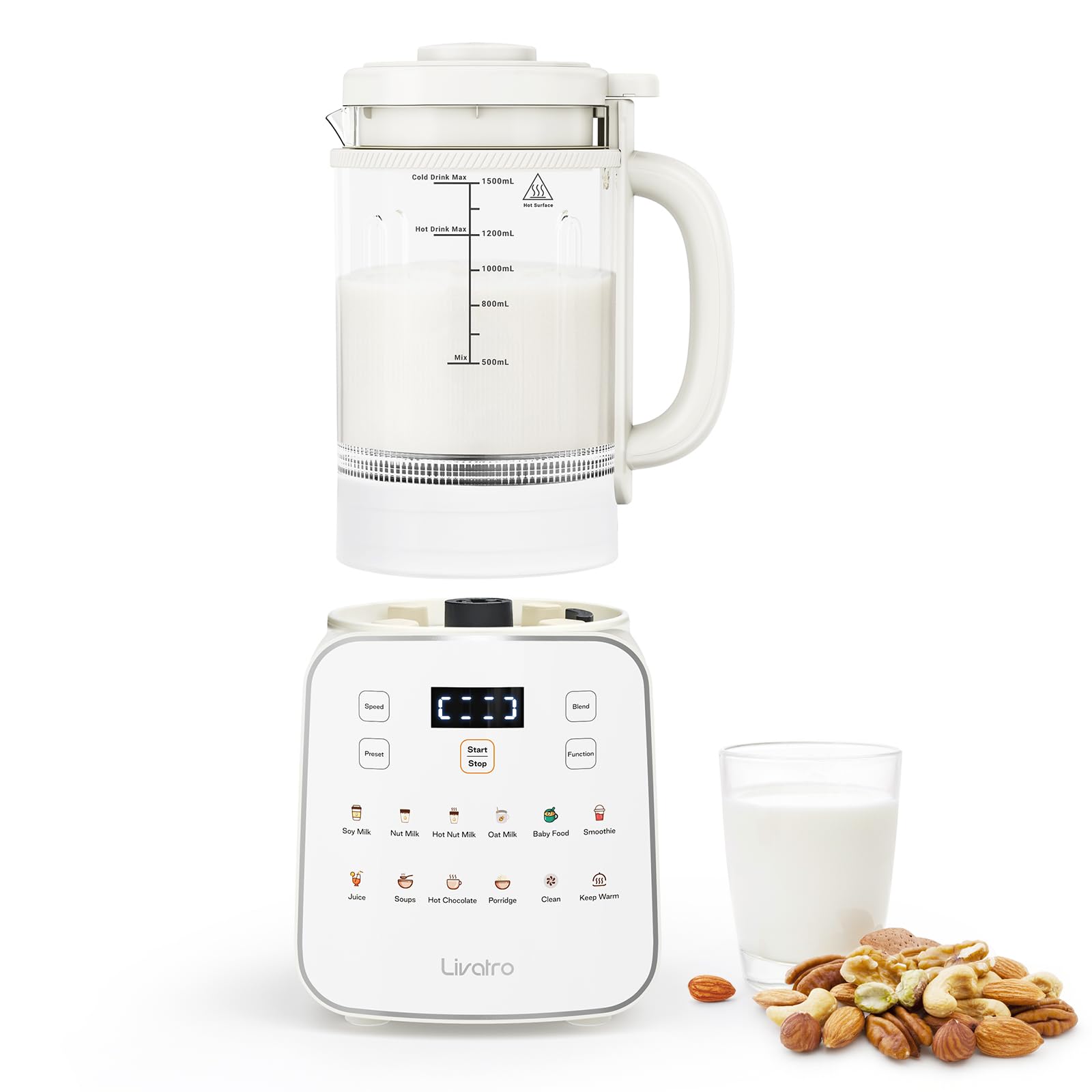
Livatro 12-in-1
Key Features
- Capacity: 50.73 fl oz
- Cleaning: Auto-clean
- Programs: 12-in-1
- Delay start: 24 hours
- Price: Midrange
Fifty-point-seven-three ounces is an odd number to print on a box, but it is the right one for a household that goes through plant milk fast. The Livatro is the large-batch machine in this group, and we think the capacity is the feature that justifies its counter space.
The detachable glass jar and removable blade assembly are the details we appreciate most. You can see the blend as it happens, and the jar comes apart so you can reach the corners instead of trusting a self-clean cycle to do everything. The two cleaning brushes in the kit are a useful admission that a quick scrub still matters.
The 12 programs cover soy, almond, oat, coconut, smoothies, soups, baby food, and more, with no pre-soaking required. The 24-hour delay start and keep-warm mode are the conveniences that make it feel like a morning appliance rather than a project. Auto-clean handles the first pass; you handle the lid and valve.
This is not the machine for someone who drinks one glass a day; the 1.5-liter jar is a commitment. For a family or a meal-prepper, the size is the point. The Livatro gives you the batch and the flexibility to use it for more than almond milk.
Pros
- Large 50.73-ounce batch
- Detachable glass jar cleans thoroughly
- 12 programs with delay start
- Auto-clean cycle
Cons
- Mixed long-term durability
Families that want a big batch, a glass jar, and delay-start convenience will find our large-capacity pick in the Livatro.
Best for Warm Milk
TUECIAO 35oz
Key Features
- Chamber: Glass
- Capacity: 35 oz
- Keep warm: 140°F for 6 hours
- Delay start: 12 hours
- Price: Midrange
The glass chamber is the first thing you notice, and it changes how the machine feels in use. Instead of a sealed metal canister, you can watch the nuts break down and see how much pulp is left. That visibility is not just cosmetic; it makes the process easier to trust and easier to troubleshoot when a batch looks thicker than you expected.
The 140°F keep-warm feature is the one we value most. It holds for six hours, and the 12-hour delay start means you can set a batch for the morning or have warm milk waiting after a long afternoon. We found the control panel straightforward, with the main milk modes easy to reach and the self-clean cycle doing the first pass before hand-washing.
The 35-ounce batch is a two-person size, not a family jug. For a couple that drinks a glass each day, it is a sensible amount to finish while it is fresh. The glass chamber and warm-hold function are the reasons to choose this one over the cheaper stainless machines; they make the routine feel a little more considered.
Pros
- Glass chamber shows the blend
- Keeps milk at 140°F for six hours
- 12-hour delay start
- One-touch self-clean
Cons
- Premium price for 35 ounces
We think a couple that wants to watch the blend and keep a warm batch waiting will find the TUECIAO worth the premium.
Best for Budget Mornings
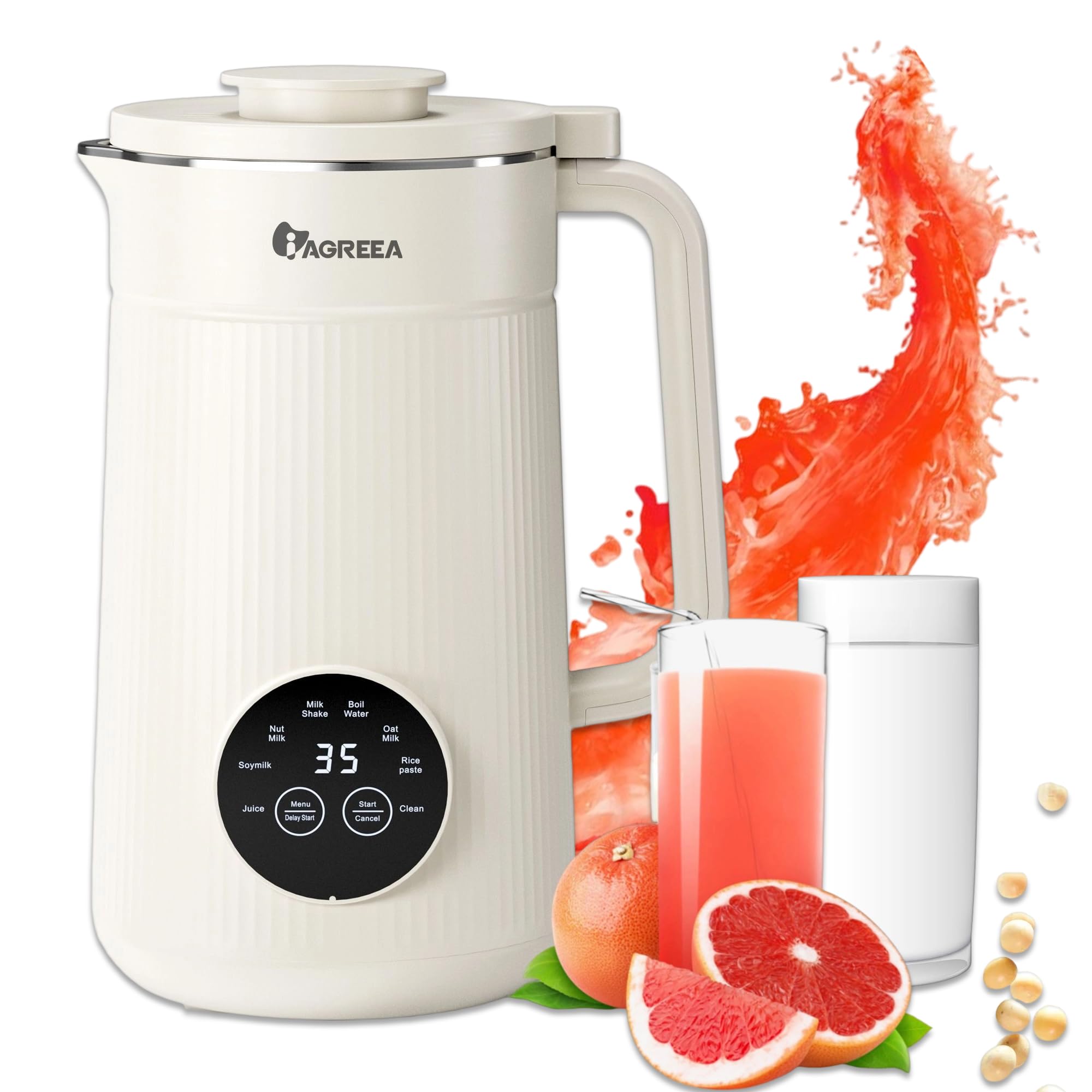
IAGREEA 35oz
Key Features
- Capacity: 35 oz
- Cleaning: 11-minute self-clean
- Programs: 8-in-1
- Keep warm: 2 hours
- Price: Budget
A warm cup of soy milk after the cycle is the IAGREEA’s reason to exist. The 35-ounce machine has eight presets, but the feature we value most is the two-hour heat preservation, which keeps the last cup from going cold while you get on with breakfast.
The milk cycles are the ones to use. They produce creamy, smooth results, and the 11-minute self-clean rinse does most of the cleanup for you. The nonstick interior helps, though you still need to wash the lid and the area around the seal. For a budget machine, the routine is refreshingly short.
The footprint is compact and the touch controls are simple. If you mainly make almond or soy milk and want it warm, this is a lot of machine for the money. It is a milk maker first; treat the extra programs as buttons you may never press, not as a reason to buy it.
Pros
- Two-hour keep-warm
- 35-ounce family batch
- 11-minute self-clean cycle
- Budget price
Cons
- Non-milk presets are inconsistent
We recommend the IAGREEA to budget-minded households that want a warm second cup without fuss.
Best for First-Time Buyers
BELVENA Bundle
Key Features
- Blades: 10-blade
- Capacity: 32 oz
- Functions: 8-in-1
- Storage bottles: 4 x 24 oz
- Price: Budget
The box is the pitch. The BELVENA arrives with four storage bottles, labels, measuring cups and spoons, a strainer, a nut bag, a recipe book, and a cleaning brush, so the first batch does not require a second shopping trip. That matters more than it sounds: most new milk makers send you hunting for a bottle and a strainer before you have made anything.
We think the bundle matters more than another preset. The 32-ounce capacity is enough for a couple of glasses or a small family breakfast, and the 10-blade system handles almonds and oats without turning the milk into a sieve job. The one-tap programs are simple, and the included bottles are genuinely useful for storing and shaking the milk before serving.
It is not a large-batch machine, so a household that goes through a gallon a week will refill it often. For a first machine, though, the BELVENA lowers the friction of starting. The bottles, labels, and measuring set turn a new appliance into a routine you can begin the same day.
Pros
- Complete starter bundle
- Smooth 10-blade blending
- Simple one-touch programs
- Four storage bottles included
Cons
We like the BELVENA bundle for first-time buyers who want bottles, tools, and a simple 32-ounce machine in one box.
Best for Singles and Couples
IntreLife 34oz
Key Features
- Capacity: 1 liter
- Cleaning: Self-clean program
- Included: Nut milk bag and brush
- Programs: 8-in-1
- Price: Budget
The IntreLife keeps the feature list short: one-liter capacity, eight presets, a nut milk bag, a cleaning brush, and a recipe book. For a budget machine, that is a sensible set rather than a pile of modes you will never use. You can make almond, soy, oat, rice paste, juice, and a milkshake, plus boil water and run a clean cycle.
The self-clean cycle and keep-warm are the two we care about at this price. They are the conveniences that make the machine part of a routine rather than a weekend project. The controls are simple, and the included recipe book gives you a starting point instead of leaving you to guess at ratios.
The 34-ounce jar is best for one or two people. It is not the machine for a family that drains a half-gallon at breakfast, and the 200-watt motor is happier with the recipe’s cut sizes than with a crammed jar. Treat it as a personal or couple’s appliance and the size makes sense.
What we like is that the budget price does not strip out the cleanup or keep-warm functions. It is a straightforward machine for someone who wants fresh milk without a big appliance commitment. The nut milk bag is the tell: this is a budget maker that still expects you to strain for the smoothest result, so do not buy it if no-strain is the goal.
Pros
- One-liter batch suits singles or couples
- Self-clean and keep-warm included
- Eight simple presets
- Affordable budget pick
Cons
- Nut milk bag needed for smoothest results
We see the IntreLife as the low-risk budget pick for one- or two-person households making about a liter at a time.
Best for Budget Versatility
Arcmira 35oz

Key Features
- Blades: 8-blade
- Display: LED screen
- Capacity: 1 liter
- Functions: 8-in-1
- Price: Budget
Eight blades and a 35-ounce jar are the headline, but the reason to consider the Arcmira is that it gets the basics right at a budget price. The 8-in-1 menu covers soy, almond, oat, rice paste, juice, and a clean cycle, with a keep-warm setting for the last cup.
The LED screen shows time and temperature, which makes the machine feel more precise than the usual one-button budget box. We found the milk creamy, and the self-clean setting handled the worst of the cleanup. The eight-blade head is strong enough for almonds and walnuts, though the recipe book is worth following for ratios.
For the money, the Arcmira is a convincing first step into homemade milk, especially if you want a visible display and a keep-warm function without paying for a premium no-strain design. It is not the machine we point to for a decade of daily use; it is the one we point to for trying the habit without a big outlay.
Pros
- Creamy results from eight blades
- LED display with time and temperature
- Self-clean and keep-warm
- Budget price
Cons
- Instruction manual is thin
- Mixed durability record
We recommend the Arcmira to budget shoppers who want creamy milk, a visible display, and self-clean in one machine.
Best for Family Batches
Brezzolife 40oz

Key Features
- Capacity: 1.2 liters
- Cleaning: Automatic cleaning
- Functions: 8-in-1
- Delay start: 1-12 hours
- Price: Budget
Forty ounces for the least money here is a tempting combination, and the Brezzolife leans hard into both. The 1.2-liter jar is the largest budget batch in this group, and the 1-12 hour delay start is a feature usually reserved for pricier machines.
The delay start is the feature we value most. Set it before bed and the machine has a batch ready when you wake, provided you follow the manual’s limits on ingredients and fill. The 8-in-1 menu and self-clean cycle round out the basics, and the compact body fits where a larger family machine might not.
The 12-blade system does a creditable job on almonds and oats, and the 40-ounce capacity means fewer repeat batches for a family. It is a budget appliance, so treat the finish and the long-term support as the unknowns. For a household that wants a large batch without paying for a premium brand, it is the value play.
Pros
- 40-ounce family capacity
- Adjustable 1-12 hour delay
- Self-clean cycle
- Compact footprint for capacity
Cons
- Mixed reliability record
Our value play for a family that wants a 40-ounce batch and delay-start convenience is the Brezzolife.
How We Tested Almond Milk Makers
To build the shortlist, I started with machines actually sold as almond milk makers rather than general high-speed blenders, then narrowed by capacity, counter footprint, mesh or filter design, motor specs, and the price tier most shoppers compare. I read the manuals before turning anything on, because a machine that only works with a precise ratio of soaked almonds to water is a different proposition from one that lets you adjust on the fly. We ended up with 12 units and used each for eight months, rotating them through the same weekly routine: a Sunday batch for drinking plain and a midweek batch for coffee and cereal.
We timed every batch from switch-on to pour and noted how much of that was hands-on—loading, pressing, straining, adjusting. We squeezed the pulp by hand to see how wet it was, checked the milk for grit at the bottom of the pitcher, and tasted it warm, chilled, and stirred into coffee. Ease of cleaning got the same treatment: we rinsed the mesh and pulp basket right away, then left one batch’s parts until the next morning to see what stubborn pulp looked like. We also ran full and half batches to check whether the machine behaved consistently, and kept notes on button response, lid fit, cracks, staining, and any motor strain over the eight months.
Value came down to yield and effort—how much usable milk came from a cup of almonds, how long the whole job took, and whether the cleanup made a second batch feel like a chore. Reliability showed up in repeated batches: did the machine produce the same texture on week 30 as week one, or did the filter clog and the motor labor? The models that made the list were not the ones with the longest feature list; they were the ones that turned out smooth milk, cleaned up without a fight, and still felt solid after months of real use.
How to Choose an Almond Milk Maker
The right almond milk maker is the one that fits your batch size and cleanup tolerance, not the one with the longest preset list.
Start With Batch Size and Real Yield
A 30- to 50-ounce machine sounds similar across listings, but the useful yield is smaller once you account for pulp and the fill line. A 32-ounce batch is roughly two generous glasses; a 50-ounce jar makes sense for a family or meal prep. The trap is buying the largest tank you can afford and then leaving it on the counter half-used.
If you drink one glass a day, the IntreLife or BELVENA size is enough. If you go through a half-gallon, start with the Livatro. Match the jar to your weekly routine, not to the biggest number on the box.
Decide How Much You Hate Straining
Automatic makers split into two families: machines that blend and then separate pulp for you, and machines that blend fine enough to drink straight or rely on a bag for the smoothest result. No-strain designs such as the Nama M1 and Almond Cow cost more, but they remove the step that makes homemade milk feel like a project.
A budget machine with an included nut milk bag can still make good milk; just know you may need to strain if you want a silky texture. The bag is not a dealbreaker, but it is the difference between a five-minute habit and a weekend experiment.
Treat Self-Clean as a Head Start
Every self-clean cycle we have seen still leaves the lid, valve, or pulp basket for you to rinse by hand. What matters is whether the jar and blade assembly come apart easily. A detachable glass jar, like the Livatro’s, lets you reach the corners; a nonstick interior and a short rinse cycle help, but they do not replace a quick scrub.
Before buying, look for a machine whose parts you can actually remove and wash, not just one with a clean button on the panel. The easiest machine to live with is the one you can clean without a bottle brush and a flashlight.
Pick the Conveniences You Will Use
Delay start and keep-warm are the features that change a morning routine, but they are only worth paying for if the machine’s core milk cycle is good. Keep-warm is best for households that drink the batch within a few hours; delay start is useful when you want a batch ready at a set time.
Presets beyond nut, soy, and oat milk are secondary. A simple 8-in-1 machine can be plenty; the extra juice or smoothie modes are no substitute for a real blender. Spend on the functions you will press every week, not the ones that impress on the box.
Plan for Noise and Service Life
Nut milk makers grind hard, and the compact budget models are often loud for a few minutes. If your kitchen opens into a bedroom or you make milk before sunrise, put the machine on a stable counter and expect some noise.
More important is the warranty: the Nama M1’s 15-year coverage is the outlier here, while the budget machines generally carry a year or less. A longer warranty will not make better milk, but it changes the risk of a motor or blade failure.
Frequently Asked Questions
Is making almond milk at home actually cheaper than buying it?
It can be, but the machine is the upfront cost and the savings build slowly. The math favors households that already buy plant milk every week and will run the maker two or three times a week. If you drink it occasionally, a blender plus a nut bag gets you fresh milk without another appliance on the counter.
Do I need to soak almonds before making milk?
Many automatic makers now offer a no-soak cycle, including the Nama M1, Almond Cow, and Livatro. With a lower-power machine, soaking still helps soften the nuts and can give a smoother result. Check the preset you plan to use and follow its recipe; if no-soak is a priority, buy a machine that advertises it rather than assuming every automatic model handles dry nuts.
How long does homemade almond milk last?
Refrigerate it promptly in a clean, covered bottle and plan to use it within three to four days. It separates as it sits, so shake before pouring. Keep the batch cold, do not leave it on the counter after the cycle, and clean the machine’s jar and lid before the next batch; those habits matter more than the exact date on the container.
Final Verdict
The Nama M1 is our overall pick because it removes the two chores that keep most people from making nut milk regularly: soaking and straining. It produces the creamiest milk in this group, and the 15-year warranty makes the premium easier to justify for daily use.
If your counter is tight, the Almond Cow is the compact no-strain alternative we recommend. If you want a large batch with delay start and a glass jar, choose the Livatro; if you are testing the habit on a budget, start with the IntreLife or BELVENA.