This post contains affiliate links. We may earn a small commission when you buy through our links — at no extra cost to you.
The promise of a bread machine is warm bread on a Tuesday night with barely any effort: flour, water, yeast, press start, walk away. The reality for plenty of first-time buyers is a squat brick with a paddle hole through the middle and a machine in the garage by spring. A good one buys you consistency: the same reliable rise in a humid July kitchen as in January, an even bake, and a pan that rinses clean without an overnight soak.
I’ve eaten a lot of mediocre toast to get here. Over nine months my team and I put 12 machines through their full cycles, and the differences showed up in odd places: how loudly a machine kneads at 5:45 a.m., how much counter it eats, whether the manual reads like it was translated twice, whether the loaf is still good on day three. One thing worth knowing before you shop: liquids first, yeast last, kept away from the salt — most failed loaves are a loading problem, not a machine problem. The picks below handled both.




Best for All-Around Home Baking
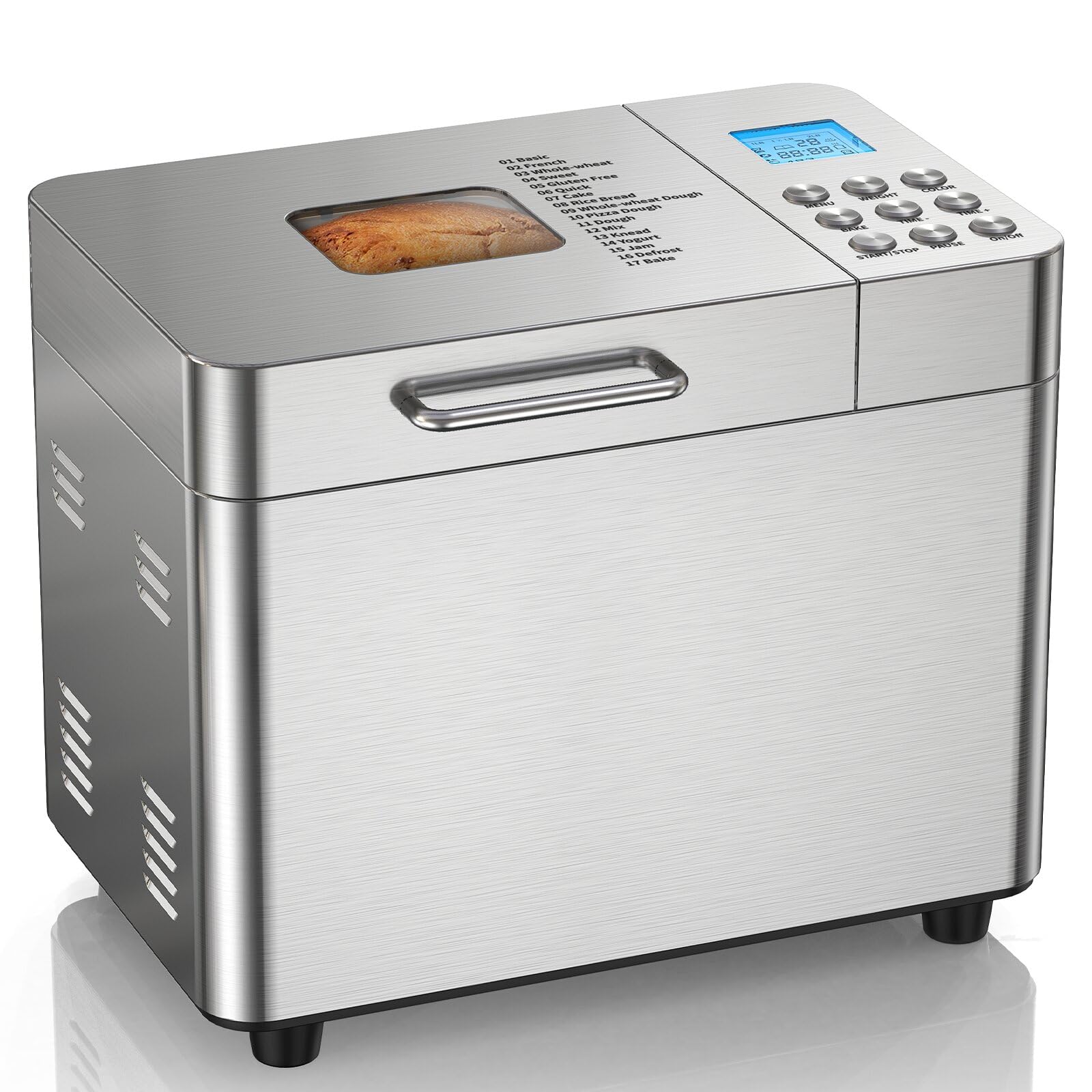
KitchenArm 29-in-1
Key Features
- Programs: 29
- Dimensions: 14.2 x 8.9 x 12 in
- Custom menus: 4
- Loaf capacity: 2 lb
- Price: Midrange
The feature we kept coming back to on the KitchenArm is not the 29-program count. It is the one-press memory: the machine saves the menu, loaf size, and crust setting for the next bake. That turns a busy control panel into a two-button routine once you have a house loaf, and it is the difference between a gadget and a weekly habit.
The rest of the package supports that convenience. You get 1-, 1.5-, and 2-pound loaves, 29 automatic menus, four custom menus, and a two-year warranty. The four custom slots are unusually generous for this group; they let you tune a favorite recipe instead of hunting for the closest preset every time. A 550-watt motor is not the most powerful here, but it handles the everyday white and whole-wheat cycles without asking for a premium.
We rate it near the top of this set for everyday flexibility. Its 14.2-by-8.9-inch footprint is narrow for a 2-pound machine, so it earns counter space without dominating it. The two-year warranty is above average here, and the four custom slots mean the machine can grow with your baking rather than locking you into presets.
The only real ceiling is capacity: 2 pounds is the largest loaf, so a big family that wants one oversized bake needs a different machine. For most households, the KitchenArm is the one we reach for first because it makes the repeat loaf easy rather than impressive once.
Pros
- Saved settings make repeat loaves quick
- 29 programs cover everyday and specialty loaves
- Bakes 1-, 1.5-, or 2-pound loaves
- Two-year warranty is above average here
Cons
- The 29-menu panel takes study at first
We recommend the KitchenArm as the best all-around bread machine here: it covers the loaves most people bake, remembers your settings, and backs the machine with a two-year warranty.
Best for Premium Artisan Loaves
Zojirushi Virtuoso Plus
Key Features
- Heaters: Base and lid
- Rapid course: 2 hr 25 min
- Loaf capacity: 2 lb
- Kneading blades: 2
- Price: Premium
At 24 pounds, the Virtuoso Plus is the machine you notice moving. That heft buys dual kneading blades, heaters in the base and lid, and a 700-watt build that feels like a small appliance rather than a countertop toy. It is also 18 inches wide, so measure the spot before you fall for it.
We think the extra hardware earns its keep in whole-grain and gluten-free loaves, where even browning and a thorough knead matter more than another preset. The rapid course is rated at 2 hours 25 minutes for white or whole wheat, which is useful when the schedule is tight. The program list looks shorter than the 29-menu machines, but the healthy-course settings are unusually broad.
The Virtuoso Plus is the premium pick in this group, and it feels that way in the pan, the blades, and the lid-mounted heater. We appreciated the key code on the lid: it makes the first few bakes less of a scavenger hunt. The 13-hour timer gives you overnight bread, though the machine is heavy enough that you will not move it casually.
The trade-off is commitment: this is a lot of counter and a premium outlay for a single loaf. If you bake whole-grain loaves often and want the most even browning here, the Virtuoso Plus justifies the space. If you mostly make white sandwich bread, the KitchenArm is easier to recommend.
Pros
- Dual heaters promote even browning
- Two kneading blades handle stiff dough
- Rapid course finishes in 2 hours 25 minutes
- Broad healthy-course settings
Cons
- One-year warranty is short at this tier
We think the Virtuoso Plus is the premium choice for bakers who care most about even browning and a thorough knead, and who can give it permanent counter space.
Best for Budget Beginners
OSIPOTO 17-in-1
Key Features
- Programs: 17
- Dimensions: 13.78 x 11.42 x 10.04 in
- Delay timer: 15 hours
- Loaf capacity: 2 lb
- Price: Budget
The OSIPOTO is the machine we point to when someone wants to try bread baking without turning it into a project. It is simple enough for a first machine, light enough to move, and covered by a 17-program menu that goes beyond white bread. At 11.7 pounds, it is one of the easier machines here to lift out of a cupboard.
The specs are sensible for the role: a 2-pound pan, 600 watts, a 15-hour delay timer, and a keep-warm mode. The delay is the feature that makes it feel more expensive than it is, because you can load it at night and wake up to bread. The keep-warm holds the loaf after the bake, though we still take it out promptly so the crust does not soften.
We rate it near the top of this set for first-time bakers. The controls are simple, the loaf size fits a family, and the menu covers the everyday cycles most people use. It is not the most powerful machine here, and the body does not feel as substantial as the premium picks, but those are fair trade-offs at the budget end.
The 600-watt motor is not the strongest here, so very stiff whole-grain doughs may need a little more attention. For a first machine, that is a reasonable trade: the OSIPOTO gets the basics right and leaves room to learn before you spend more.
Pros
- 17 programs cover everyday loaves
- 15-hour timer and keep-warm
- Light enough to move easily
Cons
- Manual and recipes are uneven
We see the OSIPOTO as the budget pick for a first machine: it is easy to live with, covers the basics, and leaves room to learn before you spend more.
Best for Seeded Loaves
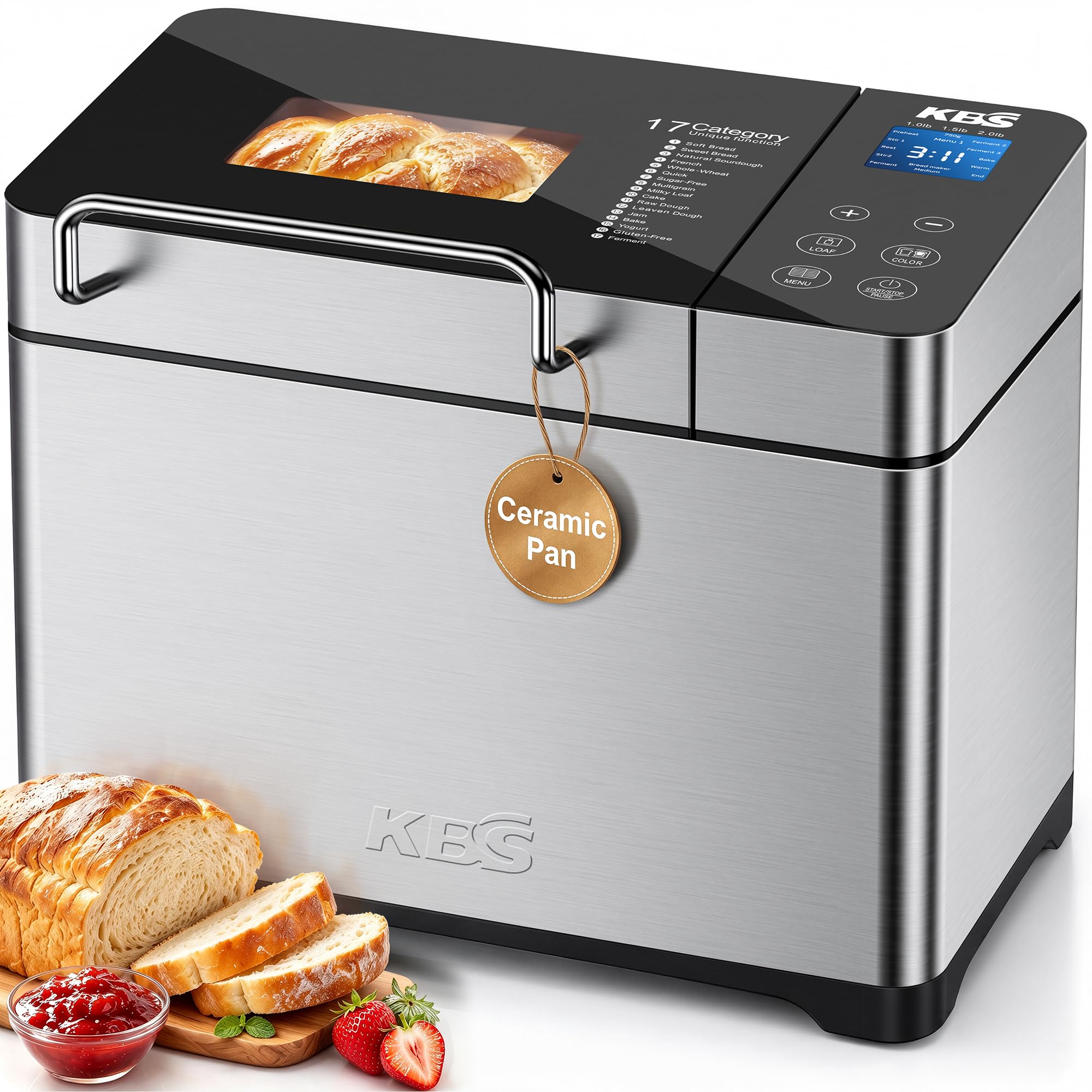
KBS Pro
Key Features
- Pan: Ceramic
- Wattage: 710 watts
- Programs: 17
- Nut dispenser: Automatic
- Price: Midrange
The KBS Pro earns its place with the two things that separate a fussy bake from an easy one: a ceramic pan and an automatic fruit-and-nut dispenser. The dispenser releases mix-ins at the right time, so raisins and seeds do not sink to the bottom or get crushed during kneading. The ceramic pan is a welcome change from dark nonstick, and it wipes clean more easily.
The hardware is serious for the midrange. A 710-watt motor is one of the stronger ones here, the 15-hour delay timer covers overnight baking, and the 60-minute keep-warm holds the loaf after the cycle. The 15-minute power recovery is the detail we did not expect: a short outage does not automatically scrap the bake.
We rate it near the top of this set for seeded and whole-grain loaves. The 17 programs plus one custom setting give you room for basic, gluten-free, and specialty bakes, and the large viewing window lets you watch the rise without opening the lid. The 14.7-pound body is stable on the counter, which matters when the paddle is working stiff dough.
If you are comfortable adapting recipes, the KBS Pro rewards you; if you want a guided first bake, the KitchenArm is the friendlier choice. The ceramic pan is the part we keep coming back to, because it makes the weekly seeded loaf less of a cleanup job.
Pros
- Automatic nut dispenser times mix-ins
- Ceramic pan is easy to clean
- 710-watt motor and 15-hour delay
- Power recovery resumes after a short outage
Cons
- Manual is confusing for first-timers
- Ceramic coating is a wear point
We recommend the KBS Pro for seeded and whole-grain loaves: the automatic dispenser and ceramic pan make those bakes less fussy, and the 710-watt motor handles stiff dough.
Best for Crust Control
Cuisinart Convection
Key Features
- Programs: 16
- Convection: Yes
- Loaf sizes: 1, 1.5, or 2 lb
- Mix-in capacity: 3/4 cup
- Price: Premium
The convection fan is the reason to look at the Cuisinart Convection. It circulates air during baking to even out crust color, and the effect is most useful on loaves that otherwise brown unevenly in a vertical pan. The edge-to-edge glass lid lets you watch the whole rise without lifting the cover and losing heat.
The rest of the feature set is aimed at mix-in bakers. The automatic fruit-and-nut dispenser holds up to three-quarters of a cup and releases at the right time, and the paddle is removable before the final rise. Sixteen programs run from everyday loaves to gluten-free, low-carb, and a sourdough starter cycle. The 13-hour delay is there for overnight baking.
We rate it near the top of this set for crust control. The 800-watt heating element and fan give it an edge over the simpler machines when you want a browner crust without overbaking the center. The automatic dispenser is the other feature we appreciate; it turns seeded loaves into a one-load job.
It is not the simplest machine here. The controls take a little learning, and the custom memory slot is less flexible than the KitchenArm’s four. If crust is your obsession and you bake mix-in loaves often, the Cuisinart Convection earns its premium; if you want the easiest first machine, the KitchenArm is still the default.
Pros
- Convection fan promotes even crust color
- Automatic mix-in dispenser holds 3/4 cup
- Removable paddle before final rise
Cons
- Pan is snug for large 2-lb loaves
We recommend the Cuisinart Convection for bakers who want an even, brown crust and an automatic mix-in dispenser, and who will use the custom slot.
Best for Sandwich Loaves
Zojirushi Home Bakery Supreme
Key Features
- Timer: 13 hours
- Programs: 10
- Dimensions: 16.87 x 8.5 x 12.25 in
- Loaf capacity: 2 lb
- Price: Premium
The Home Bakery Supreme is the rectangular-loaf Zojirushi: a horizontal 2-pound loaf, 10 programs, and a body that is 19.5 pounds rather than 24. The rectangular loaf is the draw. It slices into sandwich bread more neatly than a tall vertical loaf, and the nonstick pan releases it cleanly.
The 700-watt machine covers basic bread, cake, jam, dough, and sourdough starter settings. The 13-hour timer and quick-bake mode are useful, and the LCD control panel is easy to read. It is quieter than several machines here, which matters if the bread maker lives in an open kitchen.
The trade-off is that the Supreme is a premium machine, while the Virtuoso Plus is the model with dual heaters and dual kneading blades. The Supreme’s draw is the rectangular loaf and the Zojirushi build. For sandwich bread, that is a fair exchange; for whole-grain and gluten-free loaves, the Virtuoso Plus is the stronger choice.
We recommend the Supreme for a household that wants a classic rectangular sandwich loaf and values quiet operation over the extra hardware of the Virtuoso Plus. It is heavy and takes up a wide strip of counter, so measure first. If you want the best browning on artisan loaves, choose the Virtuoso Plus; if you want a simpler premium machine for sandwiches, this is the one.
Pros
- Rectangular loaf slices neatly for sandwiches
- Quiet operation for an open kitchen
- Cake, jam, dough, and sourdough starter settings
Cons
- Only 10 programs limits variety
We recommend the Home Bakery Supreme for a household that wants a rectangular sandwich loaf, quiet operation, and a classic premium machine.
Best for Budget Dual Heaters
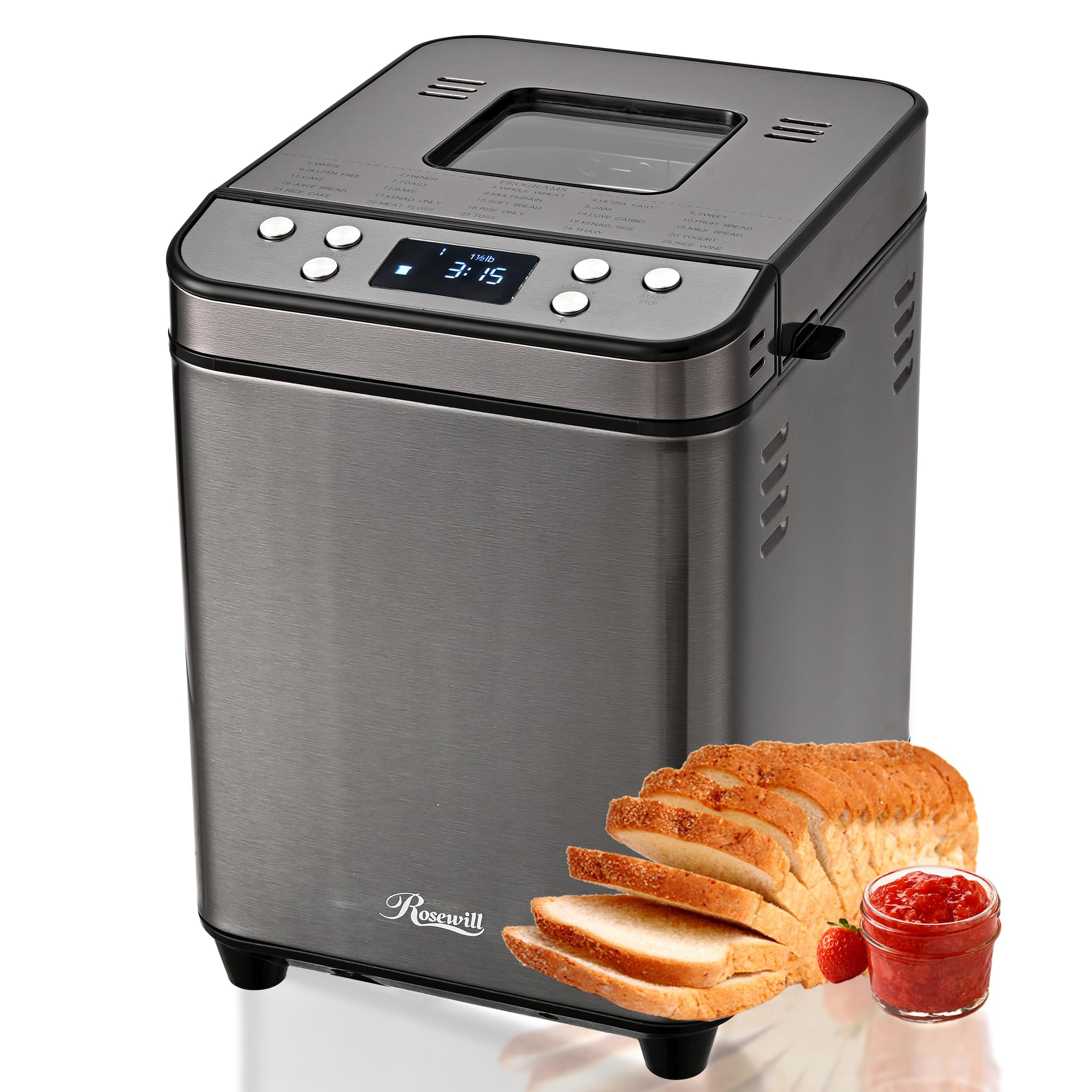
Rosewill 25-in-1
Key Features
- Heaters: Dual, 700W
- Programs: 25
- Delay timer: 15 hours
- Loaf capacity: 2 lb
- Price: Budget
The Rosewill reads like a bargain on paper: 25 programs, 700 watts, dual heaters, and a 15-hour delay in a body that is only 8.3 inches wide. That is a lot of capability for the least expensive tier here, and the stainless-and-gray finish looks more considered than the price suggests.
The dual heaters sit at the top and bottom, which is the same approach used by several premium machines to promote even browning. The nonstick pan is BPA- and PFAS-free, the keep-warm runs for an hour, and the loaf sizes go up to 2 pounds. At 8.8 pounds, it is easy to move when the counter needs clearing.
We rate it as an also-consider rather than a default because the feature list is broader than the hand-holding. The 25-program panel and dual heaters suit a tinkerer who will read the manual and adapt recipes. For a first machine, the OSIPOTO is easier to settle into.
The 2-pound maximum is the other limitation; a 3-pound family loaf is not on the menu. For a small household that wants dual heaters and a wide program range without paying premium, the Rosewill is worth a look. Just budget time for the learning curve.
Pros
- 25 programs at a budget tier
- Dual 700-watt heaters
- 15-hour delay and one-hour keep-warm
Cons
- Manual is vague about which program to use
We recommend the Rosewill when budget and program variety matter more than hand-holding; its dual heaters and 25 menus are a lot for the money.
What Nine Months of Loaves Taught Us About Bread Machines
We started with the machines that turn up again and again in owner reviews and retail listings, then cut anything discontinued or hard to get parts for. That left a spread of sizes — compact models built for one-pound loaves and shallow counters, full-size machines that turn out two-and-a-half-pound loaves for a family — across a range of prices, with and without gluten-free cycles, delay timers, and the ability to save a custom program.
Each of the 12 machines lived in a real kitchen for nine months and baked at least six loaves. We timed weekday-morning bakes to see whether bread was actually done before I had to leave the house, set overnight delay-timer loaves and checked at 7 a.m. whether the top had gone soggy, and ran white, whole wheat, and gluten-free cycles back to back. Every loaf was sliced warm and again on day three, with notes on rise height, browning evenness, the size of the paddle hole, and whether the crust caved in as it cooled.
Ease of use got judged in the moment, not on a spec sheet. I followed each manual literally once, loaded the pan in dim morning light to see whether the water markings were readable, and noted how long the add-in beep gave me to get across the kitchen. Pans and paddles were washed by hand and in the dishwasher, and every machine’s footprint was measured on the same 22-inch-deep counter. A few stayed in near-daily rotation for months, which is how we found the hinge that loosened and the belt that started to slip. We also costed out a loaf against supermarket bread, so we could tell whether the extras earned their keep.
How to Choose a Bread Machine
The right bread machine is the one that fits your counter, your schedule, and the loaves you actually eat, not the one with the longest menu.
Start With Loaf Size and Counter Space
A 2-pound loaf is the family default, but 1- and 1.5-pound settings matter if you bake for one or two and dislike leftover bread. Capacity is only half the fit question. A vertical pan can keep the width down, while a horizontal machine spreads out. Measure the spot with the lid open and leave room for steam and the cord. The KitchenArm is 8.9 inches wide; the Zojirushi Virtuoso Plus is 18 inches wide. Both bake 2-pound loaves, so the difference is placement, not output.
Choose Programs You Will Actually Use
Program counts are easy to inflate. Look first for white, whole wheat, dough, and a gluten-free cycle if you need one, then for a custom or memory setting that saves your regular loaf. A 29-menu machine is useful only if those menus match your baking; the Zojirushi Home Bakery Supreme stays at 10 programs. Crust control and loaf size should be separate choices, not buried inside a single preset. If you bake seeded or nutty bread weekly, an automatic dispenser earns its keep; otherwise an audible add-in alert is enough.
Use the Delay Timer Within Its Limits
A 13- to 15-hour delay is genuinely useful for overnight bread, but it is not a license to leave milk, eggs, or cheese sitting in the pan for hours. Use delay recipes built around dry ingredients and water, and keep the yeast away from salt until the machine starts. The keep-warm function is best measured in minutes, not hours: a 60-minute hold is convenient, but the crust softens the longer the loaf sits. Take the bread out when the cycle ends.
Look at the Pan, Paddle, and Mix-In Handling
Nonstick pans are the norm; ceramic pans are a growing alternative and can be easier to wipe clean, though they are still a wear surface. A removable paddle lets you pull it before the final rise, which leaves a smaller hole in the bottom of the loaf. Some machines sound an alert; others use an automatic dispenser. We place more value on a clear paddle system than on a long list of jam and cake programs. Check whether the pan is hand-wash only before you buy.
Treat Durability and the Manual as Part of the Purchase
Bread machines work hard, and durability is the weak spot across this group. A longer warranty and an easy return path are worth more than two extra presets. The KitchenArm carries a two-year warranty, the Cuisinart Convection three years, and several others one year. Manuals also vary widely; a clear recipe book shortens the learning curve, while a vague one sends you to your own recipes. We prefer a plain machine with good support to a feature-heavy one with a confusing manual.
Frequently Asked Questions
Why did my bread-machine loaf collapse in the middle?
A loaf that collapses usually has too much liquid, too much yeast, or too little structure from the flour. Start by checking the recipe against your machine’s pan size, then cut the liquid slightly before changing the yeast. Use a recipe written for a bread machine rather than one written for a stand mixer; the mixing and rise times are different.
Can I use a bread machine just for dough?
Yes. A dough cycle mixes and kneads without baking, so you can use the machine for pizza, rolls, and cinnamon bread and then shape and bake in your own oven. Check that your model has a dedicated dough program, and remove the dough when the cycle ends so it does not over-proof in the warm pan.
Do I need bread flour and a special yeast?
Bread flour is not mandatory, but its higher protein gives a better rise than all-purpose in most machine loaves. Instant yeast is the easiest to use because it can go straight into the dry ingredients; follow the recipe’s yeast type and amount rather than swapping freely. If you use a delay timer, keep the yeast away from salt and liquid until the cycle starts.
Can I leave the house while the machine is baking?
Yes, provided the machine is on a stable counter, away from the edge, with the cord clear of traffic. It is a small oven, so the pan and housing get hot, and steam needs space to escape. Keep children and pets away, and unplug it before you clean the base or remove the pan.
Final Verdict
The KitchenArm 29-in-1 is the bread machine we recommend first. It covers the loaves a household actually bakes, remembers your settings, and has the best balance of programs, support, and counter fit here. It is not the most powerful or the most premium, but it is the easiest to live with week after week.
For even browning and permanent counter space, the Zojirushi Virtuoso Plus is the premium alternative. For a budget first machine, the OSIPOTO is the simpler entry. For a rectangular sandwich loaf, the Home Bakery Supreme is the quieter choice.